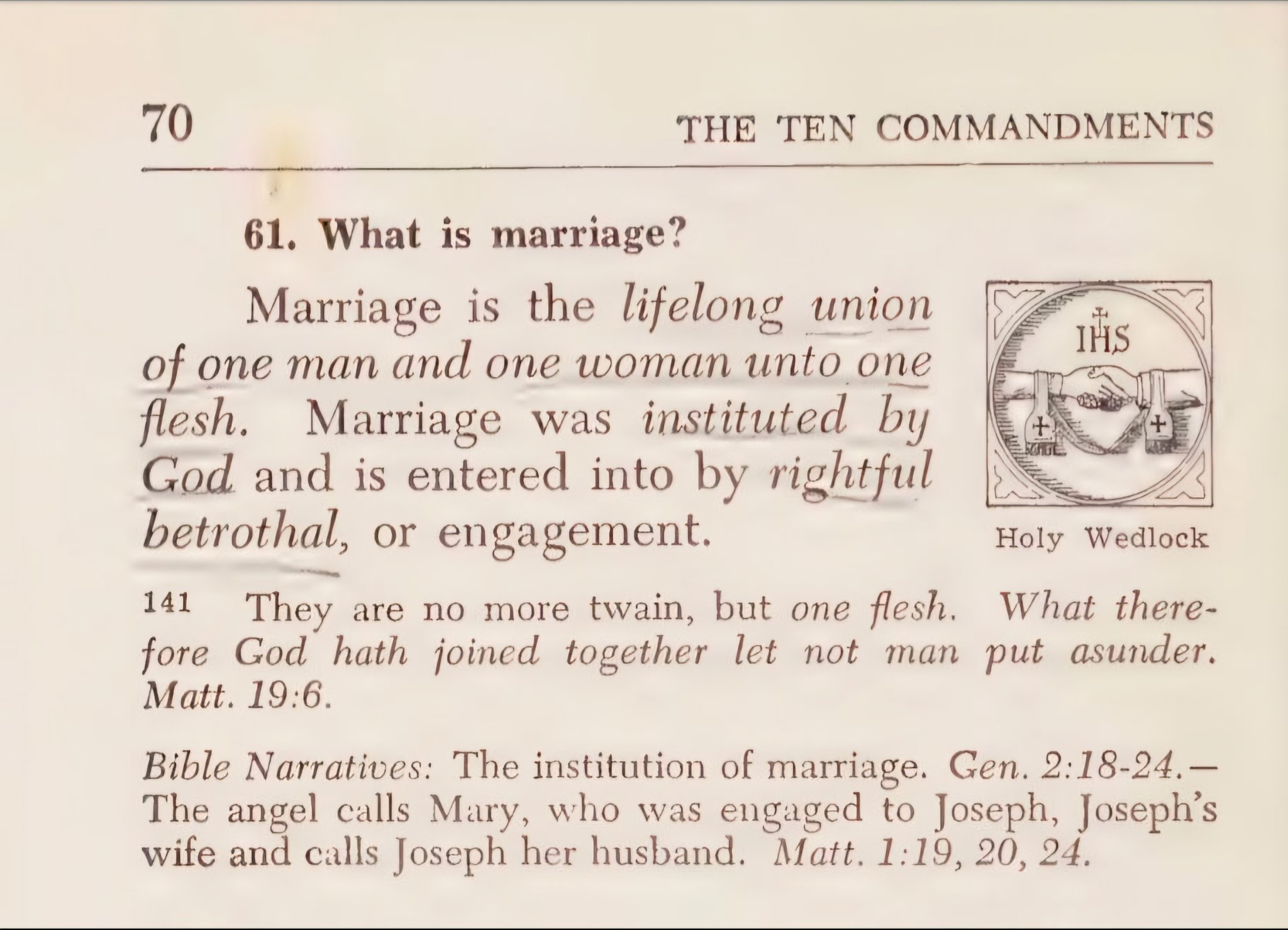
This book, a new edition of the 16th century Altenburg Bible (Altenburger Bibelwerk), was one of the first projects the early Missouri Synod took on to promote biblical literacy. The current study Bible put out by CPH used this work as a source for many of its notes, but it’s interesting to see the things that were left out. The newest copies I’ve seen are dated 1898 and I suspect it was in print or at least still available from CPH in the early 20th century.

Below is a translation of the title page followed by the prayers, section summary, references, and notes for 1 Corinthians 11:2-16.

The New Testament of our Lord Jesus Christ, Germanized by Dr. Martin Luther with his forewords [for each book] and [his] marginal notes, as well as the Summaries of M. Veith Dietrich, with the forewords [to the chapters] and closing prayers of Franciscus Vierling.

Newly issued by the Central German Evangelical Lutheran Bible Society.

St. Louis, Mo.,

Printery of the Evangelical Lutheran Synod of Missouri, Ohio and other States,

1857.

[1. Corinthians]

Prayer. [for Chapter 10—Franciscus Vierling]

May our Lord Jesus Christ preserve for us His dear word pure and unfalsified, and His holy sacrament in proper use; may He preserve and strengthen us against the crafty devil, evil world, and our sinful flesh in true faith and godly life, until our end, Amen.


The 11th Chapter. Foreword. [Franciscus Vierling]

Beloved Christians! Man is the Lord Christ’s glory, and woman is man’s glory. Man is the glory of the Lord Christ: for, when he keeps himself righteously in his station, then he presents himself symbolically to other people in the manner Christ is disposed toward his congregation: namely that he governs, loves, and protects her; and that is then a great honor to Christ, when one feels in his members his nature and character as the head. [und das ist denn Christo eine große Ehre, wenn man an seinen Gliedern spüret, seine, als des Häupts, Natur und Eigenschaft.] The woman is the glory of man: for as she helps her husband maintain livelihood, and is pious, loyal, and obedient, then that is so much as to say in deed: See here, thus has God honored my husband, that he has given him me as a helper, and has equally along with this commanded to be submissive to him. Now because man is the glory of the Lord Christ, he covers not his head when he prays, in order to show that he is thus subject to Christ, that he likewise has lordship and power, love and fidelity [Herrschaft und Gewalt, Liebe und Treu] concerning another person, namely concerning his wife. But the woman shall cover her head, as an indication of her submission, and that she does not refuse to be faithful and obedient to her husband. The first part of the 11th chapter also teaches this.

Of some behaviors [Geberden/Gebärden] in prayer, and worthy use of the holy supper.

1. Cor. 11:2-16 notes:

V. 3. *the man *Eph. 5:23.

*God *1 Cor. 3:23.

V. 4. *prophesy *1 Cor. 12:10, 14:1.

V. 7. *God’s image *Gen. 1:27 f.

V. 9. *but the woman for the man *Gen. 2:18, 23.

V. 10. apower [Macht]) i.e. the veil or covering, whereby one may mark, that she is under the man’s power, Gen. 316. [Marginal note and reference from Martin Luther c.1534]

V. 11. *in the Lord *Gal. 3, 28.

V. 13. *Judge *Act. 4, 19.

V. 16. *But if any man *1 Tim. 6, 4.

Summary. [Veith Dietrich]

This is the sixth point, and concerns the order which should be maintained between man and woman, that a man should pray and prophesy with a bare head and short hair, and a woman with covered head, V. 4. St. Paul takes this ordinance not alone from the custom of the Jews, but from nature. For it is uncomely for a woman, says he, to be bareheaded and to have short hair. To have long hair and to be covered adorns her, and is comely.
St. Paul adds yet another cause to this and says: To have something on the head is a sign that one is not free, but has a lord. Now because the man is the woman’s lord, the man should have nothing on his head; but the woman should have something on hers. But, says he, such distinction remains here below on earth; for God, a believing woman is worth just as much as a believing man. Likewise one should keep such ordinance for the sake of decency [Zucht]. For not only do the people take offence at indecency [Unzucht], but the angels are repulsed by it. V. 9.

Votum. [Franciscus Vierling]

May God the Lord, the author and preserver of the holy estate of marriage, govern all married people, that they would dispose themselves toward one another, that their deeds and life may please Him, that it may be a joy to the angels and that it may serve as a good example to others, and that they with their children might retain His temporal and eternal blessings, Amen.


You can acces the complete Altenburg Bible here.
Volume 1

Volume 2

Volume 3

2 responses to “What the Lutheran Study Bible says about Headcoverings”

  1. Christology is at the very center of the head covering debate, and the western Lutherans have completely abandoned the Christology of Lutheranism and joined camps with the Reformed. The glory of Christ is at stake in 1 Corinthians 11:1-16, and when a woman does not wear a head covering, she is refusing to give all glory not merely to men, but to Christ. It is a denial that Christ HAS come in the flesh as all false doctrines as a denial of the incarnation, that Christ is now amongst us. The reformed divide the person of Christ into two persons ever since the incarnation, one up in heaven and His human nature person on earth, and this is somewhat akin to what Lutheran women do today when they refuse to wear head coverings in Church, for actions speak louder than words. Simply put, the greater glory of Christ is being denied by Lutherans today in the west in Church, for not only is Christ greater than the prophets of old, than even that of Moses (Hebrews 3:2-5), but His glory is greater than that which was present in the Temple which is why head coverings are required in the New Testament. God says, “this is my Son, in whom I am well pleased.” And this God man is still “with us” (Matthew 1:23) applies not merely at His incarnation, but today in the Sacrament. Yes, His death and earthly humiliations “is finished” (John 19:30; Hebrews 4:3), yet this same Christ “has come in the flesh” (cf. 1 John 4:2,3; 2 John 1:7). The KJV version mistranslates these verses as “is come”, but the Greek uses the perfect active participle “has come in the flesh” as taught elsewhere (“I am with you always”). Thus Christ is still subservient to the Father according to His human nature in serving the Saints in heaven in many ways, and throughout eternity, and on earth presently, until the second coming. Christ while on earth did not always make use of His Divine powers, although He ruled the heavens and the earth while on earth, and since His resurrection (and in heaven right now) He rules both in, with, and through His human nature. At the same time He is at the right hand of the Father displaying that all authority, judgement, and power is His, and thus His equality in the Godhead (Hebrews 2:8). Yet He remains, at the same time, according to His human nature, second chair to the Father-as Joseph was to Pharaoh (Genesis 41:4) enabling Joseph to serve not merely all people, but especially the Israelites; that, as 1 Corinthians 3:21 declares, “Christ is God’s”, or as 1 Corinthians 11:3 declares, “the head of Christ God.” Even though His earthly humiliation mission is finished, His mission of serving the Church (i.e. Isaiah 25:6-8; John 14:2) and the Saints in heaven will never be finished, for His grace began from eternity and will go on forever throughout eternity-for this saving grace was present from eternity. God is love (1 John 4:8), and His love, as accomplished in time, reaches into the heavens, but also beyond the heavens into all eternity- as His very visible exaltation rose beyond the heavens-as 1 Timothy 1:9 (cf. also Hebrews 4:3) declares, “Who hath saved us…not according to our works, but…His…grace, which was given us in Christ Jesus before the world began” proving to the world no man can chose salvation, but faith itself is totally a gift from God. Chemnitz correctly identifies this grace as meaning His eternal forgiveness of sins. Christ began His service to the Church from all eternity, for no mere sinless man died on this cross as the reformed and Catholicism teach, but the love of God and His salvation have forever been from eternity, always outwardly directed from eternity, to us, to you, to me, to mankind. And thus Christ wants our love to be outwardly directed, especially to the Church (a violation of government discrimination laws today), and it is this love which continues at the right hand of the Father throughout eternity, as we witness in the book of Hebrews in numerous passages assuring our mortal souls on earth that He has our sins covered even there too (i.e. Hebrews 9:24). This is the greater person, the greater glory which is being worshipped and received in Church today, and no mere mortal glory of a woman’s hair can remain in the presence of this glory of Christ in Church, even though the laws of nature support that human right (1 Corinthians 11:15-“a glory to her”), for God is the creator, controller, an ruler of the laws of nature, and only He can rescind them at times as it serves His glory, as He did at the Red Sea,, as He also requires all men to wear short hair at all times of their life (1 Corinthians 11:14), even though the laws of nature again allow long hair often on young men, for all governments of this world, all people, and all Churches are to submit to the glory of Christ, even though the laws of nature sometimes teach otherwise…at all times, for all governments of this world, for all Churches, for all people…to God alone be the glory!

  2. Pastor David King Avatar
    Pastor David King

    A SHORT SUMMARY OF WHY HEAD COVERINGS ARE REQUIRED

    As far as the head covering traditions, the Corinthian Church was praised when Paul states in 1 Corinthians 11:2, “Now I praise you” in comparison to the Passover Meal in 1 Corinthians 11:17 “I praise you not...that ye come together not for the better”-implying that they were “coming together for the better” in regards to the head covering traditions recorded in 1 Corinthians 11:1-16.
    And Paul could never have stated “keep the traditions” in 1 Corinthians 11:2 unless the congregation was living in obedience to the traditions of wearing head covering in the first place. In addition, 1 Corinthians 11:16 proves their faithful adherence to the head covering traditions when it reads, “but if any person seem to be argumentative…” proving no female had yet taken off her head covering-that some were just beginning to question why they needed to be worn when the females were prophesying/praying.
    So what are the prophesying/prophesying of 1 Corinthians 14:4,5, and the shorthand of them both (“praying”) in 1 Corinthians 14:13? It would be weird to interpret praying and prophesying as two unrelated functions, and the context confirms this, for 1 Corinthians 11:4-16 are laying the groundwork for the following three chapters ending with 1 Corinthians 14. The “praying” of 1 Corinthians 11:13 is both the inward praying with the Holy Spirit and the outward praying (prophesying) to the congregation; it is defined as both the inward praying of the prophet (1 Corinthians 11:4) or prophetess (1 Corinthians 11:5) with the Holy Spirit, which included the Spirit of faith (cf. 1 Corinthians 5:3; 7:40; 14:14), and the outward praying to the congregation in 1 Corinthians 14:14-15
    The questioning was solely about why men did not need to wear them in Church (1 Corinthians 11:4) while prophesying, and why women had to wear them in Church when prophesying, as the praying/prophesying is talking about the praying/prophesying of tongue speaking and prophesying beginning with 1 Corinthians 14:2f, and had nothing to do with the culture of Corinth other than that some of the other religious assemblies had human traditions (or customs) that were at odds with the Divinely given traditions of Paul.
    We note that in both 1 Corinthians 8:4ff and 1 Corinthians 10 Paul starting to transition to 1 Corinthians 12-14, where both the Priests of these pagan feasts (both male or female) wore head coverings at these idol worships, and the women, it seems, were questioning that since the men had to wear them when leading the idol feasts, and the females only when leading the idol feasts, why were men exempt from having to wear them when prophesying, and why did women have to when prophesying since these were not the time of the partaking of the sacrificial idol feasts, nor was prophesying the time of the partaking of the Lord’s Supper as mentioned in 1 Corinthians 10:20-21?

    And the other, completely Biblical history passage related to a “custom” that was not in line with the new Testament Church is seen in 2 Corinthians 3:14-17 and the reader of the Torah in the synagogues and Temple having their heads covered with a full veil.
    Both 1 Corinthians 10 and 2 Corinthians 3:14-17 give us hints at what was going on by the feminists who were trying to ever so slightly slip in their glory (of their hair) into the door by opting out when praying/prophesying. But we must never go outside of Scripture to determine a doctrine of Scripture as our liberal friends do. And Paul could have easily expanded upon the “customs” in other religious bodies that were are variance with the Scripture as 1 Corinthians 10 discusses, but instead Paul stays focused upon these unchangeable head covering truths highlighting the necessity of having to do “all to the glory of God” (1 Corinthians 10:31).
    So even though the usages of “traditions” and “customs” are basically synonymous nouns in Scripture, we must note that Paul places the article “the” before “traditions”; “the traditions” or ordinances (1 Corinthians 11:2) of Paul proving these were not derived from Roman culture, nor from the oversight authority of Paul over the Corinthian congregation, nor as claimed today by Lutherans under Article 28 “Of Ecclesiastical Power” to implement “ordinances” in a congregation, but from Christ, as 1 Corinthians 11:1 mentions “of Christ,” and the shared authority of the “Churches of God” since the congregations are His Body living outwardly according to all of the Apostolic decrees or inspired directions (1 Corinthians 7) since a congregation is “built upon the foundation of the Apostles” (Ephesians 2:20) with Jesus Christ being the cornerstone, for (1 Corinthians 3:11) “no other foundation can no man lay than that which is laid, which is Jesus Christ.”
    And it is true that Article 28, paragraph 53 gives “bishops or Pastors” the right to “make ordinances that things be done orderly in the Church”, but it never delineates them as a certain lectionary, feast days, matters of scheduling, or a dress code. These beliefs have arisen since the Reformation, and fail to consider the inspired words of Paul in 1 Corinthians 3:21-23, “Therefore let no man glory in men. For all things are yours. Whether Paul or Apollos, or Cephas, or the world, of life, or death, of things present, or things to come; all are yours; And ye are Christ’s; and Christ is God’s.”
    Here, in 1 Corinthians 3:21-23, the congregation, under Apostolic decree, is seen as over and above any preacher in any congregation with no exception. Certainly the congregation has entrusted the lectionary, the hymns, and a few other things to the Preacher, like they have the Gospel and administering the Sacraments, but the congregation can, and sometimes must step in if the Gospel is not “properly” taught or practiced (1 Corinthians 14:40; James 3:1), or when they so determine, more so with divisive dress code (which should be discussed, determined, and never entrusted to a preacher).
    And Christians admit that custom and tradition are synonymous terms in Scripture, and thus Paul could have written “we have no such tradition” in 1 Corinthians 11:16, but note that instead Paul chooses “we have no such custom”; the reason the Holy Spirit uses traditions (“ordinance” in the KJV) in 1 Corinthians 11:2 is because He wants to make sure the two are not synonymous nouns at this time-as indicated when the article “the” is inserted before “traditions”-“the traditions” in 1 Corinthians 11:2-meaning these traditions are not of man but of God.
    Even loving discipline must be seen under the ultimate decision, under Apostolic advice, of a congregation as seen with Acts 15:22.
    But 1 Timothy 1:20 and 2 Timothy 2:17-18 must not be seen as Paul unilaterally delivering them to Satan as 1 Corinthians 5:3-5 proves, and as Paul shows with certain others who were bothering the freedom of the Galatian Church (Galatians 2:4-5), for Paul and Barnabas headed south and dealt with them in the Roman Church of which they were members (Acts 15:2), and never sidestepped the directives of Matthew 18:15-19. They most likely started their own Churches, which were sometimes called synagogues in the Greek text (cf. James 2:2, Revelation 2 & 3), especially with those desiring to keep certain legalistic traditions of Judaism. Those synagogues that refused to accept the full Gospel of this Promised Messiah, or those which fell away from the Christian faith due to this or that sin, were “synagogues of Satan” (Revelation 3:9).
    Other synagogues apparently made the turn in the road to Jesus, as James 2:2 states, “For if there come unto your synagogue a man…”, for it seems early on the synagogues sometimes became obedient to the faith (Acts 17:10-12).
    But the troubles continued on past their deaths, as Paul warns so in Acts 20:29 concerning the Ephesian Church, “For I know this, that after my departing shall grievous wolves enter in among you, not sparing the flock.” And Revelation 2:13 attests to this very real danger early on, “I know thy works and where thou dwellest, where Satan’s throne is: and…wherein Antipas was my faithful martyr, who was slain among you, where [also] Satan dwelleth.” The emphasis in Revelation 2:13 is the Satan dwellest in these seven regional Churches, and that (cf. also Job 1 & 2) “the devil [and his angels]…walketh about [these seven synagogues], seeking whom he may devour” (1 Peter 5:8), just as Jesus walketh about in the midst of these same seven Churches in Revelation 2:1, and His angels (1 Corinthians 11:10), and it is where He sat down at the right hand of the Father. Thus every Christian Church also the throne room of Satan and his angels present, and it is the highest place where “the devil…sitteth in the temple of God, shewing himself that he is God”, and where he meticulously operates to replace God’s glory with a multitude of different glories through false teachers as 2 Thessalonians 2:3-4, Revelation 2:14-15, and many other verses elaborate on; each local congregation is the place where (Ephesians 6:12) “we wrestle not against flesh and blood, but against principalities, against powers, against the rulers of the darkness of this world, against spiritual wickedness in high places.”
    Revelation 1:11 states this letter by John was especially meant for “the seven churches which are in Asia; unto Ephesus, and unto Smyrna, and unto Pergamos, and unto Thyatira, and unto Sardis, and unto Philadelphia, and unto Laodicea,” yet this regional encyclical has had application to all the Christian Churches since the Apostolic Age, and the same with this head covering passage (1 Corinthians 1:2).
    But there is a reason for this madness I just mentioned, for this is why Paul mentions “Churches of God” in 1 Corinthians 11:16-attesting to the fact that there were breakaway Churches or those who were contemplating returning to various legalistic teachings of their old Judaistic teachings of the synagogues. Otherwise why would John mention this possibility in Revelation 3:9, and why would Paul attach “of God” to “Churches” in 1 Corinthians 11:16?
    Thus to those who believe that “Churches of God” in 1 Corinthians 11:16 could mean a number of just regional Churches around Corinth at that time is denying the reality that Satan dwells in every Christian congregation, and the local congregation is at the same time where Christ has sat down at the right hand of God, for “Churches of God” in 1 Corinthians 11:16 implies that all of the other Churches in Christendom must have been obeying the head covering traditions, otherwise Paul erred by stating “of God.”
    Therefore “Churches of God” is not a territorial phrase, but a faith phrase which specifically excludes any territorial religious belief, as Matthew 18:20 teaches, “for wherever two or three are gathered together in My Name, there am I in the midst of thee.” The local congregation is substantiated from 1 Corinthians 14:23 when each particular Christian congregation meets at Church at a particular location as substantiated later on by 1 Corinthians 14:23.
    Yet the debate of why women need to wear them includes other requirements, based upon the laws of nature, that men wear short hair which denotes super-ordination, and therefore should not wear head coverings in Church, whereas women generally have long hair denoting subordination, and therefore females, since hair is “a glory to her” should additionally wear head coverings as Paul discusses in 1 Corinthians 11:14-15, and when both sexes live in obedience to this chain of command in 1 Corinthians 11:3, then they are blessed in many ways, for their congregational prayers are heard, and His real presence glory is there in the Sacrament.
    Thus all of these these law of nature truths (of the Order of Creation and the Order of Subordination) meet their fulfillment in the incarnate Christ as 1 Corinthians 11:3; for it is His real presence, His glory, which is at stake with both the Order of Creation and the Order of Subordination.
    Christians are commanded to do “all to the glory of God” as Paul mentions in 1 Corinthians 10:31, and her whole person, including her hair (cf. 1 Corinthians 11:7) are merely “the glory of the [mortal] person”, and temporally remains her God-given mortal glory (1 Corinthians 11:15) “is a glory [only] to her”, and therefore not a glory to men and thus not the eternal glory of the God-Man Christ in Church, and in fact is at odds with the real presence “glory of God” in Christ. No individual’s glory is allowed to slip in with their human “glory”, even that which was bestowed upon them by God in Church, as it would be breaking the chain of command (the Order of Subordination) in 1 Corinthians 11:3 as meeting its apex in the person of the subordinate Jesus serving His Church on earth. As Galatians 6:7 states, “For if a person think themselves to be something, when he/she is nothing, he/she deceiveth himself/herself.”
    But notice Paul, in 1 Corinthians 10:31, starts transitioning to 1 Corinthians 11-14 when he mentions “do all to the glory of God” as he looks backward to his discussion on the idol feasts, and yet forward to their head covering traditions, and women not being silent, having been alerted to this questioning by both the house of Chloe when some of them had visited their Church, and/or through their letter written to Paul (1 Corinthians 7:1).
    And insomuch as 1 Corinthians 10:31ff are transitional verses to 1 Corinthians 11:1ff, the head covering traditions must also be regarded as a matter of salvation to others, as Paul states his own obedience to these traditions, including himself not wearing a head covering in Church when he states, 1 Corinthians 1, “Even as I please all men in all things, not seeking mine own profit, but the profit of many, that they may be saved” as with eating food offered to idols at the idol feast (cf. 1 Corinthians 8:11), a follow-up on Paul’s abstaining from marriage and getting paid so as to benefit not himself, but the Gospel in 1 Corinthians 9:4ff.
    Thus we note in 1 Corinthians 11:1 that to be a “follower of Paul” means to “remember Paul in all things” which then implies that Paul is a “follower of Christ” since the Father had taught Christ these traditions, and as Christ had taught the Apostles (John 17:7-8), and had taught Paul these traditions through revelations (John 17:7-8)

Leave a Reply

Trending

Discover more from Old Lutherans

Subscribe now to keep reading and get access to the full archive.

Continue reading