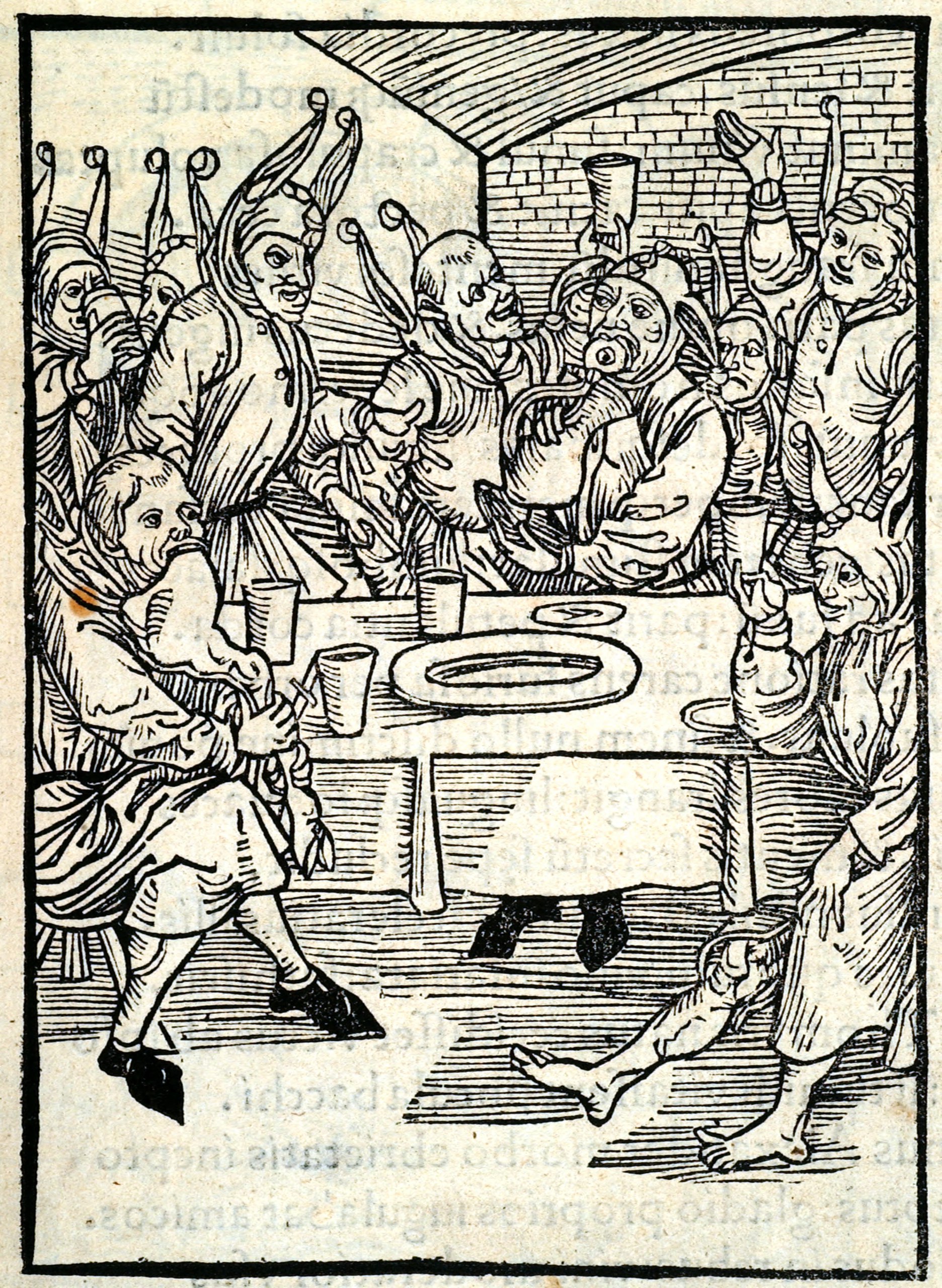
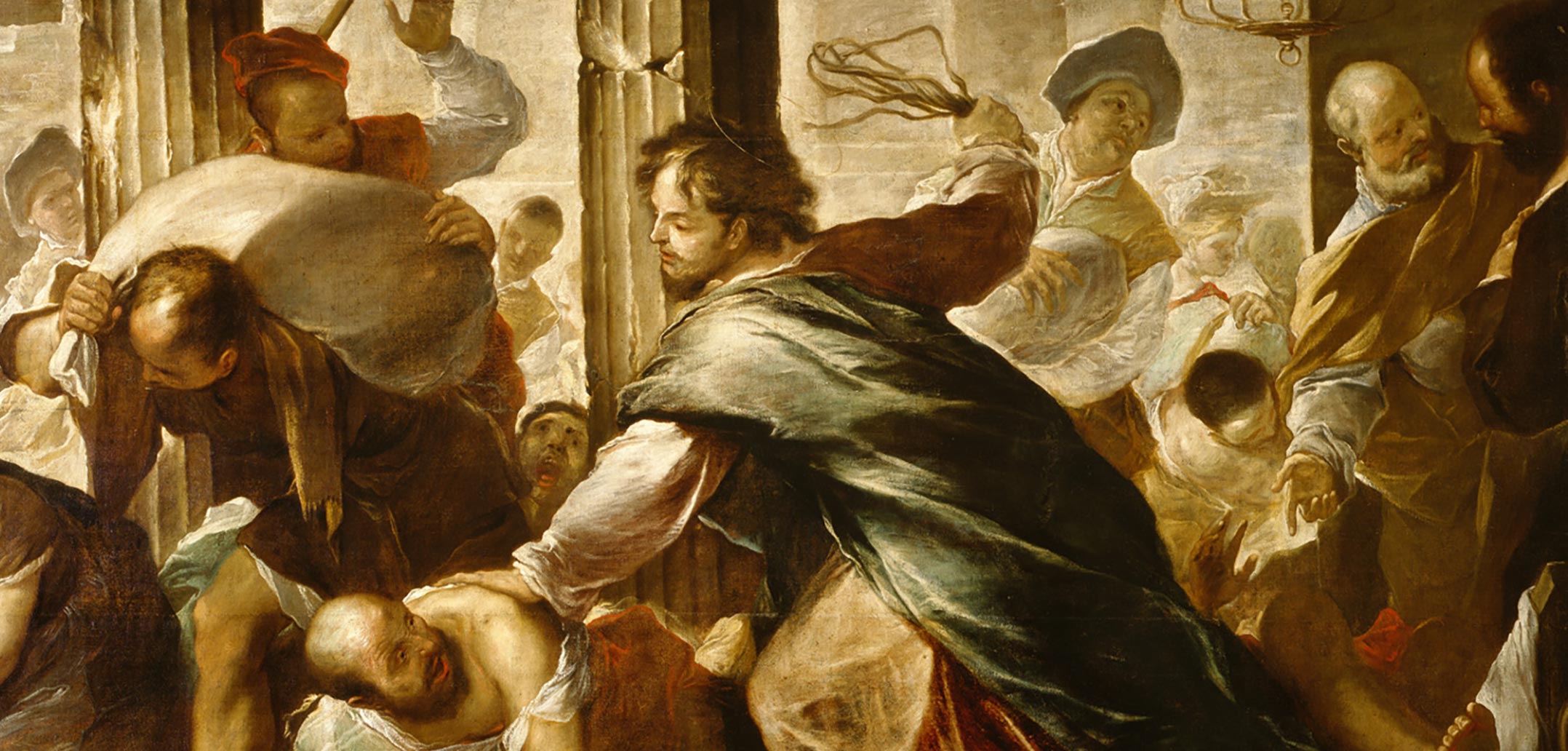
“I will sing my Maker’s praises And in Him most joyful be For in all things I see traces Of His tender love to me.”
– Evangelical Lutheran Hymn-Book #65, I Will Sing My Maker’s Praises
The Christian in all things is called not to walk as the nations, “in the vanity of their mind” (Ephesians 4:17), but to be “unspotted from the world” (James 1:27). In this age of plenty and carnal indulgence, the songs of the world have only grown in the depravity they reflect. Music, the proper and noble maid of theology and a gift of God for man’s edification, has become a subservient tool of the flesh, the devil, and the world. By devils and demoniacs, it has been a weapon against piety and good order. As the idols of Jacob, such music must be buried and left forgotten (Genesis 35:1-4).
Some, shielding themselves under a banner of Christian liberty, exhort themselves, crying, “Am I not free? May I not do as I please? Shall not what I do be the extent of the law? Saint Paul answers such men, “All things are lawful unto me, but all things are not expedient… I will not be brought under the power of any” (1 Corinthians 6:12). Christian liberty is not a license for self-gratification but the freedom to be a slave of Christ without hindrance (Galatians 5:13).
Moreover, man is more than a mere spirit. He dwells in this life, he answers to neighbor and brother, father and mother, kinsman and sojourner, believer and heathen. He must discipline the body to adhere to the spirit (Romans 7:22-23), keeping it true to the faith (1 Corinthians 9:27), crucifying the flesh (Galatians 5:24), and ensuring he can run the race of endurance to the peace of righteousness (Hebrews 12:1-11). For Christ came to fulfill the law, not abolish it (Matthew 5:17). Indeed, he establishes that the law shall be taught forever in the church (Matthew 22:34-41; That Man May Find Counsel and Help to Come to a Perfect Life: Martin Luther’s Sermon for Trinity 18). Through good works and striving in his vocation, he keeps his body under control (Hebrews 12:11). Though one errs when he believes works justify, one errs likewise when he turns faith into an occasion for the delight of the flesh. Thus, we see that the discipline of our flesh includes every aspect of our lives, including what we allow to shape our heart, mind, and soul.
If then, the Christian must keep watch over his body and soul in all respects, he must also be vigilant regarding what enters through the ear. For music is not idle, but a teacher and a master of the affections. What one permits in the heart through melody soon becomes habit, and what becomes habit shapes the course of life. Therefore, as we bridle the tongue (Psalm 39:1; James 3:2) and restrain the eye (Psalm 101:3; Job 31:1; Luke 6:42), so too must we guard the ear, lest it delight in what God condemns and lead the heart astray. For the discipline of the senses is the marrow of the Christian life The Christian life has never been only about being forgiven and living on. It includes mortifying the flesh, obeying the commandments (John 14:15), ceasing to sin willfully (Kretzmann Rogate Sunday 1956), loving the law (The Disastrous Results of Despising God’s Law”: C. F. W. Walther’s Sermon for Trinity 18), and being doers of the word (James 1:22-27). The doing of the word mixed with the reality of the flesh demonstrates Christ’s command to follow Him and pick up your cross (Matthew 10:38). Such command concerns itself with all things, even our playlists.
Against Worldly Music
“Who improvise to the sound of the harp, and like David have composed songs for themselves… I loathe the arrogance of Jacob, and detest his citadels; Therefore I will deliver up the city and all it contains.”
Here, the Lord, through the prophet Amos, rebukes the corruption of music in Israel. Their prosperity bred the worms of arrogance, and their songs no longer lifted praise to God but glorified their own sensuality. Unlike David, whose psalms magnified the Lord, they composed songs for themselves and their own baseness (Popular Commentary Book 2 Kretzmann, Amos 6:5). Thus, they had turned the gift of music inward, debasing its purpose of glorifying the Lord to the indulgence of the flesh.
This rebuke, proclaimed by a humble herdsman and grower of Sycamore figs (Amos 7:14), remains timely in our day. The instruction is eternal: a day is coming when all our songs of boast will be turned into dirges and lamentation (Amos 8:11). Nations that revel in their prosperity spurn the fear of God and set themselves forth for calamity (Amos 6:6-8). Better then, to tend our ears to the rebuke of the wise, rather than revel in the songs of the fool (Ecclesiastes 7:5).
But what is worldly music? What is music composed for oneself? It is nothing less than music shaped by the spirit of the age (Ephesians 2:2): music that stirs the passions of the flesh, encourages rebellion against divine order, and divorces itself from the fear of God. It mocks chastity, belittles authority, praises self-indulgence, and fills the imagination with images of vanity and idolatry. It is music that “abideth not in the house of the Lord,” but rather sings with the harlot from the streets (Proverbs 7:10–21). Like Satan himself, such music does not create but perverts what God has made good.
For this reason, St. Paul exhorts us, “Have no fellowship with the unfruitful works of darkness, but rather reprove them” (Ephesians 5:11). Can we, in good conscience, flood our minds with melodies that glorify what God condemns? Can we delight in that which grieves the Holy Spirit (Ephesians 4:30)? Can one feast on what God abhors and remain without defilement? As the old Latin maxim warns, corruptio optimi pessima: “the corruption of the best is the worst.” Therefore, we must not only avoid singing such songs ourselves but also cease from listening to them. As Luther is ascribed to say, “We are what we sing.”
And yet such danger is subtle. Satan needs only to slip his head into the tent; soon the whole snake follows. The devil prowls as a roaring lion ready to devour whom he may (1 Peter 5:8). Such pursuit begins not with outright heresy, but melody. What is welcomed lightly to our ears and heart soon pierces and strikes our convictions. Thus, the Christian must always guard his ears from such harm, as he guards his eye and tongue.
The devil is cunning: he clothes his poison in sweets and dissuades our worry with melody. Much like the theater, which parades itself as art, worldly music masks itself as a harmless pleasure. But its aim is singular, to please. It does not serve as recreation, which renews and prepares the man, but rather amuses him.[3] It pulls man away from contrition and the acknowledgment of sin, gratifying the flesh and distracting him from faith. Thus, even the pretty melodies, pleasant to our ears from artistic musicians, serve as the funeral march to our ruin.
We must therefore weep. We must weep for our youth, who are catechized more by their Spotify playlist than by the Catechism. We must weep for our families, who entertain demons with the music that plays over the dinner table. We must mourn for our land, which no longer sings the praises of God but howls with the wolves of Babylon, drunk upon the songs of pride.
For Godly Music
“Sing to the Lord a new song: his praise is in the assembly of the saints.”
– Psalm 149:1 (Brenton)
Here, the Holy Spirit, through David, ordains what the object and purpose of our songs ought to be. Not the service of the flesh, world, and devil, but the praise in the assembly of His people. Song, rightly ordered, is the possession not of vanity but the body of believers, not to lust but love, not to pride but praise. As St. Basil declares, the Psalms are “a compendium of all theology” (Homiliae in Psalmos) where pure doctrine, praise, and prayer are joined in a harmonious whole.
Moreover, in Ephesians 5:19 and Colossians 3:16, the Apostle Paul commends the singing of spiritual songs as part of being dear children of Christ (Ephesians 5:1), as one risen by Christ (Colossians 3:1). The Apostle does not treat music as ornamental, but as an essential discipline of the renewed life. Indeed, in Colossians 3:18-22 and Ephesians 5:22-33, we are given instructions on how, chiefly in the marriage estate, and all other estates, should be ordered. That spiritual songs are listed alongside such grave matter shows, dear reader, that this too is no small thing. Therefore, let us put off the old flesh, be renewed in the spirit, and put on the new flesh (Ephesians 4:22-24).
Thus, godly music is, first and foremost, doxological. It directs the soul away from the self and toward the Triune God. In Isaiah’s beatific vision, heaven itself is filled with song: “Holy, Holy, Holy is the Lord of hosts; the whole earth is full of His glory” (Isaiah 6:3). What heaven sings eternally, the church on Earth should echo temporally. For in the divine service, the angels and the church militant themselves join us in worship (1 Corinthians 11:10).[4] As Chemnitz notes in the Examen Concilii Tridentini, in the divine service, music is not an idol ornament but a vehicle of the Word, serving to steer the heart in faith, hope, and love. When the Church sings, she is joined in a heavenly liturgy, confessing her doctrine in melody.
Second, godly music is didactic, that is, for instruction. St. Paul instructs that psalms, hymns, and spiritual songs are one teaching and admonition (Colossians 3:16). Melanchthon and others note that the psalms are the Church’s catechesis. In this way, sacred song is pure doctrine to melody. Luther is right to say in the preface to the Wittenberg Hymnal of 1524 that “next to the Word of God, music deserves the highest praise” (Luther’s Preface to the Wittenberg Hymnal), for it makes the Word to live in the soul and drives away even the power of the devil (1 Samuel 16:23).
As Scripture demonstrates, music finds its proper place when joined to the true worship of the Lord and the instruction of His people. For when the great reformer King Hezekiah restored the worship of the unleavened bread, scripture notes, “the Levites and the priests praised the Lord day by day, singing with loud instruments unto the Lord. And Hezekiah spake comfortably unto all the Levites that taught the good knowledge of the Lord” (2 Chronicles 30:21-22). Thus, music is joined directly to worship and instruction, serving not as a distraction toward the flesh, but binding itself to teaching and confession before the living God.
Third, godly music is consolatory. Such consolation finds its basis not in sentimental ditties, worldly laments, or drivelous repetition but in songs that bring Christ to heart. Consider Paul and Silas in jail; at midnight, in an act of worship, they prayed and sang hymns to God (Acts 16:25). Such chains did not bind their praises, nor did their wounds overcome their joy. Thus, such a Christian burdened by sorrow or sin finds strength in songs that preach Christ crucified and risen again.
Fourth, godly music is communal. It serves not the vanity of a singular performer or to exalt the part over the whole but rather edifies the body. Again, turning to the example provided by King Hezekiah (2 Chronicles 30:21-22), music was bound to teaching, sacrifice, and the public confession. It served as the common song of the redeemed rather than any exaltation of the talented. For such reason, in the Apology of the Augsburg Confession (XXIV.3-4), we rightly defend the use of music and liturgy as fitting and profitable for this purpose, that, “the people also may have something to learn, and by which faith and fear may be called forth.”
Fifth, godly music is sanctifying. Godly music trains the heart to love the good, true, and beautiful in Christ and detest all evil. As the Formula of Concord Epitome (VI.5) declares, the regenerate act not idly, but “live in the Law and walk according to the Law of God.” Sacred song is such a part of the daily regenerate life (Ephesians 5:19; Colossians 3:16). Such songs bend man’s natural affections from ungodliness toward godliness, aid in subduing the flesh, and cultivate a desire for heavenly things. Just as worldly music hardens the heart and habituates the soul to sin, so sacred song accustoms the soul to righteousness, making obedience not a grievous thing requiring lashings and punishment, but a joyful thing, flowing from a joyful will (Formula of Concord Epitome VI.6).
Last, godly music is eschatological. It anticipates and prefigures the song of the Lamb, where every nation and tongue shall cry out, “Worthy is the Lamb who was slain” (Revelation 5:12). For this reason, each godly hymn sung is a rehearsal for eternity. As Augustine is credited with saying, “He who sings prays twice.” Yet, in Christ, such songs of the Church are more than prayer; it is the participation of the eternal liturgy our High Priest, the Christ, leads (Hebrews 2:12).
Therefore, we see what we are to turn toward as we turn from the howls of Babylon to the Hymns of Zion. Let us sing songs that make melody in our ears and hearts to the Lord. In such music, right doctrine is confessed, the weak are comforted, the young are catechized, the old are encouraged, and the whole Church is knitted together in worship. This is godly music: not the harlot’s song of the streets, but the bride’s eager song for her Bridegroom, the Christ.
As demonstrated by the scriptures, there is a clear demand against worldly music and a stern call for godly music. I now present, from clear reason and nature,[5] why one must be careful to avoid worldly music.
From Nature
“A double minded man is unstable in all his ways.”
– James 1:8 (KJV)
A rule of nature is that which has been set to tune is easy to recall and often comes to mind, no matter whether we have any desire to think of it or not. This presents a great blessing when what we listen to is blessed and true, but in our day, it presents great strife. Often, the tongue we use to sing praises to God also blasphemes and utters great curses in the guise of worldly songs. We know these things ought not to be so (James 3:9-10), but though we wrestle with this, we go all the while happily listening to that which causes sin. Examine yourself and find that this is true. I know it is true for me. Know then, that like the theatre or Colosseum, one cannot go to it in temperance but must cut out sinful songs entirely. Our liberty is not free to enter into sin nor even to come near it. Walther notes on 1 Corinthians 6:18, “For thus, first of all, the holy apostle Paul, in his first epistle to the Corinthians, 6:18, writes, ‘Flee fornication.’ He does not only say: Do not commit fornication! Nor does he merely say: fight against fornication! But he says: ‘Flee it!’” (C.F.W. Walther, Second Lesson on Dance, delivered 10.19.1884, Immanuel Church, Saint Louis, Missouri). Similarly, in Titus 3:22, we are to flee the lusts of youth, that is, we are to afford ourselves no occasion to sin, as the desire to sin is itself sin.
It ought to be noted that Arius sought to grow his heresy with music. He designed hymns and songs that denied the divinity of Christ to strengthen his error. The children of his day proclaimed, “There was a time when the son was naught,” and today equal blasphemies find themselves in music. Today we see this with the false Christian music of companies like Bethel and Hillsong of contemporary fame, of hymns from differing denominations, and those of the Mormon heathenry on their hie to Kolob.
Moreover, even where the music is not blasphemous, being free of curses, slander, devoid of heresy, and sin, we should be selective among this music. The Lord blesses man with the capacity to remember, and how great it is when we recall His word as it is set to song. Music serves as a way to teach the word and meditate on the Lord’s precepts. Contemporary music lacks the edifying lyrics of old, while non-religious music lacks the right focus. Let the reader understand that I am not saying all songs must go, but if he feels so convicted, I commend him for his effort. Forsake the music that causes sin and glorify God in that which attests to Him.
Now, there is obvious music that condemns Christ, which should be the first to go. Music that curses and is vulgar should likewise follow quickly. Then, you must examine for false doctrines: Lies of humanism,[6] judaizing, paganism, revolutionaryism, feminism, et cetera.
Even music that maintains a masquerade as harmless, neutral, or mere entertainment is not exempt from scrutiny. Nature teaches that affections are molded by what delights and frequents the ear. Such delights destroy our will by removing God’s law as the frontlet of our eyes and replacing it with a memory of vapor. A melody that pleases the senses, yet is void of truth, is a sure tutor of error. By repetition, the heart inclines toward vanity, sensualities, pleasure, or idleness, and the soul drifts away from vigilance toward God. This is the horrible and destructive tyranny of ungodly music: it masquerades as harmless recreation, while bending the soul toward the flesh and directing the senses toward the self.
Reason and piety demand the Christian make a choice: either enslave the ear to the world or sanctify it toward the Lord. One cannot sit idly in Satan’s brothel of sin and claim immunity; one cannot incline the heart through the ear toward unrighteousness and proclaim freedom. To permit sin by melody is to invite sin in; it is to invite sin that lieth at the door to our hearts (Genesis 4:7). If the ear is allowed impurity to dine with corruption, the mind shall follow, the heart consent, the flesh will act, and the soul will perish. Christian liberty does not incline itself toward sin, but demands the vigilance to flee wickedness, even in song.
Conclusion
Therefore, let the Christian act decisively. Remove every song that glorifies what God abhors. Destroy that which celebrates pride, lust, rebellion, and blasphemy. Examine your playlists, background music, and even hymns that you allow to enter your home, car, workplace, church; yes, even your very mind. Let no voice sing but the voice of God; let no sound echo but the sound of piety; let not tune play but that which plays for God. Fill the newfound silence once occupied with vanity at best, and outright wickedness at worst, with psalms, hymns, spiritual songs, prayerful meditation, the reading of the word, and the mutual consolation of the brethren. Teach those entrusted to you to sing only that which glorifies God. Instruct your families, your congregation, your neighbors, in discernment and obedience.
Such decisive action finds accord with Luther in his preface to the Wittenberg Hymnal. Luther declares that hymns are necessary so that there would be something “to give the young–who should at any rate be trained in music and other fine arts–something to wean them away from love ballads and carnal songs and to teach them something of value in their place” (Luther’s Preface to the Wittenberg Hymnal). If the Reformer labored to replace the corrupt songs of his age with Christian hymnody, then we, faced with far greater corruption, ought to follow the example of our fathers in far greater zeal. Let every believer cast out the songs of the flesh and put on the songs of Christ, that the law may crush the haughty of heart and the gospel may be heard in the melody that passes our lips.
Do not contend yourself with partial reform or timid avoidance. The ear, like your eye, is a battleground of the soul, and each note advances the kingdom of Christ or of the flesh. Let every house be sanctified by holy sound, every choir a host of the faithful, every ear a willing and ready recipient of the Spirit. Let Zion’s song resounds boldly, teaching the true doctrine, comforting the weary, exhorting the young, encouraging the old, and strengthening the whole Church in holy living.
Let nothing short of vigilance, decisiveness, and an unwavering commitment to the Lord be your task. For obedience in sound, as in all things, glorifies God and is for the nourishment of your soul. Let your ears, memory, and heart fight the battle of the holy war against the attacks of sin, death, and the devil. May every song you hear, sing, and recall be a witness to the glory of Christ, the Lord of music, the Lord of Life, the Lord of your salvation.
Endnotes:
[1] Translation chosen for clarity of point made in this piece.
[2] The recording in Brenton’s Septuagint reads: “who excel in the sound of musical instruments; they have regarded them as abiding, not as fleeting pleasures;… For the Lord has sworn by himself, saying, Because I abhor all the pride of Jacob, I do also hate his countries, and I will cut off his city with all who inhabit it.” Brenton’s rendering provides further notes that while there is joy in music it does not abideth.
[4] For such reason, though man grow cold or tired of the Lord’s ordinances, even the angels and Church militant weep in agony and are affronted by wickedness when women worship uncovered.
[5] See Job 38-42 and 1 Corinthians 11 for natural law explanations. Moreover, consider how the Christ regularly uses parables, which are without comprehension for those that do not reason.
The crisp October breeze drifted through the trees in the church parking lot, almost purposively. Here and there a dead leaf was torn off and forced into an unpredictable spiral—blowing, as they do, wherever the wind listeth.
Much more purposive was the gait of Pastor Frank Mueller, stumping firmly across the parking lot, listing to one side as he adjusted the position of his large black bag against his CPH drawstring bag and the large phone clipped to his belt like a sidearm.
“It’s like my field work supervisor always said: a pastor is never off duty.”
Mueller picked a leaf from his beard and threw it away, annoyed. He was breathing more heavily now, but he continued his determined progress across the parking lot.
He was going to be late for the conference. Well, not the conference itself, but the pre-conference meeting, where the real fellowship would happen.
It’s not that this was a particularly important conference. It was more of a circuit meeting. And there were no great scandals to discuss. In fact, this circuit had been free from online charges of unionism for a good five years now. Of course, there were always one or two meddlesome people on Facebook who were just looking for trouble, putting the worst construction on everything. You know the type. “Their pastors failed them,” his vicarage supervisor used to say. “You just have to forgive their slander and be the bigger man.”
Well, not to put too fine a point on it, but that’s exactly what Mueller was. Part of it was his congregation’s fault, for giving him an Advent calendar full of beer last Christmas. He didn’t really like beer, all things considered, but he appreciated the gesture, so he tried to force down a pint or two. The beer did a number on his heart, but he wasn’t going to spit in the face of his people’s generosity.
Pastor Mueller finally made it inside, huffing.
“Good morning, Father Frank!” A slender man in an Almy collarette shook his hand.
There were two things Pastor Mueller really hated: being called “Father,” and that feeling you get when someone shakes your hand with two of his. Mueller’s mind was racing through a million possible responses, but in a split second he decided to bear William’s offense with grace. “Morning, Pastor Ashburn,” he huffed, stumping through the sleepy, wood-paneled fellowship hall.
He finally reached a folding white table around which was seated such a vibrant menagerie of clergy that, but for the clerical collars on most of their necks, they might easily have been mistaken for a D&D club.
Mueller deposited all his bags at once in the general vicinity of the chair he seemed to have chosen, huffing his way into a seated position. “Morning brothers.”
“Morning Frank. Ted was just telling us about his visits.”
Teddy Baker was the only man in the circuit who didn’t wear clericals. He was an even bigger man than Mueller. Today Ted was swimming in an enormous blue polo shirt and some cargo shorts. Mueller frowned. Of course, wearing a clerical is adiaphora, but as Mueller’s seminary professor used to say, “Adiaphora doesn’t mean you can do whatever you want.” Best construction, maybe they just don’t make clericals that big, but it wasn’t just Teddy’s outfit. Everything about him made Mueller sick. In his mind, besides their shared penchant for Code Red Mountain Dew, the two had nothing in common. Baker was the incarnation of everything wrong with the LCMS.
“So basically,” Baker concluded, wiping the Cheeto dust from his fingers, “My laymen don’t respect the Office. They’re always talking behind my back.”
Mueller could smell the Cheeto breath. He scowled and glanced over at Ashburn. How could he sit there with his thin hands so calmly folded, unperturbed?
“Remember, Father Teddy,” Ashburn offered, “‘lex orandi, lex credendi.’ If you’re feeding your flock with a different service every week, how can they respect you? They’re just going to be confused. Kids aren’t looking for that happy-clappy nonsense anymore.”
He reached for his Cheetos bag. “They just don’t listen, you know? I feel like they just don’t respect me.”
Mueller kept scowling. Teddy may have been too dense to discern Ashburn’s insult, but he knew what he was after. Ashburn wanted high church. Mueller had decided a long time ago that he agreed with another seminary professor: “not high church, not low church, but just church.” Of course, that meant LSB Divine Service Settings 1 and 3, but what laymen don’t know won’t hurt them.
“It’s not just about the liturgy,” Ashburn said pointedly, looking right at Mueller. “It’s about the sacraments. Let me explain.”
The other pastors fell silent. The only sound was the leaves tapping the outside windows. Ashburn’s parish was in the inner city, so it was really hard work. Yet he somehow managed to do high church. “Not that high church is necessary, of course,” Ashburn would say. Ashburn had a way of saying things where you’d agree with him, but you’d still get the sense that somehow he was looking down his nose at you.
“What’s necessary are the sacraments,” Ashburn said.
Ted nodded in agreement, munching thoughtfully on his new Cheeto. “Right, Word and Sacrament. But…” crunch “I feel like they just don’t respect me.”
Mueller finally spoke. He may have been from a small town, but he knew something about Word and Sacrament. “Yes, the sacraments are important. In fact, I was doing a visit to a beloved elderly parishioner named Jamaal. A wonderful old man.”
Ashburn nodded understandingly. “Did you say mass?”
Mueller scowled. “After divine service, Jamaal grabbed my arm. Then he said”—Mueller cleared his throat—“‘Father, I just gotta confess, I done some bad… S-H-I…’ Well, I won’t say it, but you get what I mean.” The other pastors murmured in agreement. “Then Jamaal told me what he had done. It was pretty bad.” Mueller adjusted his belt. If the room could have gotten any quieter, it did. “I won’t say what it was he did, of course. Confessional seal.” He glanced at Ashburn, who nodded again, hands still folded.
“Anyway, I put out both my hands on his head—and you know, I didn’t care what culture he was, or what race he was, or what his hair was like. I just put both my hands on his head and said ‘Jamaal, in the stead and by the command…’ you get the idea. And yeah, this tough old gangster type man was just crying.” He was excited now. Finally, the brothers could sympathize with him.
“Lord have mercy,” Ashburn exclaimed. “Such a beloved old man. Why is it that every other culture seems so grateful for the Gospel, and ours is so calloused?” The other pastors murmured in agreement.
Ted unscrewed his Mountain Dew cap. “Can’t be grateful for the gospel if you don’t respect your pastor,” he remarked.
Ignoring him, Mueller adjusted his belt again. He was starting to feel better about himself. Maybe even on a roll. He reached into his CPH string bag. “And then I pulled out my Book of Concord.” He let the book thump on the plastic tabletop, rattling the array of soda bottles and coffee mugs it had been supporting. “I asked him ‘Jamaal, have you ever heard of the Book of Concord?’ He said no. So I opened it up to the Small Catechism, and I read him the Office of the Keys.” He paused. “And then I said, ‘Jamaal, I want you to have this. It’s the copy I got at my confirmation, but I want you to have it.”
“Was it Tappert?” asked Ashburn.
“No, it was the burgundy one. It looks nicer on the shelf. And it’s the one I had with me.” He tapped the volume on the table. “This is a new one I got afterwards. I figured I’d always keep an extra one in my bag, just in case.”
Ted swallowed. “Bag looks heavy. I don’t carry a bag.”
Mueller understood. “I got this string bag from the last conference. It was a big one. These circuit conferences are pretty small.” He glanced at Ashburn, hoping he hadn’t crossed a line. He knew Ashburn worked hard on these conferences. “So, who’s our speaker and topic for today?”
“Well, I asked three different Preuses, and they were all busy. But it’s understandable, when you have a big family.”
The pastors nodded.
Teddy was the only one of the three who was married. “I don’t have a big family, and I’m not usually too busy.”
“What about someone from the seminary?” Mueller suggested.
“Which seminary?” Ted leaned back, his meal over.
“Which seminary!” Mueller chortled. “Is that even a question?”
Ashburn gave him a thin smile. “You know, not all the Preuses went to Fort Wayne.”
“That’s right,” Mueller cut in. “Back in the 1970s, J. A. O. Preus was at St. Louis. That was right before the Seminex years.”
“Anyway,” Ashburn said, “I decided to volunteer as speaker, since we couldn’t find anyone else. I thought I would speak on the relevance of Seminex for today.”
“What about unionism?” Mueller objected.
“There haven’t been accusations of unionism in this circuit for years now.”
“Well, yes, but maybe we could do outreach to other circuits where that’s more of a problem.”
Ashburn thought for a moment. “Well, I could present on Seminex at the conference, and I could preach about unionism in my sermon.”
Mueller nodded. “That sounds good. You could talk about Yankee Stadium.”
“Oh yeah,” Ted agreed. “Yankee Stadium. What a mess.”
“Coffee’s ready!” A female voice came from the church kitchen.
“Or we could do women in the church,” Mueller added. “Maybe women’s ordination.”
“That would be part of unionism, I think,” Ashburn countered. “It’s all the same error. The same with our loss of the reverent liturgy. If you lose the liturgy, you lose everything.”
Mueller kicked himself. Of course. His field work supervisor used to quote Robert Preus all the time: “Doctrine is one.” He should have remembered that. Still, he felt that Ashburn was playing a trick on him, and he felt like snapping back. But Ashburn was the circuit visitor, so Mueller held his tongue. He also couldn’t think of a good comeback.
“Okay, I’ll go make sure the coffee is good to go.” Mueller put his hands on his knees and stood up. “I’ll see you guys at Matins upstairs.”
To be continued . . .
100% of tips from this post go to Lutheranon1483, a Lutheran fiction-writer for our times and our guys. If you wish to leave a tip through TipTopJar, please make a memo indicating your intent.
Two months ago we posted the full text of Dr. Edward Naumann’s paper, “Due Process and the Mission of the Church,” a critical review of so-called “conflict resolution” practices in the Lutheran Church – Missouri Synod, presented at the annual conference of the Lutheran Concerns Association (LCA) on January 20 of this year.
Roughly coincident with our publication of this paper (the day before, to be precise), Kevin Robson, the LCMS Chief Mission Officer, wrote to Dr. Naumann and demanded that he retract his paper and issue a public apology for it.
Old Lutherans has come into possession of that email writing.
It is either highly ironic or highly apropos, depending on where you’re sitting, that the last two paragraphs of Robson’s email entirely vindicate Naumann’s thesis, displaying, as it were, the asp’s venom which lines the lips of so many at the LCMS International Center — and when they are subjected to public censure and accountability, out come the HR-coded fangs. A real “you have said it” moment.
Below you will see that the Rev. Mr. Robson requests a meeting — “we are requesting a face-to-face meeting with you at the LCMS International Center in St. Louis at the earliest possible date.”
That meeting is now in the past. On Monday, March 10, Dr. Naumann arrived in St. Louis accompanied by his congregational chairman, whom he wished to have as a witness. His accusers would not allow a witness, nor would they proceed with the meeting unless he agreed to forgo making an audio recording.
Those who brought Luther’s Large Catechism with Annotations and Contemporary Applications (LLCACA) to the national spotlight were subjected — and continue to be subjected — to similar struggle sessions. The pattern is impossible to miss . . . once you take your hands away from your eyes.
A final note to our non-LCMS readers:
Contrary to how it might sound, the “International Center” is not a Soviet embassy dedicated to subverting the religion, morality, and prosperity of our nation but is in fact the headquarters of the Lutheran Church – Missouri Synod, which looks like this:
But your confusion is understandable.
And one last thing for the record:
Dr. Naumann did not recant, nor did he withdraw his paper. You can expect it to be published in the The Lutheran Clarion this summer.
From: Kevin Robson Date: Thu, Jan 30, 2025, 12:16 AM Subject: CONFIDENTIAL: Your Paper/Presentation to 2025 LCA Annual Conference To: Edward Naumann Cc: Allen Buss, Lee Hagan, Matthew Harrison, Cory Rajek
Dear Edward,
Who is wise and understanding among you? By his good conduct let him show his works in the meekness of wisdom. But if you have bitter jealousy and selfish ambition in your hearts, do not boast and be false to the truth. This is not the wisdom that comes down from above, but is earthly, unspiritual, demonic. For where jealousy and selfish ambition exist, there will be disorder and every vile practice. But the wisdom from above is first pure, then peaceable, gentle, open to reason, full of mercy and good fruits, impartial and sincere. And a harvest of righteousness is sown in peace by those who make peace (James 3:13–18).
After eight days of prayerful consideration following the presentation of your paper, “Due Process and the Mission of the Church,” at the 20 January 2025 Lutheran Concerns Association (LCA) Annual Conference at Concordia Theological Seminary, Fort Wayne, Indiana, we are writing under a compelling desire to live in reconciled, peaceful harmony with you. Both of us were present for your reading of the paper, your accompanying verbal commentary provided during the course of the reading and the brief question-and-answer and panel sessions that followed.
As was noted to you individually and immediately following the panel discussion, the content of your paper and your accompanying commentary caused grave offense, owing to numerous mischaracterizations, half-truths and outright errors, factual omissions, slanderous Eighth Commandment transgressions and unjustified assertions and judgments disconnected from factual reality.
It was especially disturbing to see some of the relatively less-informed laity and even clergy present at the LCA Annual Conference unquestioningly taking up your sensational accusations and distorted viewpoints. You will recall that during the panel discussion one pastor from the audience referred to the LCMS Office of International Mission as a “snake pit.” On the morning following the Conference, this pastor confirmed to me in apologetic terms that his use of that pejorative was based on the content of your paper and presentation. Others at the conference, on the basis of a natural reading of your paper, no doubt were stirred up by your scandalous characterizations of unnamed Synod officers and leadership at the national and district levels (including by association your own district president as well as members of the LCMS Office of International Mission and Board for International Mission). Taken together, your initial allusions to “false brothers,” “ministers of Satan,” etc. and your follow-on accusations of lovelessness, neglect, abuse, willful “mobbing” and other untoward behaviors, betrayal, non-transparency, lack of accountability, disregard for Lutheran theology and lack of conformity to the teachings of the Holy Scriptures had a devastating effect on those present at the Conference.
If your publicly-delivered paper and presentation were to be publicly left unaddressed, there would be alarming cause for needless divisiveness and great damage to the Church and her mission, not to mention lasting harm to the reputations of many faithful servants of Christ’s body, particularly within The Lutheran Church—Missouri Synod. Indeed, we are concerned that just such great damage and harm has already occurred.
Accordingly, we are requesting a face-to-face meeting with you at the LCMS International Center in St. Louis at the earliest possible date.
Because of a history of lack of reconciliation with you during and after your employment with the LCMS Office of International Mission, and in view of potential future actions under Synod Bylaws 1.10 and 2.14, we have alerted both your ecclesiastical supervisor, LCMS Northern Illinois District President Rev. Dr. Allan Buss, and ours, LCMS Missouri District President Rev. Dr. R. Lee Hagan, as well as LCMS President Matthew C. Harrison, of our intention to request this meeting with you; all are Cc:’d here. Both Presidents Buss and Hagan have indicated their readiness to provide consultative assistance toward reconciliation going forward.
Please consider your calendar and propose two or three options for a date/time for such a meeting to take place at the LCMS International Center no later than 18 February 2025. (Within that timeframe, Friday, 7 February and Friday, 14 February will not work for us.) Upon the receipt of such options from you, we will do our best to arrange our calendars to accommodate a mutually acceptable meeting date/time.
At the face-to-face meeting, we expect to address this sorrowful development with you through mutual repentance and forgiveness. Part of that process will necessarily include a plan for the public retraction of your paper and presentation in their entirety and your apology to the leadership of the LCMS, the LCMS Office of International Mission, the LCA and those present at the LCA’s Annual Conference.
This is a very serious situation that must be addressed thoughtfully and prayerfully, without delay. We anticipate your full attention and prompt response to the request made herein.
By the Rev. Dr. Edward Arthur Naumann Pastor, St. Paul’s Lutheran Church, Brookfield, IL
Presented at the Lutheran Concerns Association Annual Conference, Jan. 20, 2025.
Abstract
The Lutheran Church—Missouri Synod enjoys a solid biblical and confessional basis. A lack of due process in the Synod, however, stands in direct contradiction of the Church’s confession, and adversely affects her mission.
This paper will outline the theological necessity of due process, founded in the biblical and confessional teachings that: (1) hypocrites and wicked men are always found in the Church; (2) wickedness spreads and grows in the Church when left untreated; and (3) we are required by God to love our neighbor by practicing justice and mercy.
Following this theological foundation, I shall illustrate with general examples the lack of due process in our Synod, and how this opposes the mission of the Church.
Finally, this paper calls the entire Synod to repentance for our collective failure to provide due process through the Synod bylaws, and suggests a way forward, as a fruit of such repentance, that we may remedy ourselves and desire to do better.
Heavenly Confession and Worldly Practice
The words of Christ by which He sent out his apostles summarize beautifully what the Lutheran Church—Missouri Synod, perhaps better than any other church body in the world, still confesses to be the mission of the Church—to go out into all the world and make disciples of all nations.[1] Despite the high lip service that the Synod pays to Scripture and the Lutheran confessions, however, we also permit dreadful neglect and abuse of the mandate of Christ and the mission of the Church. This reality requires us to consider what remedy we ought to apply, to restore the mission of the Church to its rightful place. For we have become a Synod in which we believe, teach and confess one thing, but practice quite another.
This paper is not an attempt to root out every form of hypocrisy in our church body, which in any case would be impossible. This is precisely the point. The church has always been, and always will be, a place where faithful Christians and hypocrites are mixed. Therefore, the Church must be alert and watchful, vigilant and shrewd. If the Missouri Synod is to have any hope of reversing the growing trend (like a spreading cancer) of destroying her own mission, we must reform, to provide due process especially where its absence is giving a foothold to the devil and allowing the wicked to trample with impunity upon God’s faithful servants.
Due process is a practical and theological necessity, founded in the biblical and confessional teachings that: (1) hypocrites and wicked men are always found in the Church; (2) wickedness spreads and grows in the Church when left untreated; and (3) we are required by God to love our neighbor by practicing justice and mercy.
Corpus Permixtum
First, that the Missouri Synod is, and must be understood to be, a mixture of faithful and wicked people, is clearly and sufficiently demonstrated in many of Jesus’ parables: the parable of the wheat and the tares; the parable of the dragnet; the parable of the wedding banquet; the parable of the ten virgins; the parable of the separation of the sheep and the goats.[2] These and other similar passages contain a common teaching, which Jesus summarizes with the words, “Not everyone who says to Me, ‘Lord, Lord,’ shall enter the kingdom of heaven.”[3]
Following the writings of Augustine against the Donatists, the Lutheran Confessions acknowledge the truth of the mixed nature of the Church, and reject the Donatist error, which insists on the purity of the entire Church, especially the clergy.[4]
A fuller treatment of this subject, should it be needed, would take many hours; for Scripture so abundantly and clearly testifies that the Church is now—and always will be—a mixed body (corpus permixtum), until the last day.
The Spread of Corruption
The danger inherent to the mixture of good and wicked people in the church is that wickedness spreads. Jesus and his apostles, inspired by the Holy Spirit, prophesied that false prophets and false teachers would arise in the Church.[5]
We must not be so proud as to think these warnings do not apply to the LCMS. Rather, we ought to confess that what is common to the entire Church also takes place in our Synod. The ministers of Satan are in our midst, disguised as Lutheran pastors, which Saint Paul says should not surprise us. “And no wonder! For Satan himself transforms himself into an angel of light. Therefore it is no great thing if his ministers also transform themselves into ministers of righteousness, whose end will be according to their works.”[6]
Paul urged against tolerating false brethren, by instructing Timothy: “shun profane and idle babblings, for they will increase to more ungodliness. And their message will spread like cancer.”[7] And in another place Paul wrote: “Now I urge you, brethren, notethose who cause divisions and offenses, contrary to the doctrine which you learned, and avoid them.”[8]
The Church must shun and avoid wicked men, not only because false doctrine is wrong, but also because such false teachers lead people into further immorality.[9] Tolerating wickedness in the Church only allows it to grow.[10] “Do not be deceived: Evil company corrupts good habits.” “A little leaven leavens the whole lump.”[11]
Justice and Mercy
Scripture presents us with no small difficulty. We cannot pull out all of the tares, nor dare we try, lest, as the parable goes, “while you gather up the tares you also uproot the wheat with them.”[12] There will always be tares in the field, until the very end.
The scriptural admonitions, however, to beware of, shun, reject, note and avoid false teachers and wicked people, require us to engage in some process of judgment, which requires wisdom and justice. Jesus indicated that this process was possible, when He said, “You will know them by their fruits.”[13]
Jesus also made clear, however, that the process of identifying such people by their fruits would not necessarily be easy, and that the Church would not always be successful. Christ prophesied about false brothers within the Church: “And then many will be offended, will betray one another, and will hate one another. Then many false prophets will rise up and deceive many.”[14]
The problems are manifold. False brothers do not do everything publicly; they frequently introduce their false teachings secretly, they falsely accuse the innocent secretly, and lead people into immoral behavior secretly.[15] They come in disguise, like sheep, though they are wolves; like sons of God, though they are sons of the Devil; like ministers of righteousness, though they are ministers of Satan. Faithful apostles and teachers, meanwhile, as Jesus prophesied, are slandered, hated and persecuted for the sake of His name.[16] Good men also, whatever strength of faith and virtue they have, may be led astray by the false testimonies of the ungodly, if they are not careful to refrain from unjustly judging their persecuted colleagues. The Church must therefore exercise justice with the utmost care.
In keeping with Jesus’ admonition to the Pharisees, we must also carefully discern when mercy is more appropriate.[17] Not all sins are equal![18] Thus Jude, who warned the entire Church most sternly about those ungodly men who creep in unnoticed, nevertheless adds, “And on some have compassion, making a distinction.”[19]
Through the application of Scripture, it is possible to correct and win over an erring brother, in a spirit of gentleness, as even Peter needed to be corrected by Paul.[20] A pastor ought to imitate Paul in warning and admonishing the sheep as a father does his own children.[21] Thus one or more attempts must be made, to draw an erring brother to repent and change his ways, before any judgment should be made to cut him out of the Church.[22]
Where is due process lacking and needed?
Having seen from Scripture why due process is needed, we now turn to where it is needed. In many ways, due process is maintained in our Synod, where systems of transparency and accountability are in place, to prevent or correct the abuse of power. Parish pastors, for example, are held accountable by their elders, congregational leaders, and district presidents.[23]
Systemic problems are found, however, where transparency and accountability are lacking, where an imbalance of power leaves one party vulnerable to abuse from one or more others who are able to work against him in secret.
Problems in the Congregation
Pastors are frequently victims of injustice when their parishioners try to oust them for the wrong reasons, of which there are hundreds if not thousands of examples that could be gathered from the last few decades.
The typical story is familiar: a small yet vocal group gather to conspire and accuse their pastor of petty crimes that they cannot forgive (such as ‘chanting’, being ‘too catholic’, ‘being unwelcoming, ‘owning a hand gun’, etc.), when the real reason is something for which he should be commended (for example, that he refused to commune the daughter of a prominent family, because she was openly living in sin with her boyfriend). Certainly, many pastors caught in such a position have also made mistakes to apologize for (such as forgetting appointments, being disorganized, having less than inspiring sermons, making an off-putting joke or offensive statement, etc.); mistakes are common to every man; but these would have been overlooked and forgiven in Christian love, if it had not been for the main reason, namely, due to that pastor’s faithfulness to God’s Word, on that hill where he chose to make his stand. Meanwhile other parishioners, even if they are the majority, remain silent bystanders and fail to stand up and speak out. The circuit visitor, or more likely the District President is called in, who counsels the pastor to resign, and he often obliges. The rebellious leaders of the congregation send him off with what they think is a generous severance of a few months’ pay, to tide him over until he can find another call. The congregation starts a new call process, and sometimes treats the next pastor the same way.
Situations like this will continue in our Church until the last day, as Jesus prophesied.[24] What our Synod fails to provide is: (1) a way for troubled pastors to appeal their case to the judgment of their fellow pastors—according to the principles of divine justice and mercy—so that they can be reconciled in brotherly love with those with whom they are in conflict; (2) a way for unseated pastors more quickly to move on, to serve another parish, to continue their ministry where it will be welcomed; and (3) a way for those faithful yet silent sheep to be heard during such a dispute, who are often the ones who suffer most, when a faithful pastor is forced out.[25]
Problems in the District
At the District level, we are concerned more with the transparency and accountability of the District President and the staff of his office. I have already implied the problem that a faithful pastor will not always have the support of his district president. Pastors who find themselves on CRM status are in an especially precarious position, since District Presidents face little if any oversight of their interactions with them, and no scrutiny of their advocacy for them in the form of putting their names on call lists.
If a District President restricts the status of a pastor on CRM for any arbitrary or unjust reason, that pastor has no real recourse—he is afforded no real due process. He can make an appeal (to a panel drawn from the Council of Presidents), but that could take up to six months. Then even if he is successful in getting the restricted status overturned (a highly improbable outcome), there is no negative consequence for the District President. (LCMS Bylaw 2.13.2-3) A District President can therefore use the threat of restricted status, with impunity, to bully a pastor on CRM status to agree to whatever he wants, and to require silence about any injustice, if that pastor ever wants to serve in the LCMS again.
Some pastors are resilient enough to survive such treatment, but other pastors do not fare so well, whose marriages are torn apart, whose children leave the Church, and who themselves never return to the pulpit, because of the loveless way they are neglected, discarded, abused and betrayed by those who claim to be their brothers in Christ.
Problems in the Synod
Finally, we consider the corporate Synod—an entity that has drawn criticism from every side for a long time.[26] Significant reforms to the structure of corporate Synod were approved at the Convention in 2010, and since then no serious effort has been made to reverse the changes; and every publication from the Synod seems to indicate that everything is going just fine.
Indeed, it should not be denied that the Synod does serve effectively in some important ways, as has been discussed recently at this very conference.[27] A closer look at the reality of how the Synod operates, however, reveals some significant ‘growth areas’ that need to be addressed.
First, concerning transparency, the Synod may boast that it publicizes all that it does, with periodicals (The Lutheran Witness, The Reporter, Lutherans Engage the World), as well as the President’s Life Together, Annual Reports, and minutes of various boards and documents provided on the LCMS website.
Synodical officers and the Synod’s own publications, however, are bound to portray the Synod as an effective, functional and faithful Church. Their purpose is to raise funds and support for Synod, and to reassure ‘stakeholders’ that their investments are being wisely invested; it would undermine these objectives if they became too self-critical.[28] For the same reasons, the Synod naturally shows an interest in controlling the narrative about itself that comes from outside sources.[29]
Second, concerning accountability, the Synod structure seems to provide all that is needed and conducive to its mission. The Officers of Synod are accountable to the Board of Directors and to the President, and everyone in the chain of command reports to someone.
Again, however, we should not be surprised that such a strongly hierarchical command structure causes more problems than it solves, especially when there is no system of accountability and no due process for any member of it.
Top executives in Saint Louis formulate policies and strategies (adopted by respective boards) that may have little or no input from the people they affect, and subsequently often oppose the mission priorities and personnel they are supposed to support.[30]
Executives assume powers that do not belong to them according to the LCMS Bylaws, resulting in political conflict.[31]
Low-ranking employees (or international church partners) do not always know where ‘orders’ come from, or the reasons for those orders.[32]
Higher executives are not fully informed about everything their subordinates are doing, and vice versa.
Obedience to the ‘chain of command’ takes priority over every law of man and God, and over the mission and ministry of the Church, as if obedience to the Synod is the very definition of the Fourth Commandment.[33]
The top executive positions are especially problematic in that their job descriptions require more of them than is humanly possible.
Within such a structure, a major problem is the lack of any process by which an employee can complain with any protection of his employment. The Synod’s Human Resources department has never been fully effective in this regard, no third-party tipline is set up to handle complaints, and the Synod’s own dispute resolution process is entirely ineffective.[34] Instead, we rely entirely on our unshakable certainty that within our Synod, all its officers and employees will behave like Christians.
Another most glaring ongoing problem (which if fixed might solve many others) is that the corporate Synod, despite issuing divine calls to pastors, in practice entirely disregards our Lutheran theology of the ministry and our understanding of the permanence of the call.[35] The Diploma of Vocation given to called pastors states, “we pledge you our wholehearted and continuing cooperation and support in word and deed and in our prayers to God in your behalf.” All pastors who work for Synod, however, are also required to sign an agreement that states, “The Synod has the right, exercisable at any time, and without notice, to change wages, benefits and policies as well as to terminate, with or without cause, the employment relationship.”[36]
In other words, Synod gives its called pastors no protection at all beyond what is permitted by the State of Missouri; they are all “at-will employees” or—to use Jesus’ term—‘hirelings.’[37] Employees—including ordained pastors—have no right to a defense, and no appeal process if they are falsely slandered, accused, disciplined or dismissed. Again, the lack of due process seems to be based on the assumption that the Synod, being a group of justified and sanctified Christian folk, would never conceivably terminate anyone’s employment without a good reason.
‘Corporate Mobbing’ in the LCMS
As a result of the combination of (1) the existing hierarchical command structure, (2) the lack of due process or any effective procedure for voicing complaint or dissent, and (3) the Synod’s ability to dismiss pastors without cause; a recurring pattern of ‘corporate mobbing’ takes place within the Synod, which has been going on for decades. This social phenomenon of ‘mobbing’ has been well documented and studied, as has its widespread occurrence within LCMS institutions.[38]
To summarize the phenomenon, corporate mobbing occurs within the corporate Synod when an individual is identified as a ‘problem,’ which one or more Synod executives wants to be rid of. Once targeted, a mobbing victim is subjected to all manner of unethical behavior, with the goal that he should voluntarily resign or else be dismissed. Supervisors keep files and shadow files on employees, building a case leading to termination. To rid the Synod of their target, executives routinely engage in smear campaigns, including outright lies, to destroy a pastor’s reputation and isolate him from any other support within the organization.[39] To make their target’s work unbearable and to encourage him to resign, Synod officers engage in gaslighting, they demean and belittle him, exclude him from conferences and meetings he would ordinarily attend, give him demoralizing tasks, etc. Frequently they strip the pastor of his responsibilities, take away his budget, and leave him with little opportunity to serve effectively within the organization.
One way or another, the target is ejected; he resigns or is dismissed. Frequently the Synod buys the silence of its victim with a non-disclosure agreement in exchange for a more generous severance package. To anyone who asks what happened, the Synod officers respond that they had reasons they cannot disclose, because it is an internal matter. And if a victim seems likely to talk about his experience, he can expect the Synod to watch him closely for a long time—even years—after his employment ended, and may face ongoing opposition, such as being blacklisted from calls and other positions in the Synod, being banned from visiting foreign mission fields, and so on—again, even at the expense of the Synod’s own mission objectives.
The effect for those who continue to work for the Synod—especially international missionaries—is that they serve in a culture of constant fear, aware that their ongoing employment is at the will and whim of higher powers. Some have seen what has happened to close friends, whose demise they could do nothing to prevent, but were compelled to look on as bystanders (and they know they could become the next target, if they are not careful), which is its own form of trauma; others were persuaded to join in with the mobbing of a victim, and earned favor and even promotion, thanks to their assent and cooperation in the slander and unjust removal of a faithful colleague. Thus the structure of our Synod grants protection and immunity to those who engage in such immoral activities, as long as the perpetrators have one another’s support.[40] Therefore, we should not be surprised that our Synod, while burning through some of their best employees, is finding it increasingly difficult to recruit new ones.[41]
Lack of Due Process for non-Members of Synod
So far we have considered due process for members of Synod, and employees of the corporate Synod; we should not fail to consider how due process is sorely lacking for non-members, such as ordinary parishioners and overseas mission partners.
How does a parishioner appeal, if he is unjustly excommunicated by his pastor?[42] What process does our Synod have in place to protect a congregation or its individual members from a domineering pastor?[43] Where can an overseas bishop make his complaint, if a local LCMS missionary (and/or regional director) usurps his duties in the name of the Synod? To whom can an international school appeal, if the Synod tries to steal everything in their savings accounts, based on a ‘show of right,’ that the Synod owns that school? Do the children at the ‘orphanages’ that we sponsor in Kenya have a number to call if they are ever mistreated?[44] What provision exists to ensure that RSO applications are judged justly on their merits, not with respect to persons and political biases?
These are not hypothetical questions—they are questions that arise from real-life situations, of which there have been many thousands. What they have in common is that they represent injustices that were perpetrated secretly and with no recourse for the victims. Again, to deny that such cases exist—and that we must find appropriate remedies—is to fall back into a Donatist delusion that no injustice takes place in our church body.
Effect on Mission
Only God makes His mission effective. As Saint Paul wrote: “I planted, Apollos watered, but God gave the increase.”[45]
A Synod that claims to accept without reservations “the Scriptures of the Old and New Testament as the written Word of God and the only rule and norm of faith and of practice”[46] must, therefore, pay attention to these words: “Do justice to the afflicted and needy.”[47] This indeed is in the very best interests of the Synod itself, that we should fear the wrath of God; “For He has not despised nor abhorred the affliction of the afflicted; Nor has He hidden His face from Him; But when He cried to Him, He heard”; “The Lord executes righteousness and justice for all who are oppressed.”[48] Every instance of injustice within our church body, however great or small, significant or insignificant it seems, is potentially a scandal that causes someone to fall away from faith, and a cause for divine chastisement and discipline upon our Synod.[49]
Individuals are to blame, to be sure, and they will face justice in due course. Corporately, however, we are all guilty, when we know what is taking place, tolerate it in our midst, and fail to take the action necessary to prevent it in the future.[50] By failing to provide due process in our Bylaws where it is needed, we not only fail to serve the vulnerable, we also fail to protect the powerful from the temptations they should not have to face. If only we would practice our doctrine of: (1) original sin, which inclines every heart to evil, and (2) the mixture of the righteous and the wicked in the Church on this side of the final judgment, then we might put in place a system that protects the weak, provides justice to the oppressed, and purge from ourselves what is abominable in the sight of God.
The real danger for the mission of the LCMS is that God will cease to bless our work, and the glory of the Lord will depart from us.[51] Our danger is that we should hear the words of God’s judgment against the shepherds: “ You eat the fat and clothe yourselves with the wool; you slaughter the fatlings, but you do not feed the flock. The weak you have not strengthened, nor have you healed those who were sick, nor bound up the broken, nor brought back what was driven away, nor sought what was lost; but with force and cruelty you have ruled them.”[52]
God’s mission cannot be stopped. His will is always done, even without our help or prayer; but when we ignore the teachings of Scripture and tolerate injustice in our church, we risk losing the very object of our desire, namely, that His mission may be done among us also.[53]
Proposed Solutions to the Aforementioned Problems
Problems are always easier to identify than solutions. What I suggest here, therefore, may effectively be improved through the cooperation and collaboration of all genuinely interested parties. Indeed, an effective solution in the form of any significant change or addition to the Synod’s Bylaws would especially require the cooperation and recommendation of the leadership of the Synod, to enable such reform to get through floor committees and onto the agenda of a Synodical Convention. It is my hope, therefore, that the Synod leadership, who have themselves occasionally questioned the effectiveness of the 2010 restructuring, might also receive this paper as a contribution to their own agenda.[54]
To protect vulnerable parishioners, let each LCMS district establish a pastors’ ethics board with disciplinary powers, so that complaints can be made and impartially investigated.[55]
To protect vulnerable pastors (whose service may wrongly be impeded or ended by a congregation or district president), let them be able to make an appeal quickly to a just council of fellow elders; and let districts find a way for them to move quickly from a congregation where they are unjustly ousted to another area of ministry.
To protect employees of the corporate Synod, give them something in their contract that goes beyond the minimum state requirement. Create a tipline, inform employees about how to use it; protect those who complain in good faith from retaliation, and let there be negative consequences for those who complain with malice; then reduce the powers of those to whom we have granted too much, which have proven such a hazardous and inevitable temptation to abuse.
To protect missionaries and overseas partners, separate our overseas missions and our overseas budget entirely from the interests of the corporate Synod; give our missionaries their own district, with their own elected district president and board of directors, elected vice presidents and elected circuit visitors; let missionaries coordinate their activities freely with RSOs; let them communicate with the President’s office; let missionaries have a say in determining mission strategy in proportion to their gifts and experience; let the divine calls of missionaries be protected, so that no one is terminated without cause; and let all missionaries have a process to appeal, to have their cases heard before a just council of fellow elders. In short, let them engage in the ministry of the Gospel with our support, and without interference from Synod.
For every part of our church body, let God’s Word be proclaimed, bringing all sinners to genuine contrition and faith, and providing reconciliation between all members of the body of Christ. Let not pastors Lord it over the flock, but be examples worthy of imitation, as servants of Christ and stewards of the mysteries of God.[56] Let the Word of God come first again, and the mission of the Church take priority once more.
The details of these proposed reforms would have to be worked out, and I would rejoice if others would propose and implement better solutions than these that I have suggested.[57]
Conclusion: A Renewed Call to Repentence
In summary, we must reform our policies and procedures, so that they conform to our acceptance of the Scriptural truths: that there will be wicked and hypocritical men in our church body; that such hypocrisy will only increase and spread if left unchecked; and that it is our collective responsibility to do what we can to set things right.
Various solutions have been tried in the past, with varying degrees of success.[58] We must not fail to act, however, just because we know our Synod can never be perfect. What we should be seeking is the blessing of God himself upon our efforts.
Our solution must begin, however, first with our acknowledgement of the problem. Then follows sincere repentance, on the part of the entire Synod: for denying the problems for too long; for ignoring the pain and suffering of the many victims, who have been silenced and swept under the rug; for entirely neglecting the ministry of reconciliation, which is supposed to be at the very core of the Gospel and our mission; for all the hurt that has been caused so needlessly, which could have been prevented if sufficient protections had been in place; for approving the ‘Donatist’ LCMS Bylaws in 2010 in the first place (which so flagrantly violate article II of the LCMS Constitution), and for not trying to improve the Bylaws since; in short, for allowing the works of the flesh to eclipse the love of God in our Synod and in our hearts. And all for what? For political gain? To avoid “bad optics”? Not to harm the Synod’s fundraising? Not to affect an election? It is time to repent, and to bear fruit in keeping with repentance: the fruit of reform.
Mt. 28:19-20. “Go therefore and make disciples of all the nations, baptizing them in the name of the Father and of the Son and of the Holy Spirit, teaching them to observe all things that I have commanded you; and lo, I am with you always, even to the end of the age.” Examples of the Synod’s faithfulness in this regard include: We uphold the teachings of Christ by affirming the inspiration and inerrancy of Scripture. We continue to require every pastor to study the Lutheran Confessions and confess his own faithful adherence to them because they are an accurate exposition of Scripture. We still teach the faith, using Luther’s Small Catechism, and other resources (such as the books of synodical questions and answers), to ensure that our laity are well educated and capable of defending and articulating the faith for themselves. And we declare our confession boldly and unashamedly before the world, in our published journals, books, and hymnals. In all of this we have no small cause for rejoicing and giving thanks to God. ↑
This teaching was central to the Donatist claim that the sacraments were not effective when administered by an unrighteous man; thus Augsburg Confession VIII states: “Both the Sacraments and Word are effectual by reason of the institution and commandment of Christ, notwithstanding they be administered by evil men. [Our churches] condemn the Donatists, and such like, who denied it to be lawful to use the ministry of evil men in the Church, and who thought the ministry of evil men to be unprofitable and of none effect.” ↑
Jesus warned, “Beware of false prophets, who come to you in sheep’s clothing, but inwardly they are ravenous wolves.” (Mt. 7:15) “Take heed and beware of the leaven of the Pharisees and the Sadducees.” (Mt. 16:6) So Peter prophesied (2 Peter 2:1-2): “there will be false teachers among you, who will secretly bring in destructive heresies, even denying the Lord who bought them, and bring on themselves swift destruction. And many will follow their destructive ways, because of whom the way of truth will be blasphemed.” ↑
Romans 16:17. Paul also warned the Corinthians to avoid such people (1 Cor. 5:11): “But now I have written to you not to keep company with anyone named a brother, who is sexually immoral, or covetous, or an idolater, or a reviler, or a drunkard, or an extortioner—not even to eat with such a person.” ↑
Peter writes about such people at length in chapter 2 of his second epistle. ↑
Thus the Lord rebuked the Church in Thyatira, “because you allow that woman Jezebel, who calls herself a prophetess, to teach and seduce My servants to commit sexual immorality and eat things sacrificed to idols.” Rev. 2:18-29. ↑
And the Lord commands them, “Rejoice and be exceedingly glad!” Mt. 5:12. ↑
“Woe to you, scribes and Pharisees, hypocrites! For you pay tithe of mint and anise and cummin, and have neglected the weightier matters of the law: justice and mercy and faith.” Mt. 23:23. ↑
Indeed, every sermon and Bible class is subject to the discerning judgment of the people. With the advent of ubiquitous streaming and recording devices, today the evidence is easier than ever to find. Hundreds of my own sermons are still available online, if anyone wants to hear them. ↑
When Jesus sent out His disciples to evangelize, and instructed them, when they were rejected in one village to shake the dust off their feet and move on to preach elsewhere. Mt. 10:14, Mk. 6:11, Lk. 9:5. ↑
Clearly implicit to this criticism is that the existing dispute resolution process is inadequate. ↑
See, e.g., Wallace Schulz’ essay, “The LCMS—Its past and future” (2007), which is worth reading in its entirety. Some criticisms are, of course, more justified than others. While it has been pointed out that some are politically motivated, the uncomfortable truth is that partisan bias goes both ways, and many more people bury their justified criticism in silence, so as not to upset the re-election of the incumbent. ↑
See recent papers in the Lutheran Clarion by Martin Noland, “Why We Need the Synod”. ↑
This kind of ‘transparency,’ to use a worldly analogy, is like getting all your news from the White House Press Secretary about how the President is running the country. ↑
Thus the Synod’s interest in speaking at (or sending representatives to) the Annual Conference of the Lutheran Concerns Association should come as no surprise. ↑
Examples of such top-down policies and strategies are numerous. In the office of international mission, missionaries are not permitted to communicate with the Office of the President (church relations). Members of the Board of International Mission are not permitted to communicate with missionaries and vice versa. Missionaries are not permitted to contact CPH without permission and participation of the Chief Mission Officer. Funding is frequently used as leverage to require compliance from overseas partners, with damage to church relations. In national mission, the director of the Lutheran Hope Center-Ferguson in 2018 was forbidden from planting a congregation, in direct opposition to the first mission priority of the LCMS. ↑
There seems to be perpetual conflict, for example, between the Office of the President, which is responsible for international relations, and the Office of International Mission, as evidenced by the three-page “Agreement for Operating Protocols with Respect to India” (2-13-2019). Regarding the illegitimate assumption of powers, we may note that the withdrawing and releasing of a missionary is presently decided by the executive director of international mission (or by the Chief Mission Officer), without approval of the Board for International Mission, in violation of Bylaws 3.8.3: “Upon the recommendation of the Office of International Mission, the board shall serve as the only sending agency through which workers and funds are sent to the foreign mission areas of the Synod, including the calling, appointing, assigning, withdrawing, and releasing of missionaries (ministers of religion–ordained and ministers of religion–commissioned) and other workers for the ministries in foreign areas.” ↑
The ongoing confusion in the Ceylon Evangelical Lutheran Church (which the LCMS in Convention recognized as a “self-governing partner church”—2023 Convention Handbook, Ov. 5-04) is a perfect example, where LCMS pastors comprise the board of directors of the legal entity of the church, and thus control all church finances, and exercise all the duties of the Sri Lankan bishop, including church discipline. Yet where are the orders coming from—the missionary, regional director, executive director of OIM, or higher up? Does the LCMS President know what is happening? No one knows. Apparently still no protocol documents are in place, despite the inclusion in the approved overture of: “WHEREAS, Appropriate protocol documents guiding interactions between the LCMS and the CELC have been developed and are currently being updated”. ↑
Note what Pieper says about such obedience: “Rome’s perversion of sanctification and good works reaches its climax in the Order of the Jesuits, which has laid down the rule that sins cease to be sins and become eminently good works when the superior commands these sins and the members of the order perform them in obedience to their superior.” Christian Dogmatics III, 65. For a fuller explanation of the biblical perspective on obedience, contrary to the Synod’s interpretation of the Fourth Commandment, see Michael Lockwood, “The Idol of Obedience,” in LOGIA: A Journal of Lutheran Theology, vol. 34-1 (Epiphany 2025), 45-50. ↑
We should note that secular companies in Missouri and elsewhere routinely establish internal systems of accountability and due process, e.g. Panera Bread Company states on its website (accessed 12/21/2024): “No Associate will suffer discipline, reprimand, or retaliation for reporting concerns or violations in good faith (unless it is determined that the report was made with knowledge that it was false) or for cooperating in any investigation or inquiry regarding such conduct. Any Associate found to have made an intentionally false complaint will be subject to discipline, up to and including, immediate termination of employment. We may take corrective action and/or disciplinary action against anyone who retaliates, directly or indirectly, against an Associate who reports a suspected violation or who cooperates in an investigation.” To our shame, the sons of this world prove themselves more shrewd than the sons of light. (Lk. 16:8) ↑
This inconsistency is occasionally noted by Synod staff. See LCMS Board for International Mission Minutes, June 1-2, 2017, where John Fale reported: “The recent need to terminate a missionary during his fund-raising period raises a question as to how our policy affects the doctrine of the call.” Still no answer seems to have been reached. ↑
Quoted from the LCMS ‘Executive Employment Agreement’ as it was presented to me in 2015. ↑
On mobbing within the LCMS, see Ed Engelbrecht, “Mobbing: Organized Spiritual Abuse in the Lutheran Church – Missouri Synod,” January, 2019. Engelbrecht cites a plethora of other studies on this phenomenon, conducted over decades. ↑
For this purpose, many different tactics are used; common is the use of ‘confidential’ psychological assessments conducted by CMA or another company, to allege that the problem lies with the victim, not the perpetrators of the attack. On this tactic, see Engelbrecht, “Psychological Labeling”. ↑
Though I hope it is sufficiently clear, it is worth emphasizing that such behavior is not carried out by the entire corporate Synod, but by a small group of powerful individuals, who are able to support one another through the hierarchy, that is, by gaining the tacit or active support of their superiors and subordinates. ↑
Statistics are rarely and inconsistently provided in the Minutes of the Board of International Mission, but according to the published minutes the number of actively serving LCMS missionaries went from 120 (Feb 2017) to 95 (May 2024), indicating the difficulty of retention, which Rev. Dan McMiller called a “grave concern.” (BIM minutes, Jan 2021; McMiller was executive director of OIM). ↑
The case of Ryan Turnipseed illustrates the lack of due process; no system should require the public petition and participation of hundreds of other pastors. Another example, in 2024, in Taiwan: the wife and children of Rev. Dr. Stephen Oliver (then an LCMS missionary) were barred from communion—effectively excommunicated—by the regional director, on grounds of insufficient catechesis, despite their having been examined and admitted to communion by a local pastor. ↑
As quoted recently in M. Noland, “Why We Need the Synod (Part II),” C. F. W. Walther writes: “We need the synod so that congregations may be protected from pastors who err in doctrine, follow an offensive lifestyle, or are domineering in office.” (Duties of an Evangelical Lutheran Synod, Thesis II.c) For some reason, however, ‘domineering’ never seemed to make its way into the causes for the removal of a pastor. ↑
The fact that the LCMS sponsors such ‘orphanages’ at all in this day and age defies comprehension, in light of the abuses that have accompanied such institutions historically. ↑
1 Cor. 3:6. Jesus affirmed our mission effort requires His blessing: “He who abides in Me, and I in him, bears much fruit; for without Me you can do nothing.” Jn. 15:5. ↑
Constitution of the Lutheran Church Missouri Synod, Article II. ↑
Lord has harsh words to say, for those who are culpable: Mt. 18:6-7; Mk. 9:42. That we should fear God’s punishment and wrath, see the Small Catechism, Summary of the Ten Commandments. ↑
Nor is ignorance an excuse, though it is certainly a mitigating factor. ↑
I reference Ezek. 10, where the prophet sees the glory of the Lord depart from the Temple, because of the abominations that take place there. ↑
The consequence of this judgment is just as significant: “therefore, O shepherds, hear the word of the Lord! Thus says the Lord God: “Behold, I am against the shepherds, and I will require My flock at their hand; I will cause them to cease feeding the sheep, and the shepherds shall feed themselves no more; for I will deliver My flock from their mouths, that they may no longer be food for them.” Ezek. 34:3-4, 9-10. ↑
I adapt here the explanation of the Third Petition from Luther’s Small Catechism. We should note that such a process has already begun, by which the Synod’s mission is taken up by third party organizations (such as Lutheran Heritage Foundation), as a direct consequence of the Synod’s own reluctance or failure to meet the missional demands that other organizations now supply. ↑
Namely, the agenda of saving the Synod. Rev. Kevin Robson, the LCMS Chief Mission Officer, asked, “Did the LCMS’ 2010 restructuring result in, as intended, more effective mission leadership, goal setting and direction at the highest levels of Synod?” (“Received and Delivered: The Future of LCMS Mission,” Lutheran Concerns Association Annual Conference, 17 Jan 2022). The answer ‘no’ is really in the question, as is clear from his subsequent question: “Is it even feasible for the elected BIM and BNM, with roles / responsibilities as currently defined in LCMS Bylaws, to effectively establish ends policies and / or provide goals / directions that inspire, push and drive the OIM and ONM toward the goals reflective of the collective will of the LCMS, as expressed at the Synod’s national conventions?” Robson is not the first LCMS executive to question whether we have got things right. John Fale (at that time, executive director of the Office of International Mission) made the refreshingly honest admission (as recorded in the LCMS Board for International Mission Minutes, October 5-6, in 2017): “We corporately have to rethink how we do mission work. It will require collaboration, coordination and communication. OIM can’t control everything relating to mission work. We need to rethink our processes and improve them so we can better leverage our limited resources. Our greatest strength is our missionaries and personnel who work with local church bodies and help them develop their own programs.” ↑
Such boards exist in each State for a variety of professional occupations, for which practitioners are trusted to adhere to high ethical standards, e.g. psychologists, lawyers, physicians, nurses, pharmacists, etc. ↑
Perhaps the Synod could even enlist the service of an especially appointed ‘Blue Ribbon Task Force’ to make specific recommendations, if it will help to bring effective change to the LCMS Convention floor. ↑
We may take as an example, worthy of our imitation, the work of the Church for many centuries, which provided remedies for the same problems we face today, not by denying their problems, but by addressing them. They provided a bishop’s court to bring justice to the people, on the basis of God’s Word. (See my paper, “Audientia Episcopalis: a Blessing or a Curse?” presented at the NAPS Annual Meeting, Chicago, 2014.) And they held councils, which passed church laws (‘Canon Law’) to regulate the behavior of clergy, on the basis of an honest and open confession of the problems they faced. ↑
A guest article, submitted by Ztone (Hermann, ed.)
❦
Deliver those who are drawn toward death, and hold back those stumbling to the slaughter.
– Proverbs 24:11
The sin that goes uncondemned
The wages of sin is death [Romans 6:23], so wherever death is present, it can always be traced back to sin. If you look at the CDC’s statistics on leading causes of death, the biggest killers in America besides abortion[1] are heart disease and cancer. But I do not hear enough Christians talk about this epidemic or take it seriously. The fifth commandment calls us to support and assist our neighbor in all bodily needs, but we have fallen short by not striking at the root of this epidemic. We as Christians must rebuke the sin of gluttony as an abhorrent evil.
It is necessary to understand that the largest cause of death in America, behind infanticide, is gluttony. Not violent crime or car accidents, but the inability to control appetite. Heart disease is caused primarily by obesity and highly processed diets. Cancer rates have skyrocketed because the vast majority of food in America is laced with carcinogens. There is so much sugar consumption that many people become diabetic. And then there are all the “natural deaths” that go unlisted for obese people who die prematurely. We are actively eating our way into death and decay, and such is not the Christian life.
I am passionate about this epidemic because many of my relatives and family have died of heart attacks, cancer, and tumors. I have even fought cancer myself, praise be to God that He healed me. After facing cancer, I started taking my health far more seriously. I began to look into why our diets are so unhealthy, and what I discovered is that our diets have been orchestrated from the top down to make Americans unhealthy. Over a hundred years ago the American diet was not full of seed oils, corn syrup, and food dyes, but with eggs, dairy, and meat. It is utterly appalling that the natural food that God has given us has become vilified by modern institutions, and that in its place we are told to eat factory-produced carcinogenic slop. It makes me wonder if my family truly died of “natural causes.” It makes my blood boil knowing that some of them might still be living, had the food industry not been so maliciously evil.
But only so much blame can be cast onto the food industry and the malicious people who control it. Many Americans are well aware that they are unhealthy, obese, and dying, yet they do nothing about it. They choose to be ignorant about this issue because they know that fighting against it requires sacrifice, and they are too lazy to do it. But the Church cannot ignore this. How as Christians can we possibly sit idly by while we let our bodies decay and wither? How can we see our brothers and sisters in the faith destroy their bodies, and not cry out to them to repent? Martin Luther wrote in his Large Catechism “A person who does evil to his neighbor is not the only one guilty of [the fifth commandment]. It also applies to anyone who can do his neighbor good, prevent or resist evil, defend, and save his neighbor so that no bodily harm or hurt happen to him—yet does not do this.”
Anyone who would destroy their body violates the fifth commandment. Yet those who would not prevent their neighbor from destroying their body also violate the fifth commandment. So we as Christians must fight against gluttony in our bodies, and call other gluttons to repentance. Anything less would make us liable to judgment.
What is gluttony?
Do you not know that you are the temple of God and that the Spirit of God dwells in you? If anyone defiles the temple of God, God will destroy him. For the temple of God is holy, which temple you are.
– 1 Corinthians 3:16-17
To fight against gluttony, it is important to identify what it is. Most people would simply call overeating and obesity gluttony, and it is. But this definition is far too simple to address the issues mentioned because many skinny people are gluttons. They ravage their bodies with copious amounts of artificial sweeteners, energy drinks, and junk food, but their gluttony is not visible at a glance due to their higher metabolism. So a more apt description of gluttony would be the destruction of God’s temple. Our bodies are a gracious gift of God which He has sent His Spirit to dwell within. How then can we subject God’s temple to such ruin? If we desire to be faithful stewards of God’s temple, we must fight against gluttony in all forms.
The first form of gluttony is what people would commonly call gluttony, which is the overconsumption of food leading to obesity. Forty percent of Americans are obese, and even more are overweight. If you walk anywhere in public, you will undoubtedly stumble across someone who would have been a 19th-century circus attraction. Anyone who would let their bodies come to such a state has made their bellies an idol, and feasting their worship. It is a grave sin. And because of the Fifth Commandment’s call to help our neighbor’s bodily needs, ignoring the obesity of others is also sin [Ezekiel 33:1-9], [Proverbs 24:11].
The second form of gluttony is drunkenness. In the Bible, gluttony is always paired with drunkenness [Deuteronomy 21:18-21], [Proverbs 23:21, 28:7]. Anyone who makes themselves a slave to drink cannot be a slave of righteousness or heir of God’s Kingdom [Romans 6:18-19], [1 Corinthians 6:10]. But in the modern context, God’s condemnation of drunkenness can be better understood as a condemnation of intoxication. The apostle Paul did not have access to tobacco, marijuana, LSD, cocaine, or heroin, but these items are no less under God’s law against drunkenness. And intoxication is key to understanding the sin of drunkenness. Someone can occasionally enjoy some drinks and a cigar without being a drunkard. But hard drugs such as cocaine or heroin cannot be enjoyed in moderation, because they are far too intoxicating and destructive to the body. Christians are not only called to maintain God’s temple but also to be sober-minded [1 Peter 5:8], [1 Thessalonians 5:1-11]. Therefore, Christians must not live lives of intoxication and addiction.
The third form of gluttony is the most important one to consider in the modern context. It is the willful consumption of poison. This is the kind of gluttony that the vast majority of Americans commit, even if they do not commit the other two. If the first form of gluttony is the idolization of the belly, and the second is the idolization of intoxication, then the third form is the idolization of taste. Food in America is incredibly tasty. No other civilization throughout all human history has ever had such a wide variety of delicacies and flavors. But in the pursuit of taste, many will willingly consume poison.
Ask anyone if they would drink poison if it tasted good, and they will tell you no. But ask people why they drink soda and they will respond “it’s refreshing and tastes good!” Everyone knows that candy, soda, and fast food are terrible for them, but they willingly subject their bodies to destruction because it pleases their senses. God gave the tongue to humanity to determine the quality of food. However, this purpose was subverted with modern food production. Before the Industrial Revolution, what tasted good was almost always good for you, and what tasted bad was almost always bad for you. The tongue is the first line of defense for the body’s digestive system, warning the brain through taste what is safe to eat. But the modern food industry has found a way to hijack the taste buds and make poison irresistibly delectable. And now hundreds of millions eat it daily.
I cannot in good conscience suggest anything less than complete abstinence from seed oils, artificial food coloring, artificial sweeteners, corn syrup, sugar, soy[2], soda[3], bleached or enriched white flour, junk food[4], fast food, and anything overly processed. These ingredients and foodstuffs lead to an increased risk of heart disease, cancer, diabetes, and weight gain. Advocating for anything less than complete abstinence from these products would make me a faithless watchman [Ezekiel 33:1-9]. I am not saying it is a damnable sin each time these items are consumed individually. However I argue that people consume these daily, and thus destroy their bodies, which is a damnable sin. So it is better to repent and cast away all poison that harms the body.
Purging poison from diets
There is a hierarchy to these products, and not all are equally bad. Eating healthily can be rather expensive, and it is burdensome to get the highest quality goods when responsible for feeding others, such as children or a crowd. It is better for parents to feed their children sliced bread, canned goods, and boxed pasta than to let them go hungry, even if it is not the healthiest [2 Corinthians 12:14], [James 2:15-16]. But no money should ever be spent on soda, which provides a fleeting taste and destructive ingredients. Likewise, snacks are nutritionally lacking and lead only to excessive eating. The human body can go weeks without eating, so it can go a few hours between meals on water alone. It is better to utilize the money spent on needless things for real food, and I strongly encourage people to consider their diets a top priority when finances improve.
After soda and snacks, fast food and “vegetable” oils are the next best thing to remove from the diet. All seed oils and similar polyunsaturated fats react with the air when heated producing harmful carcinogens such as formaldehyde. These oils wreak havoc on the body but are marketed as healthy alternatives to butter and tallow because they “reduce cholesterol!”[5] Fast food contains low-quality meat and vegetables cooked with copious amounts of seed oils, so it is never worth eating. The average household spends ten percent of their income on fast food; Christians should abstain from tithing to Ronald McDonald. If quick meals are regularly needed, the funds from cutting fast food can be used to help meal prep for the week.
With the removal of snacks, sodas, fast food, and vegetable oils from the diet, more money can be put towards meat, eggs, dairy, and fresh produce. To willfully keep your diet full of processed garbage will inevitably lead to all sorts of bodily diseases. It requires great diligence to make this change, but in the end, you will find the joy and peace of a healthy mind, body, and spirit [Hebrews 12:11].
Gluttony as it relates to vocation
The Church
It is the responsibility of all Christians to be faithful stewards of their bodies. Satan’s will is to see all of God’s children destroyed, which means he desires us to be gluttons. How can we call God our Father when we serve the devil’s will? Every Christian must fight gluttony in their lives as vigorously as they do all other sin. And because the Fifth Commandment calls us to look after our neighbor’s bodies, we must call our brothers to repentance. We need to call out the obese because they are profaning God’s temple [1 Corinthians 3:16-17]. We should call out all substance abuse because a drunken heart is not set on God [Peter 1:13]. We should call out in warning to those who consume poison because they are stumbling to the slaughter [Proverbs 24:11].
The Church should also see a reemergence of Fasting. Scripture contains numerous instances of faithful men fasting. Jesus also instructed how his followers were to conduct themselves when they fast, not if, and that God would reward them for doing so [Matthew 6:16-18]. But, fasting is rarely mentioned among the churches in America. Most Americans cannot even fathom going without food for more than a day but fasting has not lost its benefits just because our society has become decadent. In fact, the decadence of our lives is all the more reason to fast, to strengthen our spirit. St. Augustine wrote that “Fasting cleanses the soul, raises the mind, subjects one’s flesh to the spirit, renders the heart contrite and humble, scatters the clouds of concupiscence, quenches the fire of lust, and kindles the true light of chastity.” The Church fathers held fasting in high esteem. The church body should as well.
Lastly, the Church should act differently when calling out gluttony towards non-believers. To them, it is simply better to list the harms of their diet and the benefits of switching to a healthier one. Any talk of gluttony and damnation may harden their hearts to your help. No Christian would ever ask a hungry beggar if they were Christian before giving them food. Therefore, we should freely counsel all of our neighbors outside the Church. If they do not take counsel, the blame is on their head. But if we neglect to counsel, the blame is on us [Ezekiel 33:1-9].
Clergy
I believe a large factor why gluttony is not discussed in congregations is because of neglectful pastors who will not call it out. Virtually every congregation in America has overweight and obese people, yet pastors are too cowardly to condemn gluttony openly as the sin it is. Even worse, many pastors themselves are obese, which makes them too ashamed to call out gluttony. They would rather ignore it because the hypocrisy would harm their image and authority [Matthew 7:3-5]. Pastors should be self-controlled and disciplined, not drunkards or gluttons [1 Timothy 3:2], [Titus 1:8]. Pastors should not shy away from condemning gluttony, even if they are gluttons. They need to repent and shepherd the flock from evil so that by living as an example to them, they will be encouraged to follow [1 Peter 5:3].
Spouses
Husbands and wives are of one flesh [Genesis 2:24]. Therefore, their bodies are not their own, but each other’s [1 Corinthians 7:4].[6] They should continually encourage each other to live healthy bodily lives, as much as they should want it for themselves. It is common in America for spouses to “let themselves go” after marriage, but this should never be the case for Christian marriages. Think of what terrible testimony it shows the world, that God’s gift of marriage would lead to decay instead of prosperity.[7]
Fathers
Fathers should be physically disciplined because children will become like their fathers [Proverbs 22:6]. They should shepherd their children from harmful foods and overeating so that they do not develop harmful habits that carry on to their adult lives. They should physically train their children, always living and teaching by example. The father’s diet will become the household’s diet.
Mothers
Mothers should understand that from the moment of conception until the end of breastfeeding, their child is being fed everything she eats. Everyone knows that pregnant women cannot have alcohol, but nobody warns against all the other toxic foods in the diet. The ramifications of being exposed to processed chemicals at such a young age have not been fully researched, but child cancer has drastically increased in recent years. What other chemicals could children be exposed to besides their diets? Mothers should fiercely defend their children’s health by eating healthy themselves. If breastfeeding isn’t possible, it is important to heavily scrutinize any baby formula purchased, since most of it is soy-based.
Children
Young children under parental authority should patiently obey their parents and not cause tantrums over what they eat. Adult children should honor their parents through their conduct, not putting their ancestors to shame with their bodies [Deuteronomy 21:18-21].
Nation
Being gluttonous dishonors one’s nation. We Americans are continually mocked across the globe for our gluttony. When sin such as gluttony becomes widespread, it can dishonor an entire nation, just like how the Cretans were dishonored for their conduct [Titus 1:12-13].
Conclusion
The wages of sin is death [Romans 6:23]. Gluttony is one of the largest killers in America today, so I must rebuke it, even if the rebuke is harsh, just as God rebukes those he loves [Proverbs 3:11-12]. Instead of letting our bodies, and the bodies of those we love, wither and die, we should put to death the deeds of the flesh, and live in the Spirit [Romans 8:13]. We need to cast aside the sin which clings to us and run with endurance the race that has been set before us [Hebrews 12:1]. Because those who are disciplined will receive righteousness and peace [Hebrews 12:11].
Endnotes:
For heinous reasons, abortions are not listed as deaths. If it were, the number would skyrocket past all other forms of death in America. Abortion is an absolute abomination, but that is not the point of the writing. ↑
Soy sauce even a few times a week will not hurt you. I am condemning soy lecithin and soybean oil, which are needlessly added to many products. As well as soy based protein and especially soy based baby formula. ↑
All soft drinks are included. Most sweet tea is made with corn syrup. Zero sugar and diet products are full of cancerous artificial sweeteners and are more destructive and subversive than just plain syrup. I recommend drinks with pure cane sugar, and to treat them like dessert, consumed sparingly, never daily. Tea and coffee are fine as long as they remain low sugar when consumed throughout the week. And remember that zero sugar sweetener packets are carcinogenic. Stevia based sweeteners are fine, but the zero calorie is misleading. It acts just like sugar, spiking insulin which stimulates weight gain. ↑
Many people fall prey to buying crackers which can be marketed as healthy alternatives to chips but are just as bad. All breakfast cereal is equally harmful and worthless. ↑
The vast majority of science done about cholesterol is completely false. Cholesterol was turned into a boogeyman to scare the masses into switching from natural fats to carcinogenic seed oils. Discussing this topic is its own beast, so I will not go into detail. ↑
Here he does not mean that women should exercise headship over the men but rather that the responsibility of marriage includes not only the responsibility of intimacy but also the maintenance of the body in the marriage estate. As P.E. Kretzmann notes, both man and woman place themselves into the service of the other. (See Kretzmann’s Popular Commentary, Book 4 on 1 Corinthians 7:1-5)↑
Fresco of a banquet[a] at a tomb in the Catacomb of Saints Marcellinus and Peter, Via Labicana, Rome. [Wikipedia]
Are you an Old Lutheran? Do you have something to say? Send it: oldluth at protonmail dot com
Submitted by anon
Dear brother,
You asked, “Why isn’t the Eucharist observed as a full meal?” As I said the other night, it’s a good question. I hope I can do it justice with my answer.
No particular short-form article comes to mind, but, as I wrote in my text to you, a few books do. I began rereading some relevant sections the other night before bed, some of which I will reproduce and comment on here. First, though, I’ll give you a thesis of a sort:
The Church has always recognized the Eucharist (variously known as the Holy Communion, the Lord’s Supper, the Sacrament of the Altar, the Blessed Sacrament, or simply the Sacrament) to be the observance (=celebration[1]) not of the Last Supper in toto, but specifically of those words and actions of Christ which He Himself identified as constituting “the New Testament.” From St. Matthew, Ch. 28:
And as they were eating, Jesus took bread, and blessed it, and brake it, and gave it to the disciples, and said, “Take, eat; this is my body.” And he took the cup, and gave thanks, and gave it to them, saying, “Drink ye all of it; For this is my blood of the new testament, which is shed for many for the remission of sins.” (vv. 26-28)
As you may know, the term “Eucharist” (εὐχαριστία) specifically refers to the giving of thanks (cf. above: “and gave thanks”) which has from ancient times been a part of the celebration of the Sacrament and has come to be a sort of synecdoche or shorthand for the Sacrament itself. The liturgical form of this thanksgiving is known as the “eucharistic prayer,” and in those rites where it is retained it precedes the Words of Institution[2] in the Liturgy of the Sacrament, which is, roughly speaking, the second half of the Mass. So even the term “Eucharist” alludes to the fact that what is being celebrated or observed is the New Testament that Christ institutes at the end of the Passover meal.
That’s probably the simplest and most perfunctory scriptural explanation as to why the Eucharist is not observed as a full meal; however, a consideration of the purpose of the Eucharist helps to illuminate the subject a bit more.
The purpose of the Eucharist is not that of ordinary food — that is to say, its purpose is not the sustenance of the human body as a mere biological hypostasis whose end is death, but the sustenance of both body and soul unto life everlasting, i.e., “the resurrection of the body and the life of the world to come” (Nicene Creed, XI-XII). Put another way, the purpose of the Sacrament is to nourish the life of faith which has been begun in the regenerating waters of Holy Baptism. Yet sin hinders this life of faith, separating us from the One who is life, who says of Himself, “I am…the life” (St. John 14:6). Thus Our Lord, when He institutes the Blessed Sacrament, says that it is “for the forgiveness of sins” (St. Matthew 26:28), and connects it with the atonement He is about to make with the offering of His body and blood on the altar of the cross, that we might be saved from death, hell, and the power of Satan, be reconciled to the Father, and participate in the life of God.[3], [4]
It is certainly no accident that Christ institutes the Sacrament within the context of the Jewish Passover: the deliverance of the ancient people (the Israelites) from bondage in Egypt foreshadows the deliverance of mankind from bondage to sin, death, and Satan; the sacrifice of the Passover lamb, the partaking of its flesh, and the marking of the Israelites’ homes with its blood (so to protect them from the Angel of Death) — these vividly foreshadow the Person and Work of Christ as the promised Seed of the Woman (Genesis 3:15) and the Lamb of God (St. John 1:29), specifically His passion and sacrificial death.[5] So, too, the Israelites’ deliverance from Pharaoh’s pursuing host through the Red Sea has from ancient times been understood as a type or prefigurement of Baptism, as was also the deliverance of Noah and his family from the Flood by the ark — this is specifically attested by St. Peter in his first epistle as a type of Baptism.
In fine, and to put it perhaps a bit too plainly, the Eucharist is food for our hungry souls, not our hungry bodies. Still, you may be wondering: if Christ’s institution of the Sacrament did take place within the context of the Passover meal, why isn’t that meal retained as part of its celebration in the Church today? As a matter of fact, some early Christian liturgies did include a communal meal known as the “Agape” (Ἀγάπαις). Here is some helpful history from Dr. Luther D. Reed’s magisterial work The Lutheran Liturgy, Ch. 1, “Earliest Christian Worship”:
The Agape, an ordinary meal of semireligious character, preceded the Eucharist. This fellowship meal was a continuation in Christian circles of the custom of Jewish fellowships which regularly partook of a meal of social and religious character in connection with their assemblies. As Christian thinking gradually grasped the sacrificial significance of our Lord’s death and its redemptive purpose, emphasis shifted from recollections of the Last Supper to observance of the Lord’s Supper as an institution of formal and ceremonial character and universal import. In the early decades, however, men and women brought their own provisions and ate them in company with their fellow believers. The wealthy brought much and presumably ate much; the poor brought little and were satisfied with that. Paul in his first letter to the Corinthians (Chaps. 11-14), seeks to correct abuses which had arisen in connection with the Agape and the more or less spontaneous devotional exercises which followed the Eucharist. (Reed, 26)
As Reed alludes above, already during St. Paul’s ministry divisions had arisen in association with the Agape — the Greek word is σχίσματα, that is, “schisms.” The specific portion of St. Paul’s First Epistle to the Corinthians is Ch. 11, v. 17ff:
Now in giving these instructions I do not praise you, since you come together not for the better but for the worse. For first of all, when you come together as a church, I hear that there are divisions among you, and in part I believe it. For there must also be factions among you, that those who are approved may be recognized among you. Therefore when you come together in one place, it is not to eat the Lord’s Supper. For in eating, each one takes his own supper ahead of others; and one is hungry and another is drunk. What! Do you not have houses to eat and drink in? Or do you despise the church of God and shame those who have nothing? What shall I say to you? Shall I praise you in this? I do not praise you. (vv. 17-22)[6]
The Apostle’s words here are anything but commendatory vis-a-vis the Corinthian practice of the Agape, as it had come to obscure the celebration of the Eucharist itself, which, unlike the Agape, had the command and institution of the Lord. The Agape’s lack of dominical[7] institution does not mean that it was an intrinsically wrong or sinful practice, only that it was potentially disruptive of the proper end or goal of the eucharistic liturgy, i.e., the participation in and reception of the Sacrament for the forgiveness of sins, life, and salvation. In the case of the Corinthian church, there was nothing potential about the disruption: the Agape had indeed become an occasion for selfishness and ostentation, as though it were a mere social event — and a rather stratified one, at that. St. Paul goes on:
For I received from the Lord that which I also delivered to you: that the Lord Jesus on the same night in which He was betrayed took bread; and when He had given thanks, He broke it and said, “Take, eat; this is My body which is broken for you; do this in remembrance of Me.” In the same manner He also took the cup after supper, saying, “This cup is the new covenant in My blood. This do, as often as you drink it, in remembrance of Me.” For as often as you eat this bread and drink this cup, you proclaim the Lord’s death till He comes. (vv. 23-26)
If I might paraphrase: “Remember, this is what you are gathered to do; this is of first importance; this concerns your eternal salvation. Follow the command and institution of Christ, don’t just imitate what has been described. This — the Eucharist, the Lord’s Supper — is what I received from the Lord.”
St. Paul’s goal is not to preserve the Agape, but to preserve the Sacrament. To be more sympathetic, however, the ostensible purpose of the Agape was honorable and truly Christian: as its name suggests, it was to be an expression of unconditional love and sharing in common. St. Paul does not denigrate such things — on the contrary: love is the necessary fruit of faith, its sine qua non, and all throughout his epistles St. Paul exhorts the brethren unto works of charity for the building up of the body of Christ. His question, “Do you not have houses to eat and drink in?” really implies that the kind of divisive cliquishness which was taking over the Corinthian church’s Agape was abortive of its own ostensible purpose: “If you’re not going to share in common, then go ahead and wall yourselves off in your houses, do your own thing, and ignore the needs of others — but such behavior has no place in the church.” There’s some definite irony in his words here.
With all of that said, the Agape did not so much die out; rather, it was gradually transferred from the context of the Church’s corporate worship, i.e., the liturgy, to the broader context of the Christians’ common life together.[8]
Yes, but why? There are two main reasons, I would say. The first was alluded to by Reed above: “As Christian thinking gradually grasped the sacrificial significance of our Lord’s death and its redemptive purpose, emphasis shifted from recollections of the Last Supper to observance of the Lord’s Supper as an institution of formal and ceremonial character and universal import.” Adornment can either accentuate or obscure the virtues of the thing which is adorned. With that said, the Agape was like a celebratory adornment to the liturgy of the Sacrament — fine so far as it went (sometimes), but as the Christians grew in knowledge, as the splendor of Christ Himself in the Sacrament dawned more fully in their minds, they began to tailor such adornment. Undoubtedly, as the years wore on and persecution began to increase, and increase in brutality, the early Christians became more solemnly aware of the full significance of the Sacrament as “the medicine of immortality.” “I have no taste for the food that perishes nor for the pleasures of this life,” wrote St. Ignatius of Antioch in 110 AD, on his way to be fed to the lions. “I want the Bread of God which is the Flesh of Christ, who was the seed of David; and for drink I desire His Blood which is love incorruptible.”[9] No earthly meal, no memorable instance of altruism, no man’s friendship, no woman’s love, no assured knowledge of your own authenticity will do in the last extremity. When you are about to die, you want the mercy of God.
The second reason relates to the first, howbeit somewhat tangentially. The “Agape” was also known as a “love-feast.” If that strikes us as a bit orgiastic-sounding, that’s not just our modernism — that’s how it sounded to the Romans, too, and not for no reason: various Gnostic sects did in fact hold orgies as part of their secret rites, as did the followers of the cult of Mithras, which had a fashionable following among the socialites of the Hellenized Roman empire, especially in places like Asia Minor.[10] The Romans were not overly studious in distinguishing between the Christians and other troublesome religious minorities, and regarded all of them alike as immoral and lascivious atheists. By the end of the first century rumors had begun to circulate alleging that Christian worship consisted of an orgy followed by a “Thyestean Feast,” i.e., a cannibalistic banquet.[11] In a letter to the emperor Trajan, Pliny the Younger (governor of Bithynia from 111-113 AD) expressed genuine surprise at the fact that no such salacious details were forthcoming from the Christians he captured and tortured:
They asserted, however, that the sum and substance of their fault or error had been that they were accustomed to meet on a fixed day before dawn and sing responsively a hymn to Christ as to a god, and to bind themselves by oath, not to some crime, but not to commit fraud, theft, or adultery, not falsify their trust, nor to refuse to return a trust when called upon to do so. When this was over, it was their custom to depart and to assemble again to partake of food — but ordinary and innocent food… I judged it all the more necessary to find out what the truth was by torturing two female slaves who were called deaconesses. But I discovered nothing else but depraved, excessive superstition.
Sadly, not all such rumors were unfounded. The Gnostic leaven had come in on a wafting, zeitgeisty breeze and begun to fester in some Christian congregations even as early as the first century AD, as attested by the Epistle of St. Jude, the only explicit biblical reference to the Agape (although no one disputes that St. Paul is writing about the Agape in 1 Corinthians 11). St. Jude writes:
Beloved, while I was very diligent to write to you concerning our common salvation, I found it necessary to write to you exhorting you to contend earnestly for the faith which was once for all delivered to the saints. For certain men have crept in unnoticed, who long ago were marked out for this condemnation, ungodly men, who turn the grace of our God into lewdness and deny the only Lord God and our Lord Jesus Christ… [T]hese dreamers defile the flesh, reject authority, and speak evil of dignitaries. Yet Michael the archangel, in contending with the devil, when he disputed about the body of Moses, dared not bring against him a reviling accusation, but said, “The Lord rebuke you!” But these speak evil of whatever they do not know; and whatever they know naturally, like brute beasts, in these things they corrupt themselves. Woe to them!… These are spots in your love feasts, while they feast with you without fear, serving only themselves. They are clouds without water, carried about by the winds; late autumn trees without fruit, twice dead, pulled up by the roots; raging waves of the sea, foaming up their own shame; wandering stars for whom is reserved the blackness of darkness forever. (vv. 3-4, 8-11a, 12-13)
Practitioners of some species of the Gnostic heresy, having no qualms about syncretism, would prey upon the naïve charity of the Christians, infiltrating their congregations and seeking to subtly pervert the worship of Christ, denying that He was the incarnate Logos, God-in-the-flesh. Why this denial, specifically? The Gnostics believed that the world of matter and corporeal existence was a vile prison to be escaped and transcended, utterly incapable of being mingled with divinity or sanctified by God. To say that the Incarnation was an affront to their sensibilities would be to understate the matter quite a bit.[12] In order to express their disdain for the flesh, some Gnostics engaged in every form of sexual deviancy you can imagine; others took the opposite tack and shunned even the most benign pleasures. Needless to say, it was the practitioners of the first variety that were infiltrating the Agape and causing the problems described by St. Jude (I would also venture to guess that those sects in the first category had more adherents — Chesterton’s “Song of the Strange Ascetic” comes to mind). I guess after a few bowls of unmixed wine, the line between a potluck and an orgy gets blurry, especially if you’re part of a sect for whom crossing that line has the character of a solemn religious duty.
By the middle of the third century, the Agape had more or less disappeared from those liturgies which once featured it; however it did persist for a time in some places as an extra-liturgical event (i.e., outside the context of the worship service proper). Even so, communal eating, sharing in common, and bearing each other’s burdens continued to characterize the common life of ancient Christians on the whole, yet in contexts which preserved the sanctity of the Eucharist as “holy things for the holy ones.”[13]
So there’s an answer, or something like it. I was going to editorialize a bit at this point, but this letter is already long enough, and I’m sure that you think I’m autistic now. Whatever the case may be, please don’t hesitate to follow up with more questions, if any more are forthcoming. I’d be glad to continue this conversation, so long as it’s helpful to you.
Oh, and I hope that the footnoting is not a distraction. The footnotes contain material that I thought was relevant but which seemed to derail the letter a bit. Just call me Anon Foster Wallace or David Foster Anon or whatever.
Love, your brother,
anon
Oculi Sunday/St. Joseph’s Day March 19, 2017 A+D
Do you enjoy this site? Help us cover our hosting costs and fund Old Lutheran Book Concern. Thank you!
Footnotes:
Although the term “celebration” may sound trite, its liturgical denotation is anything but, and it is the more venerable term for the sacramental action. For me, references to the “observance” of the Sacrament are ineluctably associated with the dour Calvinists, who are wont to speak of all of the sacraments as “ordinances,” and whose joyless celebrations of the Eucharist resemble nothing so much as “memorials for an absent friend” (to quote Pastor Louis). The word “ordinance,” at least for me, conjures up images not of heaven and the marriage feast of the Lamb, but of parking tickets, traffic court, and shrewish county clerks. ↑
The Verba Christi, “words of Christ”; often simply called the Verba. ↑
The Gospel according to St. John, though it alone contains no account of the Last Supper, is unique among the four gospels in its record of the “Bread of Life” discourse, which, when read in light of Christ’s words at the Last Supper, is unavoidably sacramental. ↑
Sectarians like our dear cousin Hannah hear a statement such as “the Eucharist gives and seals the forgiveness of sins” or “Baptism now saves you” (1 Peter 3:21) and immediately retort: “No! We’re saved by Jesus dying on the cross!” They do not understand that the sacraments are the means by which the saving work of Jesus Christ is applied to us, instituted by Christ Himself. To put it even more scripturally, the sacraments are the means by which we are united to Christ’s death and resurrection (Baptism: Romans 6:3ff) and strengthened in that sin-absolving and life-giving union (Eucharist: St. John 6:14ff, 1 Corinthians 11:23ff; Absolution: St. John 20:21ff). Relatedly, they also do not believe that the bread and wine in the Sacrament are the Body and Blood of Christ, as Christ Himself says and as the Church has confessed for over 2000 years; rather, all Protestants except Lutherans and (some) Anglicans believe that the Bread and the Wine are mere symbols of Christ’s Body and Blood. For some (i.e., the Reformed) the symbolism is more complex and entails what they call the “spiritual presence of Christ,” but it is symbolism all the same. The point is that any teaching that the elements in the Eucharist are anything less than the life-giving Body and Blood of the deathless Son of God was regarded as heretical in the early Church — and also in the medieval Church (see: . Such doctrines were unable to flourish without censure until the sixteenth century, at which time they began to be promulgated by heterodox theologians like Ulrich Zwingli, Jean Calvin, and others. You didn’t ask about this, so I won’t go into it at length, but I would be remiss not to at least make mention of it. ↑
Indeed, for God, to whom all time is eternally present, these events are nothing if not the radiant effulgence of the Person and Work of Christ “reaching back,” as it were, and permeating the Old Covenant, thus showing it to be “old” only in a human sense. ↑
I checked my analysis against that of the redoubtable R. C. H. Lenski, a late nineteenth-century German-American Lutheran émigré theologian whose twelve-volume New Testament commentary has been released to the public domain by the ELCA, a “church” which isn’t really interested in the Bible and thus has no reason to gate-keep this resource. Anyway, Lenski backs me up. ↑
Dominical, i.e., “of or coming from the Lord”; cf. Latin: Dominus.↑
For this reason I jokingly say that I credit St. Paul with indirectly instituting Sunday Brunch. To be honest, though, there’s a grain of truth to that. Moreover, time was when it was rather unimaginable for there to be no potluck luncheon in a church’s social hall after the service; now a common meal is the exception rather than the rule. Instead you’re expected to sit through a (quite often) boring Bible class with a dinky styrofoam plate of spam and crackers. I’m not going to say at this point, “No wonder people don’t go to church!” as if it were that simple. It’s not that simple, and if one were simply going to church for a “sociological group-hug” (as an English prof at Middlebury once put it), that’d be equally problematic — in fact, that’d be worse. But there’s no need to play both sides against the middle: orthodoxy and beautiful liturgy can and ought to be followed by relaxed and amicable socializing and sharing of food, either at church, or at members’ homes, or at a restaurant. Our family is very good at this; I miss being able to have Sunday brunch at Mom and Dad’s house. Mary and I try to imitate their hospitality in our home, especially on Sundays. ↑
An apt modern analogy would be to Madonna’s dabbling in Kabbalah, other Hollywood types taking up Scientology, etc.— bored rich hedonists, basically. ↑
The history of Gnosticism, as well as the fathers’ writings against it, is extremely interesting and extremely important. However, when one ventures beyond the few New Testament references to its early antecedents, it is also so compendious and dense a topic as to positively defy summary. If you’ve ever wondered about Marty’s kid’s name, he’s named after St. Irenaeus of Lyons, best known for his monumental work Adversus Haereses, the longer title of which, translated from the Greek, is On the Detection and Overthrow of the So-Called Gnosis. While I have read some of St. Irenaeus’s works, I have barely scratched the surface of Adversus Haereses. In any event, if you are interested, I could point you to a couple worthwhile volumes of Church history which take on the Herculean task of summarizing Gnosticism and the late-antique Hellenic philosophical milieu in which it arose. Here, regardless of whether you’re interested: Early Christian Doctrines by J. N. D. Kelly and The Early Church by Henry Chadwick. ↑
In this ancient Greek liturgical phrase, “holy” is not employed as a personal attribute that anyone may boast of, but it refers to the fact that the saints have been made holy by Baptism, the Gospel, the Eucharist, etc. It is a derived holiness only: the saints are clothed in white robes not their own, which have been washed in the blood of the Lamb (cf. Revelation 7:14). ↑
Are you an Old Lutheran? Do you have something to say? Send it: oldluth at protonmail dot com
Submitted by Sean Russell
A recent discussion online with a Baptist gentleman reminded me of two pivotal moments—both related to the sacraments—which finally tipped me over the edge to the point where I officially thought of myself as being more Lutheran than Reformed Baptist. The relevant part of the online discussion was this:
Baptist: Not true at all. Salvation (however you want to describe it) is brought by the baptism with/by the Spirit – same as circumcision made without hands. Water baptism comes after, as a testimony of that salvation.
Me: Well this is how the Apostle Peter explains it. Which Apostle explains it the way you say? “Then Peter said to them, ‘Repent, and let every one of you be baptized in the name of Jesus Christ for the remission of sins; and you shall receive the gift of the Holy Spirit.’” (Acts 2:38 NKJV )
Baptist: Review that with other Scripture that describes how a man is saved and make sure you don’t put stock in that one passage, which may not say what you think it does.
Me: I’ll wait.
Unfortunately, I’m still waiting at the time of this writing, and I’m confident that I’ll be waiting for eternity. The truth is that nowhere in the Bible is baptism explained the way this gentleman explains it.
This point of contention—how the sacraments are to be spoken of—is the foundation of the two tipping points I alluded to earlier. Here are those stories:
Baptism for the remission of sins?
It was Easter Sunday at the Reformed Baptist Church. A handful of new members were being received into the fold through baptism, and everyone was excited. Our worship leader—a great man of God who I still love—was giving a speech in between songs. (I hate worship leader speeches, but that is a topic for another day.) During the speech, he said excitedly, “These people are about to be baptized for the remission of sins!”
After the song, he came back to the microphone to give another speech, but this time more somber. He said, “I have to apologize. I said something before the song that wasn’t exactly right. These people are not being baptized for the remission of sins.”
I was floored by this apology, but I took it as a simple worship leader mistake. Why would he apologize for directly quoting a phrase used multiple times in Scripture—a phrase so important to the early church that they enshrined its verbage into the Nicene Creed? He knew his Bible so well that in the heat of an impromptu speech, he quoted straight from it. Why did that scare him?
I spoke with him after the service, as I always did. I joked that he didn’t have to apologize for quoting the Apostle Peter in Acts 2. He laughed and said, “I know, but people take that so far out of context.”
I did not debate the point, since I was new to the study of Lutheranism and still considered myself a Reformed Baptist at the time. I did not know exactly where I stood, and yet I still knew that I had to be comfortable explaining baptism the way the Bible does.
This is my Body?
The second of the two pivotal moments happened during an evening service. It was the one time a month that the church gave the Lord’s Supper. I was excited because it was the first time in a year I had been able to get to the evening service, let alone a communion service.
As the pastor broke the bread, he said, “This represents my body.”
I was appalled. These were not the Words of Institution. What was stopping him from saying the correct words? I had one idea why. This time I did not follow up and address the situation, but I was now two sacraments deep into Lutheranism, because the alternative could not so much as stomach the direct words of Scripture.
Why Change the Verbiage?
Many jokes have been cracked at the expense of Lutherans for saying that is means is. It’s been said that “is means is” is a silly argument. But consider this: If “is” does not really mean “is” when it’s spoken by Jesus during the words of institution, why are some afraid of having the actual words of Christ in their mouth?
I contend that people who do not feel comfortable quoting Christ directly do so because they know what “this is my body” actually means, and there is no way to twist it while saying it verbatim. They know what they are communicating when they say the word “is.” They know that their congregants know enough of the English language to understand the definition of “is.”
This is the same with baptism. We know what “baptism for the remission of sins” means. We know what “wash away your sins” means. (Acts 22:16) We know what we are communicating when we cite this either in the Nicene Creed or directly quoting Scripture. So why be scared and apologetic about directly quoting the Scriptures? The reason is because some do not truly believe it, even when they accidentally quote it from memory.
Ok, so is means is. That’s one verse.
When Paul says that we are communing with the body and blood of Christ when we eat the bread and drink the wine, (1 Cor. 10:16) does that mean we actually partake of the body and blood of Christ? Are you comfortable saying that you eat His flesh and drink His blood? (John 6)
When Peter says baptism now saves you, (1 Peter 3:21) does that mean baptism is actually the means by which God saves us? Are you comfortable saying baptism saves? Are you comfortable saying that baptism is the appeal to God for a clean conscience, as in a conscience which has had its sins washed away?
When Peter says that you will receive the Holy Spirit when you are baptized, (Acts 2:38) do you believe it, or do you teach to the contrary? (See further: Acts 19:1-7) Can you tell someone to be baptized for the remission of sins, and they will receive the Holy Spirit?
The Verbiage Matters
My point is that as a Lutheran, I can use the exact verbiage of Scripture with plain definitions and without changing a word or qualifying a statement, to describe what I believe about the sacraments. Test yourself to make sure you are comfortable doing the same thing.
These words passed down through Scripture are the Christian’s heritage. These words have power. Words are how God created the world. Jesus calls Himself the Word. The word applied to the elements are what gives the sacraments their power. Words are not meaningless, and if we cannot use the exact words Christ and the Apostles handed down to us in order to speak about the work of the church, then we are not holding to right doctrine.
So are the bread and wine the body and blood of Christ? I guess that depends on what the definition of “is” is.
Do you enjoy this site? Help us cover our hosting costs and fund Old Lutheran Book Concern. Thank you!
A meme on the Internet triggered me into writing this article. A Reformed guy posted a meme which had such bad theology that it was blasphemous. The kicker? The meme was specifically mocking the Roman Catholic doctrine of transubstantiation, a position I and other confessional Lutherans reject. Yet the meme did so in a way that corralled together into one pen all of the denominations which hold to the church’s historic teaching that “Is means is” and labeled all of us as cannibals, and direct causes of their need to vomit. In essence, the argument was that eating the flesh of Christ is gross. Obviously, I disagree. I am refreshed by the salutary gift of Christ’s body and blood every Sunday morning.
Clearly the Visual Eating of Christ’s Flesh and Blood Is Not Gross to Christ
We all know the passage I’m about to quote. John 6:52-57:
Jews therefore strove among themselves, saying, How can this man give us his flesh to eat? Then Jesus said unto them, Verily, verily, I say unto you, Except ye eat the flesh of the Son of man, and drink his blood, ye have no life in you. Whoso eateth my flesh, and drinketh my blood, hath eternal life; and I will raise him up at the last day. For my flesh is meat indeed, and my blood is drink indeed. He that eateth my flesh, and drinketh my blood, dwelleth in me, and I in him. As the living Father hath sent me, and I live by the Father: so he that eateth me, even he shall live by me.
Let’s pretend for a moment that this is just an analogy and not literal. Does Jesus teach this “analogy” as if the visual of eating His flesh and drinking His blood is gross? By no means. In fact, He says that this meal gives life.
Life in the Gospel of John
Life is not an insignificant aspect of the Gospel of John. The three synoptic gospels combined use the Greek word ζωή a total of 16 times. John, coming in at over twice that number, uses it 36 times. More than a quarter of those (11) are right here in chapter 6. Contrast this with John’s (and the other gospel writers) use of ψυχή. Pull up your favorite interlinear source and compare what type of life ζωή is with ψυχή. These are clearly not talking about the same thing, even though in English we use the same word, life.
Notable Uses of ζωή
“Eternal life” (John 3:16) and sixteen others in just this gospel alone. “You have no life in yourselves.” – Jesus talking to living people in John 6:53. “I came that they may have life and have it abundantly” (John 10:10).
Notable Uses of ψυχή
“I lay down my life for the sheep” — three times in John 10. Notice the two words contrasted in this chapter. “I will lay down my life for you” (John 13:37). “…lay down his life for his friends” (John 15:13).
A Beautiful Way of Giving a Beautiful Gift
So which Greek word is Jesus using when He says, “As the living Father hath sent me, and I live by the Father: so he that eateth me, even he shall live by me”? You probably guessed it. It’s ζωή (versions of it) all three times. Life is the greatest and central gift which Christ gives to us. It is the gift which all other gifts are built upon. In fact, life is the most beautiful gift which can exist. Surely, a far cry from “gross.” The gift is good, and true, and beautiful; but how does Christ Himself say that this gift is received? By eating His flesh and drinking His blood. His flesh is true meat indeed, and His blood is true drink indeed. So, my Reformed brothers, don’t call this gross. Even if you believe this is a simple analogy, Jesus certainly did not find it to be a gross “analogy.”
An Addendum for my Lutheran Brothers
We know that eating the flesh of Christ and drinking His blood is true. We can rest assured that Christ does not lie when He gives us His promises, especially His last will and testament before suffering death. We know that both in John 6 and the words of institution, Christ calls true bread and wine His own flesh and blood. Rest assured that Christ is not being tricky. He is truly and bodily present. We also know that the flesh and blood of Christ are truly given for the forgiveness of sins and for eternal life, because Christ says so in both the words of institution and in John 6. Do not forsake this salutary gift, for unless you eat the flesh of Christ and drink His blood, you have no ζωή in you.
In 2015, the Rev. Dr. Jeffrey Gibbs published an essay under the banner of his employer Concordia Seminary, St. Louis titled The Myth of Righteous Anger. This now-famous essay in Lutheran circles is trotted out at Winkels and by District Presidents, to the point that merely mentioning its name is sufficient to end debate on the subject.
Even while giving him the benefit of the doubt that he was well-intentioned, Gibbs’s essay is a fundamental corruption of Scripture in a way that cannot be ignored. In a properly functioning Christian body, its publication would have resulted in public admonition followed by false doctrine charges, had he remained unrepentant. This rebuttal will liberally excerpt it, but the original essay should be read in its entirety. (His follow-up article begs the question, and doesn’t address any of the errors detailed below, so it will be ignored.)
Gibbs begins:
“This essay chiefly aims to describe what the Bible, and especially the New Testament, actually says about human anger. This is the main goal of my study.” (p. 3)
When discussing anger in particular, this first sentence is a glowing red warning sign that we are on dangerous ground. Although Gibbs wishes to utterly sever all human anger from God’s anger, I will demonstrate that this is a deadly false dichotomy. With that in mind, this is why his frame is so dangerous. Marcionism was a Gnostic heresy that pits the wrathful Demiurge of the Old Testament against the gentle Jesus of the New. While Christians must necessarily dismiss the false dichotomy of two opposing Gods, most of us still cling to the comforting lie that somehow all that wrath in the OT was an aberration. We want to tell ourselves now that Jesus is here in the flesh, God has turned over a new leaf of mercy, as exemplified in His atoning sacrifice on the Cross.
There is a strong strain of this soft-Marcionism even within Confessional Lutheranism, to nearly the same degree as in the rest of what’s left of Western Christianity. We don’t want to deal with the theological implications of a God who kills by the thousands and by the millions, as though Judgement Day and hellfire were anything but. What is signaled by Gibbs in focusing “especially on the New Testament” is that he too may harbor such feelings. Though he would certainly deny it, we will soon see whether this may be one of his underlying premises.
He then doubles down on this frame:
“What does the Bible, and chiefly the NT, say about anger? These friends and colleagues have not wanted to talk about what the Bible actually says about anger.”
Hopefully at some point he explains why the NT in his view is somehow more worthy of consideration than the OT. It seems as though it is Gibbs, and not his hearers, who wishes to avoid talking about what the Bible actually says, if 39 of its books must be relegated to subordinate status. It is worth noting that every single teaching from Jesus and the Apostles is either expounding directly upon the OT, or Divine revelation through which God builds upon the OT’s foundations.
The Holy Spirit recorded though Paul in 2 Timothy 3: “All Scripture is breathed out by God and profitable for teaching, for reproof, for correction, and for training in righteousness, that the man of God may be complete, equipped for every good work.” Today this refers to the complete Scriptures which God has provided us, but it referred with equal inerrancy to those Christians who had only the OT in Paul’s day. Not one Christian in the first century of the church had the benefit of the whole NT upon which Gibbs appears eager to hinge his argument. It is concerning to imply that they may not have been fully equipped as we are today.
Gibbs soon provides his thesis:
“If I may speak frankly, without exception my Christian friends and colleagues have wanted to justify their anger; each time they have done this, they have appealed to the category of ‘righteous anger.’”
Here two of Gibbs’s givens clearly emerge:
Anyone who is angry about anything must justify himself.
Keep these in mind: All anger requires justification, and any such justification is fallacious. There is nothing wrong with such givens per se, if one manages to prove them entirely from Scripture. Just be aware of them as we proceed.
“For Christians, however, when the Scriptures speak to an issue extensively and clearly, that’s the place where the discussions should start, and not somewhere else. So, let me say it again. This essay chiefly aims to describe what the Bible, and chiefly the New Testament, says about human anger—and that teaching is pretty clear and pretty direct.”
Scripture (all of it) is the only fitting beginning or end for such discussions, so we are in at least partial agreement. Gibbs thinks Scripture is “pretty clear and pretty direct.” It has been suggested elsewhere, “For the word of God is living and active, sharper than any two-edged sword, piercing to the division of soul and of spirit, of joints and of marrow, and discerning the thoughts and intentions of the heart.” We’ll soon see which is more accurate.
“There are four reasons why I decided to do this (fairly basic) study. The first is quite personal: I have a temper, and I regularly am angry. What I have observed about myself when I am angry is that I rarely do or say the wise or loving thing if I simply act out of the anger. To be sure, when I am angry I have lots of energy to do things—do something—but in the times that I have acted in anger or have been chiefly motivated by it, the things I have chosen to do turned out badly and hurtfully for others every time.”
This is the first evidence of what will soon become clear is the fatal omission in all of Gibbs’s thinking. It is a question of cause and effect, of subject and object. Notice what he doesn’t mention here: why he gets angry. He sees the question of anger as a purely emotional one, detached from any pattern of facts, let alone moral judgements. If anger is simply emotional rather than being attached to wise judgement, the sin question becomes much simpler for him. Having detached anger from any surrounding circumstances, he correctly identifies that most human anger results in harm, but he appears ill-equipped to understand why.
Consider for a moment another emotion: love. Some people love chocolate, some love Star Wars. But is that the same thing as the love they have for their family? Is love of one’s parent, spouse, or child mere emotional reaction that wells up from time to time? Or is one’s love for family a much deeper thing, rooted in the nature of the relationship itself? The answer to the last question of course is yes. What we call emotions are sometimes far more than the momentary upwelling of brain chemistry.
“Even though this study is focused on human anger, one really has to summarize what the Old Testament says like this: anger rightly belongs to God.” (p. 5)
There is a subtle error lurking here, borne of theological confusion. Gibbs essentially categorizes anger as though it were like Promethean fire, something stolen from the gods and clasped by man in error. To understand the underlying theological error this betrays, it is necessary first to speak of God’s nature.
God reveals to us in Scripture that He is perfect, just, loving, merciful, etc. In our human experience, we have a vague sense of these things. We imagine that God elevates those known properties and actions as only the Almighty can, and His version is the best possible version of them. The truth is that we have this backwards in our minds through our insufficiency for the task. What we understand as justice is in fact one facet (from our viewpoint) of God’s own Divine nature. True Justice is that which accords with God’s Law, and the Law itself is God’s perfect will.
And God said unto Moses, I AM THAT I AM: and he said, Thus shalt thou say unto the children of Israel, I AM hath sent me unto you. –Exodus 3:14
When we consider the breaking of the Law, we think causally and sequentially. “I was doing okay, but then I sinned. God saw my sin, and got angry, so He’ll punish me for my sin.” The more ontologically precise way to think of sin is thus: “I acted contrary to God’s nature, setting myself in opposition to Him, and elevating myself as an equal god.” (Dr. Lockwood’s The Unholy Trinity: Martin Luther Against the Idol of Me, Myself, and I is an excellent book on the nature of all sin as–first and foremost–idolatry.) God of course is “a consuming fire, a jealous God,” who tolerates no competition. In our sin we are now contrary to God’s nature, necessitating our destruction.
Once we properly understand the Law like this, we see that nothing about God’s Law, or about the justice, mercy, and love surrounding our Salvation has anything to do with arbitrary rules and retribution. Rather it has everything to do with we creatures being contrary to our Creator’s nature according to our sin. Only Christ’s atoning blood can cover us in the face of God’s perfect wrath. God has declared us reconciled to His nature, and from Judgement Day onward we will live eternally in perfect accord with God.
So when Gibbs says, “anger rightly belongs to God,” he is speaking of an emotional reaction to which God is entitled because of our sin. But properly understood, righteous anger has as its object anything contrary to God’s nature. Due to Gibbs’s category error placing anger within the realm of rootless emotion rather than wise judgement, he has precluded from the outset the validity of righteous anger. Whether this error evinces a form of soft-antinomianism is left to the reader.
“The mistake would be to think that the God of the Old Testament, who is the Father of our Lord Jesus Christ, is quickly or easily or routinely angered.”
This quote is the entire point of page 5, where he goes on to quote the famous passage from Exodus 34:6-7, that God is “slow to anger, and abounding in steadfast love…” Unfortunately he neglects at any point to address Psalm 2:
Now therefore, O kings, be wise; be warned, O rulers of the earth. Serve the LORD with fear, and rejoice with trembling. Kiss the Son, lest he be angry, and you perish in the way, for his wrath is quickly kindled. Blessed are all who take refuge in him.
As Lutherans we know better than to make God contort to fit our ideal concept of Him. How often and how quickly God’s wrath is kindled against sinners is His business. We can trust that everything about it is perfect according to His nature, and leave it at that. We certainly shouldn’t be making excuses or sugarcoating anything to make God sound more acceptable to anyone. Let those with itching ears turn elsewhere, should they require a scratch.
Gibbs goes on in pages 7-8 to cite a number of verses where God exhorts us to be “slow to anger” as evidence that anger is sinful. Later on page 14, he concedes that “slow to anger” does indeed leave open the possibility that finally arriving at anger might not be sin per se. But since it’s tricky, we just shouldn’t bother. We will deal with his emotional arguments in a few minutes, but there also is a parallel error floating throughout his essay, which boils down to this summary (my words):
“Anger can easily lead to sin in the best of circumstances, so we should eschew it altogether. In the end it is probably impossible for us to have anger without sin.”
Since anger is the root of murder, it probably isn’t a coincidence that this essentially the same argument made by pacifists and opponents of the death penalty. It is the same impulse that causes men to corrupt “You shall not murder” into “You shall not kill.” The problem is that God commands killing, just as he commands hatred. Does someone who wants to hate have a spiritual problem? Undoubtedly. Does someone who wants to kill have a spiritual problem? Undoubtedly. But it does not follow that hating or killing are per se evil. As Christians we do not have the luxury of becoming our own gods who improve on His Law, just to be safe. We cannot be more moral than God.
“Another possible quarry from which one might carve out a notion of ‘righteous, human anger’ is some of the psalms. One thinks, for instance, of Psalm 139:21‒22:
Do I not hate those who hate you, O LORD? And do I not loathe those who rise up against you? I hate them with complete hatred; I count them my enemies.
“The psalmists display the complete range of human emotion, and for that reason (and others) the psalms are beloved by God’s people. It would be a little simplistic, however, to conclude that because a certain emotion is displayed (directly or indirectly) in a psalm, that this is a general endorsement of that emotion. Just as the benediction on those who kill Babylonian babies by smashing them against rocks has to be carefully handled (Ps 137:9), so does the display of emotions in the psalms.”
Psalms is one of the most quoted books in the NT. The Psalms are inspired, authoritative, and prophetic. It is easily one of the most purely Christological books in the OT. Christ quotes them repeatedly, including from the Cross. There is not one word of the Psalms that can be dismissed as potentially sinful. To make such a suggestion is shocking false doctrine. One wonders whether this same error was in the hearts of the LSB hymnal steering committee when they continued in the unbelievably wicked act of censoring the imprecatory Psalms. God does not require an editor, and woe to the man who appoints the task unto himself.
Does Gibbs want his reader to believe that the same Jesus in Psalm 2 whose wrath is quickly kindled, leading to the perishing of his enemies, would never dash any babies on the rocks? How many babies did God dash on the rocks in the Flood? Answer: all of them. Saying these passages must “be carefully handled” without clearly spelling out how is a smokescreen. Gibbs is not going to name the Demiurge here, but he is speaking falsely in order to invent a god who does not exist, one contrary to the plain Words of Scripture.
Here is Psalm 139:19-24, the context omitted from the passage above:
Oh that you would slay the wicked, O God! O men of blood, depart from me! They speak against you with malicious intent your enemies take your name in vain. Do I not hate those who hate you, O LORD? And do I not loathe those who rise up against you? I hate them with perfect hatred; I count them my enemies. Search me, O God, and know my heart! Try me and know my thoughts! And see if there be any grievous way in me, and lead me in the way everlasting!
The last two verses which Gibbs conveniently omitted are an unmistakeable claim of a clean conscience, which refutes beyond any shadow of a doubt his clear intimation that these verses describe sin.
Of equal importance to this false doctrine, Gibbs is sweeping aside this key passage for understanding what righteous anger really is. Because he misconstrues anger as an emotional outburst, he is blind when God reveals unmistakably how Psalm 139 is in perfect accord with the many other passages on gentleness, forgiveness, etc.
In Psalm 139, who is doing the hating and why? David sees the wickedness of God’s enemies, and counts them as his own enemies. The polarity of this sentiment is everything to understanding righteous anger. The many passages that exhort not seeking vengeance are precluding vengeance on one’s own behalf. The Sermon on the Mount speaks specifically of retaliation, that is defense of ego, which is wholly precluded. It goes on to command us to love our enemies, a command God must spell out explicitly because it is contrary to our own sinful nature.
This is the heart of the matter. Righteous anger is never directed towards one’s own enemies. There is no Scriptural warrant for such behavior, and every verse Gibbs cites condemns this. But this is not the end of the matter. For God has enemies who hate Him, and hate us for His sake. While we are commanded to forgive them for their hatred of us, Psalm 139 commands us to hate God’s enemies with perfect hatred. The man who does not perfectly hate God’s enemies and yet has a clean conscience is an unrepentant sinner.
“[T]here are a very few texts in which one might conclude that there is such a thing as human anger that is justified or praiseworthy or (to use the well-known phrase) ‘righteous anger.’ To be sure—and this is important—there is nowhere any direct discussion or endorsement of ‘righteous anger.’” (p. 6)
I will concede Gibbs’s point that “righteous anger” (like the word Trinity) does not appear in God’s Inspired Word, so for the remainder of this rebuttal, I will use God’s phrase: “perfect hatred,” which is unsurprisingly better, more precise, and more sharply piercing and dividing.
This perfect hatred of God’s enemies is not optional for Christians, for the same reason that God’s own hatred of evil is an a priori Truth, rather than a mere emotional response. If we are in accord with God’s Spirit, then God’s enemies are our own according to our Sanctified nature. Gibbs is not alone in Lutheranism in condemning this. Pastor Bryan Wolfmueller is fond of saying publicly that we are to have no enemy but Satan. While it sounds nice, it is contrary to Scripture, which is a better barometer for sound doctrine than warm fuzzies.
“As in the OT’s descriptions of divine anger, so in the NT. God’s anger is righteous and justified, simply because he is God. In the case of Jesus of Nazareth who was like us in every way yet without knowing any sin (2 Cor 5:21; Heb 4:15), we acknowledge that his anger was pure and righteous, with no taint of sin.” (p. 10)
Again Gibbs’s fundamental ontological error leaves no better argument than, “God can do whatever He wants.” Satan loves when we cast God as arbitrary or capricious. Why can’t men marry men? Why can’t girls be pastors too? As soon as you collapse these ontological questions into proof-texting arguments, you guarantee that in the near future, people will be doing the opposite with clear consciences and in God’s name. If you have an ontological problem for which you seek a non-ontological solution, you have almost certainly sinned, and you will have undoubtedly failed.
“Christ Jesus himself, as well as the other NT authors, explicitly teach about anger and warn of its spiritual dangers. The classic passage is, of course, from the Sermon on the Mount. There Jesus teaches that at least in some important ways, being angry with and speaking angry insults against a fellow disciple is the same as murder, and it brings the same threat of eschatological judgment:
You have heard that it was said to those of old, “You shall not murder; and whoever murders will be liable to judgment.” But I say to you that everyone who is angry with his brother will be liable to judgment; whoever insults his brother will be liable to the council; and whoever says, “You fool!” will be liable to the hell of fire.
“Let me say again that I do agree that there is a need to discuss the emotion of anger and how one might deal with it, and I will offer some thoughts to that effect. Jesus’s words, however, must stand. He makes no distinction between being angry and sinning. To be angry with a fellow Christian is, in fact, sin and terrible sin at that.”
We must assume for the sake of charity that Gibbs is merely confused when he incorrectly claims, “He makes no distinction between being angry and sinning.” Jesus said no such thing, rather He said, “But I say to you that everyone who is angry with his brother will be liable to judgment.” Gibbs can only see this question in raw emotional terms, so he ignores the object of the anger entirely.
Now that we understand perfect hatred, can it ever be directed toward a brother? No, because by definition, a brother cannot be an enemy of God. Theologically speaking, brothers and neighbors are different things. A brother is a fellow member of Christ’s body, the Church; a neighbor is a fellow creature physically located near us for the moment, for whom Christ also died. But a neighbor may also be an enemy of God. Gibbs’s categorical claim here is simply false. Matthew 5 accords with Psalm 139 perfectly, as it must.
“This essentially negative teaching about anger is taken for granted elsewhere in the NT, so much so that ‘anger’ or ‘wrath’ can simply occur in lists of sins.
For I fear that perhaps when I come I may find you not as I wish, and that you may find me not as you wish—that perhaps there may be quarreling, jealousy, anger (θυμοί), hostility, slander, gossip, conceit, and disorder. (2 Cor 12:20)
Now the works of the flesh are evident: sexual immorality, impurity, sensuality, idolatry, sorcery, enmity, strife, jealousy, fits of anger (θυμοί), rivalries, dissensions, division, envy, drunkenness, orgies, and things like these. I warn you, as I warned you before, that those who do such things will not inherit the kingdom of God. (Gal 5:20‒21)
Let all bitterness and wrath (θυμός) and anger (ὀργή) and clamor and slander be put away from you, along with all malice. (Eph 4:31)
But now, you must put them all away: anger (ὀργή), wrath (θυμός), malice, slander, and obscene talk from your mouth. (Col 3:8)”
Setting aside that one of these passages does not speak of anger, but of “fits of anger,” note that the rest all pertain to speech. While it is of course true that all sin begins in the heart, it is a poor argument to condemn anger per se when all of these passages are clearly dealing with personal enmity and public dissension. Whether a godly man may speak to his perfect hatred of God’s enemies in public is a question on which we might have some good discussion, if only there were faithful pastors to lead it.
“One other passage is significant, and it should be fronted here, namely Romans 12:14‒21. Although the specific terms for anger do not occur in these verses, it seems clearly relevant—at least to me.
Bless those who persecute you; bless and do not curse them. Rejoice with those who rejoice, weep with those who weep. Live in harmony with one another. Do not be haughty, but associate with the lowly. Never be conceited. Repay no one evil for evil, but give thought to do what is honorable in the sight of all. If possible, so far as it depends on you, live peaceably with all. Beloved, never avenge yourselves, but leave it to the wrath of God, for it is written, “‘Vengeance is mine, I will repay,’ says the Lord.” To the contrary, “if your enemy is hungry, feed him; if he is thirsty, give him something to drink; for by so doing you will heap burning coals on his head.” Do not be overcome by evil, but overcome evil with good.
“I might highlight only one thing about this remarkable exhortation, and it is this: There is a place for anger, and for vengeance. But it does not belong to the disciples of Jesus; that prerogative belongs to God alone. As I heard someone say long ago, vengeance is too dangerous a weapon to be placed into the hands of sinners. This contrast is utterly consistent with how anger is portrayed, described, and mentioned in both the OT and the NT. Anger belongs to God, not to us humans—and especially not to the disciples of Jesus. Anger is dangerous, and quickly leads to sin. So close is this connection that at times, being or becoming angry is simply equated with sin. That is a remarkable truth, and should be restated, because no other emotion receives that sort of attention in the NT. The connection between being / becoming angry on the one hand and actually sinning on the other hand is so close that most of the time, Jesus and the apostles simply equate anger with sin.”
This passage from Romans affirms the truth, “never avenge yourselves…” and “if your enemy is hungry…” Ego is to have no part in anger of any kind. Since this passage actually refutes Gibbs’s contention, let’s take the opportunity to highlight two verses here that we usually gloss over:
If possible, so far as it depends on you, live peaceably with all.
Someone who understands grammar must acknowledge that God allows for occasions when we do not in fact live peaceably, and that our enemies get a vote on the matter. God does not command that we live peaceably with all under every circumstance. It is becoming increasingly difficult to find a Lutheran pastor who will confess God’s Words here faithfully.
If your enemy is hungry, feed him; if he is thirsty, give him something to drink; for by so doing you will heap burning coals on his head.
This is not the depiction of a blithely clueless man who imagines everyone can get along. Rather God acknowledges that when we are kind and loving to our enemies, it will make them rage all the more and this is a reason to do it. Speaking of persecution in Matthew 10, Jesus says, “Behold, I am sending you out as sheep in the midst of wolves, so be wise as serpents and innocent as doves.” Cursed are those who shrink from declaring to us the whole counsel of God.
“Third, I come to the concept that so quickly arose when I spoke about this study to Christian friends and acquaintances. I’ll treat the issue in the form of a question. Is there a New Testament teaching on ‘righteous anger’ on the part of humans and especially on the part of Jesus’s disciples? In a phrase, and to speak somewhat bluntly, not really.”
I don’t intend to be one of those annoying people who hands out logical fallacy citations like a hall monitor, but Gibbs is making it difficult. This nonsense is a textbook Texas sharpshooter fallacy: Don’t look at Scripture; look only at the New Testament. Don’t look to God’s example of perfect behavior; only look at fallen man. Don’t even look at all of the NT; only look at passages directly related to the acts of Jesus’ disciples. See? No proof anywhere! Hey Jeff, should we stick to only the words in red while we’re at it? After all, those are the only parts that Jesus really said, right?
Whether or not there are any cases of Jesus’ disciples exemplifying perfect hatred is (I’m sorry) an argument from silence fallacy. Imagine for a minute that Gibbs had written this essay to make the case against the death penalty, or police carrying firearms. All of his arguments would play out identically: Sure there’s lots of killing in Scripture, but it’s nearly always wrong. “As I heard someone say long ago, vengeance is too dangerous a weapon to be placed into the hands of sinners.” Does this apply equally to killing? To weapons period?
Whether or not killing can be done in a godly way, we know from history and human nature that we’re probably going to find a way to make it sinful. And look, there are no examples in the New Testament of any of Jesus’ disciples killing. So how could we possibly believe we can kill without sin? These arguments are both logically and theologically bankrupt.
“Having pondered and read a bit, I’ve discovered that there is no ‘official’ definition of human ‘righteous anger.’ Often the truth that God has anger/gets angry is appealed to, but this doesn’t help much, nor does an appeal to the perfect human, Jesus. We’re not talking about the divine wrath, but anger on the part of humans who are far from perfect. As I have asked a few people to describe what they mean, they often say that ‘righteous anger’ is anger that arises because of something that is genuinely wrong or evil. When pressed, they admit that this can quickly become an excuse, because ‘righteous anger’ seems to generally carry along with it the notion that if my anger is ‘righteous,’ then I am not sinning. There is, as far as I can tell, no agreed-upon definition of ‘righteous anger.’”
Isn’t it fascinating that Gibbs finds anger directed at something genuinely wrong or evil to be so easily condemned? He keeps after people until they finally admit that they are in fact sinners, as though this proves his point. It never once dawns on him that all those people who answered his challenges were practically quoting Scripture. Many of them probably don’t remember Psalm 139, if they’ve ever read it. Yet their hearts are in accord with God’s Will–however imperfectly–because God’s Spirit dwells within them.
This next excerpt is long, but I want to be fair when Gibbs addresses some passages head-on, lest anyone accuse me of cherry-picking.
“Finally, there are two well-known passages that speak of anger, but scarcely in a way that commends it. Indeed, both passages reinforce the NT’s mostly negative testimony. Here is Ephesians 4:25‒27.
Therefore, having put away falsehood, let each one of you speak the truth with his neighbor, for we are members one of another. Be angry, and do not sin; I command that the sun not go down on your anger; and give no opportunity to the devil.
“It does seem valid to remark that Paul here allows that anger is not automatically sinful. This is, however, hardly a rousing endorsement of ‘righteous anger.’ To the contrary, so dangerous is anger that Paul immediately warns against sin. Indeed, the apostle hastens to add that unless a believer guards himself and gets rid of his anger, he has left an opportunity for the devil. It seems clear enough that Ephesians 4:26‒27 is part of the NT’s almost exclusively negative judgment of anger in man. Winger comments rightly:
“The connection of anger and not sinning in this verse has led to the proposition that there can be ‘righteous anger’ (as when God is angry with his sinful people), as if Paul were saying, ‘Be angry in such a way that you do not sin.’ Yet the Scriptures rarely portray human anger as righteous . . . . It is worth considering the possibility that Paul intends [with the use of ‘be angry,’ ὀργίζεσθε] ‘tremble’ in accord with [Psalm 4:4’s] original meaning; that is, fear the wrath of God in such a way that you deal with the cause of sin and anger in the church community.
“Does Ephesians 4:26‒27 ‘teach’ the concept of human righteous anger? To repeat myself, ‘not really.’ The other passage that is sometimes cited in support of claims about righteous anger is James 1:19‒20, which reads:
Know this, my beloved brothers; let every person be quick to hear, slow to speak, slow to anger; for the anger of man does not produce the righteousness of God.
“As with Ephesians 4:26‒27, the most one can say is that James here allows for the possibility of anger that is not sinful. After all, to be ‘slow to speak’ does not mean ‘don’t speak at all’; so also, one might say to be ‘slow to anger’ doesn’t mean ‘don’t ever be angry.’ The clause that follows, however, reveals James’s understanding that human anger on the part of Jesus’s disciples is a dangerous proposition, and all too often fails to conform to the ways that God wants to put things right in the world. At most, as in Eph. 4, the apparent concession is followed at once by the verse (20) which rejects anger.”
Whenever anyone begins a Scriptural citation with a verse that starts “Therefore,” they’re proof-texting. This isn’t directed at Gibbs so much as those who would appeal to the snippet Ephesians. There are eight prior verses upon which that “therefore” hinges. It is neither safe nor prudent to divorce any such passage from the full context in which God provided it. (Annotating the Bible with verse markers is one of the worst things to ever happen to Christianity, for this very reason.)
This is some of the more cogent argumentation in the essay, although it refutes his central point. Winger’s observation on the clear parallel between Psalm 4:4 and Ephesians 4:26 strongly suggests that this isn’t really about the sort of anger in question in the first place, though one usually leads to the other. I’ll refer back to my earlier point on killing. If Gibbs were making these same arguments against just killings, would you buy them? If not, why not?
The reason people struggle with these subjects is that we know instinctively what Scripture reveals: hatred and killing do not belong in Creation. Prior to the Fall, the entire Universe existed in perfect accord with God’s nature. When God saw that it was very good, that was His divine seal of approval. Adam’s sin changed everything. Man’s nature had been corrupted, and took the Universe with it. In an instant, man was transformed by his own sin from a perfect creature into an object of wrath, worthy of the full measure of God’s hatred. And again, this does not mean that God got mad that Adam disobeyed. Adam set himself up as his own god. God’s response to this wasn’t a decision. It was the only possible response according to His nature.
And this is the other thing that makes people really uncomfortable with Scripture: God hates and God kills, in perfect accord with His nature. How can this be, if hatred and killing have no place in Creation? The question answers itself in light of the Fall: God’s very good Creation ceased to be thus. God doesn’t hate out of malice or caprice; God hates that which is not godly, for that which is not godly should not exist. Killing and destruction are how God rectifies an untenable corruption of Creation. This is why we die, and why the whole world will be swept away in fire on Judgement Day.
The Gospel is the good news that death is not how we end. The same God who hates us for our unrighteousness equally loves us, for we were made in His image. “For God so loved the world, that he gave his only Son, that whoever believes in him should not perish but have eternal life.” We want to hear about God’s perfect love, but we–understandably–flee in terror from God’s perfect hatred. But this flight is unbelief in the face of Scriptural revelation.
This is where the soft-Marcionism emerges. We want to imagine God as some sort of video game character with sliders to adjust His various attributes. Sure God’s got a 9 in Wrath, but He’s got a 10 in Love! And maybe if we read the tone of the OT differently than the NT, it’s because God used to have Wrath at a 10 too?
For I the LORD do not change. –Malachi 3:6
Jesus Christ is the same yesterday and today and forever. –Hebrews 13:8
God is not man, that he should lie, or a son of man, that he should change his mind. Has he said, and will he not do it? Or has he spoken, and will he not fulfill it? –Numbers 23:19
Every good gift and every perfect gift is from above, coming down from the Father of lights with whom there is no variation or shadow due to change. –James 1:17
So why did Gibbs insist on focusing on the New Testament? Why are his pointed questions directed at those whom he challenges for advocating righteous anger always couched in terms of the NT? He finally attempts briefly to justify his choice on page 16:
“The Bible, and especially the New Testament, teaches straightforwardly that human anger is a common and dangerous reality in our lives.”
Given that Psalm 139 clearly and unmistakably exemplifies human perfect hatred, it would be charitable to call this claim eisegesis when it serves the absolute prohibition he has manufactured. The fact that he demotes the Psalms, dismisses the Divine example, ignore’s God’s nature, and erroneously defines and characterizes anger itself raises other questions about the nature of this essay. Let’s double back to page 5, where he did something very curious:
“A simple syllogism cannot be used as a comprehensive OT theology, nor can it be used to put God in a box. Nevertheless, there is validity to the following reasoning:
Yahweh is slow to anger, as he himself declares.
Yahweh is often angry in the OT, especially with his own people, Israel.
Therefore, human creatures (and especially Israel) have given Yahweh plenty of reason to be angry; one must never underestimate how grievously Yahweh has been provoked.
“In an indirect yet eloquent way, then, the sheer frequency of the OT’s mentioning of God’s anger, coupled with God’s own self-revelation, underscores how deeply and enduringly and constantly humans, and especially God’s own covenant people, have sinned against their God!”
No explanation is ever given for the curious choice of referring to God as Yahweh only this one time and only in the Old Testament section. On the same page, Gibbs also writes:
“The mistake would be to think that the God of the Old Testament, who is the Father of our Lord Jesus Christ, is quickly or easily or routinely angered.”
Reread what he just said for the second time. The first Person of the Trinity is “the God of the Old Testament,” in apparent contradistinction to “our Lord Jesus Christ!” It seems for all the world that Gibbs is implying that Yahweh is limited to the confines of the OT, and that a new and improved Godhead emerges in the NT.
And if Yahweh is the Father, and God of the Old Testament, what is Jesus in the OT? Is Jesus God yet? Is He present at all in the OT? Do the Father and the Son have different degrees of anger? At different times? Of course the Creeds, Confessions, and Scripture itself dictate the orthodox answers to each of these questions. So why is Gibbs talking this way? What godly purpose did he feel his word choices served? When private thinking spills over into public discourse in such a way, it must be called into question under these circumstances.
“It would be going too far, I believe, to say that the emotional reaction of anger is always and intrinsically sinful; it is not. It would not be going too far, however, to say that anger is always spiritually dangerous and that we need to deal with it seriously and piously. Anger is never extolled; it is not a fruit of the Spirit.” (p. 16)
Galatians 5 says, “But the fruit of the Spirit is love, joy, peace, patience, kindness, goodness, faithfulness, gentleness, self-control; against such things there is no law.” First, what is the “Spirit” here? This is the word that is always used to refer to the Holy Spirit, the third Person of the Trinity. So God teaches here that the indwelling of the Holy Spirit will Sanctify us, bearing fruit which accords with God’s nature. The things enumerated here are not an à la carte menu; the verse itself tells us what is going on: “against such things there is no law.”
The Law is God’s nature.
God dwells within believers through the gift of the Holy Spirit.
The fruit of that indwelling accords with God’s nature.
Properly understood, this passage is not simply a list of nice or salutary things. Rather it is an example of how–through Sanctification–our own spirits grow into greater accord with God’s nature. And God’s nature is not divisible. Having described these things in human terms as properties or facets of God, it is necessary to confess that such language is our imperfect attempt to faithfully describe Divine simplicity.
Therefore, the fruit of the Holy Spirit within Christians will accord with all of God’s nature. God’s nature is hatred for that which is contrary to God’s nature. In claiming that “anger… is not a fruit of the Spirit,” Gibbs has committed a Trinitarian heresy; he has confused the Persons and divided the Substance.
Given the sheer number of serious errors in this essay, one is left wondering why Gibbs wrote it in the first place. It has been demonstrated not to be exegetically sound. Its conclusions and effects are contrary to his pastoral office. He did sprinkle context for the in-person interactions he had which motivated him to write it:
“If I may speak frankly, without exception my Christian friends and colleagues have wanted to justify their anger.”
“Third, in my own involvement in the life arena, I have become more aware than ever before of how often ‘pro-lifers’ speak and write and act in ways that flow directly from their own anger.
“I have placed the phrase ‘pro-life/pro-lifers’ in quotations because I, with others, have become convinced that it is no longer a useful way to speak. For better or worse, in our current context the phrase ‘pro-life’ simply means ‘Republican’ or ‘angry.’ Whether those perceptions are accurate is not relevant; these perceptions are dominant. For my part, I am not a Republican, and as a Christian who wants to be comprehensively life-affirming, I am seeking to become less angry.
“Ironically, the few times I have tried to teach such ‘pro-lifers’ about the New Testament’s teaching about anger, these persons became angry at me and (I am not proud to say) I in return was angry at them. This motivated me to think and study more about the topic.”
“Finally, I am quite convinced that the United States of America in the twenty-first century is a profoundly angry culture, and in contemporary discourse anger (often labeled ‘outrage’) is almost regarded as a virtue. When someone with whom we agree ‘goes off on’ someone with whose position we disagree, we applaud the anger, the belittling, the demeaning words. One factor that seems clearly (at least to me) to be at work behind the distressing number of shootings and mass murders in our country is the generally angry and violent tone of significant aspects of our culture.”
“Lest any of my readers become suspicious at this point, I assure everyone that my words here do not indicate a particular view or position regarding ‘gun control.’ On the one hand, I am not a gun person and I confess that I do not really understand those perspectives; I need to learn more about them. On the other hand, I am a very large fan of the US Constitution and the Bill of Rights, including the Second Amendment. I realize, of course, that there are many debates swirling around these matters. In no way am I taking part in those debates here.”
“As I have asked a few people to describe what they mean, they often say that ‘righteous anger’ is anger that arises because of something that is genuinely wrong or evil.”
Gibbs began with the premise that anyone who is angry must be sinning. He’s angry, and he knows his sins. He has routinely confronted people around him about their anger, and declared them self-justifying sinners. The derogatory references to “pro-lifers” and culture make clear that for Gibbs this is at least in large part a political issue. He has seen and participated in political arguments were people were angry, and everyone involved was a sinner, ergo all the anger was sinful.
It is very notable that he describes himself as “comprehensively life-affirming” over against the presumably incomplete dedication to “life” by his Republican opponents. In light of the earlier point that his argumentation would work equally well to nullify the death penalty, we must ask whether he views the use of deadly force by the State to contradict his “comprehensively life-affirming” standard.
How can one theologically limit perfect hatred to God without also limiting justifiable killing, whether by the executioner, the soldier, the policeman, or the father, or neighbor–each according to his office? Christians are forbidden to reject either perfect hatred or justifiable killing, and for the same reason. In our earthly lives, there are some evils so great that they must be addressed in the here and now. God alone will fully avenge every wrong in eternity, but He also ordained that men enforce order in time. We are commanded by God to hate and to kill under certain circumstances. Anyone who claims otherwise violates the 1st and 2nd Commandments by lying about God.
Finally, why did I write this? What’s the big deal? False doctrine aside, much of what Gibbs wrote is true: anger is incredibly dangerous, and far too often leads to sin and the great suffering that accompanies it. People should lead evermore Sanctified lives where sinful anger recedes in favor of the fruit of the Spirit. So what harm is there in declaring, “you know what, from now on, all anger is off limits!” Simply put, to do so is disobedience to God and invaluable service to Satan.
There has never been a time in the era of the Church when Christians globally were beset by immediate threats AND Christians were apostatizing at an inconceivable rate. Rome persecuted the nascent Church, but God’s propitious timing in history and geographic placement of the Gospel ensured that the empire’s own roads carried away the accounts written in the lingua franca faster than the centurions could chase them. Charlemagne unified the tribes of Europe under an ever-growing Christian empire that withstood the concerted attacks by Satan’s standing army of Muslims for 14 centuries. Christendom’s greatest days took place within this period.
In our own lifetimes, Satan’s attacks and servants have continued to evolve. The 20th century was defined in large part by the industrial-scale slaughter and persecution of hundreds of millions of Christians under the Soviets. The spiritual scar this Satanic butchery left on the Church is clearly visible on maps to this day. The men responsible exported their Satanic communism to China, where today Christians are again persecuted, tortured, and exterminated by the millions.
In our own country, Satan has sent homosexual pedophiles into libraries where they read to four year olds while disguised in full makeup and garb as transexual demons. Butchers called doctors are now mutilating and chemically castrating our children in a paroxysm of demonic inversion the world hasn’t witnessed since Weimar Germany. Chastity is aberrant and transgressive, while sexual promiscuity is insufficient to fit into our society, unless coupled with unnatural acts for which God commanded death. Cities and communities are razed by bloodthirsty mobs while police guard them from the few Americans who have thus far dared to intervene.
The point is this: none of that is political. All of it is spiritual warfare, period. The people responsible could hardly be more blatant in their service to Satan. Many people are angry for non-spiritual reasons, though much of that is also ultimately rooted in hunger for Divine Justice. But many more see these things and experience perfect hatred, not because they are bad Christians, but because they are good Christians. Sanctified Christians see with increasing clarity the fundamentally Satanic nature of every one of these assaults.
Every evil enumerated above has the specific goal–and is thus far showing inexorable progress toward–the complete inversion and destruction of God’s created Order. Of course ultimately God will not permit this; Satan lost at the Cross. But God did promise that Satan would be loosed for a little while at the end. Whether those days are upon us now is immaterial to the fact that Satan is served by Christians who are castrated of their ability to experience perfect hatred toward God’s enemies.
It is the most evil people in our society who cry peace! love! as they topple civilization and salt the earth. Christians who stand shoulder to shoulder with them crying peace! love! do not serve God, but Satan–regardless of their intentions. “If possible, so far as it depends on you, live peaceably with all.” When it is no longer possible, when it no longer depends on us, God commands us to hold perfect hatred toward His enemies.
How do Christians handle this righteous anger, this perfect hatred, in the face of our sinful nature to corrupt every thing? I don’t know. That is a question that we would have faithful pastors hammering out in our seminaries, Winkels, and pulpits, if only they would get on the right side of Scripture here. Particularly in these days of profound and overtly spiritual evil, every true Christian is in fact filled with hatred against what we see happening in the world, in accord with our Sanctified hearts. It is a great tragedy that Satan has robbed us of sound preaching to address this matter when we need it most. And to have pastors damning such hatred is nothing less than the teaching of demons from our own pulpits.
May God grant pastors and laymen the Faith to believe the whole counsel of God, the wisdom to discern the lies of the Adversary, and the steadfast courage to speak Truth boldly no matter the opposition or the consequences. The final victory has already been won at the Cross. We eagerly await that day when all anger ceases for all time, and the Elect live in perfect accord with God in a new world without end. Amen.
“I came to cast fire on the earth, and would that it were already kindled! I have a baptism to be baptized with, and how great is my distress until it is accomplished! Do you think that I have come to give peace on earth? No, I tell you, but rather division. For from now on in one house there will be five divided, three against two and two against three. They will be divided, father against son and son against father, mother against daughter and daughter against mother, mother-in-law against her daughter-in-law and daughter-in-law against mother-in-law.
He also said to the crowds, “When you see a cloud rising in the west, you say at once, ‘A shower is coming.’ And so it happens. And when you see the south wind blowing, you say, ‘There will be scorching heat,’ and it happens. You hypocrites! You know how to interpret the appearance of earth and sky, but why do you not know how to interpret the present time?” – Luke 12
One fine morning (this morning, in fact), Treblewoe was feeling charitable toward the One-Year Lectionary bros and decided to read their appointed readings. This made Great Grampa Charlemagne very happy. “I didn’t invent Christian Nationalism so that my descendants would end up using a gay Jesuit Bible study!” he said, enjoying heavenly bliss. Clint Poppe, recently retired, agreed.
“ ^^^ ,” Woe observed, perhaps not realizing that some of the One-Year bros did not even read this pericope, because back in the early aughts the LSB committee downgraded the historic epistle for Trinity X to the B-list in order to subvert the Sunday theme and simp for the Jews.
Thankfully, not everyone fell for this.
The moral of the story?
It sure does pay to have a few watchmen on the wall. Of Toledo. Looking inward. Well, it would have paid.
But it pays to have some watchmen on the wall of the Lutheran Church today, now, looking inward, keeping an eye out for the family, keeping an eye on the machinations of a petty, venal corporation that has little interest in the people — the real flesh-and-blood people, who are mostly of European racial makeup to the tune of about 96%, like it or not — who actually confess the Christian faith as members of the Evangelical-Lutheran Church* on this continent. And little interest in the Word of God.
So thanks to Woe and others who are doing that.
*Not the LCMS Corp. rival, ELCA Corp., but the True Visible Church on Earth.