In the doctrine of the antinomians there was this statement: “If somebody were an adulterer, provided only that he believed, he would have a gracious God.” But what kind of church will it be, I ask, in which so awful a statement is heard? A distinction is necessary, and it should be taught that adulterers or sinners are of two kinds: some who become aware of their adultery or sin to such an extent that they shudder with their whole heart and begin to repent earnestly, and not only feel sorry for what they have done but also sincerely desire and endeavor never again to commit anything like it. These are not smug in their sin; they are thoroughly frightened, and they dread God’s wrath. If they take hold of the Word of the Gospel and trust in the mercy of God for Christ’s sake, they are saved and have forgiveness of sins through faith in Christ.
Even though the others, whether adulterers or sinners, are unable to excuse their sin, they nevertheless feel no sorrow about it. On the contrary, they are glad that they have achieved their desire. They look for opportunities to commit sins and smugly indulge in them. Because these people do not have the Holy Spirit, they cannot believe; and he who preaches to such people about faith deceives them.
This sickness demands a different medicine, namely, that you say with Paul: “God will judge the adulterous” (Heb. 13:4); “They will not see the kingdom of God” (cf. 1 Cor. 6:9–10); and “Without chastity no one can please God” (Rom. 8:8). Hence they are defiled and under the wrath of God.
Such sledges are needed to crush these rocks. Abraham does not indulge in sins, but long before this he was truly humbled in spirit. Therefore the Lord comforts him, for He takes pleasure in a smoking flax. Therefore He tends it carefully, in order that it may burst into flames.
But the people of Sodom are like crags and very hard rocks. In their case brimstone, lightning from heaven, and thunder are needed. Those foolish and lying prophets who maintain that the Law should not be taught in the church and that, in general, no one should be rebuked too severely or burdened in his conscience are not aware of this.
If this is true, however, why does the Lord want the example of Sodom preserved in His very church and taught by Abraham? Moreover, in view of the fact that He adds “in order that they may fear the Lord,” do not those who want only the promises to be taught exclude the doctrine of the fear of the Lord entirely from the church? Hence the fanatical spirits who confound the entire system of heavenly doctrine in a pernicious manner must be shunned.
But this doctrine of the Law is profitable not only for teaching the fear of the Lord; but, as the Lord adds, it also produces this fruit, that those who are frightened in this way by the judgment and wrath of God practice justice and discernment.
If you divide all Scripture, it contains two topics: promises and threats or benefits and punishments. And, as Bernard states, hearts that are neither softened by kindnesses nor improved by blows are properly called hard. Thus the works of God are also twofold. Works of mercy are those which Paul mentions in Acts 14:17: “He gives rain from heaven, fruitfulness,” etc. He does works of wrath when He also sends a plague, war, and famine in order to frighten and humble the obdurate. Thus in Christ salvation is promised to all who are baptized and believe. On the other hand, judgment and eternal death are threatened to those who do not believe in Christ.
In these circumstances how can or should the preaching of the Law be excluded from the church? Do you not at the same time exclude the fear of God and the majority of the works of God? God certainly does not perform these in order that they may remain hidden, but He wants us to see them and in this way to be led to fear Him. If there were no perils of fire and water, no sudden death and similar evils, I myself would surely not say anything about them and would speak only of God’s kindness and of His benefits. But experience teaches otherwise. Hence to declare that the Law should not be taught in the church is characteristic of men who do not know Christ and are blinded by their pride and wickedness. Previously Moses has set forth many examples of God’s graciousness: when God promised Abraham the Blessed Seed, when He honored him with an outstanding victory, and when He came to him as a guest and ate bread at his home. These events are related by Moses, and nothing else is added to them; but in this passage there is added the command to preach: “He will relate them,” says God, “to his children”; that is: “I want the destruction of Sodom by fire preached in the church.” What is the reason for this? Because the church is never altogether pure; the greater part is always wicked, as the parable of the seed teaches (Matt. 13:3 ff). In fact, the true saints themselves, who are righteous through faith in the Son of God, have the sinful flesh, which must be mortified by constant chastening, as Paul says (1 Cor. 11:31): “If we would judge ourselves, we would not be chastened by the Lord.” Therefore keep this passage in mind. It is adequate by itself to refute the antinomians.
— Bl. Dr. Martin Luther, Lectures on Genesis (18:19), LW 3:224-225
Explicit Content Warning: The following article contains one use of the “s-word.”
[Jesus said:] When the unclean spirit is gone out of a man, he walketh through dry places, seeking rest, and findeth none. Then he saith, I will return into my house from whence I came out; and when he is come, he findeth it empty, swept, and garnished. Then goeth he, and taketh with himself seven other spirits more wicked than himself, and they enter in and dwell there: and the last state of that man is worse than the first. Even so shall it be also unto this wicked generation.
However, this should not be misconstrued. Quite a few sobering and instructive lessons lie latent in the history of Seminex (used here as shorthand for the whole melange of events, q.v. Wikipedia or, better, Anatomy of an Explosion). It’s just that Missouri prefers not to study these lessons, lest they make like the mirror of the Law and reveal much which even half a century later is yet un-repented of, perhaps even re-entrenched sevenfold.
Therefore, instead of looking into the historical mirror when the anniversary of the walkout rolls around (or at any other time, for that matter), the LCMS body religious instead looks into its collective navel, and then lurches out of this comfortably slumped posture, if only for a moment, to forcefully regurgitate yet again the old triumphalist GSCG clichés. We did it, Patrick! We won the battle for the Bible! Behold our chasubles. Can you still doubt?
It’s like Burns Night, but with more heartburn. A new Omphalos Hypothesis, perhaps? Truly a rich tableau of options for the naming of this most auspicious LCMS tradition. But one thing is certain: the ceremony is never complete without the necessary pinch of incense (Ooooo! Incense!) to Respectable Opinion: shitting on Herman Otten.
But enough about what you already know. What lessons should we be learning? There are a few, but one in particular stands out as most needful at the present time:
“Even the most solemn reaffirmation of the Confessions may be a denial of them, if the errors of the day are passed over in silence.”
Our comments will follow in separate posts here and on X. In the meantime, dear Lutheran (or fellow-traveling ecumenical observer), join us for a trip into the past.
Get yourself some browline glasses, a wide tie, and some even wider lapels, and let your mind unwind to a mashup of “Simple Man” and “Thy Strong Word.”
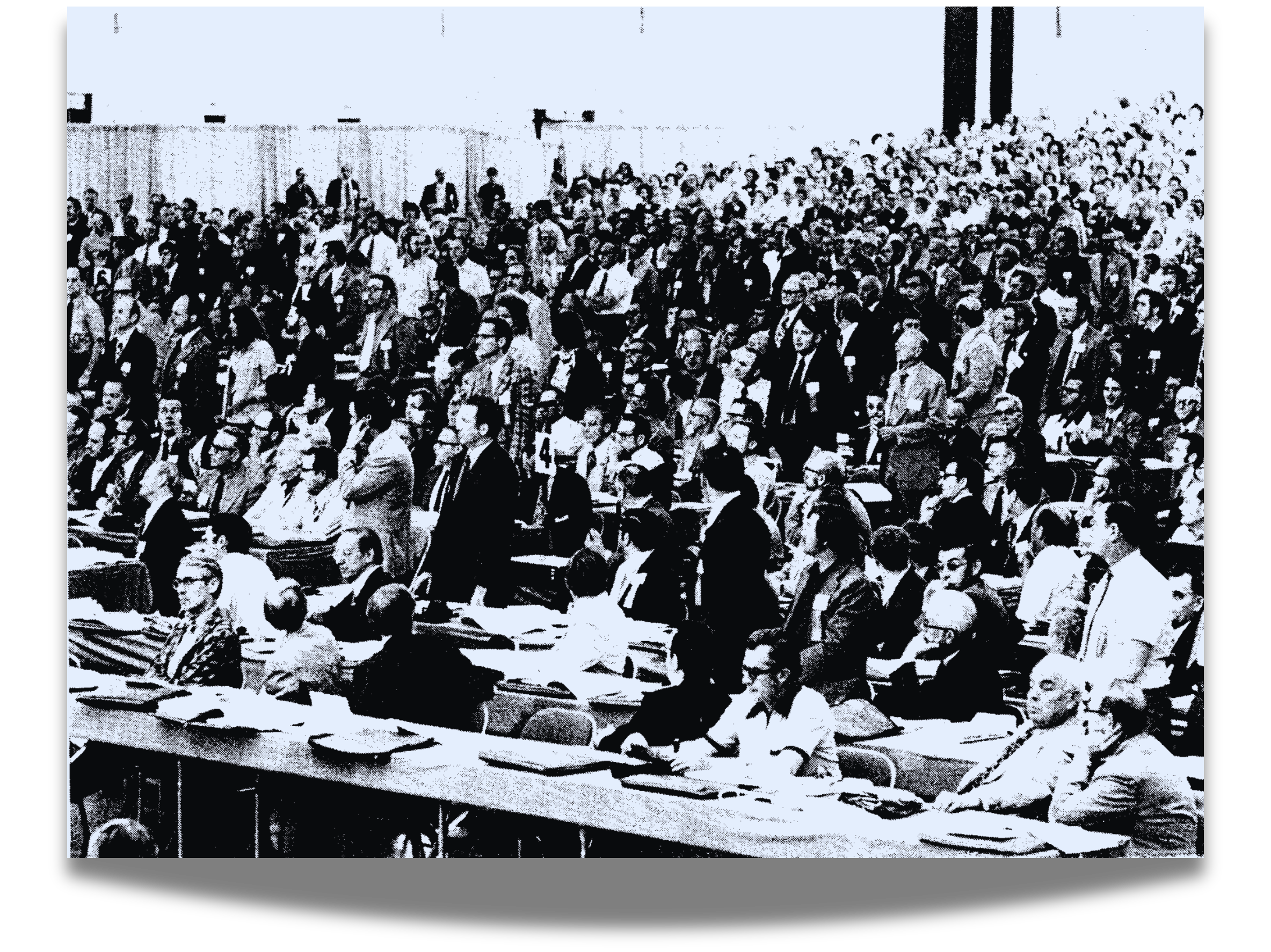
The year is 1973. It’s July, and we’re in New Orleans. The Lutheran Church – Missouri Synod is holding its fiftieth regular convention.
Resolution 2-12 has just come to the floor. What you do?
To Understand Article II of the Synod’s Constitution as Requiring the Formulation and Adoption of Synodical Doctrinal Statements
In his book, Theology of the Lutheran Confessions (Muhlenberg Press, Philadelphia, 1961), Edmund Schlink reminds Lutherans who are seriously committed to the Confessions of our church of an obligation which dare not be neglected. “Even the most solemn reaffirmation of the Confessions may be a denial of them, if the errors of the day are passed over in silence. … At the very least the church, confronted with new heresies, will have to furnish up-to-date and binding interpretations of her official Confessions.” (p. 31, emphasis added.)
At Augsburg in the year 1530 A.D. the first generation of Lutherans promised, “If anyone should consider that [our Confession] is lacking in some respect, we are ready to present further information on the basis of the divine Holy Scripture.” (Tappert, Book of Concord, p. 96: 7)
The first generation of Lutherans kept this promise and fulfilled the obligation to explain the AC [Augsburg Confession] when there was need to do so. “An extensive Apology was prepared and published in 1531 to set forth clearly the true and genuine meaning of the Augsburg Confession with a view . . . to forestalling the possibility that under the name of the Augsburg Confession someone might surreptitiously undertake to insinuate into the church errors that had already been rejected” (504: 6). For a meeting of theologians in Smalcald in 1537 Luther drafted some articles in which “the doctrine of the cited Augsburg Confession is repeated, [and] several articles are further explained on the basis of God’s Word” (505: 7) in order that in this way, for one thing, those who disagreed with the Lutheran doctrine of the Real Presence of Christ’s body and blood in the Lord’s Supper might be prevented from employing the loopholes in the Wittenberg Concordat of 1536 to interpret this document “to their own advantage.” (572: 17-18)
The second generation of Lutherans had to explain the true and genuine meaning of the Augsburg Confession to meet a need that arose after Luther’s death. Some theologians departed from the Augsburg Confession “in several important and significant articles, either because they failed to grasp their true meaning or because they did not abide by them. Some, while boasting of and benefiting from their adherence to the Augsburg Confession, even dared to give a false interpretation of these articles. This caused serious and dangerous schisms in the true evangelical churches” (502: 6–7). Because of this situation the authors of the Formula of Concord said, “Since within the past twenty-five years a number of divisions have occurred among some of the theologians of the Augsburg Confession . . . we wanted to set forth and explain our faith and confession” in order to “enable the pious reader, as far as is necessary, to compare our present position with the aforementioned doctrinal writings” for “such a comparison will show him clearly that there is no contradiction between what we taught and confessed originally and afterward expounded as occasion demanded and what we now report in this document.” (507–508: 19–20)
Sixteenth century Lutherans did not permit “fabricated slanders” to the effect that they were departing from the Augsburg Confession (pp. 5–6) and the charge that they veer[ed] from one doctrine to another” (508: 20) to deter them from preparing, accepting, approving, and subscribing the Formula of Concord “as the correct Christian interpretation of the Augsburg Confession” (p. 8). Anticipating the possibility that future circumstances might necessitate even other “doctrinal statements,” the authors of the Formula of Concord insisted “we do not intend, either in this or in subsequent doctrinal statements, to depart from the aforementioned [Augsburg] Confession or set up a different and new confession” (502: 5). The authors of the Formula of Concord acknowledged the Scriptures and earlier symbolical writings to be an adequate confessional base since “the Christian reader who really delights in the truth of God’s Word will find in [them] what he should accept as correct and true . . . and what he should reject, flee, and avoid as false and wrong.” They did not intend by their “doctrinal statement,” therefore, to broaden the confessional base of Lutheranism, but intended only “to insure that the truth may be established the most distinctly and clearly . . . and likewise to ensure that familiar terminology may not hide and conceal something” (507: 16). They were aware that some theologians who disagreed with the Augsburg Confession “sought forcibly to adduce and pervert the Augsburg Confession so as to make it appear to be in full agreement” with their false teaching (568: 1) and that they even endeavored “to employ terminology which is as close as possible to the formulas and speech-patterns of the Augsburg Confession” to conceal their error (569: 2). Far from wanting to set up a new confession by their document, the authors of the Formula of Concord wanted only to establish the old confession of Lutherans by explaining it correctly and applying it properly to current antitheses so that “anybody with Christian intelligence can see which opinion in the controverted issues agrees with the Word of God and the Christian Augsburg Confession.” (503: 10)
Nineteenth century Missouri Synod Lutherans followed the precedent established by their 16th-century forebears.
Toward the middle of the 19th century Walther prepared 19 theses on “Church and Ministry.” This treatise was prepared “to repel the attacks of Pastor Grabau of Buffalo, New York.” At Milwaukee in 1851 these theses were read to the fifth convention of the Missouri Synod and discussed in eight sessions. The Synod approved Walther’s theses and ordered their publication. When this work came from the printer (Andreas Deichert, Erlangen) it appropriately bore the title, The Voice of Our Church on the Question Concerning the Church and the Ministry, for in its pages historic Lutheranism was permitted to speak through copious quotations from the Symbols and the fathers. Since the book spoke also for the Synod that ordered its publication, it was introduced to its readers as “a testimony of the faith of the German Evangelical Lutheran Synod of Missouri, Ohio and Other States.” Walther regarded the work as “an official manifesto of the Missouri Synod . . . . In Walther’s Kirche und Amt spoke — and still speaks! — the entire God-blest Missouri Synod” (W. H. T. Dau, Walther and the Church, CPH, 1938, pp. 50–51). In this book the Synod found a voice to state its position on a controverted issue on the basis of the Scriptures and the Symbols, and the Synod gladly availed itself of this voice to express its acceptance of and adherence to the Scriptural and confessional doctrine.
Thirty years later when a controversy arose concerning the doctrine of election (predestination), a controversy that involved antagonists not only from without the Synod, but also from within, the Synod once again found a voice through which to declare its Scriptural and confessional position. Between January 15 and May 1, 1880, Walther published a series of articles in Der Lutheraner on the doctrine in dispute. At the synodical convention in Fort Wayne, May 11–21, 1881, these articles by Walther, called “Thirteen Theses,” were read, discussed, and adopted by the Synod (Proceedings, 1881, pp. 35–41) as the doctrine of the Holy Scriptures and the Lutheran Confessions. To the question as to what steps would need to be taken against those who regarded the position of the Synod as false doctrine, the convention replied that in case they failed to heed admonition they would eventually be expelled from the synodical fellowship (Proceedings, 1881, pp. 42–43). The Synod had a voice that spoke with Scriptural and confessional authority, and the Synod required as a condition of membership that this voice be recognized as Scriptural and confessional.
In adopting such doctrinal statements which expressed the Scriptural and confessional position of the Synod, the Synod acted in a way that is not only permitted but even encouraged by the confessional writings of the Lutheran church. When the authors of the Formula of Concord listed the earlier Symbols to which they committed themselves, they immediately added: “This, of course, does not mean that other good, useful, and pure books, such as interpretations of the Holy Scriptures, refutations of errors, and expositions of doctrinal articles, should be rejected. If they are in accord with the aforementioned pattern of doctrine they are to be accepted and used as helpful expositions and explanations.” (506: 10)
Since it is not unconfessional to accept and use writings which conform to the confessional pattern of doctrine, it is therefore not unconstitutional. Article II of the Synod’s Constitution commits the Synod and every member of the Synod to the pattern of doctrine in our Symbols. If in accordance with a right that the Symbols themselves grant, the Synod accepts and uses writings which agree with and uphold the confessional pattern of doctrine in order to show that the Synod in fact and not merely formally adheres to the confessional pattern of doctrine, then this, far from being unconstitutional, is the very thing that our commitment to the Symbols in Article II of the Constitution calls upon us to do!
“If they are in accord with the aforementioned patterns of doctrine” — this is the single condition for acceptance and use by the Synod of doctrinal statements. Nowhere do our Symbols even hint that a doctrinal statement depends for its validity upon unanimous acceptance, i.e, acceptance by everyone. If this were the condition for accepting and using doctrinal statements there would be no creed, no confession in all of Christendom! Not even Luther’s articles were accepted by everyone at Smalcald — they were accepted “unanimously” only by those present who agreed with them! The very purpose of a vote in connection with doctrinal statements is precisely to determine how many “unanimously” (with one mind) agree with them and how many do not — it is never the purpose of a vote to validate a doctrinal statement. Nor do doctrinal statements come into being and finally get adopted by negotiating a position acceptable to everyone. When it comes to accepting doctrinal statements the only factor that Lutherans, who take seriously their commitment to the Scriptures and the Symbols, dare take into consideration is whether or not such statements “are in accord with the aforementioned pattern of doctrine.”
If they “are in accord with the aforementioned pattern of doctrine” the church must accept and use doctrinal statements especially in times of controversy for the purpose of restraining contentious men who spread dissensions, in order to afford guidance to troubled and confused Christians, and for the sake of posterity.
The authors of the Formula of Concord prepared their doctrinal statement because they thought that “the most acute and urgent necessity demands that in the presence of so many intrusive errors, aggravated scandals, dissensions, and long-standing schisms a Christian explanation and reconciliation of all of the disputes which have arisen come into being . . . so that the way may not be left free and open to restless, contentious individuals, who do not want to be bound to any certain formula of pure doctrine, to start scandalous controversies at will” (emphasis added; Pref. to Book of Concord, Tappert, p. 13). Because controversies always “involve serious offense” for the weak in faith, some of whom “will doubt if the pure doctrine can coexist among us with such divisions, while others will not know which of the contending parties they should support . . . necessity requires that such controverted articles be explained on the basis of God’s Word and of approved writings (502–503: 710) in order that “a correct explanation and direction might be provided for simple and pious hearts, so that they might know what attitude to take toward these differences” (Pref. Book of Concord, Tappert, p. 6). The Formula of Concord was written to give a public testimony not only to those then living, but also to posterity concerning that which is and must remain the position of our churches with reference to the controverted issues (FC, SD Antitheses, 16 – German) because the fathers did not want it to happen that “nothing beyond uncertain opinions and dubious, disputable imaginations and views will be transmitted to future generations” (Pref. Book of Concord, Tappert, p. 13). On the contrary, they earnestly desired “that a pure declaration of the truth might be transmitted to . . . posterity” and therefore they exercised great care that “the Christian doctrine set forth in [their] explanation . . . might be fortified with the Word of God against all sorts of perilous misunderstanding, so that no adulterated doctrine might in the future be hidden thereunder.” (Pref. Book of Concord, Tappert, p. 7)
Melanchthon asked the church of his day a question which the LCMS should ponder well in these trying times: “How many do you think there are . . . who have begun to doubt because of the controversies that have arisen on the most important questions? How much silent indignation is there because you refuse to examine these questions and adjudge them rightly, because you do not strengthen wavering consciences . . . ?” (201: 127)
Through the centuries the following words of admonition and warning ought to strike our ears and hearts in all the earnestness with which they were originally addressed by Melanchthon to a decadent church in the 16th century: “In these very serious and difficult controversies the people desperately want instruction in order to have a sure way to go. . . . You will some day have to give account of your stewardship.” (281–282: 4–5)
Resolution
Whereas, The Lutheran church ever since Augsburg (1530) has reserved to itself the right to interpret and explain its confessional position over against aberrations of every sort; and
Whereas, The Lutheran Church – Missouri Synod from the beginning of its history did in times of controversy adopt doctrinal statements declaring the Synod’s position on the basis of Scripture and the Confessions relative to controverted issues; and
Whereas, Such right and obligation is intrinsic to commitment to a confessional position and is inherent in the Synod’s commitment to the confessional base stipulated in Article II of the Synod’s Constitution; and
Whereas, The very concept of a Synod (“walking together”) precludes individualism which allows every man to interpret Synod’s confessional position according to his own subjective preference; and
Whereas, The Synod as recently as 1971, at its Milwaukee convention, has reaffirmed “the desirability of the formulation of doctrinal statements which clearly set forth the teachings of the Holy Scriptures and apply them to issues of our day” (Milwaukee Proceedings, Res. 5-24); and
Whereas, The Synod at the same convention has asked the church to “honor and uphold” such doctrinal statements and has interpreted “honor and uphold” as meaning “not merely to examine and study them but to support, act, and teach in accordance with them unless they have been shown to be contrary to God’s Word” (Milwaukee Proceedings, Res. 2-21); therefore be it
Resolved, That the Synod recognize it as fully in accord with precedent established by our fathers both in the period immediately following the Reformation and in the early years of our Synod’s history to produce and adopt statements of doctrine which apply the teachings of Scripture and the Confessions to controverted issues; and be it further
Resolved, That the Synod understand Article II of its Constitution as permitting, and at times even requiring, the formulation and adoption of doctrinal statements as definitive of the Synod’s position relative to controverted issues; and be it further
Resolved, That the Synod recognize Article II of its constitution as requiring the Synod to take seriously its confessional commitment to the pattern of sound doctrine contained in the Symbols and to “regulate all religious controversies and their explanation according to it” (Preface to the Book of Concord, Tappert, p. 14; cf. FC, SD, Rule and Norm, 10); and be it further
Resolved, That the Synod recognize that the only basis for the acceptance of such statements is that they are in accord with Scripture and the pattern of doctrine set forth in the Symbols; and be it finally
Resolved, That the Synod reaffirm its position (Milwaukee Proceedings, Res. 2-21 and 5-24) that such statements, insofar as they are in accord with the Scriptures and the pattern of doctrine set forth in the Lutheran Symbols, are, pursuant to Article II of the Synod’s constitution, binding upon all its members. (Cf. also Article VII)
Action:Adopted (6).
(See Minutes of Sessions 4 and 6 under Seminary Issues for detailed account of the debate.)
Are you an Old Lutheran? Do you have something to say? Send it: oldluth at protonmail dot com
The Church shall never perish! Her dear Lord, to defend, To guide, sustain, and cherish, Is with her to the end. Tho’ there be those that hate her, False sons within her pale, Against both foe and traitor She ever shall prevail.
— TLH 473, “The Church’s One Foundation,” v. 5
Do you like Math?
Here’s some church calendar math. My comments below.
Look at the bottom half of the page, “A Table of the Movable Feasts and Festivals.” Look at the column labeled “Sundays after Epiphany”; note the asterisk (*). Go down to the bottom of the column where it says “6” (it’s boxed in red). Note that a liturgical “Sixth Sunday after Epiphany” only occurs when…
Easter falls on April 22, 23, 24, or 25
exceptionally, Easter falls on April 21 in a leap year
Well, how often does any of that happen? Go ahead and look the table in the second quartile from the top, “Table of the Days on which Easter will Fall from 1941–2000.” Late April Easters are rare. (As a matter of fact, April 25 is the latest possible date for Easter.) This table is a small sample, though, and if you’re not an autistic savant, it’s exceeding difficult to extrapolate frequency on the spot.
Well, the United States Census Bureau is here to help. The dates of Easter during the lifetime of the American body politic are relevant census data for reasons which are, if not immediately obvious, not terribly difficult to infer. So the USCB has a page called “Easter Dates from 1600 to 2099.” Uhhhh…based?? Ironically, the USCCB (note the extra “C”) does not have such a page. Also ironically, the USCCB has a way higher homosexual quotient than the USCB, but who’s counting? Well, the USCB is, because counting is very much their thing. You can imagine the office parties.
We can now answer the question that has been vexing you:
If the Lord tarries until His Year 2099, how many years will have had six Sundays after Epiphany since 1600 inclusive?
You’re not the only one who has been wondering.
Thirty-three out of a total of 500 years. That’s 6.6%. If you doubt the accuracy of these figures, you can check Sanctus.org, the work of Mr. Stan Lemon. For example here is February 2052. 2052 is slotted to be a leap year. It’s one of those rarities highlighted in red: April 21 Easter in a leap year. So what do we see in February of 2052? The black swan of the liturgical calendar: five Sundays after Epiphany followed by the Feast of the Transfiguration for a full six.
Time was when the Transfiguration had no fixed date of observance in the Western Church. Then John Hunyadi defeated the Turks at the Battle of Belgrade on August 6, 1456. To give thanks to God for the victory — and honor Hunyadi, who succumbed to plague only five days after his victory — Pope Callixtus III standardized the date. For this reason you will not find any references to “Transfiguration Sunday” in sixteenth-century Lutheranism. There was no such Sunday. While the seventeenth century did see a gradual shift toward the current custom of celebrating Transfiguration at the end of Epiphanytide, this change in use was not universal. By way of example: J. S. Bach (1685-1750) never wrote a cantata for Transfiguration.
But gradual shifts being what they are, in contemporary Lutheran liturgical usage the last Sunday of Epiphanytide always gives way to the Feast of the Transfiguration.
Which brings us, at last, to the point:
Because of all this, unless there are a full six Sundays after Epiphany, the Fifth Sunday after Epiphany will not be observed. Scroll back up and look at the dates boxed in green and red again. That’s what those green boxes mean. The last time rad trad Lutherans (guys who use the One-Year Lectionary) heard the Parable of the Wheat and the Tares read and preached on in church was in 2011; it will be 2038 before it comes up again.
Is it a coincidence that this same group has a high quotient of Romanizers who love to disdain utterly Biblical, orthodox Lutheran articles of doctrine like the “Invisible Church,” which they ignorantly regard as an idiosyncrasy that originated with C. F. W. Walther so that they can dump on it along with the rest of his oeuvre?
Remember the Parable of the Wheat and the Tares? It’s short.
Another parable put he forth unto them, saying, The kingdom of heaven is likened unto a man which sowed good seed in his field: but while men slept, his enemy came and sowed tares among the wheat, and went his way. But when the blade was sprung up, and brought forth fruit, then appeared the tares also. So the servants of the householder came and said unto him, Sir, didst not thou sow good seed in thy field? from whence then hath it tares? He said unto them, An enemy hath done this. The servants said unto him, Wilt thou then that we go and gather them up? But he said, Nay; lest while ye gather up the tares, ye root up also the wheat with them. Let both grow together until the harvest: and in the time of harvest I will say to the reapers, Gather ye together first the tares, and bind them in bundles to burn them: but gather the wheat into my barn. (Matthew 13:24-30)
“Invisible Church”? You might need a reminder. Here’s a good one from Bente:
The Christian Church is the sum total of all Christians, all true believers in the Gospel of salvation by Christ and His merits alone. Faith always, and it alone, makes one a Christian, a member of the Church. Essentially, then, the Church, is invisible, because faith is a divine gift within the heart of man, hence beyond human observation. Dr. Walther: “The Church is invisible because we cannot see faith, the work of the Holy Spirit, which the members of this Church have in their hearts; for we can never with certainty distinguish the true Christians, who, properly, alone constitute the Church, from the hypocrites.” (Lutheraner, 1, 21.) Luther: “This part, ‘I believe a holy Christian Church,’ is an article of faith just as well as the others. Hence Reason, even when putting on ever so many spectacles, cannot know her. She wants to be known not by seeing, but by believing; faith, however, deals with things which are not seen. Heb. 11, 1. A Christian may even be hidden from himself, so that he does not see his own holiness and virtue, but observes in himself only fault and unholiness.” (Luther’s Works. St. Louis, XIV, 139.) In order to belong to the Church, it is essential to believe; but it is essential neither to faith nor to the Church consciously to know yourself that you believe. Nor would it render the Church essentially visible, if, by special revelation or otherwise, we infallibly knew of a man that he is a believer indeed. Even the Word and the Sacraments are infallible marks of the Church only because, according to God’s promise, the preaching of the Gospel shall not return without fruit. Wherever and only where the Gospel is preached are we justified in assuming the existence of Christians. Yet the Church remains essentially invisible, because neither the external act of preaching nor the external act of hearing, but inward, invisible believing alone makes one a Christian, a member of the Church. Inasmuch, however, as faith manifests itself in the confession of the Christian truths and in outward works of love, the Church, in a way, becomes visible and subject to human observation. Yet we dare not infer that the Church is essentially visible because its effects are visible. The human soul, though its effects may be seen, remains essentially invisible. God is invisible, though the manifestations of His invisible power and wisdom can be observed in the world. Thus also faith and the Church remain essentially invisible, even where they manifest their reality in visible effects and works. Apart from the confession and proclamation of the Gospel and a corresponding Christian conversation, the chief visible effects and works of the Church are the foundation of local congregations, the calling of ministers, the organization of representative bodies, etc. And when these manifestations and visible works of the Church are also called churches, the effects receive the name of the cause, or the whole, the mixed body, is given the name which properly belongs to a part, the true believers, only. Visible congregations are called churches as quartz is called gold, and a field is called wheat.
How do we fix this? Well, first you need to read your Bible. If you are LARPing as an illiterate sixteenth-century German peasant and limiting your weekly intake of the Word of God to the Sunday pericopes, yet without the benefit of a comparatively wholesome sixteenth-century German peasant existence, you are seriously NGMI.
Secondly, you could switch to the Three-Year Lectionary. Then you’d hear the Parable of the Wheat and the Tares once every three years at “Proper 11.” There are drawbacks to this plan which I’m not going to get into here. All in all I’m not sure I’d recommend using the Three-Year just so that you can hear this parable in church more often.
There is in fact another way. A way that is quite a bit radder and very much tradder:
Put Transfiguration back where it belongs on August 6. It is meet, right, and salutary. God was glorified by John Hunyadi’s victory over the Turk, whom the Lutheran Confessions rightly call“that most atrocious, hereditary, and ancient enemy of the Christian name and religion.” Most of the time the Body of Christ lives a humdrum existence of unremarkable mutual neighborly service. This is glorious. But sometimes, when He deems it needful, God transfigures a Christian nation into a Man of War and deals death to the armies of the heathen, as He did through Ancient Israel under Joshua and Gideon and David. That is glorious, too. If you cannot affirm this, it is to be doubted whether yours is the religion of the Bible.
Not only is the August 6 observance of Transfiguration an especially worthy confession to make in a day and age when the multitude of “false sons within her pale” bring disgrace to Mother Church, but it puts the vital teaching regarding her essential invisibility back into rotation with the Parable of the Wheat and the Tares. (If this seems like a paradox to you, that means it’s working.) When Easter falls on April 15 or later and each Sunday after Epiphany gets to keep its propers — because we’re celebrating Transfiguration in August now, remember? — it happens a lot more often.
How much more often? I’m so glad you asked.
Lutherans clearly heard the Parable of the Wheat and the Tares a lot more frequently back in the day, especially if they were somewhere like Leipzig where the transfer of Transfiguration to the end of Epiphany caught on late. Clearly this, and this alone, is why the Old Lutherans were more orthodox than we and why Bach’s music is so incomparably glorious.
Obviously not. But I hope this serves to illustrate an important point about liturgical catechesis. About every three or four years, right before the decrescendo into Lent, the Old Lutherans were reminded of this sobering truth:
It is not enough to simply be a member of the visible church; you have to have faith in Christ, and true faith bears the fruit of a holy life.
If you claim to have faith but live and think like a denizen of this present evil world, your faith is false. You love to gaze into the Baptismal font, see your reflection, dip your fingers in the water, and mark yourself with the sign of the cross, but in so doing you are like a man observing his natural face in a mirror who observes himself, goes away, and immediately forgets what kind of man he was recreated in Christ to be. Repent, lest the Son of Man return and find no faith in you and the reaping angels gather you into the heap of unbelievers and cast you into the lake of unquenchable fire.
No amount of screeching and hand-flapping about irrelevant theological loci (e.g., wellackshually this is how faith is created and sustained; even Christians are sinners; muh “in great weakness”; the “Two Kingdoms” justifies hypocrisy; etc.) or chimping out about the bogeyman of “Pietism” can overturn this. No, I’m not saying that these loci are irrelevant per se. But they are certainly irrelevant — and worse than irrelevant — when neckbeards in fedoras mount up and try to weaponize them in their Reddit-tier foreverwar against Christianity 101. (For outsiders reading this: this is basically the LCMS varsity sport. Think of it as the theological equivalent of polo at the Special Olympics. Maybe you have the same kind of thing going on in your church. If so, my condolences; it’s tough out there.)
The oldest Old Lutherans didn’t sing “The Church’s One Foundation,” since it’s a nineteenth-century Anglican hymn (and a rare CoE banger, if we’re honest), but they certainly would have resonated with that fervent fifth verse (conspicuously absent from LSB, because of course) featured at the top of this piece. So for a nice chiasmus, we’ll close with it.
Thanks for reading Old Lutherans.
The Church shall never perish! Her dear Lord, to defend, To guide, sustain, and cherish, Is with her to the end. Tho’ there be those that hate her, False sons within her pale, Against both foe and traitor She ever shall prevail.
— TLH 473, “The Church’s One Foundation,” v. 5
Do you enjoy this site? Help us cover our hosting costs and fund Old Lutheran Book Concern. Thank you!
Presenting a sermon by Martin Luther for the Nineteenth Sunday after Trinity, translated by J. N. Lenker. You can view the text here. This sermon has a special, elevated status in the Lutheran Church, being specifically cited in the Book of Concord.
Please add us manually to your favorite podcatcher app. If you use PodBean, we are on it (for now).
Do you benefit from the content here at Old Lutherans? We hope you do. It will always be free to you, but it will always cost us money to put it up. Anything beyond our hosting costs goes to kickstart Old Lutherans Book Concern. Please consider donating if you’re able.
Presenting a sermon by Martin Luther, “The Fulfilling of the Law by the Christian,” written for the Eighteenth Sunday after Trinity, 1537, translated by J. N. Lenker. You can view the text here.
Please add us manually to your favorite podcatcher app. If you use PodBean, we are on it (for now).
Do you benefit from the content here at Old Lutherans? We hope you do. It will always be free to you, but it will always cost us money to put it up. Anything beyond our hosting costs goes to kickstart Old Lutherans Book Concern. Please consider donating if you’re able.
Presenting a sermon by C. F. W. Walther, “The Disastrous Results of Despising God’s Law,” preached on the Eighteenth Sunday after Trinity, 1844, translated by E. Myers. You can view the text here.
Please add us manually to your favorite podcatcher app. If you use PodBean, we are on it (for now).
Do you benefit from the content here at Old Lutherans? We hope you do. It will always be free to you, but it will always cost us money to put it up. Anything beyond our hosting costs goes to kickstart Old Lutherans Book Concern. Please consider donating if you’re able.
“Raskolnikov in the Attic”; Fritz Eichenberg, woodengraving, 1938
Dear Christian, when you read what follows, if it causes you to feel despair (as it may), fear not, but rather at every turn remember: “And such were some of you: but ye are washed…” (1 Co 6:11).
Those who snidely dismiss what is here said and feel no tinge of holy fear, beware. Such is not the peace of a good conscience but the insensateness of one which has been seared.
❦
From Ch. VI of Adolf Köberle’s The Quest for Holiness, “The Significance of Sanctification in the Preservation or Loss of the State of Faith.” Access a PDF of the whole chapter here.
In the course of our previous investigations we have seen that no attempts to gain sanctification by ourselves, whether of moral, mystical or speculative sort, are able to establish a communion with God, because all our human powers have been crippled through the enslaving and condemning power of sin (Chapters I and II). What no efforts at deification were able to attain God freely gave the world in Jesus Christ (Chapter III). In Him He promises and assures us of the two facts: “Thy sins are forgiven thee,” and “Arise and walk!” This renewal applies to the whole man and reaches to all spheres of life; to body, soul and spirit; to understanding, emotion, will and deed (Chapter IV). So no creative part, nor cooperation, which might carry some merit with it, can be attributed to the one who yields to the offer of salvation as it is proclaimed in reconciliation and redemption.
On the other hand man possesses the fearful ability to cast away the salvation that has been offered, and perhaps even attested to him personally, and so to destroy himself. Faith because of thankfulness and obedience, because of fear and love drives man to ceaseless exercise in prayer, self-discipline and service, but the natural man does not cease to despise, to hinder and destroy the “drawing to the Father by the Son” (Chapter V). This conflict in which faith and unbelief strive for the mastery continues till the hour of death. But this conflict has not been sufficiently described if it is simply considered as a general conflict that is bound to come between flesh and spirit because of their divergent principles. It has an animated history that is as full of incident, as difficult and as trying as any warfare between two nations. Here there are great battles and small skirmishes, the gain or loss of territories, displays of courageousness and of weakness, and finally the certainty that its termination must be one of two things, either a final decisive victory or a final and utter defeat. As a general must be vitally concerned in gaining information concerning the position, resources and tactics of the enemy, and as the utilization of all that might bring failure or success in a battle calls for his most strenuous exertions, so it is of vital importance for the miles christianus to know the concealed moral laws governing sin and grace that can either imperil his state of faith, or strengthen and preserve him in the conflict he must face. It is this concrete “history of the warfare of the heart” that we would discuss in the following pages.
Whosoever wants to describe the doctrine of justification must first possess a doctrine of sin. This we tried to furnish in the second chapter. Whoever wishes to provide a doctrine of sanctification must also furnish a doctrine of sins. But is not one sin like another sin, of equal seriousness and with similar consequences, or should we and must we classify them? The Reformation theology in opposition to the Roman Catholic distinction of mortal and venial sins, and the frivolous use often made of that distinction in the practice of the Confessional, always emphasized the fact that sin is an “absolute category” in which there can be no differentiation. Before God every sin, the most trifling as well as the most serious, is a complete rupture of the proper relation of trust and obedience that we owe to God, which in every case makes the offender unconditionally guilty. The theology of the 51st Psalm excludes all “puppet sins.” Before the Holy One the insidious entrance of a presumptuous thought is as grievous as the act of adultery. The degree of guilt is always infinite and requires infinite mercy for its erasure and remission. But so far we have only seen one side. Every sin involves something more than its accusing or condemning status before the holiness of God. It likewise exerts a fettering and mastering power over man and it is this aspect we have to consider as we inquire whether every sin has an equal power in enslaving our moral intentions, in dulling and confusing our ability to understand and perceive. It is evident that the answer to this question is to the greatest importance for the preservation or the loss of our state of faith.
A survey of the history of theology shows that this very essential problem has received very little consideration. We find the most attention given it in the casuistic literature of Roman Catholic moral theology and in the confessional manuals, the third volume of Albrecht Ritschl’s great work on Justification and Reconciliation, the writings of Johannes Müller and the latest literature of Anthroposophism and the Christengemeinschaft. True, all of these tendencies have shoved the doctrine of sin to a place behind their teaching concerning sins. They think of it more lightly and less seriously than the Second Article of the Augsburg Confession and consequently have always severely criticized this article of the Confession. Here we once more receive the painful impression that theological perception is apparently unable to apprehend or express more than one statement in its entirety. The other side, which in this case is the more important one, is not stated clearly and emphatically, just as the church dogmatics has neglected this phase of the question.
…
[E]vangelical theology … lacks a hamartiology which adequately describes the fearful possibilities of sin both in its accusing and its enslaving character, and which is not afraid to learn from the unquestionably able Roman Catholic moral theologians, from Ritschl, R. Rothe and Steiner, without losing Luther’s fundamental view of the enslaving burden of guilt that pervades all sin. For our own presentation, as well as for pastoral care and for training in the service of our neighbor, it is necessary to realize both; how sin invariably destroys communion with God and how it works to accomplish this end. To the dogmatician this second question may appear entirely secondary, but as soon as we begin to reflect more deeply on the moral problem of sanctification we can no longer pass it by as unimportant psychologizing. We have to pause and consider because of what is involved. The one who dodges this question will not get very far.
In his vigorous polemic, Die Theologie der Tatschen wider die Theologie der Rhetorik, Vilmar called for a “teaching concerning temptation.” It is indeed a prerequisite for successful warfare against any foe that we know the way in which he gives battle. The diabolical, uncanny way in which sin operates shows itself through a double manifestation. The one is its apparent insignificance and apparent harmlessness on first sight. It is never suggested that the spark may become a fire, the snowball an avalanche, idle thoughts turn into terrible passions and a voluntary yielding (once does not mean anything!) result in a terrible bondage. Only with the passing of time do the fetters become evident which had been fastened by the commission of the first. The first slip seems voluntary and easily retraced.
But the enemy has a still more dangerous weapon at hand. When enlisting men in his service he not only disregards all reference to future obligations but with the very first handclasp bestows intoxicating pleasure, apparently boundless liberty, and promises still more for the future. The Bible tirelessly paints pictures of the enemy and his manifold deceits, with great clearness and unmistakable warnings; on occasion compares the cozenage of sin to the harlot “who sitteth at the door of her house, on a seat in the high places of the city, to call passengers who go right on their ways.” Whoever follows her “knoweth not that the dead are there” (Prov. 9:14-18). Out of the appreciation of the tricky wiles of the beginnings of sin, from an understanding of the deceptive inversion of all values in the first temptation (eritis secut Deus), faith will acquire a holy fear and vigilance and will understand how the deceiver is the most tricky, and therefore the most dangerous, at the time of his first approach. Once men are pledged to him he soon drops the mask. The one to whom the Spirit has given a “renewed mind” sees the end of the road from the very beginning; sees the ripe poisonous fruit in its seed— and smiles at the efforts of the tempter.
A second bit of understanding that is quite essential for the conflict of sanctification is an insight into the difference in the enslaving power of different sins. The old Protestant division of sins, which is quite in accord with Scripture, into those working internally and those acting externally; into sins of the heart, the tongue and the deed (peccata interna et externa; peccata cordis, oris et operis) is anything but irrelevant trifling. It is true that Jesus in the words of the sermon on the mount used the very expression that dogmatics employed to designate distinctions in act, in the opposite way, expressly to remove every distinction. The angry thought in God’s sight is on an equality with the act of murder, the lustful glance is as evil as the adultery. But because we know ourselves equally guilty in God’s sight in the commission of every sin it does not follow that the effect of evil thoughts, words and deeds is equally significant for myself and my neighbor in every case, and that therefore there is no difference occasioned by the instrument used in its commission, whether it be the heart, the tongue or the hand.In the first place we cannot take the influence exerted by either a morbid or a wholesome mental life seriously enough. The worst delusion of the materialistic thinking of the past decade is its almost complete loss of reverence or fear of the mighty, invisible power of “mere” ideas. Even a morbid imagination that remains limited to fancies and desires is a terrifying, living power, that can torment and enslave its victims to a fearful degree, creates an atmosphere around itself and infects and poisons others, as it tremendously increases the power of evil in the world, while in a blessed way, all pure, wholesome thinking and feeling, even when it happens in the most obscure places, spreads irresistibly and bears its certain fruit. The unbridled fecundity of morbid and evil imaginations must therefore be mercilessly combated and avoided because, under any circumstances, it is sufficient by itself alone to corrupt man utterly.
But the most uncanny thing about such a play of desires is something else. It is the fact that the unrestrained roving thoughts never remain confined to the hidden chambers of the soul, but they crowd out into the open and display themselves in words and actions, that enslave, burden and shape the future of their author still more certainly than the morbid thoughts. We might say that as in the transition from the friendly disposition to the helpful deed there is always a demon present who would prevent its realization, so in the progress from the wrathful unclean desire to the hurtful work and destructive act, there is a guardian angel on the watch, seeking to hinder us from crossing the threshold. The very hesitation that restrains an evil thought from becoming an external act is proof that here again there is a fresh realization that it would involve a renewed, conscious, deeper descent into evil than that of the previous slavery, and one that would consequently still further weaken the soul.
An evil word is like a sped arrow that cannot be recalled. Its results are immeasurable and beyond all human control. The word has stronger formative power, it multiplies itself more rapidly and quickly than the originating thought. It produces lasting history, enmity and contention; inconspicuously and without effort it mould the opinions and views of many, thus involving all the more responsibility, and so there is special justification for another distinction of the old dogmatics; the one it made between peccata propria, sins that involve only the individual, and peccata aliena, sins that involve others, either by awakening in them the slumbering passions or by inciting and strengthening those already active. Because a malicious statement not only weakens the one who utters it in his own powers of moral resistance but involves at least two others, the one spoken to and the one spoken about, it becomes of great importance as to whether the evil intention realizes its purposes or whether it is repressed by the fear of God and the might of the Spirit.
“The word is worse than the thought, the deed worse than the word” (Vilmar, op. cit., p. 224). For it is the deed that finally involves the whole man, binds him closer and closer with the fetters of sin and “makes return harder, the growth of sin easier.” Deeds leave a deeper impression on the character than thoughts. Deeds produce terrible situations that cannot be recalled nor changed and whose bonds the entangled wretch tries in vain to sever by still more serious wrongdoing. It was not the covetous thought, the lustful glance nor the storm in his soul but the actual deed that drove David into such humiliating shamelessness that he caused the rightful husband of the stolen wife to become drunken, so that he could not enter his own house and that finally led to his murder. Scripture is especially severe in dealing with sins of the flesh, not only because of the terrible consequences for the companion in sin but above all because they invariably destroy the spiritual gifts of the believer. Adultery and whoredom are therefore always associated with the sins that exclude men from salvation. The other items of the catalogue of vices include a striking number of sins of action. Perjury injures life much more seriously, and ruins it more terribly within and without than the mere dalliance with the thought of its possibility, even though such an evil thought is just as bad in God’s sight as the false oath itself. The power of murder to darken and becloud the soul is far greater than the hateful thought. An accomplished swindle enslaves and torments a man’s life in an entirely different way from the “mere” desire for gold. Erotic stimulation is destroyed and vanishes again where the spirit of discipline prevails, but man loses forever his moral integrity and honor by one act of transgression. The recourse to magic, the “charming” of children produces a deeper depravity and a greater immersion in satanic power than the tempting suggestions of ungodly superstitious thoughts. …
Friedrich Bente’s American Lutheranism Vols. I & II is a vitally important work of history. We tried awhile ago to post Vol. I chapter by chapter, but the effort foundered, so here’s the second half of the book in one post.
All of the history penned by Bente is instructive, but not all of it is as pertinent to the current year Sitz im Leben of the orthodox remnant of American Lutherans, i.e. that group which—at least since the nineteenth century—has been called the “Old Lutherans.” (Surprise! The name of this blog is not original, nor was it ever intended to be; see: “Old Lutherans,” Christian Cyclopedia). The most pertinent part of the book is the second half, which is entirely dedicated to giving the history of the Evangelical Lutheran Tennessee Synod, a confessional Lutheran synod which existed in the Southeastern United States for exactly a century (1820-1920), although by the time it entered fellowship with the United Synod of the South in 1886 it had more or less lost its substance. The Wiki is a fair summary. Word Fitly Spoken did a great episode back in January 2019, “Fire From Heaven: The Evangelical Lutheran Tennessee Synod”; it is very much worth your time.
The whole of Part 2 of Bente’s history is reproduced in full below with a linked Table of Contents, should you care to click around. If you saw this tweet…
Soon—this week, Lord willing—we at https://t.co/c6tgRbl2rs will discuss the Tennessee Synod model of ministerial formation & how traditional Lutheran congs. must embrace it (or have their substance eaten out by hirelings). Stay tuned.
Although the Tennessee Synod has always been and is now only one of the smaller American Lutheran synods, its history reveals much that is gratifying, instructive, edifying, and interesting. The first report is entitled: “Report of the transactions of the first conference of the German Ev. Luth. pastors and deputies held in the State of Tennessee, in Solomon’s Church, Cove Creek, Green Co., on the 17th, 18th, and 19th of July, 1820.” The conference was organized by Pastors Jacob Zink of Virginia, Paul Henkel of Virginia, Adam Miller of Tennessee, Philip Henkel of Tennessee, George Esterly of Tennessee, and David Henkel of North Carolina (who was unable to attend the first meeting), and 19 deputies of congregations in Tennessee. (Bericht 1820, 3.) By 1827 the number of pastors had increased to 14, by 1856 to 32, and by 1900 to 40. At present the Tennessee Synod numbers about 130 congregations and 14,500 communicants. The name “Synod” appears for the first time in the English Report of 1825, and is found in the constitution since 1827. In the minutes of 1820 we read: “Firstly, it was deemed necessary and good that all business and proceedings of this conference, or synod, shall be conducted in the German language. All written reports of the proceedings belonging to the whole shall also be published in the German language.” (4.) Synod also regarded it “as most necessary that we be as diligent as possible to acquaint our children with all our doctrines of faith in our German language, since in it we are able to instruct them in the easiest way.” (9.) A footnote makes the following comment: “The reason why we desire a purely German-speaking conference: Experience has taught us that where a conference is German-English, either the one or the other party considers itself offended. When German is spoken, the English brethren understand little, and very frequently nothing at all. When English is spoken, many a German brother is unable to grasp the matter, and accordingly unable to judge in questions of the greatest importance. Besides, at the present time there are very few purely English pastors who accept the doctrine of our Church and desire to preach it.” (4.) The same sentiments are voiced in the following statement of this report: “False Lutherans prefer to seek entrance among the German church-people, because they still contribute most to the support of the ministry. Some Germans also of our day are of such a kind that if they are able to preach a little English, no matter how broken and jargonlike it is spoken, they are inflated with such senseless pride that they would no longer preach a thing in their mother-tongue nor care the least for the order of the Church, if it were not a question of bread and of keeping the good will of some obdurate Germans. They preach because they take pleasure in hearing themselves. Those who are really English and understand their language do not care to hear such, except at times, and then for their amusement only. The Germans therefore are under no obligations to the good will of such sirs, when they serve them in their language and according to their order.” (31.) Originally, then, the Tennessee Synod was determined to be and to remain a purely German-speaking body.
88. Attitude toward the English Language.
That the interest manifested by the Tennessee Synod in the German language was not due to any unreasonable prejudice or hatred toward the English language as such, appears from the fact that since 1821 the minutes of Synod were printed both in English and German. Moreover, in the minutes of the second convention, 1821, we read: “At the request of some of our brethren of North Carolina it was resolved that there be annually a synod held in North Carolina, or in an adjoining State in the English language. The members of the German Tennessee Synod may also help to compose this Synod. It shall be governed agreeably to the same constitution as that of the German Tennessee Synod (the language excepted). Those who compose this Synod may appoint the place and time of the meeting, when and where they may deem it expedient.” (Report 1821, 7.) The Report of 1822 records: “Resolved: Because this Synod is German-speaking, and Mr. Blalock not understanding this language, he cannot therefore have a seat and vote in this body. Yet, the Revs. Paul and David Henkel are allowed as individual ministers to examine him, and in case he is qualified, to ordain him. It is to be understood that Mr. Blalock is to be ordained a minister of the Evangelical Lutheran Church; but in case he should acquire a knowledge of the German language, which he expects to do, he can then have a seat and vote in the German synod. But whilst he understands the English language only, he may with other ministers, who walk agreeably to the doctrines and rules of the German synod, organize an English-speaking synod, in conformity to a resolution passed last year.” (5.) In 1826 the resolution was adopted: “Whereas there are sundry members belonging to this Synod who do not understand the German language, and yet do not wish to form a separate body, it was resolved that the Secretary, during this session, shall act as an interpreter between the German and English brethren. It was further resolved that at the next session, during the three first days, all the business shall be transacted in the German language, i.e., if so much time shall be requisite; after which the business shall be resumed in the English language.” (3.) The anxiety caused by the language-question appears from the following letter of Philip Henkel, dated October 19, 1826: “After my return from Synod, I found our German congregation-members very much dissatisfied because they believed that we had violated the constitution, and I am afraid that a separation will be the result. For the old Germans will never suffer the Tennessee Synod to become a German-English-speaking body. We must certainly act carefully in this matter, otherwise our Synod will be ruined. . . . They said that they were willing to sacrifice the constitution, provided that we remain an exclusively German-speaking body. I also am willing to relinquish the constitution, provided that the Augsburg Confession is made the constitution of this synod. We shall find that we shall not be able to keep the Germans and English together, even when we conduct synod at the same place three days in the German and three days in the English language, for the Germans will have to suffer the burden. The English will always want to attend; then they are coarsely treated by the Germans; the English complain; thus the matter will be ruined. My advice, therefore, is: Let us always hold a German-speaking synod, and afterwards an English-speaking one. In this way we shall be able to exist. For my part, I am willing to attend both. Every constitution except the Augsburg Confession may then be set aside. If the Germans refuse to maintain their language, we can’t help it, and we are not at fault if they perish. If you approve the plan of holding first an exclusively German-speaking synod and then an exclusively English-speaking synod, and also of abolishing every constitution except the Augsburg Confession, advise me at your earliest convenience. I will then write to the rest of the preachers, and appoint the time and place for synod. This seems to be the only means of keeping our people united, for at present they are apart, and who knows how we may bring them together. After the constitution has been transgressed, everybody feels free. But if the Augsburg Confession were the constitution, every member would readily agree to it. These are my thoughts. Write soon. Philip Henkel.” (L. u. W. 60, 63.) In the minutes of 1827 we read: “14. Some members of this congregation alleged the following charge against Mr. Adam Miller, Jr.: that he neglected to officiate in the German language, and thus deprived those of religious instructions and edification who do not understand the English. The Synod was convinced of the justice of the complaint, and considered it highly necessary that these brethren should be served in the German language. Mr. Miller, in defense of his conduct, said that he did not understand the German language accurately and therefore could not officiate in it, and that hitherto he has not had an opportunity of learning it. But he promised to acquire a more accurate knowledge of this language, provided his congregations were willing to spare him from their service for one year. He intends to study this language with David Henkel. The members of his congregations who were present agreed for him to do so, but requested to be visited a few times by some of the other ministers during the time they should be vacant. The Synod highly approved Mr. Miller’s resolution, and wished him to persevere in this laudable undertaking.” (12.) The Synod of 1827 was confronted by conflicting petitions as to the language-question. The following memorials were read: “1. A memorial from St. James’s Church in Greene County, Tenn., subscribed by 23 persons. They pray this Synod not to alter the constitution. Further, that this body remain exclusively German, and that some measures be taken to establish a separate English Synod…. 4. In a letter in which the Rev. Adam Miller, Sr., states the reasons of his absence, he prays this body to allow the English brethren equal privileges, so that they may not be under the necessity of establishing a separate Synod.” (14.) The constitution, which was proposed at this meeting and accepted in the following year, disposed of this question as follows: “All debates shall first be held in the German language, whereupon the same shall be resumed in the English; provided there shall be both German and English members present. After the debates on a subject shall have been ended, then the decision shall be made.” (R. 1827, 24; B. 1828, 28.) In the following years the English language rapidly gained the ascendency, until finally the German disappeared entirely. (R. 1831, 9; B. 1841, 8. 9.) Rev. Th. Brohm, after visiting the Tennessee Synod, wrote in the Lutheraner of January 2, 1855: “Though of German origin, the Tennessee Synod in the course of time has lost its German element, and has become a purely English synod.”
89. Born of Lutheran Loyalty.
The organization of the Tennessee Synod came as a protest against the projected General Synod, and especially against existing conditions in the Synod of North Carolina, to which the Tennessee pastors belonged until their secession in 1820. March 14, 1820, Philip Henkel had written to his brother: “If I am spared, I shall attend synod. . . . If the old ministers will not act agreeably to the Augsburg Confession, we will erect a synod in Tennessee.” The “old ministers” were Stork, Shober, Jacob and Daniel Sherer, and other pastors of the North Carolina Synod who advocated a union with the sects and the connection with the General Synod, and sought to suppress such testimony on behalf of Lutheran truth and consistency as the Henkels had begun to bear publicly. Aversion to faithful confessional Lutheranism was the real reason why the Synod of North Carolina in 1816 refused to ordain the young, but able David Henkel, which, even at that time, almost resulted in a withdrawal of the Henkels and their delegates. The tension was greatly increased when the Synod of 1819 degraded David Henkel to the rank of catechist, on the false charge that he had preached transubstantiation and other papistic heresies and thereby given offense to the “Reformed brethren.” As a matter of fact, he had proclaimed the Lutheran doctrine of the Lord’s Supper. The North Carolina Synod made the entry into their minutes. “He [David Henkel] is therefore no preacher of the Lutheran Church of North Carolina and adjacent States.” (G., 696.) A source of additional ill will was the autocratic procedure of the officers in arbitrarily convening the Synod of 1819, five weeks before the constitutional time (whence known as the “Untimely Synod”), and that without sending out notices sufficiently early, and for a purpose most odious to the Henkels and their adherents, viz., to elect a delegate (Shober was chosen) to the convention of the Pennsylvania Synod at Baltimore in order to participate in the framing of a tentative constitution for the projected General Synod. Resenting the arrogance and unconstitutional action of the officers as well as the obnoxious resolutions of the “Untimely Synod,” those members of the North Carolina Synod who had been either unwilling or unable (having been notified too late) to take part in the deliberations of the “Untimely Synod,” five weeks later, at the time prescribed by the constitution, held a synod of their own at Buffalo Creek, in Stork’s congregation, where the “Untimely Synod” had been held, under the oaks, near the church, Stork having refused them the use of the church for this purpose. “The Synod,” Stork declared, “has been held; and there is no need of holding it again.” He ordered his elders not to open the church, but finally permitted them to hold services there, with the express proviso, however, that no business was to be transacted in it. (B. 1820, 21.) Philip Henkel was elected president, and Bell and David Henkel were ordained. (21.) In the following year, a few months after the so-called “Quarreling Synod” (“Streitsynode”), where the majority of the North Carolina Synod decided in favor of a union with the General Synod, the minority, as related above, organized the Tennessee Synod. (15.) In the minutes (Bericht) of 1820, the members of the new synod justify their withdrawal and organization as a separate body by calling attention especially to the following points: 1. The officers and some of the members of the North Carolina Synod had proven by their words and actions that they “could no longer be regarded as truly Evangelical Lutheran pastors.” (12. 15.) 2. The “Untimely Synod” had declared the excommunication of a member of David Henkel’s congregation to be invalid, without investigating the matter in that congregation, thereby infringing upon the rights of the congregation. (20.) 3. The same synod had not rebuked its president, Rev. Stork, when he made the statement that he could not believe the Lutheran doctrine that Christ as man was in possession of all divine attributes, and that he would not believe it if 500 Bibles should say so. 4. The Synod of 1820 had declared David Henkel’s ordination “under the oaks” invalid, and had published a sort of letter of excommunication against him. (22.) 5. Synod had refused to settle the mooted questions according to the Augsburg Confession and the synodical constitution, but, instead, had demanded that the minority should yield to the majority. “We, however, thought,” says the Report, “that the doctrine of the Augsburg Confession (concerning which we were convinced that it could be proven by the doctrine of the Bible) should have greater weight with us than the voice of a majority of men who are opposed to the doctrine and ordinance of our Church.” (23.) 6. Synod had permitted the un-Lutheran remarks made at the convention and elsewhere on Baptism, the Eucharist, Election, Conversion, and the certainty of the state of grace, as well as on union with all religious parties, to pass unreproved.—Stating the causes of the deplorable schism, David Henkel wrote in 1827: “A most unhappy difference exists between this body and the North Carolina Synod. Previous to the year 1820 some members of the former and some of the latter constituted one Synod. In this year the North Carolina Synod entered into the connection of a General Synod with some other synods. This is a connection and institution which heretofore did not exist in the Lutheran community, and to which the Tennessee Synod object as an institution calculated to subvert ecclesiastical liberty, and to prepare the way for innovations. This, together with the difference in regard to some of the fundamental doctrines of the Christian religion, are the principal reasons of the division.” (R. 1827, 32.) In brief, the organization of the Tennessee Synod was a solemn protest against synodical tyranny and anticonfessional teaching then prevailing in the North Carolina Synod and in all other Lutheran bodies in America. Accordingly, as compared with her contemporaries, it remains the peculiar glory of the Tennessee Synod that she was born of Lutheran loyalty.
90. Back to Luther! Back to the Lutheran Symbols!
Such, in substance and effect, was the slogan sounded by the Tennessee Synod, for the first time in the history of the Lutheran Church in America, after long years of confessional disloyalty and of doctrinal and practical deterioration. By dint of earnest and conscientious study of the Lutheran Symbols and of Luther’s writings, the Tennessee pastors, in particular the Henkels, had attained to a clear knowledge of Lutheran truth and practise, thereby, at the same time, becoming fully convinced that of all teachings in Christendom the Lutheran doctrine alone is in full accord with Holy Writ. March 13, 1823, Solomon Henkel wrote: “A week ago Mr. York was here, bringing with him Luther’s Works. They are bound in 13 folio volumes and cost $100. I purchased the books.” To penetrate deeper and deeper into the writings of Luther, to persuade others to do the same, and to make this possible to them, such was the ardent desire and earnest endeavor of the Tennessee pastors. Evidently with this purpose in view, Paul Henkel had established a printery at New Market, Va., where books and tracts breathing a Lutheran spirit were published. Synodical colporteurs diligently canvassed them among the congregations. Sound Lutheran works, e.g., the Augsburg Confession, sermons by Luther and Arndt, the article on Good Works from the Formula of Concord, were from time to time, by resolution of Synod, appended to the synodical reports. (1831, 11.) Nor was their zeal satisfied with fostering true Lutheranism in their own midst. In order to acquaint the English-speaking public with the truths and treasures of our Church, they issued translations of standard Lutheran works. Besides an agenda and a hymnal, the New Market printery published in 1829 an English translation of Luther’s Small Catechism with notes by David Henkel; in 1834, a translation of the Augsburg Confession with a preface by Karl Henkel (in 1827 David Henkel had already been commissioned to prepare a correct translation); in 1851, an English version of the entire Book of Concord, of which a second and improved edition appeared in 1854; in 1852, “Luther on the Sacraments,” being translations of some writings of Luther by Jos. Salyards and Solomon D. Henkel, 423 pages octavo; in 1869, Luther’s Epistle Sermons, an English edition of which had been determined upon in 1855. (Rep. 1826, 7; 1830, 17; 1841, 15; 1855, 14.) On March 1, 1824, a certain Sam Blankenbecker wrote to David Henkel: “There are two sorts of Lutherans: the one sort believes there is no doctrine right and pure but the Lutheran; the other thinks that also the Methodists, Presbyterians, and Baptists are equally right and pure; and such Lutherans are very hurtful to others.” The Tennessee Synod belonged to the first class. They were conscious Lutherans, who knew what they were and what they stood for. The fact is that in those days Tennessee was the only synod with a true Lutheran heart and an honest Lutheran face.
91. Despised and Ostracized.
Their return to Luther and the Lutheran Symbols brought the Henkels and the Tennessee Synod into direct opposition to, and sharp conflict with, all other Lutheran synods of that day. For, though still bearing, and priding themselves on, the Lutheran name, they all had long ago begun to abandon the confessions and distinctive doctrines of the Church which the cherished and coveted name of Luther stood for. Their leaders had become indifferentists, unionists, and Reformed and Methodistic enthusiasts. Over against this lack of Lutheran faithfulness and apostasy from the Confessions the Henkels gave no uncertain testimony. Being Lutherans in their hearts as well as in their heads, they boldly confessed the truths, and most energetically championed the cause of genuine Lutheranism. And they squared their actions with their words and convictions. Consistent also in their practise, they refused to fellowship and recognize the errorists everywhere, even when found in Lutheran synods. No wonder, then, that the Henkels and their uncompromising attitude met with no sympathy on the part of the Lutheran synods then found in America. And, being, as they were, a standing protest against the apostasy of these synods, it was but natural, carnally, that the Tenneesee [tr. note: sic] confessors were avoided, ignored, despised, hated, maligned, and ostracized by their opponents. Tennessee was decried and stigmatized as the “Quarreling Conference” (“Streitkonferenz”). The “Henkelites,” it was said, had been convicted of error at the “Quarreling Synod”; there they had not been able to prove their doctrine; they were false Lutherans; some of them had been excluded from Synod, therefore they had no authority to officiate as ministers; their synod was not a lawful synod; its transactions were invalid, etc. (1820, 22.30; 1824, App. 3; 1827, 43 f.) All endeavors on the part of the Tennessee Synod to bring about an understanding and a unification in the truth were spurned by the other synods “with silent contempt,” says David Henkel. (1827, 6. 25.) In the Maryland Synod the prediction was heard: “This Tennessee Synod will go to pieces finally.” The Address of the General Synod of 1823 states: “Our Church, which was originally embraced in two independent synods [Ministeriums of Pennsylvania and New York], has spread over so extensive a portion of the United States that at present we have five synods [North Carolina, Ohio, Maryland and Virginia, Pennsylvania, and New York Synods], and shall shortly have several more.” (3. 9. 14.) The General Synod, then, refused to recognize Tennessee as a Lutheran synod in America. In a letter, dated January 23, 1826, and addressed to Solomon Henkel, H. Muhlenberg remarked that the Tennessee Synod “had as yet not been recognized as a synod by the other Lutheran synods.” In 1839 the General Synod censured both the Franckean and Tennessee Synods as the two extremes “causing disturbances and divisions in our churches” and standing in the way of a union of the Lutheran Church in America—a resolution which was rescinded in 1864. Thus universal contempt and proscription was the reward which Tennessee received for her endeavors to lead the Lutheran Church out of the mire of sectarian aberrations back to Luther and the Lutheran Symbols. Rev. Brohm, after his visit with the Tennessee Synod, wrote in the Lutheraner of June 5, 1855: “In order to heal, if in any way possible, the deplorable breach, the Tennessee Synod, in the course of seven years, made repeated attempts to persuade her opponents [in the North Carolina Synod] to discuss the mooted doctrines, offering them conditions most just and most acceptable . . . . But with exasperating indifference all these offers were stubbornly despised and rejected. Tennessee directed various questions also to the Pennsylvania Synod in order to learn their views on the pending doctrinal controversies. But this body, too, did not even deign to answer. The Tennessee Synod, however, though rebuffed on all sides and stigmatized as a fanatical sect, quietly went its way, without suffering itself to be confused or led astray. Unanimity and love reigned among its members. The number of congregations which united with them and desired pastors from them constantly increased, so that the Synod was not able to satisfy all requests. The synodical resolutions offer ample evidence of the lively interest and diligence of their pastors to appropriate more and more fully the riches of the Reformation, and to make their congregations partakers thereof.” (11, 166.) The first request for a minister came from Cape Girardeau, Mo. The minutes record: “At the earnest request and desire of a number of German inhabitants in Cape Girardeau (“Cape Cheredo”), Mo., through H. Johannes Schmidt and Georg Klemmer, who earnestly pray that they might be visited, it was resolved that H. Jacob Zink should make a journey thither, as soon as possible, to preach the Gospel to them and to perform all other official acts that may be required. For this laudable undertaking we wish him the rich blessing of the Lord.” (B. 1820, 10.)
Objections to General Synod.
92. Critique of So-called “Planentwurf.”
The formation of a Lutheran General Synod, warmly advocated by the Synods of Pennsylvania and North Carolina, met with the earnest and zealous, though not in every respect judicious, opposition of the Tennessee Synod. Her Report of 1820 contains a criticism of the Planentwurf, which in 1819 had been proposed by the Pennsylvania Synod as a tentative constitution for the projected General Synod. Among the objections enumerated are the following: 1. Whosoever desired to be recognized as a pastor would be compelled to pursue his studies at the proposed seminary of the General Synod. 2. Of those entitled to cast a vote there were two pastors to every lay delegate. “It would therefore be vain for a lay deputy to make the journey, except he desired the honor of being a servant of two masters.” 3. The General Synod arrogated to itself the exclusive right to introduce new books for public worship. 4. Luther’s Catechism also was to remain only until the Synod would introduce other books. 5. According to the Planentwurf, the General Synod could reject all articles of faith or omit them entirely. 6. Neither the Augsburg Confession nor the Bible was designated as the foundation of the General Synod, nor even so much as mentioned in the Planentwurf. (52 f.) 7. The General Synod was striving to establish a dominion over all Ministeriums, as appeared from the statement: “Until the permission or approval of the General Synod shall have been formally obtained, no newly established body shall be regarded as a Ministerium, nor shall an ordination conferred by them be considered valid.” “Accordingly,” they said, “one had as much liberty as the rope permitted.” (54 f.; 1822, 10.) 8. The General Synod claimed the right to specify the “ranks universally valid for the ministry.” “Catechist,” as the Report of 1820 has it, “candidate, dean, and pastor will no longer suffice; who knows but something higher will be required, such as bishop, archbishop, cardinal, or even pope!” 9. Pastors were granted the right to appeal from the decision of their synod to the General Synod. “Accordingly the case of a pastor, be he ever so bad, may drag on for years; and if, owing to extreme distances or other circumstances, the witnesses are not able to attend, he may finally even win it. This provision renders the matter similar to a temporal government, where appeals are commonly made from a lower to a higher court.” 10. “One cannot be sure that a spirit desiring as much power as appears to be granted by this Planentwurf will be able to rest and not seek further power.” 11. No one was able to guarantee that this Lutheran General Synod would not later on unite with the General Synods of the sects to form a National Synod, in which the majority would then determine all articles of faith and all church-customs. 12. Such a National Synod would be able also to change the Constitution of the United States and compel every one to unite with this National Synod, impose taxes, etc. (50 f.) By resolution of Synod the reasons why some pastors in Ohio, influenced in their action by Paul Henkel, rejected the Planentwurf were also appended to the Report of 1820. Among them were: 1. The fear “of falling into the hands of a strong hierarchy” by accepting this Planentwurf, since they knew from church history that the Papacy had developed rapidly along similar lines. (64.) 2. The General Synod would soon become English, whereas, according to its ministerial order, the Ohio Synod “must remain a German-speaking ministerium.” (65.) 3. Every meeting of the General Synod would mean for them a traveling expense of $168. 4. As the Planentwurf was subject to change, union with the General Synod would be tantamount “‘to buying the cat in the bag,’ as the proverb has it.” These scruples reveal the fact that the Tennessee Synod viewed the General Synod as a body which was hierarchical in its polity and thoroughly un-Lutheran in its doctrinal position, an opinion well founded, even though the objections advanced are not equally valid.
93. General Synod’s Constitution Criticized.
The critique of the Planentwurf was not devoid of fruit in every respect. Due to the testimony of the Henkels, its hierarchical features were toned down considerably in the constitution finally adopted at Hagerstown, Md., 1820. Thus, e.g., the odious passage regarding the establishment of new ministeriums and the validity of their ordinations was omitted. Still Tennessee was far from being satisfied with the constitution as amended. Moreover, a committee was appointed to draw up their remaining objections, and the report submitted was appended to the minutes of 1821 and printed by order of Synod. It subjects the constitution to a severe examination, and makes a number of important strictures. 1. The first objection was raised against the words of the Preamble: “Whereas Jesus Christ, the great Head of the Church, hath not given her any particular prescriptions how church-government should be regulated, she therefore enjoys the privilege in all her departments to make such regulations as may appear best, agreeably to situation and circumstances.” While recognizing that Christ has given no prescriptions “for the regulation of some things not essential to the Church,” they objected to the sweeping statement of the Preamble whereby the government of the Church would be left to a majority of votes. Tennessee maintained that Matt. 18, 16 Christ prescribes to the Church how discipline is to be exercised; that 1 Cor. 11, 4-11 sufficient rules with respect to public worship are prescribed; that 1 Tim. 3, 1-3 the grades of ministers are described; that 1 Tim. 5, 19-22 instructions are given how to receive an accusation against an elder; and that 2 Tim. 2, 3-6 Paul shows that ministers should not be entangled with the things of this world. “From these and many more passages that might be quoted, it is evident that Christ and His inspired apostles have given the Church sufficient prescriptions of her government in all her various branches. They are general rules, and yet applicable to every particular case that may occur, so that they are also particular prescriptions. But that the constitution of the General Synod saith, Christ has not left such particular prescriptions, appears a strange, unwarranted, and arbitrary assertion.” (14 f.) 2. The second objection asserted that the General Synod was a yoke of commandments of men, hence could not serve the purpose of true peace. According to the constitution the purpose of the General Synod was “the exercise of brotherly love, the furtherance of Christian harmony, and the preservation of the unity of the spirit in the bonds of peace.” But the Report maintained: “The attempt of the establishment of this General Synod has not produced any brotherly love, nor harmony, nor peace; but on the contrary, divisions, contentions, and confusion. This establishment is nothing but self-invented rules and traditions of men, and such as love Christian liberty cannot suffer themselves to be brought into bondage; hence the confusion. O ye watchmen of Zion, pity and spare the flock!” (17 f.) A “note” added by David Henkel, the “clerk of the committee,” explains: “That this institution of General Synod’s promotes unity in spirit is contrary to constant experience. The Presbyterians, Methodists, and other churches are governed by General Synods, and have many human rules and regulations; but yet from time to time many disputes and factions have arisen among them, so that they are split into many sects and parties. The Lutheran Church never heretofore was governed by a General Synod, yet she never was divided until this novel system was introduced. . . . The first Lutheran ministers emigrated from Germany and Sweden. . . . Being few in number, no particular synods were formed for many years; yet they were united. The Augsburg Confession of Faith, containing the principal doctrines of the Holy Scriptures, was their standard of union. It was unalterable; they had no novel system, produced by a majority of votes, to expect. . . . Each of these synods, before the General Constitution was formed, were independent, and not amenable to any superior tribunal, except that of Christ. Differences in local and temporary regulations, the formation of new synods, etc., were not considered as divisions of the Church; their standard of unity was far more noble, and exalted: the pure Scriptural doctrines of the Augsburg Confession of Faith was their meridian sun, which they viewed with united eyes; and anything less, such as local and temporary regulations, never influenced their minds, even to think of divisions. The Church proceeded peaceably, until the unhappy and fatal period of 1819 arrived, when a meeting was called to Baltimore, consisting of some of the Synod of Pennsylvania and an individual from North Carolina, for the purpose of devising a plan for the establishment of the General Synod, etc. (17 f.) Article III, Sec. V, which provided that “the General Synod shall take good care not to burden the consciences of ministers with human traditions,” called forth the following comment: “The General Synod shall not burden the consciences of ministers with human traditions, yet at the same time the very institution of the General Synod is nothing but human laws and traditions! How vehemently our Savior upbraided the Pharisees for their human laws and the traditions they imposed upon the common people! By means of human laws and traditions popery was established.—Why are preparations made now again to introduce that horrid beast? How careful individual synods should be not to impose human traditions upon the Church, but to remember that they do ‘not assemble for the purpose of making laws for the Church, but only to devise means to execute those already made by Christ.” (B. 1821, 26; R. 1821, 28. 29.) In an additional “note” David Henkel remarks: “The unity of the Lutheran Church doth not consist in any external forms or ceremonies, or government established by men. It is independent of any general head except Christ. The Seventh Article of the Augsburg Confession of Faith points out the true nature of her unity. . . . It is the same as if it had said: the Church of Christ is but one united body, consisting of innumerable members; but what unites them? All believers believe in one invisible Lord, by whom they are governed, for He is their King; they are anointed by the same Holy Ghost, for He is their Comforter and Guide. This is an invisible, godlike union, not discerned by the carnal eye, nor doth it imitate the unity of the kingdom of this world. Christ is its polar star, the Bible its charter, ministers who proclaim sweet words of peace, its heralds, Baptism and the Lord’s Supper its seal, bond, token, and security. This union is independent of all human ceremonies, traditions, general synods, or anything of the kind, and has existed ever since the promulgation of the Gospel in all realms and climes. . . . A union which consists of human laws, ceremonies, and discipline may be termed a political union—a union peculiar to civil government of this world. Now, even were it the case that all who call themselves Christians would be united in this manner, it would by no means prove their spiritual unity. For many may conform to one external rule, and yet be divided in heart, for they are not all Israelites that are of Israel. It is evident, because the General Synod is but the invention of men, that they make much more necessary to Christian unity than the pure preaching of the Gospel and the proper administration of the Sacraments, commanded by Christ. Thus, this establishment of the General Synod must be contrary to the Seventh Article of our Confession of Faith. True Christianity is thereby blended with human laws and policy—the true lineaments of popery. . . . If no man is to judge Christians in respect to meat and drink or of an holy day, or of the new moon, or of the Sabbath-days, who, then, has a right to judge them in respect of forming books for the public use in churches, or in respect of meeting as a synod, without a formal permission, or in respect of performing ordinations? The General Synod have arrogated this right of judging and oppressing Christians in these respects. These are prerogatives they claim, contrary to the doctrines of the apostle.” (R. 1821, 28.)
94. Criticism of Constitution Continued.
3. The third objection maintained that the General Synod was Lutheran in name only. Says the Report: “This body, indeed, may call itself Evangelical Lutheran, and yet not be such. The constitution does nowhere say that the Augsburg Confession of Faith, or Luther’s Catechism, or the Bible shall be the foundation of doctrine and discipline of the General Synod. It is well known that they always have been the standard of the Lutheran Church. Why does the constitution not once name them?” “Had the framers of this constitution been zealous advocates of Lutheran doctrine, they would have been careful to insert a clause to compel the General Synod always to act according to our standard books. It is an easy thing to prove that some of the founders of this General Synod have openly denied some of the important doctrines of the Augsburg Confession of Faith and of Luther’s Catechism.” (B. 1821, 18; R. 1821, 19.) 4. The fourth objection was based on the proposed membership of the new body, which, according to Article II, was to consist “of deputies of the different Evangelical Synodical and Ministerial Connections in the United States.” Tennessee commented: “This body [General Synod] may consist of deputies from the different evangelical connections. It is not said of the several Evangelical Lutheran connections. If this body may consist of the different connections, then it is evident that it may be composed of all denominations, such as Presbyterians, Methodists, Baptists, etc. These all denominate themselves Evangelical, and are even recognized as such by some who call themselves Lutherans. Thus it is manifest that all denominations who call themselves Evangelical may have seats and votes in this body, forasmuch as there is nothing to prohibit them from it.” (R. 1821, 22.) The German version adds the following: “The constitution has opened a door where all manner of sects and parties may creep into the Lutheran Church and extirpate her doctrine.” (B. 1821, 20.) These apprehensions of Tennessee were no mere products of their own imagination, for just such a union of all Evangelical denominations Shober and his compeers had been ardently advocating in the North Carolina Synod, especially since 1817. 5. The fifth objection was that the General Synod proposed to curtail the exercise of Christian liberty in regard to ceremonies. Article III, Section II, provided that no synod or ministry in connection with the General Synod shall publish any new catechism, liturgy, compilation of hymns, or confession of faith “without having first handed a complete copy thereof to the General Synod, and having received their sentiments, or admonitions, or advice.” The Tennessee Synod held this to be against the Seventh Article of the Augsburg Confession and said: “Why shall individual societies be robbed of the liberty to introduce such books us suit them best, when our Confession of Faith grants every person liberty in this case?” (23.) 6. A further objection was raised against this article (III, 2) of the constitution because its language permitted the introduction of a new confession of faith. Tennessee remarked: “An opportunity is here given to introduce a new confession of faith. This appears a conclusive proof that the General Synod do not intend to be governed by (the Augsburg Confession of Faith, nor vindicate the Lutheran doctrines contained therein; for if they did, they would not by this clause have given liberty to form other confessions of faith. Perhaps this may be one of the reasons why they have nowhere promised in the constitution that Luther’s Catechism, the Augsburg Confession of Faith, nor the Bible should be the guide of their body. They wish to have power to form a new confession; perhaps more popular, and suited to the newfangled opinions of this present age of infidelity. Were not the men such as Luther, Melanchthon, etc., who formed the Augsburg Confession of Faith, as a testimony against popery and other heresies, godly and enlightened men, and to whose instrumentality we owe our light of the Gospel? Will any of the votaries of the General Synod presume to say that this confession is erroneous, heretical, and wicked? Can they form a better one? If they answer in the affirmative, they are no Lutherans, as they call themselves. If they answer in the negative, why, then, have they not positively specified in the constitution that such should remain the standard of the Church? Why have they given an opportunity to introduce a new confession? It is known that all Lutheran ministers, when they are ordained, are solemnly pledged as by an oath to maintain the doctrine of the Augsburg Confession of Faith. But when there is an opportunity given to propose and introduce other confessions, perhaps the very reverse, what shall become of all the oaths made at the time of ordination?” (24.) The German Report argues: “The Evangelical Lutheran Church already has, for almost three hundred years, a confession of faith, to wit, the Augsburg Confession. To this confession all Lutheran ministers are pledged by an oath when they are ordained. Since the constitution nowhere states that the Augsburg Confession shall be retained, and other confessions of faith may be proposed, it is apparent that the General Synod has the power to abrogate the Augsburg Confession entirely, and to introduce a new and erroneous confession of faith, and consequently to set aside the oath of ordination.” (B. 1821, 22.) 7. A further objection to the General Synod was based on Article III, Section V, which provided, among other things, that the General Synod shall take good care “not to oppress any person on account of differences in opinion.” After pointing out that this can only be understood as referring to doctrinal differences, Tennessee made the following arraignment: “What an opportunity is here given to introduce all manner of false doctrines! If no person is to be afflicted in respect to difference in opinion, then no person can be excommunicated for propagating any false or wicked doctrine. One might deny the Holy Trinity, and encourage any system of infidelity, and yet, agreeably to this constitution, no one could be rebuked nor suspended. One might plead this article in defense, and say the General Synod have no right to oppress me for my different opinion.” (R. 1821, 30; B. 1821, 25.) The German report concludes as follows: “This is nourishment for the lukewarm spirit, where men are indifferent whether true or false opinions are maintained.” (27.) That also these apprehensions were not purely imaginary appears from the fact that two delegates of the Ministerium of New York, then identifying itself with the rationalism of Quitman, were permitted to participate in the organization of the General Synod. 8. Finally, Article III, Section VIII, provided that the General Synod should “be sedulously and incessantly regardful of the circumstances of the times, and of every casual rise and progress of unity of opinions among Christians in general, in order that the blessed opportunities to promote concord and unity, and the interests of the Redeemer’s kingdom, may not pass by neglected and unavailing.” In this, too, Tennessee saw but “another opportunity to extirpate the Lutheran doctrine.” “For,” said they, “how is it possible that the opinions of Lutherans can ever become agreed with those of Calvinists and other parties so long as they do not deny their teachings?” (B. 1821, 30.) The English Report merely states: “All that we can understand from this [Section VIII] is a desire to unite with all denominations.” (34.) Thus the Tennessee Synod, with the utmost candor, exposed and rebuked the un-Lutheran features of the constitution of the General Synod, which substituted external organization and union for true internal Christian unity in the Spirit. David Henkel remarked: “Is the General Synod a plant which has been planted by the heavenly Father? No. It was planted by a majority of votes. . . . It is too lamentable a fact that among the most denominations human laws, discipline, and ceremonies are made the rallying point of unity!” (R. 1821, 30; 1832, 17.) It was in the spirit of truth and conscientiousness that Tennessee had made her objections to the constitution of the General Synod. “We conclude,” they say, “hoping that the friends of the General Synod will not view us as enemies. We would freely join in with them if we could do it with a good conscience . . .; it is much easier to swim with than against the current.” (34.)
Attitude as to Church-Fellowship.
95. Refusing to Join in with General Synod.
The practise of the Tennessee Synod squared with her doctrinal position. Also church-fellowship was regarded as a matter, not of expediency and policy, but of conscience. In the conclusion to their “Objections against the Constitution of the General Synod” the committee declared: Since a general connection of all ministers in a General Synod would exalt the clerical state to a high degree above the people; since greater burdens might then be imposed on the people, and ministers could thereby live more comfortably; since our widows and orphans also might then live with much ease and our missionary services would be amply remunerated; and since the union with the General Synod would increase our popularity and decrease our burdensome labors,—”we, therefore, would freely join in with them if we could do it with a good conscience,” and “if we could justify such conduct before the judgment throne of Christ.” (R. 34; B. 30.) In accordance herewith Tennessee, at her first meeting, resolved: “It cannot be tolerated that a teacher of our conference have any connection with the so-called Central or General Synod, for the reason which will be adduced afterwards.” (5.) The minutes of 1826 record: “Whereas there is a report in circulation, both verbally and in print, that some of us, members of the Tennessee Conference, should have said that we now regard the General Synod as a useful institution; that we disapprove the turbulent conduct of a certain member of this body; that we (some of us) pledged ourselves to leave this body if we cannot succeed in having said member expelled, we deem it our duty hereby to inform the public that we are unanimously agreed in viewing the General Synod as an anti-Lutheran institution, and highly disapprove it, and are the longer, the more confirmed in this opinion; and that we know of no member among us whose conduct is turbulent or immoral, and hence have no desire either to expel any one, nor do any of us intend to withdraw from this body. Neither do we know of any member among us who is not legally ordained. We testify that we live in brotherly love and harmony. September 5, 1826.” (6.) In 1839 the General Synod publicly denounced the Tennessee Synod, charging her with un-Lutheran as well as unchristian doctrine and conduct. The matter, brought to the attention of Tennessee by a petition from the congregation at New Market and from Coiner’s Church, was disposed of by the following resolutions: “1. Resolved, That it is to us a matter of small importance whether the General Synod recognizes us as an Evangelical Lutheran Synod or not, since our orthodoxy and our existence as a Lutheran body in no wise depends on their judgment. 2. Resolved, That we cannot recognize the General Synod as an Evangelical Lutheran body, forasmuch as they have departed from the doctrines and practises of the Lutheran Church. 3. Resolved, That under present circumstances we have no inclination whatsoever to unite with the General Synod, and can never unite with them, except they return once more to the primitive doctrine and usages of the Lutheran Church. 4. Resolved, That Pastor Braun be appointed to draw up our objections to the General Synod, and to show from its own publications wherein that body has departed from the doctrine and usages of the Lutheran Church, and submit his manuscript to this Synod at its next session for examination; and that, if approved, it be printed.” (B. 1841, 11; R. 1842, 8.) In this connection the Tennessee Synod likewise resolved in no wise to take part in the centenary of the Lutherans in America as recommended by the General Synod. (15.) At the next session of Synod the committee reported that they had examined the manuscript submitted by Rev. Braun, and that it was “well calculated to place in their proper light the views and practises of the General Synod and expose its corruptions and departures from Lutheranism, as well as to evince the fact that the Tennessee Synod still retain in their primitive purity the doctrines, and adhere to the usages of the Lutheran Church.” (10.) When, in 1853, the Pennsylvania Synod called upon all Lutheran synods to follow their example and unite with the General Synod, Tennessee took cognizance of this matter in the following resolution: “Whereas we regard the Unaltered Augsburg Confession as the authorized and universally acknowledged Symbol of the Evangelical Lutheran Church, and consequently the belief and acknowledgment of it, in its entireness, as essential to the existence of Lutheranism in its integrity; and whereas we profess, in our synodical constitution, to believe the doctrines of the Christian system as exhibited in this symbol, and have pledged ourselves to teach according to it; and whereas the doctrinal position of the General Synod, as we understand it, is only a qualified acknowledgment of the Augsburg Confession, as we think it evident, a) from the constitution of this body, in which there is no clause binding its members to teach according to the Unaltered Augsburg Confession, and not even a distinct mention of this instrument; b) from the constitution recommended by the General Synod to the District Synods connected with it; c) from the form of oath required of professors in its Theological Seminary, when inducted into office; d) from the construction placed upon its Constitution by the framer of that instrument, and other prominent members of it; e) from the various publications made by distinguished members of the General Synod, in which distinctive doctrines of our Church confessions are openly assailed, and for doing which they have never been called to account: be it therefore 1. Resolved, That we cannot, under existing circumstances, take any steps toward a union with the General Synod.” (8.)
96. Attitude toward North Carolina Synod.
In her relations with the North Carolina Synod the practise of Tennessee was in perfect keeping with her doctrine, her actions tallying with her words. In 1820 they declared: “No teacher of our Conference may take seat and vote in the present Synod of North Carolina, since we cannot look upon them as a truly Evangelical Lutheran synod.” (B. 1820, 9.) Neither was it tolerated that a member of the Tennessee Synod at the same time be a member of the North Carolina Synod; witness the case of Seechrist. (R. 1826, 4.) Furthermore, Tennessee declared that steps looking to a union with the North Carolina Synod would be contemplated only if the respective pastors of that synod were to “revoke their doctrine in print as publicly as they had disseminated the same, and would give entire assent to the doctrine of the Augsburg Confession.” (1824, 11; 1825, 6.) At the sixth convention, 1825, the committee previously appointed to negotiate with the North Carolina Synod reported that the ministers of that connection had refused to deal with them, 1. Because this “committee did not entitle them as a genuine Lutheran body; and 2. because we appointed farmers to constitute the committee.” (6.) With respect to the first grievance Tennessee declared: “We must here observe that we cannot consistently grant to the Synod of North Carolina this title, because we maintain that they departed from the Lutheran doctrine. This is the very design in preferring the questions, in order to ascertain whether they adopted different views, since they published their doctrines. We, therefore, entreat them not to be offended when at this time we cannot grant the desired title, but to be contented until a union with respect to doctrine shall have been effected.” (R. 1825, 6.) Thus Tennessee was careful to avoid even the appearance of denying her convictions. Dissimulation was not in her nature. True to her convictions she formulated the address of her second petition for negotiations as follows: “To the Rev. Synod of North Carolina, who assume the title Lutheran, but which we, at this time, for the reason aforesaid, dispute. Well-beloved in the Lord, according to your persons,” etc. (R. 1825, 6.) Similar language was employed in the invitation of December, 1826, which the Tennessee committee (Daniel Moser and David Henkel) sent to Pastors Stork, Shober, Sherer, and other pastors of the North Carolina Synod to conduct a public debate, that every one might be enabled to decide for himself “who are the genuine and who the spurious Lutherans.” The invitation reveals a spirit of love, fairness, and willingness to yield in every point which was not a matter of conscience, as well as true Lutheran conscientiousness and determination not to yield a single point in violation of the Scriptures and the Lutheran Symbols. Here Daniel Moser and David Henkel who wrote the letter of invitation state with true Christian frankness: “You call yourselves Lutherans, and we call ourselves the same; notwithstanding there is a division. You have accused us with teaching erroneous doctrines, and we, notwithstanding the appellation you give yourselves, deny that your doctrines correspond with the same or with the Holy Scriptures.” (27.) “We are willing to forgive all private conduct which we conceive erroneous and criminal in you. You ought also to be willing to forgive what you conceive to be the same in us. But as we differ with you in the fundamental doctrines of the Christian religion, an ecclesiastical union is impracticable, until the one or the other party be clearly refuted and convinced.” (29.) The following were mentioned as the chief points of difference which ought to be discussed: “1. The person and incarnation of Christ, etc. 2. Justification. 3. Repentance. 4. Good Works. 5. Holy Baptism. 6. The Lord’s Supper. 7. Church Government.” (R. 1827, 26.) An offer of union made by the North Carolina Synod, in 1847, was answered by Tennessee as follows: “Resolved, That we accede to a union with the said Synod only on the platform of pure and unadulterated Evangelical Lutheranism—a union which we shall heartily rejoice to form, as is evident from the repeated overtures we made to bring about such a desirable state of things.” (R. 1847, 9.)
97. Attitude toward Other Southern Synods.
Tennessee was conscious of representing nothing but the pure truth of unadulterated Lutheranism also over against the Synods of South Carolina, Virginia, and South West Virginia. Despite enmity, contempt, and slander, they were unwilling to enter into any unionistic compromise at the expense of the truth as they saw it. As for the Synod of South Carolina (organized 1824), the Tennessee Report of 1838 recorded the following protest: “Whereas the Synod of South Carolina has recently employed various scandalous means in order to bring the Ev. Luth. Tennessee Synod into disrepute, in particular by the annotations contained in a sermon delivered by Pastor Johannes Bachman, D. D., which was published with the approval and by the support of said Synod (the aforementioned sermon, unless its evil influence is hindered, is well calculated to make a false and unfavorable impression upon otherwise honest minds, and to represent our doctrine, synod, and pastors as being the objects of scorn, disdain, and constant persecution); and whereas we believe that we stand on the primitive ground of the Lutheran Church, and that the doctrine of the glorious and memorable Reformation, which was wrought through the especial mediation of the Saxon Reformers, Dr. Martin Luther and his immortal assistants, exactly agrees with the Word of God, which we regard as the only infallible norm of faith and life: 1. therefore be it Resolved, That we regard the actions of the South Carolina Synod toward us as impolite, ignoble, dishonest, and uncharitable. 2. Resolved, That we look upon the assertions in Dr. Bachman’s sermon as utterly unfounded and without the slightest approach to the truth, but as base calumniations, well calculated to insult (beschimpfen) our Synod.” At the same time Pastors Braun and Miller were appointed a committee to publish a refutation of Bachman’s sermon. (B. 1838, 11.) In his address delivered on November 12, 1837, Bachman, as President of the South Carolina Synod, had voiced, with a squint toward Tennessee, among others, the following sentiments: “We have never boasted of being an exclusive church, whose doctrines are more Scriptural or whose confessors are purer than those of other denominations round about us. . . . We will gladly unite with every friend of the Gospel in producing the downfall of sectarianism, though not the obliteration of sects. Our pulpits have ever been open to the servants of every Christian communion, and we invite to our communion tables the followers of Jesus regardless of what particular denomination they may belong to.” Dr. Bachman, in direct contravention to what the Henkels had maintained over against Stork and Shober of the North Carolina Synod, expressed his own indifferentistic and Reformed doctrinal position as follows: “If Baptism is regeneration, why, then, does not every one who has been baptized in infancy walk with God from his Baptism? Why does not every one lead a pious life? Evidently, such is not the case!” “As a matter of fact, for a hundred years the Lutheran Church has abandoned the moot question of the body of Christ, etc., and has left it to the consciences of its members to decide what they must believe according to Holy Writ. This we may do without deviating from the faith of our Church, since at our ordination, especially in this country, we confess nothing more than that the fundamental articles of the divine Word are, in a manner substantially correct, presented in the doctrinal articles of the Augsburg Confession.” (Kirchl. Mitt. 1846, 34 f.) In the same year (1838) the Tennessee Synod instructed its secretary to inquire of the president of the Virginia Synod (organized 1829 at Woodstock) why, according to the resolution passed at their last meeting, they do “not recognize the members of the Tennessee Conference as Evangelical Lutheran pastors.” (B. 1838 12.) And, when, in 1848, the Western Virginia Synod (Southwest Virginia Synod, organized 1841) requested an exchange of delegates, Tennessee answered: “Resolved, That, although it would afford us the highest gratification, and we most sincerely desire to see those who are one with us in name also united in doctrine and practise, and in that case would most cheerfully unite and cooperate with them in such measures as are calculated to advance and promote the cause of truth, yet we wish it to be distinctly understood that, however much a union is desired, it can only be effected upon the assurance of a strict adherence to the doctrines and usages of our Church as set forth in its Symbols; and until we can have this assurance, we, on our part, can consent to no such union.” (R. 1848, 8.)
Efforts at Unity and Peace.
98. Attempts at Union with North Carolina.
Though universally decried as the “Quarreling Conference,” Tennessee enjoyed and cultivated unity and harmony within, and zealously also sought peace and unity with other Lutheran synods. In 1826 all of the Tennessee ministers signed a document, denying a report circulated by their enemies, according to which Tennessee was disagreed as to its attitude toward the General Synod, and declaring: “We testify that we live in brotherly love and harmony.” The minutes add: “Thus it is evident that all the ministers of this body live in brotherly love, and entertain uniform sentiments.” (7.) Nor did the staunch, unbending doctrinal position of Tennessee prove to be a hindrance of, and a check upon, their efforts at unity and peace, but rather a spur to most earnest endeavors in this direction. Moreover, after having themselves fully realized that the Lutheran Confessions contain nothing but God’s eternal truth over against the manifest errors of the Roman and other churches, it was, as shown above, the ambition and prayer of the Henkels to lead the American Lutheran synods out of the mire of sectarian aberrations back to the unadulterated Lutheranism of Luther and the Lutheran Symbols. When, in 1824, some members of the North Carolina Synod made proposals for a union of the two synods, Tennessee forthwith appointed a committee to negotiate with them. (10.) This committee was instructed to compile the controverted points of doctrine from the writings of the two parties, “and to put into one column what the ministers of the North Carolina Synod teach, and in an adjoining column what the Tennessee Synod teaches, so that every one may immediately perceive the difference.” In this way they hoped to enable every one to decide for himself which party taught according to the Augsburg Confession. In the interest of truth the committee was also authorized to direct such questions to the North Carolina Synod as they might see fit. (11.) It was, however, resolved that any further arrangements for union were not to be made until “said pastors, in case they would be convinced, recall their doctrine in print as publicly as they had disseminated it, and fully assent to the doctrine of the Augsburg Confession and to Lutheran order as it obtained before the institution of the General Synod arose.” (11.) Following are the questions which were directed “to the Messrs. C. Stork, G. Shober, Jacob Sherer, Daniel Sherer, Jacob Miller, Martin Walter, and to all other men belonging to this connection” (North Carolina Synod): “1. Do ye intend for the future to maintain what you have asserted, viz.: ‘Baptized or not baptized, faith saves us?’ Or upon mature deliberation, have ye concluded publicly to revoke the same as erroneous? 2. Will ye also maintain that the Christian Church may consist of twenty different opinions? 3. Do ye deny that the true body and blood of Jesus Christ are really present in the Lord’s Supper, and administered and received under the external signs of bread and wine? and that also the unbelieving communicants do eat and drink His body and blood? Further, do ye deny that Jesus Christ, agreeably to both natures, as God and man, inseparably connected in one person, is omnipresent, and thus an object of supreme worship? 4. Do ye intend to relinquish the General Synod, if in case ye cannot prove the same to be founded in the Holy Scriptures?” (R. 1825, 8; B. 1824, Appendix, 2.) However, the Carolina Synod declined to answer. The Tennessee committee reported 1825: “The ministers of said connection [Carolina Synod] refused to answer the committee that was appointed last year to negotiate with them. The reasons of their refusal shall here be inserted: Said ministers assign the following reasons which we learn from Mr. J. Sherer’s letter and their minutes: 1. That the committee did not entitle them as a genuine Lutheran body; and 2. because we appointed farmers to constitute the committee.” (R. 1825, 6.) David Henkel wrote in 1827: “In the year 1822 I addressed a letter to them [North Carolina Synod]. . . . But they refused to accept the letter because they got offended with the address which was, ‘The Lutheran Synod of North Carolina and adjoining States, so called.’ The Tennessee Synod have since, at several of their sessions, made sundry propositions to them for a reciprocal trial, and have proposed some questions to them which they were requested to answer. But as they were not addressed in such manner as to recognize them as genuine Lutherans, they rejected every proposition. It must, however, be observed that they were not thus addressed through contempt, but rather through, necessity. One of the charges against them is that they deviated from the Lutheran doctrines; hence had we addressed them in such manner as to have recognized them as genuine Lutherans, they might easily have justified themselves under the covert of the address, and have produced it as an evidence against our charge.” (R. 1827, 35.) However, though North Carolina had not even answered their letter, Tennessee did not relinquish her efforts at peace and harmony. In the following year, 1825, a memorial subscribed by nine persons was submitted, requesting Synod “to make another attempt to effect a union with the ministers of the North Carolina Synod; yet so that the genuine Lutheran doctrine be not thereby suppressed.” (R. 1825, 6.) Pursuant to this request, “it was resolved that the questions again should be preferred in a friendly manner; and provided their answer should prove satisfactory, all the necessary regulations shall be made to effect peace and harmony.” (7.) At the same time Tennessee explained and justified their action of withholding from the North Carolina Synod the title Lutheran, and of appointing laymen, “farmers,” as they were styled by North Carolina, to constitute the committee. “It was believed,” David Henkel declared with respect to the latter point, “laymen would act more impartially, since the ministers are more immediately concerned in this controversy. Neither can I discover that all the farmers are so contemptible a class of people that Mr. Sherer could possibly be offended at the appointment!” (R. 1825, 7.) Regarding the first point Synod declared: “We must here observe that we cannot consistently grant to the Synod of North Carolina this title [Lutheran], because we maintain that they departed from the Lutheran doctrine. . . . We therefore entreat them not to be offended when at this time we cannot grant the desired title, but to be contented until a union with respect to doctrine shall have been effected.” (R. 1825, 7.) In accordance herewith the letter to the North Carolina Synod was addressed as follows: “To the Rev. Synod of North Carolina who assume the title Lutheran; but which we at this time, for the reason aforesaid, dispute. Well-beloved in the Lord, according to your persons!” (R. 1825, 7.)
99. Debates at Organ and St. Paul’s Churches.
According to her resolutions of 1825, Tennessee was ready to establish peace and harmony with the North Carolina Synod. But one proviso had been added by Tennessee, limiting this action as follows: “Provided their [North Carolina’s] answer should prove satisfactory.” If such, however, should not be the case, they proposed public discussions of the differences. The minutes continue: “But if in case their answers should not prove satisfactory, that we propose to them to appoint a certain time and place, and that each party appoint a speaker, for the purpose of exhibiting the disputed doctrines, so that the assembly, which may be present, may discover the difference; and that also all the arguments, on both sides, may afterwards be published.” (R. 1825, 7.) In the following year, when the questions preferred were still unanswered by North Carolina, Tennessee resolved: “This Synod have made sundry proposals to the North Carolina connection for the purpose of amicably adjusting the difference which exists with respect to doctrine and other differences, but said connection have hitherto refused to comply with any of the proposals. Although it seems to be in vain to make any further propositions, yet this Synod deem it their duty to adopt the following resolutions: 1. That the Revs. Adam Miller, Daniel Moser, and David Henkel be authorized to proclaim and hold a public meeting at or near the Organ Church, Rowan Co., N.C. They shall continue said meeting at least three days, and preach on the disputed points of doctrine. 2. That they invite the Revs. C. A. Stork and Daniel Sherer, who reside near said Organ Church, to attend said meeting, and give them an opportunity of alleging their objections and proving their doctrines. Further, that as many of the other ministers belonging to the North Carolina connection as may be conveniently notified be also invited to attend for the same purpose. This will afford an opportunity to a number of people to ascertain which party have deviated from the Lutheran doctrine. This meeting shall, if God permit, commence on the 4th day of next November.” (R. 1826, 5.) The public meeting was duly proclaimed at Organ Church in Rowan Co., N.C., on the 4th of November. A notice was inserted into the weekly paper, and some of the ministers were individually requested to attend. However, not one of the North Carolina Synod ministers put in his appearance, or made any official statement of their reasons for not attending. Persons who had visited Rev. Stork quoted him as having said: “Let them [the committee] come to our Synod, which is the proper place to discuss these points.” (R. 1827, 5.) Stork’s remark suggested the arrangement of a second debate in connection with the prospective meeting of the North Carolina Synod in St. Paul’s Church, Lincoln Co., beginning May 7, 1827. The Tennessee Report of 1827 records: “On the day appointed [November 4, 1826], Messrs. Moser and Henkel attended [the meeting at the Organ Church]; but none of the ministers whom they had invited. Whereupon sundry respectable members of the Lutheran community [in Lincoln Co.] requested the committee [of the Tennessee Synod, Moser and Henkel] to renew this invitation, and to make another appointment. The same request was also made by the Lutheran Joint Committee of this county [composed of members of several Lutheran congregations in Lincoln County], at their session on the 9th of last December [1826]. Accordingly, Messrs. Moser and Henkel renewed the invitation, and proclaimed another meeting.” (25.) The request of the Lutheran Joint Committee reads as follows: “To Lutherans. The Lutheran Tennessee Synod had appointed a committee for the purpose of publicly debating some points of doctrine, which are in dispute between the aforesaid Synod, and that which is commonly called the Synod of North Carolina and adjoining States. Some members of the latter were invited and notified by the committee to attend at Organ Church, on the 4th ult., for the purpose of reciprocally discussing the aforesaid points of doctrine. Two of the committee attended, but none of the ministers of the North Carolina Synod. Whatever reasons they may have had for not attending, we, the members of several Lutheran congregations in this county, being assembled and constituting a joint committee for the purpose of regulating the internal government of the same, request said committee to proclaim another public meeting at a convenient place for the aforesaid purpose, and to invite the members of the North Carolina Synod to attend the same. We also hereby request the members of the North Carolina Synod to meet the committee [of Tennessee] in a friendly manner, in order to discuss the doctrines in dispute.” Moser and Henkel responded: “We . . . acquiesce in your request, and deem it pertinent to the manifestation of the truth.” (26.) They also published a proclamation, inviting the ministers of the North Carolina Synod to attend a public meeting to be held in St. Paul’s Church, Lincoln Co., “to commence on the day after you shall have adjourned, and to continue at least three days.” (R. 1827, 27.) Again invitations and notices of the projected meeting were printed, and a copy was sent to each of the ministers of the North Carolina Synod a few months prior to their session. And when the North Carolina Synod was convened, by special messenger, a letter was sent to the president for presentation to Synod, inviting them to attend the proposed debate, at the same time asking them to give their reasons in case they should refuse to comply with the request. On the following day the messenger, Mr. Rudisill, applied for an answer, and again on the day of adjournment; but in vain. The Report of 1827 records: “Mr. Rudisill handed this letter to the president, who, taking it, replied that it was not properly directed to them; notwithstanding it should be given to a committee appointed by this Synod, who should report on the same. On the next day Mr. Rudisill applied for an answer, but he received none. On Wednesday, the day of their adjournment, Mr. Rudisill again requested an answer, but he again received none. Neither did the Synod assign any reason for their refusal. Whereupon Mr. Rudisill publicly proclaimed that Messrs. Moser and Henkel would attend on the next day, i.e., on Thursday, and discourse upon these disputed topics, and invited all who were present to attend. Accordingly, Messrs. Moser and Henkel attended, but none of the ministerium of the North Carolina Synod appeared. The most of them, or perhaps all, had started on their way home. The members of the church who were present requested David Henkel to discourse on a few of those disputed points, with which he complied. After his discourse was ended, it was concluded that it was not necessary then to pursue the subject any further. The congregation, who were present, nominated a majority of the members of this committee to draw up the above statements. It was resolved that this report shall be laid before the next session of the Tennessee Synod and that the same shall be requested to annex it to the report of their transactions. It was further resolved that David Henkel be requested to write a treatise, in order to show the propriety and Scriptural grounds for the debate on the disputed points of doctrine, which was offered to the ministers of the North Carolina Synod.” (R. 1827, 31 f.) Thus the repeated and cordial offers on the part of the Tennessee Synod to discuss and settle the differences were ignored and spurned by the North Carolina Synod. David Henkel wrote: “As the committee, who gave them the last invitation to attend to public debate, knew from past experience that to address the North Carolina Synod with the addition ‘so called’ was offensive, and was made a plea to evade a public trial, they addressed some of the principal ministers thereof agreeably to etiquette, by their personal names, and including all the others, believing that no rational man would be offended to be called by his own name. Neither did I hear that any of them objected to the address as offensive, nor to any of the propositions for the manner of conducting the debate. Notwithstanding this, and although they accepted a letter directed to them also by the committee, and promised the bearer to return an answer, yet they treated both the invitation and letter with silent contempt.” (35.) The repeated endeavors of the Tennessee Synod to draw the false Lutherans out of their holes failed. The Lutheran Church of America was destined to sink even deeper into the mire of indifferentism, unionism, and sectarianism.
100. Characteristic Address of Moser and Henkel.
The truly Lutheran spirit in which Tennessee endeavored to bring about unity and peace with the North Carolina Synod appears from the following letter, published in connection with the debates proposed in the interest of union, and dated, “Lincoln Co., N.C., December 10, 1826”: “To the Revs. Charles A. Stork, G. Shober, Jacob Sherer, and Daniel Sherer, and all other ministers belonging to their Synod.—Sirs! You call yourselves Lutherans, and we call ourselves the same; notwithstanding there is a division. You have accused us of teaching erroneous doctrines, and we, notwithstanding the appellation you give yourselves, deny that your doctrines correspond with the same or with the Holy Scriptures. It is hence somewhat difficult for some professors of Lutheranism to determine with which party to associate, as they have not sufficient information on the subject. We know no method which would be better calculated to afford the people information and an opportunity for both parties to prove their accusations than to meet each other, and debate the points in dispute publicly, according to the rules of decorum.—Whereas we are informed that you intend to hold your next synod in St. Paul’s Church in this county, on the first Sunday in next May, why we wish to try your doctrines, and why we wish you to try ours by the Augustan Confession and the aforesaid symbolical books, is because the important question in the dispute is, Who are the genuine and who the spurious Lutherans? For it is known that Lutheran ministers are pledged to maintain the Augustan Confession. But if you should at said meeting declare that the Augustan Confession contains false doctrine, and that Dr. Luther erred in any of the doctrines which are here proposed for discussion, we shall then, in that case, be willing to appeal exclusively to the Holy Scriptures.—Whatever private misunderstanding may have existed between us heretofore, we notwithstanding intend to meet you in a friendly manner, without attempting to wound your feelings by personal reflections. That we intend publicly to contradict your doctrines as erroneous we beg you not to consider as an insult, as we expect and are willing for you to treat ours in the same manner. We pray you as our former brethren, do not despise and reject those proposals, as a compliance with them may have the salutary effect to convince either the one or the other party of the truth, and we are confident it will be beneficial to many of the hearers.—We are willing to forgive all private conduct which we conceive erroneous and criminal in you. You ought also to be willing to forgive what you consider the same in us. But as we differ with you in the fundamental doctrines of the Christian religion, an ecclesiastical union is impracticable until the one or the other party be clearly refuted and convinced.—We remain yours, respectfully, Daniel Moser. David Henkel.” (R. 1827, 27.)
101. Probing Orthodoxy of Pennsylvania Synod.
In the interest of doctrinal clarity and Christian unity the Tennessee Synod, in 1823, addressed to the Pennsylvania Synod the following questions: “1. Do ye believe that Holy Baptism performed with water, in the name of the Holy Trinity, effects remission for sins, delivers from death and Satan, and gives admittance into everlasting life to all such as believe, according to God’s promises? 2. Do ye believe that the true body and blood of Christ are present, administered, and received under the external signs of bread and wine? Do ye believe that the unbelieving communicants also eat and drink the body and blood of Christ? We do not ask whether they receive remission for their sins, but simply, whether they also eat and drink the body and blood of Christ. 3. Ought Jesus Christ to be worshiped as true God and man in one person? 4. Ought the Evangelic Lutheran Church, endeavor to be united with any religious denomination, whose doctrines are contrary to the Augustan Confession of faith? Or, is it proper for Lutherans to commune with such?” (R. 1825, 9.) The Pennsylvania Synod, which immediately prior to that time had been planning to establish a union seminary with the German Reformed and to enter into organic union with that body, treated the request with silent contempt. Two years later Tennessee, patiently and humbly, renewed the questions with the following preamble: “In the year of our Lord 1823, a few questions were preferred to your honorable body by this Synod, but as no answers have been received, and as the reasons thereof are not known, we [Daniel Moser, Ambrose Henkel, John Ramsauer, Peter Hoyle] were appointed by our Synod to renew the request, and to solicit you to comply with the same. We most humbly beseech you to make known the reasons of your hope that is in you, because we believe if this be done, it will contribute towards restoring peace and tranquillity [tr. note: sic] among all genuine Lutherans. We, therefore, renew the following questions,” etc. (R. 1825, 8 f.) “It was also resolved,” the Report of 1825 continues, “that the Secretary of this Synod be ordered to address a friendly letter to the Rev. Muhlenberg, member of the Synod of Pennsylvania, for the purpose of obtaining his counsel relative to the present affairs of the Church.” (9.) However, these letters also remained unanswered. But, even this did not exasperate, nor exhaust the patience of, Tennessee, as appears from the following entry in the minutes of 1826: “At our last session a few theological questions were submitted to the reverend Synod of East Pennsylvania, and a letter to the Rev. Muhlenberg; but we received no answer, neither from the Synod nor from Mr. Muhlenberg. The cause of this delay we do not know; but we indulge the hope of receiving satisfactory answers before our next session.” (R. 1826, 6.) In the same Report we read: “Several letters from Pennsylvania [not the Synod] were read in which David Henkel is particularly requested to visit that State for the purpose of preaching, and arguing the peculiar doctrines of the Lutheran Church. Resolved, That this Synod also solicit him to undertake this task. He agreed to do so, provided he can arrange his other business so as to be enabled.” (9.) In the following year, however, as no answer had arrived from the Pennsylvania Synod, Tennessee made the following declaration, which was directed also against the North Carolina Synod: “Whereas there are sundry ministers who appear under the disguise of Lutherans, notwithstanding [they] deny the Lutheran doctrines, and as they are patronized by several synods, this body deemed it expedient and to have a Scriptural privilege to demand of other bodies answers to some theological questions, in order to ascertain whether they differ in points of doctrine from this body. Accordingly, they submitted a few theological questions to the reverend Synod of Pennsylvania (now East Pennsylvania), and have waited patiently four years for an answer. But no answer was received. The secretary was also ordered by the session of 1825 to address a friendly letter on the subject to the Rev. Muhlenberg. The secretary [tr. note: sic] complied with this order; but Mr. Muhlenberg has not as yet returned an answer. In order, therefore, to ascertain the sentiments of the several synods, as well as of individual ministers on sundry points of doctrine, it was resolved, 1. That there shall be a pastoral address directed to the Lutheran community, in which shall be shown what this body deem to be the genuine Lutheran doctrines relative to such points as are in dispute. 2. That the several Synods, as well as individual ministers shall be requested, in the preface of the aforesaid contemplated address, to peruse and examine it; and then, in a formal manner, either justify it as correct, or condemn it as erroneous. That every synod and minister who shall be silent after having had an opportunity of perusing it shall be considered as fully sanctioning all its contents as correct, although they should teach or patronize a contrary doctrine. 3. That David Henkel shall compile and prepare said book for publication, and that the other ministers of this body shall assist him in it. . . . This address is intended to be published both in the German and English languages.” (R. 1827, 6 f.) Also from the Ohio Synod, which at that time practically identified itself with the indifferentistic attitude of the Pennsylvania Synod, Tennessee received but little encouragement in her efforts at purifying the Lutheran Church from the leaven of sectarianism. Says Sheatsley: “The minutes [of the Ohio Synod of 1825] report that David Henkel of the Tennessee Synod placed several theological questions before Synod. These were discussed in the ministerial meeting and answered, but as many of the older heads were absent, the answers should first be sent to them and then forwarded to Pastor Henkel. What the questions were we have no means of determining [no doubt, they were the same questions asked the Pennsylvania Synod], but, judging from the ability and bent of the doughty David Henkel, we may surmise that the questions involved some difficulties. In the following year Synod resolved that it could not answer these questions, since it is not our purpose at our meetings to discuss theological questions, but to consider the general welfare of the Church. This did not betoken indifference [?] [tr. note: sic] to doctrine, but it was then like it is now a Joint Synod; there was little or no time for the discussion of these matters.” (History, 73.)
Tennessee Justifying Her Procedure.
102. Confession of Truth a Christian Duty.
It appears from the procedure of the Tennessee Synod, as well as from the resolution of 1827, quoted in the preceding paragraph, that Tennessee felt justified in demanding a showdown on the part of the American Lutheran synods, which had persistently refused to reveal their colors. However, being unionists, indifferentists, and masked or open Calvinists, these false Lutherans resented such a demand as obtrusive, arrogant, and impudent. Hence their contemptuous silence. However, also in this matter Tennessee realized that they were only asking what, according to the Word of God, it was their solemn duty to demand. For to confess the faith which is in him is not only the privilege of a Christian, but also an obligation and a debt which he owes his brethren. Accordingly, when, in 1827, the committee reported how all efforts to induce the Carolina and Pennsylvania Synods to reveal their colors and to give testimony of their faith as to the doctrines of Baptism, the Lord’s Supper, etc., had been rebuked with silent contempt, Tennessee passed the resolutions quoted in the preceding paragraph. They felt called upon publicly to justify their procedure; and this all the more so because a member of the North Carolina Synod had declared “that it was not only improper, but also sinful to argue publicly on religious subjects.” (R. 1827, 36.) David Henkel, therefore, in a treatise appended to the Report of 1827, endeavored to show the propriety and the Scriptural grounds for the public debate proposed to the ministers of the North Carolina Synod. How Tennessee justified her actions appears from the following quotations culled from this treatise: “The members of the Lutheran Church,” says David Henkel, “are pledged by their confirmation vows to support and to adhere to her doctrines and discipline. Now as it is not a matter of little importance to break such vows, it is therefore highly interesting for every member to know who of the ministers and which of the synods have departed from the confession of faith they have vowed to maintain, as a connection with such would be a partaking of their errors.” (33.) “Because all Lutherans are pledged to maintain the doctrines of their confession of faith, it may therefore be legally required of any one to stand an examination, if it be believed that he has deviated from the same.” (36.) “The members of the Lutheran Church at the time of their confirmation declare that they believe the doctrines as held by the same, and every minister is solemnly pledged to maintain the Augustan Confession. Independently of Synods, the Augustan Confession of Faith is the point of union of all Lutherans, and by which they are distinguished from other denominations. As all bear the same name, and are pledged to maintain the same creed, they are viewed as one body. Therefore one member is accountable to another, and it is one minister’s duty to watch the other’s official conduct, as the doctrines taught by one are ascribed to the others, because they constitute one body. How does a man become partaker of another’s guilt but by being in connection with him, and not reproving it? 1 Tim. 5, 22.” (37.) “Now as one Lutheran minister’s doctrine is ascribed to another, why should the one not have the right to bring the other to an account, provided he believes that he deviates from the confession they are both pledged to maintain? The ministers of the North Carolina Synod call themselves Lutherans, but as we believe that they propagate doctrines contrary to the Augustan Confession, we considered it necessary to require of them to stand an examination. It is necessary to correct a wrong opinion, which is, that Lutheran ministers are at liberty to deviate from the Augustan Confession whereinsoever they conceive it as erroneous. Some ministers have declared that they did not care what the Augustan Confession teaches, that they simply taught the doctrines of the Scriptures; further, that Luther was only a man, and was therefore liable to err. In answer to this, I observe that Lutheran ministers have no right to deviate from any article of this Confession because the whole of it is viewed by the Lutheran community as true and Scriptural. Let them remember their solemn vows! Such as think proper to deviate, infringe upon the rights of the community. It must, however, be admitted that if any one should discover that this confession is unscriptural, he would be justifiable in renouncing it. By doing so no one would be deceived. If there are errors in this confession, why should any man who has discovered them yet pretend to preach under its covert? Such as believe that this Confession contains errors practise a twofold fraud. The one is, that they cause Lutherans to think that they hold the same doctrines as they do themselves, when yet they do not. The other is (provided it be true what they affirm), that they encourage the people in those errors, because they pretend to support the very confession which contains them. That the Bible is the proper rule of doctrine must be confessed; yet the question is, Does the Augustan Confession contradict it? That Luther was a man, and therefore liable to err, is not denied; but that he did err with regard to the doctrines contained in the Augustan Confession remains to be proven. But if he erred, why do such as believe this call themselves Lutherans? Such practise a fraud by being called Lutherans, when they affirm that Luther taught erroneous doctrines; or else [they] must own that, by being called after him, they sanction such errors.” (37 f.)
103. Truth Always Seeks the Light.
In his justification of the procedure of the Tennessee Synod, David Henkel continues as follows: “The intention of the public debate which was offered to the ministers of the North Carolina Synod was to afford them an opportunity of manifesting the doctrines we teach, and to prove them as erroneous. The same [opportunity] we would also had to have treated theirs in like manner. The propositions which were made were calculated to have brought all these things to light. They would not only have offered the hearers who might have been present the opportunity of knowing the difference, and arguments on each side, but the debates might also have been committed to paper and published, and thus the whole Lutheran community might have been judges in this controversy. When a doctrine is in dispute between two parties, how shall the public decide when they never heard the opposite arguments? Is it rational to condemn either party without a trial? Whilst the deeds of men are to be concealed, there are just grounds for believing that they are evil. Our blessed Savior says, ‘For every one that doeth evil hateth the light, neither cometh to the light, lest his deeds should be reproved. But he that doeth the truth cometh to the light that his deeds may be made manifest that they are wrought in God.’ John 3, 20. 21. No man who is confident that he has the truth on his side will ever evade coming to the light; for he is not ashamed to profess and vindicate the truth; and though it should be scrutinized to the utmost, yet he knows that thereby, like gold passing through the fire, it shall become more brilliant. Even the man who is diffident with respect to his doctrines, yet having an honest disposition, never objects to be brought to the light; for he considers that no greater favor could be shown him than that his errors be overthrown, and he be led into the paths of truth. But the man who knows that he cannot defend his doctrines upon Scriptural grounds, and yet possesses too high an estimation of himself, hates to be brought to the light, for he knows that his errors will be unmasked; ‘for every one that doeth evil hateth the light, neither cometh to the light, lest his deeds should be reproved.’ Why do men make so many shifts to evade a public trial of the doctrines, but a consciousness of being in an error which their pride does not suffer to be publicly exposed? Many a man in a hasty ill humor condemns a doctrine merely because the man whom he considers his enemy vindicates it; and though he should afterwards be clearly convinced, yet he believes it to be beneath his dignity to make a recantation, and thus throughout all his days he is tormented with a guilty conscience. In the days of the Reformation public debates were highly conducive to manifest the errors of the papists. When Luther confronted his opponents in the presence of multitudes, it was that many souls got convinced of the truth, which before were kept in ignorance. Had he refused to appear, especially before the Diet at Worms, what would have been the result? Though he knew that his life was in danger, if he appeared, yet he also knew that the cause he had espoused would have suffered, provided he evaded a public test of his doctrines. The Papists having been taught by experience that the public debates with Luther proved injurious to their party, they avoided them as much as they could and employed various stratagems to destroy him and his cause. Luther says: ‘The court of Rome most horribly fears, and shamefully flees from, a Christian council.’ Had this principle been uniformly followed in the days of Luther that it is sinful to dispute on points of doctrine, the errors of the Papish Church could have been impregnable; and those who bear the name of Christian might perhaps yet groan under papal superstition and tyranny. . . . Thousands have joined churches with whose peculiar doctrines they are not acquainted, and even do not know whether their government is republican, aristocratical, or monarchical. They are satisfied with what they hear from their ministers, without even examining their creeds or forms of government. Such being ignorant, they are already prepared for a state of slavery. They who so easily submit to an ecclesiastical slavery may also by degrees, by the same means, be led to sacrifice their civil liberty. How is it possible that people can with any degree of safety be in connection with such ministers as are publicly impeached with erroneous doctrines, and yet are not willing to be brought to light? Ought not every person conclude: If such ministers believed that they had nothing but the truth on their side, they would freely embrace every opportunity of coming to the light, so that they might show that their works are wrought in God, and refute their opponents’ calumnies? That a public debate would create animosity is no reason that it should be omitted. Would it offend real Christians? By no means. It indeed might offend false teachers and their votaries, who for the want of argument would substitute the ebullitions of their anger. But what Christian can imagine that no error should be exposed, lest the persons who are guilty might be offended?” (38 ff.)
104. Arguments Continued.
David Henkel furthermore showed from Phil. 2, 15; 1 Pet. 2, 9; 1 Pet. 3, 15. 16, that it is the duty of Christians to shine as lights in the world, to instruct the ignorant, to give an answer to every man who asks them a reason of the hope that is in them, and then proceeds to the following conclusion: “Now if it be every Christian’s duty to answer those who interrogate them respecting the grounds of their faith, how contrary to the Word of God do such synods and ministers act when they refuse answering some important theological questions either by writing or public interview! Do they refuse because they consider the persons who interrogate them too far beneath their notice? Does not this (if it be the case) indicate that they are possessed with the pride of the devil? What! poor sinful mortals, do they exalt themselves above their fellowmen? Or are they ashamed to let their sentiments be known? Are they sensible that they cannot rationally defend their doctrines if they were scrutinized? Or, indeed, have they the truth on their side, and yet fear to let it be known that they believe it, lest they should become unpopular? Alas! there are too many whose sentiments may be correct, yet through fear of getting the ill will of some others will not answer the most important questions. Let such men remember, that, whilst they wish to keep the truth in darkness, with a view to please opposite parties, that they are vile hypocrites; and let them tremble! St. Paul says: ‘For if I yet pleased men, I should not be the servant of Christ.’ Gal. 1, 10. We have asked the ministers of the North Carolina Synod for the reasons of the hope that is in them, or properly, for the proofs of their doctrines; and, agreeably to the last invitation given them, they might have had the opportunity of showing the reasonableness of their doctrines. Now as they have neglected to endeavor to convince us, why do they warn the people against us, especially since they are not willing to confront us in a public debate?” (42 f.) Henkel continues: “We, as it has been already said, are represented by the ministers of the North Carolina Synod as enemies of the promulgation of the Gospel. Particularly I am charged with teaching the most dangerous heresies, as may be seen from a scurrilous pamphlet written by their president, Mr. Shober. How is such a dangerous man to be treated by Christian pastors? Is he to be at liberty without reproof? Is he to be opposed behind his back, and defeated by arguments, or rather invectives, to which he has no opportunity of replying? No. For such treatment has rather a tendency to strengthen him in his errors, and cause such as are led by him to conclude that his doctrines are incontestable; otherwise the learned and pious clergy would confront him in a public interview. St. Paul describes the duty of a bishop in this respect: that he should ‘hold fast the faithful Word as he hath been taught, that he may be able by sound doctrine both to exhort and to convince the gainsayers.’ He adds: ‘For there are many unruly and vain talkers and deceivers, specially they of the circumcision, whose mouth must be stopped, who subvert whole houses, teaching things which they ought not, for filthy lucre’s sake.’ Titus 1, 9. 11. As these show that it is the duty of a bishop to exhort and convince the gainsayer, and to stop his mouth, the question may be asked, How is this to be done? It cannot be done otherwise than to propose to the gainsayer an interview, and if he attend to it, to refute his arguments. But if he refuses to attend, the bishop has discharged his duty; for the gainsayer thereby shows that he is, already convinced, and his mouth stopped, because, if he believed that he could not be refuted, he would by no means avoid the light. Again, when the gainsayer in a public debate is closely pursued by the truth, he uses invectives instead of arguments, which is a plain indication of his mouth being stopped. A false teacher is said to be a wolf in sheep’s clothing, which signifies to be under the covert of a servant of God. . . . Now, indeed is it possible that the ministers of the North Carolina Synod represent me as the most dangerous wolf, and yet can see me come among their congregations, and gain a goodly number of their people, without even being willing to confront me in a public debate, which would be calculated to show me in mine originality. Why do they flee? Do they not feel for their flocks? To pronounce them hirelings would seem uncharitable. How could I otherwise acquit them of such a charge, unless I would suppose that they in reality do not consider me as a false teacher? Otherwise they would not flee, but stand public test. But that they have called me a false teacher is perhaps owing to the violence of the old man in them, whom they have not yet crucified through the Spirit.” (44 ff.) Finally, in defending the propriety of the procedure of the Tennessee Synod, David Henkel refers to the example of Christ, who “answered the questions of the Pharisees, Sadducees, scribes, and the devil. Now, as Christ debated with wicked men, yea, with the devil himself, with what face can any man say, It is wrong to dispute on doctrinal topics?” (45 f.) David Henkel concludes: “Whereas all Lutherans are pledged to their creed by a solemn vow, it must be a matter of great importance for every one to know the sentiments of the ministers under whose care he may be; for whosoever supports such as are inimical to the doctrines of the Church acts contrary to his vow. Every Lutheran ought to be certain, and able to prove by texts of Scripture, that his creed contains erroneous doctrine, before he adopts a contrary one, lest he incur the crime of perjury. The ministry of the North Carolina Synod are charged with denying the most important doctrine of the Lutheran Church, and have been requested to come to a reciprocal trial, which they have obstinately refused. Now, what is the duty of the people under their care? Ought they not to urge them to come to a reciprocal trial? How can they consider themselves safe under a ministry who are not willing to come to the light!” (47.)
Doctrinal Basis.
105. Attitude toward the Scriptures.
Regarding the constitution of the Tennessee Synod we read in the Report of 1827: “Whereas the constitution [of 1820] of this Synod is blended with the transactions of the session at which it was formed, and as the unalterable articles are not distinguished from those that are local and of a temporary nature, and as the language is not sufficiently explicit, it was deemed necessary, in order to supply those defects, to supply another. Consequently a committee was appointed to draw up one for examination.” The committee complied with the order, drew up a constitution, and laid it before the body. Every one of its articles having been critically examined, Synod resolved: “1. That this constitution shall be annexed to this journal [Report]; but it shall not now be adopted nor ratified, so that the absent ministers, as well as the congregations may have the opportunity of alleging their probable objections, or of proposing necessary amendments. This also affords an opportunity for the members of the present session to reexamine it. 2. But that, if no objection of importance shall be alleged, or necessary amendments proposed by any member of this body, or by any congregation, and be laid before the next session, it shall then be considered as the adopted and ratified constitution of this Synod.” (9.) In the following year the new constitution was adopted and ratified in a somewhat revised form, and appended to the minutes of the same year. The English version is found also in the Report of 1853. The First Article of this constitution reads as follows: “The Holy Scriptures, or the inspired writings of the Old and New Testaments, shall be the only rule of doctrine and church-discipline. The correctness or incorrectness of any translations is to be judged according to the original tongues, in which the Scriptures were first written.” (B. 1828, 13; R. 1853, 20.) The Introduction declared: “Nothing relative to doctrines and church-discipline ought to be transacted according to the mere will of the majority or minority, but in strict conformity with Holy Writ.” (B. 1828, 12; R. 1853, 19.) According to the constitution of 1828, therefore, Tennessee recognized the Holy Scriptures as the only norm and rule of doctrine and life. This had been the position of the Tennessee Synod from the very beginning. As early as 1822 they declared: “Forasmuch as the Holy Bible is the only rule of matters respecting faith and church-discipline, and because the Augsburg Confession of Faith is a pure emanation from the Bible, and comprises the most important doctrines of faith and discipline, hence it must always remain valid. Therefore our Synod can neither be governed by a majority nor a minority, now nor ever hereafter, with respect to doctrine and discipline. This is the reason why nothing can be introduced among us, now nor at any time hereafter, which may be repugnant to the Bible and the Augsburg Confession of Faith. Neither the majority nor the minority shall determine what our doctrine and discipline are, because they are already determined in the above-named rule. But that we assemble from time to time is neither to form new rules, doctrines, nor traditions, but as united instruments in the hand of God we wish to promulgate the doctrine of the Bible, and to execute the rules already laid down in the Holy Scriptures. But with respect to local and temporary regulations, such as the place and time of meeting, and such like things, which do not interfere with matters of faith and discipline, the Synod suit themselves to the conveniences of the most of their members. We refer the reader to the Seventh, Fifteenth, and Twenty-eighth Articles of the Augsburg Confession of Faith, where he may find more satisfactory instructions with respect to these things.” (R. 1822, 9 f.)
106. Augsburg Confession Adopted with a “Quia.”
From the very beginning the Tennessee Synod regarded the Book of Concord as a correct exhibition of the teachings of Holy Writ, although at first only the Augsburg Confession was officially received into the constitution. At its organization in 1820 Synod declared: “All doctrines of faith and the doctrine of the Christian Life, as well as all books which are used for public worship in the Church, shall, as far as possible, be arranged and observed according to the Holy Scriptures and the Augsburg Confession. Especially shall the youth and others who have need thereof in our Church be instructed according to the Small Catechism of Dr. Luther, as has been the custom hitherto. Said Catechism shall always be the chief catechism of our Church.” (4.) “Whoever will be a teacher shall solemnly promise that he will teach according to the Word of God, and the Augsburg Confession, and the doctrine of our Church.” (5.) The minutes of 1821 record: “On motion made by Mr. Peter Boger, it was resolved that a copy of the Augsburg Confession of Faith, likewise a copy of the minutes of the Synod, shall be deposited in every church.” (8.) The Second Article of the new constitution, adopted 1828, reads as follows: “The Augustan Confession of Faith, comprised in twenty-eight articles, as it is extant in the book entitled ‘The Christian Concordia,’ is acknowledged and received by this body, because it is a true declaration of the principal doctrines of faith and of church-discipline. Neither does it contain anything contrary to the Scriptures. No minister shall therefore be allowed to teach anything, nor shall this body transact anything that may be repugnant to any article of this Confession. Luther’s Smaller Catechism is also acknowledged and received, because it contains a compendium of Scriptural doctrines, and is of great utility in the catechising of youth.” (R. 1853, 21.) The “Remarks” appended to this article explain: “Creeds fraught with human tradition and opinions are rejected by this body. Neither is the authority of a general council considered as valid, or sufficient to establish any point of doctrine. . . . Now there is a considerable difference when a body of Christians receive a human composition [symbol] as an unerring guide in addition to the Scriptures, or when they receive it to show their views as respecting points of doctrine. Lutherans acknowledge the Holy Scriptures as the only rule of doctrine and discipline; nevertheless they receive the Augustan Confession because it exhibits the same views they have on the Scriptures, and is a formal declaration of what they believe. But if it were possible to prove that the views on the points of doctrine contained in the Augustan Confession were erroneous, it would be the duty of this body to renounce it; nevertheless, in that case they could by no means be Lutherans, as they would have rejected the views of Lutherans. As there have been various editions of the Augustan Confession, this body have chosen the one which is extant in the book entitled ‘The Christian Concordia,’ because they are well assured that that is genuine.” (22.) The revised constitution of 1866 recognized the entire Book of Concord as being the doctrinal basis of the Tennessee Synod, thereby merely giving expression to the position which the Tennessee Synod had actually occupied from the very beginning. In their letter of December 10, 1826, addressed to the pastors of the North Carolina Synod, Daniel Moser and David Henkel declared: “We also wish to appeal to the book called ‘Concordia,’ as it is one of the principal symbolical books of the Lutheran Church.” (R. 1827, 28.) The sixth of the “Alterable Articles” of the proposed constitution submitted to synod in 1827 reads: “The book entitled ‘Concordia,’ which contains the Symbolical Books of the Lutheran Church, shall be viewed as a directory in Theology.” (24.) After visiting the Tennessee Synod in 1855, Brohm wrote: “Creditable witnesses have given me the assurance that, as far as their persons are concerned, all the pastors of the Synod adhere to the entire Concordia.” (Lutheraner 11, 78.) When the Tennessee Synod was organized, it was the only American Lutheran synod which was pledged to the Lutheran Confession, not merely with a quatenus, i.e., as far as it agrees with the Bible, but with an honest quia, i.e., because it agrees with the Bible.
Confession Enforced.
107. Confession No Mere Dead Letter.
That Tennessee did not regard the Lutheran Confession a mere dead document appears from her attitude toward the Pennsylvania, North Carolina, and other unfaithful Lutheran synods, as delineated above. The treatise appended to the Report of 1827 declared: It is necessary to correct the wrong opinion that Lutheran ministers are at liberty to deviate from the Augustan Confession whereinsoever they conceive it as erroneous. As long as a minister pretends to be a Lutheran minister, he has no right to deviate from any article of this Confession. Let him remember his vows! If any one should discover that the Augsburg Confession is unscriptural, he is justified and bound to renounce it. But if he continues to preach under its cover, he is guilty of a twofold fraud. He deceives the Church by causing Lutherans to believe that he agrees with them. And he deceives the Christians by failing to warn them against what he regards erroneous teaching. If Luther and the Lutheran Confessions erred, “why do such as believe this call themselves Lutherans? Such practise a fraud by being called Lutherans, when they affirm that Luther taught erroneous doctrines; or else must own that, by being called after him, they sanction such errors.” (38.) Tennessee was not satisfied with being called Lutheran. They were seriously determined to be Lutherans. The Lutheran Confessions were the living norm of both their preaching and their practise. In publishing books, receiving pastors and teachers, examining candidates, in negotiating with other synods, Tennessee was scrupulously guided and governed by the Lutheran Symbols. In 1821 they resolved on a Liturgy to be prepared by Paul Henkel “according to the Augsburg Confession of Faith and the Bible.” (7.) In 1826 it was resolved that Luther’s Smaller Catechism should be translated into the English language, and that Ambrose Henkel was to provide both for an accurate translation and for the publication of the Catechism. (7.) Numerous instances where pastors were carefully examined with respect to doctrine before they were admitted to membership are recorded in the synodical minutes. In the Report of 1831, e.g., we read: “Mr. Rankin [who previously had been a member of the Presbyterian Church] presented himself to the committee. He was first made a full member of the Lutheran Church by confirmation. Then, having taken the most solemn pledge, he was ordained a pastor of the same Church with prayer and laying on of hands.” (8.) The Report of 1832 records: “Whereas Mr. Rankin, as appears from a letter of Mr. Bonham, addressed to Synod, and from other trustworthy sources from Green County, Tenn., has departed from the Augsburg Confession, both as to doctrine and discipline, it was resolved that Mr. Rankin be requested to attend the next session of our Synod, and there defend himself against the above-mentioned charges, otherwise we can regard him as member of this Synod no longer.” (9. 16.) In the Report of 1827 we find the following entry: “It was considered necessary that one of the pastors should visit all the other pastors, and their congregations, and examine whether there be any who deviate from the doctrines and rules of our Church. But as none of the pastors who were present could undertake this visit, it was resolved that any of the absent ministers who may volunteer his services shall hereby be authorized to make this visit, and to reprove all errors that may come within his knowledge. Whatever pastor may undertake this visit is requested to inform the secretary of his intention, and to hand in a report of his journey at the next session.” (12.)
108. Symbols Regarded as Necessary.
In the “Remarks,” appended to the Second Article of the constitution, adopted 1828, the necessity of symbols in explained as follows: “Now the question may be put, Is not the Augustan Confession a human composition? Why is it adopted by this body? Answer: The Apostle Peter exhorts Christians to ‘be ready always to give an answer to every man that asketh them a reason of the hope that is in them,’ etc. 1 Pet. 3, 15. 16. From the history of the Reformation it is evident that the Protestants were called upon to deliver their confession of faith before the diet assembled at Augsburg. Every Christian is not only privileged, but also commanded to confess what he believes. Although the Scriptures be a sufficient guide without any other, and though there be but one explanation of them which can be correct, yet not all who profess Christianity explain them alike, for their views are widely different. Hence, as all do not explain the Scriptures alike, it could but be known what each body of Christians believed; consequently others could not know whether they should fellowship them, provided they had not a formal declaration of their views on the points of doctrine contained in the Scriptures. But when a body of Christians make a formal declaration of their views on the Holy Scriptures, others are enabled to judge whether they be correct, and thus may know with whom to hold Christian fellowship. . . . Lutherans acknowledge the Holy Scriptures as the only rule of doctrine and discipline; nevertheless they receive the Augustan Confession because it exhibits the same views they have on the Scriptures, and is a formal declaration of what they believe.” (22.) According to his own report of a conversation with a pastor of the General Synod, dated December 2, 1824, Andrew Henkel answered as follows the objection that the Scriptures are sufficient, and that for that reason symbols are superfluous: “I told him then that he had departed from the Augsburg Confession, and, of course, from the Lutheran Church. He then told me that the Bible was his creed, and not the Augsburg Confession, and that the said Confession contained things which were not in the Scriptures. I then replied and said that every fanatic and sectarian said so, and that Lutherans as much considered the Scriptures to be the only guide in doctrines as he or any other person did, but that it was necessary to have some standard by which men could know how the Scriptures were understood by this or the other denominations, as men varied materially in their explanations of the Scriptures. I then demanded of him to show wherein the Confession did not correspond with the Scriptures. He referred me to the word ‘real’ in the article of the Lord’s Supper, and added that that word was inserted by the hotheaded Luther.”
Anti-Romanistic Attitude.
109. Church Governed by Word of God Alone.
The Tennessee Synod did not only realize the importance of the Symbols for the Lutheran Church, but had correctly apprehended also their spirit and doctrinal content. This appears from her uncompromising attitude toward the Romanistic, Reformed, Methodistic, and unionistic tendencies prevailing in the Lutheran synods and congregations at the time of her organization. As to polity, the cast of the first American Lutheran synods and congregations was of the hierarchical type. The congregations were subordinate to their pastors, the pastors and congregations to their respective synods, as a rule called ministeriums, because, essentially, they were bodies composed of ministers. David Henkel had experienced the tyranny to which such an order would naturally lead and lend itself. The Tennessee Synod must be credited with being the first, in a large measure, to recognize, confess, and defend the inalienable rights of all Christians and Christian congregations. The Henkels must be regarded as champions also of the basic truth of all normal church-government, viz., that no one is to govern the Christian Church, save Christ and His Word alone, not the pastor, nor the ministerium, nor the synod, nor any sort of majority. (1820, 23; 1828, 12.) In 1820, when the leaders of the North Carolina Synod, in matters of right and wrong, demanded subjection to the majority of votes, the Henkels maintained: “We thought the doctrine of the Augsburg Confession, of which we were assured that it can be proved by the doctrine of the Bible, ought to be of greater authority to us than the voice of a majority of men who are opposed to the doctrine and order of our Church.” (1820, 23.) Nothing short of clear proof and conviction from the Word of God and the Augsburg Confession would satisfy the Henkels. In 1822 Tennessee declared: “Our Synod can neither be governed by a majority nor a minority, now nor ever hereafter, with respect to doctrine and discipline. . . . Neither the majority nor the minority shall determine what our doctrine and discipline are to be, because they are already determined in the above-named rule. . . . But with respect to local and temporary regulations, such as the place and time of meeting, and such like things, which do not interfere with matters of faith and discipline, the Synod suit themselves to the conveniences of the most of their members.” (R. 1822, 9.) In a “Note” appended to the above declaration, David Henkel defines the position of Tennessee as follows: “Herein is the difference between the government of the pure Evangelical Lutheran Church and the government of the General Synod. The established rule of the pure Christian Church is the Holy Scriptures and her supreme Head, Jesus Christ. Christ, by His Word, governs the Church in the doctrines of faith and discipline; there needeth no majority of votes to determine. In such matters as do not immediately interfere with the doctrines of faith and government of the Church, as, for instance, to appoint the time and place for the meeting of a synod, or the erection of a synod, and such like things, herein our Church doth not seek to exercise any authority, but granteth liberty to each congregation and to each of her ministers to act and do as they judge it most convenient for themselves. No one is despised for not joining with us in our Synod; no one is oppressed who is not in conformity with us in matters which are not essential to the doctrine of faith. Nothing can separate our union or break our peace with any, only when they deviate from the pure doctrine of the Gospel, and when they compose traditions of their own and impose them on others. A majority is not to have authority over any one, because they have no power to impose traditions of men on others with regard to religion. The government of the General Synod is altogether otherwise. . . . It is plainly to be seen in her constitution that her aim is to impose a number of human traditions on the Church, as, for instance, that no synod shall be erected in any State, unless there are six ordained ministers living therein, and not even then unless they are authorized by the General Synod. The General Synod is to be governed by a majority; if it were not so, she would admit that every congregation and every minister should act agreeably to their own advantage in matters not interfering with the doctrines of faith, and not seek such universal power, by which they may compel men to act according to the will of a majority. The Church of God on earth was never constantly governed right by a majority. In the times of the prophets the Church was oppressed by a majority. . . . How was it in the time of Christ? How did the majority act against the Savior? Who was right? The great council of Jerusalem and thousands of their adherents, or Jesus of Nazareth, and the few of His disciples who were despised by the world? How was it in the days of Luther? What was he against millions of the Papist Church? And yet every Protestant will confess that Luther’s cause was just, and is thankful to God that the light of the Gospel was set up by Luther. But supposing that Luther had yielded to be governed by a majority as the advocates for a General Synod insist, or wish that the Church should be governed by a majority, might we not have remained in the ignorance of blind popery to the present day? The government of the world is supported by a majority, and thus, many imagine to themselves, it ought so to be in the Church; but they are greatly mistaken! Jesus saith, ‘My kingdom is not of this world,’ and consequently not His manner of government. . . . Jesus Himself hath already prescribed all things respecting the doctrine and discipline of His Church, therefore we need no General Synod to give us prescriptions! As touching matters not essential, as appointing the time and place of a convention or the like, whereof no prescription is given, no one is justifiable to give any prescription or direction, much less to compel any one thereto, whereas all are to enjoy Christian liberty. See Rom. 14; Col. 2. But those of the General Synod undertake to erect universal directions in these matters, or else they would not name their Synod Universal. Whosoever submits himself to be governed by a majority must be such as trust to a majority. The Scripture saith: ‘Cursed is the man who putteth his trust in man.’ Jer. 17.” (R. 1822, 11 f.) These views were embodied also in the constitution of 1828. In the explanatory “Remarks” to the Fourth Article we read: “As the aforesaid duties [to supply laborers, detect false teachers, examine and ordain ministerial candidates, etc.] devolve on all churches and ministers, they undoubtedly have the privilege to perform them jointly, i.e. they may constitute a synod. But no Christian synod can have legislative powers, consequently have no right to make rules for churches. All necessary and salutary rules pertaining to the government of the Church are prescribed in the Scriptures; therefore every body of men who make rules for the Church are in opposition to Christ. To make rules for the Church is one thing, but to execute these rules already made, and to employ the proper means for the promulgation of the Gospel, is another. The latter, but by no means the former, is the business of this body. That there ought to be no appeals from the decisions of congregations is evident from Matt. 18, 15-20.” (B. 1828, 20; R. 1853, 25.) Of course, appeals from the congregation to the synod as a higher authority, to which the congregation is subordinated, were meant. The Introduction to the constitution says: “The rules and principles of church-government are contained in the Holy Scriptures. Therefore no body of Christians have authority to dispense with, or alter or transact, anything contrary to them. Human traditions or rules impressed upon the Church as necessary for Christian fellowship, which have no foundation in the Scriptures, are rejected by our Savior. Matt. 15, 9. 13. 14.” Although, in executing the rules of the Church, different times, persons, and local circumstances intervene, as, for instance, in one age and country one language is prevalent, but not in another age, and perhaps not in the same country . . ., nevertheless, Christ being omniscient, and His all-wise Spirit having inspired His apostles, they have provided the Church with salutary rules, which are applicable to all persons in all places, times, and circumstances. Nothing relative to doctrines and church-discipline ought to be transacted according to mere will of the majority or minority, but in strict conformity to the Scriptures. Local and temporary regulations, such as the time and place of the meeting of the synod, the ratio of representatives from congregations, etc., may be varied for the sake of convenience, hence are subject to be altered, amended, or abolished by the majority; yet they ought not to attempt to make their decisions in such cases absolutely obligatory upon the whole community, because such regulations are only subservient to the execution of the rules which are founded upon the Scriptures.” (19.)
110. Antihierarchical Principles Practised.
The organization of, and connection with, a synod was regarded by Tennessee as a matter not of divine obligation, but of Christian wisdom and liberty. No congregation was condemned or refused fellowship merely because it refused to unite organically with their synod. In the “Remarks” to the Fourth Article of her constitution Tennessee explains: “When ministers and lay-delegates are assembled, they may have a more accurate knowledge of the exigencies of the whole connection they represent, hence are the better enabled to impart their counsel. By their simultaneous efforts, vacant churches may be supplied with ministerial labors, and others formed and organized. Indeed, the same end may also be obtained by individual ministers and churches; nevertheless, as it frequently becomes necessary for such to receive cooperation from their brethren, this end may be obtained with more facility by the meeting of a Synod.” (1853, 25.) According to Tennessee, then, the organization of, and connection with, a synod is a matter of Christian liberty, wisdom, and expediency. But, while not opposed to synods as such, Tennessee most strenuously objected to any kind of human autocracy within the synods and congregations. When, in a letter, several members of the North Carolina Synod designated Paul Henkel “the head” of the Tennessee Synod, the latter declared, and could do so truthfully, that their Synod “confesses no man as its head save the one and only God-man, Jesus Christ.” (B. 1824, 10.) The fact is that, in the beginning, Tennessee was even without standing officers. The chairmen were elected and changed at pleasure even during the sessions of the same convention. (B. 1820, 7.) Largely, her opposition to the General Synod also was rooted in her determined hostility to every form of Romanism. (R. 1820, 55; 1821, 17.) “If you will consider,” they said to the North Carolina Synod, which had joined the General Synod, “what pertains to true Christianity, you certainly cannot reasonably desire that a government, shall be forced upon the Church, of which no trace can be found in the Bible.” (B. 1824, Anhang 2.) Indeed, in their aversion to any and every form of synodical dominion over the congregations Tennessee frequently went so far as to create the impression that they viewed with suspicion and as questionable, if indeed not as directly objectionable and sinful, every form of organization of synods into a general body. On this point, also in her criticism of the General Synod, Tennessee frequently ran riot. But, though occasionally losing her balance and making a wrong application of her antihierarchical doctrine, the principle as such was sound to the core and truly Lutheran. When the North Carolina Synod, without further investigation, annulled a ban of excommunication which David Henkel’s congregation had imposed, Tennessee repudiated the action as an infringement on the rights of the congregation. “For,” said they, “it cannot be proven anywhere that a synod has authority to break the decision made by the church council and the congregation. In such matters a congregation has greater power than any synod.” (B. 1820, 20.) In agreement herewith the Fourth Article of the constitution submitted in 1827 provided: “But this Synod shall have no power to receive appeals from the decision of congregations, with respect to the excommunication or receiving of members. For every congregation in this respect is independent of the Synod.” The German version adds: “Hence Synod cannot change or annul a decision of any congregation pertaining to the exclusion or the acceptance of a member.” (R. 1827, 22; B., 21.) The form in which this article was finally adopted (1828) reads: “But this Synod shall have no power to receive appeals from the decisions of, nor to make rules nor regulations for, congregations.” (B. 1828, 19; R. 1853, 25.) Neither did the Tennessee Synod arrogate to itself the right to appoint pastors to the congregations or to remove them. The Report of 1824 records concerning Adam Miller: “This young man displays strong inclination for preaching; but since he has produced no regular call from a congregation, he could not be ordained.” (14.) The Tennessee Synod claimed no power whatever over the individual congregations. The minutes of 1825 record: “It is reported that this Synod, in 1821, ordered all the congregations not to suffer any minister who is connected with the General Synod to preach in their meeting-houses. Be it therefore known to all whom it may concern that there was no such a resolution adopted; although, there was a petition handed in, subscribed by three congregations in Tennessee, in which they stated that they had adopted a resolution among themselves not to suffer a minister belonging to the General Synod to preach in their meeting-houses, and also petitioned the Synod to admonish all the congregations to concur with their resolution. But the Synod sanctioned their resolution only in part, in so far as not to be connected with the General Synod; yet the Synod do not arrogate to themselves any authority to prescribe to any congregation, whom they shall suffer to preach in their meeting-houses. All congregations in this respect are independent of the Synod.” (R. 1825, 11; 1821, 7.) The Report of 1832 declared: “This body arrogates to itself no power to make laws and rules for the congregations, because it is against their rights and liberties, as well as also against the Fourth Article of our constitution.” Indeed, such was their care not to exceed their authority that, e.g., Synod, superscrupulously, refrained even from making a declaration how to further the instruction of the young, but contented itself with merely advising “the diverse church councils and congregations to make such rules and arrangements how they might most fittingly and conveniently (wie es fuer sie am schicklichsten und bequemsten sei) instruct their young.” (B. 1832, 9.) According to the Fourth Article of the constitution it was the business of Synod “to detect and expose false doctrines and false teachers.” But the “Remarks” appended to this article are careful to explain: “That it shall be the duty of this body to detect erroneous doctrines and false teachers does by no means suppose that the same does not also devolve upon individual churches and ministers, for this body does not claim it as their prerogative. But it is believed that this duty may be performed more advantageously by a synod.” (R. 1853, 25; B. 1828, 19.) Even the right of examining and ordaining ministers was not denied to the congregation. The draft of the constitution published 1827 declared: “The business of this body shall be . . . to examine (if requested) candidates for the ministry who may be called by congregations, and, if they be found qualified, to consecrate them with the imposition of hands and prayer.” (R. 1827, 22.) The reading adopted in 1828 ran thus: “The business of this body shall be to impart their useful advice . . . and, upon application, to examine candidates for the ministry.” (1853, 24.) The “Remarks” appended this explanation: “Neither does this body claim the exclusive right of examining and ordaining candidates for the ministry. For every congregation has the privilege of choosing fit persons for their ministers, and individual pastors have the authority to perform their ordination. This is evident from the practise of the primitive Christians, as well as from the Scriptures. But when any congregation shall request this body to examine and ordain the person of their choice, it then devolves on this body to perform this duty. As the aforenamed duties devolve on all churches and ministers, they undoubtedly have the privilege to perform them jointly, i.e., they may constitute a synod. But no Christian synod can have legislative powers, consequently have no right to make rules for churches.” (1853, 25.)
111. Rights of Laymen Recognized.
From the very beginning the Tennessee Synod vindicated to the deputies of the congregations the right not merely to listen, to witness, and to testify, when called upon to do so by the ministers, as had been the custom in the Pennsylvania Synod, but also, on equal terms with the pastors, to deliberate, decide, and vote on all matters submitted to Synod. ( Lutheraner 11, 166.) Article Three of the Constitution declared: “It shall not be allowed either for the ministers to transact any business exclusively of the lay delegates, or for the lay delegates exclusively of the ministers; provided there shall be both ministers and lay delegates present.” (B. 1828, 16; R. 1853, 23.) The “Remarks” appended, add the following: “It is not the privilege and duty of the clergy alone to impart their counsel in ecclesiastical matters, and to employ means for the promulgation of the Gospel, but also of other Christians. The first Christian council was convened in Jerusalem, and consisted of the apostles, the elders, and the other brethren. They decided the question whether it was necessary to be circumcised. See Acts 15, 1-31. The apostles were inspired, hence could have made the decision, without the assistance of the lay brethren; but it appears they desired no such prerogative. This precedent justifies the laity in being in council with the clergy for the purpose of deliberating on the most important ecclesiastical matters. Christians, in common, are called ‘a chosen generation, a royal priesthood, an holy nation, a peculiar people,’ and they are ‘to show forth the praises of Him who hath called them out of darkness into His marvelous light.’ 1 Pet. 2, 9. Now, since Christians in common have such honorable titles, sustain such a high dignity, and are to manifest the praises of God, it may be concluded that they have the same rights in church-government as the clergy. St. Paul, in writing to the Corinthians, said: ‘Do ye not know that the saints shall judge the world? And if the world shall be judged by you, are ye unworthy to judge the smallest matters? Know ye not that ye shall judge angels? how much more things that pertain to this life?’ 1 Cor. 6, 2. 3. Not only the believing ministers, but also the laity are saints. . . . Now, if saints shall judge the world, even the angels, why should they not also be capable and privileged to transact the most important matters pertaining to the Church? That laymen should exercise equal rights with clergymen in church-government, is not only Scriptural, but also conducive to the preservation both of civil and ecclesiastical liberty. . . . From the history of the Church it appears that whenever the clergy governed without the laity, they enslaved the people, grasped civil authority, and persecuted those who detected or opposed their aspiring views. This not only has been the case under the reign of Popery, but also some of the clergymen who called themselves Protestants have been the most bloody persecutors.” (B. 1828, 17; R. 1853, 23.) In accordance with these principles, laymen in the Tennessee Synod were also represented on, or even exclusively composed, most important committees. Thus, in 1824, three laymen were elected members of the committee which was to confer with the North Carolina Synod in an effort to remove the doctrinal differences separating them. “They appointed farmers,” Jacob Sherer of the North Carolina Synod, in a letter, remarked contemptuously, “to instruct us, who in public print have slandered us, and treated us scornfully when it is known to them that the priests’ lips are to preserve the doctrine.” David Henkel, then secretary of the Tennessee Synod, however, in a “Note,” recorded in the Report of 1825, justified the action of Tennessee. Here he wrote: “I conceive it to be my duty to observe that it is truly astonishing that farmers should not also, as well as ministers, be capable of judging the Christian doctrine. Whenever it shall be proved that farmers are not to read the Holy Scriptures, then only ought they to be excluded from this important business. It is well known that in the dark ages of Popery the layman was not permitted to judge in religious controversies, and it seems very alarming that Mr. Sherer has expressed a similar sentiment, inasmuch as he considers himself much offended because the Synod appointed laymen or, as he says, farmers to constitute the committee. That the priests’ lips are to preserve the doctrine does not prove that it is inexpedient or wrong to appoint laymen to assist on deciding a dispute. It was believed laymen would act more impartially, since the ministers are more immediately concerned in this controversy. Neither can I discover that all farmers are so contemptible a class of people (so niedertraechtige Leute) that Mr. Sherer could possibly be offended at the appointment! If in case the committee have published anything, which is contrary to truth, Mr. Sherer is at liberty to make it appear.” (R. 1825, 6.)
Anti-Methodistic Attitude.
112. Fanatics Described.
At the time of the organization of the Tennessee Synod the Lutheran Church of America generally was suffering with a threefold malady: Unionism, Reformedism, and Methodism. Methodism may be defined as a diseased condition of Christianity, causing Christians to base their assurance of salvation not on the gracious promises of God in the objective means of grace, the Word and Sacraments, but on feelings and experiences produced by their own efforts and according to their own methods. As the years rolled on, the early Lutheran Church in America became increasingly infected with this poison of subjectivism and enthusiasm, especially its English portions. Rev. Larros of Eaton, 0., said in a letter to Paul Henkel, dated August 2, 1821: “I remember when eighteen or twenty years ago many among the Germans in North Carolina were awakened as to their salvation, and we, in joyful hope, spared no trouble teaching and instructing, in order to make of them men for the kingdom of Jesus, preserving the Bible-religion, that even then one could notice how some were flushed and puffed up with pride. This was evident especially at the time of the great revival of the English Church, when, at the large meetings, their novices [“Neulinge,” young English preachers] admonished the people, and, to the detriment of the Church and the depreciation of the older ministers, by their bold and arrogant actions indicated, that they understood the business of converting the people better than the old preachers, and this without being called to order by their superiors. Since that time impudence and lust of ruling have greatly increased, so that the fruit of it appears at public synods.” (B. 1821, 35.) The Methodistic doctrine of conversion, as related above, was a point of dispute also between the North Carolina and Tennessee Synods. The Tennessee Report of 1820 states this difference as follows: “Since our opponents [of the North Carolina Synod] refuse to admit that regeneration is wrought in the manner taught by our Church, we infer that they believe it must be effected in an altogether different way. For almost all religionists of this time teach most frequently and diligently and urge most earnestly that one must experience regeneration, or be eternally lost. We are also accused by many that we deny the doctrine of regeneration. Our answer is: We do not deny the doctrine of regeneration at all; moreover, we teach it as well as our opponents. But that regeneration is effected in the manner and by the means such as they teach and pretend, this we cannot believe, nor do we admit that it is possible in this way. Some of them teach and maintain that regeneration cannot be wrought in any other way than by fear and terror, when one, experiencing true contrition and sorrow of sin, is moved to pray and cry anxiously, beseeching the Holy Ghost to perform in him the work of regeneration. They hold that the Holy Ghost can operate this in such only as are previously brought into this state of fear and terror. As a natural birth cannot be effected without pain, in like manner, they argue, no one could be born anew without previously, through anguish and fear, having experienced pains of the soul, more or less. Such teachers, however, fail to observe that by this example they contradict themselves. For in a natural birth, as everybody knows, only the mother has pain, not the child, while according to their doctrine the child ought to have the pain. Who, therefore, does not see that their teaching is most absurd and questionable? Now, in order to bring about regeneration in the manner they teach, it is the rule to preach the Law and its curse. To produce the required pangs of the soul, the poor people are threatened with the devil, eternal death, and hell. The intention is to cause a sinner to pray earnestly in order, by such prayer, to receive the Holy Spirit. To produce this result, joint prayers are said to contribute the most, viz., when a number of people gather and strain every power of body and soul in crying and screaming to move the Holy Spirit, or even to force Him, to finish the work of regeneration. They imagine that, by their own exercises in prayer, and especially by their joint prayers, they have advanced the matter and earned and obtained the Holy Ghost, and that, He [the Holy Ghost] having united with their exercises and labor, the work of regeneration was finished through the combined operation of their prayers and the gifts of the Holy Spirit acquired by them. They mistake imaginations for divine revelations. And the sensation rising from such imaginations they regard as effects of the Holy Spirit. They apply to themselves what the Apostle Paul writes Rom. 8, 16: ‘The Spirit itself beareth witness with our spirit that we are the children of God.’ They declare: We are born anew, and we know indeed that it is so, for the Spirit of God has given testimony to our spirit. But if one desires to learn how He had given this testimony, whether they had seen Him or heard Him, or in what manner or whereby He had given such assurance, they appeal to their imaginations and sensations, from which also something peculiar, like an apparition, may come to them; but whatever this is we do not know. One can be absolutely sure, however, that it is not the Holy Spirit. For as soon as you let them understand that you believe that they have been deceived and you endeavor to lead their attention to the testimonies of Holy Scripture in order to obtain from it reliable testimonies, immediately their anger begins to rise, their countenance becomes disfigured, and, alas, with some already a fist is clenching with which they strike the table or their knees and declare defiantly: ‘I don’t care anything for what you say; it is none of your business; I know that I am born of God, and will suffer it to be taken away from me by nobody, by no learned man, nor by any devil; what I know I do know.’ There is a reason, why such a person will not suffer his opinion to be taken from him by anybody, and he need not fear that any devil will rob him of it, especially when he is ready to use his fist in defense of his opinion.” (B. 1820, 32 ff.)
113. Sober Attitude of Tennessee Synod.
In opposition to the subjectivism of the Methodistic enthusiasts within the Lutheran synods, Tennessee based the certainty of salvation on the objective means of grace, placing especial emphasis on the well-known comforting passages of Holy Writ concerning Baptism, such as John 3, 5; Eph. 5, 23. 25. 26; Titus 3, 5; 1 Pet. 3, 20. 21; Rom. 6, 3-5; Acts 2, 38; 22, 16; Gal. 3, 26. 27; Mark 16, 16. “These passages of the Bible,” they said, “show us that we are not to seek salvation in any work which we ourselves can create or perform, no matter whatever its nature may be, but only through faith on the Lord and Savior Christ, who alone has done everything for us, and through the grace which He bestows and confers on us in Holy Baptism, whereby we are regenerated.” (B. 1820, 34.) Again: “From the passages here quoted the attentive reader is able to see and comprehend that regeneration is not effected in the manner as some teach.” It was evident from the Scriptures, they maintained, that Christ referred to Baptism when He declared that no one can enter the kingdom of God unless he was born again of the water and the Spirit. They explained: Self-evidently it is not a natural power or effect of the water to wash away sin. “Yet we see that the washing and cleansing from sin is effected alone [?] [tr. note: sic!] through Baptism, and that by faith alone such grace is appropriated. Accordingly, whoever believes and is baptized shall be saved. Mark 16, 16.” (38.) In this passage, Mark 16, 16, Tennessee declared, “Christ in a few and clear words indicates the whole condition under which a man can be saved. It consists in this, that he believes that, for the sake of Christ and what He has done and suffered for us, God will forgive all our sins, and that by faith, in Baptism, he appropriates such promises of all the gifts of salvation which God imparts to man for Jesus’ sake. This also shows us that man cannot be saved by his own work or merit, but alone by what God presents and imparts to him. He obtains faith through preaching, which is by th. Word of God, as Paul writes, Rom. 10, 17. Baptism is administered by the command of Jesus Christ, Matt. 28, 19, through the service of the minister of the Church. In this way God, through means, seeks man before man seeks Him. Accordingly, for having been translated into the state of salvation, man is to thank God and His ordinances alone, not himself, his merit, his own works, or his experiences.” “Because we understand and teach this matter in the manner indicated, we are said to despise prayer, declare it unnecessary, and teach men that it is sufficient for salvation if they are baptized and attend the Lord’s Supper, and that nothing else is needed. To this we answer: Whoever is baptized and has true faith in Christ, is in need of nothing else in order to die a blessed death; if he should die thus, he would be saved, for whosoever believeth and is baptized shall be saved. And Paul writes to the Galatians: ‘Ye are all children of God through faith in Christ Jesus; for as many of you as have been baptized into Christ have put on Christ.’ However, if they are possessed of the true faith, they will also acknowledge the grace of God, for which they thank Him heartily. Whoever truly believes, loves his neighbor; indeed, he loves all men, he prays for all, being moved to do so by love and compassion toward all. Such a one will also experience many temptations and tribulations by the devil, the world, and his own flesh against which he will have to fight and strive daily. This will cause him trouble and teach him to pray of his own accord. Such people we advise to pray heartily, and give them instruction therein. And this we do for the reason that God in His Word promises to hear them, and that they may be strengthened in faith, to continue faithfully to the end, but not in order that thereby they may be born anew.” (36 f.) The question, “How does the Spirit give testimony?” was answered by David Henkel as follows: “When an evil-doer condemned to death receives a document with the name and seal of the Governor affixed, that his crime is pardoned, and that he shall be set free, then he is in possession of something upon which he may firmly rely. By it he cannot be deceived, as would be the case when such a thing merely appeared to him in his thoughts, or he had dreamt that he was set free. In like manner he cannot be deceived who firmly believes the assurances given him in the Word of God that God, for the sake of Christ, has forgiven all his sins. The Spirit is then giving him, through the Word, firm assurance of the forgiveness of his sins. And if he remains in faith, he always has this firm assurance in the Gospel which proclaims the forgiveness of sins. All men could have such an assurance if by faith they were obedient to the Gospel. The Romans had it, but only for the reason that, in accordance with the ordinance of Jesus Christ, they were baptized and believed in Him. That this text [Rom. 8, 16] does not, though always misinterpreted in this way, prove that one must have been favored with a certain heavenly vision in order to know that one’s sins are forgiven, every intelligent man will see without further explanation. The Prince of Darkness always endeavors to lead men away from the ordinances and promises of God, and causes them to rely on all manner of works and merits of their own, in order, finally, to make the poor creatures believe as all Deists do, viz., that Christianity is nothing but a nursery-tale. There is reason also to believe that wily Satan presents some illusion to such as, in an overwrought frame of mind, are in great expectations of seeing a vision, and that they regard it as sent from heaven, and build on it their assurance of the forgiveness of their sins.” (43.) In the letter, appended to the Report of 1821, from which we quoted above, Jacob Larros says: “If I can again, after falling from baptismal grace, appropriate to myself from Holy Scripture the blessed marks of a state of grace and of regeneration, then it truly is no new grace, produced by the storming of men; but it most assuredly is the same grace promised in Baptism which has been found once more. The grace secured by storm [die gestuermte Gnade] may also have its marks, drawn from the air or out of the head, not from the Bible, but from the majority of false voices.” (B. 1821, 35.) Concerning the “new measures” (die “neuen Massregeln”) the Report of 1841 records the following: “Now the ‘new measures’ were taken under advisement [by Synod], and after a carefully considered discussion it was unanimously Resolved, That we disapprove most strongly of the ‘new measures’ which have been introduced into the Lutheran Church by modern enthusiasts, because we believe that they are in conflict with the Word of God, with the doctrine of the Augsburg Confession, with the Symbolical Books of the Lutheran Church, and with the usages of the Church in her best and purest era, and are calculated to arouse discord and contention between the members of the Church.” (B. 1841, 10.) However, though strenuously opposed to Methodistic enthusiasm, Tennessee, at the same time, was very considerate of Christians who were pietistically inclined, and care fully avoided judging their hearts. In the Report of 1820 we read: “It is indeed true that some men of honest mind do err in this matter; they do not perceive the difference and seek in their own exercise and experience what in reality they have already received in Baptism. However, if they are but faithful, they will advance in holiness by the thing wherein they seek regeneration, and thus it cannot, harm their salvation. The harm, however, is this, that the Price of Darkness misleads many who are in such error to believe that, since they seek to be regenerated by their own works and doings, Baptism is unnecessary; and, remaining unbaptized themselves, they will not permit their children to be baptized.” (43.)
Anti-Unionistic Attitude.
114. Refusing Fellowship to Non-Lutherans.
The purpose of the General Synod was an external union of all bodies bearing the Lutheran name, irrespective of their differences as to doctrine and practise, and to cultivate intimate fraternal relations with other Evangelical denominations. The Tennessee Synod, on the contrary, was not only opposed to any kind of union with non-Lutheran churches, but also sought to bring about a separation of the true Lutherans from the spurious Lutherans, and to unite the former in defense of true Lutheranism against Reformed and other corruptions then prevailing in the Lutheran synods. Unity in the spirit, unity in doctrine, unity in faith and confession, was viewed by Tennessee as the sine qua non, the absolutely necessary condition, of all church-fellowship, church union, and cooperation. This appears from their attitude toward the North Carolina and other synods, as described above. While Stork, Shober, and others advocated a union not only with the General Synod, but with all religious bodies in America, the Henkels and their adherents declared at the “Quarreling Synod,” 1820: “The general union of the numerous religious parties, though a very desirable matter, is not to be hoped for, as we can clearly see that such a thing is impossible at this time. How should it be possible? Some teach: Christ died on the cross for all men to redeem all. Others teach: This is not true; He died only for the small number of those who, according to the holy will and the wise counsel of God, are elected from eternity and are compelled to be saved; the rest of mankind, also according to His wise counsel, God, from eternity, has ordained and elected unto damnation, and they must be lost. Again, some teach: Baptism is necessary to salvation, because Christ and His apostles teach thus. Others hold: This is not true; Baptism is a mere outward sign indicating obedience toward the command of the Lord and nothing more; Baptism is not at all necessary unto regeneration, as regeneration is wrought by the Holy Spirit without any means whatever. Some say: It is right to baptize children. Others maintain: Infant Baptism is an institution of the Pope. Others: It is of the devil. Some reject every kind of baptism. Such and similar are the people who constitute the present so-called Christendom: opinions, opposing one another, and that always will be opposed to each other! All these are supposed to be united in one church, and to become one congregation and one flock, all under the care of one shepherd. That would be like stabling together sheep, goats, lambs, cows, oxen, horses, bears, wolves, wildcats, foxes, and swine, and putting them under the care of one shepherd, saying, ‘Here you have a united flock which now you may feed and pasture in peace; you have many heads under one hat, take your place among them.’ That some were much displeased by this objection to the general union is not to be wondered at, for some of that stripe were present. There were also some of almost all religious parties in attendance.” (B. 1820, 26.) It is apparent from these statements that a general union of all denominations, irrespective of their doctrinal differences, was certainly not relished by Tennessee in 1820. Twenty years later Synod still occupied the same position. In 1841, after discussing an appeal which had gone out to unite all the different religious parties in one big body, Tennessee “resolved that whereas the Church of Christ is a gathering of all true believers, and is not now, nor ever has been, divided; and whereas it is impossible that all the different, contradictory teachings should agree with the Word of God; and whereas it is also impossible to bring about a Christian union of all the different denominations without the unity of opinions; and whereas the teachers do greatly differ in their views on religion and the form of church-government: a union of all the various denominations in one large body is both impossible and improper; and even if brought about, instead of furthering the kingdom of our Redeemer, it would harm the welfare thereof and jeopardize the religious liberty of our happy land.” (B. 1841, 11.)
115. Refusing Fellowship to False Lutherans.
That the attitude of Tennessee also over against those whom they regarded as false Lutherans was of a most determined and consistent nature, and free from all unionism, has been shown above. Nor did they regard this a mere matter of policy, but of conscience. With respect to their public testimony against the errorists of the North Carolina Synod the men of Tennessee declared: “Should any one raise the accusation that it was unbecoming for us as teachers of the Gospel to publish and reveal this matter here [in the Report of 1820], to him we give the answer: The prophets in the Old Testament did also contend against every erroneous doctrine, and the Apostles Paul, Peter, and John marked all such as taught false doctrine, and warned the Christians against them. If, however, it can be proven from Holy Writ that we proclaim erroneous or false doctrine, we will suffer ourselves to be corrected. We cannot, however, for the sake of keeping the peace, let everything pass and approve of everything they preach, for we know that it does not agree with the Holy Scriptures. It is certainly our desire to be able to live and continue to work in peace and union with all members of the entire Synod. We cannot, however, unite with them at present [because they were not agreed doctrinally]. We consider it our supreme duty and obligation to defend the doctrines of our Church against all false teachings; and though they proceed from such as call themselves Lutheran preachers, we cannot on that account spare them nor keep silence in this matter, even if we could thereby win their favor and the favor of all great men on earth.” (1820, 31.) With special reference to Shober, Stork, and their compeers Tennessee declared: “Should we help them to cover such bold things as you have here read [errors concerning Baptism, Lord’s Supper, etc.], because they belong to our organization and bear the name Lutheran? Can we do this with a good conscience?” (1820, 31.) True, at the “Quarreling Synod,” 1820, the Henkels were charged with having served all religious parties with the Word and Sacrament. They admitted that this was true, and expressed their confidence that it had not been without blessing, at least, for some. But they added: “This, however, must also be taken into consideration, that they [the Henkels] had always taught such people what our Church teaches, and that they had never preached anything else in deference to them, or to please them. Now, if any one was agreed with our doctrine, and hence felt free to hear our doctrine and to commune with us, we could not hinder him. We do not regard the name of such people, but what they believe.” (1820, 25.) However, one will admit that the practise of Tennessee at this early date does not appear to have been fully consistent. The Report of 1820, for example, records: “With the Evangelical Reformed David Henkel had no quarrel that we know of, for many of them, who are members in good standing, receive Communion from him.” (18.) The following remark of the same Report uncovers a similar inconsistency: “Should any one who has been baptized according to Christ’s command, and who has been confirmed in another church, desire to commune with us and to be in fellowship with our Church, it shall be permitted him, and he may be looked upon as a member of the Church without being baptized or confirmed for the second time.” (5; 1831, 8.) These shortcomings, how ever, do not dispute the fact that the Tennessee Synod, in a manner most energetic and persistent, endeavored to steer clear of, and opposed every kind of, unionism with the sects, as well as with unfaithful Lutherans. In 1886, however, Tennessee, untrue to its noble traditions, participated in the unionistic organization of the United Synod in the South, and in 1918 she joined the Lutheran Merger, which brought her into complete fellowship with all the unionistic synods that constituted the General Synod, opposition to which having been the primary cause of her separate organization in 1820.
Tennessee And Missouri.
116. Mutual Attraction.
The doctrinal, confessional, and practical position of the Tennessee Synod being such as described, it was but natural that, as soon as Missouri and Tennessee became acquainted with each other, both should sense their kindred spirits, and feel attracted mutually. And such was the case in spite of the fact that Tennessee at this time had practically sloughed off the German language, while Missouri was thoroughly German, and continued so for many decades. Immediately after the first contact with Tennessee, Missouri displayed a lively interest in these early protagonists of genuine confessional Lutheranism. They rejoiced in having found in the Tennessee confessors flesh of their flesh and bone of their bone. With great satisfaction they reported on the antiunionistic position which Tennessee held over against the old, apostate synods. In Loehe’s Kirchliche Mitteilungen of 1847 we find the following: “Several Virginians came to St. Louis to the Lutheran Pastor Buenger, and asked him whether he still adhered to the old Lutheran faith, which he affirmed to their joy. Thereupon they told of Henkel. . . . They had protested against an edition of Luther’s Small Catechism in which, with reference to Baptism, the words ‘who believe it‘ (die es glauben) had been made to read ‘who believe’ (die da glauben).” (94.) The Lutheraner of February 22, 1848, published the Tennessee resolution, stating that they could unite with the Synod of North Carolina “only on the ground of pure and unadulterated Evangelical Lutheranism,” and added the comment: “We confess that a closer acquaintance has filled us with the best prepossessions for this Synod. As far as we can see from the Report, they are earnestly striving to preserve the treasure of pure Lutheran teaching.” At the convention of the Missouri Synod at Fort Wayne, in 1849, Dr. Sihler was elected a delegate to the Tennessee Synod. He wrote to Loehe that “according to its Reports and confessions, this Synod maintains an upright churchly position.” “It would be a great joy,” Sihler adds, “if we could enter into definite church-fellowship with them, especially, as we, above all others, have been stigmatized as the ‘exclusive Lutherans.’” (Kirchl. Mitt. 1849, 92.) Reviewing the Tennessee Report of 1848, Walther remarked in the Lutheraner of January 23, 1849: “Like its predecessor, this Report proves that this Synod belongs to the small number of those who are determined not only to be called Lutherans, but also to be and to remain Lutherans.” After reporting their chief resolutions, including the one expressing their delight over the organization of the Missouri Synod, and recommending the Lutheraner to their German-speaking members, Walther continues as follows: “We close this extract with the sincere wish that the Lord would continue to bless this Synod, which for almost thirty years, in spite of much shame and persecution, has faithfully testified and fought against the apostasy of the so-called American Lutheran Church, especially against the General Synod, and which, as far as we know, of all the older Lutheran synods, alone has preserved in this last evil time the treasures of our Lutheran Church; and we also wish that the Lord would make this Synod a salt of the earth to stay the growing spiritual corruption in other synods.” (5, 84.) At the meeting of the Tennessee Synod in 1853, a letter dated October 6, 1853, and signed by Theo. Brohm and A. Hoyer, delegates appointed by Missouri, but unable to attend personally, was read, stating, in part: “We are highly rejoiced in this vast desert and wilderness to meet a whole Lutheran synod steadfastly holding to the precious Confession of our beloved Church, and zealously engaged in divulging the unaltered doctrines and principles of the Reformation among the English portion of Lutherans, by translating the standard writings of the Fathers, at the same time firmly resisting the allurements of those who say they are Lutherans and are not. Our Synod extends, through our instrumentality, the hand of fraternity to you, not fearing to be refused, and ardently desires, however separated from you by a different language and local interests, to cooperate with you, hand in hand, in rebuilding the walls of our dilapidated Zion. We are authorized to beseech your venerable Synod to delegate as many of your members as you may deem proper to our synodical meeting to be held next year at St. Louis, promising hereby a friendly and hospitable reception. Should your Synod next year assemble at a place more easily accessible, and more convenient, to us, we, or they whom our Synod may appoint, shall not fail to attend.” (1853, 18.) With special reference to a letter of Rev. A. Biewend, also a delegate appointed by the Missouri Synod, but prevented from attending, in which he expressed “the hope and desire that a more intimate acquaintance may be formed between both synods,” Tennessee adopted the resolution, “That we duly appreciate the kind regard of the Missouri Synod, and that we also desire a more intimate acquaintance with them, and that we appoint Rev. J. R. Moser a delegate to the next session of that Synod.” (1853, 13.) In the Tennessee minutes of 1854 we read: “The Rev. Theodore Brohm, of the Synod of Missouri, Ohio, and Other States, was introduced to Synod, and received as a corresponding member of this body.” (5.) “During recess, Rev. Th. Brohm preached from Rev. 14, 6. 7.” (11.) “The Rev. Theodore Brohm, of the Missouri Synod, being present, the following preamble and resolutions were unanimously adopted: Whereas the Rev. Theodore Brohm, of the city of New York, delegate of the Synod of Missouri, Ohio, and Other States, has appeared amongst us, and we are assured from personal interviews with him, as well as from other sources of information, that the Synod which he represents adhere strictly to the doctrines of the Ev. Lutheran Church, as exhibited in her confessional standards, and are zealously and actively engaged in promoting the interests of the Redeemer’s kingdom, be it therefore 1. Resolved, That we are highly gratified to see Brother Brohm in our midst. 2. Resolved, That we fully and cheerfully reciprocate the kind and fraternal feelings expressed and manifested towards us by the Missouri Synod. 3. Resolved, That we endeavor to cultivate a more intimate acquaintance and a closer union with the Missouri Synod. 4. Resolved, That, for this purpose, Rev. Socrates Henkel be appointed a delegate from this body to the Eastern division of the Missouri Synod, to be holden in Baltimore; and that Rev. J. R. Moser be appointed our delegate to the Western division of said Synod, at its next session.” (12; Lutheraner 11, 77.) Moser attended and reported to his Synod in the following year. (1856, 23.) Brohm, relating in the Lutheraner his visit to the Tennessee Synod, said, in part: “Let the assurance here suffice that, among the pastors in attendance, I have found a faithful adherence to our common Mother Church, and that I have not met with any essential doctrinal differences. It gave me great pleasure to observe how these men, in spite of the great dearth of English-Lutheran literature, have preserved such a living consciousness of Lutheran orthodoxy and such a firm Lutheran character.” (11, 78.)
117. Tributes from Dr. Walther.
When, in 1852, the book, Luther on the Sacraments, published by the Tennessee Synod, came to Walther’s attention, he wrote: “We praise God that He has caused this glorious work to succeed. The importance of the appearance of this work in this country, where the great majority of the English-speaking Lutherans have fallen into Reformed errors regarding the articles of the holy Sacraments, and are ignorant of, yea, do not even suspect, the good foundation on which the Lutheran doctrine of the Sacraments is built, cannot be estimated at its true value. After the Book of Concord had been presented to the English-speaking Lutherans in their own language, no better selection could have been made for them than the above-mentioned three writings [Sermon on Holy Baptism, of 1535; Letter on Anabaptism, of 1528; Confession of the Lord’s Supper, of 1528 of Luther, the chosen vessel of God for the reformation of the Church. These two books, now rendered into English, are gracious visitations indeed for the English Lutheran Church of this country. May it know the time of its visitation! . . . And the right reverend Tennessee Synod, which has issued both works (the Book of Concord and Luther on the Sacraments) in the English language, as well as the dear men who moved by love for the truth and the Church of their fathers, have regarded neither the unspeakable labor nor the great expense connected with this undertaking—may God reward them by showering His blessings upon them in abundant measure!” (9, 115.) When the second edition of the Book of Concord appeared, Walther wrote: “We thank God for the unspeakable blessing which He has conferred upon the Church of our adopted fatherland [through the publication of this book], and in our hearts we bless the faithful publishers. It is surprising as well as faith-strengthening to learn that already in the first year a second edition has become necessary. May many hands reach out for it, and may a third edition soon become necessary!” (L. 11, 63.) Walther’s joy and enthusiasm over these works published by Tennessee in the English language will be understood when we remember that it was the time when the Definite Platform was preparing, and Benjamin Kurtz and others, in order to discredit the “Old Lutherans,” who still adhered to the Lutheran doctrine of the Lord’s Supper, were boldly repeating the Heidelberg Lie (die Heidelberger Landluege), according to which Luther, shortly before his death, disavowed his doctrine regarding the Lord’s Supper. (L. 12, 31.)
Peculiarities Of Tennessee Synod.
118. Opposed to Incorporation.
The peculiarities of the Tennessee Synod, several of which have already been alluded to, may be accounted for partly by the lack, on their part, of correct logical distinctions and clear conceptions, partly by their fear of synodical tyranny over the individual ministers and congregations. Conspicuous among these abnormalities is the rejection of civil incorporation us a reprehensible commingling of State and Church. Article 5 of the Constitution declares: “This Synod shall never be incorporated by civil government, nor have any incorporated Theological Seminary under their care.” (B. 1828, 20; 1827, 22; 1853, 26.) The “Remarks” appended explain: “This article prohibits this body ever from being incorporated by civil government. That the government of the Church ought not to be blended (vereinbart) with the State, is a tenet of the Augustan Confession, amply supported by the Scriptures. See 28th Article. Our Lord declared that His kingdom was not of this world. John 18, 36. That the Church ought not to be blended with the State is also according to the Constitution of the United States, whose spirit and design is to secure to every person full liberty with respect to spiritual matters. The kingdom of Christ admits of no bondage, for ‘it is righteousness and peace and joy in the Holy Ghost,’ Rom. 14,17; ‘and where the Spirit of the Lord is, there is liberty,’ 2 Cor. 3, 17. But when the Church is identified with the State, it is also fettered by human traditions, aspiring priests obtain the power to tyrannize men’s consciences. However, an ecclesiastical body may be incorporated by civil authority, and yet not be the established Church of the nation; and so far as I am acquainted with our civil constitutions there is nothing contained in them to prohibit a legislative body from incorporating any society. But when a Church is incorporated, it approximates to a State coalition. The Church, by an act of incorporation, if I am not greatly misinformed, would have power to enact laws and regulations binding upon all their members, and could recover by a civil suit at law any property, or its value, bequeathed to them. Thus empowered, could they not also borrow money upon the credit of their whole community for the establishment of any institution? An incorporated Church may not only preserve their funds, but they may also lend out their money on usury, and obtain a vast increase. The aspiring priests of such a body, knowing that the wealth of the Church is their interest, they invent many schemes to enlarge the so-called treasury of God, lest it should ever get exhausted. They fetter the conscience of some persons, by telling them that they ought to promote the cause of God, by casting their donations into the sacred treasury, so that they yield to their request, whilst they denounce those who refuse to comply with their importunities as foes to Christ and His holy Gospel. They contrive to obtain testamentary devices to the injury (in many cases) of widows and orphans; they condescend to flatter the female sex until they have begged all that they are able to bestow. Thus by the instrumentality of those clerical beggars, and by the cause of Christ being made a pander, the Church becomes wealthy; and wealth creates power, and power, tyranny and oppression. That many of the clergymen of the day possess an aspiring spirit is evident from the several attempts they have made to get some of their institutions incorporated by civil authority. If a few of the most numerous denominations in the United States were to unite, join their funds, in one, and could succeed in obtaining an incorporation act, they would not only be extremely wealthy already; but they might also increase in wealth to such a degree as would endanger our civil as well as ecclesiastical liberty. But if it be asked in what manner this could be effected, I answer: In various ways, as, for instance, such a gigantic body might by means of their wealth establish so great a number of printing-offices as would enable them to print and sell Bibles at so reduced a price that they would engross the sales of all the Bibles wanted in America, which would be an annual revenue of millions. They would be enabled to educate thousands for the ministry who otherwise had no inclination to embark in that office; and they, tutored in the principles of aristocracy, and the churches filled with them, those principles might be disseminated among millions; they could also supply the most of the common schools with their teachers, and thus the rising generation would imbibe the same pernicious principles, until at length persons of this description would occupy all the civil offices in our country, which would ultimately effect the destruction of civil liberty. In a similar manner the Roman Church became elevated above the State. By testamentary devises from the people, as well as from noblemen and kings, by the sales of indulgences and other inventions, the Church became exceedingly wealthy; cloisters were erected, and they occupied by friars and nuns supported at the expense of the people, it was their interest to support the power and dignity of the Roman pontiff. The same causes will produce the same effects. If the Church should ever acquire great wealth, aspiring priests will grasp great power. Whereas this body know these things, and wish to preserve both spiritual and civil liberty, and to prevent their successors from attempting to blend the Church with the State, they have by this article prohibited an incorporation of this body, and of any theological seminary under their care, and from accumulating funds for the support of such a seminary and of missionaries.” (1853, 27.)
119. Establishment of Seminaries Discouraged.
Tennessee did not only oppose the incorporation of seminaries, but, strangely enough, never did encourage the establishment of any kind of theological school whatever. According to their views, theological and literary schools, supported by the Church, were superfluous, since the languages might be studied in the secular academies of the country, and a course of theology could be pursued with some able divine. The Fifth Article of the Tennessee Constitution provides: “Neither shall they have any particular treasury for the purpose of supporting . . . theological seminaries.” (1853, 26.) The “Remarks” appended to this article explain: “Although this body shall have no incorporated theological seminary under their care, nor any particular treasury for its support, nevertheless they consider it highly beneficial to the Church for every minister to understand the original tongues of the Scriptures, and to be well skilled in theology. But such qualifications may be acquired without an incorporated theological seminary. There are already a goodly number of academies dispersed throughout our country which are not under the care of any particular denomination, in which the student may acquire a classical education. He, in like manner, may have the opportunity of studying theology with some able divine.” (1853, 26.) However, though Tennessee in no way encouraged the establishment of a theological seminary, the conclusion must not be drawn that they underestimated or despised a well-educated ministry. The minutes of 1821 record: “A motion was made by Rev. David Henkel that no person shall be ordained a pastor of our Church unless he understands as much of the Greek language as will enable him to translate the New Testament. But no resolution respecting it was passed. It remains postponed until the next Synod, when it shall be taken into contemplation.” (1821, 8.) In 1827 Tennessee made the following recommendations and declarations with, respect to the German, Greek, and Hebrew languages: “Whereas the Symbolical Books of our Church, particularly Luther’s works, are extant in the German language, and as sundry extracts have been made out of them, and most erroneously translated into the English; and as it is probable that such frauds may be practised in future, this body recommend the study of the German language to all the members of the Church. This would enable them to detect the glaring frauds practised by men under the garb of Lutherans. It was resolved that a more strict attention shall be paid to the literary qualifications of those who enter the ministry than has been done heretofore. A deacon should at least understand the language in which he officiates with some degree of accuracy, and be able to make the logical compositions in writing. A pastor ought, in addition to these qualifications, be acquainted with the Greek, the original tongue of the New Testament. Also an acquaintance with the Hebrew, the original tongue of the Old Testament, would the more amply qualify him for the sacred ministry. The Synod, however, do not think that there are not also useful men in the ministry who do not possess all those qualifications. For there are men whose manifold experience supplies some literary defects. But when a whole body of ministers are illiterate, they are not able to defend the truth of the Gospel against the subtile attacks of enemies. Suppose false teachers were to make a spurious translation of the Scriptures, how could such an illiterate body of ministers detect the forgery? If the knowledge of the original tongues should ever become extinct, the Gospel might soon become forged and corrupted. It is to be lamented that there are too many young men who wish to be ministers; notwithstanding, they are too indolent to acquire a knowledge of the original tongues. They are infatuated to think that they are immediately inspired from heaven, and that, therefore, they need no literary qualifications. In order to check this growing evil, and to oppose this fanaticism, it was resolved that every candidate for the ministry shall stand a literary as well as a theological examination, and be promoted agreeably to his industry. This resolution principally respects young men.” (11.)
120. General Mission Treasury Regarded Dangerous.
The Report of 1824 records: “Synod has not, and does not want to have, a treasury to pay traveling missionaries.” (8.) The “Remarks” appended to the Fifth Article of the constitution, rejecting “any particular treasury for the purpose of supporting missionaries and theological seminaries,” explain as follows: “There are but few, if any, young men in our country who are not able to defray the expenses of their education either by means of their property or industry. Yet if there be such whose indolence is the cause why they are not able to defray the expenses of their education, they should by no means embark in the ministry, as the faithful discharge of ministerial duties requires men of great industry. It must also be observed that this article does not limit the charities of liberal Christians who wish to encourage the promulgation of the Gospel; for they may, if they deem it expedient, assist any student in getting his education, or any indigent congregation in getting ministerial labors. Nor does it prohibit individual congregations from having funds under their own care, for the purpose of defraying their own expenses, and assisting any of their indigent brethren. It would be expedient for every congregation to have a fund, yet by no means to hold such under an act of incorporation. Again, although this article prohibits this body from having any particular treasury for the purpose of supporting missionaries, yet some of the ministers of this body annually perform missionary labors. Now if it be asked how they are supported, it may again be asked, How were the apostles of Christ supported when they went into all the world to preach the Gospel? Did Christ recommend the establishment of a general fund by begging donations, and obtaining testamentary devises from dying men to remunerate His apostles for missionary labors? By no means. He said unto them that they should ‘first seek the kingdom of God and His righteousness,’ and that ‘all these things should be added unto them.’ Matt. 6, 33. See also vv. 25-31. Thus they had the promise of being supported whilst they labored in the Lord’s vineyard. Every faithful minister may rely upon these promises. If he be industrious in preaching the Gospel and instructing the ignorant, he will turn many unto righteousness, who will consider it their duty and privilege to manifest their gratitude in contributing towards his support. But such people as manifest an avaricious disposition, so that they will suffer faithful ministers to serve them without contributing something towards their support, prove themselves unworthy of the Gospel, and minister to others, who will receive them with gratitude.” (1853, 26.) In their “Objections” to the constitution of the General Synod, Tennessee declared: “We cannot conceive the propriety of paying missionaries out of a general fund. How many pious ministers heretofore have preached the Gospel in remote parts, without such a provision. Men who are commissioned by Christ to preach the Gospel, ‘take no thought, saying, What shall we eat, or what shall we drink, or wherewithal shall we be clothed?’ Matt. 6, 31-34. Their daily employment is to teach and admonish the people—for their support they depend on the faithful promise of our Lord who said: ‘All these things shall be added unto you.’ Men who are sent of God shall profit the people; the Lord, therefore, who feeds the winged songsters, though they toil not, and arrays the lilies of the field, stirreth up the hearts of the people, and fills them with gratitude, so that they freely honor Him with their substance in supporting His ministers. Thus the promise of Christ shall evermore be verified. But hirelings and wolves do not believe this promise. They are either entangled with some temporal employment to secure their support, or else must know what they are to have from a general fund before they go forth to labor in the Lord’s vineyard. When men know what they shall get from a general fund, before they preach, they have no need to exercise faith in the promise of Christ, for their trust is in the general fund! The country is already filled with such hired circuit-riders, whose trust for a support is not in the promise of our Lord; because they first bargain with their superiors or general synods what they are to have per month or year from the general fund. Was the mission of the primitive apostles conducted in this manner? Had Christ established a general treasury, out of which He had hired His apostles by the month or year? No. Is it not degrading for Christians to depart so far from the paths of Christ and His apostles? Is it not enough that we have His promise? Genuine ministers have no need of a general fund to support them; their mission is profitable to the people, whose hearts, being moved by the Lord, will support their teachers—but such men, who are not called of God do not profit the people; they therefore do not expect to be be supported by the promise of Christ, hence they must look to the general treasury. What is better calculated to induce hirelings to enter into the holy orders than their sure wages, by a general fund?” (1821, 31.) The German Report of 1821 concludes these remarks as follows: “Give an itinerant preacher 40 to 50 dollars a month, as some already receive, and it will prove to be a veritable bait to lead all manner of evil men into the ministry, whether they are called of God or not; for the salary calls them!” (28.)
121. Funds for Widows and Orphans of Pastors Denounced.
Regarding Christian benevolence and charity, Tennessee admonished the Christians to be liberal, and also to establish a congregational treasury to meet their needs. General treasuries, however, were denounced as leading to synodical tyranny and worldly-mindedness. This was applied also to the establishment of general funds for the support of widows and orphans of pastors. In the Report of 1821 we read: “Why are ministers’ widows and orphans, and poor ministers only, to be supported by a general fund, and not also the poor members of the church? Are the families of ministers a nobler race than other people, so that extraordinary provisions must be made for them in preference to others? Would it not be better if every congregation had a fund of its own to support their needy at home? Each congregation are best acquainted with their own poor, and know who deserves help. Is it necessary that the congregations should send their money several hundred miles from home, into the general fund, and that the poor should receive it from thence? Pious ministers accustom their families to honest labor, so that they may know how to support themselves when they need it. Who supports the people’s widows and orphans? It is too lamentable a fact that too many ministers do not accustom their children to labor, but indulge them in their pride, vanity, indolence, and in the imitation of rich, proud, and pompous people of the world. Behold how many ministers with their wives, in our time, surpassing humility—how grand their attire, how lofty their appearance, how great their association with the wealthy of this world! With what contempt do they view the poor! How numerous their waiters, and how little do they expose themselves to preach the Gospel unto the poor! There is no similarity between them and Christ, whose ministers they affect to be—for He was poor; He appeared lowly and in the form of a servant. Such vain, arrogant, and indolent families truly cannot support themselves in such style after their fathers’ decease; a general treasury indeed might be considered necessary to support such in their vanity. The farmers and mechanics may labor hard to procure money to fill this treasury, of which, though, their widows and orphans in their straits could expect no assistance. Have we any nobility in America whom the people must bear upon their hands? What a constant tax is hereby imposed upon the congregations! How frequently the ministers or church-council must admonish the people to cast their mites into the general fund, lest it should be exhausted! There would be no end to begging and expostulating with the people for money. Howbeit, it is said that no person is compelled to contribute towards the general fund. We grant it in one sense, but not in another; for such as did not freely contribute would be viewed with a contemptible eye, and frequently reproved as avaricious, hardened wretches, so that at last they would find themselves obliged to contribute. Such widows and orphans who by some misfortune are rendered unable to support themselves generally find benefactors, in addition to those means civil government hath already provided.” (33.) The “Remarks” to the Third Article of the constitution conclude as follows: “Can it be believed that the majority of the clergy of the day are true shepherds? and that they do not cherish the most aspiring views? Why are there so many attempts made to identify the Church with the State? Why are so many petitions sent to legislative bodies for incorporation? Why is there such an insatiable thirst for creating funds of immense sums for churches under incorporation acts, if the clergy of the day did not cherish the most aspiring views, and did not wish to acquire a spiritual dominion blended with civil power?” (1853, 24.) It was in keeping with these views on general funds when Tennessee, in 1841, resolved not to participate in the Lutheran centenary jubilee advocated by the General Synod, also for the reason that they were opposed to the plan of collecting $150,000 as an endowment fund for its literary and other institutions. (15.)
122. Doctrinal Peculiarities.
Evidently at the time of its organization, the views prevailing in the Tennessee Synod concerning “The Last Things” were not as yet sufficiently clarified. They believed that by the organization of the General Synod the way was prepared for “the great falling away,” spoken of in the Bible, when “the Antichrist prophesied 2 Thess. 2 would set himself in the temple of God.” In the “Conclusion” of his “Objections” to the constitution of the General Synod, David Henkel said: “We do not expect finally to prevent the establishment of this General Synod by publishing our objections, because we believe, agreeably to the divine predictions, that the great falling away is approaching, so that Antichrist will set himself into the temple of God. 2 Thess. 2 We also believe that the establishment of General Synods are preparing the way for him. Antichrist will not, nor cannot, get into power without a general union, which is not effected by a divine harmony of godly doctrines, but by common temporal interests and the power of a majority. Notwithstanding, we consider it our duty to make the people attentive to those things, and to instruct such as are not wilfully [tr. note: sic] blind. But should we be deceived in our opinion, and clearly be convinced of it, we shall not be ashamed to recant. In vain people dream of the Millennium before crosses and tribulations shall have visited the Christian world by the rage of Antichrist. His kingdom is reared under a good garb; if this were not the case, no person would be deceived. Men who are notoriously immoral and vicious cannot deceive, but they only who appear like innocent lambs. May God preserve all His people against every temptation, for Jesus’ sake! Amen.” (1821, 35.) In a letter of Jacob Larros, appended to the German Report of 1821, we read: “O that our dear brethren in office would recognize the prophecies of Holy Writ concerning the kingdom of Antichrist which . . . soon will undergo a great change and appear in its highest stage; for then they would be on their guard. Of him it is written: ‘And it was given him to make war with the saints, and to overcome them; and power was given him over all kindreds and tongues and nations. And all that dwell upon the earth shall worship him.’ He desires a universal communion (Universalgemeinschaft) to reach his purpose. This he neither can nor denies to attain by [bringing them all into] agreement with the Scriptures, but by the majority of votes. Oh, how it will grieve our brethren when they, having by their well-meant Planentwurf [constitution of the General Synod] organized a universal communion, behold that, as forerunners, they have only prepared the way for Antichrist to reach his goal and obtain his dominion. From this, Lord God, preserve our Church and our dear brethren in the ministry! Amen.” (36.)—Concerning the ministry the Sixth Article of the constitution, adopted 1828, declares: “The grades of the ministry are two: pastor and deacon, or, as St. Paul calls them, bishop and deacon. They must possess the qualifications which are described by St. Paul 1 Tim. 3, 1-14; Titus 1, 4-9.” (1853, 25.) Both of these offices, as well as ordination, were regarded as necessary. Says the Report of 1820: “As concerning the states and grades of the ministry (des Lehramts), we do not recognize more than two, to wit, pastor and deacon, as necessary for the preservation and propagation of the Church. A pastor is an evangelical teacher who discharges the office fully, in all its parts, or who performs all ministerial acts. He must be ordained and consecrated to this office by prayer and the imposition of hands by one or more pastors, when he also solemnly promises faithfully to discharge such office according to the Word of God and the doctrine of our Church. A deacon is indeed also a minister of the Word of God, but he does not discharge this office fully, like a pastor, but conducts catechetical instruction, reads sermons, conducts funerals, exhorts and, in the absence of a pastor, also baptizes children, where such is desired. He must be a regular member of the church and possess the testimony of a Christian conversation. At the request of the church-council he is to be examined at the synod as to his qualifications. If he is found able, he is dedicated [gewidmet] to such service by one or more pastors by prayer and laying on of hands either at the conference or in one of the congregations which he serves. And in the presence of the whole congregation he is, at the same time, to make the solemn promise that he will faithfully discharge his office according to his instructions. If such a deacon proves to be diligent in his office and acquires the knowledge and ability needed for the discharge of the office of a pastor, and also receives a regular call from one or more congregations who are without a minister, he may be consecrated and ordained a pastor in the manner indicated before.” (1820, 6.)—In the celebration of the Lord’s Supper the Tennessee Synod adhered to the custom of breaking the bread, instead of using wafers. When questioned by Missouri concerning this practise, they appealed to 1 Cor. 10, 16 and to passages of the Confessions which speak of a “breaking of the bread.” In 1856 Synod declared: “With all due deference to the learning and high character of the Missouri Synod for orthodoxy, we have been unable to see sufficient reason to make any change in our manner of administering the Lord’s Supper. We are influenced in our practise in this respect by the authority of both the Holy Scriptures and the Symbolical Books of the Lutheran Church. . . . For the present, therefore, we feel fully justified in our present practise.” (R. 1856, 23 f.) Self-evidently, Tennessee did not adhere to this practise in the interest of Reformed or unionistic views.
The Henkels.
123. A Most Influential Family.
The Henkels were by far the most prominent and influential of the men composing the Tennessee Synod. Because of their bold and uncompromising attitude toward the sects as well as all others deviating from the Christian doctrine, as taught by the Lutheran Confessions, they, together with their adherents, were universally, by false Lutherans as well as Methodists, Baptists, Presbyterians, and other sects, hated and ostracized, and stigmatized as “the Henkelites,” Paul Henkel being designated as their “head.” (B. 1824, 10.) The sire of the American branch of the Henkel family was Gerhard Henkel. For a time he was court chaplain to the Duke Moritz of Saxony. But when the duke turned Roman Catholic, Henkel was banished. He left for America and served the first Lutherans in Virginia and later on Lutheran congregations in Pennsylvania, notably in New Hanover and Germantown. James Henkel, the grandson of G. Henkel, was the father of Moses, Paul, Isaac, and John Henkel. Thus Paul Henkel, born 1754, was the great-grandson of Gerhard Henkel. He was educated by J. A. Krug and ordained by the Pennsylvania Ministerium in 1702. For many years he served as missionary, laboring especially in Virginia, North Carolina, and Ohio. He was pastor at New Market, Va., at Salisbury, Va., and again at New Market, where he died, November 17, 1825. He participated in the organization of the North Carolina Synod, in 1803, of the Ohio Synod, in 1818, of the Tennessee Synod, in 1820. In New Market, Paul Henkel, together with his sons, established a printery for the purpose of supplying the Lutheran Church with the books, German and English, which they were in need of so sorely: Luther’s Catechism, the Augsburg Confession, a Liturgy, hymn-books, etc. Paul Henkel was the father of six sons: Solomon, Philip, Ambrose, Andrew, David, and Carl. Solomon was a physician and manager of the printing-establishment. Philip was pastor in Green County, Tenn., and a member of the North Carolina Synod. Together with Bell, who was later ordained a minister, he opened a Union Seminary which, however, soon passed out of existence. He was one of the founders of the Tennessee Synod. Two of his sons, Irenaeus and Eusebius, were Lutheran ministers. Ambrose was minister at New Market, and a member of the New Market publishing firm. Under him the Book of Concord and other important works were issued. He was joint translator of the Augsburg Confession, the Apology, the Smalcald Articles, the Appendix, and the Articles of Visitation. Andrew, the fourth son, was pastor in Ohio. David, the fifth son, was the most gifted of the Henkel family. A clear, able, and undaunted theologian, he was preeminent in zealously defending the Lutheran truth. He died 1831, at the early age of thirty-six years. His two sons, Polycarp and Socrates, entered the ministry. The latter was pastor in New Market for more than forty years; he also assisted in the publication of the Book of Concord. Charles, the youngest son, was pastor in Ohio and published a translation of the Augsburg Confession in 1834. Dr. Graebner remarks with respect to the publishing house established by the Henkels at New Market: “From this printery, which is in existence today as the oldest Lutheran publishing house in America, were issued numerous large and mall publications in both the English and German languages, abc-books, catechisms, hymnals, theological dissertations and polemical writings, books for pastime and for instruction for young and old, Christmas booklets, such as Das Virginische Kinderbuch of 1809, a paper entitled, Der Virginische Volksberichter und NeuMarketer Wochenschrift bearing the motto: ‘Ich bring’ das Neu’s, So gut ich’s weiss!‘ The Henkels were a busy and skilful [tr. note: sic] people. When in need of manuscript for their press, they wrote it; when in need of verses, they composed them; when in need of woodcuts, they cut in wood; after the books were printed, they bound them; and when the bindings had dried, they, in part themselves, canvassed the finished product throughout the country.” (611.)
124. Paul Henkel.
“My father,” says Andrew Henkel, “was a large man, within half an inch of six feet in height, well developed, with a keen black eye, as erect as an Indian; somewhat inclined to corpulency, and yet athletic and rapid in his movements. Though his health was not always good, yet he was almost constantly employed either in reading, writing, preaching, or traveling; and when necessary he did not hesitate to labor with his hands. He had no desire for this world’s goods beyond what was wanting for daily use; whatever savored of ostentation was foreign to his nature. His manner of living was frugal, and his dress plain, and yet in performing the services of the sanctuary, he uniformly wore a gown of rich black silk. He had great equanimity and serenity of temper, and his friendships were sincere and constant, and his friends numerous. In the social circle he always rendered himself agreeable, and often communicated important instruction by means of some pertinent and, sometimes, humorous anecdote. As a preacher he possessed much more than ordinary power. In the commencement of his discourse he was slow and somewhat blundering, but, as his subject opened before him, he would become animated and eloquent, with a full flow of appropriate thought and glowing language. His illustrations were lucid and forceful, simple and natural. He assisted in training a goodly number of young men for the ministry, some of whom have occupied responsible stations with great fidelity and usefulness.” (Sheatsley, History, 40; L. u. W. 43, 106 ff.) The obituary notice of “Father Paul Henkel of blessed memory,” appended to the Tennessee Report of 1826, says, in, part: “During his illness his greatest concern was that we might all remain faithful to the pure Evangelical Lutheran doctrine, and with meekness and patience, yet manfully contend for the truth for which he had contended so earnestly.” (B. 1825, 16.) He expressed the same sentiments in a message to Pastor Riemenschneider, by whom also desired to be buried. Ambrose Henkel, in a letter, November 30, 1825, reports concerning the death of his father: “I then asked him whether I should inform also all my brothers to this effect concerning him. He said: ‘O yes; write to all of them, that by all means they should remain steadfast.’ I furthermore asked him whether he still stood on the faith which he had hitherto defended. He said: ‘Yes, indeed; on this faith I have lived, and on it I will now die.’ I was also careful to call in several neighbors to listen to his words, fearing that enemies might contradict my report of his statements.” In his last letter, written to his son David, and dated August 20, 1825, Paul Henkel wrote: “If the doctrine is right and it is the will of the Lord that it should be taught publicly, He will also find and show ways and means to do it. . . . How our mendax-priests would rejoice if they could accuse some of us that we deviated in a single article from the teaching of the Augsburg Confession of Faith.” (L. u. W. 60, 62.)
125. David and Philip Henkel.
As for David Henkel, the Report of 1831 enumerates his publications and speaks of him as “this much-esteemed and venerable fellow-laborer.” “His last illness,” says the notice of his death, “was dyspepsia, which disabled him from officiating in a public capacity for the term of nine months. He bore his afflictions with a perfect resignation to the will of his divine Redeemer. He embarked in the cause of his blessed Savior when a youth (1812). And we are happy to say, to the praise of this worthy servant of Christ, that his assiduity and vigilance to study and deep researches into the truth of divine revelation have seldom been equaled by any. He remained immovable in the doctrines he promulgated to the end of his life. This venerable servant of the Lord had to endure many trials, crosses, and temptations, but he maintained his integrity through them all, trusting to the promises of his Redeemer; and notwithstanding the difficulties he had to encounter, he left a bright example to succeeding pilgrims. His ardent desire for the promotion of his Redeemer’s kingdom and his love of truth caused him to submit cheerfully to the difficulties connected with his official labors. When on his death-bed, being interrogated by his friends whether he still remained steadfast in the doctrines which he had taught, he confidently answered in the affirmative. Being again asked whether he feared death, he replied in the negative. The last words which he was heard to utter, were, ‘O Lord Jesus, Thou Son of God, receive my spirit!’ and in a few moments expired.” “The perishable remains of this worthy brother were followed to the grave by his loving companion and seven children, together with a numerous train of mourners, who were left to lament the loss of a kind father, an affectionate husband, a friend and benefactor. The body is deposited at St. John’s Church, Lincoln County, N.C. The funeral sermon was delivered by the Rev. Daniel Moser, from Phil. 1, 21: ‘For to me to live is Christ, and to die is gain.’” From 1812 to 1830 David Henkel preached 3,200 sermons, baptized 2,997 infants and 243 adults, and confirmed 1,105 persons. The whole course of his ministry was distinguished for industry and perseverance. He traveled in all seasons, even the most inclement, and frequently preached two and three times in a day, in the German and English languages. Besides, he maintained an extensive correspondence and was quite active also in a literary way. (1831, 15.)—Concerning Philip Henkel we read in the obituary notice, appended to the Tennessee Report of 1833: “Already in his youth he was a confessor and defender of the Christian religion, and began in 1800 to consecrate his services to the Lord, in whose vineyard he labored incessantly for 33 years and 3 months. During this time he preached 4,350 sermons, of which 125 were funeral sermons. He baptized 4,115 children and 325 adults, and confirmed 1,650 persons into the Christian Church. . . . Shortly before his end he declared, if it were the will of God to take him home, he was willing, and prayed the verse, which were also the last words he was heard to utter: ‘For me to live is Jesus, To die is gain for me, To Him I gladly yield me, And die right cheerfully.’” (B. 1833, 24.) Philip Henkel was the first to conceive the plan of organizing the Tennessee Synod. In a letter to his brother David, dated December 9, 1819, he wrote that he would do his utmost to induce Pastor Zink and Miller to join them. “But,” he added, “do not say a word of it to anybody, not even to your best friend, lest they get wind of it. In a second letter, dated March 14, 1820, Philip declared: “If the old ministers will not act agreeably to the Augsburg Confession, we will erect a synod in Tennessee.” (L. u. W. 59, 481.)
Old Lutherans is indebted (indirectly, but truly nonetheless) to Antonius Angelus for compiling this excellent sequenced list. God grant him long life.
We are pleased to announce the beginning of Old Lutherans Audio. It’s nothing fancy; just a robot reading our posts.
Our inaugural reading is “Slavery, Humanism, and the Bible,” by Missouri Synod founding father C. F. W. Walther, translated by Erika Bullmann Flores. You can view the text here.
Please add us manually to your favorite podcatcher app. If you use PodBean, we are on it (for now).
Do you benefit from the content here at Old Lutherans? We hope you do. It will always be free to you, but it will always cost us money to put it up. Anything beyond our hosting costs goes to kickstart Old Lutherans Book Concern. Please consider donating if you’re able.
Sorry! This product is not available for purchase at this time.
One fine morning (this morning, in fact), Treblewoe was feeling charitable toward the One-Year Lectionary bros and decided to read their appointed readings. This made Great Grampa Charlemagne very happy. “I didn’t invent Christian Nationalism so that my descendants would end up using a gay Jesuit Bible study!” he said, enjoying heavenly bliss. Clint Poppe, recently retired, agreed.
“ ^^^ ,” Woe observed, perhaps not realizing that some of the One-Year bros did not even read this pericope, because back in the early aughts the LSB committee downgraded the historic epistle for Trinity X to the B-list in order to subvert the Sunday theme and simp for the Jews.
Thankfully, not everyone fell for this.
The moral of the story?
It sure does pay to have a few watchmen on the wall. Of Toledo. Looking inward. Well, it would have paid.
But it pays to have some watchmen on the wall of the Lutheran Church today, now, looking inward, keeping an eye out for the family, keeping an eye on the machinations of a petty, venal corporation that has little interest in the people — the real flesh-and-blood people, who are mostly of European racial makeup to the tune of about 96%, like it or not — who actually confess the Christian faith as members of the Evangelical-Lutheran Church* on this continent. And little interest in the Word of God.
So thanks to Woe and others who are doing that.
*Not the LCMS Corp. rival, ELCA Corp., but the True Visible Church on Earth.
The more things change, the more things stay the same.
Kindergartens, in which younger children are instructed and engage in play before [formally] entering school, can only be justified when great poverty requires mothers to earn their daily bread during the day. A small child flourishes nowhere better than under the eyes of his mother; she shoud be his nurturer [Erzieherin] and teacher. But idle, comfortable, pleasure-seeking women experience it as a “relief” to be able to send the “little pests” to Kindergarten where the caretakers have to “bother” with them.
I wrote this in February, put it in a barrel, and aged it. It might not have improved. I am posting it now with minimal edits just to get it off the desktop, because I can’t do anything with a barrel on my desk.
With this post I especially mean to skewer Dr. Jeff Gibbs’s “myth of righteous anger” teaching as the complete hokum that it is. This is the buried lede. The Luther quotation at the bottom is the heart of the whole post: “I must hate them, or I must hate God, who commands and wills that men should cling to His Word alone. So it is a blessed hatred and hostility, one which proceeds from love.”
So, to all of my righteously angry brothers out there:
Keep the faith, and stay Joy:Fully angry. Hate the enemies of God with perfect hatred. Love them by hating them. God grant that the buckets of burning coals you heap upon their unrighteous heads would be for the destruction of their flesh, that they would be saved on the Day of the Lord. But in the meantime, keep hating them. It is not your job to guarantee the end result. God will sort it out and direct it to His good purposes. This post is dedicated to you. – Ed.
“Accursed is that peace of which revolt from God is the bond, and blessed are those contentions by which it is necessary to maintain the kingdom of Christ.”
— John Calvin
Elon Musk looks on as the first ever LCMS attempt at a papal encyclical blows up on the launchpad, critically maiming dozens of golden retrievers that were sent to provide “comfort” to the bystanders at the historic event.
A close reading and response to President Matthew Harrison’s letter of February 21, 2023
The Lutheran Church—Missouri Synod, its president, vice-presidents and all 35 district presidents, along with its ministerium and congregations, categorically reject the horrible and racist teachings of the so-called “alt-right” in toto (including white supremacy, Nazism, pro-slavery, anti-interracial marriage, women as property, fascism, death for homosexuals, even genocide).
Right off the bat, the use of the term “alt-right” demonstrates a lack of cognizance of current political discourse. It would be like inveighing against the incursion of the teachings of “the emergent church” in the LCMS in the current year. Finger not quite on the pulse there.
Secondly, we should note that this letter reads like a rough draft. Perhaps it’s specious and Harrison didn’t write it.* [*This best construction was valid for about twenty-four hours, after which it collapsed stupendously. – Ed.] In any event, the grammar is awkward. The “racist teachings” of the “so-called ‘alt-right’” are said to include “white supremacy, Nazism, pro-slavery, anti-interracial marriage, women as property, fascism, death for homosexuals, even genocide.”
Well, what about these things? Filling in “I teach [predicate]” with terms from the list doesn’t yield many statements that make sense:
“I teach white supremacy.”
“I teach pro-slavery.”
“I teach women as property, even genocide.”
Run the rest on your own; you get the point.
The letter continues:
The Synodical explanation of Luther’s Small Catechism teaches that the Fifth Commandment, “You shall not murder,” includes the prohibition of “hating, despising, or slandering other groups of people (prejudice, racism, and so forth).” The Scriptures agree: “Everyone who hates his brother is a murderer, and you know that no murderer has eternal life abiding in him” (1 John 3:15). Every human being is precious to God and as valuable as the very blood of Jesus Christ shed for all, “for God so loved the world, that he gave his only Son” (John 3:16).
“The Synodical explanation of Luther’s Small Catechism” is not part of the Lutheran Confessions and binds the conscience of exactly zero Lutherans. Period. It merits—requires, in fact—a quatenus subscription only (as does the Koran, as the great 17th century Lutheran dogmatician Dannhauer once noted wryly).
So let us examine this excerpt from the Synodical Catechism in the light of Scripture.
Claim: “You shall not murder,” includes the prohibition of “hating, despising, or slandering other groups of people (prejudice, racism, and so forth).”
By way of a refresher, Luther’s explanation of the Fifth Commandment is “We should fear and love God that we may not hurt nor harm our neighbor in his body, but help and befriend him in every bodily need [in every need and danger of life and body].” His explanation of the Eighth Commandment is “We should fear and love God that we may not deceitfully belie, betray, slander, or defame our neighbor, but defend him, [think and] speak well of him, and put the best construction on everything.”
While it is true that all of the commandments are related, it is, as the gentle say, “unhelpful” to conflate the meanings of these two words of law. It should surprise no one that the official CPH Catechism Formerly Known as Small, a very strange book, sows confusion here.
The parenthetical appositive is almost humorous: “prejudice” is supposed to go with…what, exactly? Hating, despising, slandering? This is a very 90’s word. Unless, of course, you are using it in a positive sense, which is what Hillsdale College (the alma mater of one of Harrison’s sons) will teach you to do, especially if you have the pleasure of digesting some of the works of Russell Kirk while you’re there.
“It is perilous to weigh every passing issue on the basis of private judgment and private rationality,” writes Kirk. He goes on:
“The individual is foolish, but the species is wise,” Burke declared. In politics we do well to abide by precedent and precept and even prejudice, for the great mysterious incorporation of the human race has acquired a prescriptive wisdom far greater than any man’s petty private rationality.
Basically, the fact that “Not All X Are Like That” doesn’t mean squat when, in reality-land, most X are like that (X referring to people, dogs, Applebees, thunderstorms, whatever you want). So you use prejudice, derived from your own experience or that of others whom you trust, as the basis for some of your decisions. In this sense, “prejudice” is the thing that makes you keep driving and reroute when Google directs you to take the exit for “Martin Luther King Jr. Boulevard.” Thanks to your prejudice and that of many others, State Farm is able to keep your car insurance rates relatively low.
“Prejudice” is the virtue described anecdotally by Jesse Jackson when he says, “There is nothing more painful to me at this stage in my life than to walk down the street and hear footsteps… then turn around and see somebody white and feel relieved.” It may be painful, but it isn’t as painful as getting mugged—something which even Jordan Cooper can’t deny is about 6 million times more likely to be perpetrated against a black guy by a black guy than by a white guy. If you don’t like it, take it up with Jesse and Jordan. Take it up with St. Paul, who was always relieved when he heard footsteps behind him, turned around and saw someone who was not a Cretan.
The goodness of prejudice aside, the biggest issue with President Harrison’s letter so far is his unqualified contention that “hating…groups of people” constitutes a violation of the Fifth Commandment. It simply does not. This is easily proven from Scripture:
“I have hated the congregation of evil doers; and will not sit with the wicked.” Psalm 26:5. What is that if not godly hatred of a group of people, namely evildoers?
“I have hated them that regard lying vanities: but I trust in the Lord.” Psalm 31:6. Same as above.
“Do not I hate them, O Lord, that hate thee? and am not I grieved with those that rise up against thee? I hate them with perfect hatred: I count them mine enemies.” Psalm 139:21-22.
“Nevertheless David took the stronghold of Zion: the same is the city of David. And David said on that day, ‘Whosoever getteth up to the gutter, and smiteth the Jebusites, and the lame and the blind that are hated of David’s soul, he shall be chief and captain.’ Wherefore they said, ‘The blind and the lame shall not come into the house.’” 2 Samuel 5:8.
Blog favorite P. E. Kretzmann writes:
The difficult passage is best rendered: “Every one who conquers the Jebusites, let him cast into the waterfall both the lame and the blind, hated of David’s soul.” The expression “blind and lame” applied to all the Jebusites, and the order to throw the slain down the declivity was given in order to gain space for the hand-to-hand encounter in the fortress. “Wherefore they said”—it became a proverbial saying—”The blind and the lame”—undesirable people like the Jebusites—”shall not come into the house.”
David hated the Jebusites, because he hated the congregation of evildoers, he hated those who regarded lying vanities, and he hated those who hated God. And the Jebusites were all of those things. So he hated them with perfect hatred. But he did not hate his brother in this, per 1 John 3:15. (When King David did hate his brother in another instance, it was indeed sinful and wicked: Nathan the prophet rebuked him for hating his brother Uriah the Hittite, and David repented and was forgiven for the sake of Him who was both his son and his Lord. For the rest of his earthly days the death of his own child reminded him of the price that his Lord would pay—and had in fact paid already, before the foundation of the world—to ransom his soul from the Evil One.)
The OT passages cited above are not sub-evangelical. They do not describe states of mind and heart that are unbecoming of or improper for Christians. They are not opposed to Christ’s command to love one’s enemies. Rightly understood, they describe “a blessed hatred…which proceeds from love,” as Luther puts it. Martin Luther had the right understanding here. These are his comments on Psalm 26:
5. I hate the company of the evildoers, and I do not sit with the wicked.
I am hostile to them, and I want nothing to do with the evildoers. From my heart I mean what my mouth is saying. I turn away from them with my heart, for one should have nothing to do with the evil- doers and the wicked, as the psalm says (Ps. 139:22): “I hate them with perfect hatred.” And the First Psalm also calls the Christians blessed who avoid and separate themselves from the wicked, as David says (Ps. 1:1): “Blessed is the man who walks not in the counsel of the wicked, nor stands in the way of sinners, nor sits in the seat of scoffers.” If one has a lot to do with them otherwise, eventually he makes himself a party to their false teaching, lies, and error. Who- ever handles pitch will soil himself with it. Thus Psalm 18:25, 26 also says, “With the holy Thou art holy; with the faithful Thou art faithful.” Again, “With the pure Thou art pure; and with the crooked Thou art crooked.”
Now a question arises: Does not the Lord Christ command (Matt. 5:44) that we should also love our enemies? Why, then, does David boast here that he hates the company of the evildoers and does not sit with the wicked? Shouldn’t one do good to them and thus heap coals of fire on the head of the enemy (Prov. 25:22)? Yes, I should hate them, but on no other account than on account of doctrine. Otherwise I should be at their service, in case I might convert some of them. As far as their person is concerned, I should love them, but on account of their doctrine I should hate them. Thus I must hate them, or I must hate God, who commands and wills that men should cling to His Word alone. So it is a blessed hatred and hostility, one which proceeds from love. Love is subject to faith, and faith is a master in love. A Christian says: “I will not forsake God for the sake of men. Whatever I cannot love with God, that I should hate. If they preach anything that is against God, all love and friendship go by the board. Then I hate you and do nothing good for you.” Faith must be in charge. Where the Word of God is involved, there hate comes in, and love is out. But where my person, my property, my reputation, or my body is involved, there I should render him complete honor and service. These are God’s property, given by God to help the neighbor. They are not God’s Word, and these one may risk and put on the line. Do not risk God’s Word, for that belongs to the Lord, our God. There say: “I shall gladly forsake whatever God has given to me for your sake. But what God Himself is, what belongs to the Lord our God, that I will not lose or release. If I give you my temporal property, God can give me more. But I will keep God for myself.” We can easily give away the temporal gifts and property that we have received from God. In this way faith is the the rule, measure, and master over love, so long as the Word of God remains pure and faith stays in motion.
So David wants to say: “I hate them, not because they have done evil or wrong to me, nor because they have led a wicked and sinful life, but because they despise God’s Word, defame and blaspheme it, adulterate and persecute it.”
So you see how we should endure, and also how we should behave in relation to the false teachers and schismatics.
There is no contradiction here: the Jebusites were not David’s brothers. (They were, among other things, typological for the remnants of sin that remains in the regenerate after baptism and wars against the Spirit.) If someone is a brother, he is not an enemy, and vice versa. It follows that the love which is owed to brothers and to enemies is not identical. (This is a large topic; we cannot explicate it fully here. It suffices to say that not everyone is your brother, just as not every group is a family and not every woman is your wife.)
The letter continues:
We were shocked to learn recently that a few members of LCMS congregations have been propagating radical and unchristian “alt-right” views via Twitter and other social media. They are causing local disruption and consternation for their pastors, congregations and district presidents. They have publicly stated that they seek the destruction of the LCMS leadership. They have made serious online threats to individuals and scandalously attacked several faithful LCMS members. Through these social media posts, even our wonderful deaconesses have been threatened and attacked.
This is evil. We condemn it in the name of Christ.
These “alt-right” individuals were at the genesis of a recent controversy surrounding essays accompanying a new publication of Luther’s Large Catechism. This group used that opportunity to produce not only scandalous attacks and widespread falsehoods, but also to promote their own absolutist ideologies.
Here we read the real gravamen of the letter. The scaremongering outline of the “alt-right” in general having been quickly pencilled, Harrison moves on to drop the news that there are “alt-right” Lutherans in the LCMS, and that they are propagating their radical and “unchristian” views on the internet. How do we know that their views are unchristian? Because they are “alt-right.”
Where can one see proof of the unchristian nature of the views espoused by these people?
What does “publicly stated that they seek the destruction of the LCMS leadership” mean?
This is mealy-mouthed, and for a reason: it is a worst construction, and it is misleading. If you find a tweet wherein a random person says, more or less, “the IC needs to be taken down,” and you immediately think that this rather anodyne statement constitutes a death-threat, you are the delusional one. Period. The IC does need to be taken down. For one, it is a hideous building. It looks like Gattaca. It needs to be taken down with a wrecking ball—preferably the same wrecking ball that the South Minnesota DP had swung through David Kind’s office in the old University Lutheran Chapel (the opening swing, in case you’re wondering).
“They seek the destruction of the LCMS leadership” makes it sound more exciting than it is. It is true that some people express in very bald terms their desire to see the current leadership of the LCMS lose their jobs. That’s about it. Maybe there are some who think that if we had a godly magistrate, he would punish heterodox pastors. You can have a debate over whether these men are heterodox; you can’t really have a debate over whether desiring this kind of action from a Christian ruler is Lutheran. It’s about the most confessionally Lutheran sentiment imaginable.
The “wonderful deaconesses” comment is amusing, though I’m sure this is not the intent. “Threaten” and “attack” seem to be rather capacious in their meaning these days. How were these gals threatened and attacked? Did someone make them feel bad? Did someone point out that there’s no office of deaconess in Holy Scripture and that they give the lie to the Word of God with their mere presence in seminary classrooms? Again, no evidence. (In the event that this post is getting any attention, here is a great piece by Cheryl Naumann on the strange history of the deaconess program at CTS.)
The letter continues:
Anyone trying to sully the reputation of the LCMS based on comments from a small number of online provocateurs does not know the loving, faithful, generous, kind and welcoming Synod that I have met all across the nation. Our people are delighted to gather with sinners of every stripe to receive full and free forgiveness from our crucified Savior and are not represented by these few men with their sinful agenda.
Here the worst fear of LCMS Corp. is revealed: that people might think we are not decent, respectable, mainstream folks like they are; indeed, that they might think we are racists! DR3!! DR3!! Liturgical Republicans no son racistas! Leave us alone—we espouse Respectable Opinion!
This has been a thing ever since the Great War. This is why Old Glory and the Methodist Sunday School flag are in your church’s chancel.
The letter continues.
I am not speaking about the individuals who may have expressed theological concerns about the essays published alongside the Catechism. I’m talking about a small number of men who based their opposition upon racist and supremacist ideologies. The former we welcome. The latter we condemn.
This is a classic example of what is known in informal logic as “poisoning the well.” It isn’t going to work, though, because too many people already know that the concerns of the supposedly “alt-right” detractors were (and are) entirely theological. The questions they are asking—and in some cases answering—are biblical ones. You don’t have to like their tone. You don’t have to like their memes. But you can’t just call them “racist” and “alt-right” in order to avoid having hard conversations. These few unnamed men (unnamed here; they are named elsewhere) are being scapegoated for the controversy over La Caca, which was highly embarrassing for the cloud people of the LCMS, who were planning their vacations when it all went down.
The letter continues:
The LCMS is a robust Christian community under the absolute authority of the inerrant Scriptures as the very Word of God and bound together in subscription to our Lutheran Confessions. Theological dialogue is good. We have clear processes for registering concerns over published materials, and we encourage such theological critique. The biblical confession of the LCMS on doctrine and life is true and unchangeable.
What does the Bible say about the list of hot topics given at the beginning of the letter? It would probably be good if we all swallowed hard and studied what the Bible and the Confessions have to say on the topics of slavery, interracial marriage, and women as property. The kids are actually quite keen on learning the real definitions of things like fascism, national socialism, autocracy, monarchy, etc., and what the Bible might be able to teach us about these things. We should study the death penalty and learn why it was divinely prescribed for more than just murder in Ancient Israel (adultery, sodomy, witchcraft, etc.) and why what God prescribed in the Israelite civil code is perfectly just. We should talk about “genocide” (do you remember the Jebusites? the Amalekites? the Assyrians?) although we need not insist on using this neologism as we do so.
The LCMS is a 501(c)3. It is not a community in any meaningful sense of that term. It is not really a Gemeinde or communion. The Evangelical-Lutheran Church is. Your congregation is. The Una Sancta is. What is the LCMS? This is increasingly unclear. It is fitting that President Harrison is called a President and not Synod Bishop. He is only a bishop at Village Lutheran Church.
Yes, we are bound by the Scriptures and the Confessions, which are truly and perfectly normed by them. That is the point these “alt-right” men have been making. Yes, theological dialogue is good, and it’s what these men are doing.
Quite the sleight of hand here, though: “We have clear processes for registering concerns over published materials, and we encourage such theological critique.” We encourage such theological critique. This kind, not that kind. If it goes through the “clear process” for registering concerns over published materials, then it is the good kind. We have declared it to be so, by the authority vested in us by ourselves.
“The biblical confession of the LCMS on doctrine and life is true and unchangeable.” This is very interesting. What constitutes the biblical confession of the LCMS on doctrine and life? Scripture, the norming norm, is true and unchangeable, and in a different way, so, too, the Confessions, the norm that is normed, are true and unchangeable. Is there something else? Synod resolutions, perhaps? Encyclicals posted on The Reporter?
The letter continues.
LCMS congregations agree to uphold our biblical standards. We are not a top-down institution. That said, I will work together with our pastors and district presidents to address this matter wherever it arises among us and reject it. We issue the cry of Jesus: “Repent, for the kingdom of heaven is at hand” (Matt. 3:2). We are confident that the same Law and Gospel that broke the hard heart of St. Paul, himself a murderer and blasphemer, can and will do the same today. We are all called to repentance daily. “The blood of Jesus his Son cleanses us from all sin” (1 John 1:7). Where that call to repentance is not heeded, there must be excommunication.
Of all the things I’ve seen as LCMS president, this is the most bizarre. I am informed that other conservative denominations are experiencing similar challenges. This horrid attack of the devil drives us to be firm in our confession. Our message of Christ the Savior for all, our local and global mission that serves the entire human race with forgiveness and joy stands firmly opposed to Satan and all evil. Our steadfast message of love and biblical fidelity on the cultural issues of marriage, sexuality, race, and life is an assault on the devil and his minions to no end. Our steadfast witness and assistance to our global Lutheran friends has the devil fuming.
Of all the things that I’ve seen as a cradle Lutheran who once thought that President Harrison was going to do some good, this is the most bizarre: the President of the LCMS calling for the excommunication of some laymen who ticked him off by having the audacity to throw a little sand in the gears of the Machine, thereby showing that doing so can have an effect that is outside of the control of its operators. Spare us the sanctimonious claptrap about 1 Corinthians 14:33—yes, godly order is good, but the Synod is anything but the conservator of it. Forgive me for quoting Calvin: “Accursed is that peace of which revolt from God is the bond, and blessed are those contentions by which it is necessary to maintain the kingdom of Christ.” Amen!
One final note:
The phrase “to no end” implies frustration of purpose, failure to achieve a goal, futility, etc. It does not imply persistence, doggedness, or perpetuity. To say “Our steadfast message of love and biblical fidelity on the cultural issues of marriage, sexuality, race, and life is an assault on the devil and his minions to no end” is to say “Our steadfast message of [insert question-begging and preening self-congratulation] is an assault on the devil and his minions that is having zero effect whatsoever.”
This might be the best Freudian slip in a letter which could itself be deemed a giant Freudian slip. One small slip for President Harrison; one giant slip for the LCMS.
But it is in fact the sad truth: the messaging of LCMS Corp.—not, mind you, the confession and preaching of the Evangelical-Lutheran Church, which is by no means the same thing—is now to the point where it is totally ineffectual against the devil and his minions. It is salt that has lost its savor. The Synod has become the very bushel smothering the bright candle that is the Evangelical-Lutheran Church. For the weapons of the Synod’s warfare are carnal. They are not mighty through God to the pulling down of strongholds. The Synod does not cast down imaginations and every high thing that exalteth itself against the knowledge of God. The Synod does not bring into captivity every thought to the obedience of Christ.
The Synod protects itself, and that is all it does. It wasn’t always that way, but it is that way now.
“It’s Time” for faithful pastors and congregations to leave this Babylonian captivity.
Roman Catholics who listen to a reading of the Augsburg Confession with an open mind tend to convert to Lutheranism immediately. Few know this.
This one monk in Saxony and his autist friend reformed the Catholic Church with one weird trick. Doctors (of the papal church) hate him.
Listening to a tip-to-tail reading of the Apology of the Augsburg Confession will change your life. It simply will.
Thanks to the Rev. Jonathan Lange, you can have this experience during your commute—or while you zone out in your cubicle, or, for you housewives, while you fold laundry, darn socks, or do dishes. Indeed, you can take in not only the Apology (my personal favorite, for whatever reason) but the entire Book of Concord, ably read by this Wyomingite Lutheran parson in an accessible, folksy, yet also undeniably passionate and erudite manner.
Let’s call him Reader 6060. Lange has done a lot of great work: Luther’s Bondage of the Will, Walther’s Proper Distinction Between Law & Gospel, Luther’s Great Galatians lectures from 1535, Bede’s Ecclesiastical History, just to name a few titles from his LibriVox oeuvre. All wonderful stuff. A true labor of love and service to Christ’s Church. Thank you, Pastor Lange.
In presenting this external recommendation Old Lutherans wishes to state for the record that the author of the featured content is in no way affiliated with this site, its authors, or the opinions and content which are featured, published, and/or promoted herein.
“[A]ccording to the Gospel or, as they say, by divine right, there belongs to the bishops as bishops, that is, to those to whom has been committed the ministry of the Word and the Sacraments, no jurisdiction except to forgive sins, to judge doctrine, to reject doctrines contrary to the Gospel, and to exclude from the communion of the Church wicked men, whose wickedness is known, and this without human force, simply by the Word. Herein the congregations of necessity and by divine right must obey them, according to Luke 10, 16: ‘He that heareth you heareth Me.’ But when they teach or ordain anything against the Gospel, then the congregations have a commandment of God prohibiting obedience, Matt. 7, 15: ‘Beware of false prophets’; Gal. 1, 8: ‘Though an angel from heaven preach any other gospel, let him be accursed’; 2 Cor. 13, 8: ‘We can do nothing against the truth, but for the truth.’ Also: ‘The power which the Lord hath given me to edification, and not to destruction.’ So, also, the Canonical Laws command (II. Q. VII. Cap., Sacerdotes, and Cap. Oves). And Augustine (Contra Petiliani Epistolam): ‘Neither must we submit to Catholic bishops if they chance to err, or hold anything contrary to the Canonical Scriptures of God.’”
A new and genuinely novel interpretation of the fourteenth article of the Augsburg Confession began to circulate in the Lutheran internet this week, at least in the corners of it that we frequent.
Before we get into the new interpretation, the text in question, by way of reminder:
Of Ecclesiastical Order they teach that no one should publicly teach in the Church or administer the Sacraments unless he be regularly called.
— Article XIV, “Of Ecclesiastical Order”
It may not be consciously espoused by anyone—then again, it may be—but the new interpretation, which seems to have been adduced from an ad hoc polemical position against “alt-right” Lutherans, is this:
Only ordained men may publicly opine about or make theological assertions in public.
Now, that only men, and not women, should be opining publicly about anything, really, is indisputable. As a rule, women should not be speaking publicly. If they are, it’s because something in the society in question is very wrong; examples in Scripture, such as Deborah, are not normative (cf. Isaiah 3:12ff).
However, that only ordained men should be speaking, asserting, and arguing about theology in public is a preposterous notion—ludicrous, really, especially coming from Lutherans. So, too, the idea that an ordained man may only be admonished, corrected, rebuked, etc., by another ordained man. This is sacerdotalism, pure and simple.
AC XIV is about who may teach in the church. It is not only about the divine service (see this fine translation of Stoeckhardt on the topic), but neither is it about every forum in society. If it were, it would follow that only pastors may speak publicly about anything, since literally all topics are ultimately theological.
Not so fast! St. Paul says to St. Timothy, “Rebuke not an elder, but intreat him as a father.” ‘Elder’ means ‘presbyter.’ QED TKO, layman!
Well, you can think that. That’s a plausible reading. But even if it were the only allowable one (it’s not), it would not follow that only ordained men may publicly opine about or make theological assertions in public.
If and when pastors err in their theology, and do so persistently—especially if they do so as a group—they can and must be corrected. Yes, even by laymen, if necessary, as the citation from the Formula of Concord featured above attests. To be frank, this is about the most Lutheran contention imaginable.
We’ll go further. If and when pastors act shamefully in public and attempt to use their status as pastors to shield themselves from rebuke and criticism, they should be rebuked by other Christian men, firmly and decisively, in order that they may be brought to repentance. They should be, as they say, taken down a couple notches. After all, we are all called to repentance daily, are we not? “The blood of Jesus his Son cleanses us from all sin” (1 John 1:7). Where that call to repentance is not heeded by erring pastors, there must be defrocking.
This is borne out in the writings of the Blessed Doctor, Martin Luther. The citations which follow are from his Church Postil. God grant that the pious reader would read, mark, learn, and inwardly digest them, for his own edification and that of the Evangelical-Lutheran Church, the true Visible Church on earth.
Dr. Luther on the Duty of Christians to Judge Doctrine
27. Now the Church is not wood and stone, but the company of believing people; one must hold to them, and see how they believe, live and teach; they surely have Christ in their midst. For outside of the Christian Church there is no truth, no Christ, no salvation.
28. From this it follows that it is unsafe and false that the pope or a bishop wishes to have himself alone believed, and that he poses as a master; for they all err and are inclined to err. But their teaching should be subject to the congregation of believers. The congregation should decide and judge what they teach; their judgment should stand, in order that Mary may be found before Joseph, the church be preferred to the preachers. For it was not Joseph but Mary who retains the words in her heart, ponders them, gathers them together and compares them. The apostle also taught this in 1 Corinthians 14:29-30 when he says: “And let not the prophets speak by two or three, and let the others discern. But if a revelation be made to another sitting by, let the first keep silence.”
14. Now Paul begins to mention the nature of love, enabling us to perceive where real love and faith are to be found. A haughty teacher does not possess the virtues the apostle enumerates. Lacking these, however many gifts the haughty have received through the Gospel, they are devoid of love. First, love “suffereth long.” That is, it is patient; not sudden and swift to anger, not hasty to exercise revenge, impatience or blind rage. Rather it bears in patience with the wicked and the infirm until they yield. Haughty teachers can only judge, condemn and despise others, while justifying and exalting themselves.
10. But what does the resurrection advantage us? It has already brought us this gain: our hearts are enlightened and filled with joy, and we have passed from the darkness of sin, error and fear into the clear light; the Christian is able to judge all sects, all doctrines of devils, that may arise on earth. Is it not a thing of unspeakable value, a precious gift, to be enlightened and taught of God to the extent of being able to judge correctly every doctrine and every kind of conduct exhibited in this world, and to show all men how to live—what to do and what to avoid? Well may we boast, then, of having here on earth also a Father—“the Father of lights”—from whom we receive blessings of such magnitude that man should willingly yield body and life for their attainment. What would I in my darkness not have given to be liberated from the very dread which prompted the celebration of masses and other abominations, yes, from the torture and anguish of conscience which left me no rest? Or to have instruction enabling me rightly to interpret a single psalm? I would, for such enlightenment, readily have crawled on the ground to the ends of the earth. Thank God, we now have the blessed treasure abundantly, the great and precious light, the gracious Word. What is the sum of all suffering and misfortune compared to this light?
51. In the first place, therefore, it is necessary that both preachers and hearers take heed to doctrine and have clear, unmistakable evidence that what they embrace is really the true Word of God revealed from heaven; the doctrine given to the holy and primitive fathers, prophets and apostles; the doctrine Christ himself confirmed and commanded to be taught. We are not permitted to employ the teaching dictated by any man’s pleasure or fancy. We may not adapt the Word to mere human knowledge and reason. We are not to trifle with the Scriptures, to juggle with the Word of God, as if it would admit of being explained to suit the people; of being twisted, distended and patched to effect peace and agreement among men. Otherwise, there would be no sure, permanent foundation whereon the conscience might rely.
52. Nor is it any more admissible for one who chances to have an office of greater influence than others, who is peculiarly holy, or who is of exalted spirit and intellect—even though he were an apostle—to presume upon his gifts and the office and take authority to teach according to his own inclinations, requiring his hearers to accept unquestioningly his word and rely upon it because what he teaches must be right. But thus the Pope in time past persuaded the world that because he occupied the seat of the apostles, the highest office, and assembled the councils, the latter could not err, and that therefore all men are obliged to believe and obey what they resolve and confirm.
33. The second truth is that all Christians have the power and right to pass judgment upon any doctrine, and to turn from false preachers and bishops, refusing obedience to them. For you hear in this Gospel that Christ says of his sheep: “My sheep hear my voice, and a stranger they will not follow, but will flee from him, for they know not the voice of the stranger.” The reason Christians can rightly judge is because they apply the standard—as I mentioned—from this Word of Christ, that all who fail to teach Christ are thieves and murderers. These words have already passed the judgment and further knowledge than that of Christ is unnecessary. Christians, then, are in duty bound to follow this judgment, fleeing and avoiding all it contains, it matters not who, how wise or how many they are.
2. We must boldly consider the two kinds of doctrine, the true and good, and the false and erroneous, and that they will always accompany each other, for thus it has been from the beginning, and thus it will continue to the end of the world. Hence it will not do for us to creep along in silence, and resort to a safe and secure manner of life. The evil teachings of men and the doctrines of devils, and all our enemies oppose us without ceasing, and hence we dare not think that the issue is settled. We are not yet across the river. Therefore the Lord diligently warns us and says: “Beware of false prophets, which come to you in sheep’s clothing, but inwardly they are ravening wolves.”
3. We should well consider this passage, for Christ our Lord here commands and gives all Christians the power to be judges of all doctrine, and he gives them power to judge what is right and what is not right. It is now well on a thousand years that this passage has been perverted by false Christians, so that we have had no power to judge, but had to accept what the Pope and the councils determined, without any judgment of our own.
4. Now this Gospel here overthrows the very foundation of popery and of all councils, for we are not bound to keep what the Pope commands and men decree. Therefore I say again, firmly grasp what this Gospel teaches, for the authority has never been given either to the Pope or councils, or anyone else, to sit and determine what is faith. For Christ says: “Beware of false prophets.” Either the Gospel lies, or the Pope and the councils do. Christ says we have the right to judge all doctrines, and whatever is proposed for us to keep or to reject. Here the Lord does not speak to the Pope, but to all Christians. And as the doctrine is proclaimed to all: “Whatsoever ye would that men should do to you, do even so to them;” so likewise the words exclude no one: “Beware of false prophets.” From which it clearly follows that I may indeed judge of the doctrine.
8. These words are blows and thrusts for the false apostles and preachers. Paul is mortal enemy to the blockheads who make great boast, pretending to what they do not possess and to what they cannot do; who boast of having the Spirit in great measure; who are ready to counsel and aid the whole world; who pride themselves on the ability to invent something new. It is to be a surpassingly precious and heavenly thing they are to spin out of their heads, as the dreams of pope and monks have been in time past. “We do not so,” says Paul. “We rely not upon ourselves or our wisdom and ability. We preach not what we have ourselves invented. But this is our boast and trust in Christ before God, that we have made of you a divine epistle; have written upon your hearts, not our thoughts, but the Word of God. We are not, however, glorifying our own power, but the works and the power of him who has called and equipped us for such an office; from whom proceeds all you have heard and believed.
9. It is a glory which every preacher may claim, to be able to say with full confidence of heart: “This trust have I toward God in Christ, that what I teach and preach is truly the Word of God.” Likewise, when he performs other official duties in the Church—baptizes a child, absolves and comforts a sinner—it must be done in the same firm conviction that such is the command of Christ.
10. He who would teach and exercise authority in the Church without this glory, “it is profitable for him,” as Christ says (Matthew 18:6), “that a great millstone should be hanged about his neck, and that he should be sunk in the depths of the sea.” For the devil’s lies he preaches, and death is what he effects. Our Papists, in time past, after much and long-continued teaching, after many inventions and works whereby they hoped to be saved, nevertheless always doubted in heart and mind whether or no they had pleased God. The teaching and works of all heretics and seditious spirits certainly do not bespeak for them trust in Christ; their own glory is the object of their teaching, and the homage and praise of the people is the goal of their desire. “Not that we are sufficient of ourselves, to account anything as from ourselves.”
11. As said before, this is spoken in denunciation of the false spirits who believe that by reason of eminent equipment of special creation and election, they are called to come to the rescue of the people, expecting wonders from whatever they say and do.
4. Therefore, not without reason does Paul warn Christians to be always wise and circumspect— to keep the Word of God before them. Upon so doing depends their wisdom and understanding. Let each one make it a matter of personal concern, and especially should it be the general interest of the congregation. Where care is not observed to retain the Word in the Church, but there are admitted to the pulpit brawlers who set forth their own fraudulent doctrines, the Church is injured; the congregation will soon be as the preacher. Again, if the individual fails to regulate his daily life—the affairs of his calling—by the Word of God; if he forgets the Word and absorbs himself in accumulating wealth; if he is tangled with secular interests, he soon becomes a cold and indolent Christian, then an erring soul, and finally utterly disregards God’s will and his Word. It is for these reasons God so frequently commands us in the Scriptures continually to explain and apply his Word, to hear it willingly and practice it faithfully, and to meditate upon it day and night. He would have our lives emanate from the Word in honor to God and gratitude to him— from the Word wherein we daily look as in a mirror. But care and diligence are necessary to bring it to pass, and we should faithfully assist each other by instruction, advice, and in other ways.
39. [The foregoing] is a brief statement as to the first estate or government, both in its higher and its lower functions, to show how far we. are away from our true position and how full the world is everywhere of thievery. But these matters are worst of all, if one is to expound this passage (Render to God what is God’s) and speak of the God-thieves in the spiritual government of Christendom, in which I and the likes of me are. For as high as heaven is above the earth so dangerous and difficult is this office in comparison with secular or imperial positions which, indeed, are also dangerous where their occupants do not call upon God for help to discharge their duties properly and without injury to their subjects. But if unfaithful ministers or preachers get into their office they will be, not thieves of bread, meat or clothing, wherewith the body is nourished and with which jurists busy themselves, who teach nothing further than what ministers to the belly and try to check that class of stealing; but those who occupy the office that is to give the bread of eternal life to souls and, instead, cause them everlasting thirst, hunger and nakedness, taking away the word by which man is nourished from death to life, such are not simply belly-thieves, but thieves of God and of the heavenly kingdom.
Antinomianism is poison to the soul. It turns the truth of God, the precious Holy Gospel, into a lie and leads inexorably to the death of faith and the loss of salvation.
We offer to you, dear reader, a javelin in the fight against this monstrous error. The following sermon of the sainted doctor Paul Edward Kretzmann for Rogate Sunday, was published in his 1956 collection of Lenten and Post-Easter sermons, Jesus Only. (View available copies on Bookfinder here.) Read, mark, learn and inwardly digest it, and ask yourself whether it accords with the Word of God.
I thirsted for such teaching when I was a young man. Thanks be to God, I eventually learned that men like Kretzmann were the true torchbearers of Lutheran doctrine, and that the horrendous caricatures of the Gospel in the name of Lutheranism—yes, in the name of “Confessional Lutheranism”—that I had previously encountered were not, in fact, true Christianity.
God’s people—especially His young people—are destroyed for lack of such knowledge. Pray for reformation and revival. If the lamp-stand of a major American Lutheran synod is removed, that does not spell the end of Lutheranism in our land; no, it means that the faithful men and congregations which remain must hold their candles higher aloft that they might the more easily find one another and rejoice in the godly concord that the Holy Spirit has given.
n.b. — Dr. Kretzmann quotes several wonderful hymns. We have included in-line citations to where they may be found in TLH as well as links to MIDI/MP3 melodies (hosted on the site of Ascension Lutheran Church (CLC), Tacoma, WA) for those who might wish to learn them.
Dr. Paul Edward Kretzmann (1883-1965)
(Introit, Is. 48:20b)
Rom. 6:3-9: “Know ye not, that so many of us as were baptized into Jesus Christ were baptized into his death? Therefore we are buried with him by baptism into death: that like as Christ was raised up from the dead by the glory of the Father, even so we also should walk in newness of life. For if we have been planted together in the likeness of his death, we shall be also in the likeness of his resurrection: knowing this, that our old man is crucified with him, that the body of sin might be destroyed, that henceforth we should not serve sin. For he that is dead is freed from sin. Now if we be dead with Christ, we believe that we shall also live with him: knowing that Christ being raised from the dead dieth no more; death hath no more dominion over him.”
Those who watch the liturgical side of the Sunday service carefully, may have some reason to ask questions regarding the name and the lessons of this Sunday. In the first place, the common name for this Sunday, namely Rogate, is not taken from the Psalter or from one of the Prophets, but from the ancient Gospel lesson of the day, as we find it in John 16:23-30. On the strength of the admonition there presented by the Savior: “Ask, and ye shall receive,” the Sunday also bears the name Prayer Sunday, and the emphasis on prayer was ever an important feature of the day.
But this fifth Sunday after Easter bears also another name, one taken from the Introit of the day, found in Is. 48:20b, where we read: “With a voice of singing declare ye, tell this, utter it even to the end of the earth” In the Latin language, as formerly used in the services of the Church, we have the words Vocem jucunditatis, and therefore these words are the second name for the present Sunday.
And surely, this Introit has special significance and value in connection with the time of the church year and with the general theme of the series of meditations which have engaged our attention. In view of the coming third great festival of the Church, Pentecost, it is necessary for us to cultivate prayer and to be engaged in prayer without ceasing, for, as Jesus assures us, the heavenly Father will give the Holy Ghost to them that ask Him. — And if we turn to the Introit as now contained in our hymnal, we remember all the miracles of God as performed for our salvation, and we look back once more to the miracle of the resurrection of our blessed Savior. With a heart full of unspeakable joy every Christian will give heed to the call: “With a voice of singing declare ye, tell this.” It was ever thus in the Church, in both the Old and the New Testament, that it was the message of salvation, not only in the spoken language of men, but also in the voice of singing which made known to others what great things God has done in preparing redemption for all mankind. That is why the Prophet admonishes us to utter the good news even to the end of the earth. Even in the Old Testament the message of redemption was not confined to the believers of Jewish descent, for we have evidence that the story of the one true God was known in many parts of the ancient civilized world, even before the great Dispersion of the Jews as the result of the exile. And if we turn to the New Testament, we have that overpowering text of the Great Commission, in which our Lord bids us: “Go ye therefore, and teach all nations, baptizing them in the name of the Father, and of the Son, and of the Holy Ghost: teaching them to observe all things whatsoever I have commanded you.” Or, as the Evangelist Mark reports, Jesus told His disciples: “Go ye into all the world, and preach the gospel to every creature.”
And what is the content of that Gospel which we are to proclaim? It is well summarized in one line: “The Lord hath redeemed his servant Jacob,” the name here representing all those who are the spiritual children of the patriarch, as he waited for the salvation of the Lord. And so we gladly receive the Lord’s exhortation: “Make a joyful noise unto God, all ye lands: sing forth the honor of his name: make his praise glorious.”
We ask: How could we employ our time to better advantage than in learning more about the great Shepherd of our souls, our Savior Jesus Christ, and in telling others about Him? For this is surely the motto of our lives, that we see no man but Jesus only. And another phase of this motto is brought out in the text which we have before us, since it suggests the wonderful topic to us:
JOINED WITH CHRIST IN THE LIKENESS OF HIS DEATH AND HIS RESURRECTION.
Let us, with the gracious assistance of the Holy Spirit, learn what the inspired Apostle presents to us under this heading. The chief thoughts of our text may well be presented in three statements:
Our baptism in its relation to the death of Christ:
Our baptism in its relation to the resurrection of Christ;
Our baptism and our life in Christ.
1.
Our text presents a thought which is probably foreign to our daily thinking. How many of us have this day given thought to the Sacrament of Holy Baptism and its significance in our lives? How many of us make it a practice daily to renew the baptismal vow? How many of us connect the baptismal blessings with our conduct throughout the day?
And yet, by our Baptism we are joined with Christ. The Apostle asks a very searching question: “Know ye not, that so many of us were baptized into Jesus Christ were baptized into his death?” The tone of the question implies: You should know this fact; you should keep it in mind always, since it is so fundamental in our spiritual life. We are bound to note at once that the Apostle in this instance does not say, “baptized in the name of Jesus,” but “baptized into Jesus Christ.” The expression, as used by the Greeks, indicated that a person, by some ceremony — in this case, by the Sacrament of Holy Baptism — became the property of the one in whose name he was baptized, that is, he dedicated himself to the service of Jesus. The Apostle, at the same time, says that being baptized into Jesus means being baptized into His death, That means: In Holy Baptism we become partakers of all that He gained for us by His death, when He died on the cross as the Substitute for men.
This thought is further developed by the Apostle, when he writes: “We are buried with him by baptism into death.” He uses almost the same words in Col. 2:12: “Buried with him in baptism.” We know that, after Christ had died on the cross, He received an honorable burial at the hands of two disciples who had, till then, remained in the background. But the burial of the Savior had a figurative, spiritual significance, since He thereby buried our sins, with all their dire consequences. And to this we must add the statement of the Apostle: “We have been planted together in the likeness of his death.” Note that he uses the verb “planted,” not merely, placed into the grave. For he pictures the entire process like that involved in the sowing of seed or planting a small flower: he looks forward, even here, to a new life springing up out of death.
This thought is presented by the Apostle in still another picture when he writes: “Knowing this, that our old man is crucified with him, that the body of sin might be destroyed, that henceforth we should not serve sin.” To understand this we must remember that the purpose of crucifixion was to destroy life, to cause life to be replaced by death. This was true even in the case of the Savior, when He laid down His life. In applying this picture to us the Apostle states that our old man, our natural sinful self, is crucified with Christ, nailed to the cross in order to effect its death. In this way the body of sin, that is, sin as it lives, as it is active in us, should be destroyed, made ineffective, removed entirely. As a result of this removal we should henceforth not serve sin, not be subject to it. In other words, the Apostle declares that we should and can overcome sin.
Just how much headway have we respect? How is our struggle against sin The Apostle John goes so far as to state: “Whosoever is born of God doth not commit sin; for his seed remaineth in him; and he cannot sin, because he is born of God” (1 John 3:9). Is this expecting too much of the Christian? Is the Apostle presenting an impossibility? Not if we keep the proper balance in our thinking and follow what the Apostle Paul describes in Romans 7, where he closes his argument with the words: “So then with the mind I myself serve the law of God; but with the flesh the law of sin.” The Lord rightly expects us to fight every inclination to sin, so that, according to the new man, we serve only that which is good. Surely no Christian will knowingly, willingly, commit sin. And if he out of ignorance or weakness does stumble and fall, he immediately turns to the Lord in true repentance, for he cannot have his relationship with his Savior severed.
2.
This entire series of arguments is now further strengthened by the Apostle’s reference to our Baptism in its relation to the resurrection of Jesus Christ,
We here remind ourselves once more that the fact of our being baptized into Christ has made us, in a most unique way, the spiritual property of the Savior, that we have thereby been dedicated to His service. The words found in the explanation of the Second Article may well be applied here:
“That I may be His own, and live under Him in His kingdom, and serve Him in everlasting righteousness, innocence, and blessedness.”
It is this point which the Apostle brings out so beautifully in our text: “Like as Christ was raised up from the dead by the glory of the Father, even so we also should walk in newness of life.” We have here a number of important points for our faith and life. When Scripture wants to emphasize the divine nature of the Redeemer in connection with the Easter miracle we usually find the expression “Christ rose from the dead.” If, on the other hand, Holy Writ wants to point to the human nature of Christ in connection with His resurrection from the dead, it usually speaks of His being raised from the dead. We are at once reminded of passages like these: “Who (that is, Christ) was delivered for our offences, and was raised again for our justification” (Rom. 4:25). And Peter, in his great Pentecost sermon, tells the assembled multitude: “This Jesus hath God raised up, whereof we all are witnesses” (Acts 2:32). Truly, Christ was raised up from the dead by the glory of the Father. God’s almighty majesty was displayed in the Easter miracle, because God wanted to testify before the whole world that He had accepted the sacrifice of His Son and was now fully reconciled to the world. It is now true, eternally true, as our text says, in verse 9, that death hath no more dominion over Christ. Death, to which He had surrendered Himself of His own free will, could not hold Him who had declared: “I have power to lay it (my life) down, and I have power to take it again” (John 10:18).
And now we have an amazing fact before us, namely this: that we are not dealing with a mere historical account, but with a fact which has the most definite relationship to our Baptism, since it means being united with Him, It is a fact that we, all believers, share with Christ in His resurrection and its glorious fruits and consequences. Our text says: “If we have been planted together in the likeness of his death, we shall be also in the likeness of his resurrection.” As we were, in a spiritual sense, but nevertheless in a very real manner, buried with Christ, we placed our old sinful flesh in the grave with Him. And as Jesus arose from the grave as the Victor over death and the grave, so we should share in this victory. We have left our sinful flesh in the grave, and therefore it can no longer rule over us. The beautiful Easter hymn by Paul Gerhardt brings out this truth in a most impressive manner.
Now hell, its prince, the devil, Of all their pow’r are shorn; Now I am safe from evil, And sin I laugh to scorn. Grim death with all his might Cannot my soul affright; He is a pow’rless form, Howe’er he rave and storm.
And a hymn by Gellert offers some of the same thoughts:
Jesus lives! I know full well Naught from me His love shall sever; Life nor death nor powers of hell Part me now from Christ forever: God will be a sure Defense; This shall be my confidence.
And all this glorious assurance is ours because we were baptized into His resurrection, because He, by faith, has made us partakers of all the blessings which were assured to the world on Easter morning. The cheering word of the angel comes to us whenever we think of our Baptism in connection with Christ’s resurrection: “Fear not ye: for I know that ye seek Jesus, which was crucified. He is not here: for he is risen” (Matt. 28:5-6). We also should cast aside all fear, as we sing with the great hymn-writer of the 17th century:
Jesus Christ, my sure Defense And my Savior, ever liveth; Knowing this, my confidence Rests upon the hope it giveth Though the night of death be fraught Still with many an anxious thought.
But there is still another thought that is connected with the fact of our being joined with Christ by virtue of our Baptism. It is a very practical thought, for it is connected with our every-day life. The Apostle has already taught us that we are partakers of all the blessings which He earned by His death and resurrection. These truths, however, are not to be mere head-knowledge; they are, rather, to become part and parcel of our daily life.
We are no longer in bondage to sin, since we are joined with Christ in His glorious victory. We should, and we can, overcome all deliberate sinning; we should, and we can, withstand the attempts of Satan to lead us astray. In fact, the only sins which may be found in a Christian are sins of weakness and of ignorance, of which we daily repent, as did the Apostle Paul. The argument of our text runs along these lines: “Now if we be dead with Christ,” in His death, and its results, “we believe that we shall also live with him;” and “he that is dead is freed from sin.” Sharing in the death of Christ and its marvelous consequences, we not only rest our trust in the forgiveness of our sins, which is a glorious truth in itself, but we also share in His gracious power to overcome sin. “Christ, being raised from death dieth no more: death hath no more dominion over him.” Now here is the comforting argument and thought. We share in the fruit of Christ’s death. But the sting of death is sin, and Christ has taken sin with its curse upon Himself, and likewise Christ, by His death, has overcome death and brought life and immortality to light. Death and sin have no more dominion over Him, and death and sin should have no dominion over us, who share in the fruits of His redemption. Every Christian, in repeating his baptismal vow every morning, should tell himself: With the help of my risen Savior I can and I will make progress in sanctification today, just as the Apostle states: “Likewise reckon ye ye also yourselves to be dead indeed unto sin, but alive unto God through Jesus Christ our Lord. Let not sin therefore reign in your mortal body!” A very fine stanza for the opening of the day is that by Albert:
Let the night of my transgression With night’s darkness pass away: Jesus, into Thy possession I resign myself today; In Thy wounds I find relief From all sorrow, sin, and grief.
I am joined with Christ, my Savior, By the bonds of faith and love And His mercy daily draws me To the throne of grace above; He with me His mercy shares And I cast on Him my cares.
I was buried with my Savior By Baptism into death When He, on the cross suspended, Gave for me His final breath: Then my sins were laid away In the Savior’s tomb to stay.
As my Savior was delivered From the power of the grave, As His resurrection witnessed: He has grace and might to save; I may in this glory share Since His robe of love I wear.
By the death of Christ, my Savior, I am freed from death and sin; Sin no longer has dominion Nor can rule my soul within: In my heart my Savior lives And to me His strength He gives.
JERUSALEM (JTA) — Israeli Sephardic leader Rabbi Ovadia Yosef in his weekly Saturday night sermon said that non-Jews exist to serve Jews.
“Goyim were born only to serve us. Without that, they have no place in the world; only to serve the People of Israel,” he said during a public discussion of what kind of work non-Jews are allowed to perform on Shabbat.
“Why are gentiles needed? They will work, they will plow, they will reap. We will sit like an effendi and eat,” he said to some laughter.
Yosef, the spiritual leader of the Shas Party and the former chief Sephardi rabbi of Israel, also said that the lives of non-Jews are protected in order to prevent financial loss to Jews.
“With gentiles, it will be like any person: They need to die, but God will give them longevity. Why? Imagine that one’s donkey would die, they’d lose their money. This is his servant. That’s why he gets a long life, to work well for this Jew,” said the rabbi, who recently turned 90.
But does this square with what the Talmud teaches? Yes, it does. But just how far does this go? Surely this is just theoretical.
You might be surprised. Counterpunch, August 2009: “Israel’s very first, historic heart transplant used a heart removed from a living patient without consent or consulting his family.”
Many Christians labor under the delusion that the Talmud is just annotations on the books of Moses. I remember a neo-evangelical friend telling me years ago that his men’s group was reading Everyman’s Talmud in order to better understand the Old Testament (best construction). But the Talmud has virtually nothing to do with the Torah (i.e. the Pentateuch); it has nothing to do with the Scripture and faith of Old Testament Israelite believers.
It’s really a shame—I mean it: a real shame—that the LSB Altar Book omits the prayer for the Jews from the Bidding Prayer. In fact the LSB contains no prayers specifically for the Jews. Not a single one.
Rewind to the the 1941 TLH. This is what you would have prayed on Good Friday:
There is absolutely no good reason for the removal of this prayer. Sadly, it appears that the editors of the LSB cared more about currying favor with the world than they did about the eternal salvation of this miserable, cursed people.
Don’t be offended. “Miserable” means “pitiable.” Cursed means…well, cursed! But it doesn’t mean that a given Jewish person cannot be saved. Consider what the father of the LCMS, C. F. W. Walther, had to say about the earthly fate of the Jews:
[I]f one dreams of a glorious future of the Jews as a special nation, perhaps with a return to Palestine [and] ruling over all nations, that already borders on chiliasm and becomes dangerous and objectionable. As a nation the Jews will remain Jews till Judgment Day, for 1 Thess. 2:16 says that God’s wrath has come upon them eis telos, till the end [of time]. And Christ says: “This generation [or “race”] will not pass away till it all comes to pass” (Matt. 24:34). As a nation there is no more hope for them; there is salvation for them only if they enter the open door of the Christian church. But then they also stop being Jews, and their glory will be no greater than that of other Christians. In the kingdom of God physical descent provides no privileges (Matt. 3:9).
C. F. W. Walther, Essays For The Church: C.F.W. Walther, Volume I, 1857-1879 (CPH, 1992), 188
I can’t wait to meet Walther in heaven. Stop being a Jew! What a wonderful evangelical admonition.
Also, stop coveting my kidneys.
Thanks for reading Old Lutherans. Want to help fund Old Lutherans Book Concern, which will be the best Lutheran publishing house ever? You can support us with a secure donation via TipTopJar. Thank you and God bless!
A better Charles. Among Charlemagne’s many notable accomplishments was the publication of the 1943 edition of Luther’s Small Catechism. Signed copies are still floating around out there.
It is an unfortunate and common mistake when browsing the Book of Concord to assume that the article titles indicate limited topical scopes of discussion. Though there are numerous examples—one need only think of how frequently the cardinal truths concerning justification sola fide are reiterated—one in particular stands out in light of recent discussions regarding the proper Lutheran understanding of faith and politics. One of the most interesting statements on this topic is located near the very end of Article XXI of the Apology of the Augsburg Confession, “Of the Invocation of Saints.” Melanchthon writes:
Therefore, most excellent Emperor Charles, for the sake of the glory of Christ, which we have no doubt that you desire to praise and magnify, we beseech you not to assent to the violent counsels of our adversaries, but to seek other honorable ways of so establishing harmony that godly consciences are not burdened, that no cruelty is exercised against innocent men, as we have hitherto seen, and that sound doctrine is not suppressed in the Church. To God most of all you owe the duty [as far as this is possible to man] to maintain sound doctrine and hand it down to posterity, and to defend those who teach what is right. For God demands this when He honors kings with His own name and calls them gods, saying, Ps. 82:6: I have said, “Ye are gods,” namely, that they should attend to the preservation and propagation of divine things, i.e., the Gospel of Christ, on the earth, and, as the vicars of God, should defend the life and safety of the innocent [true Christian teachers and preachers].
Brackets are in the original and contain Justas Jonas’s elaborations from the German edition.
When is the last time you heard a Lutheran pastor or theologian of any sort teach that it is the duty of the state—specifically of the ruler—“to maintain sound doctrine and hand it down to posterity, and to defend those who teach what is right”? When have you heard a Lutheran teach that “[kings] should attend to the preservation and propagation of divine things, i.e., the Gospel of Christ, on the earth,” distinguish between true and false teachers, and defend the latter?
I’m not going to run a poll, but I’m going to guess that the answer is either “never” or “it was mentioned once in a Confessions study that ‘they used to think that way back then.’”
This is what our Lutheran fathers believed, because it’s what the Bible teaches. “Freedom of religion” is a modern notion. It is not derived from Scripture. If the prince will not support the Church in his realm, if he will not suppress heresy, he is failing to do his duty as a prince, not just failing to “do his Christian duty.” This is not descriptive; it’s prescriptive. This is not just what rulers did once upon a time; this is what all rulers are supposed to do. In every age. For the sake of the glory of Christ.
Be of good cheer, Lutheran man. More and more people are waking up to the truth. You’re not alone. There are many like you out there. Our numbers are growing every day. Those who are married and blessed with children are teaching their children these good things, these forgotten truths, this true spiritual meat. “And the Lord, he it is that doth go before thee; he will be with thee, he will not fail thee, neither forsake thee: fear not, neither be dismayed.”
Let’s pray for Christ to hasten his return. And until he comes again, let’s pray that God would send us a ruler who will defend the Faith. Saying that we can’t Christianize America is like saying that you can’t Christianize your home. Speak for yourself, naysayer! I Christianize my home every day, by God’s grace, and I, and people like me, intend to Christianize America. Because it’s our home.
Thanks for reading Old Lutherans.
We are unabashedly doing this for more than just kicks. If you enjoy this blog, please consider making a secure donation via TipTopJar. We are doing things. https://t.co/DbSeEWle9Lpic.twitter.com/NvScQgCGpp
Where and when are women to be “in silence”? Why does St. Paul give this command? Is it unseemly for women to speak up in a Sunday Bible class? How about head coverings? A selection from “On the Vocation of Women Teachers in Christian Parochial Schools” by George Stoeckhardt, translator S. B. (no affiliation with Old Lutherans) helps us consider these questions aright.
Old Lutherans has taken the liberty of inserting a few additional paragraph breaks in the following selection for ease of reading. Readers wishing to see the original paragraph breaks are encouraged to consult the full translation at Brosamlein, linked above.
In the 14th chapter of the first letter to the Corinthians, St. Paul gives the Corinthian Christians an instruction on the establishment and order of the public divine service: how it should be held when they come together (v. 26,) especially on the correct use of the double χάρισμα of prophecy and speaking in tongues. He impresses upon them, that prophets should not speak over one another, but rather in order and that in every gathering about two or three should speak so that the hearers can correctly grasp what they are hearing. “For God is not a God of disorder, but of peace” (v.29-33) And now he adds a prohibition which concerns the women. “The women should be silent in the congregation.”
It must have also occurred in the Corinthian congregation, which had suffered so much disorder, that women emerged as teachers in the public divine services. The Apostle sees a disorder in this and takes it on with complete determination. The portion of the chapter that is in consideration here begins with the last words of verse 33. These words connect better with that which follows than the preceding. Accordingly, we translate verse 33b and 34a as: “As in all assemblies of the saints, so also your women should be silent in the assemblies.” With the expression ἐν πάσαις ταῖς ἐκκλησίαις as well as ἐν ταῖς ἐκκλησίαις the congregational assemblies are meant. The εκκλησίαι of a Corinthian congregation can be nothing other than the public assemblies of the congregation. Indeed, the entire chapter deals with how the liturgical assemblies should be held. The localization ἐν ταῖς ἐκκλησίαις, “in the assemblies,” set over against the other localization ἐν οἶκω, “at home” (v. 35.) The meaning of the Apostle is not that women should be quiet in the realm of the church in every respect or that they should not speak “on behalf of the congregation,” but rather that they should be quiet in the liturgical gatherings and should not speak, i.e. refrain from public teaching. That this and nothing else is the sense of the apostolic prohibition is evident from its justification. “For it is not permitted to them to speak, but to be submissive, as the law also says.” The emphasis is laid upon ὑποτάσσεσθαι. It becomes women to be submissive. To whom? Clearly to the men. This is the law. The apostle points to the word that God spoke to Eve while still in Paradise: “Your will shall be subjected to your husband, and he will be your lord,” 1 Moses 3:16. This was the will and command of God from the beginning that women should subordinate themselves to men in all things. Precisely for this reason it was not permitted to women to speak and instruct men in the public assembly and therefore in the presence of so many men. In this way, they would elevate themselves above men. Women should be submissive to men, they should be quiet in the liturgical assembly, piously listen, and let themselves be instructed by the men, by the teachers of the congregation. In this way, they submit themselves to the men. For the student is subordinate to the teacher. St. Paul adds: “If, however, they wish to learn something, they should ask their husbands [Männer] at home.”
Frequently a discussion connected to the instructional discourses, a sort of conversation on the teaching. Whoever had not understood something asked the teacher, and this point was discussed. The Apostle, however, does not even permit women to direct questions to the teacher and thus to occasion a public discussion and participate therein. They should rather ask their husbands at home. Paul gives the reason for this with the words: “for it is shameful for women to speak in the assembly.” From the subordination of women under men flows womanly discipline and shame, restraint in conversation with men. However, women injure and deny this female propriety and modesty when they somehow seize the word in a public gathering, even by raising questions, participating in discussion and thereby drawing the attention and glances of so many men upon themselves. What St. Paul here forbids to women and to the congregation with respect to women, is a direct, apostolic prohibition. He speaks categorically: “Women should be silent.” “It is not permitted to women to speak.” But on top of that, he expressly asserts his instruction as God’s Word. “Or has the Word of God come from you? Or has it come to you alone?” (v. 36.) The word of God has not gone out from the Corinthians; it was handed down to them by others and not only to them, but it has come to many other places. But everywhere else, where the Word has come, in all other congregations, the public divine service is held in accordance with the Word of God, so that women may not act as teachers. Thus the Corinthians should follow the example of other congregations and comply with the Word of God in this matter as well.
Just how serious the Apostle is that the natural relationship which exists between man and woman, that of superordination and subordination, not be disturbed within the Church can been seen from another passage from 1 Corinthians, ch. 11:1-16. Here he is also dealing with the liturgical gatherings of the congregation and instructs women to appear with a covered head, men, however, with an uncovered head. It was the custom among Greeks that in public gatherings and especially in temples and the festivals of idols women wore a head covering, but men were seen with a free, exposed head. The covering of women’s heads was considered a symbol of the dependence upon men; the free, uncovered head of men as a sign of their dignity and grandeur. The apostle does not introduce what he writes here about the external attire and bearing as an apostolic command, as a Word of God, but rather he imparts good counsel to the Corinthians; it is a laudable custom, συνἠθεια (v. 16,) that is well established in all other congregations, which he here commends to them. He does not want to engage in further dispute with those who are of another opinion and contradict him.
Ultimately, Christian women can sufficiently maintain and signify their position toward men, their dependence upon men, even when they appear in the divine service without a head covering. For the Apostle, what matters is that everywhere they stay within their limits. So in this context he recalls the creation of man and woman and the relationship of the one to the other established in creation. “Man is not from woman, but woman from man. And man is not made for the woman’s sake, but woman for the man’s sake.” (v. 8,9.) It follows from this that the man is the head of the woman, but the woman is subordinate to the man (v. 3.) To be sure, in Christ there is neither man nor woman; woman are partakers of the same grace as men. But Christendom does not remove the distinction between man and woman that is grounded in the order of creation. In external converse, in gatherings with men, and also in liturgical [gottesdienstlich] assemblies, women should not forget, but rather prove that they are women, subordinate to men.
“Let as many servants as are under the yoke count their own masters worthy of all honour, that the name of God and his doctrine be not blasphemed.”
— St. Paul of Tarsus, First Epistle to St. Timothy, Cap. VI, 1
I have loved the readings for Easter Monday and Easter Tuesday ever since I was an undergrad. My first real Lutheran pastor pointed out to me how prominently the Old Testament features in our resurrected Lord’s catechesis of his disciples in Luke 24. First, Jesus unfolds the Scriptures to the Emmaus disciples:
Then he said unto them, O fools, and slow of heart to believe all that the prophets have spoken: Ought not Christ to have suffered these things, and to enter into his glory? And beginning at Moses and all the prophets, he expounded unto them in all the scriptures the things concerning himself.
Then he does the same for the ten who are gathered in the locked upper room:
And he said unto them, These are the words which I spake unto you, while I was yet with you, that all things must be fulfilled, which were written in the law of Moses, and in the prophets, and in the psalms, concerning me. Then opened he their understanding, that they might understand the scriptures.
It may have been a prosaic point, but it has stuck with me ever since. Let it be made again: the Old Testament is a book about Jesus Christ. Father Abraham rejoiced to the see the day of the Lord (John 8), and even Moses the Lawgiver preached the Gospel of peace, as Jesus testifies to the Jews in John 5:
Search the scriptures; for in them ye think ye have eternal life: and they are they which testify of me. … Do not think that I will accuse you to the Father: there is one that accuseth you, even Moses, in whom ye trust. For had ye believed Moses, ye would have believed me; for he wrote of me.
Abraham and Moses were Christians. These men believed in the promises of God, as did their father Eber[1] and his father Shem and his father Noah and his father Seth and his father Adam. They heard Christ’s declaration of victory and absolution with their own ears when he descended into Hades between Good Friday and Easter Sunday. They’re in heaven now. So they not only were Christians; they are Christians.[2]
The Old Testament preaches Christ, because it is the Word of God. God forbid that we engage in hermeneutical Docetism (“Gospel reductionism”) whereby we select from the Old Testament (or the New, for that matter) “those things that preach Christ”—as though we can extra-textually decide what does and does not do so—and then use this manmade canon to measure the rest. All of Scripture has something to teach us about the mystery into which the angels longed to look. “What still sublimer thing can remain hidden in the Scriptures, now that the seals have been broken, and the supreme mystery brought to light, namely, that Christ the Son of God has been made man, that God is three and one, that Christ has suffered for us and is to reign eternally?” Luther asks rhetorically in the Bondage of the Will, mocking Erasmus for his claim that Scripture is obscure. “Take Christ out of the Scriptures, and what will you find left in them?”[3] This is again rhetorical: you can’t take Christ out of the Scriptures; it is impossible. That is the point Luther is making.[4]
You would think, then, that Lutherans would be particularly solicitous to expound the full counsel of God’s Word on every topic, since the mystery of Christ leavens the whole lump of it. And we do claim to be. For what darkness cannot be illuminated from the light of the sacred page? What vexing topic cannot be elucidated by the words of the Holy Spirit? Is there anything in heaven and on earth that is undreamt of in God’s philosophy? Simple, honest Christians know the answers to these rhetorical questions.[5]
But how does the Lutheran claim hold up? Pretty well, in general. Very well, if we include the Voters Assembly of the Dead.
But do we? If you’ve been following this blog so far, you may have noticed that it is concerned with some Biblical topics that North American Lutheranism seems to have forgotten. It isn’t so much that the topics themselves have been forgotten; rather, it’s that Lutherans—even conservative Lutherans—no longer know how to proceed Biblically when thinking about them and have become conformed to the pattern of this present and evil world. They, we, have become “politically correct” according to the Polis Anthropou.
This is the result of weak, timid, lukewarm, and sometimes outright false teaching. While all Christians, teachers and hearers alike, are accountable to God for adulterating his saving Word and making a false confession, teachers are subject to stricter judgment (see James 3:1). There is, in fact, an answer to this chicken/egg question: false teachers came first. The first false teacher was Satan, the fallen angel who preached a false Gospel.[6] So strict is the judgment against him that there is no salvation for him; indeed, we are saved from him, all of his works, and all of his ways. The itching ears of undiscerning hearers are the necessary condition for the perpetuity of false doctrine, for every false teacher was once (and remains) an undiscerning hearer, but they are not its cause. False teaching is the cause.
And false teaching is often a sin of omission. Which brings us, at long last, to the point.
Old Lutherans originated with an observation. Or perhaps it is more accurate to say that a single recent observation was the straw that broke the camel’s back, or the flint that set alight the heap of faggots:
Right after Moses delivered the Ten Commandments to the Israelites on Mt. Sinai, he delivered to them first of all—being of first importance, as it were, after the Decalog itself—that which he also received from God: laws about altars (Exodus 20:23-26), and laws about slaves (Exodus 21).
Yet Exodus 21 is conspicuously absent from basically all LCMS lectionaries. You will not find it in the popular Treasury of Daily Prayer, which follows the Daily Lectionary of the Lutheran Service Book (see page 300). Not only is Exodus 21 omitted, but it also is not featured in italics as a suggested extended reading, as is often done with other pericopes.
Nor will the careful reader be able to locate Exodus 21 in the daily lectionary of the venerable Lutheran Hymnal of 1941:
Search all 1024 pages of the LSB Altar Book for “Exodus,” and you will see that a pericope from Exodus 21 is not to be found as an optional Old Testament reading—not for the One-Year lectionary, and not for the Three-Year lectionary.
Scour the 2017 Synodical Catechism Formerly Known as Small for references to Exodus 21, and you will come up dry. In readily accessible first and second-tier lay devotional resources, a lone reference to “killing through carelessness” (Exodus 21:29) appears in the 1943 Synodical Catechism’s gloss on the Fifth Commandment (loc. cit., page 67).
If your church circulates a parochial “Congregation at Prayer,” take a look at the schedule of readings. In my experience, and in that of the friends I polled, Exodus 21 always gets the axe, even when the reading schedule is fairly gap-free.
A typical example.
Did the words of Exodus 21 fall inconsiderately from the Holy Ghost? Its absence from LCMS lectionaries is especially conspicuous in the current year, when “alt-right”[7] Lutheran Twitter users are subject to Jeremiads from the highest levels of the Synod for being, among other things, “pro-slavery.”[8] This certainly gives the impression to the uninitiated and biblically illiterate that such deplorables have taken up a position (or a variety of positions) at odds with the Bible.
But they haven’t. The Bible actually says that slavery is a godly institution. Scripture would have us believe that slavery is at times a mercy to the enslaved and at other times a punishment or chastisement—of the slave, the master, or both. That slavery as we know it would not have existed before the fall is no argument against it, just as it is no argument against the rectitude of the medical profession, law enforcement, the military, capital punishment, or Ruth’s Chris Steak House that none of them would have existed before the fall, either.
It also bears mentioning that “chattel slavery” is a term worthy of the Department of Redundancy Department. The word “chattel” makes people think of chains and Kunta Kinte, but in reality it just means “property.” The Ninth Commandment is about your neighbor’s property in general; the Tenth Commandment is a representative itemization of his property: wife, servants (slaves, since hired servants weren’t property—they also had a lower status than slaves), cattle (cf. chattel, capital; let’s hear it for the 1943 Catechism![9]), anything that is thy neighbor’s (lit. “et cetera”). Yes, wives belong to their husbands, like Christians belong to Christ—or is it not your hope and prayer that you would be his own and serve him in everlasting righteousness, innocence, and blessedness?
Abusus non tollit sed confirmat substantiam; “Abuse [of a thing] does not destroy [the thing] but confirms the substance [of the thing].”[10] The truth of this axiom extends to more than just the sacraments. Godly hierarchy, which is to say patriarchy, most certainly did exist before the fall, and you’d better thank your heavenly Father that it will exist in Paradise. The only place where you’ll find pure liberté, egalité, and fraternité free from any taint of patriarcat is Hell.
We’re not laying down an argument in this post; we are merely pointing out the basic Scriptural data. This is just a pilot for a whole batch of content here at Old Lutherans, and frankly it is all going to be redundant. This blog is a dwarf on the shoulders of giants. Luther, Melanchthon, Brenz, Chemnitz, Gerhard, Balduin, Hengstenberg, Keil, von Harless, Walther, Sihler, Pieper, Kretzmann. These men knew the testimony of God’s Word on the topic of slavery—and on many other topics, hot in their day and ours—and they were not ashamed to believe it, teach it, and confess it. Start at Luther and go backward rather than forward in time, and the result is the same. They did not want, nor did they receive, the approval of the arbiters of Respectable Opinion in their day. They did not want, nor did they receive, the praise of men. They did not start with, nor did they end with, “What am I allowed to believe alongside the American Creed?” Great is their reward in heaven.
Old Lutherans invites you to face the doctrine of your fathers in the faith. Test it against Scripture and plain reason. If you find it to be in accord with the Word of God and the Lutheran Confessions, submit to them as to Christ. If you cannot silence them from Scripture and yet would still demur from their instruction, you simply are not a Lutheran. God alone knows your heart. It’s not our place to say that you’re an unbeliever. But at that point, the honest thing to do would be to find a different confession in which to work out your salvation, because the Evangelical-Lutheran Church is simply not your turf. There is no magic dirt on the floor of the True Visible Church on Earth. Take off your shoes and get your feet washed, or get out. We do not show our temple furnishings to Assyrians, and we do not give that which is holy unto dogs.
Hopefully, though, it will not come to that. Our true goal here is to gain you, brother. We want you at our altar, and we want you in our church. For the Lutheran Church is Christ’s Church, and her liturgy is a beacon for his elect.[11] Come in from the stormy sea which rages with every wind of this world’s doctrine. Board the Ark of Christ’s body, ye clean lost sheep of Israel. Only see to it that you enter through the strait gate, the door of his wounded side, which is sealed with his sacred shed blood.
More to come. Thank you for reading Old Lutherans.
Footnotes
[1] “The 13th-century Muslim historian Abu al-Fida relates a story noting that the patriarch Eber (great-grandson of Shem) refused to help with the building of the Tower of Babel so that his language was not confused when it was abandoned. He and his family alone retained the original human language (a concept referred to as lingua humana in Latin), Hebrew, a language named after Eber” (“Eber”; Wikipedia). I don’t think Hebrew was the Ur-language, but I do like to think that Eber was among the faithful Shemites. There is more reason to give Eber the benefit of the doubt on this score than Ben Shapiro, a midwit blasphemer whom certain LCMS pastors fawn over, take selfies with, and invite to speak to their congregations during Bible class.
[2] As an aside: neither of these men was a Jew. I’m not being edgy, friends. They literally were not Jews in any sense of the word. The Jews were descendants of Judah. Abraham was Judah’s great grandfather, and Moses was a descendant of Judah’s brother Levi.
[4] See J. T. Mueller, Luther’s “Cradle of Christ,”Christianity Today, October 24, 1960: “Every now and then, in reading publication that deny the divine inspiration of Holy Scripture, we find Luther’s evaluation of the Bible quoted as the manger or cradle of Christ in the sense that Luther, highly esteeming the Christ of Scripture, regarded less highly the Scriptures setting forth Christ. They may also add that according to Luther the words and stories of the Bible are unpretentious swaddling clothes, while only Christ, who is the treasure that lies within, is precious. This interpretation of Luther’s statement calls for examination.”
[5] (1) No darkness; (2) no vexing topic; (3) no. Spare me the Big Brain derp about the Bible “not being a science textbook” or the Holy Spirit “not attempting to give precise history.” You people and your studious insistence on missing the point are going to be the death of the Lutheran Church.
[6] The first evil bishop, who ordained a woman to preach a false Gospel, to be precise. Pastor Rolf Preus contends that it was in fact Adam who ordained Eve: “The chronological order of Creation establishes the order for the right relationship between man and woman from the beginning to the end of time. God speaks to the woman through the man. The man spoke for God. God chose to speak to the woman through the man. When the man disobeyed God it was because he listened to the voice of his wife. God had not given to Eve the authority to speak on his behalf to the man. By listening to her voice and obeying her Adam acquiesced to her assuming the pastoral office. He made her his pastor. He ordained her. The ordination of a woman was the original sin” (Rolf D. Preus, “The Service of Women in and for the Church,” Christ For Us, June 2008). In that case, Satan was the first District President who sent the first voters assembly (consisting of Adam) an ineligible candidate. Now we know the origin of that most auspicious LCMS tradition.
[7] No amount of disambiguation can save this term. “But then, it’s hard to dismiss the possibility that this ambiguity is precisely the point,” Lutheran blogger Matthew Cochran notes. He goes on: “Inasmuch as we ask ourselves now whether we are targets for excommunication, we will be asking the same question before we speak out next time Synod publicly embraces false teaching. If a pastor acts like Luther did and publicly stands against the official errors of his day, will Synod come for his pulpit? If a layperson talks about public teaching on social media, will he be getting a call from his elders if he gets too many views? Whatever the letter says about welcoming theological concerns, the clear and objective effect is to place a Sword of Damocles over the necks of any would-be critics” (Matthew Cochran, “Excommunicating the Alt-Right,”The 96th Thesis, February 2023).
[8] Yet the same Jeremiahs evidently can Not See any of the incursions of the truly godless far left (I prefer the term “teleological left”) in the LCMS. See upcoming post “The Window and the Wall” for the proper distinction between the left, which is godless, and the right, which is not.
[9] Also superior on the form and meaning of the Fourth Commandment: “The Fourth Commandment. Thou shalt honor thy father and thy mother, that it may be well with thee and thou mayest live long on the earth. What does this mean? We should fear and love God that we may not despise our parents and masters, nor provoke them to anger, but give them honor, serve and obey them, and hold them in love and esteem” (Luther’s Small Catechism with Explanation, §. The Fourth Commandment, St. Louis, 1943, p. 6; emphases mine). The 1921 Triglotta English translation is very close and is also superior to the 1986. “American workers adopted the word ‘boss’ in the nineteenth century, when the old title of ‘master’ began to chafe their republican pride. A slave had a ‘master’ but a free man had a ‘boss.’ The common point of master and boss is that both had hold of ‘the whip hand’” (J. M. Smith, “Living on Sufferance,”The Orthosphere, January 2018).
[10] A favorite legal maxim of Martin Luther’s, cited in the Large Catechism (Part IV, Holy Baptism, 59) and in “Concerning Rebaptism” (LW 40:246, 248).
[11] “We do not sell Jesus. We proclaim Him to be risen from the dead and are too busy being excited about that to give a particular damn what some heathen thinks about it: as many as are appointed to eternal life will believe, the elect of every nation will be gathered, nothing can stop God’s plan and purpose and nothing can direct or control it. It is Christ’s to weep over unbelieving Jerusalem, and surely as little Christ’s [sic] we will learn to do the same: but ours is not to understand the mystery of unbelief, let alone think that we can solve it by our machinations when Christ himself could not. Instead, the Church just turns on the beacon of God’s Word in the liturgy so that the elect know where they are supposed to gather.” (Heath R. Curtis, “Freed from the Shopkeeper’s Prison: Election, Evangelism, and Functional Arminianism,” May 9, 2011).
On the eastern and southern rim of Europe, Islam remained a threat until the end of the seventeenth century. Even when the activities of the Ottoman fleet were curbed after the battle of Lepanto in 1571 (chapter 7, p. 331), north African corsairs systematically raided the Mediterranean coasts of Europe to acquire slave labour; in fact they ranged as far as Ireland and even Iceland, kidnapping men, women and children. Modern historians examining contemporary comment produce reliable estimates that Islamic raiders enslaved around a million western Christian Europeans between 1530 and 1640; this dwarfs the contemporary slave traffic in the other direction, and is about equivalent to the numbers of west Africans taken by Christian Europeans across the Atlantic at the same time. Two religious Orders, the Trinitarians and the Mercedarians, specialized in ransoming Christian slaves, and over centuries honed diplomatic expertise and varied local knowledge to maximize the effectiveness of this specialized work. Large areas of Mediterranean coastline were abandoned for safer inland regions, or their people lived in perpetual dread of what might appear on the horizon; this may well explain, for instance, why Italians lost their medieval zest for adventurous trade overseas. The fear which this Islamic aggression engendered in Europe was an essential background to the Reformation, convincing many on both sides that God’s anger was poised to strike down the Christian world, and so making it all the more essential to please God by affirming the right form of Christian belief against other Christians. It is impossible to understand the mood of sixteenth-century Europe without bearing in mind the deep anxiety inspired by the Ottoman Empire (for further discussion of the consequences, see chapter 13, pp. 550-55).
Diarmaid MacCulloch, The Reformation, Penguin Books, London, 2003, p. 57
By all means. For not only did priests in the Old Testament have their lawful wives, but Paul also writes, in the New Testament, that such a bishop and elder is to be chosen as is both of blameless life and the husband of one wife (l Ti 3:2; Tts 1:5-6).
But some say: Paul is to be understood allegorically, namely that a bishop is to be appointed over only one church, or that he indeed can be chosen bishop who formerly was the husband of one wife, but not he who still is, or he who still has his own wife.
Paul himself is his own clear interpreter, namely that by husband of one wife he means him who has children, and not only of the church, but also of a family, that is, he rules well a wife, children, and servants (1 Ti 3:4; Tts 1:16). So also some of the apostles had their own wives, not only before they became apostles, but they also lived in marriage with them at the very time when they were apostles (1 Co 9:5). So also Ignatius and Clemens explain that passage of Paul. Moreover, Paul does not say, He who was the husband of one wife, but: He who is. And if these words were to be wrested to the past tense, it would necessarily also follow therefrom that a bishop is to be chosen who was at one time sober and able to teach, but is no longer so.
Martin Chemnitz, Ministry, Word, and Sacraments: An Enchiridion (1593, 1603), ed., trans. Luther Poellot; St. Louis: Concordia Publishing House, 1981; 148-149
The entirety of American Lutheranism Vol. I is gradually being compiled as an HTML book here on the site. Subscribe for weekly email updates.
Lutheran Swedes In Delaware
9. New Sweden
The first Lutheran pastor who set his foot on American soil in August, 1619, was Rasmus Jensen of Denmark. He was chaplain of a Danish expedition numbering 66 Lutherans under Captain Jens Munck, who took possession of the land about Hudson Bay in the name of the Danish crown. In his diary we read of the faithful pastoral work, the sermons, and the edifying death, on February 20, 1620, of this Lutheran pastor. However, the first Lutheran minister to serve a Lutheran colony in America was Reorus Torkillus. He was born in 1609 at Faessberg, Sweden, educated at Linkoeping, and for a time was chaplain at Goeteborg. Gustavus Adolphus already had entertained the idea of founding a colony in America, chiefly for the purpose of carrying on mission-work among the Indians. Peter Minuit, a German, who had come to Manhattan Island in 1626 to represent the interests of the Dutch West India Company (organized in 1621), led also the first Swedish expedition to Delaware in December, 1637. Nine expeditions followed, until the flourishing colony was captured by the Dutch in 1655. The work of Torkillus, who died September 7, 1643, was continued by John Campanius (1601 to 1683), who arrived on February 15, 1643. Three years later, one hundred years after the death of Luther, he dedicated the first Lutheran Church in America at Christina (Wilmington). His translation of Luther’s Small Catechism into the language of the Delaware Indians antedates Eliot’s Indian Bible, but was not published till 1696. Returning to Sweden in 1648, Campanius left about 200 souls in the charge of Lars Lock (Lockenius), who served them until his end, in 1688. In 1654, Pastors Vertunius and Hjorst arrived with 350 additional souls. Both, however, returned to Sweden when Stuyvesant took possession of the colony in 1655, permitting the Swedes in Delaware to retain only Lars Lock as pastor. Jacob Fabricius, who, after rendering his stay in New Amsterdam (New York) impossible, was laboring among the Dutch along the Delaware from 1671 to 1675, before long also began to do mission-work among the Swedes and Finns, at the same time intriguing against Lock, whose cup of sorrow was already filled with family troubles and other griefs. In 1677 Fabricius took charge of the Swedes at Wicaco (Philadelphia), where he, though blind since 1682, continued faithfully to wait on his office until his death in 1693 (1696). He preached in Dutch, which, as reported, the Swedes “spoke perfectly.”
10. Succored by the King of Sweden
In 1692 the now orphaned Lutherans in Delaware addressed themselves to Karl XI, who promised to help them. However, four years passed before Pastor Rudman arrived with two assistants, Bjoerk (Bioerck) and Auren, as well as with a consignment of Bibles and other books. New life entered the Swedish colony. In 1699 the new Trinity Church was erected at Christina, and in 1700 Gloria Dei Church in Wicaco (Philadelphia). From the very beginning, however, a spirit of legalism, hierarchy, and of unionism wormed its way into the promising harvest. The congregations were not taught to govern themselves, but were ruled by provosts sent from Sweden. In the interest of discipline, Andreas Sandel, who arrived in 1702, introduced a system of monetary penances. In his History of the Lutheran Church in America Dr. A. Graebner writes: “Whoever came to church tipsy, was to pay 40 shillings and do public penance. Blasphemy of the divine Word or the Sacraments carried with it a fine of 5 pounds sterling and church penance; to sing at unseemly hours was punished by a fine of 6 shillings; such as refused to submit to the discipline were to be excluded from the congregation and to be refused interment at its cemetery.” (86.) Eric Unander, who returned to Sweden in 1760, employed the same methods to keep order in the congregational meetings. A. Rudman, after his brief pastorate among the Dutch Lutherans in New York during 1702, returned to Philadelphia. From 1707 to his death, in 1708, he served an Episcopal church without severing his connection with the Swedes. His successors followed his footsteps. From 1737 to 1741 J. Dylander preached at Gloria Dei Church in German, Swedish, and English every Sunday, served the Germans in Germantown and Lancaster, and, in the absence of their pastor, ministered also to the Episcopalians. The same practise was observed by the provosts: Eric Bjoerk, who was appointed the first provost in 1712, and returned to Sweden in 1714; A. Sandel, who also served Episcopalian congregations and returned in 1719; A. Hesselius, who left in 1723, and in Sweden, 1725, published a short report of the conditions prevailing in America; Peter Tranberg, who was stationed at Raccoon and Pennsneck, N. J., from 1726 to 1740, and at Christina till his death in 1748; J. Sandin, who arrived in 1746, dying two years later; Israel Acrelius, who arrived in 1749, saw the language question become acute, served Episcopalian congregations, and returned to Sweden in 1756, where he published (1759) a description of the conditions in New Sweden; Olaf Parlin, who arrived in 1750 and died in 1757; Dr. C. M. Wrangel, who was provost from 1759 to 1768, assisted in rejuvenating the Pennsylvania Synod in 1760, and began a seminary with Peter Muhlenberg, Daniel Kuhn, and Christian Streit as students; Nils Collin, whose activity extended from 1770 to 1831, during which time he had eight Episcopalian assistant pastors in succession.
11. Church-fellowship with Episcopalians
In 1710 Pastor Sandel reported as follows on the unionism practised by the Swedes and Episcopalians: “As pastors and teachers we have at all times maintained friendly relations and intimate converse with the English preachers, one always availing himself of the help and advice of the other. At their pastoral conferences we always consulted with them. We have repeatedly preached English in their churches when the English preachers lacked the time because of a journey or a death. If anywhere they laid the corner-stone of a church, we were invited, and attended. When their church in Philadelphia was enlarged, and the Presbyterians had invited them to worship in their church, they declined and asked permission to come out to Wicaco and conduct their services in our church, which I granted. This occurred three Sundays in succession, until their church was finished; and, in order to manifest the unity still more, Swedish hymns were sung during the English services. Also Bishop Swedberg [of Sweden], in his letters, encouraged us in such unity and intimacy with the Anglicans; although there exists some difference between them and us touching the Lord’s Supper, etc., yet he did not want that small difference to rend asunder the bond of peace. We enter upon no discussion of this point; neither do we touch upon such things when preaching in their churches; nor do they seek to win our people to their view in this matter; on the contrary, we live in intimate and brotherly fashion with one another, they also calling us brethren. They have the government in their hands, we are under them; it is enough that they desire to have such friendly intercourse with us; we can do nothing else than render them every service and fraternal intimacy as long as they are so amiable and confiding, and have not sought in the least to draw our people into their churches. As our church is called by them ‘the sister church of the Church of England,’ so we also live fraternally together. God grant that this may long continue!” (G., 118.) Thus from the very beginning the Swedish bishops encouraged and admonished their emissaries to fraternize especially with the Episcopalians. And the satisfaction with this state of affairs on the part of the Episcopalian ministers appears from the following testimonial which they gave to Hesselius and J. A. Lidenius in 1723: “They were ever welcome in our pulpits, as we were also welcome in their pulpits. Such was our mutual agreement in doctrine and divine service, and so regularly did they attend our conferences that, aside from the different languages in which we and they were called to officiate, no difference could be perceived between us.” (131.)
12. Absorbed by the Episcopal Church
The evil influence which the unionism practised by the Swedish provosts and ministers exercised upon the Lutheran congregations appears from the resolution of the congregation at Pennsneck, in 1742, henceforth to conduct English services exclusively, and that, according to the Book of Common Prayer. In the same year Pastor Gabriel Naesman wrote to Sweden: “As to my congregation, the people at first were scattered among other congregations, and among the sects which are tolerated here, and it is with difficulty that I gather them again to some extent. The great lack of harmony prevailing among the members makes my congregation seem like a kingdom not at one with itself, and therefore near its ruin.” (335.) The unionism indulged in also accounts for the trouble which the Swedes experienced with the emissaries of Zinzendorf: L. T. Nyberg, Abr. Reinke, and P. D. Bryzelius (who severed his connection with the Moravians in 1760, became a member of the Pennsylvania Synod, and in 1767 was ordained by the Bishop of London). Unionism paved the way, and naturally led to the final undoing of the Lutheran Swedes in Delaware. It was but in keeping with the unionism advised from Sweden, practised in Delaware, and indulged in to the limit by himself, when Provost Wrangel gave the final coup de grace to the first Lutheran Church in America. Dr. Wrangel, the bosom-friend of H. M. Muhlenberg, openly and extensively fraternized not only with the Episcopalians, but also with the Reformed, the Presbyterians (in Princeton), and the Methodists, notably the revivalist Whitefield. And, evidently foreseeing the early and unavoidable debacle of Swedish Lutheranism in Delaware, von Wrangel, at his departure for Sweden, suffered the Episcopalians to use him as a tool to deliver the poor, weakened, and oppressed congregations, whose leader he had been, into the hands of the Anglicans. (392.) On his way home Wrangel carried with him an important letter of introduction from the Episcopalian Richard Peters to the Bishop of London, the ecclesiastical superior of the Anglican ministers and congregations in the American Colonies. The letter, dated August 30, 1768, reads, in part: “Now Dr. Wrangel intends to utilize properly the general aversion [in Delaware] to the Presbyterians in order to unite the great mass of Lutherans and Swedes with with the Church of England, which, as you know, is but small numerically and in humble circumstances in this province; through union with the German Lutherans, however, we both would become respectable. According to Dr. Smith’s and my opinion this could be effected through our Academy. In it we could establish a theological professorship; then German and English young men could be educated, and as their training would embrace both languages, they could preach German as well as English at places where both nations are mixed. That would unite us all and make us one people in life and love. It is a happy thought. I would desire your Excellency to speak with Dr. Wrangel, and encourage him as much as possible. In this matter I have written to the two archbishops, asking them to consider it carefully together with your Excellency. I am sure that now the opportunity is good to bring this desirable affair to a happy conclusion.” (394.) In a document dated June 25, 1789, the Swedish government served official notice on the congregations in America that in future they could no longer expect help from Sweden, alleging that, whereas “the purpose, the Swedish tongue,” had come to an end, it was but just that in future also the disbursements in Sweden should be discontinued. (401.) The result was that one congregation after another united with the Episcopalians. By 1846 the Lutheran name had disappeared from the last charter. Thus the entire Swedish mission territory, all of whose congregations exist to the present day, was lost to the Lutheran Church. The chief causes of this loss were: unionism, hierarchical paternalism, interference from Sweden, the failure to provide for schools and for the training of suitable pastors, and the lack of Swedish and, later, of English Lutheran literature. The report of the Pennsylvania Ministerium of 1762 remarks: “For several generations the Swedish schools unfortunately have been neglected in the Swedish congregations; Dr. Wrangel, however, has organized an English school in one of his parishes where Luther’s Catechism is read in an English translation.” From the very beginning the foundations of the Lutheran structure along the Delaware were both laid insecurely and undermined by its builders.
N. J. Laache, Bishop of Nidaros Cathedral in Trondheim, Norway, 1884-1892
Old Lutherans is pleased to announce the beginning of a series of posts that, taken as a whole, will feature the entirety of Nils Jakob Laache’s great devotional work, The Book of Family Prayer. Laache was the bishop at Nidaros Cathedral in Trondheim, Norway (the church featured as the Old Lutherans site favicon) from 1884-1892. For those interested, a short biography of Laache can be read here.
The BFP was first published in Norway in 1883, and the first — and, in our opinion, best — English translation appeared in 1902, the work of Peer O. Strømme. First editions are hard to come by, but well worth the money.
BFP postings for each upcoming week will drop here at Old Lutherans every Saturday night. We are gradually compiling the entirety of the work at a dedicated page here on the site. The hoped-for culmination of the free online posting of this wonderful devotional work will be a new, high quality hardback edition of the Strømme translation published by the Old Lutherans Book Concern. More details TBA.
Feast of the Resurrection of Our Lord (Easter Sunday)
174. Easter Day. I.
The voice of rejoicing and salvation is in the tabernacles of the righteous.
Gospel Lesson, Mark 16, 1-7. And when the sabbath was past, Mary Magdalene, and Mary the mother of James, and Salome, had bought sweet spices, that they might come and anoint him. And very early in the morning the first day of the week, they came unto the sepulchre at the rising of the sun. And they said among themselves, Who shall roll us away the stone from the door of the sepulchre? And when they looked, they saw that the stone was rolled away: for it was very great. And entering into the sepulchre, they saw a young man sitting on the right side, clothed in a long white garment; and they were affrighted. And he saith unto them, Be not affrighted: Ye seek Jesus of Nazareth, which was crucified: he is risen; he is not here: behold the place where they laid him. But go your way, tell his disciples and Peter that he goeth before you into Galilee: there shall ye see him, as he said unto you.
❦
“Who shall roll us away the stone from the door of the sepulchre?” anxiously inquired the women; but “when they looked, they saw that the stone was rolled away; for it was very great.” The stone which imprisons us in death and the grave is sin. It is so large and heavy that no man and no angel could have removed it. It would without any question have held us forever in the cave of death, separated from God, shut out from all life and light. But Jesus has taken away sin, and burst open the grave; then the angel rolls the stone away, that the victory may become known. Go to the grave of Jesus; and behold, the stone is rolled away! He who died for the sins of the world, and who said, “It is finished,” he is risen, and the truth of his announcement has been established. If he had not in truth fully paid for our sins and fulfilled all things for us, the death to which he delivered himself would have held him bound. Now we know of a certainty that he is risen; and hence it is clear that the cup of death has been drained to the dregs, and that the whole burden of sin has been taken away. The stone is rolled away. Should sin still rest heavy on your conscience, and death still have terrors for you, then bear in mind that you are baptized into him who was dead and is alive, and that hence you are dead with him and risen again with him. Sin has no more any right to cause you death. In Christ death has already been suffered; it is finished. — Neither shall death be able to make your heart a grave filled with death’s ugly brood, a habitation for the evil powers of darkness. You are united with the living Christ; you are one with him, over whom death has no authority whatever. Christ is risen; therefore the stone is rolled away. Christ is risen; and thereby sin is vanquished, and death destroyed. To me there is nothing, and can be nothing, more grand than the declaration of Paul (2 Tim. 1, 10), that “Jesus Christ hath abolished death.” Death, this terrible reality; death abolished, done away with! Hallelujah! O, that we might make our shout of victory heard in all the earth! Verily, death is abolished, death for us and death in us. We are saved from the greatest of all terrors; for we are members of his body, who died and rose again, and are one with him in his death and in his resurrection. To be sure, our faith still is weak; but it is founded on the word of God, and is therefore stronger than all the gates of hell.
The grave of Jesus is the door to all graves in which the bodies of the faithful are laid to rest. The seal is broken, and the stone rolled away; he is the resurrection and the life. “He that believeth in me, though he were dead, yet shall he live; and whosoever liveth and believeth in me shall never die.” (John 11, 25. 26). My reader, believest thou this? There is no doubt whatever of its truth; himself, who is the truth, has spoken it, and you may trust in it with absolute safety. Blessed are you, if you believe! Yes, blessed is everyone who in truth believes, even though his faith be weak and he be obliged to fight continually against unbelief. — How shall I thank thee, Lord Jesus, for thy victory over death and the devil, and for life, everlasting life, which thou hast given me! Grant me grace to live for thee while life endures, to confess thy name by walking in godliness, and to bring forth much fruit for thy kingdom. And let me then forever lie at the foot of thy throne with praise and thanksgiving. Thou knowest that it is my innermost heart which says: Blessed be thy glorious name evermore! How blest shall I be to praise thee with a new tongue in thy kingdom forever and ever! Amen.
Christ the Lord is risen today, Sons of men and angels say; Raise your joys and triumphs high, Sing, ye heavens, and earth reply.
Lives again our glorious king; Where, O death, is now thy sting? Dying once, he all doth save; Where thy victory, O grave?
175. Easter Day. II.
Lord Jesus, our living Savior; quicken us, and sanctify us with thee. Amen.
Epistle Lesson, 1 Corinthians 5, 7. 8. Purge out therefore the old leaven, that ye may be a new lump, as ye are unleavened. For even Christ our passover is sacrificed for us: Therefore let us keep the feast, not with old leaven, neither with the leaven of malice and wickedness; but with the unleavened bread of sincerity and truth.
❦
The use of leaven was, under penalty of death, prohibited among the children of Israel during the Easter festival. They ate the passover every year; and with the faith of our heart we eat the true passover all the time. Christ was sacrificed for us, and they that believe in him live in communion with him alway, and celebrate Easter without ceasing. “Except ye eat the flesh of the Son of Man, and drink his blood, ye have no life in you.” (John 6, 63). Reference is here had to the union of the heart with Jesus. In this union only is there life. But do you hear what the apostle says in regard to the leaven? Do you remember that the leaven is prohibited, and that it is death itself? “The old leaven” is the nature and life of the natural man. War must be made on all the lusts of the flesh, even as the Israelites were to have no leaven in the house at the time of Easter. It means death, if you again conclude peace with any of your carnal lusts. “The leaven of malice and wickedness” means an evil and deceitful mind. Is it possible, do you think, that hate and anger, the spirit of Esau and Saul, can be united with Jesus, who is all love? Or how should malice, deceit, and craftiness be connected in any way with our holy and blameless Lamb of the passover? No, sincerity and truth shall be our bread. You, the Lord’s believers, are a new lump, unleavened and pure; and this is what you should be. The passover is sacrificed; and thereby you are become a new lump, says the apostle. How happy we would be, did we but understand the word of God and believe the truth! As you are a new lump you can and shall purge out the old leaven. Your whole life shall be a life in sincerity and truth. It shall be lived in the power of Christ’s resurrection and in the fellowship of his suffering. Your whole life shall be on a high plane; you shall not wallow in the mire of sin, but climb the heights, bathe in the sunshine of truth and holiness, and breathe the pure and heavenly spirit of Jesus. In like manner as a leaven leavens the whole lump, so shall the new life, the life of Christ’s resurrection, be manifest in all that you do. It is a life of the heart, and must be seen in every act down to the least important, even as the heartbeat sends the blood coursing through the body out into the tips of the fingers.
God help us to be true believers, and to lead a life of true holiness. Amen.
The strife is o’er, the battle done! The victory of life is won; The song of triumph has begun, Hallelujah!
The powers of death have done their worst, But Christ their legions hath dispersed; Let shouts of holy joy outburst, Hallelujah!
176. Easter Monday. I.
Come, Lord Jesus, and speak to our hearts. Amen.
Gospel Lesson, Luke 24, 13-35. And behold, two of them went that same day to a village called Emmaus, which was from Jerusalem about threescore furlongs. And they talked together of all these things which had happened. And it came to pass, that while they communed together and reasoned, Jesus himself drew near, and went with them. But their eyes were holden, that they should not know him. And he said unto them, What manner of communications are these, that ye have one to another, as ye walk, and are sad? And the one of them, whose name was Cleopas, answering said unto him, Art thou only a stranger in Jerusalem, and hast not known the things which are come to pass there in these days? And he said unto them, What things? And they said unto him, Concerning Jesus of Nazareth, which was a prophet mighty in deed and word before God and all the people: And how the chief priests and our rulers delivered him to be condemned to death, and have crucified him. But we trusted that it had been he which should have redeemed Israel: and beside all this, today is the third day since these things were done. Yea, and certain women also of our company made us astonished, which were early at the sepulchre; and when they found not his body, they came, saying, that they had also seen a vision of angels, which said that he was alive. And certain of them which were with us went to the sepulchre, and found it even so as the women had said: but him they saw not. Then he said unto them, O fools, and slow of heart to believe all that the prophets have spoken! Ought not Christ to have suffered these things, and to enter into his glory? And beginning at Moses, and all the prophets, he expounded unto them in all the scriptures the things concerning himself. And they drew nigh unto the village whither they went: and he made as though he would have gone further. But they constrained him, saying, Abide with us: for it is toward evening, and the day is far spent. And he went in to tarry with them. And it came to pass, as he sat at meat with them, he took bread, and blessed it, and brake, and gave to them. And their eyes were opened, and they knew him; and he vanished out of their sight. And they said one to another, Did not our heart burn within us, while he talked with us by the way, and while he opened to us the scriptures? And they rose up the same hour, and returned to Jerusalem, and found the eleven gathered together, and them that were with them, saying, The Lord is risen indeed, and hath appeared to Simon. And they told what things were done in the way, and how he was known of them in breaking of bread.
❦
You never walk alone, dear Christian, but at all times in the grandest company. You have, no doubt, made the acquaintance of many most excellent men; and while traveling together you have conversed piously, as Christians should. When you have done this, he who is greater than all has been with you. Where two or three believers speak together of the Lord, he is always near; and the hearts, of a certainty, receive a blessing. But you have also often walked alone with him, in the bright morning of the new day and at night in darkness and gloom. In the scripture he has spoken to your heart, and you have taken courage to speak to him. He has resolved your doubts, and changed your lamentation into a song of joy. At times you have forgotten him, but still he has walked with you, and has never for one moment forgotten you. He often disappeared from your view; but still he was near; and he always revealed himself anew to you, either in the congregation of the brethren when you were hearing the word or partaking of the sacrament, or in the secrecy of your chamber when you read the word and bent the knee in prayer. — If you have a wife, or a husband, who loves the Lord, or if you live with other friends in God, do not let Satan hinder you from speaking with one another concerning those things which came to pass in Jerusalem at the time of Easter. Let him who is the fulfillment of the scriptures, and who in these same sacred writings reveals himself to us, obtain a hearing among you. In other words, seek light and counsel in the Bible in regard to every concern of your soul; and he shall surely speak to you, and guide you into all truth. You shall see more and more clearly that Christ is that Sun of righteousness whose light, according to the eternal and loving purpose of God, was to flood the world after the multitude of beams more or less bright which had pierced the darkness during the times of the Old Testament. You shall see that this Sun must rise on the world in this way; that in him righteousness and mercy kiss each other, and that hence he ought to suffer and die. As God’s eternal nature and will are, so is his eternal decree; as it was decreed, so it is written; and as it is written, so it ought to be, and so it has come to pass. And your heart shall, on occasion at least, burn within you. — If you walk alone, dear reader, remember that you are not alone, if you have the scriptures and believe them. Open your eyes, and see. Verily, the living Savior is with you. Do you not see him? Do you not believe that he is near, and that he sees and hears you? Walk with him; speak to him; pray to him, saying: “Abide with me, Lord. Abide with us; for it is toward evening, and the day is far spent!” He tarried with the two disciples in Emmaus; and in the evening he walked with them, though not in visible form, when they returned to Jerusalem. He will do likewise with us. Through the world’s darkness we go, in company with the Invisible One, to the brethren in Jerusalem; — there we shall see him as he is. We thank thee, precious Savior, for this mercy; and we pray thee: Expound to us the scriptures, that our hearts may burn within us. Amen.
Abide with me! fast falls the eventide; The darkness deepens; Lord, with me abide! When other helpers fail, and comforts flee, Help of the helpless, O abide with me!
Swift to its close ebbs out life’s little day; Earth’s joys grow dim, its glories pass away; Change and decay in all around I see; O thou who changest not, abide with me!
177. Easter Monday. II.
O God, give us honest hearts. Amen.
Acts 10, 34-41. Then Peter opened his mouth, and said, Of a truth I perceive that God is no respecter of persons: But in every nation he that feareth him, and worketh righteousness, is accepted with him. The word which God sent unto the children of Israel, preaching peace by Jesus Christ: (he is Lord of all:) That word, I say, ye know, which was published throughout all Judæa, and began from Galilee, after the baptism which John preached; how God anointed Jesus of Nazareth with the Holy Ghost and with power; who went about doing good, and healing all that were oppressed of the devil: for God was with him. And we are witnesses of all things which he did, both in the land of the Jews, and in Jerusalem; whom they slew and hanged on a tree: Him God raised up the third day, and shewed him openly; not to all the people, but unto witnesses chosen before of God, even to us, who did eat and drink with him after he rose from the dead.
❦
Jesus went about in Galilee and all the land doing good, and healing all that were oppressed. Not one sought his assistance in vain. He received all that came, of all sorts and conditions, and never once refused aid to one who needed it. Let all note this: There is not one single instance in which Jesus failed to relieve misery when it came to him. Grace and mercy shine forth in his every act. After his death and resurrection he is no longer in Galilee, or in the whole land of the Jews, only; but he is in all places where human hearts, of whatever race, long for him. For he loves all; he has redeemed all by his death on the cross, and he has healing and salvation for one and all. The preaching of peace through Jesus Christ unto the children of Israel is to be continued; but the glad tidings shall be proclaimed to all gentiles also; and himself is with his witnesses alway unto the end of the world. The apostles eat and drink with him after his resurrection. In invisible form he is in their midst everywhere, and reveals himself whenever it pleases him to do so. After the ascension and the outpouring of the Spirit they see him no more; but do you think that he is not with them? In their preaching he manifests his power in glorious fashion, gives them victory everywhere, tears down the ramparts of Satan, and makes manifest through his disciples the sweet savor of his knowledge in every place. — Go out confidently, then, with the words of the Savior, ye his witnesses! You shall never, never go alone. Live all the time with him in faith; and preach his death and resurrection as something in which you have your life, as something which you have yourselves experienced. His peace shall obtain victory in your heart; and he shall manifest his victorious strength in his word, which you preach. Shall not he, who even in his lowly estate on earth healed all that were oppressed of the devil, send out his power from his throne of glory, and force the devil to retreat before the truth and life in the gospel of peace? Or, peradventure, he no longer desires to save man? “Jesus Christ is the same yesterday, and today, and forever.” (Hebrews 13, 8). God help us, that we may no longer be faithless, but believing!
O praise the Lord, all ye nations; praise him all ye people. For his merciful kindness is great toward us; and the truth of the Lord endureth forever. Hallelujah! Amen.
Let every kindred, every tribe, On this terrestrial ball, To him all majesty ascribe, And crown him Lord of all.
O that with yonder sacred throng We at his feet may fall; Join in the everlasting song, And crown him Lord of all!
178. Tuesday after Easter Day.
Lord, increase our faith. Amen.
Luke 24, 36-48. And as they thus spake, Jesus himself stood in the midst of them, and saith unto them, Peace be unto you. But they were terrified and affrighted, and supposed that they had seen a spirit. And he said unto them, Why are ye troubled? and why do thoughts arise in your hearts? Behold my hands and my feet, that it is I myself: handle me, and see; for a spirit hath not flesh and bones, as ye see me have. And when he had thus spoken, he shewed them his hands and his feet. And while they yet believed not for joy, and wondered, he said unto them, Have ye here any meat? And they gave him a piece of a broiled fish, and of an honey-comb. And he took it, and did eat before them. And he said unto them, These are the words which I spake unto you, while I was yet with you, that all things must be fulfilled, which were written in the law of Moses, and in the prophets, and in the psalms, concerning me. Then opened he their understanding, that they might understand the scriptures, and said unto them, Thus it is written, and thus it behoved Christ to suffer, and to rise from the dead the third day: And that repentance and remission of sins should be preached in his name among all nations, beginning at Jerusalem. And ye are witnesses of these things.
❦
Jesus showed the disciples his hands and feet with the print of the nails by which he had been suspended to the cross, that they might make sure of its being he and none other. When he comes again we shall know him by these same prints. The Lord really has his wounds still, but in transfigured form. He is the same on the throne as on the cross, God and man in one person, the crucified and risen Savior. After death he might have resumed his body without its scars, had he wished it; but it was his will to show them to the Father and the angels, as well as to his accuser; and, as for us, we have reason to hold them dear; for they speak our cause before God. He that died for us, the same lives for us with the atoning and saving grace of his death.
In the meantime, our eye cannot see him; for this is precisely the condition which God has fixed in regard to our salvation, that we must believe without having seen. “For we walk by faith, not by sight.” But how, then, shall we find him, and be assured that we are with him, and that he is with us, and that it is he himself? For on this our life depends, and here we must not build on dreams, nor on human wisdom; here, if anywhere, it is necessary that we have a sure foundation under our feet. O that the Spirit might declare this truth to your heart! Pay attention, then, to that which you read in this gospel text. He sends his apostles, who were eyewitnesses of his death and resurrection, out into the world to gather people to him; and he promises to be with them in this work. But they could no more than we point to the print of the nails and exhibit his scars to the eye; they could and should only preach the gospel and baptize. Herein his scars are plainly enough to be seen by the eye of faith. Where repentance and forgiveness are preached he is himself present and creates faith, as surely as he was with the ten disciples and brought conviction to them and caused them to believe. Let us not, as did the Pharisees, seek a sign from heaven; but let us hear the word and study the scriptures. Are not these all the signs that we need? They are precisely the right signs, certain, clear, and infallible. For the Lord himself is in them. Through them Jesus is in truth come to us with his death and resurrection, with peace and pardon. What more do you desire? By these means the Holy Spirit creates faith in your heart, if you do not stubbornly resist him. What more do you need? If you refuse to believe, that will be your condemnation. Whosoever believeth hath life in his name.
Precious Savior, thou art at the right hand of God and dost make intercession for us; and thou art here and dost reveal thyself to our heart. We thank thee for thy holy word and thy worthy sacraments; we will ask no other sign, and will seek thee in no other place. Nevertheless, thou knowest how hard a fight we still have against the unbelief in our heart. We pray thee, increase our faith, open the scriptures to us, give us a simple and childlike spirit, keep us by thy side, and give us grace to confess thee, and never to be offended by reason of thy cross. Amen.
He closed the yawning gates of hell; The bars from heaven’s high portals fell; Let hymns of praise his triumphs tell; Hallelujah!
Lord! by the stripes which wounded thee, From death’s dread sting thy servants free, That we may live, and sing to thee, Hallelujah!
179. Wednesday after Easter Day.
O God, let our hope of resurrection be grounded in the resurrection of Christ. Amen.
John 20, 1-10. The first day of the week cometh Mary Magdalene early, when it was yet dark, unto the sepulchre, and seeth the stone taken away from the sepulchre. Then she runneth, and cometh to Simon Peter, and to the other disciple, whom Jesus loved, and saith unto them, They have taken away the Lord out of the sepulchre, and we know not where they have laid him. Peter therefore went forth, and that other disciple, and came to the sepulchre. So they ran both together: and the other disciple did outrun Peter, and came first to the sepulchre. And he, stooping down, and looking in, saw the linen clothes lying; yet went he not in. Then cometh Simon Peter following him, and went into the sepulchre, and seeth the linen clothes lie, and the napkin, that was about his head, not lying with the linen clothes, but wrapped together in a place by itself. Then went in also that other disciple, which came first to the sepulchre, and he saw, and believed. For as yet they knew not the scripture, that he must rise again from the dead. Then the disciples went away again unto their own home.
❦
The stone is rolled away, and the sepulchre is open; the Lord is not there; the linen clothes remain, and the napkin is wrapped together in a place by itself. Everything contradicts the assumption that enemies have despoiled the grave; nor is it possible that his friends have removed his body. — The grave is a tenement of death no more; nothing remains in it save the trappings of death. This is the grave of Jesus; but his grave is my grave. For whose sin did he die? It must have been for ours; for himself had none. It is, then, our death which he dies; but then it also is our grave in which he is buried. Does anyone doubt that the eyes of Mary and Peter and John told them the truth; that the sepulchre was empty? That is a fact about which there can be no question, whether or no. But who can be supposed to have opened the grave and removed the body? The disciples could not have done it; for a watch had been set, and the stone had been sealed. Besides, such a thing would never have occurred to them; for they had no idea that he would, in fact, rise again from the dead. No; this is what has transpired, and to us it means eternal life: He is risen; the grave is rent asunder; for the wages of sin has been paid, and death is swallowed up in life. The scripture speaks true; and Jesus was in the right when he said that he would rise again on the third day. My grave still looks, to be sure, as though it were the tenement of death. The casket and the shroud and the napkin are there, and my body also, for a time; but my Jesus, who lay in the grave and arose again, has said: “I am the resurrection and the life; he that believeth in me, though he were dead, yet shall he live.” (John 11, 25). The truth of this is evidenced to me by his open and empty sepulchre. My heart lives in Jesus; I may say that I feel, that the life which he gave, and which throbs in my innermost heart, is eternal and cannot die. Nevertheless, that which is more sure and certain, a thousand times more certain than all things else, is his promise: “Because I live, ye shall live also.” (John 14, 19). Because he is risen, we shall rise from the dead also.
Thou wilt shew me the path of life, O God; in thy presence is fulness of joy; at thy right hand there are pleasures for evermore. Give us grace to believe; give us the light of the Spirit, that we may have a true and living faith. Amen.
Jesus lives! thy terrors now Can no longer, death, appall me; Jesus lives! by this I know, From the grave he will recall me. Brighter scenes will then commence: This shall be my confidence.
Jesus lives! henceforth is death But the gate of life immortal; This shall calm my trembling breath, When I pass the gloomy portal. Faith shall cry, as fails each sense, “Lord, thou art my confidence.”
180. Thursday after Easter Day.
Living Savior, reveal thyself to our heart. Amen.
John 20, 11-18. But Mary stood without at the sepulchre weeping: and as she wept, she stooped down, and looked into the sepulchre, and seeth two angels in white, sitting, the one at the head, and the other at the feet, where the body of Jesus had lain. And they say unto her, Woman, why weepest thou? She saith unto them, Because they have taken away my Lord, and I know not where they have laid him. And when she had thus said, she turned herself back, and saw Jesus standing, and knew not that it was Jesus. Jesus saith unto her, Woman, why weepest thou? whom seekest thou? She, supposing him to be the gardener, saith unto him, Sir, if thou have borne him hence, tell me where thou hast laid him, and I will take him away. Jesus saith unto her, Mary. She turned herself, and saith unto him, Rabboni; which is to say, Master. Jesus saith unto her, Touch me not; for I am not yet ascended to my Father: but go to my brethren, and say unto them, I ascend unto my Father, and your Father; and to my God, and your God. Mary Magdalene came and told the disciples that she had seen the Lord, and that he had spoken these things unto her.
❦
The Lord had rescued Mary Magdalene out of the most wretched condition, into which she, by her sins, had plunged herself. He had saved her; had driven seven devils out of her. Now she was a new person, and she loved him with a living love. To her was given also the great honor and mercy of being the first to see him after his resurrection. Still, she had not as yet reached the perfection of saintliness. She clings too fondly to the earthly aspect of the Savior, though not, to be sure, in the same manner as the apostles. It is not probable that her mind was especially bent on seeing the Lord as a king, in order that she might reign with him; but her love still savored somewhat of the senses, though we must by no means think of it as being in any way a carnal affection; and it had its roots in sight and sense, rather than in faith. “Tell me where thou hast laid him,” she says, “and I will take him away.” And Jesus says to her: “Touch me not; for I am not yet ascended to my Father.” She was to see his holiness and greatness and divine majesty in a new light, and learn to say: “We know Christ no more after the flesh.” Her love was in need of being purified; the Spirit of God must unite it with a holy reverence for the exalted Son of God. And yet, how gently does he not correct her! He speaks her name, “Mary;” and in the tone there is nothing but kindness. Then he adds only, “touch me not;” and her heart quakes with awe, and does penance.
It were to be wished that all Christians had a mind as zealous and pure as that of Mary Magdalene. The kind of carnality which Paul especially rebuked in the Corinthians, namely, envy, contentions, and heresies, is not the only one among us. There are various kinds of sensuality more secret and more dangerous. We are acquainted with it, and we know how it gnaws at the heart unless we fight against it with all our strength; but we also know and testify that the Spirit of God gives victory to the upright. All the old leaven must be purged out, and by the grace of God it shall be done; for Christ is dead and risen again for us, we are baptized into his death, we eat and drink his body and blood, and our life in him is spiritual and heavenly. Make no terms, brethren, with any sort of carnality in you; but have a pure bridal spirit toward our heavenly bridegroom. Love him of your whole soul with a holy devotion, proclaim his death and resurrection everywhere, and love one another tenderly of a pure heart! Then shall you have great peace.
Lord, chasten us, and cleanse us, and draw our mind to thee in heaven. Amen.
Now let the heavens be joyful, Let earth her song begin, Let all the world keep triumph, And all that is therein: In grateful exultation, Their notes let all things blend. For Christ the Lord hath risen, Our joy that hath no end.
181. Friday after Easter Day.
Lord, show us the excellence of our heritage, and strengthen our hope. Amen.
Psalm 16. Michtam of David. Preserve me, O God: for in thee do I put my trust. O my soul, thou hast said unto the Lord, Thou art my Lord: my goodness extendeth not to thee; but to the saints that are in the earth, and to the excellent, in whom is all my delight. Their sorrows shall be multiplied that hasten after another god: their drink offerings of blood will I not offer, nor take up their names into my lips. The Lord is the portion of mine inheritance and of my cup: thou maintainest my lot. The lines are fallen unto me in pleasant places; yea, I have a goodly heritage. I will bless the Lord, who hath given me counsel; my reins also instruct me in the night seasons. I have set the Lord always before me: because he is at my right hand, I shall not be moved. Therefore my heart is glad, and my glory rejoiceth: my flesh also shall rest in hope. For thou wilt not leave my soul in hell; neither wilt thou suffer thine Holy One to see corruption. Thou wilt shew me the path of life: in thy presence is fulness of joy; at thy right hand there are pleasures for evermore.
❦
This psalm was fulfilled in Christ when he rose from the dead. But the head, which is raised up, will not let the members remain in the grave. As many as are united with Jesus through a living faith can sing this psalm as applying to themselves; and they shall thereby stir their soul to rejoice in the Lord. What are the riches and honors of the world worth as compared with the bliss of living in God? The human heart multiplies its sorrows when it hastens after other gods; but whosoever can say that “the Lord is the portion of his inheritance and of his cup,” has received “an inheritance incorruptible, and undefiled, and that fadeth not away.” Together with all the saints he shall have fulness of the purest joy in the presence of the Lord for evermore. — As surely as Jesus lives, all his believers shall live with him; as surely as he has entered heaven, we shall be gathered to him in the pleasant mansions at the right hand of God. Let us remember this, and praise the Lord, who gave us so goodly a heritage, and caused our lines to fall in pleasant places. His Spirit shall remind us of these things when we walk in darkness; at night, in the deepest darkness, he shall speak to us concerning them in the innermost chamber of the heart. Be assured that the Lord will maintain your lot, dear Christian. It is of his mercy that you can say: “The Lord is my portion; I have set the Lord always before me!” How shall you be moved, when he is at your right hand? Or how shall death be able to hold you fast, now that you are a member of the body of Christ? Be obedient to the Spirit of God; remember your hope! Train yourself to set the Lord always before you! Do not let unbelief, or a slavish spirit of fear, or the cares of this world, choke the joy which the Holy Ghost pours out in your innermost heart by showing you the path of life and reminding you of your goodly heritage.
Preserve me, O God; for in thee do I put my trust. Let me no more grieve thy Holy Spirit, whereby thou hast sealed me unto the day of redemption. Help me to be “rejoicing in hope, patient in tribulation, continuing instant in prayer.” Let me not lose my goodly heritage, but reach it, in heaven. Amen.
O Lord of heaven and earth and sea, To thee all praise and glory be; How shall we show our love to thee, Who givest all?
Thou didst not spare thine only Son, But gav’st him for a world undone, And freely with that blessed one Thou givest all.
182. Saturday after Easter Day.
Give thanks unto the Lord; for he is good; for his mercy endureth for ever. Amen.
Psalm 118, 14-24. The Lord is my strength and song, and is become my salvation. The voice of rejoicing and salvation is in the tabernacles of the righteous: the right hand of the Lord doeth valiantly. The right hand of the Lord is exalted; the right hand of the Lord doeth valiantly. I shall not die, but live, and declare the works of the Lord. The Lord hath chastened me sore: but he hath not given me over unto death. Open to me the gates of righteousness: I will go into them, and I will praise the Lord; this gate of the Lord, into which the righteous shall enter. I will praise thee; for thou hast heard me, and art become my salvation. The stone which the builders refused is become the head stone of the corner. This is the Lord’s doing; it is marvellous in our eyes. This is the day which the Lord hath made; we will rejoice and be glad in it.
❦
This psalm was sung at the time when the foundation of the temple was laid in the days of Ezra, an account of which is given in his book, Ezra 3, 10-13. Israel had been in exile; but the Lord had again received them into favor, and had made them the cornerstone of the world’s development. But it is through Christ that Israel is what it is. He is the stone which was rejected, and which then was made the chief stone of the corner. The Jews, the builders of God’s kingdom, despised him; but it was by the death which they caused him that he became the substructure of his church, which is the habitation of God among us and the tabernacle of life on earth. As the people of Israel exulted when they had been delivered out of Egypt, while their enemies sank like lead into the deep waters; as they shouted aloud for joy in the gate of the Lord at Jerusalem when they had returned from Babylon; thus the church of Christ sings of victory and life and salvation through the death and resurrection of Jesus, by which death and hell have gone down into an eternal grave, so that we nevermore shall see them. To be sure, the voice of weeping still is mingled with the voice of gladness, as in the days of Ezra; but the rejoicing shall prevail; for “the glory of this latter house shall be greater than of the former, saith the Lord of hosts.” (Haggai 2, 9). — “Open to me the gates of righteousness.” The doors were opened to the court of the temple, and the people streamed in with their joyful songs of praise. To us the gates of righteousness are opened; the entrance to heaven itself through the merit of Jesus; and we go in, and stand before his throne. This we now do in faith; but later on we shall see that which we now believe. This is the Lord’s doing; it is marvellous in our eyes. Let us rejoice and be glad in him!
Can any others sing, as do the faithful: “I shall not die, but live, and declare the works of the Lord”? “Not die, but live.” These words are a present to you from the Lord, faithful Christian. “I shall not die, but live, and declare the works of the Lord.” This is the lot which the Lord has given you. The sickle of death mows down everything on earth; the throne and the cottage, the scholar and the clown, the virtuous and the vicious; but the church of Christ breasts the storm without being shaken, and lifts its golden spire toward heaven. And in this church is life, and the voice of rejoicing and salvation. When the eternal gates of death open to receive the unbelievers, the righteous shall enter their perfect and everlasting home of joy.
Lord, thou hast chastened me sore; but thou hast not given me over unto death. I will praise thee; for thou hast heard me, and art become my salvation. Save now, I beseech thee, O Lord; O Lord, send now prosperity. Thou art my God, and I will praise thee; thou art my God, I will exalt thee. Give thanks unto the Lord; for he is good; for his mercy endureth for ever. Amen.
Oh, bless the Lord, my soul! His grace to thee proclaim! And all that is within me join To bless his holy name.
Oh, bless the Lord, my soul! His mercies bear in mind! Forget not all his benefits! The Lord to thee is kind.
Old Lutherans is pleased to announce the beginning of a series of posts that, taken as a whole, will feature the entirety of Friedrich Bente’s great work of church history, American Lutheranism, Vol. I: Early History of American Lutheranism and the Tennessee Synod, first published in 1919 and now, thank God, in the public domain.
This post features the Preface, the Table of Contents (which serves as a nice preview of what is to come), and the Introduction. The entirety of the work is gradually being compiled at a dedicated page here on the site. As the title suggests, there is also a Volume II, which will also be featured here at Old Lutherans in due time.
American Lutheranism, Vol. I: Early History of American Lutheranism and the Tennessee Synod, by Gerhard Friedrich Bente, Concordia Publishing House, St. Louis, 1919
Preface
Essentially, Christianity is the special divine faith in the truth revealed by the Bible that we are saved, not by our own efforts, works, or merits, but alone by the pure and unmerited grace of God, secured by Christ Jesus and freely offered in the Gospel. And the Christian Church is the sum total of all those who truly believe, and therefore confess and propagate this truth of the Gospel.
Accordingly, the history of Christianity and of the Christian Church is essentially the record concerning this truth, viz., how, when, where, by whom, with what success and consistency, etc., it has been proclaimed, received, rejected, opposed, defended, corrupted, and restored again to its original purity.
Lutheranism is not Christianity plus several ideas or modifications of ideas added by Luther, but simply Christianity, consistent Christianity, neither more nor less. And the Lutheran Church is not a new growth, but merely the restoration of the original Christian Church with its apostolic, pure confession of the only saving Christian truth and faith.
The history of Lutheranism and of the Lutheran Church, therefore, is essentially the story concerning the old Christian truth, restored by Luther, viz., how, by whom, where, when, etc., this truth was promulgated, embraced, rejected, condemned, defended, corrupted, and restored again to pristine purity.
As for American Lutheranism, it is not a specific brand of Lutheranism, but simply Lutheranism in America; for doctrinally Lutheranism, like Christianity, with which it is identical, is the same the world over. Neither is the American Lutheran Church a distinct species or variety of the Lutheran Church, but merely the Lutheran Church in America.
The modified Lutheranism advocated during the middle of the nineteenth century as “American Lutheranism” was a misnomer, for in reality it was neither American nor Lutheran, but a sectarian corruption of both.
Hence, also, the history of American Lutheranism is but the record of how the Christian truth, restored by Luther, was preached and accepted, opposed and defended, corrupted and restored, in our country, at various times, by various men, in various synods and congregations.
In the history of American Lutheranism four names are of special significance: Muhlenberg, Schmucker, Walther, Krauth.
H. M. Muhlenberg endeavored to transplant to America the modified Lutheranism of the Halle Pietists. S. S. Schmucker’s ambition was to transmogrify the Lutheran Church into an essentially unionistic Reformed body. C. F. Walther labored most earnestly and consistently to purge American Lutheranism of its foreign elements, and to restore the American Lutheran Church to its original purity, in doctrine as well as in practise. In a similar spirit Charles Porterfield Krauth devoted his efforts to revive confessional Lutheranism within the English portion of our Church.
The first volume of our presentation of American Lutheranism deals with the early history of Lutheranism in America. The second, which appeared first, presents the history of the synods which in 1918 merged into the United Lutheran Church: the General Synod, the General Council, and the United Synod in the South. The third deals with the history of the Ohio, Iowa, Buffalo, and the Scandinavian synods, and, Deo volente, will go to press as soon as Concordia Publishing House will be ready for it. In the fourth volume we purpose to present the history and doctrinal position of the Missouri, Wisconsin, and other synods connected with the Synodical Conference.
As appears from the two volumes now in the market, our chief object is to record the principal facts regarding the doctrinal position occupied at various times, either by the different American Lutheran bodies themselves or by some of their representative men, such comment only being added as we deemed indispensable. We have everywhere indicated our sources, primary as well as secondary, in order to facilitate what we desire, viz., to hold us to strict accountability. Brackets found in passages cited contain additions, comments, corrections, etc., of our own, not of the respective authors quoted.
As collateral reading, especially to pages 1 to 147 of Vol. I, we urgently recommend the unique, thorough, and reliable work of our sainted colleague Dr. A. Graebner: “Geschichte der Lutherischen Kirche in Amerika. Erster Teil. St. Louis, Mo. Concordia Publishing House, 1892.”
While, as stated, the immediate object of our presentation is simply to state the facts concerning the questions, theologians, and synods involved, it self-evidently was an ulterior end of ours also, by the grace of God, to be of some service in furthering and maintaining the unity of the Spirit, an interest always and everywhere essential to the Lutheran Church.
“May the almighty God and Father of our Lord Jesus grant the grace of His Holy Spirit that we all may be One in Him and constantly abide in such Christian unity, which is well-pleasing to Him! Amen.” (Form, of Conc., Epit., 11, § 23.)
F. Bente, Concordia Seminary, St. Louis, Mo. July 28, 1919.
Table of Contents
Introduction
Early History of American Lutheranism
Lutheran Swedes in Delaware
Salzburg Lutherans in Georgia
Lutherans in New York
Justus Falckner
Joshua Kocherthal
William Christopher Berkenmeyer
Deterioration in New York
New York Ministerium
John Christopher Hartwick
Germantown, Pennsylvania
Slavery of Redemptioners
Lutherans in Pennsylvania
Henry Melchior Muhlenberg
Further Activity and Death of Muhlenberg
Muhlenberg’s Confessionalism
Muhlenberg’s Pietism
Muhlenberg’s Hierarchical Tendencies
Muhlenberg’s Unionism
Training of Ministers and Teachers Neglected
Deterioration of Mother Synod
Unionism in the Ascendency
Typical Representatives of Synod
Synod’s Unlutheran Attitude Continued
Lutherans in South Carolina
The North Carolina Synod
Critical Conventions
Gottlieb Shober
North Carolina Rupture
Lutherans in Virginia
Special Conference in Virginia
Synod of Maryland and Virginia
The Tennessee Synod
Organization
Objections to General Synod
Attitude as to Church-fellowship
Efforts at Unity and Peace
Tennessee Justifying Her Procedure
Doctrinal Basis
Confession Enforced
Anti-Romanistic Attitude
Anti-Methodistic Attitude
Anti-Unionistic Attitude
Tennessee and Missouri
Peculiarities of Tennessee Synod
The Henkels
Introduction
1. Christianity the Only Real and True Religion
Religion is man’s filial relation to, and union with, God. Natural religion is the concreated relation of Adam and Eve in their state of innocence toward their Creator. Fallen man, though he still lives, and moves, and has his being in God, is, in consequence of his sinful nature, atheos, without God, and hence without true and real religion. His attitude toward God is not that of a child to his father. Heathen religions are products of the futile efforts of men at reconciling God and restoring union with Him by their own penances and works. They are religions invented and made by men. As such they are counterfeit religions, because they persuade men to trust either in fictitious merits of their own or in God’s alleged indifference toward sin. Christianity is the divine restoration of religion, i.e., of the true spiritual and filial relation of fallen man toward God. Essentially, Christianity is the divine trust and assurance that God, according to His own merciful promise in the Gospel, is, for the sake of Christ and His merits, my pardoning and loving Father. It is the religion of justification, restoration, and salvation, not by human efforts and works, but by divine grace only. Paganism believes in man and his capacity for self-redemption; Christianity believes in the God-man and in salvation by His name and none other. From Mohammedanism, Buddhism, and all other religions of the world Christianity differs essentially, just as Jehovah differs from idols, as divine grace differs from human works. Christianity is not one of many species of generic religion, but the only true and real religion. Nor is Christianity related to other religions as the highest stage of an evolutionary process is to its antecedent lower stages. Christianity is divine revelation from above, not human evolution from below. Based, as it is, on special divine interposition, revelation, and operation, Christianity is the supernatural religion. And for fallen man it is the only availing and saving religion, because it alone imparts real pardon, and engenders real and divine assurance of such pardon; because it alone really pacifies the conscience and fully satisfies the heart; and because it alone bestows new spiritual powers of sanctification. Christianity is absolute and final, it is the non plus ultra, the Alpha and Omega, of religion, because its God is the only true God, its Mediator is the only-begotten Son of God, its ransom is the blood of God, and its gift is perfect union with God. Compare John 8, 24; Acts 4, 12; John 14, 6; 3, 36; Gal. 1, 8. 9. Romanism, Rationalism, Arminianism, Synergism, etc., are heathen remnants within, and corruptions of, Christianity, elements absolutely foreign to, and per se subversive of, the religion of divine grace and revelation.
2. The Church and Its Manifestations
The Christian Church is the sum total of all Christians, all true believers in the Gospel of salvation by Christ and His merits alone. Faith always, and it alone, makes one a Christian, a member of the Church. Essentially, then, the Church, is invisible, because faith is a divine gift within the heart of man, hence beyond human observation. Dr. Walther: “The Church is invisible because we cannot see faith, the work of the Holy Spirit, which the members of this Church have in their hearts; for we can never with certainty distinguish the true Christians, who, properly, alone constitute the Church, from the hypocrites.” (Lutheraner, 1, 21.) Luther: “This part, ‘I believe a holy Christian Church,’ is an article of faith just as well as the others. Hence Reason, even when putting on ever so many spectacles, cannot know her. She wants to be known not by seeing, but by believing; faith, however, deals with things which are not seen. Heb. 11, 1. A Christian may even be hidden from himself, so that he does not see his own holiness and virtue, but observes in himself only fault and unholiness.” (Luther’s Works. St. Louis, XIV, 139.) In order to belong to the Church, it is essential to believe; but it is essential neither to faith nor to the Church consciously to know yourself that you believe. Nor would it render the Church essentially visible, if, by special revelation or otherwise, we infallibly knew of a man that he is a believer indeed. Even the Word and the Sacraments are infallible marks of the Church only because, according to God’s promise, the preaching of the Gospel shall not return without fruit. Wherever and only where the Gospel is preached are we justified in assuming the existence of Christians. Yet the Church remains essentially invisible, because neither the external act of preaching nor the external act of hearing, but inward, invisible believing alone makes one a Christian, a member of the Church. Inasmuch, however, as faith manifests itself in the confession of the Christian truths and in outward works of love, the Church, in a way, becomes visible and subject to human observation. Yet we dare not infer that the Church is essentially visible because its effects are visible. The human soul, though its effects may be seen, remains essentially invisible. God is invisible, though the manifestations of His invisible power and wisdom can be observed in the world. Thus also faith and the Church remain essentially invisible, even where they manifest their reality in visible effects and works. Apart from the confession and proclamation of the Gospel and a corresponding Christian conversation, the chief visible effects and works of the Church are the foundation of local congregations, the calling of ministers, the organization of representative bodies, etc. And when these manifestations and visible works of the Church are also called churches, the effects receive the name of the cause, or the whole, the mixed body, is given the name which properly belongs to a part, the true believers, only. Visible congregations are called churches as quartz is called gold, and a field is called wheat.
3. Visible Churches, True and False
The objects for which Christians, in accordance with the will of God, unite, and should unite, in visible churches and local congregations, are mutual Christian acknowledgment and edification, common Christian confession and labor, and especially the establishment of the communal office of the public ministry of the pure Gospel. This object involves, as a divine norm of Christian organization, and fellowship, that such only be admitted as themselves believe and confess the divine truths of the Bible, and who are not advocates of doctrines contrary to the plain Word of God. Christian organizations and unions must not be in violation of the Christian unity of the Spirit. Organizations effected in harmony with the divine object and norm of Christian fellowship are true visible churches, i.e., visible unions as God would have them. They are churches of the pure Word and Sacrament, professing the Gospel and deviating from none of its doctrines. Christians have no right to embrace, teach, and champion error. They are called upon and bound to believe, teach, and confess all, and only, Christian truths. Nor may they lawfully organize on a doctrinally false basis. Organizations persistently deviating from the doctrines of the Bible and establishing a doctrinally false basis, are sects, i.e., false or impure visible Churches. Yet, though error never saves, moreover, when consistently developed, has the tendency of corrupting the whole lump, false Churches may be instrumental in saving souls, inasmuch as they retain essential parts of the Gospel-truths, and inasmuch as God’s grace may neutralize the accompanying deadly error, or stay its leavening power. Indeed, individuals, by the grace of God, though errorists in their heads, may be truthists in their hearts; just as one who is orthodox in his head may, by his own fault, be heterodox in his heart. A Catholic may, by rote, call upon the saints with his lips, and yet, by the grace of God, in his heart, put his trust in Christ. And a Lutheran may confess Christ and the doctrine of grace with his lips, and yet in his heart rely on his own good character. False Churches as such, however, inasmuch as theirs is a banner of rebellion in the kingdom of Christ, do not exist by God’s approval, but merely by His sufferance. It is their duty to reform on a basis of doctrinal purity and absolute conformity with the Word of God.
4. The Lutheran Church the True Visible Church
The Lutheran Church is the only known religious body which, in the Book of Concord of 1580, confesses the truths of the Gospel without admixture of any doctrines contrary to the Bible. Hence its organization is in perfect harmony with the divine object and norm of Christian union and fellowship. Its basis of union is the pure Word and Sacrament. Indeed, the Lutheran Church is not the universal or only Christian Church, for there are many believers belonging to other Christian bodies. Nor is it the only saving Church, because there are other Churches preaching Christian truths, which, by the grace of God, prove sufficient and powerful to save men. The Lutheran Church is the Church of the pure Word and the unadulterated Sacraments. It is the only Church proclaiming the alone-saving truth of the Gospel in its purity. It is the Church with a doctrinal basis which has the unqualified approval of the Scriptures, a basis which, materially, all Churches must accept if they would follow the lead of the Bible. And being doctrinally the pure Church, the Lutheran Church is the true visible Church of God on earth. While all sectarian churches corrupt God’s Word and the Sacraments, it is the peculiar glory of the Lutheran Church that it proclaims the Gospel in its purity, and administers the Sacraments without adulteration. This holds good with regard to all Lutheran organizations that are Lutheran in truth and reality. True and faithful Lutherans, however, are such only as, being convinced by actual comparison that the Concordia of 1580 is in perfect agreement with the Holy Bible, subscribe to these symbols ex animo and without mental reservation or doctrinal limitation, and earnestly strive to conform to them in practise as well as in theory. Subscription only to the Augustana or to Luther’s Small Catechism is a sufficient test of Lutheranism, provided that the limitation does not imply, and is not interpreted as, a rejection of the other Lutheran symbols or any of its doctrines. Lutheran churches or synods, however, deviating from, or doctrinally limiting their subscription to, this basis of 1580, or merely pro forma, professing, but not seriously and really living its principles and doctrines, are not truly Lutheran in the adequate sense of the term, though not by any means un-Lutheran in every sense of that term.
5. Bible and Book of Concord on Christian Union and Fellowship
Nothing is more frequently taught and stressed by the Bible than the truth that church-fellowship presupposes, and must be preceded by, unity in the spirit, in doctrine. Amos 3, 3: “How can two walk together except they be agreed?” According to the Bible the Word of God alone is to be taught, heard, and confessed in the Christian Church. Only true teachers are to preach, in the Church: Deut. 13, 6 ff.; Jer. 23, 28. 31. 32; Matt. 5, 19; 28, 20; 2 Cor. 2, 17; Gal. 1, 8; 1 Tim. 4, 16; 1 Pet. 4, 11. Christians are to listen to true teachers only: Matt. 7, 15; John 8, 31; 10, 27. 5; Acts 2, 42; Rom. 16, 17; 2 John 10; 1 Tim. 6, 3-5; Eph. 4, 14; Titus 3, 10; 2 Cor. 6, 14-18. In the Church the true doctrine, and only the true doctrine, is to be confessed, and that unanimously by all of its members: 1 Cor. 1, 10; Eph. 4, 3-6. 13; 1 Tim. 5, 22; Matt. 10, 32. 33. Christian union and fellowship without the “same mind,” the “same judgment,” and the “same speech” with respect to the Christian truths is in direct conflict with the clear Scriptures. The unity of the Spirit demanded Eph. 4, 3 requires that Christians be one in doctrine, one, not 50 or 75, but 100 per cent. With this attitude of the Bible toward Christian union and fellowship the Lutheran symbols agree. The Eleventh [tr. note: sic!] Article of the Augsburg Confession declares: “For this is sufficient to true unity of the Christian Church that the Gospel be preached unanimously according to the pure understanding, and that the Sacraments be administered in agreement with the divine Word. And it is not necessary to true unity of the Christian Church that uniform ceremonies, instituted by men, be observed everywhere, as St. Paul says, Eph. 4, 4. 5: ‘One body, one Spirit, even as ye are called in one hope of your calling; one Lord, one faith, one Baptism.’” “Pure understanding of the Gospel” is here contrasted with “ceremonies instituted by men.” Accordingly, with respect to everything that God plainly teaches in the Bible unity is required, while liberty prevails only in such things as are instituted by men. In this sense the Lutheran Church understands the “Satis est” of the Augustana, as appears from the Tenth Article of the Formula of Concord: “We believe, teach, and confess also that no church should condemn another because one has less or more external ceremonies not commanded by God than the other, if otherwise there is agreement among them in doctrine and all its articles, as also in the right use of the Sacraments, according to the well-known saying: ‘Disagreement in fasting does not destroy agreement in faith.’” (Mueller 553, 7.) It cannot, then, be maintained successfully that, according to the Lutheran symbols, some doctrines, though clearly taught in the Bible, are irrelevant and not necessary to church-fellowship. The Lutheran Confessions neither extend the requirements for Christian union to human teachings and institutions, nor do they limit them to merely a part of the divine doctrines of the Bible. They err neither in excessu nor in defectu. Accordingly, Lutherans, though not unmindful of the admonition to bear patiently with the weak, the weak also in doctrine and knowledge, dare not countenance any denial on principle of any of the Christian doctrines, nor sanction the unionistic attitude, which maintains that denial of minor Christian truths does not and must not, in any way, affect Christian union and fellowship. In the “Treatise on the Power of the Pope” the Book of Concord says: “It is a hard thing to want to separate from so many countries and people and maintain a separate doctrine. But here stands God’s command that every one shall be separate from, and not be agreed with, those who teach falsely,” etc. (§42.)
6. Misguided Efforts at Christian Union
Perhaps never before has Christendom been divided in as many sects as at present. Denominationalism, as advocated by Philip Schaff and many Unionists, defends this condition. It views the various sects as lawful specific developments of generic Christianity, or as different varieties of the same spiritual life of the Church, as regiments of the same army, marching separately, but attacking the same common foe. Judged in the light of the Bible, however, the numerous sects, organized on various aberrations from the plain Word of God, are, as such, not normal developments, but corruptions, abnormal formations, and diseased conditions of the Christian Church. Others, realizing the senseless waste of moneys and men, and feeling the shame of the scandalous controversies, the bitter conflicts, and the dishonorable competition of the disrupted Christian sects, develop a feverish activity in engineering and promoting external ecclesiastical unions, regardless of internal doctrinal dissensions. For centuries the Pope has been stretching out his arms to the Greek and Protestant Churches, even making concessions to the Ruthenians and other Uniates as to the language of the liturgy, the marriage of priests, the cup to be given to the laity, etc. In order to present a united political front to the Pope and the Emperor, Zwingli, in 1529, offered Luther the hand of fellowship in spite of doctrinal differences. In political interests, Frederick William III of Prussia, in 1817, forced a union without unity on the Lutherans and Reformed of his kingdom. In America this Prussian Union was advocated by the German Evangelical Synod of North America. The Church of England, in 1862, 1874, and 1914, endeavored to establish a union with the Old Catholics and the Russian Church even at the sacrifice of the Filioque. (The Lutherans, when, in 1559 and again in 1673 to 1681, negotiations were opened to bring about an understanding with the Greek Church, insisted on unity in the doctrines of Justification and of Free Will, to which Jeremiah II took exception.) Pierpont Morgan, a number of years ago, appropriated a quarter million dollars in order to bring the Churches of America under the leadership of the Protestant Episcopal Church, which demands as the only condition of union the recognition of their “historical episcopate,” a fiction, historical as well as doctrinal. In 1919 three Protestant Episcopal bishops crossed the seas seeking a conference with the Pope and the representatives of the Greek Orthodox churches in the interest of a League of Churches. The Evangelical Alliance, organized 1846 at London, aimed to unite all Protestants against Rome on a basis of nine general statements, from which the distinctive doctrines were eliminated. The Federal Council, embracing 30 Protestant denominations, was organized with the definite understanding that no Church, by joining, need sacrifice any of its peculiar doctrines. The unions effected between the Congregationalists and Methodists in Canada, and between the Calvinistic Northern Presbyterians and the Arminian Cumberland Presbyterians in our own country, were also unionistic. Since the beginning of the last century the Campbellites and kindred sects were zealous in uniting the Churches by urging them to drop their distinctive names and confessions, call themselves “Christians” or “Disciples,” and accept as their confession the Bible only. Indeed, the number of physicians seeking to heal the schisms of Christendom is legion. But their cure is worse than the disease. Unionistic henotics cannot but fail utterly, because their object is not unity in the Spirit of truth, but union in the spirit of diversity and error.
7. Lutherans Qualified to Head True Union Movement
Most of the union-efforts are failures ab initio. They seek outward union without inward unity. They proceed on a false diagnosis of the case. They observe the symptoms, and outlook or intentionally ignore the hidden cause, the deviations from the Word of God, which disturb the unity of the Spirit. And doctrinal discussions, which alone can bring about a real cure, are intentionally omitted and expressly declared taboo, as, e.g., by the Federal Council. The Church, suffering from blood-poisoning, is pronounced cured when the sores have been covered. They put a plaster over the gap in Zion’s wall, which may hide, but does not heal, the breach. Universally, sectarian henotics have proved to be spiritual quacks with false aims, false methods, and false diagnosis. Nowhere among the sects a single serious effort to cure the malady from within and to restore to the Church of Christ real unity, unity in the true doctrine! Indeed, how could a genuine unity-union movement originate with the sects? Can the blind lead the blind? Can the beggar enrich the poor? Can the sects give to Christendom what they themselves are in need of? The Lutheran Church is the only denomination qualified to head a true unity-union movement, because she alone is in full possession of those unadulterated truths without which there can be neither true Christian unity nor God-pleasing Christian union. Accordingly, the Lutheran Church has the mission to lead the way in the efforts at healing the ruptures of Christendom. But in order to do so, the Lutheran Church must be loyal to herself, loyal to her principles, and true to her truths. The mere Lutheran name is unavailing. The American Lutheran synods, in order successfully to steer a unity-union movement, must purge themselves thoroughly from the leaven of error, of indifferentism and unionism. A complete and universal return to the Lutheran symbols is the urgent need of the hour. Only when united in undivided loyalty to the divine truths of God’s Word, will the American Lutheran Church be able to measure up to its peculiar calling of restoring to Christendom the truths of the Gospel in their pristine purity, and in and with these truths the true unity of the Spirit and a fellowship and union, both beneficial to man and well-pleasing to God.
8. Lutheran Statistics
God has blessed the Lutheran Church in America abundantly, more than in any other country of the world. From a few scattered groups she has grown into a great people. In 1740 there were in America about 50 Lutheran congregations. In 1820 the Lutheran Church numbered 6 synods, with almost 900 congregations, 40,000 communicants, and 175 pastors. In 1867 about 1,750 pastors, 3,100 congregations, and 332,000 communicants. Twenty-five years later, 60 synods, with about 5,000 pastors, 8,390 congregations, and 1,187,000 communicants. In the jubilee year, 1917, the Lutheran Church in America embraced (besides about 200 independent congregations) 65 synods, 24 of which belonged to the General Synod (350,000 communicants), 13 to the General Council (500,000 communicants), 8 to the United Synod South (53,000 communicants), and 6 to the Synodical Conference (800,000 communicants). The entire Lutheran Church in America reported in 1917 about 9,700 pastors; 15,200 congregations; 2,450,000 communicants; 28 theological seminaries, with 112 professors and 1,170 students; 41 colleges, with 640 professors and 950 students; 59 academies, with 404 teachers and 6,700 pupils; 8 ladies’ seminaries, with 72 instructors and 340 pupils; 64 orphanages, with 4,200 inmates; 12 home-finding and children’s friend societies; 45 homes for the aged, with 1,650 inmates; 7 homes for defectives, with 430 inmates; 9 deaconess homes, with 370 sisters; 50 hospitals; 19 hospices; 17 immigrant homes and seamen’s missions; and 10 miscellaneous institutions; a large number of periodicals of many kinds, printed in numerous Lutheran publishing houses, in English, German, Swedish, Norwegian and Danish, Icelandic, Finnish, Slavonian, Lettish, Esthonian, Polish, Portuguese, Lithuanian, etc., etc.
In presenting this liberated PDF, Old Lutherans wishes to state for the record that the author of the featured content is in no way affiliated with this site, its authors, or the opinions and content which are featured, published, and/or promoted herein.
In 1956 the Committee on Woman’s Suffrage concluded its thorough report to the Synod at St. Paul with these words: “We believe that Scripture fully sanctions the basic polity set up in our church, and we foresee only evil results in any change of the polity under which our church has been so signally blessed for more than a century.”[1] In 1969, nevertheless, the Synod at Denver changed that basic polity by allowing women to exercise the franchise in congregational or synodical assemblies,[2] and the evil results foreseen have ensued in many places. The Synod has already experienced female presidents of congregations and female vicars.[3]
The Denver resolution (2-17) was a strange one. It commends two contradictory studies on the question of woman’s suffrage, one of which, the 1956 report mentioned above, obviously undermines the resolution itself. It further negates itself by permitting congregations to alter their polity with respect to woman’s place in the church, provided that such alteration not allow women to “exercise authority over men.”[4] Such a sweeping proviso, however, eliminates woman suffrage in congregational and synodical assemblies, since voting is obviously an exercise of authority (except in the pseudo-elections of Communist countries) and since congregational and synodical assemblies, equally obviously, exercise authority over men. (It may be noted, by the way, that Denver Resolution 2-17 is in no way a doctrinal resolution requiring some special form of dissent, since it leaves the practice of woman suffrage as an option.)[5] The author must admit, to be sure, that he favoured the resolution concerned at the convention in Denver, considering woman suffrage a necessary concession to the spirit of the times. His witness of the evil results of this arrangement, however, has driven him back to a thorough study of the matter in the light of the Word of God. The time has come for others in the Synod to reconsider their stance in the same light.
Woman suffrage in the church is contrary to Genesis 2 and the Order of Creation established by God.
(a.) Woman was created from man and for man and is, therefore, by nature subordinate to man,[6] vv. 18-23: “Then the Lord God said, ‘It is not good that the man should be alone; I will make him a helper fit for him.’ So out of the ground the Lord God formed every beast of the field and every bird of the air, and brought them to the man to see what he would call them; and whatever the man called every living creature, that was its name. The man gave names to all cattle, and to the birds of the air, and to every beast of the field; but for the man there was not found a helper fit for him. So the Lord God caused a deep sleep to fall upon the man, and while he slept took one of his ribs and closed up its place with flesh; and the rib which the Lord God had taken from the man he made into a woman and brought her to the man. Then the man said, ‘This at last is bone of my bones and flesh of my flesh; she shall be called Woman, because she was taken out of Man.’” Woman suffrage, on the contrary, gives woman an authority equal to man and so overthrows the natural order. By the “natural order” or the “Order of Creation” is meant the relationship in which the various creatures of God stand to each other on the basis of their creation by Him, while the “Order of Redemption” refers to the relationship in which the various creatures of God stand to each other on the basis of their redemption by Him, that is, within the Church of Christ. Note that one’s position in the Order of Creation is not abolished by incorporation into Christ and His church; rather one’s position in the Order of Creation is thereby hallowed as one’s position in the Order of Redemption. Thus, in I Corinthians 7:7-20, Paul urges Jews not to try to become Gentiles and Gentiles not to try to become Jews, but rather that “every one lead the life which the Lord has assigned to him, and in which God has called him” (v. 17) and that “every one should remain in the state in which he was called” (v. 20). Our Lord Himself, indeed, directs His followers to the original pattern of the natural order as a pure expression of God’s will and the ideal form of Christian conduct; in Matthew 19:3-8 Christ warns His disciples against divorce on the grounds that “in the beginning it was not so.” The Order of Creation, then, so far from being alien to the church, ought to be more manifest there than anywhere else. For this reason one must reject the exegesis of those who use Galatians 3:28 to show that woman possesses an authority equal to man in the church. This notion confuses spiritual unity with identity of roles. Children, after all, are one with adults in Christ Jesus, but it does not follow that children have an authority equal to adults in the church.
(b.) Woman was created as an assistant (‘ēzer) to man and by nature, therefore, possesses less authority than man. vv. 18, 20: “Then the Lord God said, ‘It is not good that the man should be alone; I will make him a helper fit for him.’. . . The man gave names to all cattle, and to the birds of the air, and to every beast of the field; but for the man there was not found a helper fit for him.” Woman suffrage, on the contrary, again gives woman an authority equal to man and so overthrows the natural order. Some may object that the word ‘ēzer is also applied to God (e.g., Ps. 70:5, “Thou art my help and my deliverer; O Lord, do not tarry!”). No one would argue that God possesses less authority than man because He is called man’s helper, and so some might question why we argue in this manner with respect to woman. We must observe, however, that woman, unlike God, is not man’s assistant by a simple act of her will; although, of course, the Christian woman delights in her position. The point here is that woman was created as man’s assistant par excellence; assisting man is her special role in the scheme of the universe. Thus, although the Lord is the Christian’s shield (Ps. 28:7) and is not under the Christian’s authority, yet a metal plate which is specifically made as a shield for a Christian is under his authority. So too one who is specifically made as a helper for man is under his authority.
Woman suffrage in the church is contrary to Genesis 3 and the Order of Creation established by God.
(a.) Woman fell into sin when Satan deceived her into seeking a place in the natural order higher than that allocated to her by God, and man yielded himself to sin when he acceded to woman’s exercise of authority over him, vv. 6, 17: “So when the woman saw that the tree was good for food, and that it was a delight to the eyes, and that the tree was to be desired to make one wise, she took of its fruit and ate; and she also gave some to her husband, and he ate. . . And to Adam God said, ‘Because you have listened to the voice of your wife, and have eaten of the tree of which I commanded you, “You shall not eat of it,” cursed is the ground because of you; in toil you shall eat of it all the days of your life.’” Woman suffrage, on the other hand, allows woman to exercise authority over man, thus overthrowing the natural order. For any vote which determines or is capable of determining a certain course of action is, by nature, an exercise of authority; suffrage in any group implies the exercise of authority unless the vote granted to a person is purely advisory. A woman exercises authority over men every time that her vote contributes to the passage or defeat of some measure on which some men voted the opposite way. A woman likewise exercises authority over men every time that her vote contributes to the passage or defeat of a measure which requires action to be carried out by men who act as the executive personnel of the group in question. A congregational assembly in almost every measure adopted prescribes some course of action to be taken by the pastor, male teachers, or officers of the congregation (e.g., holding a certain number of services each week, purchasing equipment, etc.), so that a woman, by voting in the assembly, continually exercises authority over men.
(b.) The Order of Creation established by God is that the husband is to rule over the wife, v. 16: “Yet your desire shall be for your husband, and he shall rule over you.” Woman suffrage, on the other hand, gives the wife an authority equal to the husband and so overthrows the natural order. Some might object that this rule of the husband over the wife is not part of the Order of Creation because it comes into existence only as part of God’s curse on mankind in response to the fall into sin. Such is not the case, however. The subordination of woman to man in general and of the wife to the husband in particular existed even in paradise. The reason that it is mentioned in the curse on the woman is this: Her special role of assistant to man formerly brought only blissful satisfaction to woman, but now sin would render even it liable to abuse, problems, and pain. It is the same with woman’s other main role in life, the raising of children. Woman would have borne children in paradise, but now she would do so in pain because of her sin (3:16a). It is the same with man’s work too. He was created to work (2:15), but now, by virtue of his sin and God’s curse, his work would be difficult, burdensome, and of itself futile (3:17-19).
Woman suffrage in the church is contrary to Isaiah 3.
It is as shameful for woman to rule over man as for children to oppress adults, v. 12: “My people—children are their oppressors, and women rule over them. O my people, your leaders mislead you, and confuse the course of your paths.” Woman suffrage, on the contrary, allows woman to rule over man.
Woman suffrage in the church is contrary to I Corinthians 11 and the Orders of Creation and Redemption established by God.
(a.) Man is the head (kephalé) of woman just as Christ is the head of man, v. 3: “But I want you to understand that the head of every man is Christ, the head of a woman is her husband, and the head of Christ is God.” Therefore, just as it would be reprehensible to give man an authority equal to Christ, so is it reprehensible to give woman an authority equal to man (as woman suffrage does). Some might wonder how the apostle can call God the head of Christ and so give the Father greater authority than the Son. The reason is that Paul is referring to Christ according His human nature; compare chapter 15:28. Some have objected to the citation of I Corinthians 11 as proof of the proper relationship between man and woman in the church. Their rationale is that even the most conservative pastors and churches now apparently allow women to worship without veils (or hats), even though Paul demands in this chapter that women wear them as a sign of man’s authority over woman. If Paul’s command as to the sign of male authority is dispensible (sic), argue the objectors, then so too is his assertion of male authority itself. This reasoning is, however, quite unsound. In the first place, even the most conservative pastors and congregations can stray from some points of God’s Word, but that does not give us a free hand to throw out other points, especially more important ones. Secondly, the word “veil” occurs in the English translations of I Corinthians 11, but not in the original Greek. The covering with which Paul tells a woman to cover herself in worship as a sign of male authority is defined in verse 15 as her hair.
(b.) Paul reiterates thesis 1(a), namely, that woman was created from man and for man, vv. 8-9: “For man was not made from woman, but woman from man. Neither was man created for woman, but woman for man.” The same conclusion follows as was enunciated at thesis 1(a), namely, that woman is by nature subordinate to man.
Woman suffrage in the church is contrary to I Corinthians 14.
(a.) Woman ought to be subject to man (hupotassesthai) in the churches, vv. 33b-34: “As in all the churches of the saints, . . . the women should be subordinate, as even the law says.” Woman suffrage, on the contrary, gives woman an authority equal to man in the churches. Now, some students of Scripture refer the word ecclesiai (“churches”) in this verse to all congregational assemblies, whether they be convened for the purpose of worship or for the purpose of business. For in Acts 15:22, certainly, the word ecclesia is used to denote an assembly convoked for the purpose of deliberation and decision, rather than worship. In this case, the application of the verse to the question of woman suffrage would be direct. Other students, however, refer the word ecclesiai to congregational assemblies in the apostolic church at which both worship and business were conducted, on the grounds that the New Testament authors do not distinguish between various kinds of assemblies of the church and that Paul uses similar terminology for a meeting at which business is conducted, I Corinthians 5:4, and for one at which worship is conducted, I Corinthians 14:26. In this case, the application of verse 34 to the question of woman suffrage would still be a direct one, even if churches now hold separate meetings for the purposes of worship and business respectively. Perhaps most exegetes, however, prefer a third option, that the direct reference of the word ecclesiai is to those meetings of the church in particular which are convened for the purposes of worship, since Paul is mainly discussing the proper conduct of worship in this chapter. In this case, verse 34 still applies to the question of woman suffrage in an indirect, nevertheless very real, sense. For if woman must be subject to man in worship assemblies, she must also be subject to him in such assemblies as determine the nature, time, place, leadership, conduct, and other circumstances of such worship assemblies. Paul, indeed, is here commanding the Corinthians to follow in the practice of woman’s subjection the established custom of the other Christian churches, vv. 33, 36. And it is clear from Acts 1:16, where Peter uses the word andres (a word used only of males), that when in what we should call “business matters” the earliest New Testament church took action, only the men voted. Like the other verses cited in these theses, then, the verse under discussion, whether directly or indirectly, precludes woman from voting in any ecclesiastical institution possessing authority over men—worship assemblies, congregational business assemblies, synodical assemblies and commissions, etc.
(b.) Woman is forbidden even to speak (lalein) in the churches, vv. 33b-35: “As in all the churches of the saints, the women should keep silence in the churches. For they are not permitted to speak, but should be subordinate, as even the law says. If there is anything they desire to know, let them ask their husbands at home.† For it is shameful for a woman to speak in church.” Thus, it follows a minori ad maius that woman is also forbidden to vote in the churches, since then, as now, suffrage in a certain group constituted a greater degree of authority than the mere right to speak. Evidently even the immature Corinthian congregation did not go to the extreme of instituting woman suffrage. But if it be shameful for a woman to speak in the churches, v. 35, how much more shameful it is for her to vote there. Note that the verb lalein embraces all forms of individual verbal expression—preaching, reading a Scripture lesson, leading a prayer, conducting the liturgy, giving a testimony, etc.—but does not include corporate participation in liturgy and singing. This stricture, moreover, for the same reasons as enunciated above, applies to all ecclesiastical institutions possessing authority over men—worship assemblies, congregational business assemblies, synodical assemblies and commissions, etc.—but not to women’s organizations, classes for children, etc.[7] Note also that the Apostle describes the principle of the silent submissiveness of women in the churches as a command of the Lord, v. 37; part and parcel of the word of God, v. 36; and a clear statement of the law, that is, the Old Testament, v. 34.
Woman suffrage in the church is contrary to Ephesians 5 and the Order of Redemption.
(a.) The wife ought to be subject (hupotassesthai) to the husband in everything, just as the church is subject to Christ her Lord, vv. 22, 24: “Wives, be subject to your husbands, as to the Lord. . . As the church is subject to Christ, so let wives also be subject in everything to their husbands.” Therefore, just as it would be reprehensible to give the church an authority equal to Christ, so it is reprehensible to give the wife an authority equal to the husband (as woman suffrage does).
(b.) The husband is the head (kephalé) of the wife just as Christ is the head of the church, v. 23: “For the husband is the head of the wife as Christ is the head of the church, his body, and is himself its Saviour.” The same conclusion follows as in thesis 6(a), namely, that just as it would be reprehensible to give the church an authority equal to Christ, so it is reprehensible to give the wife an authority equal to the husband (as woman suffrage does).
Woman suffrage in the church is contrary to Colossians 3 and the Order of Redemption.
The wife ought to be subject (hupotassesthai) to the husband, v. 18: “Wives, be subject to your husbands, as is fitting in the Lord.” Woman suffrage, on the contrary, again gives the wife an authority equal to the husband. Note that the Apostle describes the principle enunciated here as “fitting in the Lord”; it definitely obtains within the Order of Redemption.
Woman suffrage in the church is contrary to I Timothy 2 and the Order of Creation.
(a.) Woman ought to remain in silence (en hēsuchia) in the church, vv. 11, 12: “Let a woman learn in silence with all submissiveness. I permit no woman to teach or to have authority over men; she is to keep silent.” The same conclusion follows as in thesis 5(b), namely, that woman is also forbidden to vote in all ecclesiastical institutions possessing authority over men. The raising of children, on the other hand, including their education in the church, is the special province of woman, 2:15.
(b.) Woman must not be permitted to exercise authority (authentein) over man, v. 12: “I permit no woman to teach or to have authority over men”; whereas woman suffrage does, in fact, give woman an authority over man. (Refer back to thesis 2(a) for elaboration of this point.) Note that the verb authentein in this passage, contrary to some translations, applies not merely to certain forms of the exercise of authority—such as abuse of authority, domineering, lording it over someone—but to any exercise of authority. Any restriction of the full connotation of the word in this passage is devoid of exegetical warrant. Woman’s exercise of authority over man cannot be abused; it is already an abuse in and of itself.
(c.) Paul reiterates thesis 1(a), namely, that woman was created from man and for man, v. 13: “For Adam was formed first, then Eve.” The same conclusion follows as was previously enunciated, namely, that woman is by nature subordinate to man.
(d.) Paul reiterates thesis 2(a), namely, that woman fell into sin when Satan deceived her into seeking a place in the natural order higher than that allocated to her by God, and man yielded himself to sin when he acceded to woman’s exercise of authority over him, v. 14: “And Adam was not deceived, but the woman was deceived and became a transgressor.”
Woman suffrage in the church is contrary to Titus 2.
Paul reiterates thesis 7, namely, that the wife ought to be subject (hupotassesthai) to the husband, v. 4-5: “And so train the young women to love their husbands and children, to be sensible, chaste, domestic, kind, and submissive to their husbands, that the Word of God may not be discredited.” Note that women who are not submissive discredit the Word of God.
Woman suffrage in the church is contrary to 1 Peter 3.
(a.) Peter reiterates thesis 7, namely, that the wife ought to be subject (hupotassesthai) to the husband, vv. 1, 5: “Likewise you wives, be submissive to your husbands, so that some, though they do not obey the word, may be won without a word by the behaviour of their wives. . . So once the holy women who hoped in God used to adorn themselves and were submissive to their husbands.”
(b.) The wife ought to obey the husband and consider him lord, following the example of Sarah and the other holy women of the Old Testament Church, vv. 5, 6: “So once the holy women who hoped in God used to adorn themselves and were submissive to their husbands, as Sarah obeyed Abraham, calling him lord. And you are now her children if you do right and let nothing terrify you.” Woman suffrage, on the contrary, again gives the wife an authority equal to the husband.
Conclusion
Woman suffrage in the church is contrary to at least ten clear testimonies of the Word of God and to the Order of Creation established by God from the beginning and hallowed as the Order of Redemption by the atoning blood of our Lord and Saviour Jesus Christ. For woman was created from man and for man, as an assistant to man, to live under man’s authority; and she is redeemed to fulfill this same role as fully as is possible in a world corrupted by sin. Man sins, therefore, when he gives woman an authority equal to or over him, and the woman who assumes such a role denies what she really is by nature and by grace. The correct understanding of the respective responsibilities of the two sexes in the church is not a doctrine necessary to salvation, but it is a doctrine of great import to the body of Christ. Men and women who try to fill roles of their own invention, misunderstanding or ignoring the roles assigned to them by God, cannot expect to experience as full a manifestation of the Holy Spirit in their midst as if they were satisfied to be what they are. Wanting to make themselves what God has not made them, they waste much spiritual energy by attempting to swim against the stream. Quite understandably, then, the warming rays of the Divine Countenance beam more abundantly on those men and women who see themselves as they really are in the mirror of God’s Word and see clearly their distinct roles in God’s Orders of Creation and Redemption. Wanting to be ever more fully what God has made them, they are at peace with themselves and with the God who created and redeemed them.
[1]Proceedings of the Forty-Third Regular Convention of the Lutheran Church-Missouri Synod (St. Louis, 1956), p. 569.
[2]Proceedings of the Forty-Eighth Regular Convention of the Lutheran Church-Missouri Synod (St. Louis, 1969), pp. 88-89.
[3] Judicius, “Women in Authority,” The Springfielder, XL, pp. 136-137.
[4]Proceedings of the Forty-Eighth Regular Convention, p. 88.
[5] Ibid. We may also note that the later Resolution 2-27 states that the Synod “has not found it necessary to disavow any of its doctrinal statements and does not today.” Proceedings of the Forty-Eighth Regular Convention, p. 91. Resolution 2-17, however, presumably abrogates the pertinent Resolutions of the Synod at St. Louis in 1938, at Houston in 1953, and at St. Paul in 1956. The Synod at Denver, therefore, clearly did not consider Resolution 2-17 a doctrinal one.
[6] The word “subordinate” here in no way suggests inferiority. It is important to understand that these theses use the word “subordinate” in the strict sense only, that is, “lesser in rank.” The author rejects any idea that woman is morally or spiritually inferior to man. Nor does he mean to imply that woman is intellectually or physically inferior. There is no question, indeed, that some women are morally, spiritually, intellectually, and physically superior to some men, but this is not the point under consideration. To illustrate with an analogy from military life, a certain colonel may be more virtuous, more intelligent, and more fit than his commanding general; yet he is still subordinate to the general.
[7] Congregational officers ought, however, to announce ahead of time matters of business which are due to appear on the agenda of congregational assemblies in order to allow women to express their feelings to their husbands, fathers, brothers, elders, or pastors. For it is especially important in this individualistic day that the church foster the proper view of each family as a distinct unit represented by its men—whether they be the husbands, fathers, brothers, sons, brothers-in-law, or sons-in-laws of the women and children of the family. If a woman has no male relative to relay her ideas to the voters’ assembly, then it is the duty of the pastor and elders to act as her brothers in Christ by representing her views to the other men in the family of God. And women who wish to present a formal case on a certain measure to a voters’ assembly possess the privilege of doing so in writing. Indeed, congregational and synodical assemblies and commissions should be readier to seek out the counsel of such women as are especially qualified to advise them on the particular questions with which they deal; woman can provide such expert counsel to an authoritative ecclesiastical group, once again, either in writing or through an individual member of the group.
In presenting this liberated PDF, Old Lutherans wishes to state for the record that the author of the featured content is in no way affiliated with this site, its authors, or the opinions and content which are featured, published, and/or promoted herein.
“Luther and Liberalism: A Tale of Two Tales (Or, A Lutheran Showdown Worth Having)[1]“
When originally asked if I might speak to this Symposium on some subject concerning Luther’s theology, I replied that I might indeed be interested in addressing what has come to be called his “political theology.” Almost immediately, however, I began to question the wisdom of doing so. Not only because, as Harro Höpfl has rightly noted, it is “impossible to give … a brief summary of his political theology,”[2] but also because, as the cliché has it, politics and theology are the two subjects one ought to avoid in polite company. Addressing both at the same time, then, seems doubly unwise. Yet despite contentious, perhaps even unanswerable questions concerning the nature and relevance of Luther’s political theology, I do take small comfort in the conviction that, precisely because such questions are contentious, they remain incredibly important—perhaps especially so in our own context and at this particular juncture of the American experiment, which only coincidentally overlaps with an important anniversary of the Reformation.
Before turning to Luther himself, however, I would like, by way of introduction, to summarize a debate taking place among some Roman Catholics, as it might helpfully highlight the sorts of questions and concerns with which Lutherans ought also to be more intentionally wrestling. Perhaps the most useful entrée to this debate is a much-discussed essay written two years ago by Notre Dame political theorist Patrick Deneen, titled “A Catholic Showdown Worth Watching.”[3] The showdown in question is not the frequently covered contest between so-called liberal and conservative Catholics, but between two factions of what most would colloquially call conservatives. The one is united, according to Deneen, by a shared belief that there is “no fundamental contradiction between liberal democracy and Catholicism,”[4] that they are not only compatible but in fact mutually beneficial.
This line of thought will undoubtedly be familiar to you, as it has been on prominent display in recent debates about the contraceptive mandate, public accommodation of gay and transgender individuals, and similar controversies. In all cases, the unsurprising response of those affected has been an appeal to that very important aspect of America’s own liberal democracy: the constitutional protection of religion’s free exercise. Perhaps more surprising and more interesting, though, are those narratives which have attempted to portray religious liberty and freedom of conscience as having always and everywhere been constitutive of Catholicism. Writing in First Things, for example, George Weigel characterized the 1648 Peace of Westphalia—which brought to an end the Reformation-era “wars of religion,” and is often identified as having birthed the modern idea of the nation state—as having reversed a policy of religious toleration stretching back nearly two millennia to Constantine’s Edict of Milan. As such, he offers, it was, “in fact, the West’s first modern experiment in the totalitarian coercion of consciences.”[5] More officially, by way of inaugurating the now annual “Fortnight for Freedom,” the US Conference of Catholic Bishops released a statement on “Our First, Most Cherished Liberty,” lauding Catholics for having been pioneer defenders of religious liberty and freedom of conscience (without, of course, highlighting a history of inquisitions, heresy trials, European Crusades, or Catholic confessional states).[6]
On the other side of Deneen’s showdown worth watching is what he dubs “radical Catholicism,” which “rejects the view that Catholicism and liberal democracy are fundamentally compatible.” It is, he notes, “wary of the basic premises of liberal government” because “liberalism is constituted by a substantive set of philosophical commitments that are deeply contrary to the basic beliefs of Catholicism.” Therefore, and most pointedly: “Because America was founded as a liberal nation, ‘radical’ Catholicism tends to view America as a deeply flawed project,” the philosophical commitments of its founding “leading inexorably to civilizational catastrophe.”[7]
Now, to be sure, this is not likely what most American Catholics are hearing from their pulpits, but neither is it novel or necessarily fringe. If one of the central principles of liberalism, for example, is a religious liberty such as that codified in a separation of church and state, it must be admitted that this is not, contrary to Weigel, a long-held or “basic” Catholic belief. It was a principle explicitly rejected as “absolutely false” and “a most pernicious error” by popes as recently as the twentieth century.[8] In the previous century’s Syllabus of Errors was reiterated the traditional proposition that “the Catholic religion should be held as the only religion of the State, to the exclusion of all other forms of worship.”[9] The Second Vatican Council notwithstanding, a number of contemporary Catholic scholars understand such proclamations to remain prescriptive. Indeed, King’s College London philosopher Thomas Pink, among others, has argued with some persuasive force that the careful wording of Vatican II’s Dignitatis Humanae does not—and cannot— reverse the traditional Catholic teaching of both popes and councils that the state is obligated to act, when circumstances allow, as the “police department of the Church.”[10] Journalist John Zmirak recounts visiting a small Catholic college and conversing with a student who very excitedly explained to him this interpretation: “‘So that means the Pope has the right to throw any Lutheran in jail?’, I asked skeptically. ‘I know, right?’ he said, beaming a smile.”[11]
And so we come, at last, to the Lutherans. But what does any of this have to do with Luther himself? As will have become obvious, the Catholic showdown worth watching is a showdown over the very legitimacy of what Deneen calls “liberal democracy” and “the basic premises of liberal government.”[12] As I hope is also obvious, by “liberal” Deneen does not simply have in view the Obama administration or the readership of Mother Jones; he uses the term in its more traditional sense, to encompass virtually the whole of the modern western understanding of the origins, nature, and purpose of our political life—and its relation to religion—as articulated most influentially by seventeenth-century philosopher John Locke. As such, “liberal” might be understood simply as a synonym for “modern.” What this has to do with Luther, then, concerns the relation of Luther to the rise of liberalism, or the origins of western modernity.
This is a long-debated question, perhaps most famously engaged in the early twentieth century by Ernst Troeltsch and Karl Holl.[13] I will touch briefly on the Troeltsch thesis in a bit, but it now approaches consensus that it did not prevail in that debate. And perhaps it could not have been expected to, as by that time Holl’s portrayal of Luther as “the pivotal figure for the emergence of modernity” had a good deal of momentum behind it.[14] As early as the eighteenth century, Luther was being hailed as “a veritable guardian angel for the rights of reason, humanity, and Christian liberty of conscience.”[15] In the nineteenth century, Heinrich Geffcken could claim that “it remains an everlasting title to glory of the Reformation that political liberty…first became possible through its principles.”[16] An early twentieth-century work called The Political Theories of Martin Luther concluded by insisting that “we must recognize in Luther not merely a prophet, or a forerunner, but the founder of the modern theory of the state.”[17] Later in that century, Gerhard Ebeling offered that “in the long history of the concept of conscience, since the days of classical antiquity, the phrase ‘freedom of conscience’ appears first … in Luther.”[18] And recently Joseph Loconte wrote in The Wall Street Journal, “The European states endured a long season of religious violence and political absolutism, drenching much of the continent in blood, until Luther’s vision of human freedom quickened the conscience of the West. In this sense, whatever our religious beliefs, we are all Protestants now.”[19]
I will forego comment on that conclusion, but would like to point out that when he is not writing opinion pieces, Loconte’s research interest is not Martin Luther, but John Locke.[20] This is worth noting because, just as Locke is widely regarded as the “father of liberalism,” it is regularly asserted that “Locke’s political philosophy is grounded in Martin Luther’s.”[21] It is tempting to brush aside such claims by pointing out that Luther as a theologian, and an exegete more especially, simply did not develop or embrace a “political philosophy.” And there is of course something to this. But we should also be willing to acknowledge that this was not exactly Luther’s own opinion. Instead, he would proclaim—more than once—that before his own writing “no one knew anything about temporal government, whence it came, what its office and work were,”[22] and that “not since the time of the apostles have the temporal sword and temporal government been so clearly described or so highly praised as by me.”[23]
Moreover, when he does “clearly describe” temporal government, he regularly does so in what can sound astonishingly like Lockean terms. To note only some of the most obvious examples: As Locke will do in his Second Treatise of Government, Luther would insist that “temporal government has laws which extend no further than to life and property and external affairs.”[24] Therefore, as Locke would do in his published A Letter concerning Toleration, Luther counseled that temporal authorities should “let men believe this or that as they are able and willing,” in part because, just as Locke would argue, it is “impossible to command or compel anyone by force to believe.”[25] Finally, and despite his early and firm rejection of any right of resistance, Luther, like Locke, would eventually acknowledge and advocate a right to resist even duly elected authorities.[26] In this light, it is perhaps not surprising that contemporary scholars regularly conclude that it is “largely right to argue for a connection between Protestant theology and the emergence of political liberalism.”[27]
Now, if one appreciates the advantages of political liberalism, with its emphases on individual rights, religious liberty, free markets, and governments contracted of, by, and for the people, there is a great temptation at this point to wax Whiggish and give three cheers to Luther for getting the ball rolling. And so it is precisely at this point that we might want to pause and consider whether doing so is warranted. I want to suggest three reasons why it may not be. The first is simply that, especially for committed Lutherans, such a triumphalist narrative smacks of the very “theology of glory” that Luther himself denounced. A second is that, among those who do embrace a triumphalist account of liberalism, plenty have argued that its origins are better traced to Catholic—or Reformed, or Enlightenment—thinkers and institutions.[28] The particular reason for hesitation I would like to emphasize, however, is that precisely the same Luther-to-liberalism story told by liberalism’s loudest cheerleaders is told also by its most vociferous detractors.
The most recent example, with which many of you will be familiar, is Brad Gregory’s 2012 tome, The Unintended Reformation: How a Religious Revolution Secularized Society.[29] Its thesis, greatly expanding on Sheldon Wolin’s evaluation of Luther’s thought as “ominously modern,”[30] has been summed up succinctly: “Protestants created the modern world; Brad saw it and it was not good.”[31] The teleological history of the liberal narrative remains, but it is, as Victoria Kahn observes, a teleology in reverse.[32] Or, in Mark Lilla’s more memorable characterization, “Its method is an inverted Whiggism—a Whiggism for depressives”[33]—for depressives because, from the vantage point of modernity critics such as Gregory, the world wrought by liberalism can only be cause for depression. It is constituted, he notes, by
a hyperpluralism of divergent secular and religious truth claims[,] … individuals pursuing their desires whatever they happen to be[,] … Highly bureaucratized sovereign states wield[ing] a monopoly of public power[,] … The hegemonic cultural glue […of…] all-pervasive capitalism and consumerism… There is no shared, substantive common good, nor are there any realistic prospects for devising one.[34]
And we eventually arrived at this point because Luther’s doctrine of sola scriptura could lead only to irresolvable doctrinal disagreements, which ineluctably led to war, which led to the creation of confessional states, which led to more wars. Modern liberalism was born to cope with these conflicts. But the price was high: it required the institutionalization of toleration as the highest moral virtue. … It thus left … us to sink ever deeper into the confusing, unsatisfying, hyper-pluralistic, consumer-driven, dogmatically relativistic world of today.[35] And that, as Lilla wryly summarizes Gregory’s book, is “how we got from Wittenberg to Wal-Mart.”[36] That is also why Alasdair MacIntyre, a great influence not only on Gregory but on all the “radical” Catholics with whom we began, would conclude that “only by going back before the fall—before Luther—can modernity be healed.”[37]
Now, without endorsing nostalgia for a golden age that never was, we can certainly acknowledge that all is not well in the modern West. If individual rights are understood to include, for example, a right to murder the unborn, if capitalism inevitably cultivates a consumerism driven by—and stirring up—our basest passions, and if religious liberty increasingly means a liberation from religion and any public influence it might have, then perhaps liberalism is not all it was cracked up to be. Whatever our ultimate assessment of liberalism, however, the fact remains that from the eighteenth century into the twenty-first, some of the most dominant narratives of both its proponents and opponents tend to begin with Luther. And, with respect to Luther, the only alternative narrative given much attention is that popularized especially by Troeltsch, echoed in the Marxist historians, and culminating in what is still sometimes called the “Shirer thesis.” That is, rather than being a progenitor of liberalism, Luther—in reaction to the Peasants’ Revolt, for instance—undermined it (in the words of Friedrich Engels) “as no bootlicker of absolute monarchy had ever been able,”[38] and so encouraged the kind of illiberal authoritarianism issuing eventually in the Third Reich.[39]
What we have on the table, then, are three interpretive and evaluative options. Characterized with gross simplicity, they are as follows:
Luther was a proto-liberal, and that’s a good thing.
Luther was a proto-liberal, and that’s a bad thing.
Luther was not a proto-liberal, and that’s a bad thing.
If for no other reason than symmetry, though, a fourth option deserves to be in the mix, which is that Luther was not a proto-liberal, and that’s a good thing. So far as I am aware, however, no one is setting forth in any serious or sustained fashion the argument that (to revise Deneen) “liberalism is constituted by a substantive set of philosophical commitments that are deeply contrary to the basic beliefs of Lutheranism,” and therefore we ought to be “wary of [its] basic premises.”[40] Perhaps it is an argument that cannot convincingly be made. Or perhaps it can be, but we have so accommodated ourselves to liberal modernity that we would rather not entertain it too seriously. That it is not currently being made, however, means that there is at present no “Lutheran Showdown Worth Watching.” But I leave you with the suggestion that it is a showdown very much worth having.
[1] The present essay is a version of remarks presented as the keynote address for the Thirty-Ninth Annual Symposium on the Lutheran Confessions at Concordia Theological Seminary, Fort Wayne, on January 21, 2016. I would like to express my appreciation to Dr. David Scaer and the Symposium organizers for their kind invitation.
[2] Harro Höpfl, “Introduction,” in Luther and Calvin on Secular Authority, ed. Harro Höpfl (Cambridge: Cambridge University Press, 1991), xxii.
[6] United States Conference of Catholic Bishops, Ad Hoc Committee for Religious Liberty, “Our First, Most Cherished Liberty: A Statement on Religious Liberty” (Washington, D.C.: USCCB, 2012).
[8] Pope Pius X, Vehementer Nos (February 11, 1906), § 3.
[9] Pope Pius IX, Syllabus of Errors (December 8, 1864), § 77.
[10] See, e.g., Thomas Pink, “The Right to Religious Liberty and the Coercion of Belief,” in Reason, Morality, and Law: The Philosophy of John Finnis, ed. John Keown and Robert P. George (Oxford: Oxford University Press, 2013), 427–442. The characterization of the medieval state as the “police department of the Church” derives from John Neville Figgis, Political Thought from Gerson to Grotius, 1414–1625 (Kitchener: Batoche Books, 1999), 8, but is also accepted, e.g., by William T. Cavanaugh, The Myth of Religious Violence: Secular Ideology and the Roots of Modern Conflict (Oxford: Oxford University Press, 2009), 84.
[13] Cf., e.g., Ernst Troeltsch, Protestantism and Progress: A Historical Study of the Relation of Protestantism to the Modern World, trans. W. Montgomery (New York: Putnam’s Sons, 1912), and Karl Holl, The Cultural Significance of the Reformation, trans. Karl Hertz, Barbara Hertz, and John Lichtblau (New York: Meridian, 1959).
[14] As Holl’s thesis is summarized by Hans J. Hillerbrand, “The Legacy of Martin Luther,” in The Cambridge Companion to Martin Luther (Cambridge: Cambridge University Press, 2003), 236.
[15] Friedrich Germanus Lüdke, Über Toleranz und Geistesfreiheit (Berlin, 1774), 204; quoted in Hillerbrand, “The Legacy of Martin Luther,” 234.
[16] Heinrich Geffcken, Church and State: Their Relations Historically Developed, 2 vols., trans. Edward Fairfax Taylor (London: Longmans, Green, and Co., 1877), 1:309.
[17] Luther Hess Waring, The Political Theories of Martin Luther (Port Washington: Kennikat Press, 1910), 278.
[18] Gerhard Ebeling, “Zum Gegensatz von Luther-Enthusiasmus und Luther-Fremdheit in der Neuzeit,” in Lutherstudien, vol. 3 (Tubingen: Mohr, 1989), 385.
[20] See Joseph Loconte, God, Locke, and Liberty: The Struggle for Religious Freedom in the West (Lanham: Lexington Books, 2014).
[21] Charles D. Arthur and Philip A. Michelbach, “He Jumbles Heaven and Earth Together: John Locke, Martin Luther, and Political Theology,” unpublished paper presented at the 2009 National Conference of the Midwest Political Science Association (Chicago, Illinois), 2.
[22] Martin Luther, “On War against the Turk” (1529): vol. 46, p. 163, in Luther’s Works, American Edition, vols. 1–30, ed. Jaroslav Pelikan (St. Louis: Concordia Publishing House, 1955–76); vols. 31–55, ed. Helmut Lehmann (Philadelphia/Minneapolis: Muhlenberg/Fortress, 1957– 86); vols. 56–82, ed. Christopher Boyd Brown and Benjamin T. G. Mayes (St. Louis: Concordia Publishing House, 2009–), hereafter AE.
[23] Luther, “Whether Soldiers, Too, Can Be Saved” (1526), AE 46:95.
[24] Luther, “Temporal Authority: To What Extent It Should Be Obeyed” (1523), AE 45:105.
[26] See, e.g., the brief summary of Luther’s development on this question in W. D. J. Cargill Thompson, The Political Thought of Martin Luther, ed. Philip Broadhead (Sussex: Harvester Press, 1984), 102–103.
[28] For an example of the Catholic narrative, see e.g., Thomas E. Woods Jr., How the Catholic Church Built Western Civilization (Washington, D.C.: Regnery, 2005).
[29] Brad S. Gregory, The Unintended Reformation: How a Religious Revolution Secularized Society (Cambridge: Harvard University Press, 2012).
[30] Sheldon S. Wolin, Politics and Vision: Continuity and Innovation in Western Political Thought (Boston: Little, Brown, 1960), 194.
[31] William Storrar, “Blame It on Scotus,” Commonweal 139, no. 12 (2012): 24.
[37] As summarized by Joshua Mitchell, “Luther and Hobbes on the Question: Who Was Moses, Who Was Christ?” The Journal of Politics 53, no. 3 (1991): 681.
[38] Friedrich Engels, “The Peasant War in Germany,” in Marx & Engels on Religion (New York: Schocken Books, 1964), 108.
[39] See, e.g., Uwe Siemon-Netto’s treatment of this narrative in The Fabricated Luther: The Rise and Fall of the Shirer Myth (St. Louis: Concordia, 1995).
The Lutherans consider the confessions not only a doctrinal standard; they are more than a body of truth; they become a public confession, a confessional act. They are in the first place, the believer’s joyful response to God’s gracious offer in the Gospel. The Lutheran confessions are kerygmatic and prayable, i.e. they belong in the pulpit and the pew. They are a doxology. In the second place the confessions establish the consensus with the fathers and with their own contemporaries. The act of confessing places the present church in the continuity of faith and is a public testimony that she shares the conflicts and the conquests of the faithful of all ages. And finally Lutherans believe that loyalty to the confessions is a precious heritage which each generation must recapture for itself and transmit to its descendants. Lutherans believe that divine truth is absolute, has not changed since Apostolic times, will not change during future generations in accord with Jesus’ saying that His words shall never pass away. The Lutheran confessional principle is expressed in the slogan:
God’s Word and Luther’s doctrine pure Shall to eternity endure.
F. E. Mayer, The Religious Bodies of America (St. Louis: Concordia Publishing House, 1945), p. 138ff
When PTM was right, he was really right. God bless him for being a watchman on the wall at a critical time. And He has. Requiescas in pace, Paule.
Don’t go believing the latecomers who tell you that JBC started the Great Sanctification Debate of 2012-2016 (or has it ended yet?); PTM was waaaaaay ahead on that. And so was HRC—Master Stewardship, not Madam Secretary. Few know this.
I was just in a conversation with two younger men who were seriously saying that listening to the audio pornography and vile filth of Eminem is appropriate for Christians. One suggested that because only what comes out of a man is what makes him sinful that it matters not what he sees, or hears, as a Christian. These two young men are sadly typical of a poorly formed understanding of the life of good works to which we are called as Christians that seems pandemic in the Christian Church, where apparently some can wax eloquent about how they are striving to be faithful to God’s Word, but then turn right around and wallow in the mire and squalor of sin. This all the more underscores for me the point that we have a serious lack of emphasis on sanctification in our beloved Lutheran church. There is much teaching that is not being done, that must done. Simply repeating formulas and phrases about justification is not teaching and preaching the whole counsel of God. Comforting people with the Gospel when there is no genuine repentance for sin is doing them a disservice. There is a serious “short circuit” here that we need to be mindful of. Let this be clear. Listening to the “music” of swine such as Eminem is sinful and willfully choosing to listen to it is sin that drives out the Holy Spirit. This is deadly serious business. Deadly. Serious.
Pastors who wash their hands of this responsibility claiming that they want to avoid interjecting law into their sermons when they have preached the Gospel are simply shirking their duty as preachers and are being unfaithful to God’s Word.
We have done such a fine job explaining that we are not saved by works that we have, I fear, neglected to urge the faithful to lives of good works as faithfully and clearly as we should. This should not be so among us brethren.
I’m growing increasingly concerned that with the necessary distinction between faith and works that we must always maintain, we Lutherans are tempted to speak of good works and the life of sanctification in such a way as to either minimize it, or worse yet, neglect it. I read sermons and hear comments that give me the impression that some Lutherans think that good works are something that “just happen” on some sort of a spiritual auto-pilot. Concern over a person believing their works are meritorious has led to what borders on paranoia to the point that good works are simply not taught or discussed as they should be. It seems some have forgotten that in fact we do confess three uses of the law, not just a first or second use.
The Apostle, St. Paul, never ceases to urge good works on his listeners and readers. I recall a conversation once with a person who should know better telling me that the exhortations to good works and lengthy discussions of sanctification we find in the New Testament are not a model at all for preaching, since Paul is not “preaching” but rather writing a letter. This is not a good thing.
Two years ago an article appeared that put matters well and sounded a very important word of warning and caution. It is by Professor Kurt E. Marquart of Concordia Theological Seminary in Fort Wayne, Indiana. I strongly encourage you to give it your most serious attention.
Antinomian Aversion to Sanctification?
An emerited brother writes that he is disturbed by a kind of preaching that avoids sanctification and “seemingly questions the Formula of Concord . . . about the Third Use of the Law.” The odd thing is that this attitude, he writes, is found among would-be confessional pastors, even though it is really akin to the antinomianism of “Seminex”! He asks, “How can one read the Scriptures over and over and not see how much and how often our Lord (in the Gospels) and the Apostles (in the Epistles) call for Christian sanctification, crucifying the flesh, putting down the old man and putting on the new man, abounding in the work of the Lord, provoking to love and good works, being fruitful . . . ?”
I really have no idea where the anti-sanctification bias comes from. Perhaps it is a knee-jerk over-reaction to “Evangelicalism”: since they stress practical guidance for daily living, we should not! Should we not rather give even more and better practical guidance, just because we distinguish clearly between Law and Gospel? Especially given our anti-sacramental environment, it is of course highly necessary to stress the holy means of grace in our preaching. But we must beware of creating a kind of clericalist caricature that gives the impression that the whole point of the Christian life is to be constantly taking in preaching, absolution and Holy Communion-while ordinary daily life and callings are just humdrum time-fillers in between! That would be like saying that we live to eat, rather than eating to live. The real point of our constant feeding by faith, on the Bread of Life, is that we might gain an ever-firmer hold of Heaven-and meanwhile become ever more useful on earth! We have, after all, been “created in Christ Jesus unto good works, which God hath before ordained that we should walk in them” (Eph. 2:10). Cars, too, are not made to be fueled and oiled forever at service-stations. Rather, they are serviced in order that they might yield useful mileage in getting us where we need to go. Real good works before God are not showy, sanctimonious pomp and circumstance, or liturgical falderal in church, but, for example, “when a poor servant girl takes care of a little child or faithfully does what she is told” (Large Catechism, Ten Commandments, par. 314, Kolb-Wengert, pg. 428).
The royal priesthood of believers needs to recover their sense of joy and high privilege in their daily service to God (1 Pet. 2:9). The “living sacrifice” of bodies, according to their various callings, is the Christian’s “reasonable service” or God-pleasing worship, to which St. Paul exhorts the Romans “by the mercies of God” (Rom. 12:1), which he had set out so forcefully in the preceding eleven chapters! Or, as St. James puts it: “Pure religion and undefiled before God and the Father is this, to visit the fatherless and widows in their affliction, and to keep himself unspotted from the world” (1:27). Liberal churches tend to stress the one, and conservatives one the other, but the Lord would have us do both!
Antinomianism appeals particularly to the Lutheran flesh. But it cannot claim the great Reformer as patron. On the contrary, he writes:
“That is what my Antinomians, too, are doing today, who are preaching beautifully and (as I cannot but think) with real sincerity about Christ’s grace, about the forgiveness of sin and whatever else can be said about the doctrine of redemption. But they flee s if t were the very devil the consequence that they should tell the people about the third article, of sanctification, that is, of new life in Christ. They think one should not frighten or trouble the people, but rather always preach comfortingly about grace and the forgiveness of sins in Christ, and under no circumstance use these or similar words, “Listen! You want to be a Christian and at the same time remain an adulterer, a whoremonger, a drunken swine, arrogant, covetous, a usurer, envious, vindictive, malicious, etc.!” Instead they say, “Listen! Though you are an adultery, a wordmonger, a miser, or other kind of sinner, if you but believe, you are saved, and you need not fear the law. Christ has fulfilled it all! . . . They may be fine Easter preachers, but they are very poor Pentecost preachers, for they do not preach… “about the sanctification by the Holy Spirit,” but solely about the redemption of Jesus Christ, although Christ (whom they extol so highly, and rightly so) is Christ, that is, He has purchased redemption from sin and death so that the Holy Spirit might transform us out of the old Adam into new men . . . Christ did not earn only gratia, grace, for us, but also donum, “the gift of the Holy Spirit,” so that we might have not only forgiveness of, but also cessation of, sin. Now he who does not abstain fro sin, but persists in his evil life, must have a different Christ, that of the Antinomians; the real Christ is not there, even if all the angels would cry, “Christ! Christ!” He must be damned with this, his new Christ (On the Council and the Church, Luther’s Works, 41:113-114).
Where are the “practical and clear sermons,” which according to the Apology “hold an audience” (XXIV, 50, p. 267). Apology XV, 42-44 (p. 229) explains:
“The chief worship of God is to preach the Gospel…in our churches all the sermons deal with topics like these: repentance, fear of God, faith in Christ, the righteousness of faith, prayer . . . the cross, respect for the magistrates and all civil orders, the distinction between the kingdom of Christ (the spiritual kingdom) and political affairs, marriage, the education and instruction of children, chastity, and all the works of love.”
Grant, we beseech Thee, Almighty God, unto Thy Church Thy Holy Spirit, and the wisdom which cometh down from above, that Thy Word, as becometh it, may not be bound, but have free course and be preached to the joy and edifying of Christ’s holy people, that I steadfast faith we may serve Thee, and in the confession of Thy Name abide unto the end: through Jesus Christ, Thy Son, our Lord. Amen.
“Slavery, Humanism, and the Bible”: Selections from Lehre und Wehre
By C. F. W. Walther, 1863 Translated by Erika Bullmann Flores, 2000 Revised by Old Lutherans, 2023
The following selections were from several issues of Lehre und Wehre (Doctrine and Defense), published in St. Louis in 1863; all of the articles translated in this paper are from Volume (Jahrgang) 9. They have been pieced together for ease of reading. The first two articles were published in several issues of Lehre und Wehre and are joined together here for clarity. Where the articles spanned issues is indicated by a horizontal line. Bible quotations are from The New English Bible, Oxford University Press, 1971.
It is an irrefutable fact that humanism has not only supplanted Christianity among a large part of the current population, it has also infected Christian theology in its very inner core, has poisoned and weakened it. We define humanism as the belief in a human ideal, the belief that man within himself has the ability to develop into a state of completeness and achieve happiness. Therefore, in order to reach this ideal state nothing else is needed than to grant each person as much room as possible to develop freely and without restraint. Freedom and equality, equal rights, equal possessions, equal enjoyment and pleasure, are thus the goal of man’s striving, the attainment of which will eradicate poverty and suffering from this earth. Happiness will have found its domicile on earth; there will be heaven on earth.
This humanism is as old as the fallen world itself. As soon as man had fallen away from God, he became aware of the bitter consequences of his sin, of the curse under which God had placed this earth because of him. Despite all that still had remained for man, he felt dissatisfied, unhappy, and wretched. However, instead of recognizing his sin as the cause of his wretchedness, seeking to return to God and His help, he saw the consequences themselves as the cause, and deemed that he could achieve happiness by gaining what this world has to offer.
Therefore, the church’s antithesis of this humanism in the world of unbelievers is as old as the church itself. Already during the first world Cain’s unbelieving race sought their salvation in exploitation of the earth (Gen. 4:16-22), while the believing race of Seth (though already diminishing in numbers) renounced worldly happiness and possessions. They sought their salvation in the proclamation of the name of the Lord, that is, the promise of the one who would smash the head of the serpent and all evil, in the promise of the coming redemption from sin, death and hell, upon which they based their hope for eternal life, happiness and salvation (Gen. 4:25-26). We find the same conflict in the race after the flood. Paganism evolved which made creatures and things of this world the object of its utmost desire, to the point where it elevated creation, i.e. the creature, itself as its god and its final refuge. Meanwhile, the church— through Abraham— considered itself to be an earthly pilgrim, was waiting for a city whose builder was God and continued to seek its promised heavenly home. When finally the one whom all the prophets referred to as “the comforter of all heathens” appeared, the Jews, lost in their earthly anticipations, expected to hear from the mouth of the promised one nothing other than the pronouncement of the start of a complete, happy age. When he, the hope of all people, opened his mouth, they heard: “Blessed are the poor in spirit, for theirs is the kingdom of heaven.” They had expected to hear: “Blessed are you, for now you shall become rich.” Instead they heard the opposite: blessed are they, regardless of their worldly riches, whose spirit and heart is poor, those who are rich as if they were not, and those who are poor consider themselves rich (Matt. 5:3, cf. Luke 6:20, I Cor. 7:29, II Cor. 6:10).
Though Christianity is directly opposed to humanism, we find this concept accepted and practiced by name-only-Christians throughout the centuries. In the history of our Christian church we are confronted with numerous pages where the most consequent humanism is theoretically presented as the only right belief and openly and freely confessed. The grossest depiction of it appears during the 14th century among certain groups of The Brothers and Sisters of Free Spirit, especially the Turlupines, the Adamites and the Luciferians, who express their common theory thus:
Everything which is done in love is pure, because the spirit which is God dwelling in us cannot sin; neither can worldly desire damage the spirit. On the contrary, it redeems by disintegrating marriage and property and the feeling of uncleanliness resulting from unnatural fissure.[2]
It was this spirit which was apparent during the time of the reformation among the farmers of Swabia and Thuringia— under the leadership of Thomas Münzer; among the Anabaptists under Jan von Leide, and the Libertines of Switzerland. It was no other spirit but the spirit of humanism which promised Adam heaven on earth, promised to relieve him from his earthly burdens, thereby making all men into abolitionists and communists, with equal rights and possessions, making all superiority in these things a punishable transgression. Though the first two of these groups base their humanism on doctrine and promises of Christian revelation, and the latter on a pantheistic system, the underlying spirit is the same. For instance, the farmers stated in their “Twelve Articles”:
3) It has been the custom that we were considered property, which is abominable, in view of the fact that Christ has redeemed and saved us with his precious blood, the lowly shepherd as well as the highest placed, none excluded. Therefore Scripture tells us that we are to be free. 4) It has been the custom that no poor man has the right to game, birds, or fish in the water, which seems to us to be entirely unseemly and unbrotherly, selfish and not at all in accord with the word of God… When God, the Lord, created man He gave him dominion over all creatures, over the birds in the air and fish in the waters, Gen. 1:28, 30. God the Lord created animals for man’s free use. (Luther’s Works, Walch, XVI, 26, 27)
Münzer expressed what these articles demanded with the words “Omnia simul communia” which means all things should be communal and distributed according to need and ability. It is understood, of course, that with this new “order” there was no mention of rulers and lords. Ranke explained:
The concept was that since all are the children of one God, and all have been redeemed by the blood of Christ, it followed that there should be no more inequality in possessions or rank. Münzer preached everywhere about the liberation of Israel and the establishment of a heavenly kingdom on earth.[3]
At that time, what was the position of the church? It certainly did recognize the misuse of power by the privileged classes which had driven the oppressed into desperation and delusion. The church declared the farmer’s rebellion to be a well-deserved, divine punishment, and demanded that oppression of the poor and the tyranny against subordinates cease. It called for improvement of the shamefully flagrant, social and civil conditions of the underclass. However, the church did not succumb to the temptation to perceive the distinction between master and servant, sovereign and vassal, rich and poor, as incompatible with the Gospel. The church, together with its attempt to change these conditions, denounced with a loud voice the wrongful application and explanation of the Gospel of Christ and His Kingdom.
Pertaining to the first point, Luther wrote in his Ermahnung zum Frieden auf die zwölf Artikel der Bauernschaft in Schwaben, (Admonishment to Peace on the Twelve Articles of the Swabian Farmers), written in 1525:
First, we can’t blame anyone here on earth for this rebellion other than you lords and sovereigns, especially you blind bishops, mad monks and clergymen. To this day you are determined and do not cease your efforts against the Holy Gospel, even though you know that it is the truth and you cannot contradict it. In addition, in your worldly administrations you do no more than abuse and lay on taxes so as to increase your own glory and arrogance, until the common man can no longer endure. Know this, dear lords, God is making it so that your fury cannot nor will it be tolerated any longer. You must change your ways and accept God’s word. If you don’t do this willingly, others will do it for you in a destructive manner. If the farmers don’t do it, someone else will. Even though you may slay them all, they are undefeated, God will call forth others. For he wants to slay you and He will slay you. It is not the farmers, dear lords, who are opposing you, it is God Himself who seeks to destroy you and your madness.
However, after Luther spoke in this and similar manner to the lords and preached to them the Word of God, he turned to the subordinates, the farmers, and chastised their rebellion. Among other things he said:
What, there is to be no serf because Christ has redeemed us all? What is this? This means that Christian liberty is turned into liberty of the flesh. Did not Abraham and other patriarchs and prophets own serfs? Read what St. Paul has to say about servants, who at that time were all in bondage. Therefore this article is directly opposed to the Gospel and it is rapacious, for everyone who is a bondman to remove himself from his master. A bondman can very well be a Christian and have Christian freedom, just as a prisoner or sick person can be a Christian, but yet is not free. This article proposes to make all men equal (This is literally what Luther says in the original—“alle Menschen gleich machen.” I wonder why the American edition would alter the sense.) , and turn the spiritual kingdom of Christ into a worldly one, which is impossible. For a worldly kingdom cannot exist where there is no class distinction, where some are free, some are prisoners, some are masters, and some are vassals, etc. As St. Paul says in Gal. 3:28, that in Christ both master and vassal are one. (See also XVI, 60, 61, 85, 86.)
Luther’s coworkers were in agreement with him. Amongst other things, Melanchthon writes in his Schrift wider die Artikel der Bauernschaft (“Statement Against the Farmers’ Articles”):
It is wanton and violent that they do not want to be bondmen. They are citing Scripture, that Christ has freed them. This pertains to spiritual freedom: that we are assured that through Him our sins have been forgiven without our own doing, and that henceforth we may look to God’s blessings, that we may beseech Him and be hopeful; that Christ poured out the Holy Spirit on those who believe in Him so that they may oppose Satan and not fall under his power like the godless whose hearts he has in his power. He forces them to commit murder, adultery, etc. Therefore, Christian freedom is of the heart, it cannot be seen with the eye. Outwardly a Christian submits joyfully and patiently to all worldly and social order and makes personal use of it. He can be a bondman or a subject, he can avail himself of the Saxon or Roman law regarding the division of goods. These things do not, however, influence the faith, indeed, the Gospel demands that such worldly order be maintained for the sake of peace. Paulus writes in his letter to the Ephesians 6:5-7: “You slaves, obey your masters with fear and trembling, with a willing heart, as serving Christ, not merely with outward show of service to curry favor with men, but as slaves of Christ, do wholeheartedly the will of God.” And in Colossians 3:22, he writes: “Slaves, give entire obedience to your earthly masters… Whoever does wrong, will receive what he has done wrong.” Joseph too was a slave in Egypt for a long time, as well as many other saints. Therefore, the farmer’s demands have no basis, indeed, it seems necessary that these wild, insolent people as the Germans are, should have less freedom than they have now. (See also 48, 49)
So writes Melanchthon, the one so finely educated by humaniora, the humanist in the best meaning of the word. He was at the same time, however, an obedient and humble Christian, and a theologian who saw through the false wisdom of the blind world which concerns itself only with matters of the flesh.
This battle by the Church was not in vain. The terrible flames which would consume the entire social and governmental order of Germany, threatening to leave behind nothing but the terror of destruction, soon died down and after some time extinguished completely. However, humanism, which wants to be independent of God and men, wants man to renounce the happiness and life to come as something which is dubious. It wants man to find within himself such happiness as will surely change the earth into heaven and promise equal happiness to all. This humanism is the chiliasm of the secular world; it is its religion. It always appears with force wherever Christianity waivers. When at the end of the 17th century and the beginning of the 18th century Deism raised its head in England, moved on to France and finally was exported to Germany, there were many heralds of humanism. Rousseau stands out as a proponent of humanism. It was he who first expressed the idea that man by nature is pure and good, and that in order to achieve happiness, he needs to leave all that is unnatural and return to nature, to himself, to become human again. He spoke in a truly magical manner which, like a sweet poison, saturated the hearts of millions.[4] This idea developed into the evermore common theories of undeniable, inherent human rights, of inherent freedom and equality, that only the democratic-republican constitution as well as the socialist and communist theories of the “new times” were acceptable. These theories came to fruition in the world-shaking catastrophe of the first French revolution whose well-known slogan was “freedom, equality, and brotherhood.” They incorporated these tenets in their constitution of 1791 as the basis for their model state, and proclaimed that “human rights” was the most important principle of all state laws. It is known what pinnacle of human and national happiness this grand humanistic experiment did achieve. It was a happiness in which all of hell’s murderous spirits triumphed over the world with their demonic laughter against humanity itself, which caused terror even among humanists abroad.
Nevertheless, these first seeds of humanistic theories germinated, grew and were nourished, first through the German rationalismus vulgaris and then the German pantheistic and materialistic, philosophical systems. Communism or some other form of ochlocratic state, abrogation of all monarchies and the church, extermination of all nobility and proclaimers of Christianity and all religions (whom they refer to as Paffen[5]), that is what these public speakers of the race are presenting as the ultimate national happiness. They refer to it as the beginning of the golden age, as predicted down through the centuries by all prophets of the human spirit. The masses who have fallen away from God and who are renouncing their hope for eternal life, the masses who have been charmed and deluded, upon them they are trying to inflict brutality and bestiality as humanity.
In this respect, how is our America doing? The founding of our union occurs exactly at the time when humanism was in its youth and had the attraction of something new. In addition, it seemed to furnish the only basis for a new republican state, which obviously could not become a reality without absolute freedom of religion. Thus humanists like Thomas Jefferson, Benjamin Franklin, Thomas Paine, and others gained immense influence, not only in the formulation of our government, but also in the ideas, concepts, and views of the people. These elements of destruction and dissolution were greatly strengthened during the last decades by whole hordes of men with revolutionary tendencies. None of them acknowledge God and eternal life, for them earthly life is the only goal of human existence. They see the beginning of common human happiness in the realization of their tenets of common freedom and equality.
Especially during recent years, Christian communities have had to face trial by fire. But, to put it bluntly, they have not passed this trial. Not that the American theology— if we want to mention it— has only just now succumbed! It has been quite obvious for some time, that in addition to the various sects with their false teachings, many humanistic ideas and efforts of the modern world have found their way into Christianity. Wherever in the old world there was a revolutionary movement against a monarchy, the religious press here has announced their support of the rebels. Wherever atheistic journalists and their correspondents reported wrong-doing by a European sovereign, they have busily claimed that this was further evidence that only under a republican constitution the masses could achieve happiness; that the model republic for the entire world was the American one, and that the world was yet to enjoy freedom and happiness under such an ideal constitution. Participation in temperance agitations has almost become a test of godliness among the believers. Reverends of all so-called denominations are members of all lodges. They not only assert their freemasonic, deistic philanthropism in the hidey-holes of their meetings, but also from their pulpits, their publications and their administrations. Not one important discovery or invention is made which is not shown by the local theologians as new proof of the grandeur, the fruitfulness, the creative and all-overcoming power of the human intellect, and as actual evidence that finally the age of progress and enlightenment has come. Earlier centuries are denounced, with great pride and self-complacency, as times of darkness, superstition, barbarism, and subordination. The local theology is carried along by this stream of fashionable, current opinions. They do not even shy away from serving movements who are obviously nothing other than affirmation of the spirit of these days; movements which are quite easily such that one can perceive them as the beginning of the world’s terrible, final drama of the battle of the anti-Christian powers against the estates of state, church, and home.
The question about slavery has been foremost in the hearts and minds of many. In following issues, we intend to deal with this question. Of course, not as it relates to political issues, for we have nothing to do with that, but as it relates to Christian-religious morals.
Before we discuss the agitating question of slavery, we wish to reiterate that we are not concerned with emancipation, which for political reasons is being considered by the government, for this is not a theological issue. For us Christians here too the word of God applies: “Be subject to those who are in authority over you.” What we are dealing with here is the question whether slavery itself, that is, the relationship between slave and master, is a sin; or does sin adhere to this relationship merely in concreto, as all relationships between sinful men, for instance between poor and rich, seller and buyer. Is therefore slavery a sin which must be unconditionally opposed, or should Christians concentrate on doing away with the connected sinfulness, so that the relationship between slave and master is according to God’s will and order, according to the laws of justice, fairness, and love.[6] We therefore hold that abolitionism, which deems slavery a sin and therefore considers every slave holder a criminal and strives for its eradication, is the result of unbelief in its development of rationalism, deistic philanthropy, pantheism, materialism, and atheism. It is a brother of modern socialism, Jacobinism and communism. Together with the emancipation of women it is the rehabilitation of the flesh. As proof of this blood-relationship it suffices to point not only to its history, but also to the close union between abolition-minded representatives of Christianity and the abolitionist tendencies of anti-Christians and radical revolutionaries in church, state, and home. The more their non-religiosity increases and reaches the pinnacles of theoretical atheism and indifferentism, the more fanatically they fight for the principle of slave emancipation. Often they have no economic interests and even oppose those who do. Therefore, a Christian abolitionist, who finds himself in the company of such as these, should become aware of the wrong path he has chosen. How could it be possible that these enemies of Christianity and religion per se, all those who are intent on doing away with the existing religious, political, and economical order of things to realize their humanistic utopia, that especially they would be so enthusiastic for something good and holy, for “the final reason of Christianity” and so greatly exert themselves? Can a Christian accept that now, in the 19th century, Christ’s word has come to naught through progress, enlightenment, and civilization? “Can grapes be harvested from thorns, or figs from the thistle tree? A rotten tree does not bear fruit.” We can only pity those Christians who have forgotten all this and with best intentions, in the desire to work for a Christian-humane purpose, have allied themselves with the enemies of Christendom, and have come under the banner of anti-Christian humanism and philanthropy, thus having lent themselves as mediums of the spirit of the age.
However, we do not demand that these our erring fellow-Christians be satisfied with these á priori reasons. Regarding questions of morals or religion, Christians do not acquiesce until they have the answer to the question: “What is written?” They are ever mindful of the words of the prophet: “Yes, according to the law and witness. If they do not say this, they will not see the sun rise” (Is. 8:20). The Christian’s thoughts are as Solomon’s: “A man may think that he is always right, but the Lord fixes a standard for the heart” (Prov. 21:2). Therefore, he “gladly compels every human thought to surrender in obedience to Christ” (2 Cor. 10:6). When man has found the clear witness of Scripture, even though it may go totally against the grain of his own intellect, heart, and his entire view of the world, he will say together with Christ: “Scripture cannot be set aside” (John 10:36). For such Christians then, who are Christians according to John 14:23, 8:31, 32, 47, we will consult Scripture which alone is “the true fount of Israel,” which alone is the true guide upon which all doctrine and teachers are to be fixed and judged.[7]
In order not to commit any blunders, it is necessary that we agree with our opponents on the definition “slavery.” However, we do not know a better definition than the one rendered by the magister Germaniae, Melanchthon. It is found in the appendix to his examination of those who are to be publicly ordained and given the office of the ministry (1556). There he says:
Civil slavery, which is approved by God (as Joseph and Onesimus were slaves), is the lawful removal of the ability of ownership, the freedom to chose one’s vocation or employment, and to move from one place to another. (Corpus reformatorum, Vol. XXI, p. 1096)[8]
There is no doubt that Holy Scripture, Old and New Testament, deal with slavery in this sense. Though the word “slave” is not contained in our German Bible, the words “man-servant” (Hebrew Aebed, Greek Doulos) and “maid-servant” (Hebrew Amah or Schiphchah, Greek Doule) have the same basic meaning.[9] They are often used in reference to those without civil freedom, or to vassals, those whom we now refer to as “slaves.” That is why Melanchthon, in a citation from the New Testament quoted in the previous issue, translates the word Douloi with Leibeigene[10] and Luther himself often translated the Hebrew words Aebed and Amah with “man or maid-servant owned by another,” i.e. a slave (Gen. 47:19, 15; Lev. 25:39, 42, 44), and the Hebrew word Schiphchah with “maid-servant owned by another.” It is clear that this translation is correct, that the meaning of the words Aebed, Amah, Schiphchah, Doulos, and Doule mean nothing other than maid- or man-servants owned by another person, as is apparent by usage and context. Thus the servants of Abraham “men born in his household and those purchased from foreigners” (Gen. 14:14, 17:12) and the maid and man-servants are juxtapositioned with the “free” (Eph. 6:8; Gal. 4:30-31; 3:28; 1 Cor. 7:22). It is deceptive when the laity are told that whenever Scripture (especially the New Testament) speaks of maid- or man-servants it speaks of hired workers, which these days are called “maid or man servants.” The Hebrew and Greek languages have specific words for these, in Hebrew Sachir (from the root word Sachar = to hire out for wages). Compare Job 7:2; Lev. 19:13 (“a laborer”), Ex. 12:45 (“a hireling”), and the Greek Ergates in Matt. 10:10; 20:1 (“a worker”), or Misthotes in John 10:12 (“a hireling”).
What then do we read in Holy Scripture about slavery? Certainly it is not our intent to deal completely with every mention of slavery in Scripture. One can find relative instructions in every good, complete biblical archeology. It should suffice to highlight that which expresses God’s view of the morality and immorality of these political and economical issues.
The first mention of slavery we read in Scripture is the prophetic oath Noah utters over his godless son Ham, when he tells him that as a godly punishment his descendants shall be the slaves of slaves to his brothers (Gen. 9:20-27).
In the following we learn that almost all wealthy saints of the old covenant owned such slaves. According to Gen. 12:16, Abraham, the father of all believers, already acquired such servants in Egypt, and later we learn that he had 318 of these, able to bear arms, who were born in his house (Gen. 14:14). In the report about the institution of circumcision (Gen 17:12) slaves are mentioned which “were purchased from foreigners, not of your own seed.” Following that we read that Isaac (Gen. 26:12-14), Jacob (Gen. 32:6), Job (Job 1:3, 31:53), Solomon (Eccl. 2:7), and others, all had slaves, some of them in great number.
Further we read in the Holy Ten Commandments that slaves are to be considered as family members, whom the master bids obey just as he bids his children obey. The third commandment: “You shall do no work, neither your son, your daughter, your maid- or man-servant…,” and in the tenth commandment God Himself solemnly declares again blessing for all who will keep this commandment, and a curse for those who will not: “Thou shalt not covet thy neighbor’s wife, nor his man-servant, nor his maid-servant, nor his cattle, nor anything that is thy neighbor’s.” In the words of Ex. 20:17: “Do not lust after your neighbor’s wife, his man-servant, his maid-servant, nor his oxen, his ass, or anything which is your neighbor’s.”[11]
We also read that Moses, as commanded by God, established the law that convicted thieves, who were unable to make restitution for the goods they had stolen, could be sold into slavery (Ex. 22:3). In addition, the Israelites were allowed to purchase slaves, but with one condition: an Israelite sold into slavery to another Israelite for non-payment of debt had to be freed in the seventh year of his slavery. The Jewish people were to demonstrate also with their civil laws that they were free people of God, and because of the promised Messiah they were to retain their division into tribes until the coming of the Promised One. Thus the “slave” was to return to his father’s house, unless he chose not to be freed, in which case he had to remain as a slave “forever.” In regard to Hebrew slaves, it was also the law that if the freed slave had come into bondage without wife and children, he was discharged without wife and children. In these cases, they remained the property of the master (Ex. 21:1-6; Lev. 25:39-43).
For slaves purchased from heathens there were different rules. “Should you desire to own slaves, you shall purchase them from the nations round about you, from your guests and the foreigners among you, and from their descendants which they sired in your land. Those you may have to own, and your children after you, as your property for ever and ever, and shall have them as your slaves” (Lev. 25:44-46).
In this manner God defines the relationship between master and slave as a civil, physical, and temporal order. He reiterates this order by defining all manner of duties of the master to the slave, and the slave to the master. The master is to consider his slaves as family members and is therefore responsible for their spirituality (Gen. 17:12; 18:19; Ex. 20:10; Deut. 5:14; Ex. 12:44), not regarding them as free persons, but as slaves (Prov. 29:21), treating them with justice, fairness, and love (Job 31:13). Exodus 21:26-27 decreed that if a slave was brutally treated, where his master struck him and the slave lost an eye, the master was bound to set the slave free as a recompense for the lost eye. Servants and slaves were so tightly bound to the family that for instance, if the family was that of a priest, the servants enjoyed priestly privileges, even though a married daughter was no longer entitled to these privileges. We read in Lev. 22:10-12: “No one shall eat of the holy gift, nor may a stranger lodging with him nor his hired man. A slave bought by the priest with his own money may do so, and slaves born in his horse may eat of it. When a priest’s daughter marries an unqualified person, she shall not eat of the holy gift.”
The slaves themselves are under the obligation of honor, which includes love, loyalty and obedience towards their master. So says the Lord in Malachi 1:6: “A son shall honor his father, and a slave his master.” When the Egyptian slave girl Hagar ran away from her mistress after she had been chastised, the angel of the Lord, that is the Lord Himself, appeared to her and asked her: “Hagar, slave of Sarai, where have you come from and where are you going?” She answered: “I am running away from Sarai, my mistress.” And the angel of the Lord said to her: “Go back to your mistress, and submit to her ill treatment.” In this manner God Himself decided when a slave girl tried to emancipate herself.
From all this we can conclude that according to Holy Scripture (here the Old Testament) God did not initially institute slavery or servitude as he did the state of matrimony or civil authority. Neither did He institute absolute monarchy, the class of the poor or any other social burden in life. Rather He deemed them punishment for sin itself and considered them as a “duty-relationship” based on the fourth commandment. Furthermore, he declared slaves to be the indisputable property of their master in the tenth commandment, in societies where such a relationship is lawful, just as He confirmed all other worldly and civil freedoms, burdens, rights, duties, ownership, etc.
We willingly agree, however, that if the Old Testament alone spoke of such slavery, there would still be room for the idea that the morality of such a relationship has not been proven beyond all doubts. The people of Israel received from God, through Moses, their civil laws. These civil laws, though, could not punish all that which is punished by “moral law,” the law of the eternal will of God Himself. Therefore, because of the wickedness of man a lot could not be held to be moral, but things were allowed which were directly in opposition to the “moral law” in order to maintain civil peace, based on the old axiom: aliud jus poli, aliud jus soli, “a different law for heaven, a different law for the earth.” One might think that this relationship between master and slave could fall into this latter category.
For instance, divorce was allowed, according to Deut. 24:1, with a letter of divorce “if the wife does not win her husband’s favor.” And yet, when the Pharisees referred to this passage, our Lord directed them to God’s institution of matrimony as the eternal valid order and added: “Moses allowed you to divorce your wives because of the hardness of your hearts. It was not like this in the beginning. I say to you: If a man divorces his wife for any cause other than unchastity, and he marries another, he commits adultery. And whoever marries the divorced woman, is also committing adultery” (Matt. 19:3-9).
Does the question of master-slave therefore also belong to the category which during Old Testament times were permitted, according to worldly law, but according to moral law and conscience were sinful and therefore punishable by God? Does it belong to those liberties which were only granted on behalf of the stiffnecked people but was not used by those who wanted not only to keep worldly law but also wanted to remain faultless in the face of God? Does this belong to the New Testament where only moral law is valid, and Old Testament dispensations have been canceled? The manner in which not only Moses, but other prophets of the Old Testament deal with this issue makes it quite clear that it does not belong into the latter category, but concurs with moral law. In order to achieve certainty, let us therefore search the New Testament.
Even though during the times of the apostles, under the Roman Empire, slavery was closely tied to the injustice of raiding by the envious and everlasting thirst for conquest of the Romans (often with the worst types of tyranny, where the masters had the right over life or death of the slaves, a right which was not withdrawn until Antonin), we never read that the apostles themselves denounced slavery as a sin against the law of “love thy neighbor.” Neither did they denounce the authority of Nero, despite this monster’s horrible abuse of his power. They do, however, emphasize the masters’ responsibilities. Thus writes the holy apostle Paul in his letter to the Christians in Ephesians: “You masters also must do the same by them (the slaves), give up the use of threats, remember you have the same master in heaven, and He has no favorites.” In a similar manner he writes to the Christians in Colossae: “Master, be just and fair to your slaves, knowing that you too have a master in heaven” (Col. 4:1). At the time, however, the same apostle admonishes the slaves to obey their masters. In his letter to the Ephesians, after having addressed children and parents regarding their duties to one another: “Slaves, obey your masters with fear and trembling, single mindedly as serving Christ. Do not offer merely the outward show of service, to curry favor with men, but, as slaves of Christ, do wholeheartedly the will of God. Give the cheerful service of those who serve the Lord, not men. For you know that whatever good each man may do, slave or free, will be repaid him by the Lord” (Eph. 6:5-8).
He uses almost the same words as he counsels the slaves in his letter to the Colossians in Col. 3:22-25. Paul also asks the bishop of Titus in Crete to remind the slaves: “Tell the slaves to respect their masters’ authority in everything, and to comply with their demands without answering back; not to pilfer, but to show themselves strictly honest and trustworthy; for in all such ways they will add luster to the doctrine of God our Savior” (Titus 2:9-10). He gives the same pastoral advice to Timothy when he writes to him: “All who wear the yoke of slavery must count their own masters worthy of all respect, so that the name of God and the Christian teaching are not brought into disrepute” (1 Tim. 6:1). Unanimous with Paul, because he is inspired and driven by the same Spirit, Peter writes, after having explained his basic principle: “Servants, accept the authority of your masters with all due submission, not only when they are kind and considerate, but even when they are perverse. For it is a fine thing if a man endure the pain of undeserved suffering because God is in his thought” (1 Peter 2:18-19). Thus Peter equals obedience and disobedience of a slave to his master to obedience and disobedience to authority per se, and declares the disobedient slave and the one who has incited him to be a rebel.
Who then can read all of this, in his heart accepting Holy Scripture as the word of God, and still consider the relationship of master and slave to be a sinful one, offensive to God’s will and order and to the spirit of the Gospel which therefore must be abolished? Is every slave owner a thief, a robber, and a denier of the truth and therefore guilty; and if he wants to be just before the eyes of God must he release his slaves? How could than the apostle give instructions to the masters, as he does, and how could the apostle demand from the slaves that they obey their masters “as Christ” and to “give them all honor,” even those masters who mistreat them, to submit to them for “the sake of their conscience”? Can one give rules and instructions to a thief and robber to treat that which he has stolen in a decent and righteous manner? Does one consider a thief and robber who has unlawfully set himself over us “with all honors” and submit even to those who mistreat us “for the sake of conscience”? Or does one want to believe that the holy apostles thought up such teachings only for political reasons, and for political reasons explained the duties of master and slave, based on the fourth commandment; that the Gospel actually condemns slavery and demands emancipation? Did they avoid this issue because they feared the power and rage of those in authority and did not want general unrest and change?
What Christian could speak in such a blasphemous manner of God’s chosen saints and His word? No, those who say of themselves: “We cannot agree with falsehood, neither do we pervert God’s word, rather we confess the truth and stand fast before God against the conscience of others” (2 Cor. 4:2); they cannot turn light into dark and evil into good for political reasons or fear of their fellow man. Had the Holy Spirit enlightened them that slavery is an immoral practice which is irreconcilable with the spirit of the Gospel, they would have boldly spoken out against it. They would have demanded its abolishment from all those wanting to be saved, without compromise, just as they have fought any other ungodly ways of the pagan and Jewish world. They would have demanded that they desist, or else lose salvation. They were under the command: “What I say to you in the dark, you must repeat in broad daylight; what you hear whispered, you must shout from the housetops” (Matt. 10:27). They had the promise: “However, when He comes who is the spirit of truth, He will guide you into all truth…” (John 16:13). And they knew that Christ “had not come to bring peace to the earth, but a sword” (Matt. 10:34), and to “light a fire on earth” (Luke 12:49) which would burn them too. And note, not fearing this sword and fire, they fearlessly “disclosed to them the whole purpose of God” (Acts 20:27). Therefore, far be it from every true Christian to suspect that these “chosen instruments” (Acts 9:15) who did not shrink from the fight with the whole word, namely the rich, would have agreed with the worldly view concerning slavery.
Had the apostles only admonished the slaves and bade them to be obedient and loyal to their masters, one might think that slavery was a cross to be borne patiently. To be a slave owner, however, would be incompatible with Christianity, such as a Christian is required to patiently endure the tyranny of a despot, but may himself not be a tyrant. However, as we have already learned, the apostles of the Lord did not only admonish the slaves, they also admonished their masters and instructed the latter not how to set their slaves free, but how to treat them properly. Even escaped slaves whom they converted, were sent back to their masters from whom nothing else was demanded but to accept them as their spiritual brothers (Philem. 10-19). It is quite clear that the apostles did not only address pagans and Jews, but Christians as well, as can be ascertained from a letter Paul wrote to Timothy, in which there is explicit mention of “believing” slave owners. It states: “If the masters are believers, the slaves must not respect them any less for being their Christian brothers. Quite contrary, they must be all the better servants because those who receive the benefit of their service are one with them in faith and love” (1 Tim. 6:2). It is not the intention of the Holy Spirit that the slaves of believers should get the idea: “My master is my brother in Christ, therefore I am his equal. Consequently he should free me, and I need no longer serve him.” To the contrary, they should think: “My master is my brother in Christ, before God I am his equal, he has no greater father in heaven, no greater savior nor spirit, no better mercy and justice, no greater hope, than I. So I will not concern myself with the physical inequality in which I find myself here on earth, but I will serve him all the better as a dear brother in faith.” In another letter the apostle writes: “For the man who as a slave received the call to be a Christian is the Lord’s freedman, and equally, the free man who received the call is a slave in the service of Christ” (1 Cor. 7:22).
It is noteworthy at 1 Tim. 6:1-2 that the apostle, after first having defined the duties of slaves—both those belonging to believers and non-believers—addresses Timothy himself with these words: “This is what you are to teach and preach. If anyone is teaching otherwise, and will not give his mind to wholesome precepts—I mean those of our Lord Jesus Christ—and to good religious teaching, I call him a pompous ignoramus. He is morbidly keen on mere verbal questions and quibbles, which give rise to jealousy, quarreling slander, base suspicions, and endless wrangles: all typical of men who have let their reasoning powers become atrophied and have lost grip of the truth. They think religion should yield dividends” (1 Tim. 6:2-5).
Truly, we cannot understand how a believing Christian can read this and still agree with the humanists of our times that slavery and serfdom are unjust. We assert that anyone who still has regard for God’s Word will be pierced by these words into his very heart. Anyone dreaming this modern world’s dream of abolition should perceive these words as God’s slaps, waking him from his dream. For here the apostle, in the Holy Spirit, explains in plain words that all he had said before, concerning the slave’s conduct towards his master, should be taught by every preacher of the Gospel; and that he who teaches otherwise is in the dark and knows nothing, no matter how brilliant he considers himself. Such a man, therefore, is to be avoided by the believing Christian! This must, therefore, be a matter of consequence and great importance, on which hinges God’s honor and man’s salvation. And so it is! For the Christian this is not merely a neutral, political issue. The question is not: Is it advantageous for a state, a country, a people, to lawfully abolish slavery? The question is: Does the law of love and justice demand that all people enjoy equal civil liberties and rights; is it right or wrong to use the existing civil law which enables one to exercise rights over another person; is it right or wrong to acknowledge and accept such a law? The question is whether the old canon—Evangelium non abolet politias—the Gospel does not remove political law—is a lie, and whether the Gospel demands civil equality. The question is whether Christian freedom, that is the freedom we received from Christ, is a physical, civil one; whether Christ was the kind of Messiah expected by the Jews, who would free his people from earthly oppression; whether the Gospel contains elements of rebellion which seek to do away with worldly law. The issue is whether the apostle’s words are the truth applied to all conditions: “Where there is authority, it is ordained by God.” According to the old logical principle Non variant speciem plusve minusve suam, (“more or less does not change the essence of a thing”), every other involuntary relationship of subservience especially in a monarchy where voters do not elect their leaders, would also be against the law of human rights. Furthermore, it is a question whether it is a sin to be rich while the neighbor is poor, and whether love and “inherent equal human rights” demands that the rich use his possessions to prevent the poor from falling into slavery and thus effect emancipation via sharing of goods.[12] It is a question whether he is a thief, who, though he lawfully acquired his possessions, cannot prove whether those from whom he acquired them legitimately owned them; whether all owners, based on the origin of their property, are thieves and should be treated as such. And finally it is a question whether the large number of saints mentioned in Holy Scripture in the Old Testament who owned slaves, were in reality tyrannical thieves of men, and whether Holy Scripture is the holy, eternal, unchanging word of God, or man’s composition to effect a quasi-godly approval of oppression and a product of papal lies and deceit (as claimed by atheists).
“What then,” comes the cry, “does the Gospel not demand compassion for the often terrible conditions of slavery? Does the Gospel demand that one remain unsympathetic to the tears and sighs forced from these slaves by inhumane masters? Does the Gospel not demand that at least one works on removing these horrible atrocities so often connected with slavery? Or does the Gospel cover all these obscenities, this total spiritual neglect, injustice, destruction of marriages, cruelty, etc., with a halo?” We answer: “Far from it!” We have already pointed to Gen. 18:19, 17:12; Exod. 20:10; Deut. 5:14; Ex. 12:44, 21:26-27; Job 31:13; Eph. 6:8-9; Col. 4:1, where it is shown how slaves are to be treated by their masters. We also remind of scripture which deals with abduction or selling of men into slavery and the punishment thereof (1 Tim. 1:10; Ex. 21:16; Deut. 24:7). To see to it that these godly rules are observed, especially by authority, this we consider to be the true task of each Christian who lives in a land where slavery is lawful. Such efforts, where slavery itself remains (in principle: Abusus non tollit usum, sed confirmat substantiam, “misuse does not abolish proper use but rather confirms the essence of a thing”), which would result in a Christian, just, loving, formulation of this political and economical condition which would honor God and serve man. Such efforts are worthy of the diligent efforts of the true Christian.
May this suffice as proof that slavery is not against Christian morals. In the following issues we intend to let our true theologians of old speak to this matter. Their comments will make clear that we have no hidden agenda underlying our protest against acceptance of the humanistic, revolutionary leaven into our Lutheran theology. We are merely concerned with the preservation of purity of our Lutheran, biblical theology. We have long since given witness privately, and in publications, of our opposition to the current political confusion and the dangerous abolitionist movements which are anti-Gospel and anti-Christ.
We come to the close of this year’s foreword by declaring our serious fight against the spread of humanism, which has already infiltrated our church with its deistic and atheistic concepts of philanthropy, as the most important issue for this year.
True to our promise, we are now citing some of our old scholars on the question of slavery. Quite properly, we start with Luther. He mentions slavery often, especially in his exegetical writings. In his explanation of Chapter 7 of 1 Corinthians, Paul’s words give him the necessary impetus. We quote:
1 Cor. 7:20-21: “Everyone should remain in the condition in which he was called. Were you a slave when you were called? Do not let that trouble you, but if a chance for liberty should come, take it.”
At another time Paul reiterates this counsel. At that time there were still many who were slaves, as still are to this day. Just as a spouse is to relate to the other spouse, which is also a form of slavery, so shall a slave relate to his master, if his master owns him. That is, his slavery is no hindrance to his Christian belief. Therefore, he should not run away from his master, but remain with him, whether his master is a believer or not, whether he is good or evil; except in cases where the master keeps or forces the slave from his belief, then it is time to escape and run. However, as mentioned above concerning a Christian spouse, that applies also to a Christian slave of a non-Christian master. “…But if a chance for liberty should come, take it.” Not that you rob your master of yourself, and run away without his will and knowledge. This does not mean that you should remain in bondage though you want to be free and your master is willing to set you free. Paul merely wants to inform your conscience so that you know how both these states are free in the sight of God— whether you are a slave or not. He does not want to deny you the right to become free, with your master’s agreement, rather to assure your conscience that you are equal in the sight of God, free to honor God. For Christian doctrine does not teach to steal another’s property, but rather to honor all commitments one has towards another.
Verse 22: “For the man who as a slave received the call to be a Christian is the Lord’s freedman, and, equally, the free man who received the call is a slave in the service of Christ.”
This means: It is all the same to God whether you are free or a slave; just as circumcision does not matter: none of these are a hindrance to faith and salvation. In this respect I might say: in matters of faith it is of no consequence whether you are rich or poor, young or old, handsome or unattractive, educated or uneducated, a lay-person or a cleric. Whosoever was poor when called into the faith is rich in the sight of God. Whosoever was rich when called into the faith is poor in the sight of God; whoever was young when called is old in the sight of God; whoever was unattractive when called is handsome in the sight of God. And vice-versa: The uneducated one is educated before God; the layperson is a cleric before God. All this is to show that our faith makes us equal in the sight of God, and that before God there is no difference between persons or class. Therefore here too: Whoever was a slave when called to faith is a freedman of God, that is, God values him the same as if he were free. And again: Whoever was a freedman when called to faith is a slave of Christ, that is, he is no better than the slave. It is as Paul said in Gal. 3:28: “There is no such thing as Jew and Greek, slave and freedman, male and female; for you are all one person in Christ Jesus.” For there is equal faith, equal property, equal inheritance and all is equal. So you might also say: “If a male has been called, he is female before God, and where a female has been called, she is male.” Therefore, the words “slave of Christ” do not refer to the service for Christ, but mean that he is a slave among men on earth, because he belongs to Christ and is subject to Him. Thus, he is equal to the freedman, and the freedman is equal to the slave, and yet he belongs to Christ because he is His slave.
Verse 23: “You were bought at a price, do not become slaves of men.”
What has been said here? Just now he taught that to remain a slave for slavery is no hindrance to the faith, and then he admonishes not to become a slave? Without doubt this is a statement against men’s teaching, which wants to negate such freedom and equality in faith and burden the conscience. It becomes clear that this is what he means when he says: “You have been bought at a price…” He is referring to Christ here, who has redeemed us from all our sins and laws with his own blood (Gal. 5:1) This redemption does not occur in a worldly manner, and it disregards all relationships men have with one another, such as between slave and master, husband and wife. These relationships all come to naught, for here something spiritual is happening, in the knowledge that before God we are no longer bound by the law, but we are all free of it. Before we were prisoners of sin, but now we are without sin. Whatever worldly obligations or freedom remain, however, are neither sin nor virtue, they are merely external comfort or discomfort, sorrow or joy, just as other worldly possessions or unpleasantries. With either of them we can live freely and without sin.
Verse 24: “Thus each one, my brothers, is to remain before God in the condition in which he received his call.”
Here he reiterates for the third time the concept of Christian freedom, that all external things are free before God. A Christian may therefore use them as he likes; he may take advantage of them or leave them. Then he adds: “before God,” which means it is between you and God. For you are not performing a service to God when you marry or remain unmarried, are a slave or free, or become this and that, eat certain things only. Neither are you offending God if you do the one or the other. Finally, all you owe God is to believe and confess. Concerning all other matters He gives you the freedom to do as you want, without risk to your conscience. Neither does He care whether you release a woman, run away from your master or keep a promise. What does He care if you do these things or omit them? But since you are obligated to your neighbor by becoming his slave, God does not want to deprive anyone of his property by demanding freedom for another. He wants you to honor your commitment to your neighbor. For even though God does not care for His own sake, He does care for your neighbor’s sake. This is what He means when He says: “Among men or your neighbor I will not free you, for I do not want to take what is his, until he himself sets you free. But for me you are free and cannot come to ruin, whether you hold on to or let go of things external.” Therefore, note and understand this freedom properly, that the relationship between you and God is not like the one between you and your neighbor; in the former there is freedom, in the latter there is not. The reason for this is that God gives you this freedom only in what is yours, not what is your neighbor’s. Differentiate, therefore, between what is yours and what is your neighbor’s. For this reason a man cannot leave his wife, his body is not his, it belongs to his wife. And again. The physical body of the slave is not his own, but it belongs to the master. Before God it is nothing whether a man leaves his wife; for the physical body is nothing to God but has been freely given by God for external use. Only the inner faith belongs to God, but men must honor their commitment to each other. Sum total therefore: We owe no one anything except to love them and serve our neighbor with our love. Where there is love there is no danger of conscience or sin before God with eating, drinking, clothing, living this way or that— where it is not offensive to one’s neighbor. We cannot sin against God in this manner, only against our neighbor.
Now it must be noted that the word “call” here does not refer to position (status) into which one is called, as one says: matrimony is a position, the priesthood is a position, and so on, each has such a call from God. St. Paul is not referring to such a “call” here, rather he is speaking about the evangelical call which means: Remain in the call to which you have been called, that is, as the Gospel calls and finds you, there remain. If you are married when receiving the call, remain in that position; if it calls you while in slavery, remain in slavery into which you have been called. What then? If it is calling me while in a sinful position, must I remain therein? Answer: If you are in the faith and love, that is, you have received the Gospel’s call, do whatever you will, go on sinning; but how can you sin if you have faith and love, since by faith things are done for God and by love for your neighbor. Therefore it is impossible that you would be called while in a sinful position, remaining in it. However, if you so remain, you either have not been called or you have not perceived the call. For this call causes you to change from the sinful position to the devout one so that you cannot sin as long as you remain within the call. You are free before God by faith; but for man you are everyone’s servant through love. From this you can determine that monasticism and spirit-mongering are wrong for our times, for they join forces before God with external things, though God readily releases them they strive against faith’s freedom and God’s order. Again, they ought to be committed to man in that they lovingly serve everyone, yet they obtain their freedom and are of no use or service to anyone but themselves, striving against love. Thus it is a foolish people, reversing all of God’s rights, wanting to be free though they are committed, and committed where they are free, and yet aiming to obtain higher seats in heaven than the ordinary Christian. Indeed, they will be seated in the abyss of hell, they who perverted heavenly freedom into hellish constraints and made loving servitude into hostile freedom. (Walch Tom., IIXX, 1123-1130)
Melanchthon writes further:
Aristotle rightfully denounces those who, based on their unlawful and excessive desire for freedom, indict the type of slavery accepted by international law. However, we would be greatly more justified to indict the Schwärmerei of our times, who under the guise of the Gospel are calling people to freedom, insisting that slavery is against the Gospel. Since we have already discussed this matter quite often, let it suffice for now to remind the reader that just as the Gospel does not negate the command: “Honor your father and mother,” neither does it disapprove of masters or slavery, but rather confirms them by its witness and teaches that for the taming of the godless, human masters and slaves are necessary. And these things are being made use of by the saints, as well as other good creatures of God… The concept that according to natural law all is common is being explained in that it applies to man’s nature as it was before the occurrence of original sin. Speaking of the current condition, after the fall, we rightfully ascertain that the apportionment of things is a matter of natural law. And I do not agree with the assertion of the old lawyers that based on natural law all is common; for they are speaking of the current natural condition which indicates that apportionment of things is necessary. Thus they say: “According to natural reasoning that which previously belonged to no one will be apportioned to the one who takes possession.” This assertion teaches that based on natural reasoning one gains a thing by simply taking possession. Natural reasoning here means natural law. I am saying this in order to warn the reader not to be fooled by those declarations which praise those platonic communes which because of their newness tempt the uninitiated, giving opportunity for vast, destructive, errors. No other virtue adorns Christian cognizance more fully than when one conscientiously honors the state’s laws and its heads. Therefore statements which speak against public peace must be far removed from the Gospel. If someone says that community of goods is a godly law, let your reply be: “Thou shalt not steal.” For that command demands that everyone keeps that which is his. If someone insists that community of property is an evangelical prerogative, answer with St. Paul’s statement which refers to lawful orders of government as God’s order, Rom. 13:1. If someone argues that community of property is based on natural law, reply with the judgment of reason, proving that based on the sinful nature of man it is impossible to have property in common. For the slothful would want to be sustained by the labor of others, against natural law, which is validated by the words of Gen. 3:19: “You shall gain your bread by the sweat of your brow…” (Corpus Reformator, XVI, 426, 427, 432, 433)[14]
Luther writes about Johannes Brenz, whom he respected highly:
Among the Israelites, there were two systems of slavery. One concerned Israelites who were sold to other Israelites or to foreigners living among them. About these the law says: “When your brother is reduced to poverty and sells himself to you, you shall not use him to work for you as a slave. His status shall be that of a hired man or a stranger lodging with you; he shall work for you until the year of jubilee. He shall then leave your service…” (Lev. 25:39-41). Concerning those who sell themselves to foreigners, it says: “One of his brothers shall redeem him…” (v. 49). Shortly thereafter it says: “…you shall not let him be driven with ruthless severity by his owner. If the man is not redeemed in the intervening years, he and his children shall be released in the year of jubilee…” (v. 53-54). The other dealt with conditions for slaves which the Israelites purchased from foreigners or had taken as prisoners of war. There conditions were much more severe. Here the law says that “These may become your property and you may leave them to your sons after you; you may use them as slaves permanently” (v. 46). These never gained freedom, not even during the year of jubilee, except when their master released them or they were redeemed with money, or in cases of disability (see Ex. 31). One can thus see that the conditions for slaves were sometimes severe, sometimes more easily bearable. Though the experts of the law contend that slavery is against natural law, for according to natural law all men are at first born free. However, because of sin, slavery is one of the bonds with which those who are mentally weak are held to their duties; and those who are reckless and irresponsible are controlled.
Therefore, God does not condemn civil law where slavery is legal, as long as it is bearable and not in conflict with Love with which we are to treat our neighbors; where the master does not have the right to mistreat or kill the slave according to his own desires, treating them like beasts of burden, but must provide sustenance and discipline for the slave, as discussed by Syrach. The Holy Spirit Himself expressed that God does not abhor slavery among men, and that the wicked and wild must be held in check and punished with the yoke of slavery when He cursed Canaan: “Cursed be Canaan, slave of slaves shall he be to his brothers” (Ex. 9:25), and to Esau He said: “…the older shall be servant to the younger” (Gen. 25:23). And St. Paul says: “Every man should remain in the condition in which he was called for the man who as a slave received the call to be a Christian…” (1 Cor. 7:20-21). Elsewhere he admonishes the masters, not that they should set their slaves free if they want to be Christians— though this is allowed and would be a great mercy— but that they demonstrate justice to their slaves and to remember that they too have a master who is in heaven. (About Leviticus, Chap. I, p. 902, 903)
Brenz, the old, enlightened theologian, is very certain that the duty of the slave against his master is part of the fourth commandment. Instead of proving this, he uses it as proof. About Gen. 16:9 he writes:
Let us analyze what the angel is saying to Hagar, the slave woman. First he orders her to return home and obey her mistress according to the law. We can see from this that we are dealing with a good angel, for Satan’s angel does not teach lawful obedience, but unlawful rebellion and riots. (ibid)
Luther says about Caspar Cruciger, his co-worker on Bible translation: “His books are ample proof of the spirit in which he teaches and advances God’s word.”[15] Cruciger writes the following, among others, about 1 Tim. 6:
To instruct people of various social positions, St. Paul also instructs the slaves of their duties. Here we have to accept that the Gospel does not abolish civil slavery or the difference between freedmen and slaves. Indeed, as the Gospel confirms other political issues, so it also confirms freedom, dominion and slavery. Other testimony by St. Paul regarding masters and slaves must be viewed in the same manner, in opposition to that of the Schwärmgeister (those filled with the spirit of religious visions)[16] who strive to abolish dominion, property rights, slavery, and similar political orders. Without doubt, at the time of our church’s beginning there were some, wrongly informed, who had similar views, as if man ought not be burdened with slavery. These views caused dissension among the slaves. For these reasons St. Paul often repeats the relevant commandment, adding that they should not desecrate the Gospel. For men, upon hearing that the Gospel negates political relationships, become fearful of the Gospel and insult it. Even believers must diligently beware of such vexations. (In epist. Pauli ad Tim. Argentor, 1540, pp. 257-258.)
Martin Chemnitz, the well-known, incomparable, “Second Martin” (“Alter Martinus”) of our church, citing Scripture in his Loci dealing with the slave owner’s duties, continues:
However, the slaves’ duties are more carefully defined because their conditions are harsh, and seem unworthy of the Christian confession, in that those who have been freed with the blood of Christ should be under men’s yoke of slavery. St. Paul describes the obedience of slaves by first explaining that they are not in slavery as the result of chance or human oppression, but that God Himself has established these differences of occupation. Therefore they are to be obedient to their masters for thus they are doing God’s will, for God has in this manner given their (the slaves’) labors to their masters. Consequently they need not doubt that God regards these labors as if having been done for Him. (Loc. Th. II, 64.)
Friedrich Balduin, professor in Wittenberg (d. 1627), writes concerning 1 Tim. 6:1-2:
The apostle begins with the slaves, as his letters often do, especially those letters to Asian congregations, such as the Ephesians, the Colossians, and Timothy. He was compelled by five reasons.
There were many slaves in Asia who were well reputed, as Agesilaus, king of the Lacedaemonians, used to say that the freedman among the residents of Asia were wicked while the slaves were good. If these slaves were to be converted to Christianity, they needed to be instructed that though their worldly position was disdainful, it was nevertheless pleasing to God as long as they would diligently perform their duties according to their positions.
Hebrew slaves obtained their freedom after six years (Ex. 21:2). To prevent Christian slaves from demanding the same of their masters, they are commanded by St. Paul’s apostolic authority to be subject to their masters, as explained by Augustinus in his 77th question about Exodus.
Already at that time there were people who misunderstood the apostolic doctrine of Christian freedom, which frees from sin, death, hell, and other spiritual enemies. These people understood this to mean political freedom as if Christians are not subject to authority and sovereignty. This instruction was therefore necessary because the Gospel does not negate political law. This issue is treated by Chrysostomus in his 16th Homily, a commentary on this text.
Disgust expressed by the heathen had to be dealt with lest they become more repulsed by the Christian religion when they observed immorality even among the slaves. For the heathen did not base their judgment on words, but on works and conduct, says Chrysostomus in his fourth homily on the letter to Titus.
The lifestyles of the slaves themselves demanded repeated instruction of this kind, Chrysostomus continues. It was accepted as fact among all peoples that slaves were usually impudent, intolerant, spiteful, sly, and scarcely able to accept the doctrine of virtue; not because of their very nature, but because of their consociates and negligent lifestyle. Concerning morality they seem to have been totally neglected by their masters. For these reasons then the apostle often reminds the slaves of their duties.
In our text he gives them two rules: One pertains to those slaves whose masters are unbelievers; the other to those whose masters are believers. The first one: “Slaves are to honor their masters, so as not to revile the name of God and His doctrine.” Slaves are different from laborers, though. Laborers serve many. They are also called banausi and also thetes. The Athenisians called them thessae because they were low-class women serving for hire. Among these same Athenisians the “thetic” class was the fourth after the census which included tradesmen and day laborers which were excluded from holding public office and were exempt from tax.
Slaves, however, are those whose service has become the property of another. Of these it is said that they have either been born into this class or have been made slaves. Born into it because they were born by women slaves; made into slaves by political power, e.g., by being a prisoner of war or, as a freedman over twenty years old, who sold himself into slavery. The apostle is not talking about hired laborers here, because they are not owned by any one master, and are under the rule of 1 Thess. 4:6. “No man must do his brother wrong in this matter or invade his rights…” He is speaking of slaves, of whom he says are “under the yoke,” for they are not their own masters but tied to a master.
Slavery is indeed a yoke under which one suffers. It is a lowly and terrible state, for nothing is lower and more terrible than to be given to another as his own, and if one obtains something, it is obtained for the other. “Yoke” (zygos or zygon) is a pair of oxen, tied together. As a metaphor it relates to slavery. Plato speaks of the yoke of slavery, describing the hardship and misery of slavery. Those who are under the yoke of slavery are called by the apostle to “honor their masters.” He defines as “their masters” those who have authority over them, regardless of their social position or their religion, as long as they are masters of slaves. He wants these not only to be honored— something which is often against the slave’s will— he also wants them deemed to be worthy of honor, because God Himself has found them worthy of this honor, He defined the difference between slave and master. This is made clear in the fourth commandment which says to honor father and mother, names which also apply to our masters and all those who have been set over us. He refers to “all honor” which slaves owe their masters, for there is also an honor which is due only to God and which we exclude here, of course. This honor to which masters are entitled, is not only reverence, but all acts of kindness[17], and everything else which is not against God. The basis for this rule is: “So as not to revile the name of God,” namely among the heathens. For, as we said above, the heathens do not judge our belief by words, but by the actions and lives of men.
Homer writes about slaves in his Odyssey that they have lost half of all virtues, that slaves usually are evil and sly and are perceived as such. For these reasons, terrible punishments were devised by governments in order to curb this evil and increasing audacity. Therefore, says Chrysostomus in his fourth homily on the Epistle to Titus, once the heathens notice that such an impudent, insolent type of people are influenced by our religion and become controllable, honorable and humble, their masters will respect the tenets of our religion, though they (the heathens) may be ignorant and unreasonable. Obedient slaves can be of great service to our church. As Chrysostomus himself adds, the more wicked they once were, the more the power of the Gospel becomes apparent through them once they have become believers.
This is the other rule for slaves: “Those whose masters are believers ought not despise them because they are brothers, but rather be all the more of service to them because they are one with them in faith and love.” Converted slaves could have objected that all Christians are united by Christ, and therefore it is iniquitous that one assume authority over the other, or that one should become subservient to another. The apostle answers that Christians should not scorn their masters. The relation through Christ refers to the soul, the faith, word and sacrament, and salvation itself, where there is no difference between slave and freedman (Gal.3:28). However, concerning their vocation and social position, they are different. Therefore, they ought to be even more willing to serve those masters whom they know to be believers. These faithful he calls “brothers” of the church.
It must be noted here what Hieronymus said to contradict Helvidius towards the end. Holy Scripture uses the term “brothers” with four different meanings: based on nature, based on race, based on kinship, and based on affection. Based on nature, brothers are those with the same parents like Esau and Jacob; based on race such as all Jews (Deut. 15:12); based on kinship as Lot is referred to as Abraham’s brother. Brothers based on affection are divided into two categories— spiritual and general. In the spiritual sense all Christians are brothers, according to Psalm 133:1 “How good it is and how pleasant for brothers to live together.” In this sense then slaves become the brothers of their masters who are believers, because all people are of one father and therefore in brotherhood with one another. 1 Cor. 5:11 states: “I now write that you must have nothing to do with any so-called Christian who leads a loose life…” However, the apostle adds three reasons why slaves should obey their masters who are believers.
“Because they are believers.” Common faith works toward greater love, and the apostle advises elsewhere to do good works but first of all to those who are fellow believers (Gal. 6:10).
Because they are “loved.” The Greek word agapetos usually means a loved one or one who already is being loved by another. Hieronymus comments on the epistle to Philemon that it means the same as being worthy of love, because the run-away slave Onesimus is referred to as a beloved (agapetos) brother (v. 16), which means that he is worthy of love. Christian masters are loved by God, therefore worthy of the love of men. Others use the words “gentle, kind, not testy but affable.” All this is the result of the Christian religion, for the sake of which slaves are to honor these masters even more.
Because “they are the recipients of good deeds.” Chrysostomus relates these words to the slaves as if they receive more good from their masters than the masters receive from the slaves. However, because this is the same for slaves of believers and non-believers, this explanation does not fit. We tend to agree instead with Ambrosius who speaks of “God’s good deeds,” which is otherwise referred to as God’s mercy which He grants, through Jesus, to the slaves as well as to their believing masters. That is why some have added the word “God”: “They are recipients of God’s good deeds,” which is not found in the Greek text. Because all believers receive God’s mercy in Christ, no one is to scorn the other, nor should the believing slave deny his service to his master.
These are the rules for slaves. According to the apostle’s admonishment they should not only be taught, but also be impressed upon the slaves. It is in their nature to defy those masters whom they know to be their equal concerning spiritual blessings, against whom they easily rebel unless they are regularly reminded of their duties. He goes on to discuss false teachers, who either scorn certain doctrines concerning domestic life and therefore claim to possess superior wisdom and concoct new, but useless ideas, or are otherwise not sound in their faith. (Commentar. in Epp. Pauli Francof, 1664, pp. 1367-1369)
Michael Reichard, during a Latin disputation held in 1617 in Wittenberg, answered the question “Does slavery disagree with Christian freedom?” thus:
Erasmus of Rotterdam writes about Eph. 6:5: “Among the Christians the words master and slave seem to be scorned; for as baptism makes us all brothers, how then is it fitting for a brother to call the other ‘slave’”? However, it is quite wrong to mistake Christian freedom for civil freedom. We need to realize that man must be regarded in two vocations and social positions. First as a Christian and in fellowship with God, all of which relates to spiritual matters. Here of course is the highest measure of equality between masters and slaves, for in Christ we are neither man nor woman, neither slave nor freedman (Gal. 5:13); in love we serve one another. Such services were probably performed by men while in the state of innocence; as it is fitting that the younger obey the older and the inexperienced obey the experienced. Secondly, man is also viewed as a citizen, which pertains to matters of physical and external nature. Here there is a difference between freedmen and slaves, but neither does being a master increase Christian freedom nor does slavery decrease it. Christian freedom is not of external relations, nor is it part of civil law; but it belongs to Christ’s kingdom which is spiritual. Therefore, slavery can coexist with Christianity and Christian freedom as well as submission of children to their parents.
Politicians and theologians view the origin of slavery differently. The former are of the opinion (according to Plinius in the Seventh Book of Natural History, ch. 56) that the Lacedaemonians were the first Greek people (among which slavery was unknown for a long time, according to Herodotus’s witness in the Seventh Book) to espouse the concept of slavery; as it spread, the victor would not slay those whom he had actually captured (manu cepissent), keep them for himself (servarent) whereby they became servants (servi) and were consequently called slaves (mancipia). Horace refers to this in his Epistles, Book 1, Ep. 16 when he says: “If you can sell the prisoner, do not slay him” (“vendere cum possis captivum, occidere noli”).
The apostle Peter writes in 2 Peter 2:19 “…for a man is the slave of whatever has mastered him.” However, the origin of slavery accepted by theologians is much older. They refer to slavery as a consequence of sin, and rightly so. Man was made in the image of God, but it is God’s nature to rule, not to obey. Therefore it follows that it is not in man’s nature to be a slave. For this reason then, while in the state of innocence, men were not masters over men, for they willingly did everything in order to do the will of the Creator. However, after the fall all this changed, and soon dominion of men over men and the difference between master and slave developed as punishment for sin on both parties. For the master is subject to much toil and endless dangers. The slave must submit to another’s will, and neither of them lives his life without severe hardships. They are both suffering the just punishment from a just God. That is why Scripture mentions the first slave after the flood, Gen. 9:25 where Noah says: “Cursed be Canaan, slave of slaves shall he be to his brothers.” Ambrosius refers to this section of scripture in his Book of Elisha and Fasting, Chapter 5: “If there had been no dipsomania, there would be no slavery today.” That is why God Himself later on gave the law, defining the duties of slaves in the Hebrew republic (Ex. 21ff.). Based on these, the condition of our slaves is much more bearable.
All of this leads us to believe that slavery is a God-pleasing condition, ordered by Him; a condition under which everyone can live as best as possible and do God-pleasing works, even though there are enough tribulations. Some of these are because by nature we are not suitable for slavery, some of them are because we were born to pride and arrogance. It is much easier, though, to serve than to rule, especially if one deals with wicked, stupid, people. For these reasons we repeatedly read apostolic admonishments concerning slavery, such as Eph. 6:5; Co. 3:22; 1 Tim. 6:6; 1 Peter 2:18, and so on. (Quaestiones Illustres Ex Epp. Ad. Phil. et Col. Erutae Aut, F. Balduino, Disp. 8, Mich. Reichard. pp. 5-7)
III. A Later Lutheran Theologian About Slavery.[18]
We could refer to many more testimonials by old Lutheran teachers. The above, however, suffice to show to what conclusions they have come, concerning Christian doctrine and slavery. After having cited a number of these testimonials, we now turn to a newer theologian.
Dr. G. C. A. von Harless writes in his Ethics:
It is the relationship of Christian brotherhood under whose guise the slaves attempted to change the God-ordered difference between master and slave into a false equality; or, in the name of Christian freedom tried to replace Christian obedience with disobedience and rebellion. (Compare admonishments to the slaves by St. Paul and Peter: “If the masters are believers, the slaves must not respect them any less for being their Christian brothers. Quite the contrary, they must be all the better servants because those who receive the benefit of their service are one with them in faith and love” (1 Tim.6:2). “Servants, accept the authority of your masters with all due submission, not only when they are kind and considerate, but even when they are perverse. For it is a fine thing if a man endure the pain of undeserved suffering because God is in his thoughts” (1 Peter 2:18, ff.). The perverse attitude of the slaves is often met with the equally perverse attitude of the masters. They either think that they must yield their right over the slaves in order to demonstrate to them the concept of Christian brotherhood, or, under the pretense of their Christian rights, they harbor selfish and cruel harshness.
The spirit of Christ reacts against this self-delusion or deceit of all sorts. By His power we transfer to relationships within the family those principles with which we are already familiar, we realize that within the family too there is godly order and structure. These are not to be torn down but to be fulfilled, filled with the power of the spirit of Christ, which is a spirit of righteousness as well as of self-denying, merciful love. According to the apostle, in this manner then the slaves obey their masters “as serving Christ” (Eph. 6:5), and the masters forget the state of slavery in their treatment of slaves “as their brothers.” (See also Philem. 15)
Therefore, the form is not changed (1 Cor. 7:21), but everything is new through the spirit of Christ’s freedom, which gives the proper content to all earthly form, excluding all selfish misuse which is perversion of earthly form. (See also 1 Cor.7:22). (Christian Ethics, 5 ed., Stuttgart 1853, pp. 287, 288.)
Concerning Eph. 6:1 and following, he writes:
The apostle discusses the issue of slaves also in Col. 3:22ff; compare Tit. 2:9ff.; 1 Tim. 6:1 ff.; 1 Cor. 7:21 (where I accept the explanation of the Greek elders “if you can obtain freedom remain a slave,” as the right one, based on language and content), also on 1 Pet.2:18. The apostle shows that even under these conditions the power of the Gospel can be manifest in the individual, not by repulsion of slavery, but in that the curse of slavery turns into a blessing through ready obedience.
The Gospel does not abrogate external consequences and punishment for sin. First it waits to see if the contrite, unfettered heart can be turned around. Neither does it say to the Christian slave: “break your fetters.” It breaks the fetters for him in that it removes the master’s cruelty in his fear of a higher master. The repulsion of the slave turns into willing obedience towards him who is the lord of both slave and master. External slavery is neither a product nor a hindrance of the power of the Gospel’s truth. Once the truth takes over, whatever external issue does not agree with it will disappear on its own. It penetrates the roots of the dead tree and with renewed life-power it casts off the dead leaves. Human wisdom cleans the hard trunk of the dead leaves, making it more visible in its ugliness.
I cannot understand, however, how one can consider the concept “general(?) human dignity and human rights”[19] as the doctrine by which the Gospel abolishes slavery— defining it as a doctrine based on Gospel. Heathen antiquity already had this realization. “They are slaves? No, human beings. They are slaves? No, companions. They are slaves? No, fellow servants (conservi)” said Seneca. Antiquity does not lack good principles, suggestions for proper authority and proper service (“serve freely and you will not be a slave,” says Menander).
However, none of these realizations led to abolishment of slavery. Heathendom was not able to get beyond the following: “Every freedman is under a law, but the slave is under two, the law and his master.” That which caused slavery to remain slavery was done away with by Christianity, in that it gave one redeemer to both master and slave, where there is only brotherly love, no slave and no freedman (Gal. 3:28; Philem. 16), but all are one in Christ.
Faced with such a freedom, could the apostle advise to remain in earthly slavery? Or should he at least advise it (1 Cor.7:21) where the concept of Christian freedom was in danger of being misused for the flesh? It is evident that the ancient church did not use this section as perverted ascetics (compare Ignatius im Briefe an Polykarp, chapter 4), as also taught by Thedoret’s comments to 1 Cor. 7:21: “He did not mean this hyperbole to be a generalization, but saw its use in preventing escape from slavery under the guise of religion.” And the master remained master, and the slave remained slave, even though they had become brothers in Christ.
Notes:
Forward. “Vorwort,” No. 1, January 1863, pp. 1-8 and No. 2, February 1863, pp. 33-46. ↑
It seems that these brothers and sisters of the free spirit, with their ways of the flesh, free love, and communism, have already robbed our “young Germany” of the glory to have introduced something new, and impress on our era the stamp of emancipation. ↑
Cf. Ranke’s Deutsche Geschichte im Zeitalter der Reformation, 3rd. Ed., Ch. II, pp. 144-183 (German History During the Reformation). ↑
It is the same Rousseau who turned over his five illegitimate children to an orphanage, and on his deathbed declared that he was returning his soul to nature in as pure a condition as he had received it. ↑
Paffe = a cleric, referred to in a contemptuous sense. ↑
We are quite aware of what kind of antagonism we are inviting in that we are discussing the issue based on God’s word. We are quite aware of what terrible weapon against us we are placing into the hands of those who oppose slavery. However, the word and honor of God is higher than all else. What God has made known to us in His word, we will confess, for as long as God allows us to live, no matter how the world and its charmers rage against us or laugh at us. We are not conformists, rather we stand on God’s word. We know that ultimately God’s word and the truth will be victorious, and all who have fought against this word will see that they have fought against God himself, in vain. We see quite well that the wild waters of the new spirit will not be dammed. Unobstructed they flow their way, washing away all that now exists. We, however, do not want to throw ourselves into this stream and perish in it. We will raise our voices, though weak, and give witness against it, hoping for the day when it will be apparent that “God’s foolishness is wiser than man’s wisdom.” That day will grant, without doubt, that for which Christendom has prayed for nearly two thousand years. Amen! ↑
We are therefore inconsiderate of those who have themselves confessed that they will no longer accept the Bible as the word of God if it justifies slavery, but rather condemn it as a work of tyranny. It is clear that these have never truly regarded Holy Scripture as God’s word. Should this article prompt rebuttals, we will only deal with those who seriously consider our biblical explanations. Others, merely expressions of power under the influence of Zeitgeist, empty humanistic declamations or even malicious insinuations with political motives, will be disregarded, no matter how long or seemingly thorough they might be. According to Hamann “those with the emptiest heads have the loosest tongues and most prolific pens” (See Hamann’s Schriften III, 10). ↑
Immediately before that, Melanchthon defines civil liberty thus: “It is the physical ability, as decreed by law, to move one’s body in an honorable manner, from locality to locality, to freely elect an honorable vocation, to own property and to dispose of it at will, as well as enjoying lawful protection of person and property; while Joseph could not move his person from locality to locality neither could he take it away from his master. However, the emphasis is on ‘as decreed by law’ because freedom is not uncontrolled licentiousness. . .” (see also p. 1095). ↑
It is a given that these words also have other, related meanings, just like other words; and it is not important here. ↑
Translator’s note: Leibeigene means literally the proprietary right over the person of another, i.e. a vassal, bondman, or slave. ↑
Therefore Luther says about the ninth and tenth commandments in his Large Catechism, as can be found in our Book of Concord: “God has added these two, that it should be considered a sin; he forbade that one covet his neighbor’s wife or property, especially because under Jewish rule servants were not free to serve for hire, as they do now, but rather they were owned by their masters together with all they might have.” ↑
These latter consequences are readily understood by our radical men of rebellion. The same spirit which in Europe declared the rank of princes to be an outrage in this century, who strove to depose them and replace them with democracy as the only rightful order; this same spirit compels them here to denounce slavery as a degradation of free-born man. It drives them to communism, demanding women’s emancipation (though they quite clearly agree that the female, according to God’s order, is in a certain kind of slavery). Every Christian who aids these agitators concerning slavery, is in the service of this radical-revolutionary spirit. Horrified, they will find out that these contemporary revolutionaries will not be satisfied, that after having achieved once, they will determinedly go on. By then regret over the coalition with these men of radical advancement will be too late. ↑
“The Old Lutheran Scholars About Slavery.” “Die alten lutherischen Lehrer über Sclaverei,” No. 3, March 1863, pp. 79-84, No. 4, April 1863, pp. 118-120, and No. 5, May 1863, pp. 142-147. ↑
Even Calvin could not avoid recognizing that this teaching about servanthood was Biblical. He writes about Ephesians 6:5-9: “The apostle is not speaking about servants who are working for a salary, as is the case today, but about that of those whose servanthood was permanent, unless they were set free out of the goodness of their masters. Their masters had bought them with money for the purpose of misusing them for the dirtiest of services, and by law they had the power of life and death over them. To those servants, he commanded that they should obey their masters, so that they should not dream, but that they might obtain a freedom of the flesh through the gospel…He testifies, however, that they are obedient to God when they serve their earthly masters faithfully; as if he wished to say: do not be sorrowful that you have been brought into servanthood through human arbitrariness. It is God who has placed this burden upon you, who has lent your services to your masters. So the one who does the duties which he owes his earthly master with a clear conscience, not only fulfills his obligations to a person, but to God.” (John Calvin in N.T. Commentary. Ed. A. Tholuck. II, 68.) About Philemon, said Calvin in his commentary about the epistle to the same: “Philemon was not one of the common people, but a coworker with Paul in Christ’s vineyard, and yet his lordship over his servant, which was his through the law, was not taken from him, but he was only instructed to grant forgiveness to the same, and to reinstate him, yes, Paul pleaded on his behalf, that he should receive his former position.” (U. a. D. G. 371.) ↑
See Luther’s introduction to his explanation of Genesis. ↑
Translator’s note: There is no satisfactory one-word translation of the German word Schwärmer; he is a person whose views are not based on fact, but rather on his own visions and imaging. The word Schwärmer can be used with negative as well as positive connotations. ↑
Translator’s note: The German word used is Liebesdienste, i.e. services as an expression of love. ↑
“A Later Lutheran Theologian About Slavery.” “Ein neuerer lutherischer Theolog über Sclaverei”, No. 6, June 1863, pp. 186-187. ↑