
If you want to piece it together on X, start here and work your way back. The following is unedited, more or less. A couple typos were fixed and two sentences got spliced.
It basically is, actually.
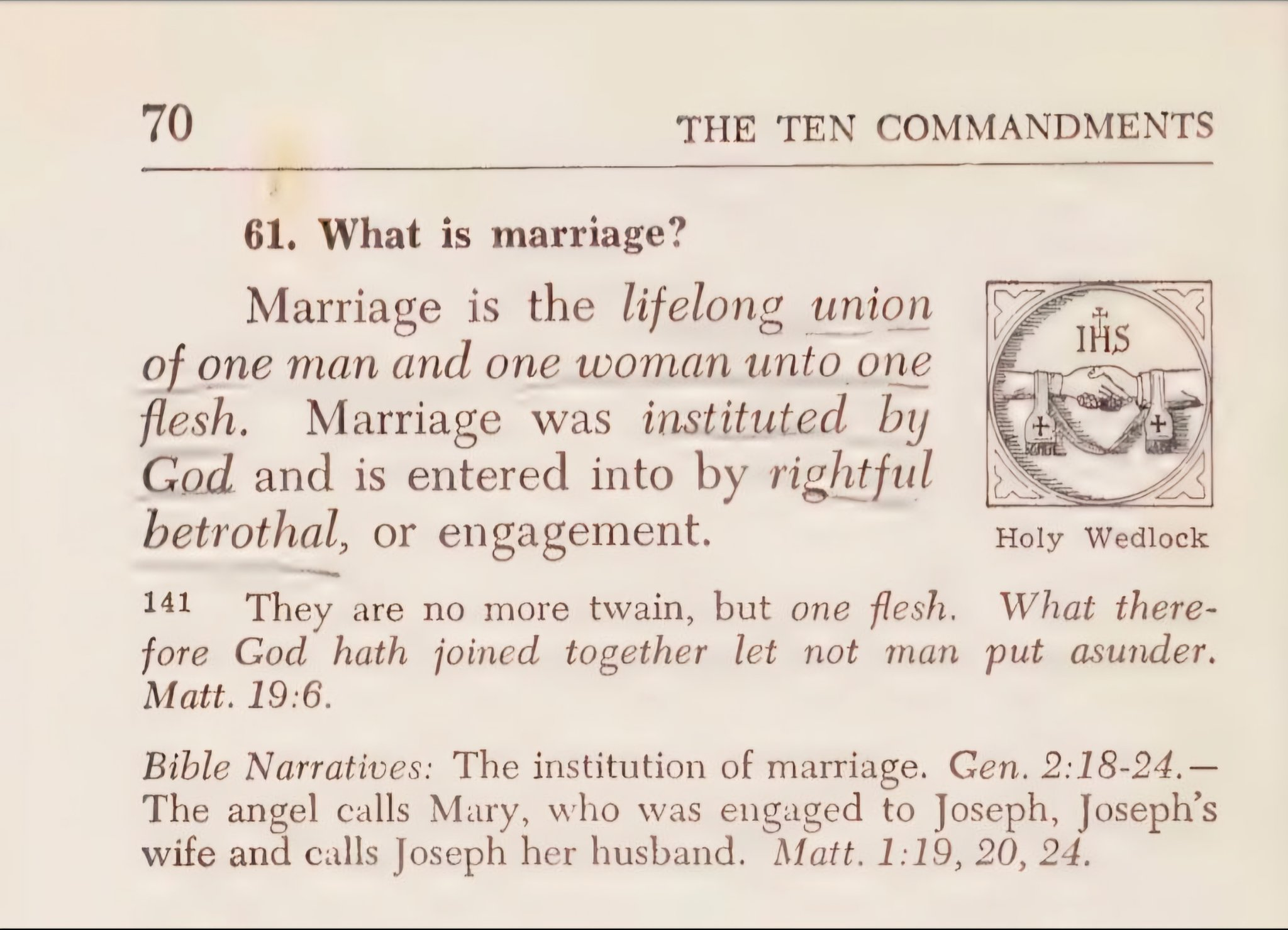
The Missouri Synod correctly taught this biblical truth until (wait for it) shortly after WW2. This is from the 1943 Catechism:

But I would not expect little boys like Deberny to know this, even after four years of clown school.
Rather fitting that the director of placement at Concordia Ft. Wayne, Todd Peperkorn, could not conceal his smug disdain on this point in a footnote to his STM thesis, which treats of Paul Edward Kretzmann and his exodus from Missouri in 1951:

“It is beyond the author”
Indeed.
That engagement “basically is” marriage can be misunderstood, however.
Consider:
The estate of marriage is entered into by engagement. But marriage itself is not consummated by engagement.
But look at the Scriptures that are cited by the 1943 Catechism. They did not fall idly from the Holy Ghost.
Marriage entails a promise of faithfulness by the two parties. The civil magistrate records this promise — this plighting of troth — as fact and upholds it by law (or rather he is supposed to). The Church blesses it with the Word of God and prayer. But marriage is made through a pact and promise. Let your “yes” be “yes.” “Will you marry me?” “Yes.” This is not a light thing. It cannot be simply dispensed with.
There is a beginning, a middle, and an end to things. Yes, marriage is essentially conjugal. If there is no solemnization or consummation, this alters the case to a large degree. But fornication, simply because it is a conjugal act, does not effect a marriage. Adultery does not effect an additional marriage.
For the sake of making arrangements for the solemnization and blessing of the marriage and for subsequent cohabitation — and because no public vows have yet been given (and the bride herself has not been given, by her father, though permission has been) — chastity ought to be maintained throughout the duration of an engagement. But by that token, the engagement should be brief. It should not drag on at the behest of worldly concerns. It is better to marry than to burn. Let each man have his own wife.
Get married. Keep it simple. If you want a party and it would take an obscene amount of time to plan (whatever), then have it after the marriage has been solemnized. The solemnization of marriage is rightly a civil act and can be witnessed and sealed by a JOP. Have your church ceremony and party later if you need to.
Marriage is a civil ordinance, not a sacrament. The papists are wrong.
Might seem like a niggling objection, but “civil marriage” is redundant. Marriage just is a civil ordinance, and it is the way you become “married in the sight of God,” because God’s minister in marriage is the State. When pastors solemnize marriages, they do so as agents of the State. This is good and godly. Your typical “church marriage” is in fact the civil rite of marriage taking place at church. If a Christian congregation celebrated Holy Communion at a conference room at the courthouse, it wouldn’t be “civil communion.”
That the State also does evil and abominable things does not alter the fact that the State is a divine institution and that the solemnization of marriages is one of the works that it has been given to do by God, and still does do.
It would be one thing if the State refused to solemnize marriages. In a sense it would in that instance cease to be the State, for reasons which aren’t too difficult to tease out logically. But, again, the fact that the State does evil works alongside its good works does not make the good works illegitimate.
To parse the matter more precisely:
A good man capable of providing for a wife betroths himself a woman (the root here is “troth,” from which we get “truth”; compare to “beget”) by supplicating and negotiating with her father, who is her head and her earthly lord. When this permission has been granted, he then makes arrangements with the magistrate to have this be-trothing registered with the State, both so that his investment would be protected and so that he himself would be bound to deal in good faith with another man (i.e., the father) whose property is about to be transferred to him. It is a public pledge and trust. The State witnesses and seals, i.e., solemnizes, the pact and transfer, and enforces the terms of the deal, for the good of all involved: the men, the woman, and the community.
All three divine estates are operative in marriage: a man takes a woman that a father deigns to give (Home); the judge solemnizes the union (State); the pastor blesses it (Church). A man “takes” the woman in every sense, but there is a godly order to be observed, and his carnal taking of her must respect that.
A fornicator shows himself to be untrustworthy. This isn’t an unforgivable sin, but it manifests certain character traits which are rightly sanctioned by everyone else with a stake in the bargain and for which they will rightly hold him in contempt and distrust. Socially speaking, it is a sin that is only forgiven if there is proper penance, enforced and performed. Fornicators were obviously not easily able to hide their crimes until contraception became easily accessible and expedient.
With that said, it is stupid for all parties to play with fire and drag their feet in executing the bargain, and it sets everyone and everything up for trucebreaking, strife, and distrust, and it creates scandal, large or small depending on who’s aware of it, but whether large or small, never good. (Note that in Deuteronomy fornicators are forced to behave, whereas adulterers are put to death. There’s some “general equity” there, call it what you will, for anyone with eyes to see.)
The manner in which a fatherless woman (actually or de facto) is taken and wed is attenuated somewhat. It’s important to speak to this, too, in this day and age when this is so often the kind of woman one encounters. I’ll have to do this later. There is actually much to be gleaned from the concept of the “war bride” in this matter (see Deuteronomy 21 and Judges 21).
But the most important thing to remember in all of this, the thing that is essential and without which everything else falls apart, is that women are property, and this is good and godly, actually. And when everything is working as it should, they love it. A good wife absolutely loves being her husband’s property, belonging to him, being his most cherished possession, unconcerned with her “rights” except when it comes his love.

A friend asks: “Should we start having local Christian magistrates solemnize marriages in the ceremony? By this, I meant that if you have a member of your congregation in a public office (i.e. the mayor or a county treasurer or something), would it be appropriate to give him some kind of ceremonial role in the wedding service at your church/outside the doors of your church?”
My response:
You could do this, but this would simply be a courtesy. It’s always tempting to LARP certain elements of the old Post-Reformation parochial system, but as with most systems, if only certain players are present, it looks less like the system one has in mind and more like a nostalgic living museum.
Again, in the modern American context, when pastors solemnize marriages, they do so as agents of the State. This is good and godly. Your typical “church marriage” is in fact the civil rite of marriage taking place at church. A pastor is wearing multiple hats in a wedding, usually two. Potentially all three, if it’s the wedding of one of his children.
What is dumb is that you will hear LCMS pastors today talking as though the legal aspect is an annoying technicality that they have to comply with, but what they do strictly as pastors is “the real deal.” A truly odd mashup of anabaptistic and sacerdotalistic thinking. And just plain ignorant.
Boom, the pope is the chief enthusiast. We’ve come full circle, and Luther is, once again, forever vindicated.
Seriously, though: both the pope and the anabaptists deny the legitimacy of the civil realm as an estate of God: the anabaptists think it’s evil per se, and the pope thinks it depends on him for its legitimacy.
More as it occurs to me, maybe.

Leave a Reply