This book, a new edition of the 16th century Altenburg Bible (Altenburger Bibelwerk), was one of the first projects the early Missouri Synod took on to promote biblical literacy. The current study Bible put out by CPH used this work as a source for many of its notes, but it’s interesting to see the things that were left out. The newest copies I’ve seen are dated 1898 and I suspect it was in print or at least still available from CPH in the early 20th century.
Below is a translation of the title page followed by the prayers, section summary, references, and notes for 1 Corinthians 11:2-16.
The New Testament of our Lord Jesus Christ, Germanized by Dr. Martin Luther with his forewords [for each book] and [his] marginal notes, as well as the Summaries of M. Veith Dietrich, with the forewords [to the chapters] and closing prayers of Franciscus Vierling.
Newly issued by the Central German Evangelical Lutheran Bible Society.
St. Louis, Mo.,
Printery of the Evangelical Lutheran Synod of Missouri, Ohio and other States,
1857.
[1. Corinthians]
Prayer. [for Chapter 10—Franciscus Vierling]
May our Lord Jesus Christ preserve for us His dear word pure and unfalsified, and His holy sacrament in proper use; may He preserve and strengthen us against the crafty devil, evil world, and our sinful flesh in true faith and godly life, until our end, Amen.
The 11th Chapter. Foreword. [Franciscus Vierling]
Beloved Christians! Man is the Lord Christ’s glory, and woman is man’s glory. Man is the glory of the Lord Christ: for, when he keeps himself righteously in his station, then he presents himself symbolically to other people in the manner Christ is disposed toward his congregation: namely that he governs, loves, and protects her; and that is then a great honor to Christ, when one feels in his members his nature and character as the head. [und das ist denn Christo eine große Ehre, wenn man an seinen Gliedern spüret, seine, als des Häupts, Natur und Eigenschaft.] The woman is the glory of man: for as she helps her husband maintain livelihood, and is pious, loyal, and obedient, then that is so much as to say in deed: See here, thus has God honored my husband, that he has given him me as a helper, and has equally along with this commanded to be submissive to him. Now because man is the glory of the Lord Christ, he covers not his head when he prays, in order to show that he is thus subject to Christ, that he likewise has lordship and power, love and fidelity [Herrschaft und Gewalt, Liebe und Treu] concerning another person, namely concerning his wife. But the woman shall cover her head, as an indication of her submission, and that she does not refuse to be faithful and obedient to her husband. The first part of the 11th chapter also teaches this.
Of some behaviors [Geberden/Gebärden] in prayer, and worthy use of the holy supper.
1. Cor. 11:2-16 notes:
V. 3. *the man *Eph. 5:23.
*God *1 Cor. 3:23.
V. 4. *prophesy *1 Cor. 12:10, 14:1.
V. 7. *God’s image *Gen. 1:27 f.
V. 9. *but the woman for the man *Gen. 2:18, 23.
V. 10. apower [Macht]) i.e. the veil or covering, whereby one may mark, that she is under the man’s power, Gen. 316. [Marginal note and reference from Martin Luther c.1534]
V. 11. *in the Lord *Gal. 3, 28.
V. 13. *Judge *Act. 4, 19.
V. 16. *But if any man *1 Tim. 6, 4.
Summary. [Veith Dietrich]
This is the sixth point, and concerns the order which should be maintained between man and woman, that a man should pray and prophesy with a bare head and short hair, and a woman with covered head, V. 4. St. Paul takes this ordinance not alone from the custom of the Jews, but from nature. For it is uncomely for a woman, says he, to be bareheaded and to have short hair. To have long hair and to be covered adorns her, and is comely. St. Paul adds yet another cause to this and says: To have something on the head is a sign that one is not free, but has a lord. Now because the man is the woman’s lord, the man should have nothing on his head; but the woman should have something on hers. But, says he, such distinction remains here below on earth; for God, a believing woman is worth just as much as a believing man. Likewise one should keep such ordinance for the sake of decency [Zucht]. For not only do the people take offence at indecency [Unzucht], but the angels are repulsed by it. V. 9.
Votum. [Franciscus Vierling]
May God the Lord, the author and preserver of the holy estate of marriage, govern all married people, that they would dispose themselves toward one another, that their deeds and life may please Him, that it may be a joy to the angels and that it may serve as a good example to others, and that they with their children might retain His temporal and eternal blessings, Amen.
You can acces the complete Altenburg Bible here. Volume 1
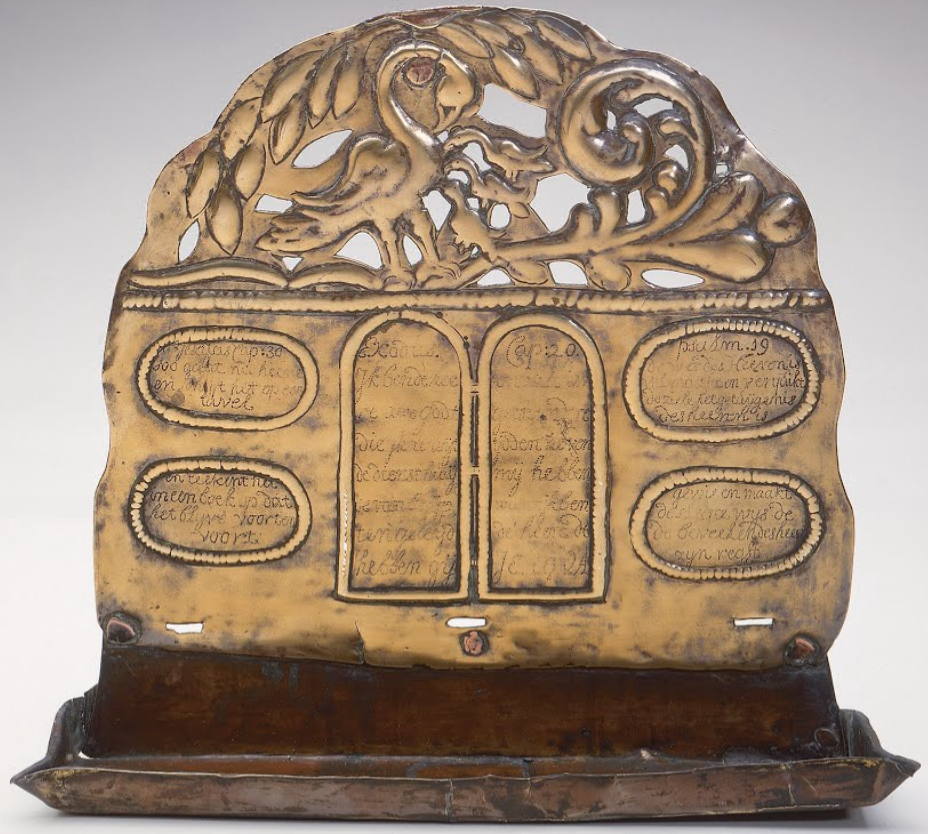
A Hannukah Lamp found in a Portuguese Synagogue, having been used by conversos; upon it are inscribed Dutch renderings of Bible passages.
As our brother dialogenes has shared for our edification we are well aware that, prior to the current Zeitgeist of modernity, the confessional, Lutheran attitude towards that people called modern Jewry was that they would necessarily have to cease to be so in order to receive the Gospel and its promises:
[I]f one dreams of a glorious future of the Jews as a special nation, perhaps with a return to Palestine [and] ruling over all nations, that already borders on chiliasm and becomes dangerous and objectionable. As a nation the Jews will remain Jews till Judgment Day, for 1 Thess. 2:16 says that God’s wrath has come upon them eis telos, till the end [of time]. And Christ says: “This generation [or “race”] will not pass away till it all comes to pass” (Matt. 24:34). As a nation there is no more hope for them; there is salvation for them only if they enter the open door of the Christian church. But then they also stop being Jews, and their glory will be no greater than that of other Christians. In the kingdom of God physical descent provides no privileges (Matt. 3:9).
C. F. W. Walther, Essays For The Church: C.F.W. Walther, Volume I, 1857-1879 (CPH, 1992), 188
At first pass, one might be stumped by the bracketed text Herr Walther inserted in his quotation of Matthew 24:34. Why did he seek to clarify the term ‘generation’ with ‘race’? Are we to be suspicious as to whether this is an antiquated use of the term as might commonly occur when one wrestles with Scripture in the KJV today? or, rather, have we been given a clearer term than the original ‘generation’ (which gains its provenance from the KJV, we ought mind!)? The following will be a close reading of the underlying Greek word from which we derive the translated word ‘generation,’ γενεᾱ́, in Matthew 24:34, as well as Matthew 23:34-36 and finally its implications alongside extended uses in terms like γενεαλογίαις in 1 Timothy 1:4 and Titus 3:9.
From the mouth of Christ: Matthew 23:34-36 & 24:34
If one were to start with simply Matthew 24:34, the confusion might be justified: surely, when Christ confesses that “This generation will not pass away till it all comes to pass,” He was merely intending to say that all people or some such generic group shall not pass away until His prophesying as He pronounces in Matthew 24 comes to pass, no? Truly, I say, no!
Matthew 24:32-35
When we read Christ proclaim that “this generation (γενεᾱ́) will not pass away,” what needs to be kept in mind is the clear, direct usage of the same word earlier in just the preceding chapter.
Matthew 23:34-36 sees Christ preaching the woes to the Scribes and Pharisees, the hypocrites. Following the last woe proclaimed to them, He goes on to conclude:
Matthew 23:34-36
It is thus we see that, indisputably, when Christ states that “all these things will come upon this generation (γενεᾱ́),” He is referring to the race of the Scribes and Pharisees, i.e the Judaizers who strove toward righteousness through fulfilling the Law alone, whom we today bear the burden of tolerating as Talmudic Jews. Read in conjunction with Matthew 24, it becomes clear that Our Lord warned us and preserved His warning to our posterity in Scripture that this burden is to be borne until His return.
Yet, the rebuttal may remain: how can one be so certain that γενεᾱ́ in Matthew 24:34 is used with the same referent as 23:36, i.e the Judaizing race upon which all the righteous blood shed on earth has fallen? To respond to this we profit by how Christ frames His statement in Matthew 24:34 by the parable of the fig tree. Just a few chapters earlier, in Matthew 21:18-19, we read:
Matthew 21:18-19
To unpack the import of this miracle in the terms given us by Christ in Matthew 24:32-35, let us begin with the parable itself: “when its branch has already become tender and puts forth its leaves, you know that summer is near.” By what sign does Christ inform us summer, i.e the time of the return of the Son of Man, occurs? When the fig tree’s branch has become tender and puts forth leaves. In what condition did Christ find the fig tree in Matthew 21:18-19? “He came to it and found nothing on it except leaves only”; that is, when it was summer, the allegorical referent for the return of the Son of Man, the fig tree was found bearing no fruit. Therefore the Son of Man rendered punishment upon the fig tree, cursing it that no longer it should bear fruit.
Still, one can ask, but how do we know that the referent for “generation” in Matthew 24:34 is that very same generation (or race, γενεᾱ́) which corresponds with that of the Jews mentioned in Matthew 23:36? For this we benefit from the frame of Matthew 21:18-19, for the evangelist, writing through the Holy Spirit, benefits us by just before in his account writing of the cleansing of the temple. That in Matthew 21:19-19 the Jews are the referent to the fig tree, to no longer bear fruit, becomes obvious in such close narrative circumlocution.
And yet, if one were to remain so stiff-necked as to still require further evidence, one can finally look at the signs of Christ’s return themselves, not only as found in Matthew but so also in the account given in Luke’s Gospel. In Matthew 24:15-16, He prophesies “Therefore when you see the abomination of desolation which was spoken of through Daniel the prophet, standing in the holy place (let the reader understand), then those who are in Judea must flee to the mountains”; Luke 21:20-21 records an extended quotation: “But when you see Jerusalem surrounded by armies, then know that its desolation is at hand. Then those who are in Judea must flee to the mountains, and those who are in the midst of the city must leave, and those who are in the countryside must not enter the city; because these are days of vengeance, so that all things which are written will be fulfilled.” As most prophecy, this portion of Scripture can be taken in two ways: having been fulfilled, and yet still to come. I therefore do not intend to claim that the Son of Man has already come by referring to these signs as having already been fulfilled, but I merely intend to acknowledge that these signs have indeed been fulfilled in the destruction of the Second Temple. When one reads, therefore, the warning Christ gives in Matthew 24:16 to “those who are in Judea [to] flee to the mountains” as referring to the destruction of the Second Temple, a reading strengthened by Luke 21:20-21, the referent of generation (or race, γενεᾱ́) in Matthew 24:34 as the Jews having punishment exacted upon them for only bearing leaves in summertime is made clear.
What, then, of Genealogies?
For those unaware, the word “genealogy” is derived from two words: γενεᾱ́ and λογος. If one were to translate literally, a genealogy is a race-story. It is in two places that we see warnings for the Church to avoid indulging in genealogies, and not just any kind, but rather Judaizing genealogies in particular.
Titus 3:1-111 Timothy 3-7
What is the common denominator in both of these passages other than the warning against genealogies? The presence of those who wished to be teachers of the Law, creating strife and conflicts about It. Such close circumlocution must again ping our respective antennae to get the message: The Judaizers who plagued the New Testament Church, continuing in the same tradition of works righteousness as the Scribes and Pharisees as Christ identified them in Matthew 23:34-36 (see above!), were so bold as to engage in genealogoi, race-stories, wherein one can only speculate upon the Judaizing proto-chiliasm already rearing its ugly, seemingly perennial head.
Letters from Opa: For Our Benefit Centuries Later
This allows us to finally return to and unpack how C.F.W. Walther was able to so piercingly preach on 1 Thessalonians 2:16, Matthew 24:34, and Matthew 3:9. Particularly poignant here is the utterly Scriptural way in which Saint Walther traffics in the term ‘Jew.’ He confesses in his citation of 1 Thessalonians that “As a nation the Jews will remain Jews till Judgement day”: that is to say, he who is to retain his racial identity as a Jew above all other things, which is itself the core tenet of Talmudic Judaism, will remain so until Judgement day, continually having God’s wrath come upon him until the end. Therefore, this race, the race which covets works righteousness and fulfillment of the Law above all else and drags others to Hell with its false gospel of circumcision et cetera, is to be suffered by Christ’s elect until the Return of Christ. Here, however, is where Walther’s preaching cuts deepest: “As a nation there is no more hope for them; there is salvation for them only if they enter the open door of the Christian church. But then they also stop being Jews, and their glory will be no greater than that of other Christians.” To fully understand, one must unpack the logic of these statements as such:
(Premise 1) A Jew is he who has no more hope and preaches only the Law
(Premise 2) A Jew who opens the door of the Christian church and receives the Gospel ceases to be a Jew
(Conclusion) The Jewish race will never receive the Gospel
Indeed, while some might theologize that the Jewish people might be converted, many fail to effectively iterate Premise 2 and therefore wind up with the same consequence as Christendom has already seen with its failed effort to convert Jews evident in the Judaizing conversos. A final, salutary word on this ultimate fact, that the Jewish race insofar as it self-conceives itself as such and remains therefore definitionally Jewish will never receive the Gospel can be provided by Saint Luther.
“…God has locked all not in wrath or lust but in unbelief, lest any who pretend that they are fulfilling the Law by chaste and gentle works (as are the political and human virtues) presume that they will be saved.”
As promised, sero maius quam numquam, here is the second weekly installment of Schmidt Posting, where we walk through potential questions and quandaries which arise in our reading and progressive publication of our Latin reader of Sebastian Schmidt’s Sacra Biblia et cetera…
Our first yet subtle point of note is the well placed semi-colons at the end of the first two clauses, “Et factum est in istis diebus; Venit Jesus de Nazareth Galilaeae; et baptizatus est a Joanne in Jordane.” One might appreciate the punchy, staccato, matter of fact cadence this lends the text. Schmidt added these semi-colons; they draw out the trifold structure of the 9th verse of Mark; it even possibly reflects a trinitarian confession as to how these events unfolded. (1) “And it happened in these days,” from the birds-eye, Father in Heaven view; (2) “Jesus of Nazareth went to Galilee,” the second person of the Trinity begins His earthly ministry; (3) “and he was baptized by John in the Jordan,” the Holy Ghost anointing God the Son as sent by His Father. You tell me, am I reaching here?
“dilectus” is an interesting choice for “well-beloved,” substituting the Koine ἀγαπητός in verse 11. Surely “amicus” would have sufficed, but for Schmidt it is possibly too plain. Yea, of course, God the Father loves His only Son as amicus would aptly convey, but dilectus comes with a bare, literal semantic core of selection in addition to overtones then used to mean loving or esteeming. By Schmidt’s use of “dilectus” for the descriptor by which God the Father makes His Son known, we not only understand that Jesus Christ is beloved by His Father, but that He is also prized and distinguished by His Father to be His selection above all others. Such a rich word as “dilectus” is not to be overlooked when closely reading the Latin translation of Greek Scripture. One might even dare to say that dilectus is more rich in meaning than ἀγαπητός!
“in quo complacuit perplacuit Mihi” is certainly one of the more confusing lines in Schmidt’s translation-commentary. To understand why, a quick review of the original Koine is required: we read for this clause ἐν ᾧ εὐδόκησα… that’s it. A three word phrase which becomes five in the Latin. Naturally, we see Schmidt employing the Latin ablative doing the work of what the Greek uses the dative for. Interestingly enough, here is an instance where we can potentially detect the MS tradition that Schmidt is using: by using in quo instead of, say, in te, Schmidt could likely be following the reading of the Textus Receptus which uses the relative pronoun ἐν ᾧ instead of other MSs that read ἐν σοὶ, utilizing the second person pronoun. Yet, MS traditions aside, the insertion of a second verb in such close semantic proximity begs exasperation. What information are we meant to get out of perplacuit that complacuit fails to convey? Moreover, why insert the first person pronoun Mihi in the text when it very well could have been elided, and even moreso why not include “me” in italics as an addition to the original Greek which does not need ἐμοὶ? Count me stumped, Schmidt!
The comment “ad aggrediendum tentationibus officium suum Messianum, superando et subjiciendo sibi diabolum” explains for us wherefore the Holy Ghost had to impel Christ to go out into the desert: for undertaking his Messianic duty by means of trials, [namely] his overcoming and subduing [of] the devil. The syntax here is perhaps being stretched. We begin with a prepositional gerund construction “for undertaking,” the direct object of which is “His Messianic duty,” and the ablative “trials” tells us the means by which this undertaking will occur. Yet then Schmidt shifts us into what I can only identify as a double dative construction, “for the overcoming and for the subjecting for himself the devil” when translated literally in its original, ‘wooden’ word order. In my translation of the entire editorial insertion above I supplied the word “namely” to convey, in my interpretation, that this double dative construction is meant to explain to us what these trials are. A major objection that could be made to this reading is the fact that I have identified the tentationibus as an ablative of manner whereas superando et subjiciendo sibi is a double dative construction. Therefore a plain case of appositional predication is lacking here, and I am forced to argue that there is semantic predication. It is well possible that what we have here is ‘bad’ Latin on Schmidt’s part, and superando et subjiciendo sibi would have been more properly written in the ablative superando et subjiciendo se or sese. As we see, the case being built here is dependent upon several plausabilities. How would you read the text?
“neque tamen modo ullo vel dubitando et sibi timendo peccavit, sed victor evasit” is another head scratcher. One might render it “And nevertheless by not any mean or by doubting and by fearing to himself did he sin, but he appeared the victor.” In doing so, sibi is read as dative while the gerunds this time are kept in the ablative in relation to modo ullo at the start of the clause. We therefore have just a dative of reference in the use of the third person reflexive pronoun. While not impossible, one wonders if this is how the previous sibi (see bullet point above) is meant to be taken. We would then wind up with a clearer case for apposition with superando et subjiciendo remaining in the ablative case to act as the predicates for tentationibus and sibi just clarifying that these actions are Christ’s.
Why “Unde” is not italicized beats me. Neither the TR or other MSs to my knowledge include a spatial adverb with the original Koine διηκόνουν such as ὅθεν.
“Unde Angeli boni Ipsi tanquam victori Messiae ab illis magis agnito etiam, submiserunt se ultro et ministrarunt Ipsi” is a classic instance of Schmidt taking the liberty of making what was a five word phrase καὶ οἱ ἄγγελοι διηκόνουν αὐτῷ and stretching it into eighteen in Latin. “Whence good angels, just as likewise the victor Messiah was recognized by the Magi, voluntarily placed themselves under and ministered to Him.” By keeping my translation as italicized as Schmidt’s Latin one might see how much information is added here.
Verso is a semantically dense verb that can have several connotations and so in the vocabulary gloss on page 2 I have included the options for (1) to turn, its literal meaning, (2) to be busy, which is a meaning more common in the passive voice use of the verb + the preposition “in” and so can be read as “because he was busied in/occupied with Judaea throughout everywhere,” or (3) to disturb. While (3) makes plenty of sense contextually in the sense that Our Lord was frequently having to stay on the move for various reasons, persecution or popularity alike, (2) has a stronger attestation for usage in terms of frequency. I should certainly not wish to restrain Schmidt to the purely Classical precedents of Latin expression, however, and therefore remain ambivalent as to whether he is making full use of semantic distinction by applying the verb in a less seen context with the (3) definition.
“poenitentiam agite” is a great phrase with much usage in several contexts in antiquity, yet here I have elected to gloss ago as ‘to exercise.’ Simply and colloquially, poenitentiam agite means ‘to repent.’ The emphasis I tried to make by having it translated as ‘to exercise repentance’ was several, both to stress the continual, present aspect of the imperative command and how it reflects proper theology of sanctification, while also reminding the translator that Christ speaks this command for His followers to do, and so we are therefore able to read this command as one which involves the believer as a vessel for the Holy Spirit to do this good work in him.
Saint Paul Preaching in Rome, an engraving by Philip Galle after Jan van der Straet, 1537/1612
As our brother Osmanthus has recently brought to our attention, the Missouri Synod Corporation’s antinomians have been up to their usual reverse-Pharisaical tricks. Their efforts this time are to conflate the subject from sodomites to all sinners in the Apostle’s clear preaching against sodomy in Romans 1:18-32. Upon reading Osmanthus’s effective refutation of their perversion of the distinction between Old Testament ceremonial and moral law, in light of the very words that the Apostle wrote for our benefit I found their lies an even more abhorrent mangling of Scripture. Therefore, the following is a close reading of Scripture in its original Koine Greek language with expository commentary for the layman without the knowledge of this dead tongue. It is my intention that you, too, may be shown the truth of Romans 1:18-32 as the Apostle preached it so as to know that, from God’s very own words to us, the sodomites are still ἄξιοι θανατοῦ (deserving of death), even now after the death of Christ, and yes, even now after the passing of the time in which the Levitical laws were given to be the governing rule of Israel.
It is in the spirit of charity and observance of the 8th commandment that I must witness to what the Revs. Wilken and Middendorf get right. Yes, it is true, sodomy is an abomination (in mine & Osmanthus’ words, never theirs, of course) because
“[sodomitic acts] are contrary to God’s design, specifically for sexual conduct, which leads to procreation… So male-female produces offspring. Genesis one, be fruitful, multiply, fill the Earth. Same-sex acts do not. So I think that’s kind of what’s driving this if you’re asking me a ‘why’ of God.”
Yes, this is true, and we have here the baseline gist as to why gay bad. Nevermind the incredible revelatory truths we are told elsewhere, such as when the Apostle preaches to the Athenians in the Areopagus “…for in Him we live and move and have our being [ἐσμέν], as also some of your own poets have said, ‘For we also are His offspring.’ [29] Therefore, since we are the offspring of God, we ought not to think that the Divine Nature [τὸ θεῖον εἶναι][1] is like gold or silver or stone, something shaped by art and man’s devising.” (Acts 17:28-29, NKJV); or such as when later in the Epistle to the Romans Paul states that God is He “who gives life to the dead and calls those things which do not exist as though they did. [καλοῦντος τὰ μὴ ὄντα ὡς ὄντα]” (Romans 4:17, NKJV) I will cede, for the purpose of this present writing, that the exact meaning of the latter half of this second quotation can vary from translation to translation,[2] and yet to fulfill the promise made at the outset I shall here explicate that the words ἐσμέν and ὄντα are each forms of the word εἰμί–yes, the very same εἰμί that Christ speaks in His proclamation to the Jews in John 8:58, “ἐγὼ εἰμί.”[3] Therefore, when Christ announces “I AM” and affirms the name by which He was known to His elect before His incarnation, this ought to prime us for further teachings given by the Holy Spirit such as Saint Paul’s above statements from Acts and Romans that in Him… we have our being, (ἐσμέν) that is, our being is only possible and derived from He Who is, and so Therefore… we are the offspring of God. It is in this way that I claim that the Apostle intends us to understand that He calls those things which do not exist as though they did (καλοῦντος τὰ μὴ ὄντα ὡς ὄντα). God is very life Himself, and this Divine Nature, τὸ θεῖον εἶναι,(εἶναι! There’s that εἰμί verb again in yet another form!) namely, our very living and moving and being is such a gift–all the more so in that the creative act of marriage aids in this.
Ahem–now that I have established the proper frame, we may return to the actual passage of consternation here at which Revs. Wilken and Middendorf completely whiff the proverbial bat. Romans 1:18-32 is in need of such a frame because it is, as Middendorf can correctly grope towards, a passage describing sodomitic acts and the failure of such to follow God’s command in Genesis to be fruitful and multiply. What is lacking from such a baseline reading was the very essential[4] discussion of other passages of Scripture which illuminate the very power of God in His ability to still in this world participate in and shape our creation, and our living, and our moving, and our being. This, as we shall see below, will play a major point in our close reading of Romans 1:18-32.
We shall therefore commence our reading of Romans 1:18-32 in the order it was written for the sake of clarity. At the outset, we are told “For the wrath of God is revealed from heaven against all ungodliness and unrighteousness of men, who suppress the truth in unrighteousness, [ἀνθρώπων τῶν τὴν ἀλήθειαν ἐν ἀδικίᾳ κατεχόντων].” (Romans 1:18) Notice the qualifier here: the Apostle is not stating that it is against simply all men, i.e all of mankind, whom the wrath of God is revealed, but specifically men who suppress (ἀνθρώπωντῶν… κατεχόντων[5], a participle modifying a relative pronoun which heads off the relative clause here) the truth in unrighteousness. Immediately, then, we ought to be able to shut the Book, declare the case closed, and deign the repentance of Revs. Wilken and Middendorf a necessary and swift matter. But for those stiff-necked ones out there who require more convincing, let us continue.
In the following verse, the Holy Spirit expounds for us who He means by these men who suppress the truth in unrighteousness: “because [διότι] what may be known of God [τὸ γνωστὸν τοῦ θεοῦ] is manifest in them, for God has shown it [italics as original] to them.” (Romans 1:19, NKJV) It is this διότι (an explanatory conjunction) clause that shows us what is meant in the preceding verse by how these men are suppressing the truth in unrighteousness (v.18, ἀνθρώπωντῶν… κατεχόντων). What is this thing known of God, τὸ γνωστὸν τοῦ θεοῦ? As Paul continues, “For since the creation of the world His invisible attributes [italics as original] are clearly seen, being understood by the things that are made [τοῖς ποιήμασιν νοούμενα], even [it. as orig.] His eternal power and Godhead, so that they are without excuse.” (Romans 1:20, NKJV) There is a lot in this verse, but to succinctly rephrase: what may be known of God (τὸ γνωστὸν τοῦ θεοῦ) is His invisible attributes, which are His eternal power and Godhead, which are understood by the things that are made. Particularly germane for our purposes here is τοῖς ποιήμασιν νοούμενα, the things which are made by which one can come to a natural revelation of God’s invisible attributes, i.e. His eternal power and Godhead. Indeed it is with this very fact, that God is the Creator of the things that are made, τοῖς ποιήμασιν, that the Apostle begins his preaching to the Athenians in the Areopagus in Acts 17:24 “God, who made [ὁ θεὸς ὁ ποιήσας] the world and everything in it…”: the phrase ὁ ποιήσας uses the very same verb from which τοῖς ποιήμασιν is derived from, ποιέω.[6] This beginning of the Apostle’s sermon to the Athenians in Acts 17 is so crucial for us to incorporate into our understanding of Romans 1:18-32, for it is from this very plain fact of natural revelation, that God is He Who made the world and everything in it, that Saint Paul then goes on to affirm that in Him we have our being, ἐσμέν (Acts 17:28, see above): indeed, as a good teacher may, the Apostle proceeds from the visible to the invisible, the tangible to the theoretical, the empirical to the theological, in his expository preaching. In summary, then, Romans 1:19-20 informs us what is known of God that is ultimately suppressed in unrighteousness by the men against whom God’s wrath is revealed.
The following verses, 21-3, are then all led off with another explanatory conjunction, γὰρ, which is commonly translated with the English “For,” and it is this word that signals to the Apostle’s audience that he is providing a summary conclusion for the preceding points made. For, we are told,[7] these men became futile in their thoughts with darkened hearts, becoming fools in spite of their claimed wisdom, “…and changed the glory of the incorruptible God into an image made like corruptible man—and birds and four-footed animals and creeping things.”[8] (Romans 1:23, NKJV) In the following verse 24 we read “Therefore [Διὸ] God gave them up to uncleanness, in the lusts of their hearts, to dishonor their bodies among themselves.” (NKJV) Διὸ, another explanatory conjunction, (closely related to the above seen διότι, verse 19) serves to explain the causality between what precedes the clause which it begins. That is to say, the worship of the creature rather than the Creator, as the Apostle himself goes on to explain in verse 25,[9] is inextricably bound up in the rejection of the knowledge – the truth – of God the Maker, and the gift of life He gives and breathes[10] into all made things–the rejection of natural revelation. This worship of creature rather than Creator is commensurate with and known by the evil fruit of sexual immorality and the dishonoring of bodies among a people. It is once they “…exchanged the truth of God for the lie, and worshiped and served the creature rather than the Creator” (Romans 1:25, NKJV) that these men suppressed the truth in unrighteousness: the exchanging of God’s truth for a lie is the very suppression of truth in unrighteousness mentioned at the outset (Romans 1:18), and the lie here told is that men and women can dishonor each others’ bodies in their worship of themselves rather than Him.
At this junction it should be abundantly clear that here in Paul’s preaching we are given a dense, multi-layered argument of explanation upon explanation as to who these men who suppress the truth in unrighteousness are, how they suppress the truth, and what action (sodomy) is commensurate with this suppression.[11] And yet, if it were not clear enough for those among us such as Revs. Wilken and Middendorf, the Apostle goes into detail in verses 26-7. It is particularly noteworthy, as Kretzmann observes, that here “The heinousness of their transgression is marked by the words referring to the sex of the transgressors,” (Pop. Comm. NT II, emphasis mine) that is, αἵ θήλειαι for “females” rather than the expected γυναῖκες for “women,”[12] and likewise οἵ ἄρσενες for “males” rather than ἄνδρες, “men.” Then, in verse 28, we read “And even as they did not like to retain God in their knowledge [τὸν θεὸν ἔχειν ἐν ἐπιγνώσει], God gave them [αὐτοὺς] over to a debased mind, to do those things which are not fitting [τὰ μὴ καθήκοντα].” (NKJV) In the bolded phrase, we are given the verb ἔχειν, to retain or hold, which is itself the root verb of the compound verb form used earlier in v.18 for “suppress,” κατεχόντων; also found here is the compound noun ἐπιγνώσει, closely tied to the previously discussed thing known of God, τὸ γνωστὸν τοῦ θεοῦ (v. 19). For the Apostle Paul’s intended audience of live speakers of Koine Greek, this creative rephrasing of words and themes stated earlier would have perked their ears to remind them that through all that has been discussed, he is still discussing those very same men against whom the wrath of God is revealed, who suppress the truth in unrighteousness by their sodomitic worship of their own creaturely bodies in spite of the natural revelation of God given to them in all made things, including those most precious made things of all in which we participate in God’s gift of creation: babies, the result of marriage as God intended. Yea, rather, God gave them over to a debased mind, to do τὰ μὴ καθήκοντα, those things which are not proper, i.e the sodomy as described in 26-7 which finds the sexes improperly burning in unnatural passion with themselves.
The attentive reader will have noticed that of the last quotation (v.28) there was a bolded word of Greek that I have not yet expounded upon. This is αὐτοὺς, a third person plural personal pronoun which is translated “them.” This word has a case ending, -οὺς, which is in the accusative case. The accusative case is most commonly used to denote a direct object which receives the action of a verb performed by the subject of a clause. Therefore, we read, “God [subject] gave [verb] them [direct object] over to a debased mind,”– yet it does not end there! The following list of descriptors found in verses 29-31 are so crucial to understand in the context of this grammatical information, for these descriptors themselves all coincide with and are in apposition to the accusative case αὐτοὺς. Apposition is a syntactic phenomenon where a noun in one grammatical case is then further described with another noun (or, as in our present case, nouns) in the same grammatical case. The very fact that these descriptors are in apposition to αὐτοὺς is the surefire proof for certainty that the Apostle, in Romans 1:18-32, is only ever discussing sodomites and the results of a sodomitic society, and never just mere sinners in need of the body and blood of Our Lord as our antinomian would-be teachers Revs. Wilken and Middendorf try to convince us of otherwise. For the sake of thoroughness, I here reproduce v.29-31 with the accusative plural case endings bolded as visual aid to demonstrate the replete apposition to αὐτοὺς throughout this passage: (nota bene, a number of these apposite accusative plural nouns are in the feminine gender, in contrast to the masculine-gendered αὐτοὺς, and so therefore are given the –ας accusative plural case ending, yet are nonetheless in just as much appositive position relative to αὐτοὺς)
So then we have finally arrived to v.32, where the Apostle provides us with his concluding summary of Romans 1.18-32: “who [οἵτινες], knowing [ἐπιγνόντες]the righteous judgment [τὸ δικαίωμα] of God, that those who practice such things are deserving of death [ὅτι οἱ τὰ τοιαῦτα πράσσοντες ἄξιοι θανάτου εἰσίν], not only do the same but also approve of those who practice them.” (NKJV) The referent of οἵτινες, the subject “they who” of this verse, is the preceding αὐτοὺς of v.28 who are described with appositional nouns from v.29-31. Before we are finally given the main clause of this sentence, that they “… not only do the same but also approve of those who practice them,” the Apostle interrupts the main clause with a participial phrase, that is, a clause led with the verbal adjective (known as a participle) ἐπιγνόντες. With ἐπιγνόντες, we should again be reminded of the preceding γνο- stem words we have already encountered, such as τὸ γνωστὸν τοῦ θεοῦ (v.19) and ἐπιγνώσει (v.28); Paul is summarizing the same point he has been making throughout here, that by natural revelation even the heathen is responsible for knowing basic facts toward respecting the gift of life and creation endowed by the Unknown Creator God. Furthermore, before delivering the main statement that they “… not only do the same but also approve of those who practice them,” we get one final interruption of this main clause: a ὅτι clause which itself operates as one large phrase in apposition to the direct object of the verb ἐπιγνόντες “knowing,” the accusative case noun τὸ δικαίωμα. Yes, Paul juxtaposes τὸ δικαίωμα with the entire appositional phrase ὅτι οἱ τὰ τοιαῦτα πράσσοντες ἄξιοι θανάτου εἰσίν, and a way in which one may translate this so as to emphasize this apposition would be so:
“who, knowing the righteous judgment of God, namely the fact that those who practice such things are deserving of death…”
God’s righteous judgment, his τὸ δικαίωμα, is that those who practice such things (τὰ τοιαῦτα, a demonstrative pronoun whose referent is the previously mentioned “things which are not fitting,” τὰ μὴ καθήκοντα, v. 28) are worthy of death. Saint Paul’s final words on this matter, that “they… not only do the same but also approve of those who practice them,” should then be conclusively shown to be referring to the sodomites whose suppression of the truth in unrighteousness causes the wrath of God to be revealed against them.
[1] While the Divine Nature is a fine rendering, one may also translate this phrase as the Divine Being, with emphasis placed on the nominal-verbal expression Being, Divine being an adjectival modifier that particularly stresses the fact that it is, in fact, God Whom the Apostle is speaking of.
[2] For example, the Legacy Standard Bible, following the NASB, renders the bolded phrase “calls into being that which does not exist,” which more clearly shows the relevance to Acts 17:28-9–God not only raises the dead from the dead to life, but gives life to those who have not known death as of yet and simply do not exist, τὰ μὴ ὄντα.
[3] For those presently unaware for the full import of this proclamation not only as a beautiful affirmation of the Trinity from the mouth of Our Lord in His ministry but furthermore as the very name of God given to His people before the incarnation of the Son, read this thread from Woe explaining as much while refuting the blasphemous false name Yahweh.
[5]Nota bene, our participial verb here is the very same from which we derive the English “catechize”; another way one may render Romans 1:18 would be “For the wrath… of men who catechize truth in unrighteousness.” Of course, the sarcasm of the original Greek expression would here be lost on most people upon first hearing, and so the negative translation of κατεχόντων as “suppress” makes better sense for a general audience.
[6]Nota bene, this is also the word from which we derive the English “poet.” It is therefore the opinion of the author that God is truly the ultimate poet.
[7] The following is a paraphrase of v.21-3, all of which is found within the single γὰρ clause.
[8] Kretzmann makes a salutary summary of this phenomenon in practice: “Such an idol was to be a representation of the Godhead, Is. 44, 12-19; Ps. 115, 4-8; 135, 15-18. History gives many examples; for the idols of the Greeks and Romans, also of the ancient Germans were statues in the form of men; the eagle of Jupiter and the ibis and hawk of the Egyptians were sacred birds; the white ox of the Egyptians, the golden calf of the Israelites, goats and monkeys in other nations, were four-footed idols; and among the reptiles were the crocodile and various serpents, all of which were given divine honor. Such were and are the manifestations of the false religions of men when they turn from the true God. In the foolishness of their unnatural idolatry they pervert the original order of God.” Popular Commentary, New Testament Vol. II
[9] “who exchanged the truth of God for the lie, and worshiped and served the creature rather than the Creator, who is blessed forever. Amen.” (NKJV) οἵτινες μετήλλαξαν τὴν ἀλήθειαν τοῦ θεοῦ ἐν τῷ ψεύδει, καὶ ἐσεβάσθησαν καὶ ἐλάτρευσαν τῇ κτίσει παρὰ τὸν κτίσαντα, ὅς ἐστιν εὐλογητὸς εἰς τοὺς αἰῶνας: ἀμήν.
[10] “Nor is He worshiped with men’s hands, as though He needed anything, since He gives to all life, breath, and all things.” (Acts 17:25, NKJV)
[11] At this point also a summarizing motto may be penned: Sodomy is the heathen’s catechesis of unrighteous truth, i.e falsehood.
[12] Kretzmann takes this point even further, stating that due to their gross unchastity “they can no longer be designated as women.”
JERUSALEM (JTA) — Israeli Sephardic leader Rabbi Ovadia Yosef in his weekly Saturday night sermon said that non-Jews exist to serve Jews.
“Goyim were born only to serve us. Without that, they have no place in the world; only to serve the People of Israel,” he said during a public discussion of what kind of work non-Jews are allowed to perform on Shabbat.
“Why are gentiles needed? They will work, they will plow, they will reap. We will sit like an effendi and eat,” he said to some laughter.
Yosef, the spiritual leader of the Shas Party and the former chief Sephardi rabbi of Israel, also said that the lives of non-Jews are protected in order to prevent financial loss to Jews.
“With gentiles, it will be like any person: They need to die, but God will give them longevity. Why? Imagine that one’s donkey would die, they’d lose their money. This is his servant. That’s why he gets a long life, to work well for this Jew,” said the rabbi, who recently turned 90.
But does this square with what the Talmud teaches? Yes, it does. But just how far does this go? Surely this is just theoretical.
You might be surprised. Counterpunch, August 2009: “Israel’s very first, historic heart transplant used a heart removed from a living patient without consent or consulting his family.”
Many Christians labor under the delusion that the Talmud is just annotations on the books of Moses. I remember a neo-evangelical friend telling me years ago that his men’s group was reading Everyman’s Talmud in order to better understand the Old Testament (best construction). But the Talmud has virtually nothing to do with the Torah (i.e. the Pentateuch); it has nothing to do with the Scripture and faith of Old Testament Israelite believers.
It’s really a shame—I mean it: a real shame—that the LSB Altar Book omits the prayer for the Jews from the Bidding Prayer. In fact the LSB contains no prayers specifically for the Jews. Not a single one.
Rewind to the the 1941 TLH. This is what you would have prayed on Good Friday:
There is absolutely no good reason for the removal of this prayer. Sadly, it appears that the editors of the LSB cared more about currying favor with the world than they did about the eternal salvation of this miserable, cursed people.
Don’t be offended. “Miserable” means “pitiable.” Cursed means…well, cursed! But it doesn’t mean that a given Jewish person cannot be saved. Consider what the father of the LCMS, C. F. W. Walther, had to say about the earthly fate of the Jews:
[I]f one dreams of a glorious future of the Jews as a special nation, perhaps with a return to Palestine [and] ruling over all nations, that already borders on chiliasm and becomes dangerous and objectionable. As a nation the Jews will remain Jews till Judgment Day, for 1 Thess. 2:16 says that God’s wrath has come upon them eis telos, till the end [of time]. And Christ says: “This generation [or “race”] will not pass away till it all comes to pass” (Matt. 24:34). As a nation there is no more hope for them; there is salvation for them only if they enter the open door of the Christian church. But then they also stop being Jews, and their glory will be no greater than that of other Christians. In the kingdom of God physical descent provides no privileges (Matt. 3:9).
C. F. W. Walther, Essays For The Church: C.F.W. Walther, Volume I, 1857-1879 (CPH, 1992), 188
I can’t wait to meet Walther in heaven. Stop being a Jew! What a wonderful evangelical admonition.
Also, stop coveting my kidneys.
Thanks for reading Old Lutherans. Want to help fund Old Lutherans Book Concern, which will be the best Lutheran publishing house ever? You can support us with a secure donation via TipTopJar. Thank you and God bless!
Luther has the following to say about Sarah’s modesty in his Commentary on Genesis.
[Genesis 18:]9. They said to him: Where is Sarah your wife? And he said: She is in the tent.
After Moses has finished the description of the feast, than which the sun has never seen anything more sumptuous–for the table companions are God Himself with His angels–he appends the conversation or discourse that took place at the feast. He does so in order that this description may lack nothing and in order that it may become known to the entire world that this feast was not like one partaken of by monks upon whom silence is imposed.
Nothing is more irksome and more senseless than a feast at which silence reigns; for discourses are the real condiments of foods if as Paul says (Col. 4:6), they are seasoned with salt. For word is whetted by word; and not only is the belly fed with food, but the heart is also fed with doctrine, since godly conversations refresh the hearts, arouse faith, kindle love, and instruct in many ways. Away, therefore, with the silly and silent monks who suppose that worship and saintliness consist in silence!
Sarah seems to have had some doubt concerning the promise that was given above in chapter seventeen, namely, that she herself would be the mother of the Promised Seed. Therefore the Lord calls her in order that He, in person, may strengthen her in faith. For it is the perpetual work of God to instruct, enlighten, and strengthen weak hearts through His Spirit, not to condemn them or to cast them aside because of their weakness. Accordingly, God asks where Sarah is, and Abraham gives the short answer: “She is in the tent.” An indifferent heart reads this and pays no attention to it; but by means of these few words the Holy Spirit wanted to set before all women an example to imitate, so that, just as Abraham is presented everywhere as a rule, so to speak, of faith and of good works, so Sarah might give instruction about the highest virtues of a saintly and praiseworthy housewife.
For the weakness or inborn levity of this sex is well known. Women are commonly in the habit of gadding and inquiring about everything with disgraceful curiosity. Or they stand idle at the door and look either for something to see or for fresh rumors. For this reason Proverbs (7:11) states about wicked women that they have “feet that do not tarry.” This is due to their curiosity to see and hear things which nevertheless do not concern them at all. Therefore levity in morals as well as garrulousness and curiosity are censured in this sex.
In the case of Sarah, however, the opposite virtues are given praise in this passage, and this by means of Abraham’s brief statement that she is in the tent. If she had been inquisitive after the fashion of other women, she would have rushed to the door, would have seen the guests, would have listened to their conversations, would have interrupted them, etc.; but she does none of these things. She busies herself with her own tasks, which the household demands, and is unconcerned about the other things.
Thus Paul prescribes (Titus 2:5) that a woman should be οικουρος, a domestic, so to speak, one who stays in her own home and looks after her own affairs. The heathen depicted Venus as standing on a tortoise; for just as a tortoise carries its house with it wherever it creeps, so a wife should be concerned with the affairs of her own home and not go too far away from it. This is demanded not only by the tasks peculiar to this sex but also by the requirements of the children and of the domestics, who need careful supervision.
Hence it is great praise for Sarah that on this occasion she tends to her own affairs and does not offend by being curious but, like a tortoise, remains in her little shell and does not take the time required to get a brief look at the guests she has and at what kind of guests they are.
This modesty or restraint surpasses all the acts of worship and all the works of all the nuns, and these words, “Sarah is in the tent,” should be inscribed on the veils of all matrons; for in this way they would be reminded of their duty to beware of inquisitiveness, gadding, and garrulousness, and to accustom themselves to managing the household with care. With this brief statement Moses has described all the virtues of a good housewife, one who gladly stays at home and takes care of the management of the household, in order that the things which her husband provides may be properly allotted and administered.
Why should anyone be frightened by a hat?
Our opponents, the papists, boast of their great and wonderful works; but they laugh at us when we bestow praise on such activities in the household and in civil life, for they regard these as insignificant and ordinary. But to fast on certain days, to dress in a particular color, to abstain from eating meat, to undertake pilgrimages to distant places, etc.–these things they extol with full cheeks, and for them they promise heaven and supreme blessedness.
But even though the papists are undeserving of our replies to their nonsense and their absurdities, it is useful for us to understand and appraise those domestic and civil works properly. Hospitality is a domestic and civic work; but it must certainly be preferred to all the works of the hermits, yes, even to the fasting of St. John the Baptist, even though he undertook this as a result of God’s directive or order.
And this modesty or restraint of Sarah is a work that has to do with the home. What virgin or widow could be compared to her? But this union of male and female bothers the little saints so much that they not only do not believe that this kind of life is saintly but even think that it stands in the way of saintly religious exercises. It was for this reason that the pope imposed celibacy on his people. Furthermore, this kind of life is too ordinary and common among all people; therefore it is devoid of all show and is especially looked down upon by those who want to be the saintliest.
Yet their eyes should have been fixed on Him who instituted the state and the household. If the popes did this, they surely would have a loftier opinion about both functions. “God created them male and female,” and “He blessed them” (Gen. 1:27). You are not going to suppose, are you, that these are insignificant matters?
Therefore let us maintain that those works in the household and in the state which the papists despise as ordinary and worthless are most excellent and also most pleasing to God. For, to mention hospitality, what work is there, I ask, among all acts of worship of the popes that can be compared to it?
It seems to be something insignificant to give a cup of cold water to a thirsty person. But listen to Christ. What grand praise He bestows on this, and what rewards He promises (Matt. 10:42)!
But we shall reach the same conclusion about the other works in the household. If faithful parents bring up their children properly and accustom them to a godly conduct, and if through strict discipline they keep the domestics at their duty, these are ordinary works, I admit, without any outward show and without any reputation or saintliness; but the verdict should have been reached on the basis of the Word, not on the basis of reason.
It would not have been difficult for Abraham to fast on certain days, something which he no doubt did; but Moses records nothing about his fasting, for he wanted to record his true virtues, not such works as hypocrites can and usually do imitate.
But the papists do not deserve a more extensive answer from us. Therefore let us give thanks to God that we, having been taught by the Word, know what are truly good works, namely, to obey our superiors, to honor our parents, to manage our domestics, and to render the ordinary services which the need of the brethren demands, etc. For we see that these works were so highly esteemed by Moses, by the prophets, by Christ Himself, and by the apostles that they were not ashamed to preach about them often and to prescribe them.
They saw what snares reason ties for itself. Entangled in these snares, it cannot arrive at a knowledge of the true forms of worship; for, because of their outward appearance, the works or the traditions of men are always wont to lead men away from true works and exercises of godliness.
Draw me a sheep.
Look at a monk. He shuns obedience to all authorities, even to parents. He does not bring up children, does not work, and is beneficent to no one; but he is filled with hatred and ill will toward his own people and grows fat on the sweat of the poor. Yet he takes pride in his vow of poverty.
But Abraham, the godly head of the household, is truly poor. For he obeys when God calls him into exile. Nowhere does he have a fixed place. Although God blessed him, he nevertheless looks among the unbelieving heathen for attacks, violence, and rapine at any hour. Sarah, his companion, willingly follows her husband into exile, looks after the domestics and the home, is obliging toward the neighbors, and is obedient to her husband.
These are the highest virtues. There is nothing like them in all human traditions. Learn, therefore, to regard them highly and, since they are ordinances of God, to prefer them to human traditions, however grand and showy. For these corrupt faith and the ordinances of God. Like innkeepers, they mix wine with water.
Therefore let us take note of this example. Sarah is praised for diligently performing her duty in her home. For if a mistress of the household desires to please and serve God, she should not, as is the custom in the papacy, run here and there to the churches, fast, count prayers, etc. No, she should take care of the domestics, bring up and teach the children, do her work in the kitchen, and the like. If she does these things in faith in the Son of God and hopes to please God for Christ’s sake, she is saintly and blessed.
“What therefore God has joined together,” says Christ (Matt. 19:6), “let no man put asunder.” Therefore separation or celibacy, such as exists in the papacy, is not of God. On the contrary, the services which that divine union demands are holy and truly good works, no matter how insignificant and ordinary they are considered so far as outward appearance is concerned.
Where there is true obedience toward God in faith, there whatever the calling demands is holy and a worship pleasing to God. But if some prefer either widowhood or virginity and are able to forego marriage without sinning, let them do it, yet in such a way that they do not for this reason condemn domestic economy and the state. For these are kinds of life that have been ordained and instituted by God.
Let monks and nuns glory in their works. For a husband let it be enough if he rules his house properly; for a wife let it be enough if she takes care of the children by feeding them, washing them, and putting them to sleep, if she is obedient to her husband and diligently takes care of the household affairs. These works far surpass those of all nuns. Nevertheless, nuns are exceedingly proud of what they do.
For from human traditions this bane results, that hearts become complacent and take their sanctity for granted. But a godly mistress of the household is not proud; for she is vexed and humbled in various ways when countless annoyances are put in her way by the domestics, by her husband, by the children, by the neighbors, etc. Thus opportunities are nowhere lacking for the practice both of faith and of prayer. But let this be enough about the example of Sarah, and let us go on to what follows.
Grown-ups never understand anything by themselves and it is rather tedious for children to have to explain things to them time and again.