In the doctrine of the antinomians there was this statement: “If somebody were an adulterer, provided only that he believed, he would have a gracious God.” But what kind of church will it be, I ask, in which so awful a statement is heard? A distinction is necessary, and it should be taught that adulterers or sinners are of two kinds: some who become aware of their adultery or sin to such an extent that they shudder with their whole heart and begin to repent earnestly, and not only feel sorry for what they have done but also sincerely desire and endeavor never again to commit anything like it. These are not smug in their sin; they are thoroughly frightened, and they dread God’s wrath. If they take hold of the Word of the Gospel and trust in the mercy of God for Christ’s sake, they are saved and have forgiveness of sins through faith in Christ.
Even though the others, whether adulterers or sinners, are unable to excuse their sin, they nevertheless feel no sorrow about it. On the contrary, they are glad that they have achieved their desire. They look for opportunities to commit sins and smugly indulge in them. Because these people do not have the Holy Spirit, they cannot believe; and he who preaches to such people about faith deceives them.
This sickness demands a different medicine, namely, that you say with Paul: “God will judge the adulterous” (Heb. 13:4); “They will not see the kingdom of God” (cf. 1 Cor. 6:9–10); and “Without chastity no one can please God” (Rom. 8:8). Hence they are defiled and under the wrath of God.
Such sledges are needed to crush these rocks. Abraham does not indulge in sins, but long before this he was truly humbled in spirit. Therefore the Lord comforts him, for He takes pleasure in a smoking flax. Therefore He tends it carefully, in order that it may burst into flames.
But the people of Sodom are like crags and very hard rocks. In their case brimstone, lightning from heaven, and thunder are needed. Those foolish and lying prophets who maintain that the Law should not be taught in the church and that, in general, no one should be rebuked too severely or burdened in his conscience are not aware of this.
If this is true, however, why does the Lord want the example of Sodom preserved in His very church and taught by Abraham? Moreover, in view of the fact that He adds “in order that they may fear the Lord,” do not those who want only the promises to be taught exclude the doctrine of the fear of the Lord entirely from the church? Hence the fanatical spirits who confound the entire system of heavenly doctrine in a pernicious manner must be shunned.
But this doctrine of the Law is profitable not only for teaching the fear of the Lord; but, as the Lord adds, it also produces this fruit, that those who are frightened in this way by the judgment and wrath of God practice justice and discernment.
If you divide all Scripture, it contains two topics: promises and threats or benefits and punishments. And, as Bernard states, hearts that are neither softened by kindnesses nor improved by blows are properly called hard. Thus the works of God are also twofold. Works of mercy are those which Paul mentions in Acts 14:17: “He gives rain from heaven, fruitfulness,” etc. He does works of wrath when He also sends a plague, war, and famine in order to frighten and humble the obdurate. Thus in Christ salvation is promised to all who are baptized and believe. On the other hand, judgment and eternal death are threatened to those who do not believe in Christ.
In these circumstances how can or should the preaching of the Law be excluded from the church? Do you not at the same time exclude the fear of God and the majority of the works of God? God certainly does not perform these in order that they may remain hidden, but He wants us to see them and in this way to be led to fear Him. If there were no perils of fire and water, no sudden death and similar evils, I myself would surely not say anything about them and would speak only of God’s kindness and of His benefits. But experience teaches otherwise. Hence to declare that the Law should not be taught in the church is characteristic of men who do not know Christ and are blinded by their pride and wickedness. Previously Moses has set forth many examples of God’s graciousness: when God promised Abraham the Blessed Seed, when He honored him with an outstanding victory, and when He came to him as a guest and ate bread at his home. These events are related by Moses, and nothing else is added to them; but in this passage there is added the command to preach: “He will relate them,” says God, “to his children”; that is: “I want the destruction of Sodom by fire preached in the church.” What is the reason for this? Because the church is never altogether pure; the greater part is always wicked, as the parable of the seed teaches (Matt. 13:3 ff). In fact, the true saints themselves, who are righteous through faith in the Son of God, have the sinful flesh, which must be mortified by constant chastening, as Paul says (1 Cor. 11:31): “If we would judge ourselves, we would not be chastened by the Lord.” Therefore keep this passage in mind. It is adequate by itself to refute the antinomians.
— Bl. Dr. Martin Luther, Lectures on Genesis (18:19), LW 3:224-225
In 1540, Luther wrote 91 sentences on the often misinterpreted saying of Christ: “Sell all that thou hast, and distribute unto the poor, and thou shalt have treasure in heaven.” Luke 18:22. The papists understood this saying as if, according to it, true perfection consisted in putting away all earthly goods and becoming a monk. The Anabaptists, however, sought to prove from this that it was sinful to possess earthly goods. In the propositions which Luther wrote against this perversion of the word of Christ, he also speaks of self defense. We would therefore like to share the propositions relating to this here. They are as follows:
In teaching that one should sell and leave everything, the Lord has permitted, or rather commanded, that everything should be lawfully sought and possessed; for you cannot sell or leave anything that you have not lawfully acquired and possessed; otherwise it would have had to be said that everything must be given back and restored to God, its rightful Lord, as plundered, stolen, and unrighteously posessed things. It is also evident from the second table of the holy commandments that therein it is commanded to seek everything in lawful ways when it is commanded: Thou shalt not steal; that is, what thou hast shall be thine, and not another man’s; or, as Paul exhorts, “Let every man labour, working with his hands the thing which is good, that he may have to give to him that needeth.” Eph. 4:28.
Now it is certain that Christ did not come to abolish the binding force of the commandments of the second table of the law, but rather to confirm them, Matthew 5:17. Yes, he also confirms the authorities and police laws, since he says before Pilate: “It is given thee from above,” John 19:11. Christ speaks of the sale and forsaking of all things with regard to the first table of the holy ten commandments, that is, with regard to the public profession of faith. For when it comes to the duties of the first table of the holy commandments and the purchase of the precious pearl of the kingdom of heaven, the field must be sold for its sake and everything must be abandoned. Then that which is rightly possessed according to the second table must be joyfully forsaken for the sake of the first table, that is, for the sake of eternal life. Except in this case, however, and if it does not depend on a public confession, one can acquire, preserve, administer and protect something in the world. For we are also obliged to follow the second table of the law, that is, we must provide, nourish and protect our lives according to divine and human law.
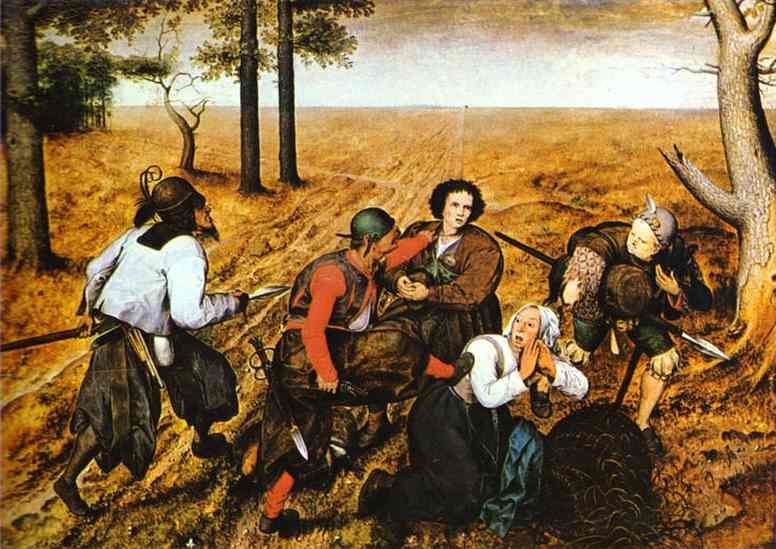
Apart from the fact that one must confess one’s faith by denying earthly things, every true Christian is a citizen of this world and must both do and share with others what the duties of the second table require. Therefore, if a murderer would do violence to you or a thief would take what is yours because you are a Christian,[2] you must resist such evil if you otherwise wish to be a righteous citizen in the world; for just as the secular authorities, of which you are a member and subject, themselves resist in such a case, so they also command you to resist by virtue of the second table when violence is done to you, and you are bound to obey. So if a murderer attacks you in the street and wants to kill you because you are a Christian, you must resist him, even if it costs him his life. For you know that the authorities have commanded that a murderer should be resisted and that the citizens should be protected. In such a case, you will fulfill the requirements of the first and second table. –
On the same subject the old godly and conscientious theologian Martin Chemnitz writes the following, translated into the vernacular:
The question of self-defense is a difficult one; namely, when someone in an unavoidable emergency, because he cannot otherwise escape, nor otherwise expel the violence, nor otherwise defend his life, kills the attacker. The civil rights in regard to this case are known; but the question is, whether this applies according to heavenly law and before the judgment seat of conscience, since Christ says: “I say unto you, That ye resist not evil: but whosoever shall smite thee on thy right cheek, turn to him the other also.” Matthew 5:39. Some reject the proof from the law of nature that it is lawful to drive out violence with violence, as ungodly and contrary to the gospel. Some, however, extend this saying so far that they maintain that private revenge is perfectly lawful, thus setting aside the precepts of Christ (Matthew 5:39).
The true grounds of this contention must therefore be carefully considered. For not all natural principles, especially in the teaching of the law, are to be rejected and condemned. For this is also a principle of the law of nature: “Whatsoever ye would that men should do to you, do ye even so to them.” Matthew 7:12. But neither are all without exception to be accepted and approved, because “the natural man receiveth not the things of the Spirit of God: for they are foolishness unto him.” 1 Cor. 2:14. Therefore two useful rules are taught: 1. The gospel does not abolish the law of nature, because it is the truth of God, which was written on the hearts by God himself at creation, (Rom. 1:18, 2:14). 2. But because what is known of the law in this darkness of corrupt nature is obscure, and the stubbornness of the passions in the heart also corrupts right knowledge in the mind, the Word of God adds the interpretation to the law of nature and punishes and abolishes the falsifications of it that have been added from the corrupt inheritance.
But in order to see what the right principle is and how this natural knowledge is put in order, it must be noted that opposition to violence takes place in three cases: 1. In lawful dominions and in the office of authority. For the latter rightly expels violence with violence when it averts highway robberies with an armed hand and by war. There is no dispute about this case. 2. In the defense of those who are entrusted to our care, e.g. when a father of a family expels violence by force when his house is attacked and defends his own. 3. in defending his own body against an unjust, sudden and openly violent attack. With regard to these last two cases there is a dispute.
The question is to be presented in such a way that defense with the removal of all unjust desires is lawful and necessary. But the following factors also belong to such defense: 1. That the violent attack which one suffers is a sudden one that one cannot escape in any way by giving way, fleeing, or suffering a (lesser) injustice. 2. That the violent attack is an obvious one, that one cannot save life and limb by any other means of defense than by striking back and killing. 3. That the authorities are so absent that they cannot come to the rescue, and that delay and waiting are clearly dangerous to life. 4. That restrictions be kept on innocent self-protection; to which, as the jurists teach, the following belong: (1) That self-defense be done immediately on the act. For if it occurs some time after the wrong has been done, it is evident that it is not done to repel the attack, but out of a desire for revenge. (2) That it is not done with the intention of revenge, not out of pain at the injustice experienced, but only to abort the violence and to protect life. If one could escape in any other way, one would rather not defend oneself or at least not kill, but is forced to defend oneself if one does not want to neglect one’s own life and that of one’s own.[3] (3) They also say that a uniformity of offensive and defensive weapons is required, so that if someone attacks you unarmed or with a stick, you will not immediately shoot him with a firearm if he hits you with it.
The question is therefore this: since in such a case the law and the authorities permit self-defense, whether this is in conflict with the teaching of the Gospel and with the commandment to love one’s enemies. Although this question is the subject of many disputations, the following simple and true reasons should be noted. 1. Christ did not come into the world to abolish, by his teaching and preaching, the law of nature and the laws which accord with common sense, and to establish a new political order; but he mainly delivers the spiritual doctrine of the kingdom of heaven, and he declares that the doctrine of the law is to be used for this, because the knowledge of it has been darkened and corrupted by the darkness of original sin. We have already said what evil desires and sinful passions corrupt natural knowledge in this case. These excluded, the work of the law is written in our hearts, that, as we ought to harm no one, likewise we ought to protect our own bodies against unjust violence, either by the ordinary powers of the authorities, or by self-defense, if the authorities cannot come to our aid. For thus says (the pagan philosopher) Cicero, when he describes the first principles of natural law: “In the beginning the whole race of living beings was ordained by nature to protect itself, its body and its life, and to ward off from itself that which seems to want to harm it.” This judgment, because it in truth contains that of the right of nature, is not annulled by the teaching of the Gospel, but only the explanation is added that no sinful desires may be mixed into it and that it may not be done without or against the authority of the laws and the authorities in personal outrage. This is the first reason.
2. The laws themselves, which are consistent with common sense, permit and approve such a case of self-defense. It has been established by the authority of the magistracy that in the case of sudden and openly violent attacks, when the judge is absent and cannot come to the rescue, everyone may justly protect himself and his own by self-defense. But it has been shown above that public punishment includes everything that is done according to the law or by order or authorization of a lawful authority, even by private persons.
3. More clear and certain are the proofs which are taken from the testimonies of Holy Scripture. For there is a case of self-defense of a private person explained in the Law of Moses Ex 22, 2, 3: “If a thief be found breaking up (with an instrument for breaking in), and be smitten that he die, there shall no blood be shed for him. If the sun be risen upon him, there shall be blood shed for him.” Consider how carefully God has indicated the circumstances of self-defense and restricted it by the definite limits of blameless protection. If someone is seized at night with a weapon during a burglary, it is assumed that he came with the intention of committing murder, and therefore defense is permitted. After the sun has risen, however, the owner of the house can protect himself and his property in other ways; therefore, if he then kills the thief under the pretext of defense, he is guilty because he did not observe the limits of innocent protection. It is true that the judicial laws of Moses do not bind us, but it is right to judge from them which political laws agree with the law of nature and with the eternal law that is in God’s heart. For God has not established anything that conflicts with his word and will.
Even before the Mosaic Law, there is an example of self-defense by a private person in the story of Abraham (Gen. 14:14), for he was a stranger in the land of Canaan, held no office of authority, and especially had no lawful power in Salem, and yet he armed his family to defend his nephew, pursued and killed the enemy, and freed not only Lot but also the other captives. And far from disapproving of this defense, Melchizedech, the priest of God Most High, blesses the victor: “Blessed be Abram of the most high God, and blessed be the most high God, which hath delivered thine enemies into thy hand.” But note the circumstances of blameless protection in this story. Firstly, his help is requested, for one who had escaped reports to Abraham. Secondly, the authorities at Salem were so overwhelmed that they could not come to his aid. Third, he is in league with Mamre, Escol and Aner, who were the rightful rulers in their place, but had no power in the land of Sodom; and yet they take up arms with Abraham to defend their neighbors.
John 18:36 also belongs here: “If my kingdom were of this world, then would my servants fight, that I should not be delivered to the Jews.” Thus in civil life, if the lawful authorities command and permit it, private individuals may justly resort to self-defense. And Proverbs 24:11 says: “Save those who would be killed, and do not withdraw from those who would be strangled.” However, he (Solomon) speaks here mainly of the office of authority; but he adds the general conclusion: “He rewards a man according to his work.” Hence Ambrose (the Church Father) writes: “He who does not remove injustice from his companion, if he can, is as much in the wrong as he who inflicts it.” Likewise: “If one can help and does not do so, this is nothing other than being favorable to wickedness.”
4. But, says one, these examples prove only the defense of one’s neighbor, not of one’s own body and life. Answer: The law says: Love thy neighbor as thyself. If, therefore, I act rightly when I defend my neighbor in an openly violent attack, it follows that the defense of one’s own body also belongs to the commandment of love. And the case of Ex 22:2-3 also includes the defense of one’s own body. Furthermore, Exodus 21:13 reads: “But if he did not lie in wait for him, but God let him fall into his hand,” i.e. as in Genesis 14:15. Some would counter this with Matthew 5:39: “Do not resist the one who is evil. But if anyone slaps you,” etc.,[4] and also by Matthew 26:52: “All who take the sword will perish by the sword.” But these sayings are also explained above. They distinguish between the offices of the authorities and the ministry of the gospel and instruct the pious, when the authorities either persecute them or deprive them of their protection and reputation, that they should not resist the evil in personal passion and iniquity. – Resistance also seems to conflict with the commandment to love one’s enemies. But then Abraham would also have sinned against this commandment (Gen 14:15), as would the law (Ex 22:2), as would the authorities when they punish evildoers.
We are sharing some testimonies on this subject at the request of several who are in such circumstances that they are in great need of clarity from God’s Word for conscientious conduct. Hopefully these testimonies will also be read with pleasure and not without benefit by those who are not exactly in such circumstances. –Editors of Der Lutheraner. ↑
Luther places here the case where a citizen is attacked because he is a Christian, since the occurrence of this case was to be particularly expected in his time and actually occurred a few years later, in the Schmalkaldic War. It goes without saying, however, that self-defense is all the more justified when the attack of a robber or murderer happens for other worldly reasons. ↑
This restriction, that self-defense is not done out of vindictiveness and hatred, is especially important, since many Christians are now so inflamed by abolitionist fanaticism that they seem to have stripped off not only the Christian, but even the human being. Not only every spark of love against their enemies, but even every spark of the meanest sense of justice against their opponents seems to have been extinguished. A truly diabolical hatred and a hellish joy at the misfortune and misery of the enemy has driven all Christian, even human feeling out of them. And this bestiality is glossed over with the name of patriotism and obedience to the authorities. ↑
Concerning this saying, see Luther’s Folk Library (Volksbibliothek), combined volume 9 and 10, pages 167-182 (i.e. Luther’s 1530 homilies on the Sermon on the Mount). ↑
Congregationalist is nary a word used but as a descriptor for the theology of Old Missouri Synod founder C. F. W. Walther. This is a fact much to the chagrin, I should like to offer, of the Reformer himself, Dr. Luther. While some may hand-wave this 1523 treatise away as some early expression of especial mettle on the part of Saint Luther, it is the opinion of us here at Old Lutherans that he meant what he said herein not only for the particular time and place he wrote it in but for us and all posterity of the seed of Christ to diligently and critically apply. Indeed, it is just the case that Saint Walther sought so to do.
It is necessary, first of all, to know where and what a Christian congregation is, so that men may not engage in purely human affairs under cover of the name of a Christian congregation, as has always been the custom of non-christians. Now the certain mark of the Christian congregation is the preaching of the Gospel in its purity. For as one can tell by the army standard, as by a sure sign, what leader and what army have taken the field, so one may surely know by the Gospel where Christ and His army are stationed. Of this we have God’s sure promise in Isaiah 55:10. “My word,” He says, “that goeth forth out of my mouth, shall not return unto me void; but as the rain cometh down from heaven and watereth the earth, so shall my word accomplish all things whereto I send it.” Hence we are certain that where the Gospel is preached, there must be Christians, no matter how few in number or how sinful and frail they be; just as where the Gospel is not preached and the doctrines of men hold sway, there can be no Christians but only heathens, no matter how great their numbers or how saintly and good their lives.
From this it follows undeniably that bishops, foundations, monastic houses, and all that crew have long since ceased to be either Christians or a Christian congregation, though they have flaunted this name as their exclusive possession. For whoever knows what the Gospel is can see, hear and understand that they are based, to this very day, upon their human teachings and have driven, and are still driving, the Gospel far from them.
Whatever such folk do and say must be regarded, therefore, as heathen and secular.
Secondly, in this matter of judging teachings and of appointing and dismissing teachers or pastors, not the least attention is to be paid to any human decree, law, precedent, usage or custom, whether it be decreed by pope or emperor, by princes or bishops, whether it have been observed by half the world or by all the world, whether it be in existence for one year or for a thousand years. The soul of man is eternal and above everything that is temporal; therefore it must be ruled and equipped with an eternal word alone. It is most absurd to rule conscience, in God’s stead, by means of human law and long established custom. We must be guided, therefore, in this matter by the Scriptures and the Word of God. For the Word of God and the teaching of man cannot but clash when the latter undertakes to rule the soul. Of this we desire to give a plain instance in the question before us.
The word and teaching of man have decreed and prescribed that the judging of doctrine be left altogether to bishops, theologians, and councils.
Whatever these have decided, all the world is bound to regard as law and as articles of faith. This is abundantly proved by their daily harping on the pope’s canon law. One hears scarcely anything else from them but the boast that they have the power and the right to judge what is Christian and what is heretical; the plain Christian must await their decision and abide by it. This claim of theirs, with which they have intimidated the whole world, and which is their chief stronghold and defense, lo, how shamelessly and how senselessly it rages against the law and Word of God!
For Christ decrees the very opposite. He takes from the bishops, theologians and councils both the right and the power to judge doctrine, and confers them upon all men, and upon all Christians in particular. He does this when He says in John 10:27, “My sheep hear my voice”; and, “My sheep do not follow a stranger, but flee from him; for they know not the voice of strangers. As many as have come are thieves and robbers; but the sheep did not hear them.” Here you see plainly who has the right to judge teaching. Bishops, pope, theologians, and anyone else have the power to teach; but the sheep are to judge whether what they teach is the voice of Christ or the voice of strangers. What reply can be made to this by the windbags who bluster and shout, “Councils! councils! Ah, we must listen to the theologians, the bishops, the great majority; we must look to ancient usage and custom.” What! God’s Word yield to your ancient usage, your custom, your bishops? Never! We therefore let bishops and councils decide and decree what they please; but when we have God’s Word on our side, it shall be for us, and not for them, to say whether it is right or wrong, and they shall yield to us and obey our word.
Here you see plainly enough, I fancy, how much trust is to be placed in those persons who deal with souls by means of the word of men. Who does not see that all bishops, foundations, monastic houses, universities, with all that are therein, rage against this clear word of Christ by shamelessly taking from the sheep the judgment of doctrine and appropriating it to themselves by their own impudent decree? Hence they are certainly to be regarded as murderers, thieves, wolves and apostate Christians, who are here openly convicted not only of denying the Word of God, but of setting up and carrying out decrees in opposition to this Word. Thus it behooved antichrist and his kingdom to do according to Paul’s prediction in 2 Thessalonians 2:3 [Let no man deceive you by any means: for that day shall not come, except there come a falling away first, and that man of sin be revealed, the son of perdition].
Again, Christ says in Matthew 7:15, “Beware of false prophets, which come to you in sheep’s clothing, but inwardly they are ravening wolves.”
Observe that He here assigns the judgment not to the prophets and teachers, but to the pupils, or the sheep. For how could one beware of false prophets unless one examined, judged and gave a decision on their teaching? Indeed, there can be no false prophets among the hearers, but among the teachers alone. All teachers should and must, therefore, be subject with their teaching to the judgment of the hearers.
Our third passage is from St. Paul, in 1 Thessalonians 5:21, “Test all things; hold fast that which is good.” Note that Paul would have no doctrine or decree to be observed unless it be tested and found good by the congregation that hears it. For this testing certainly does not pertain to the teachers; they must first declare that which is to be tested. Thus, in this passage also, the judgment is taken from the teachers and committed to the pupils among Christians; hence there is a vast difference between Christians and the world. In the world the ruler commands what he pleases, and his subjects accept it; but “among you,” says Christ, “it shall not be so.”
Among Christians everyone is the other’s judge and, on the other hand, also subject to the other. The spiritual tyrants, however, have turned Christendom into a temporal power.
Our fourth passage is again a saying of Christ’s, in Matthew 24:4, “Take heed that no man deceive you; for many shall come in my name, saying, I am Christ, and shall deceive many.” But what need is there of adducing further passages? All the warnings of St. Paul in Romans 16:13, 1 Corinthians 10:14, Galatians 3:4 and 5, Colossians 2:8, and everywhere else, as well as the sayings of all the prophets in which they teach that doctrines of men are to be rejected, these altogether deprive the teachers of the right and power to judge any teaching, and assign this right and power to the hearers with urgent commands and on pain of losing their souls. So that the hearers not only have the power and the right to judge all preaching, but are obliged to judge it under penalty of forfeiting the favor of Divine Majesty. Thus we see in how unchristian a manner the despots dealt with us when they deprived us of this right and appropriated it to themselves. For this thing alone they have richly deserved to be cast out of the Christian Church and driven forth as wolves, thieves and murderers, whose rule and teaching are contrary to God’s Word and will.
We conclude, then, that where there is a Christian congregation which has the Gospel, it not only has the right and the power, but is in duty bound, according to the obedience it pledged to Christ in Baptism, and under pain of forfeiting its salvation, to shun, to flee, to put down, to withdraw from, the authority which our bishops, abbots, monastic houses, foundations, and the like exercise today; since it is plainly to be seen that their teaching and rule are opposed to God and His Word. Thus our first point is established certainly and firmly enough, and we should depend upon it that to put down or to shun such bishops, abbots, monasteries, and the like rule, is a divine right and necessary for the salvation of souls. A Christian congregation, however, should not and cannot be without the Word of God. It follows therefore logically enough from the foregoing, that it must have teachers and preachers to administer this Word. And since in these last accursed times the bishops and false spiritual rulers neither are nor have any intention of being such teachers, and are moreover unwilling to give us or to suffer us to have such teachers; and since we ought not to tempt God to send down anew preachers from heaven: therefore we must do as the Scriptures say, and call and appoint from among ourselves men who are found fit for this work, and whom God has enlightened with understanding and endowed with the requisite gifts.
For no one can deny that every Christian has God’s Word and is taught of God and anointed by Him to the priesthood. Thus Christ says in John 6:45, “They shall all be taught of God.” And in Psalm 45:7, “God hath anointed thee with the oil of gladness above thy fellows.” By “fellows” are meant Christians, Christ’s brethren, consecrated to be priests with Him. As Peter also says in 1 Peter 2:9, “Ye are a royal priesthood, that ye should show forth the praises of him who hath called you into his marvelous light.” Now, if Christians have the Word of God and are anointed by Him, they are in duty bound to confess, preach and spread this Word. As Paul says in 2 Corinthians 4:13, “We have the same spirit of faith, and therefore we speak”; and the prophet says in Psalm 116:10, “I believed, therefore I speak”; and in Psalm 51:13, he says in the name of all Christians, “I will teach transgressors thy ways, that sinners may be converted unto thee.”
These passages prove once more that a Christian not only has the right and power to teach God’s Word, but is in duty bound to teach it on pain of losing his salvation and forfeiting God’s favor.
Now you will say: “But, unless he has been called to do this, he dare not preach, as you yourself have repeatedly taught!” I reply: Here you must consider the Christian from a double point of view. On the one hand, when he is in a place where there are no Christians, he needs no other call than the fact that he is a Christian, inwardly called and anointed by God; he is bound by the duty of brotherly love to preach to the erring heathens or nonchristians and to teach them the Gospel, even though no one call him to this work. That is what St. Stephen did (Acts 6:8 and Acts 7:2); the office of preaching was not committed to him by the apostles, yet he preached and performed great wonders among the people. Philip, Stephen’s fellow-deacon, did the same (Acts 8:5), without having received the office of preaching. The same is true of Apollos (Acts 18:25). In such circumstances the Christian looks, in brotherly love, upon the needs of poor perishing souls, and waits for no commission or letter from pope or bishop. For necessity breaks every law and knows no law; moreover, love is bound to help when there is no one else to help. But, on the other hand, when the Christian is in a place where there are Christians, who have the same power and right as he, he should not thrust himself forward, but should rather let himself be called and drawn forth to preach and teach in the stead and by the commission of the rest. Indeed, a Christian has such power that he may and should arise and teach, even among Christians, without being called of men, in case he finds the teacher in that place to be in error, provided that this be done in a becoming and decent manner. Such a case is plainly described by St. Paul in Corinthians 14:30, where he says, “If anything be revealed to another that sitteth by, let the first hold his peace.” Notice what St. Paul does here. He commands the man who is teaching to hold his peace and to retire (among Christians!), and commands the hearer to arise, even without a call, because necessity knows no law.
If then St. Paul here bids anyone, in case of necessity, among Christians, to arise even without a call, and calls him by virtue of this word of God; and if he bids the other to retire, and deposes him by virtue of these words: how much more does an entire Christian congregation have the right to call a man to this office whenever it becomes necessary! And it is always necessary, and never more than now. For in the same passage St. Paul gives to every Christian the power to teach among Christians whenever it becomes necessary, “Ye may all prophesy one by one, that all may learn and all may be admonished”; and, “Desire earnestly to prophesy, and forbid not to speak with tongues; but let all things be done decently and in order.”
Take this passage as a most sure basis, which gives more than sufficient authority to the Christian congregation to preach, to permit men to preach, and to call preachers. Especially in case of necessity, this passage itself calls everyone in particular, without any call of men; so that we might have no doubt that the congregation which has the Gospel may and should choose and call, out of its number, one who is to teach the Word in its stead.
But now you will say: “St. Paul, however, commanded Timothy and Titus to appoint priests; moreover, we read in Acts 14:23 that Paul and Barnabas appointed priests in their congregations. The congregation cannot, therefore, call anyone, nor can anyone come forward of his own accord to preach among Christians; but we must have the consent and commission of bishops, abbots or other prelates, who sit in the apostles’ seat.” I reply: If indeed our bishops and abbots sat in the apostles’ seat, as they claim, one might speak of letting them do what Titus and Timothy, Paul and Barnabas did when they appointed priests. But now that they sit in the devil’s seat, and are wolves, neither preaching the Gospel nor permitting it to be preached, the appointment of men to the office of preaching and pastoral care among Christians concerns them as much as it concerns the Jew and the Turk. Mule drivers and dog leaders, that is what they ought to be!
Moreover, even if they were the right sort of bishops and desired to have the Gospel and to appoint the right sort of preachers, they could not and should not do this without the consent, choice and call of the congregation; except in cases of necessity, in order that souls might not be lost for lack of God’s Word. For in such necessity, as we have seen, anyone may provide a preacher, either by personal request or through the power of the secular authorities; nay, he should himself step into the breach and rise up and teach, if he be able, for necessity is necessity and knows no bounds, just as, when fire breaks out in a town, everyone should hasten to lend a hand and not wait to be asked.
But where no such necessity exists, and where there are those who have the right, the power, and the gift to teach, no bishop ought to appoint anyone without the consent, choice and call of the congregation; it is his duty rather to confirm the man whom the congregation has elected and called. If the bishop does not confirm him, he is none the less confirmed by virtue of the call of the congregation. For neither Titus nor Timothy nor Paul appointed any priest unless he was chosen and called by the congregation. This is clearly proved from Paul’s words in Titus 1:7 and 1 Timothy 3:2, “A bishop, or priest, must be blameless”; and, “The deacons must first be proved.” Titus certainly did not know who was blameless: this information must needs come from the congregation, who must bring such a one to his attention. We read also in Acts 6:2, with respect to a very minor office, that the apostles themselves did not venture to appoint men to be deacons without the knowledge and consent of the congregation. The congregation, on the contrary, chose and called the seven deacons, and the apostles confirmed them. But if the apostles did not venture, upon their own authority, to appoint men to an office that had to do merely with the distribution of bodily food, how should they have been so bold as to commit to anyone the highest office of all, that of preaching, by their own power and without the knowledge, consent and call of the congregation?
But since in our days the necessity exists, and there is never a bishop to provide evangelical preachers, the example of Titus and Timothy does not apply here. We must rather call a preacher out of the congregation, whether he be confirmed by Titus or not. For the people to whom Titus ministered would or should have done the same, if he had refused to confirm their preachers or if there had been no one else to appoint preachers. These days are altogether unlike the days of Titus; then the apostles ruled and desired the right sort of preachers, but now our despots desire none but wolves and thieves.
And why do the raging tyrants condemn us for electing and calling in this manner? They themselves do the same thing, and have no other way.
Among them no one is ever appointed pope or bishop by the authority of one man, but he is elected and called by the chapter and thereupon confirmed by others, bishops by the pope as their superior, but the pope himself by the Cardinal of Ostia as his inferior. And if one should happen not to be confirmed, he is none the less bishop or pope. Now I ask the dear tyrants this question: If the election and call of their congregation can make a man a bishop, and if the pope is pope solely by virtue of his election without confirmation by any other authority, why should not a Christian congregation make a man a preacher solely by virtue of its call? (My argument has the greater force because, forsooth, they regard the estate of bishop and pope as superior to the office of preacher.) Who has granted this right to them and withheld it from us? The more since our call has Scripture in its favor, while theirs is but a human fable without Scripture, whereby they rob us of our rights. They are tyrants and knaves, dealing with us as the devil’s apostles are bound to do.
Hence it has also been the custom in certain places that even secular authorities such as burgomasters and princes appointed and salaried their own city and castle preachers, choosing whom they pleased, without the consent or commission of bishops or popes; nor has anyone ever interfered with this custom. I am afraid, however, that it was not done from a correct understanding of their Christian rights; it has come about rather because the spiritual tyrants despised the office of preaching, held it common, and made a sharp distinction between it and the spiritual rule. But it is in truth the highest office of all, on which all other offices depend and from which they follow; on the other hand, where this office does not exist none of the others can follow. For in John 4:2 we read that Christ did not baptize, but only preached; and Paul boasts in 1 Corinthians 1:17 that he was sent not to baptize, but to preach the Gospel.
Therefore, the man to whom has been committed the office of preaching has committed to him the highest office in the Christian Church. He may then also baptize, say mass, and take full charge of the care of souls. Or if he prefer, he may confine himself to preaching, and leave baptizing and such minor offices to others, as Christ did, and St. Paul, and all the apostles (Acts 6:4). By this we see that our present bishops and spirituals are painted images and no bishops at all. For the highest office, that of the Word, which ought to be their proper work, they leave to the very lowest orders, to chaplains and monks, alms-collectors! To whom they leave also the minor offices, such as baptism and other pastoral acts. Meanwhile they themselves administer confirmation and bless bells, altars and churches, works which are neither Christian nor episcopal, but invented out of their own heads. They are perverse and blind mummers, and nothing but make-believe bishops.
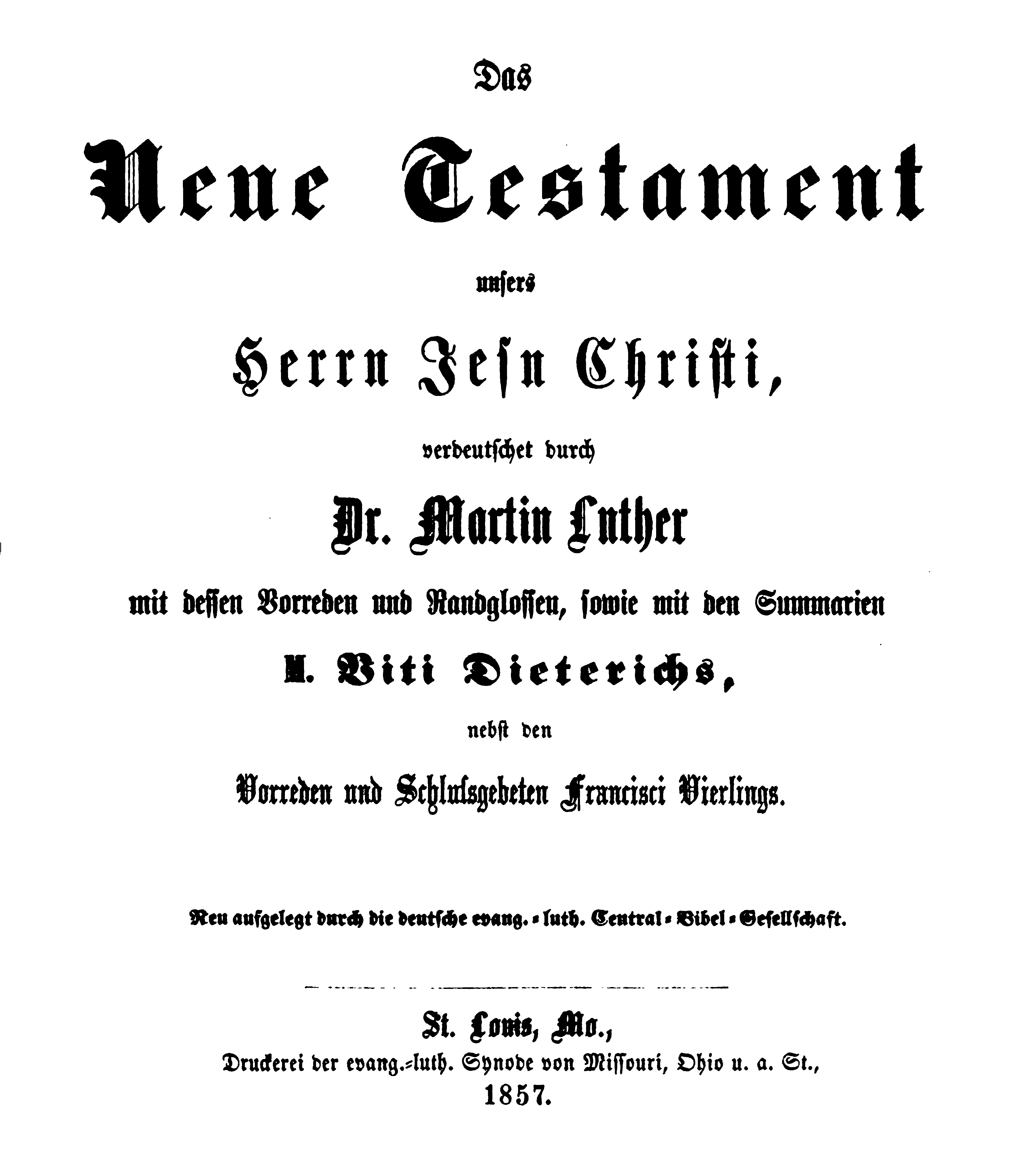
This book, a new edition of the 16th century Altenburg Bible (Altenburger Bibelwerk), was one of the first projects the early Missouri Synod took on to promote biblical literacy. The current study Bible put out by CPH used this work as a source for many of its notes, but it’s interesting to see the things that were left out. The newest copies I’ve seen are dated 1898 and I suspect it was in print or at least still available from CPH in the early 20th century.
Below is a translation of the title page followed by the prayers, section summary, references, and notes for 1 Corinthians 11:2-16.
The New Testament of our Lord Jesus Christ, Germanized by Dr. Martin Luther with his forewords [for each book] and [his] marginal notes, as well as the Summaries of M. Veith Dietrich, with the forewords [to the chapters] and closing prayers of Franciscus Vierling.
Newly issued by the Central German Evangelical Lutheran Bible Society.
St. Louis, Mo.,
Printery of the Evangelical Lutheran Synod of Missouri, Ohio and other States,
1857.
[1. Corinthians]
Prayer. [for Chapter 10—Franciscus Vierling]
May our Lord Jesus Christ preserve for us His dear word pure and unfalsified, and His holy sacrament in proper use; may He preserve and strengthen us against the crafty devil, evil world, and our sinful flesh in true faith and godly life, until our end, Amen.
The 11th Chapter. Foreword. [Franciscus Vierling]
Beloved Christians! Man is the Lord Christ’s glory, and woman is man’s glory. Man is the glory of the Lord Christ: for, when he keeps himself righteously in his station, then he presents himself symbolically to other people in the manner Christ is disposed toward his congregation: namely that he governs, loves, and protects her; and that is then a great honor to Christ, when one feels in his members his nature and character as the head. [und das ist denn Christo eine große Ehre, wenn man an seinen Gliedern spüret, seine, als des Häupts, Natur und Eigenschaft.] The woman is the glory of man: for as she helps her husband maintain livelihood, and is pious, loyal, and obedient, then that is so much as to say in deed: See here, thus has God honored my husband, that he has given him me as a helper, and has equally along with this commanded to be submissive to him. Now because man is the glory of the Lord Christ, he covers not his head when he prays, in order to show that he is thus subject to Christ, that he likewise has lordship and power, love and fidelity [Herrschaft und Gewalt, Liebe und Treu] concerning another person, namely concerning his wife. But the woman shall cover her head, as an indication of her submission, and that she does not refuse to be faithful and obedient to her husband. The first part of the 11th chapter also teaches this.
Of some behaviors [Geberden/Gebärden] in prayer, and worthy use of the holy supper.
1. Cor. 11:2-16 notes:
V. 3. *the man *Eph. 5:23.
*God *1 Cor. 3:23.
V. 4. *prophesy *1 Cor. 12:10, 14:1.
V. 7. *God’s image *Gen. 1:27 f.
V. 9. *but the woman for the man *Gen. 2:18, 23.
V. 10. apower [Macht]) i.e. the veil or covering, whereby one may mark, that she is under the man’s power, Gen. 316. [Marginal note and reference from Martin Luther c.1534]
V. 11. *in the Lord *Gal. 3, 28.
V. 13. *Judge *Act. 4, 19.
V. 16. *But if any man *1 Tim. 6, 4.
Summary. [Veith Dietrich]
This is the sixth point, and concerns the order which should be maintained between man and woman, that a man should pray and prophesy with a bare head and short hair, and a woman with covered head, V. 4. St. Paul takes this ordinance not alone from the custom of the Jews, but from nature. For it is uncomely for a woman, says he, to be bareheaded and to have short hair. To have long hair and to be covered adorns her, and is comely. St. Paul adds yet another cause to this and says: To have something on the head is a sign that one is not free, but has a lord. Now because the man is the woman’s lord, the man should have nothing on his head; but the woman should have something on hers. But, says he, such distinction remains here below on earth; for God, a believing woman is worth just as much as a believing man. Likewise one should keep such ordinance for the sake of decency [Zucht]. For not only do the people take offence at indecency [Unzucht], but the angels are repulsed by it. V. 9.
Votum. [Franciscus Vierling]
May God the Lord, the author and preserver of the holy estate of marriage, govern all married people, that they would dispose themselves toward one another, that their deeds and life may please Him, that it may be a joy to the angels and that it may serve as a good example to others, and that they with their children might retain His temporal and eternal blessings, Amen.
You can acces the complete Altenburg Bible here. Volume 1
The following appears in Der Lutheraner V. 63 (1911) No. 21 (October 17th) p. 346
Rome and marriage. A political newspaper, apparently under Roman Catholic influence, wrote not long ago that the Roman Church acts rightly and wisely in favoring early marriages and large families, thus proving itself a promoter of all the virtues that spring from the love of family life. Thus one reads from time to time that Roman priests condemn so-called racial suicide, and last year one of their bishops spoke out strongly against it at the Eucharistic Congress in Montreal. But none of this can erase the fact that Rome is the greatest enemy of God-ordained marriage and Christian family life. For to this day, she continues to describe the unmarried state as a higher, more perfect state, year in, year out compelling thousands of men and women in monasteries to live unmarried lives, and forbidding all priests and bishops to marry, contrary to God’s word. Therefore the Lutheran confession in the 23rd article of the Augsburg Confession and elsewhere condemns this anti-Christian error of the papacy, and Luther says the sharp words: “The fountainhead of all fornication and immorality in the papacy is that they condemn marriage, the most holy estate. For all who despise the marriage state must fall into shameful, abominable fornication, even to the point of turning natural use into unnatural use, as St. Paul says in Romans 1:26, because they despise God’s order and creation, that is, woman. For God created woman to be with man, to bear children and keep house. Therefore they take their deserved reward justly, because they despise marriage, and, as St. Paul says, they receive the reward in their own bodies, as it ought and should be, because of their error.” L(udwig). F(ürbringer).
It is a near certainty that you will never hear such truths resounding from a Lutheran pulpit in the current year. No matter what the text says, you’ll just get milky re-treads of the doctrine of justification and then it will END WITH THE GOSPEL. “This is all you need,” they will say. “Just love God and do as you please. (That’s Augustine! I am very smart!) No one needs to tell you what to do. Heck, I sure don’t/can’t. You just go be you. Muh vocation!”
Well, they’re wrong.
“My people are destroyed for lack of knowledge: because thou hast rejected knowledge, I will also reject thee, that thou shalt be no priest to me: seeing thou hast forgotten the law of thy God, I will also forget thy children.” – Hosea 4:6
The fact that you want to correct that passage so that “Law” means “Gospel” or “teaching” or “testimony” or “precept” or anything other than “Law” means that you are part of the problem. Unlike you, the Lutheran confessors thought this sermon was so great that they literally endorsed it in the Book of Concord. See below.
Therefore, because of these lusts of the flesh the truly believing, elect, and regenerate children of God need in this life not only the daily instruction and admonition, warning, and threatening of the Law, but also frequently punishments, that they may be roused [the old man is driven out of them] and follow the Spirit of God, as it is written Psalm 119:71: “It is good for me that I have been afflicted, that I might learn Thy statutes.” And again, 1 Corinthians 9:27: “I keep under my body and bring it into subjection, lest that, by any means, when I have preached to others, I myself should be a castaway.” And again, Hebrews 12:8: “But if ye be without chastisement, whereof all are partakers, then are ye bastards and not sons”; as Dr. Luther has fully explained this at greater length in the Summer Part of the Church Postil, on the Epistle for the Nineteenth Sunday after Trinity.
Ephesians 4:22-28 That ye put away, as concerning your former manner of life, the old man, that waxeth corrupt after the lusts of deceit; and that ye be renewed in the spirit of your mind, and put on the new man, that after God hath been created in righteousness and holiness of truth. Wherefore, putting away falsehood, speak ye truth each one with his neighbor: for we are members one of another. Be ye angry, and sin not: let not the sun go down upon your wrath: neither give place to the devil. Let him that stole steal no more: but rather let him labor, working with his hands the thing that is good, that he may have whereof to give to him that hath need.
❦
1. Here again is an admonition for Christians to follow up their faith by good works and a new life, for though they have forgiveness of sins through baptism, the old Adam still adheres to their flesh and makes himself felt in tendencies and desires to vices physical and mental. The result is that unless Christians offer resistance, they will lose their faith and the remission of sins and will in the end be worse than they were at first; for they will begin to despise and persecute the Word of God when corrected by it. Yea, even those who gladly hear the Word of God, who highly prize it and aim to follow it, have daily need of admonition and encouragement, so strong and tough is that old hide of our sinful flesh. And so powerful and wily is our old evil foe that wherever he can gain enough of an opening to insert one of his claws, he thrusts in his whole self and will not desist until he has again sunk man into his former condemnable unbelief and his old way of despising and disobeying God.
2. Therefore, the Gospel ministry is necessary in the Church, not only for instruction of the ignorant — such as the simple, unlettered people and the children — but also for the purpose of awakening those who know very well what they are to believe and how they are to live, and admonishing them to be on their guard daily and not to become indolent, disheartened or tired in the war they must wage on this earth with the devil, with their own flesh and with all manner of evil.
3. For this reason Paul is so persistent in his admonitions that he actually seems to be overdoing it. He proceeds as if the Christians were either too dull to comprehend or so inattentive and forgetful that they must be reminded and driven. The apostle well knows that though they have made a beginning in faith and are in that state which should show the fruits of faith, such result is not so easily forthcoming. It will not do to think and say: Well, it is sufficient to have the doctrine, and if we have the Spirit and faith, then fruits and good works will follow of their own accord. For although the Spirit truly is present and, as Christ says, willing and effective in those that believe, on the other hand the flesh is weak and sluggish. Besides, the devil is not idle, but seeks to seduce our weak nature by temptations and allurements.
4. So we must not permit the people to go on in their way, neglecting to urge and admonish them, through God’s Word, to lead a godly life. Indeed, you dare not be negligent and backward in this duty; for, as it is, our flesh is all too sluggish to heed the Spirit and all too able to resist it. Paul says (Galatians 5:17): “For the flesh lusteth against the Spirit, and the Spirit against the flesh … that ye may not do the things that ye would.” Therefore, God is constrained to do as a good and diligent householder or ruler, who, having a slothful man-servant or maid-servant, or careless officers, who otherwise are neither wicked nor faithless, will not consider it sufficient once or twice to direct, but will constantly be supervising and directing.
5. Nor have we as yet arrived at the point where our flesh and blood will joyfully and gladly abound in good works and obedience to God as the spirit is inclined and faith directs. Even with the utmost efforts the Spirit scarce can compel our old man. What would be the result if we were no more urged and admonished but could go our way thinking, as many selfsatisfied persons do: I am well acquainted with my duties, having learned them many years ago and having heard frequent explanations of them; yea, I have taught others? It might be that one year’s intermission of preaching and admonition would place us below the level of the heathen.
6. Now, this exhortation in itself is simple and easy of comprehension. The apostle is but repeating his exhortations of other places — on the fruits of faith, or a godly walk — merely in different terms. Here he speaks of putting away the old man and putting on the new man, of being “renewed in the spirit of your mind.”
7. What he calls “the old man” is well known to us; namely, the whole nature of man as descended from Adam after his fall in paradise, being blinded by the devil, depraved in soul, not keeping God before his eyes nor trusting him, yes, utterly regardless of God and the judgment day. Though with his mouth he may honor God’s Word and the Gospel, yet in reality he is unchanged; if he does have a little additional knowledge, he has just as little fear, love and trust in God as heretofore.
8. Such a life and such conduct should not be found among you, says the apostle; you are not to continue with “the old man.” He must be put off and laid aside. Your former manner of life, inherited of Adam, consisted in disobeying God, in neither fearing, trusting nor calling upon him. Again, in your body you obeyed not God’s commandments, being given to lust, pride, insatiable greed, envy, hatred, etc. A life and walk of this nature is not becoming a Christian who is regarded as, and truly is, a different order of being from his former self, as we shall hear. Necessarily he should walk differently.
9. In this respect a Christian must take heed that he does not deceive himself; the true Christian differs from the hypocrite. True Christians so live that it is apparent from their lives that they keep God before their eyes and truly believe the Gospel, while hypocrites likewise show by their walk that their pretensions of faith and forgiveness of sin are hollow. No proof is seen in their lives and works showing that they have in any wise mended their former ways; they merely deck themselves with a pretense, with the name of Gospel, of faith, of Christ.
10. Now, the apostle has two things to say of the old man: that he corrupts himself in error as to the soul and in lusts as to the body. Paul portrays the old man — meaning every man without true faith though he bear the name of a Christian — as in the first place given to error: coming short of the truth, knowing naught of the true knowledge of Christ and faith in him, indifferent alike to God’s wrath and God’s grace, deceiving himself with his own conceit that darkness is light. The old man believes that God will not be moved to vengeance though he do as he pleases, even to decorating vices with the names of virtues. Haughtiness, greed, oppressing and tormenting the poor, wrath, envy — all this he would call preserving his dignity, exercising strict discipline, honestly and economically conducting his domestic affairs, caring for his wife and children, displaying Christian zeal and love of justice, etc. In short, he proceeds in the perfectly empty delusion and self-conceit that he is a Christian.
11. Out of this error proceeds the other corruption, the lusts of the body, which are fruits of unbelief. Unbelief causes men to walk in sinful security and yield to all the appetites of their flesh. Such have no inclination toward what is good, nor do they aim to promote orderliness, honor or virtue. They take desperate chances on their lives, wanting to live according to the lusts of their flesh, and yet not be reprimanded.
12. This, says the apostle, is the old man’s course and nature. He will do naught but ruin himself. The longer continued, the greater his debasement. He draws down upon himself his own condemnation and penalty for body and soul; for in proportion as he becomes unbelieving and hardhearted, does he become haughty, hateful and faithless, and eventually a perfect scoundrel and villain. This was your former manner of life, when as yet you were heathen and non-Christians. Therefore you must by all means put off the old man and cast him far from you; otherwise you cannot remain a Christian. For glorying in the grace of God and the forgiveness of sin is inconsistent with following sin — remaining in the former old un-Christian life and walking in error and deceitful lusts.
“And that ye be renewed in the spirit of your mind, and put on the new man, that after God hath been created in righteousness and holiness of truth.”
13. Having put away the old man, the apostle exhorts us further to put on the new man, that day by day we may grow as new creatures. This is effected by first being delivered from error — from the erroneous thoughts and ideas incident to our corrupt nature with its false conceptions of God, wherein we do not fear nor believe him — and then from God’s Word receiving the right understanding of him. When we rightly understand, we shall fear his wrath against sin and rely on his grace in true faith, believing that he will forgive our sins for Christ’s sake and will hear our prayer for strength and assistance to withstand and conquer, and to continually grow in faith.
14. This change Paul calls being “renewed in the spirit of your mind”; that is, constantly growing and becoming established in that true conception and clear knowledge of Christ begun in us, in opposition to error and idle vaporings. He who is thus received, says the apostle, is a man “that after God hath been created in righteousness and holiness of truth.” In the old man there is naught but error, by means of which the devil leads to destruction. But the new man has the Spirit and the truth, by which the heart is illumined unto righteousness and holiness, wherein man follows the guidance of God’s Word and feels a desire for a godly walk and good life; just as, on the other hand, the desire and love for sin and wickedness is the product of error. This new man is created after God, as an image of God, and must of necessity differ from such as live in error and in lusts, without the knowledge of God and disobedient to him. For if God’s image is in man, man must consequently have the right knowledge of God and right conceptions and ideas, and lead a godly life consistent with holiness and righteousness as found in God himself.
15. Such an image of God Adam was when first created. He was, as to the soul, truthful, free from error, and possessed of true faith and knowledge of God; and as to the body, holy and pure, that is, without the impure, unclean desires of avarice, lasciviousness, envy, hatred, etc. And all his children — all men — would have so remained from their birth if he had not suffered himself to be led astray by the devil and to be thus ruined. But since Christians, by the grace and Spirit of God, now have been renewed to this image of God, they are so to live that soul and spirit are righteous and pleasing to God through faith in Christ; and that also the body — meaning the whole external life — be pure and holy, which is genuine holiness.
16. Some there are who pretend to great holiness and purity, but it is mere pretense, deceiving the people in general. Such are the factious spirits and monastic saints, who base their holiness and uprightness solely on an external, peculiar life and on self-elected works. Theirs may be apparently a commendable, holy and pure way of praying and fasting, of denying self, etc., and the people may call it so; but inwardly they are and remain haughty, venomous, hateful, filled with the filth of human lust and evil thoughts, as Christ says of such (Matthew 15:19; Luke 16:15). Likewise their righteousness on which they pride themselves before God has a certain gloss, on the strength of which they presume to merit the grace of God for themselves and others; but inwardly they have no true conception of God, being in rank unbelief, that is, false and vain suppositions, or doubts. Such righteousness, or holiness, is not true nor honest. It is made up wholly of hypocrisy and deceit. It is built, not of God nor after God, but after that lying spirit, the devil.
17. The true Christian, Paul asserts, has been molded through faith in Christ into a new man, like unto God, truly justified and holy in his sight; even as Adam originally was in perfect harmony of heart with God, showing true, straightforward confidence, love and willingness. And his body was holy and pure, knowing naught of evil, impure or improper desire. Thus the whole life of the man was a beautiful portrait of God, a mirror wherein God himself was reflected; even as the lives and natures of the holy spirits the angels are wrapped up in God and represent true knowledge of him, assurance, and joy in him and utterly pure and holy thoughts and works according to the will of God.
18. But since man is now so grievously fallen from this cheerful confidence, this certainty and joy, into doubts or into presumption toward God, and from unspotted, noble obedience into the lusts of iniquity and ungodliness, it follows that not from mankind can come help or relief. Nor can any one hope for remedy except the Christians, who through faith in Christ begin again to have a joyful and confident heart toward God. They thus enter again into their former relation and into the true paradise of perfect harmony with God and of justification; they are comforted by his grace. Accordingly they are disposed to lead a godly life in harmony with God’s commandments and to resist ungodly lusts and ways. These begin to taste God’s goodness and loving kindness, as Paul says, and realize what they lost in paradise. He, therefore, that would be a Christian should strive to be found in this new man created after God; not in blind error and vain conceit, but in the very essence of righteousness and holiness before God.
“Wherefore, putting away falsehood, speak ye truth each one with his neighbor: for we are members one of another.”
19. Lest there might be one who failed to understand the meaning of the old and the new man, or of true and false righteousness and holiness, the apostle now proceeds to give an example or two, making it easier for us to grasp the idea. All sin comes under one of two classes: First, that of the devil’s own making, such as murder and deceit; for by lies he establishes all idolatry, error, false faith and holiness, and among men he creates faithlessness, deceit, malice, etc. Secondly, those sins which he instigates man to commit against man; deeds of wrath, hatred, vengeance and murder. Paul combines these two classes.
20. Now, when a man does not deal fairly with his neighbor, but practices dishonesty and deceit, be it in matters spiritual or temporal (and the world is ever deceitful in all transactions), then certainly the old man holds sway and not righteousness nor holiness, however much the man may effect a good appearance and evade the courts. For such conduct does not reflect God’s image, but the devil’s. For the heart does not rely on God and his truth, otherwise it would war with fraud and deception; but its object is to clothe itself with a misleading garb, even assuming the name of God, and thus to deceive, belie, betray and forsake its neighbor at the bidding of every fiendish whim, and all for the satisfaction of its avarice, selfishness and pride.
21. In contrast thereto you can recognize the new man. He speaks the truth and hates lies, not only those momentous lies against the first table of the Ten Commandments, but also those against the second table; for he deals faithfully and in a brotherly way with others, doing as he would be done by himself. Thus should Christians live with each other, as members of one body, according to the apostle, and as having in Christ all things common and alike. “Be ye angry and sin not: let not the sun go down upon your wrath.”
22. Half the sins which the world has learned of its lord and master, the devil, consist in lying and deceiving, and that in the name and appearance of truth. No one wants to be called a liar, and even the devil covers his lies with the name of truth. The other half, which is easier to recognize, consists in wrath and its fruits. And this class is usually the result of the other. The world, for its own advantage, lies and deceives; and when it sees mankind acting in opposition to its wishes, or beholds its lies exposed and its schemes thwarted, it begins to rage in wrath against God, endeavoring to avenge itself and inflict harm, but fraudulently disguising its wicked motive under the plea of having good and abundant reasons for its action.
23. Therefore Paul admonishes the Christians as new creatures, to guard against this vice of wrath, adducing the fourth verse of the fourth Psalm: “Stand in awe and sin not.” The repetition of this passage sounds, in Paul’s rendering, as if permission to be angry were given; he says: “Be ye angry, and sin not.” But Paul is taking into consideration the way of the world. Men are tempted and moved to anger. There are no clean records. Under sudden provocation the heart swells with ire, while the devil busily fans the flame; for he is ever alert to stamp upon us his seal and image and make us like unto him, either through error and false doctrine, or through wrath and murder in conflict with love and patience. These two forms of evil you will encounter, especially if you make an effort to be a godly Christian, to defend the truth and to live uprightly in the sight of all. You will meet with all manner of malice aforethought and deceit, and with faithlessness and malignity on the part of those you have benefited; again, with unmasked violence and injustice on the part of those who should protect you and see to your interests. This will hurt and move you to wrath. Yea, in your own house and among your dear Christian brethren you will often meet with that which vexes you; again, a word of yours may hurt their feelings. And it will not be otherwise. This life of ours is so constituted that such conditions must be. Flesh and blood cannot but be stirred at times by wrath and impatience, especially when it receives evil for good; and the devil is ever at hand kindling your anger and endeavoring to fan into a blaze the wrath and ill humor between yourself and your neighbor.
24. But right here, says the apostle, you should beware and not sin; not give rein, nor yield to the impulse and promptings of wrath. That you may indeed be moved, the apostle would say, I well know, and you may fancy to have the best of reasons for exhibiting anger and vengeance; but beware of doing what your wrath would have you do: and if overcome by wrath and led to rashness, do not continue in it, do not harbor it, but subdue and restrain it, the sooner the better; do not suffer it to take root or to remain with you over night.
25. If followed, wrath will not suffer you to do a single right thing, as James affirms ( James 1:20). It causes man to fall and sin against God and his neighbor. Even the heathen have seen that wrath gets the better of reason and is never the source of good counsel. In line with this, we read that St. Ambrose reproved the emperor Theodosius for having, while in a rage, caused the execution of many persons in Thessalonica; and that he succeeded in having the emperor issue a rescript to the effect that no one should be executed, even on his imperial order and command, until a full month had passed by, thus affording an opportunity to rescind the order if given in haste and wrath.
26. Therefore the Psalm says: When wrath attacks and moves you, do not at once give it leave to do its will. Therein you would certainly commit sin. But go into your chamber, commune and take counsel with yourself, pray the Lord’s Prayer, repeat some good passages from God’s Word, curb yourself and confide in God; he will uphold your rights.
27. It is this the apostle has in mind when saying: “Let not the sun go down upon your wrath.” A Christian must not entertain wrath; he should instantly quench and stifle it. It is the part of the new man to control anger, that the devil may not move him from his new-found faith and make him lose what he has received. If he yields to these instigations of his flesh, he thereby returns to the error and condemnation in the old man and loses control of himself, following his own desires. Then he adorns a lie with the appearance of truth, claiming the right to be angry and take revenge; just as the world does when it asserts: This fellow has done me infinite violence and injustice; am I to suffer it? I have a just cause and shall not recline my head in ease until he is repaid! By such talk it loses its case before both God and men; as the saying goes: He that strikes back has the most unjust cause.
28. Both divine and human justice forbids that a man be judge in his own case. For this very reason God has established governmental and judicial authority, in his stead to punish transgressions, which — when properly administered — is not man’s but God’s judgment. He therefore that invades such judgment, invades the authority of God himself; he commits a double wrong and merits double condemnation. If you desire to seek and obtain redress in the courts, you are at liberty to do so, provided you proceed in the proper way, at the proper place and with those to whom God has entrusted authority. To these authorities you may appeal for redress. If you obtain it according to law, well and good; if not, you must suffer wrong and commit your case to God, as we have explained more fully elsewhere.
29. In short, we find in this unique passage a statement to the effect that he who curbs not his wrath but retains it longer than a day, or over night, cannot be a Christian. Where then do they stand who entertain wrath and hatred indefinitely, for one, two, three, seven, ten years? Such is no longer human wrath but fiendish wrath from hell; it will not be satisfied nor extinguished, but when it once takes possession of a man he would, if able, destroy everything in a moment with his hellish fire. Even so the arch-fiend is not satisfied with having cast the whole human race into sin and death, but will not rest content unless he can drag all human beings into eternal damnation.
30. A Christian therefore has ample cause to carefully guard against this vice. God may have patience with you when wrath wells up in your heart — although that, too, is sinful — but take heed that wrath does not overcome you and cause you to fall. Rather take serious counsel with yourself and extinguish and expel your anger by applying passages of Holy Writ and calling upon your faith. When alone or about to retire, repeat the Lord’s Prayer, ask for forgiveness and confess that God daily forgives you much oftener than your neighbor sins against you. “Neither give place to the devil. Let him that stole steal no more: but rather let him labor, working with his hands the thing that is good, that he may have whereof to give to him that hath need.”
31. This thought is brought out also in the next Epistle, namely, that a Christian should guard against giving offense to anybody by his life, lest God’s name be blasphemed. It is a grand thing to be a Christian, who, as has been stated, is a new man created after God and a true image of God, wherein God himself desires to be reflected. Therefore, whatever of good a Christian does, or whatever of evil he does, under the name of a Christian, either honors or disgraces God’s name. Now, says Paul, whenever you follow your lusts, in obedience to your old Adam, you do naught but give occasion to the slanderers — the devil and his troop — to blaspheme the name of God. For the devil, even without your assistance, at all times seeks opportunity — nor can he desist — to befoul our dear Gospel and the name of God with his slanderous tales, composed, if need be, entirely of lies. But where he finds the semblance of occasion he knows how to profit by it. He will then open his mouth wide and cry: Behold, these are your Gospel people! Here you have the fruits of this new doctrine! Is their Christ such a one as they honor by their lives?
32. So then a Christian should be exceedingly careful and cautious for this reason, if for no other: to protect the name and honor of his dear God and Savior and not to do the devil the favor of letting him whet his slanderous tongue on Christ’s name. How shall we stand and answer in his sight when we cannot deny the fact that our life gives just cause for complaint and offense? By such a life we intentionally bring disgrace and shame upon God’s name and Word, which things should be our highest treasures and most valuable possessions.
33. When the apostle says, “Let him that stole steal no more: but rather let him labor, working with his hands the thing that is good, that he may have whereof to give to him that hath need,” he indicates the true fruit of repentance, which consists in abandoning and utterly abstaining from evil and in doing good. He at the same time attacks and reproves the sin of theft so common in all walks of life. And them who idle away their time and neglect their duty of serving and helping their fellow-beings, he calls — and rightfully — thieves in God’s sight.
34. For the right interpretation of the commandment, “Thou shalt not steal,” is this: Thou shalt live of thine own work, that thou mayest have to give to the needy. This is your bounden duty, and if you do not so God will pronounce you not a Christian but a thief and robber. In the first place, because you are an idler and do not support yourself, but live by the sweat and toil of others; in the second place, because you withhold from your neighbor what you plainly owe him. Where now shall we find those who keep this commandment? Indeed, where should we dare look for them except where no people live? But such a class of people should Christians be. Therefore, let each of us beware lest he deceive himself; for God will not be mocked nor deceived (Galatians 6:7).
The following is from the American Edition of Luther’s Lectures on Genesis.
[Genesis 25:]19. These are the descendants of Isaac, Abraham’s son: Abraham was the father of Isaac,
20. and Isaac was forty years old when he took to wife Rebecca, the daughter of Bethuel the Aramean of Paddan-aram, the sister of Laban the Aramean.
I have frequently pointed out—and it must be impressed frequently—that in the accounts of the fathers it is most delightful to see how they are described as true human beings, weak and altogether like us. On the other hand, under that human weakness there were most saintly angels and sons of God. For, what is most surprising, in the kind of life involving the management of a household they had absolutely no unusual or special semblance of saintliness; and when the flesh, that is, the wise men of this world and the monks, sees this weakness, it is greatly offended and has profound contempt for the saintly patriarchs. Thus Augustine confesses about himself that he laughed at the accounts of Isaac and the other patriarchs when he was still a Manichean, because he kept in mind nothing else than that most ordinary kind of life, namely, having a wife, begetting children, having a few sheep and cattle, and living with one’s fellow citizens and neighbors.[1] What could one learn from this that is uncommon or unique? Or why are these seemingly unimportant and unprofitable facts read and presented?
It is indeed a misfortune of the flesh that in this manner it must remain attached to the common weakness in respect to which the fathers are like other people and must therefore be offended and find fault with the ordinary life and invent another, extraordinary kind of life, such as celibacy, monasticism, the priesthood, etc. For an ungodly person must not see the glory of God; he must see only the weak and foolish things and, if I may use this expression, the nullity of God. But he must not see the glory and majesty, the power and wisdom of God, even if they are set before his eyes. Thus here Moses relates in a very simple manner that when Isaac was 40 years old, he married a weak little woman from Mesopotamia in Syria. What is this? Do not other people contract marriages that are similar to this one or sometimes more splendid? Why, then, do we read about these things? I answer that the flesh is permitted to see the human nature and weakness in the saints but by no means to see the divine nature and the saintliness of the angels, in order that it may be offended and seem to have found a reason for inventing new forms of worship in which to put saintliness.
Moreover, it is not without purpose and beside the point when Holy Scripture states that Isaac married Rebecca when he was 40 years old. For it points out that he did not take a wife in the well-known first passion of youth but stood firm for a considerable time in his battle against and victory over the flesh and the devil. For the accounts and the experience of individuals attest how great the impatience of lust is in youth, when the urgent sensation of the flesh begins and the one sex has an ardent desire for the other. This is a malady common to the entire human race, and those who do not resist its first flames and do not suppose that there is something for them to endure, plunge into fornication, adultery, and horrible lusts; or if they take wives rashly and ill-advisedly, they involve themselves in perpetual torture. Accordingly, Isaac endured that conflict and contended most valiantly with the flame and his flesh, because he was a true and complete human being just as we are. Moreover, our nature has been created in such a way that it feels the passions of the flesh at about the twentieth year. To endure and overcome those passions up to the fortieth year is surely a heavy and difficult burden. In this last age our young people refuse to assume this burden; they are unwilling to have patience for a moderate period of time.
Therefore if they take wives during those first manifestations of passion, the devil, who earlier inflamed them with lust, later on cools them down with a breath to the opposite effect and causes them to go to extremes in their hatred of the woman. Those things are truly diabolical. Therefore the heart should first be instructed by the examples of the fathers, in order that it may be able to undertake and keep up that first battle against the flesh. The maturer age, which has arrived at the years of manhood, has its own battles—battles that are greater. During adolescence love begins to learn, just as it is described in adolescents in the works of the comic poets.[2] But the sacred accounts present examples in which the victory, and at the same time the battles against the flesh, are set forth. Thus Isaac, too, felt the flames of lust just as other adolescents do. But he was taught by his father that one must contend against these flames, first by reading Holy Scripture and praying, and then by working, being temperate, and fasting. These should be the exercises of adolescents, at least for one year or two, in order that those who are no longer able to be continent may learn nevertheless what the endurance of lust means. For this, too, is endurance and martyrdom, just as some assume several kinds of martyrdom, among which they count a rich, generous, and chaste young man.[3] Indeed, this man is surely a martyr, because he is crucified every day by the passions of his flesh.
Young people should avoid promiscuity. In order to be able to protect their chastity, they should strengthen their hearts against the raging desire of the flesh by reading and meditating on the psalms and the Word of God. If you feel the flame, take a psalm or one or two chapters of the Bible, and read. When the flame has subsided, then pray. If it is not immediately checked, you should bear it patiently and courageously for one, two, or more years and persist in prayer. But if you can no longer endure and overcome the burning desires of the flesh, ask the Lord to give you a wife with whom you may live in a pleasing manner and in true love. I myself have seen many people who gave free rein to their passions and fell into detestable lusts. But in the end they had to endure woeful punishments; or if on a blind impulse they were fixing their minds on marriage, they got wives who were not at all suited and obedient. This, of course, served them right.
All people should know that they have been called to war against the flesh. This is one battle. The second is against the devil. The third is against the world. Therefore one should not yield immediately to those first impulses, especially in this era, when the hope of marriage has reappeared. We did not have it in the papacy, for he who wanted to become a priest was compelled to vow perpetual celibacy. That papal tyranny has now been brought to light, and true freedom has been restored. Consequently, you should learn to pray and to wage war against the flesh. But then ask God to give you a Rebecca and not a Hagar or someone worse. For a good wife does not come by chance and without God’s guidance; she is a gift and not the result of our own plan or will, as the heathen think.
Isaac was not brought up in this heathen manner. He undoubtedly did not escape the vexation and the flame of his flesh during the 40 years he lived before his marriage, for the flesh contends against the spirit no less in the household than in the government or in the church. But he obeyed his father Abraham, who instructed him to meditate on the commandments of God and by means of sacred studies to arm himself for the first battle. This is why God later on gave him Rebecca, with whom he led a quiet and peaceful life. Holy Scripture points this out in a concealed manner, and in the matter of the weakness that has been mentioned it presents Isaac to us as a most excellent example of a young man’s chastity, which is important because it is a war in which young people are involved. And the chastity of Isaac includes the upbringing and instruction through which he learned to avoid bad company; and evidence is given that he was diligent, meditated, prayed, and engaged in work. Here all this is discernible in a concealed manner in those 40 years during which he lived without a wife.
Moreover, it seems to have been customary at that time for young men not to take wives before they were 40 years old, but for girls to marry when they were 10 years younger, as we saw above in the case of Sarah. I think that Rebecca, too, was 30 years old. After the Flood nearly all the fathers took wives when they were about 30 or 40 years old. Before the Flood they married later; they waited until they were 100, 80, or 90 years of age. After the Flood God accelerated the multiplication of the human race. Therefore the time was shortened, so that men married when they were 40 years old, and the women when they were 30. Consequently, that age was far better and far more excellent than ours. We think that this evil is mitigated by satisfying lust through acts of fornication and adultery, but in this way human beings degenerate altogether into beasts and become unsuited for all good works. If they rush into marriage rashly and without the definite procedure prescribed by God, they do not take wives but incur punishment and perpetual annoyance, because they were without prayer and the fear of God. God forbids this when He says (Ex. 20:7): “You shall not take the name of the Lord your God in vain,” and also (Ps. 50:15): “Call upon Me in the day of trouble.”
“But,” someone will say, “such delaying is very annoying and unbearable.” Right indeed. This is why I stated above that it is on a par with the other exercises in patience by the saints, like the suffering and annoyance of fasting, imprisonment, cold, sicknesses, and tortures. In the same way lust is a serious sickness and burden. But one must resist it and fight against it. Thus later on, when you hold a position in the government, you will be annoyed by other difficulties, such as thefts, robberies, and various kinds of human wickedness. In the church you will have to contend with heretics and with the devil, who assails faith, hope, and the love of God. But you have the Word; you have Holy Scripture, your studies, exercises, and labors. From these your faith will grow and be strengthened. Thus lust, too, when it has been overcome by prayer, will serve to increase faith and prayer. Therefore in these seemingly useless words Holy Scripture presents an outstanding example of Isaac’s chastity and of the very fine discipline that existed in the church and in the house of Abraham.
21. And Isaac prayed to the Lord for his wife, because she was barren; and the Lord granted his prayer, and Rebecca, his wife, conceived.
This is another trial. After the flame of lust has ceased and Isaac has become a husband and has had Rebecca as his wife for 20 years (for so long does God delay the promise in which He had promised his father Abraham: “Through Isaac shall your descendants be named”), another affliction now follows, and indeed one that is far more burdensome than the previous trial. The victor over lust overcame the devil by his chastity up to the time of his marriage. In the marriage state he longs for offspring, in accordance with the promise; and he certainly has no slight hope, since he knows that his wife was prepared for him and brought to him in accordance with God’s plan. But Rebecca does not bear a child; nor does she have a promise that she will be a mother, just as Sarah, too, did not have a promise at first. This undoubtedly troubled his heart, and to this trial were added fear of and worry about perpetual barrenness, which they considered to be a curse. For the fathers laid very great stress on this statement (Gen. 1:28): “Be fruitful and multiply.” They felt that a special blessing of God rested on this statement; and because they did not multiply, they supposed that they were cursed and under God’s wrath.
Therefore one can easily conclude how severely Rebecca was tortured and how great Isaac’s grief was when he saw that his wife almost despaired of having offspring; for at that time she was about 50 years old. Then she thought: “Now I shall be exhausted and unable to bear children.” Isaac still had some hope. If Rebecca did not bear a child, he would take another wife, just as his father Abraham had done.
Rebecca was deprived of this hope, and she anxiously counted every year and day that had elapsed since she had married Isaac. She wondered whether her years and her age still left her any hope. Therefore this was a far more burdensome trial than the earlier one, for poor Rebecca suspects that she is numbered among those women who have been deprived of the blessing of God. What, then, shall she do, since she sees that she has so anxiously desired offspring in vain? She has been barren for 20 years, and now she is becoming a woman as good as dead; for the year and the time when her womb would be dead were at hand. She undoubtedly asked her husband to pray for her. This one last help she found. She does not want to give him another wife and deprive herself of the glory of motherhood, as Sarah had given her maid Hagar to her husband (Gen. 16:3). Therefore Moses says: “And Isaac prayed to the Lord for his wife.”
But once again the flesh will be offended and will look down on this as ordinary and trivial. For of what importance is it that a husband prays for his barren wife? After all, there are many women who become pregnant without prayer, yes, even contrary to the wish and will of many of them who do not desire to have offspring. But observe that most excellent perseverance, endurance, and expectancy of faith which the flesh does not perceive, and you will find something you will marvel at. For Rebecca could not think about the promise without grief and deep emotion—the promise that descendants should be born from Isaac. While all other women, who neither prayed nor had a promise from God, had been blessed, she alone was living without any hope of offspring and was passing the time of her marriage in great sorrow and tears. Nevertheless, she keeps her faith and with great perseverance urges her husband to intercede for her with the Lord.
If one of us is distressed for so many years by the same kind of affliction or by other misfortunes, by diseases, by exile, and by imprisonment, and does not murmur and does not cast aside his endurance but perseveres firmly in faith and hope, he will see what Rebecca suffered. The flesh considers only the outward things and the things that pertain to the management of the home, namely, that she is engaged in domestic and daily tasks and sleeps with her husband. But it does not see that she has been patient, has sighed, and has wept throughout those entire 20 years; for those most excellent virtues, such as patience, faith, and waiting when the promise of God is delayed, are hidden from the eyes of the world. The flesh gives thought and marvels when it sees a monk in a gray garment, girt with a rope, refraining from eating meat, and yet having none of the faith, the endurance, the affliction, and the things that Rebecca has. Why? Because the world is blind.
But we should accustom ourselves to those conflicts which from time to time, one after another, are usually in store for the godly; and we should learn to believe and persevere, in order that we may not waver and abandon the promise but may be strong and fight against impatience and the fiery darts of the devil (Eph. 6:16), who impels our hearts to grumble and to be angry with God in order that he may destroy our faith and endurance in misfortunes. Let us set before ourselves the example of Isaac and Rebecca. Both waited 20 years, and meanwhile they saw the happiness and the fecundity of the ungodly, who ridiculed them and assailed them with abuse. They said: “Why did he marry that woman and woo a foreigner? Why did he not marry some respectable girl of our own families? Rebecca is done for and is rejected by God.” She undoubtedly heard this sort of abuse, not without great grief in her heart and not without tears, just as Sarah deplored her barrenness and as Hannah mourns pitiably for the same reason (1 Sam. 1:11). Nevertheless she has overcome through patience and the strength of her faith.
We should praise these virtues, and in the accounts of the fathers we should carefully ponder those examples of patience. For this battle against the promise of God is very difficult. Through it ill will, murmuring, and impatience with God’s delaying are overcome. This is characteristic of God, and He is very correctly called “the Expected One.” But we are called “the expectant ones.” These designations should be perpetually observed by our eyes and hearts, in order that we may learn to crush the first impulses, lest we immediately murmur if He delays for one or two or more years what we are looking for. But let us remember that we must persevere and boldly overcome everything that puts our patience to the test, just as Rebecca learned to disdain the insults of other women and of her own domestics until eventually she prevailed over God through her own prayers and those of her husband.
The Hebrew verb עָתַר is very emphatic; for it is a special verb of praying and means “to pray importunately and beyond measure,” in such a way that by knocking and importuning in a vexatious manner we annoy God. We call it “to prevail upon.” First one must ask; in the second place, one must seek; in the third place, one must knock (Matt. 7:7). If we have cried: “Lord, God, help me in this misfortune; deliver me from this evil or from another one,” and immediate deliverance does not follow, then one should look for all the examples of the fathers. “Look, O heavenly Father, how Thou hast aided Thy people at all times.” If He still delays, you should nevertheless not stop praying but should say: “I shall not cease, and I shall not stop knocking; but I shall cry out and knock until the end of my life.” Rebecca exhorted her husband in this manner: “Dear Isaac, do not become weary, and do not give up.” And Isaac saw her tears and sighs, and he prevailed upon the Lord.
Consequently, one should learn from this that when we pray, we are most certainly being heard, just as so far the church has certainly procured peace through prayer and has restrained the Turk together with the pope. Only let us be on our guard lest after we have once begun to pray, we immediately grow weary. But let us seek and let us cast all our care, misfortune, and affliction on God (1 Peter 5:7) and set before Him the examples of every kind of deliverance. Finally let us knock at the door with confidence and with incessant raps. Then we shall experience what James says (5:16): “The prayer of a righteous man has great power”; for it penetrates heaven and earth. God can no longer endure our cries, as is stated in Luke 18:5 about the unjust judge and the widow. But one should not pray only one hour. No, one must cry out and knock. Then you will compel Him to come. Thus I fully believe that if we devote ourselves to prayer earnestly and fervently, we shall prevail upon God to make the Last Day come.
In the same way Rebecca took refuge in earnest and persistent prayer and sighed anxiously night and day. Isaac, too, prayed for her and placed before God nothing else than that one trouble, namely, his wife’s barrenness. We should learn from this that all our troubles, even those that are physical, should be placed before God, but above all the spiritual needs. Isaac prayed in this way: “If it means the hallowing of Thy name, and if it tends to preserve Thy kingdom, give Rebecca offspring.” Where a promise is lacking, as Rebecca lacked it, prayer should supply this and should come to the rescue. But it is a difficult thing and requires great exertion. It is far more difficult than the preaching of the Word or other duties in the church. When we teach, we experience more than we do; for God speaks through us, and it is a work of God. But to pray is a most difficult work. Therefore it is also very rare.
Hence it is something great for Isaac to have the courage to lift up his eyes and hands to the Divine Majesty and to beg, seek, and knock; for it is something very great to speak with God. It is also something great when God speaks with us. But this is more difficult; for our weakness and unworthiness come along and draw us back, so that we think: “Who am I that I should have the courage to lift up my eyes and raise my hands to the Divine Majesty, where the angels are and at whose nod the entire world trembles? Shall I, wretched little man that I am, say to Him: ‘This is what I want, and I beg Thee to give it to me?’ ” The great crowd of the monks and the priests has no knowledge of this; nor do they know what praying is, although some of the godly overcome these thoughts more easily. But really efficacious and powerful prayers, which must penetrate the clouds, are certainly difficult. For I, who am ashes, dust, and full of sins, am addressing the living, eternal, and true God. Therefore it is no wonder that he who prays trembles and shrinks back. Thus long ago, when I was still a monk and for the first time read these words in the Canon of the Mass: “Thou, therefore, most merciful Father,” and also: “We offer to Thee, the living, the true, and the eternal God,” I used to be completely stunned, and I shuddered at those words. For I used to think: “With what impudence I am addressing so great a Majesty, when everybody should be terrified when looking at or conversing with some prince or king!”[4]
But faith, which relies on the mercy and the Word of God, overcomes and prevails over that fear, just as it conquered it in Isaac, who despaired of all human help; for no one is able to help his barren wife. Therefore he takes heart and directs a fervent and powerful prayer to God. Such outstanding boldness and greatness of faith the flesh does not see. But this is written for our sakes, in order that we may be bold and confident, and may learn to pray; for the prayers of believers cannot be in vain. Thus Isaac does not pray in vain either; but, just as Moses says: “And the Lord granted his prayer,” so the Lord will not disregard our sighs and cries either. Only let us be stirred up to pray.
At this point the Jews raise a question about the word נֹכַח. To the Jews it really means “straightforward” or “directly,” stracks für sich, as in Is. 57:2: “Who walks נְכֹחוֹ,” that is who has turned aside neither to the left nor to the right. Accordingly, the Jews maintain that Isaac prayed directly in front of his wife.[5] If it was the common custom to pray in this manner, Rebecca stood directly before him or fell down on her knees, and he placed his hands on her as she wept and sighed. And in this manner they implored the Lord together. If there had been such a rite of praying, the proper meaning of the word could be retained; but if it was not an accepted custom, it has to be explained in a spiritual manner, namely, that he prayed with his whole heart and with concentration on his wife’s misfortune, just as when I pray for someone, I present him to myself in the sight of my heart and see, or think of, nothing else but look upon him alone in my heart.
Thus Isaac prayed while he had his wife before his eyes. In this way Moses wants to point out that it was a fervent and earnest prayer, in which he was not hesitant and did not roam about in his heart and thoughts. A prayer of this kind is praised in the case of the man who had made a bet with Bernard that he would say the Lord’s Prayer without any wandering thoughts. But since they had staked a horse and, in accordance with their agreement, he was forced to confess the truth after finishing his prayer, he confessed that while he was praying, he had been concerned about the saddle and the bridle, whether these had to be added to the horse or not.[6] The prayer of the godly should not be like this, because this prayer is not spoken in a straightforward manner. Instead, the heart wanders now to the right and now to the left. But a true and fervent prayer presents the case to God and with great zeal and fervor directs its attention to this matter alone. It is not disturbed either by any presumption or by any doubt; it says: “Lord God, consider this afflicted little woman and Thy promise.” It neither thinks of nor is concerned about anything else. And this is that unremitting, that is, earnest and straightforward, prayer of a righteous man of which the Epistle of James (5:16) speaks.
[1] Augustine, Confessions, Book III, chs. 5, 6, pars. 9, 10
[2] Cf., for example, Crates in The Greek Anthology, Book IX, epigram 497.
[4] Luther referred to this incident of May 2, 1507, frequently, especially in his Table Talk; it seems to have been on his mind about this time, for he discussed it at table in the summer of 1540 (W, Tischreden, V, Nr. 5357).
[6] Bernard speaks of impediments to praying the Lord’s Prayer, but not of the wager to which Luther refers here, in his Sermones de tempore, VI, Patrologia, Series Latina, CLXXXIII, 181-183
The February 6th issue of the “Lutherische Kirchenbote” gives two excerpts from the writing of Dorpater Kurtz, “Bible and Astronomy.” And what does he give his poor readers from this work, which, certainly contains many wonderful things?–the assertion that the first man before the creation of woman was a hermaphrodite! How could the church messenger find nothing better than this old Jewish fable, newly warmed up by the enthusiasts Jacob Böhme, Valentin Wiegel, Gichtel, the author of the Berleburger Bible and others? Luther writes about this: “The second chapter (of the 1st book of Moses) overthrows and drives back all such lies. For if this were true, how could it be written here that God took one of Adam’s ribs and made a woman out of it? Such lies are found in the Talmud, and have been mentioned, that we may see from them the wickedness of the devil, who puts such absurd things into men’s heads.” (See Luther’s Lectures on Genesis 1:27.)
Luther has the following to say about Sarah’s modesty in his Commentary on Genesis.
[Genesis 18:]9. They said to him: Where is Sarah your wife? And he said: She is in the tent.
After Moses has finished the description of the feast, than which the sun has never seen anything more sumptuous–for the table companions are God Himself with His angels–he appends the conversation or discourse that took place at the feast. He does so in order that this description may lack nothing and in order that it may become known to the entire world that this feast was not like one partaken of by monks upon whom silence is imposed.
Nothing is more irksome and more senseless than a feast at which silence reigns; for discourses are the real condiments of foods if as Paul says (Col. 4:6), they are seasoned with salt. For word is whetted by word; and not only is the belly fed with food, but the heart is also fed with doctrine, since godly conversations refresh the hearts, arouse faith, kindle love, and instruct in many ways. Away, therefore, with the silly and silent monks who suppose that worship and saintliness consist in silence!
Sarah seems to have had some doubt concerning the promise that was given above in chapter seventeen, namely, that she herself would be the mother of the Promised Seed. Therefore the Lord calls her in order that He, in person, may strengthen her in faith. For it is the perpetual work of God to instruct, enlighten, and strengthen weak hearts through His Spirit, not to condemn them or to cast them aside because of their weakness. Accordingly, God asks where Sarah is, and Abraham gives the short answer: “She is in the tent.” An indifferent heart reads this and pays no attention to it; but by means of these few words the Holy Spirit wanted to set before all women an example to imitate, so that, just as Abraham is presented everywhere as a rule, so to speak, of faith and of good works, so Sarah might give instruction about the highest virtues of a saintly and praiseworthy housewife.
For the weakness or inborn levity of this sex is well known. Women are commonly in the habit of gadding and inquiring about everything with disgraceful curiosity. Or they stand idle at the door and look either for something to see or for fresh rumors. For this reason Proverbs (7:11) states about wicked women that they have “feet that do not tarry.” This is due to their curiosity to see and hear things which nevertheless do not concern them at all. Therefore levity in morals as well as garrulousness and curiosity are censured in this sex.
In the case of Sarah, however, the opposite virtues are given praise in this passage, and this by means of Abraham’s brief statement that she is in the tent. If she had been inquisitive after the fashion of other women, she would have rushed to the door, would have seen the guests, would have listened to their conversations, would have interrupted them, etc.; but she does none of these things. She busies herself with her own tasks, which the household demands, and is unconcerned about the other things.
Thus Paul prescribes (Titus 2:5) that a woman should be οικουρος, a domestic, so to speak, one who stays in her own home and looks after her own affairs. The heathen depicted Venus as standing on a tortoise; for just as a tortoise carries its house with it wherever it creeps, so a wife should be concerned with the affairs of her own home and not go too far away from it. This is demanded not only by the tasks peculiar to this sex but also by the requirements of the children and of the domestics, who need careful supervision.
Hence it is great praise for Sarah that on this occasion she tends to her own affairs and does not offend by being curious but, like a tortoise, remains in her little shell and does not take the time required to get a brief look at the guests she has and at what kind of guests they are.
This modesty or restraint surpasses all the acts of worship and all the works of all the nuns, and these words, “Sarah is in the tent,” should be inscribed on the veils of all matrons; for in this way they would be reminded of their duty to beware of inquisitiveness, gadding, and garrulousness, and to accustom themselves to managing the household with care. With this brief statement Moses has described all the virtues of a good housewife, one who gladly stays at home and takes care of the management of the household, in order that the things which her husband provides may be properly allotted and administered.
Why should anyone be frightened by a hat?
Our opponents, the papists, boast of their great and wonderful works; but they laugh at us when we bestow praise on such activities in the household and in civil life, for they regard these as insignificant and ordinary. But to fast on certain days, to dress in a particular color, to abstain from eating meat, to undertake pilgrimages to distant places, etc.–these things they extol with full cheeks, and for them they promise heaven and supreme blessedness.
But even though the papists are undeserving of our replies to their nonsense and their absurdities, it is useful for us to understand and appraise those domestic and civil works properly. Hospitality is a domestic and civic work; but it must certainly be preferred to all the works of the hermits, yes, even to the fasting of St. John the Baptist, even though he undertook this as a result of God’s directive or order.
And this modesty or restraint of Sarah is a work that has to do with the home. What virgin or widow could be compared to her? But this union of male and female bothers the little saints so much that they not only do not believe that this kind of life is saintly but even think that it stands in the way of saintly religious exercises. It was for this reason that the pope imposed celibacy on his people. Furthermore, this kind of life is too ordinary and common among all people; therefore it is devoid of all show and is especially looked down upon by those who want to be the saintliest.
Yet their eyes should have been fixed on Him who instituted the state and the household. If the popes did this, they surely would have a loftier opinion about both functions. “God created them male and female,” and “He blessed them” (Gen. 1:27). You are not going to suppose, are you, that these are insignificant matters?
Therefore let us maintain that those works in the household and in the state which the papists despise as ordinary and worthless are most excellent and also most pleasing to God. For, to mention hospitality, what work is there, I ask, among all acts of worship of the popes that can be compared to it?
It seems to be something insignificant to give a cup of cold water to a thirsty person. But listen to Christ. What grand praise He bestows on this, and what rewards He promises (Matt. 10:42)!
But we shall reach the same conclusion about the other works in the household. If faithful parents bring up their children properly and accustom them to a godly conduct, and if through strict discipline they keep the domestics at their duty, these are ordinary works, I admit, without any outward show and without any reputation or saintliness; but the verdict should have been reached on the basis of the Word, not on the basis of reason.
It would not have been difficult for Abraham to fast on certain days, something which he no doubt did; but Moses records nothing about his fasting, for he wanted to record his true virtues, not such works as hypocrites can and usually do imitate.
But the papists do not deserve a more extensive answer from us. Therefore let us give thanks to God that we, having been taught by the Word, know what are truly good works, namely, to obey our superiors, to honor our parents, to manage our domestics, and to render the ordinary services which the need of the brethren demands, etc. For we see that these works were so highly esteemed by Moses, by the prophets, by Christ Himself, and by the apostles that they were not ashamed to preach about them often and to prescribe them.
They saw what snares reason ties for itself. Entangled in these snares, it cannot arrive at a knowledge of the true forms of worship; for, because of their outward appearance, the works or the traditions of men are always wont to lead men away from true works and exercises of godliness.
Draw me a sheep.
Look at a monk. He shuns obedience to all authorities, even to parents. He does not bring up children, does not work, and is beneficent to no one; but he is filled with hatred and ill will toward his own people and grows fat on the sweat of the poor. Yet he takes pride in his vow of poverty.
But Abraham, the godly head of the household, is truly poor. For he obeys when God calls him into exile. Nowhere does he have a fixed place. Although God blessed him, he nevertheless looks among the unbelieving heathen for attacks, violence, and rapine at any hour. Sarah, his companion, willingly follows her husband into exile, looks after the domestics and the home, is obliging toward the neighbors, and is obedient to her husband.
These are the highest virtues. There is nothing like them in all human traditions. Learn, therefore, to regard them highly and, since they are ordinances of God, to prefer them to human traditions, however grand and showy. For these corrupt faith and the ordinances of God. Like innkeepers, they mix wine with water.
Therefore let us take note of this example. Sarah is praised for diligently performing her duty in her home. For if a mistress of the household desires to please and serve God, she should not, as is the custom in the papacy, run here and there to the churches, fast, count prayers, etc. No, she should take care of the domestics, bring up and teach the children, do her work in the kitchen, and the like. If she does these things in faith in the Son of God and hopes to please God for Christ’s sake, she is saintly and blessed.
“What therefore God has joined together,” says Christ (Matt. 19:6), “let no man put asunder.” Therefore separation or celibacy, such as exists in the papacy, is not of God. On the contrary, the services which that divine union demands are holy and truly good works, no matter how insignificant and ordinary they are considered so far as outward appearance is concerned.
Where there is true obedience toward God in faith, there whatever the calling demands is holy and a worship pleasing to God. But if some prefer either widowhood or virginity and are able to forego marriage without sinning, let them do it, yet in such a way that they do not for this reason condemn domestic economy and the state. For these are kinds of life that have been ordained and instituted by God.
Let monks and nuns glory in their works. For a husband let it be enough if he rules his house properly; for a wife let it be enough if she takes care of the children by feeding them, washing them, and putting them to sleep, if she is obedient to her husband and diligently takes care of the household affairs. These works far surpass those of all nuns. Nevertheless, nuns are exceedingly proud of what they do.
For from human traditions this bane results, that hearts become complacent and take their sanctity for granted. But a godly mistress of the household is not proud; for she is vexed and humbled in various ways when countless annoyances are put in her way by the domestics, by her husband, by the children, by the neighbors, etc. Thus opportunities are nowhere lacking for the practice both of faith and of prayer. But let this be enough about the example of Sarah, and let us go on to what follows.
Grown-ups never understand anything by themselves and it is rather tedious for children to have to explain things to them time and again.
In presenting this liberated PDF, Old Lutherans wishes to state for the record that the author of the featured content is in no way affiliated with this site, its authors, or the opinions and content which are featured, published, and/or promoted herein.
“Luther and Liberalism: A Tale of Two Tales (Or, A Lutheran Showdown Worth Having)[1]“
When originally asked if I might speak to this Symposium on some subject concerning Luther’s theology, I replied that I might indeed be interested in addressing what has come to be called his “political theology.” Almost immediately, however, I began to question the wisdom of doing so. Not only because, as Harro Höpfl has rightly noted, it is “impossible to give … a brief summary of his political theology,”[2] but also because, as the cliché has it, politics and theology are the two subjects one ought to avoid in polite company. Addressing both at the same time, then, seems doubly unwise. Yet despite contentious, perhaps even unanswerable questions concerning the nature and relevance of Luther’s political theology, I do take small comfort in the conviction that, precisely because such questions are contentious, they remain incredibly important—perhaps especially so in our own context and at this particular juncture of the American experiment, which only coincidentally overlaps with an important anniversary of the Reformation.
Before turning to Luther himself, however, I would like, by way of introduction, to summarize a debate taking place among some Roman Catholics, as it might helpfully highlight the sorts of questions and concerns with which Lutherans ought also to be more intentionally wrestling. Perhaps the most useful entrée to this debate is a much-discussed essay written two years ago by Notre Dame political theorist Patrick Deneen, titled “A Catholic Showdown Worth Watching.”[3] The showdown in question is not the frequently covered contest between so-called liberal and conservative Catholics, but between two factions of what most would colloquially call conservatives. The one is united, according to Deneen, by a shared belief that there is “no fundamental contradiction between liberal democracy and Catholicism,”[4] that they are not only compatible but in fact mutually beneficial.
This line of thought will undoubtedly be familiar to you, as it has been on prominent display in recent debates about the contraceptive mandate, public accommodation of gay and transgender individuals, and similar controversies. In all cases, the unsurprising response of those affected has been an appeal to that very important aspect of America’s own liberal democracy: the constitutional protection of religion’s free exercise. Perhaps more surprising and more interesting, though, are those narratives which have attempted to portray religious liberty and freedom of conscience as having always and everywhere been constitutive of Catholicism. Writing in First Things, for example, George Weigel characterized the 1648 Peace of Westphalia—which brought to an end the Reformation-era “wars of religion,” and is often identified as having birthed the modern idea of the nation state—as having reversed a policy of religious toleration stretching back nearly two millennia to Constantine’s Edict of Milan. As such, he offers, it was, “in fact, the West’s first modern experiment in the totalitarian coercion of consciences.”[5] More officially, by way of inaugurating the now annual “Fortnight for Freedom,” the US Conference of Catholic Bishops released a statement on “Our First, Most Cherished Liberty,” lauding Catholics for having been pioneer defenders of religious liberty and freedom of conscience (without, of course, highlighting a history of inquisitions, heresy trials, European Crusades, or Catholic confessional states).[6]
On the other side of Deneen’s showdown worth watching is what he dubs “radical Catholicism,” which “rejects the view that Catholicism and liberal democracy are fundamentally compatible.” It is, he notes, “wary of the basic premises of liberal government” because “liberalism is constituted by a substantive set of philosophical commitments that are deeply contrary to the basic beliefs of Catholicism.” Therefore, and most pointedly: “Because America was founded as a liberal nation, ‘radical’ Catholicism tends to view America as a deeply flawed project,” the philosophical commitments of its founding “leading inexorably to civilizational catastrophe.”[7]
Now, to be sure, this is not likely what most American Catholics are hearing from their pulpits, but neither is it novel or necessarily fringe. If one of the central principles of liberalism, for example, is a religious liberty such as that codified in a separation of church and state, it must be admitted that this is not, contrary to Weigel, a long-held or “basic” Catholic belief. It was a principle explicitly rejected as “absolutely false” and “a most pernicious error” by popes as recently as the twentieth century.[8] In the previous century’s Syllabus of Errors was reiterated the traditional proposition that “the Catholic religion should be held as the only religion of the State, to the exclusion of all other forms of worship.”[9] The Second Vatican Council notwithstanding, a number of contemporary Catholic scholars understand such proclamations to remain prescriptive. Indeed, King’s College London philosopher Thomas Pink, among others, has argued with some persuasive force that the careful wording of Vatican II’s Dignitatis Humanae does not—and cannot— reverse the traditional Catholic teaching of both popes and councils that the state is obligated to act, when circumstances allow, as the “police department of the Church.”[10] Journalist John Zmirak recounts visiting a small Catholic college and conversing with a student who very excitedly explained to him this interpretation: “‘So that means the Pope has the right to throw any Lutheran in jail?’, I asked skeptically. ‘I know, right?’ he said, beaming a smile.”[11]
And so we come, at last, to the Lutherans. But what does any of this have to do with Luther himself? As will have become obvious, the Catholic showdown worth watching is a showdown over the very legitimacy of what Deneen calls “liberal democracy” and “the basic premises of liberal government.”[12] As I hope is also obvious, by “liberal” Deneen does not simply have in view the Obama administration or the readership of Mother Jones; he uses the term in its more traditional sense, to encompass virtually the whole of the modern western understanding of the origins, nature, and purpose of our political life—and its relation to religion—as articulated most influentially by seventeenth-century philosopher John Locke. As such, “liberal” might be understood simply as a synonym for “modern.” What this has to do with Luther, then, concerns the relation of Luther to the rise of liberalism, or the origins of western modernity.
This is a long-debated question, perhaps most famously engaged in the early twentieth century by Ernst Troeltsch and Karl Holl.[13] I will touch briefly on the Troeltsch thesis in a bit, but it now approaches consensus that it did not prevail in that debate. And perhaps it could not have been expected to, as by that time Holl’s portrayal of Luther as “the pivotal figure for the emergence of modernity” had a good deal of momentum behind it.[14] As early as the eighteenth century, Luther was being hailed as “a veritable guardian angel for the rights of reason, humanity, and Christian liberty of conscience.”[15] In the nineteenth century, Heinrich Geffcken could claim that “it remains an everlasting title to glory of the Reformation that political liberty…first became possible through its principles.”[16] An early twentieth-century work called The Political Theories of Martin Luther concluded by insisting that “we must recognize in Luther not merely a prophet, or a forerunner, but the founder of the modern theory of the state.”[17] Later in that century, Gerhard Ebeling offered that “in the long history of the concept of conscience, since the days of classical antiquity, the phrase ‘freedom of conscience’ appears first … in Luther.”[18] And recently Joseph Loconte wrote in The Wall Street Journal, “The European states endured a long season of religious violence and political absolutism, drenching much of the continent in blood, until Luther’s vision of human freedom quickened the conscience of the West. In this sense, whatever our religious beliefs, we are all Protestants now.”[19]
I will forego comment on that conclusion, but would like to point out that when he is not writing opinion pieces, Loconte’s research interest is not Martin Luther, but John Locke.[20] This is worth noting because, just as Locke is widely regarded as the “father of liberalism,” it is regularly asserted that “Locke’s political philosophy is grounded in Martin Luther’s.”[21] It is tempting to brush aside such claims by pointing out that Luther as a theologian, and an exegete more especially, simply did not develop or embrace a “political philosophy.” And there is of course something to this. But we should also be willing to acknowledge that this was not exactly Luther’s own opinion. Instead, he would proclaim—more than once—that before his own writing “no one knew anything about temporal government, whence it came, what its office and work were,”[22] and that “not since the time of the apostles have the temporal sword and temporal government been so clearly described or so highly praised as by me.”[23]
Moreover, when he does “clearly describe” temporal government, he regularly does so in what can sound astonishingly like Lockean terms. To note only some of the most obvious examples: As Locke will do in his Second Treatise of Government, Luther would insist that “temporal government has laws which extend no further than to life and property and external affairs.”[24] Therefore, as Locke would do in his published A Letter concerning Toleration, Luther counseled that temporal authorities should “let men believe this or that as they are able and willing,” in part because, just as Locke would argue, it is “impossible to command or compel anyone by force to believe.”[25] Finally, and despite his early and firm rejection of any right of resistance, Luther, like Locke, would eventually acknowledge and advocate a right to resist even duly elected authorities.[26] In this light, it is perhaps not surprising that contemporary scholars regularly conclude that it is “largely right to argue for a connection between Protestant theology and the emergence of political liberalism.”[27]
Now, if one appreciates the advantages of political liberalism, with its emphases on individual rights, religious liberty, free markets, and governments contracted of, by, and for the people, there is a great temptation at this point to wax Whiggish and give three cheers to Luther for getting the ball rolling. And so it is precisely at this point that we might want to pause and consider whether doing so is warranted. I want to suggest three reasons why it may not be. The first is simply that, especially for committed Lutherans, such a triumphalist narrative smacks of the very “theology of glory” that Luther himself denounced. A second is that, among those who do embrace a triumphalist account of liberalism, plenty have argued that its origins are better traced to Catholic—or Reformed, or Enlightenment—thinkers and institutions.[28] The particular reason for hesitation I would like to emphasize, however, is that precisely the same Luther-to-liberalism story told by liberalism’s loudest cheerleaders is told also by its most vociferous detractors.
The most recent example, with which many of you will be familiar, is Brad Gregory’s 2012 tome, The Unintended Reformation: How a Religious Revolution Secularized Society.[29] Its thesis, greatly expanding on Sheldon Wolin’s evaluation of Luther’s thought as “ominously modern,”[30] has been summed up succinctly: “Protestants created the modern world; Brad saw it and it was not good.”[31] The teleological history of the liberal narrative remains, but it is, as Victoria Kahn observes, a teleology in reverse.[32] Or, in Mark Lilla’s more memorable characterization, “Its method is an inverted Whiggism—a Whiggism for depressives”[33]—for depressives because, from the vantage point of modernity critics such as Gregory, the world wrought by liberalism can only be cause for depression. It is constituted, he notes, by
a hyperpluralism of divergent secular and religious truth claims[,] … individuals pursuing their desires whatever they happen to be[,] … Highly bureaucratized sovereign states wield[ing] a monopoly of public power[,] … The hegemonic cultural glue […of…] all-pervasive capitalism and consumerism… There is no shared, substantive common good, nor are there any realistic prospects for devising one.[34]
And we eventually arrived at this point because Luther’s doctrine of sola scriptura could lead only to irresolvable doctrinal disagreements, which ineluctably led to war, which led to the creation of confessional states, which led to more wars. Modern liberalism was born to cope with these conflicts. But the price was high: it required the institutionalization of toleration as the highest moral virtue. … It thus left … us to sink ever deeper into the confusing, unsatisfying, hyper-pluralistic, consumer-driven, dogmatically relativistic world of today.[35] And that, as Lilla wryly summarizes Gregory’s book, is “how we got from Wittenberg to Wal-Mart.”[36] That is also why Alasdair MacIntyre, a great influence not only on Gregory but on all the “radical” Catholics with whom we began, would conclude that “only by going back before the fall—before Luther—can modernity be healed.”[37]
Now, without endorsing nostalgia for a golden age that never was, we can certainly acknowledge that all is not well in the modern West. If individual rights are understood to include, for example, a right to murder the unborn, if capitalism inevitably cultivates a consumerism driven by—and stirring up—our basest passions, and if religious liberty increasingly means a liberation from religion and any public influence it might have, then perhaps liberalism is not all it was cracked up to be. Whatever our ultimate assessment of liberalism, however, the fact remains that from the eighteenth century into the twenty-first, some of the most dominant narratives of both its proponents and opponents tend to begin with Luther. And, with respect to Luther, the only alternative narrative given much attention is that popularized especially by Troeltsch, echoed in the Marxist historians, and culminating in what is still sometimes called the “Shirer thesis.” That is, rather than being a progenitor of liberalism, Luther—in reaction to the Peasants’ Revolt, for instance—undermined it (in the words of Friedrich Engels) “as no bootlicker of absolute monarchy had ever been able,”[38] and so encouraged the kind of illiberal authoritarianism issuing eventually in the Third Reich.[39]
What we have on the table, then, are three interpretive and evaluative options. Characterized with gross simplicity, they are as follows:
Luther was a proto-liberal, and that’s a good thing.
Luther was a proto-liberal, and that’s a bad thing.
Luther was not a proto-liberal, and that’s a bad thing.
If for no other reason than symmetry, though, a fourth option deserves to be in the mix, which is that Luther was not a proto-liberal, and that’s a good thing. So far as I am aware, however, no one is setting forth in any serious or sustained fashion the argument that (to revise Deneen) “liberalism is constituted by a substantive set of philosophical commitments that are deeply contrary to the basic beliefs of Lutheranism,” and therefore we ought to be “wary of [its] basic premises.”[40] Perhaps it is an argument that cannot convincingly be made. Or perhaps it can be, but we have so accommodated ourselves to liberal modernity that we would rather not entertain it too seriously. That it is not currently being made, however, means that there is at present no “Lutheran Showdown Worth Watching.” But I leave you with the suggestion that it is a showdown very much worth having.
[1] The present essay is a version of remarks presented as the keynote address for the Thirty-Ninth Annual Symposium on the Lutheran Confessions at Concordia Theological Seminary, Fort Wayne, on January 21, 2016. I would like to express my appreciation to Dr. David Scaer and the Symposium organizers for their kind invitation.
[2] Harro Höpfl, “Introduction,” in Luther and Calvin on Secular Authority, ed. Harro Höpfl (Cambridge: Cambridge University Press, 1991), xxii.
[6] United States Conference of Catholic Bishops, Ad Hoc Committee for Religious Liberty, “Our First, Most Cherished Liberty: A Statement on Religious Liberty” (Washington, D.C.: USCCB, 2012).
[8] Pope Pius X, Vehementer Nos (February 11, 1906), § 3.
[9] Pope Pius IX, Syllabus of Errors (December 8, 1864), § 77.
[10] See, e.g., Thomas Pink, “The Right to Religious Liberty and the Coercion of Belief,” in Reason, Morality, and Law: The Philosophy of John Finnis, ed. John Keown and Robert P. George (Oxford: Oxford University Press, 2013), 427–442. The characterization of the medieval state as the “police department of the Church” derives from John Neville Figgis, Political Thought from Gerson to Grotius, 1414–1625 (Kitchener: Batoche Books, 1999), 8, but is also accepted, e.g., by William T. Cavanaugh, The Myth of Religious Violence: Secular Ideology and the Roots of Modern Conflict (Oxford: Oxford University Press, 2009), 84.
[13] Cf., e.g., Ernst Troeltsch, Protestantism and Progress: A Historical Study of the Relation of Protestantism to the Modern World, trans. W. Montgomery (New York: Putnam’s Sons, 1912), and Karl Holl, The Cultural Significance of the Reformation, trans. Karl Hertz, Barbara Hertz, and John Lichtblau (New York: Meridian, 1959).
[14] As Holl’s thesis is summarized by Hans J. Hillerbrand, “The Legacy of Martin Luther,” in The Cambridge Companion to Martin Luther (Cambridge: Cambridge University Press, 2003), 236.
[15] Friedrich Germanus Lüdke, Über Toleranz und Geistesfreiheit (Berlin, 1774), 204; quoted in Hillerbrand, “The Legacy of Martin Luther,” 234.
[16] Heinrich Geffcken, Church and State: Their Relations Historically Developed, 2 vols., trans. Edward Fairfax Taylor (London: Longmans, Green, and Co., 1877), 1:309.
[17] Luther Hess Waring, The Political Theories of Martin Luther (Port Washington: Kennikat Press, 1910), 278.
[18] Gerhard Ebeling, “Zum Gegensatz von Luther-Enthusiasmus und Luther-Fremdheit in der Neuzeit,” in Lutherstudien, vol. 3 (Tubingen: Mohr, 1989), 385.
[20] See Joseph Loconte, God, Locke, and Liberty: The Struggle for Religious Freedom in the West (Lanham: Lexington Books, 2014).
[21] Charles D. Arthur and Philip A. Michelbach, “He Jumbles Heaven and Earth Together: John Locke, Martin Luther, and Political Theology,” unpublished paper presented at the 2009 National Conference of the Midwest Political Science Association (Chicago, Illinois), 2.
[22] Martin Luther, “On War against the Turk” (1529): vol. 46, p. 163, in Luther’s Works, American Edition, vols. 1–30, ed. Jaroslav Pelikan (St. Louis: Concordia Publishing House, 1955–76); vols. 31–55, ed. Helmut Lehmann (Philadelphia/Minneapolis: Muhlenberg/Fortress, 1957– 86); vols. 56–82, ed. Christopher Boyd Brown and Benjamin T. G. Mayes (St. Louis: Concordia Publishing House, 2009–), hereafter AE.
[23] Luther, “Whether Soldiers, Too, Can Be Saved” (1526), AE 46:95.
[24] Luther, “Temporal Authority: To What Extent It Should Be Obeyed” (1523), AE 45:105.
[26] See, e.g., the brief summary of Luther’s development on this question in W. D. J. Cargill Thompson, The Political Thought of Martin Luther, ed. Philip Broadhead (Sussex: Harvester Press, 1984), 102–103.
[28] For an example of the Catholic narrative, see e.g., Thomas E. Woods Jr., How the Catholic Church Built Western Civilization (Washington, D.C.: Regnery, 2005).
[29] Brad S. Gregory, The Unintended Reformation: How a Religious Revolution Secularized Society (Cambridge: Harvard University Press, 2012).
[30] Sheldon S. Wolin, Politics and Vision: Continuity and Innovation in Western Political Thought (Boston: Little, Brown, 1960), 194.
[31] William Storrar, “Blame It on Scotus,” Commonweal 139, no. 12 (2012): 24.
[37] As summarized by Joshua Mitchell, “Luther and Hobbes on the Question: Who Was Moses, Who Was Christ?” The Journal of Politics 53, no. 3 (1991): 681.
[38] Friedrich Engels, “The Peasant War in Germany,” in Marx & Engels on Religion (New York: Schocken Books, 1964), 108.
[39] See, e.g., Uwe Siemon-Netto’s treatment of this narrative in The Fabricated Luther: The Rise and Fall of the Shirer Myth (St. Louis: Concordia, 1995).