
71. Tuesday after Second Sunday after Epiphany.
Lord, unite our hearts to thee
in the fellowship of love. Amen.
Ephesians 5, 22-33. Wives, submit yourselves unto your own husbands, as unto the Lord. For the husband is the head of the wife, even as Christ is the head of the church: and he is the savior of the body. Therefore as the church is subject unto Christ, so let the wives be to their own husbands in every thing. Husbands, love your wives, even as Christ also loved the church, and gave himself for it; that he might sanctify and cleanse it with the washing of water by the word, that he might present it to himself a glorious church, not having spot, or wrinkle, or any such thing; but that it should be holy and without blemish. So ought men to love their wives as their own bodies. He that loveth his wife loveth himself. For no man ever yet hated his own flesh; but nourisheth and cherisheth it, even as the Lord the church: For we are members of his body, of his flesh, and of his bones. For this cause shall a man leave his father and mother, and shall be joined unto his wife, and they two shall be one flesh. This is a great mystery: but I speak concerning Christ and the church. Nevertheless, let every one of you in particular, so love his wife even as himself; and the wife see that she reverence her husband.
❦
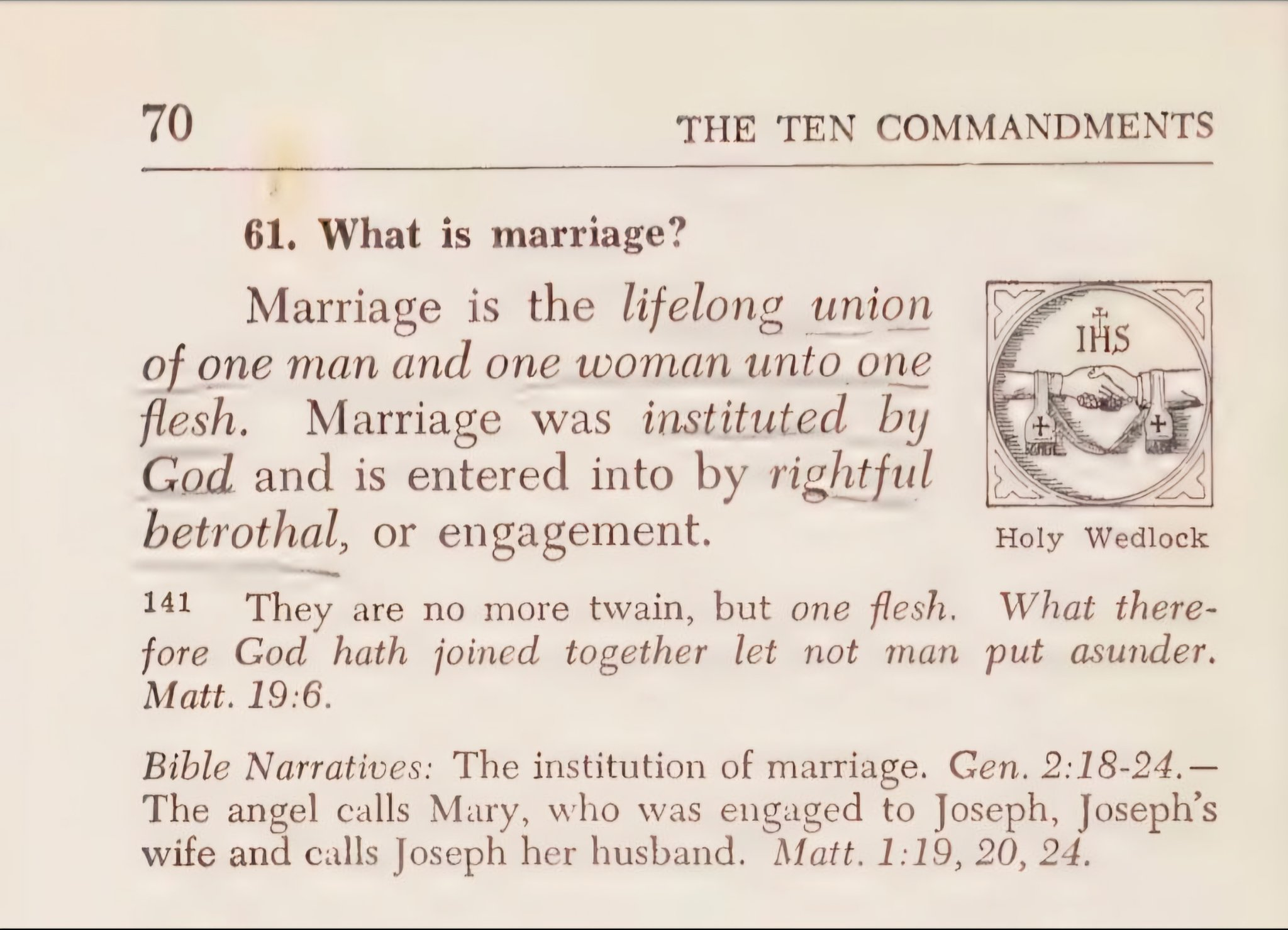
Christ loved the church, and gave himself for it. He left everything for the sake of his church, and gave to this his whole heart; he forgot his divine glory, the heavenly hosts, and all creation; and he came to us, became a man, and sacrificed himself in death, in order that he might win his bride. In baptism he sets her apart from the world, makes her pure, and adorns her with the mantle of his holiness, the proper and becoming ornament of the bride who is to stand at his side before the face of God the Father; and in the Holy Supper he nourishes her with his body and blood. She is sprung from him, as Eve from Adam; she is of his flesh and bone, and in the union with him she lives and grows. He thus wins her undivided love; he tolerates no rival in her affections, but must have her whole heart. And thus the church is in an indissoluble, everlasting, holy marriage covenant with the Lord. It is his work, and on his part everything necessary has been done; therefore the apostle speaks of the holiness of the church as already perfect.
Of this mystery the Christian marriage between man and woman is not only a symbol; it has its root in the union of Christ and the church. If this were not true, how could the apostle, as he does in our text, treat these two unions as one? The union of the Lord with sanctified mankind is the deep and eternal social idea in which all true forms of human society have their origin; and of these the marriage institution is in every respect the first. — How much of encouragement and admonition is there not in this conception of the nature of the union between the Christian man and woman! With the self-denying and self-sacrificing love of Christ the husband shall live with his wife, and help her to grow in holiness; with the tenderness and gentleness of Christ he shall carry her in his heart; and there he shall keep her, not with unclean desire or mean jealousy, but with that unselfish love which, for the sake of her own happiness, wishes her heart to be his. And the woman shall trustfully and gladly give herself into her husband’s keeping; esteem him highly for Christ’s sake, in spite of his human infirmities; be his faithful helpmeet; and “in that which is not corruptible, even the ornament of a meek and quiet spirit,” let her make of his house a home of peace, the place of all on earth the best, for the husband. It is a great problem, but it will pay well to work it out. Let none lose heart who believes in Christ. You dwell in the same house with him; he is your wedded husband, who nourishes and strengthens you with his life.
Dear Lord Jesus, we thank thee for thy great grace. Give us thy Spirit, that we may believe; and quicken and sanctify us in thee. Amen.*
Renew my will from day to day,
Blend it with thine, and take away
All that now makes it hard to say,
Thy will be done!
Then, when on earth I breathe no more
The prayer oft mixed with tears before,
I’ll sing upon a happier shore,
Thy will be done!
* Here the head of the family says a short morning or evening prayer in his own words, and closes with the Lord’s Prayer and the Benediction. This is to be done every day. If the stanzas are not sung, they may be read in their proper place before the impromptu petition and the Lord’s Prayer.

Leave a Reply