A German translation of both the Lutheran and Missionary introduction and Bachman’s original letter appear in Lehre und Wehre, Volume 11 (1865), pp. 360-375. Here I publish the original English with the only portions I have translated from German in italics.
Dr. Bachman’s Vindication for an accusation published against him in the “Lutheran and Missionary”
This interesting document, which we believe we must not withhold from our readers, is introduced in the “Lutheran and Missionary” of October 26th with the following words:
“The letter of Dr. Bachman, which we give this week, will be read, doubtless, by many with deep and painful interest. We have given it entire, though there is much in it, which we heartily wish had not been written. But the venerable age and the commanding position of Dr. Bachman, not alone in our Church, but as one whose scientific renown is as wide as Christendom, entitle him to a hearing in just such form, as he may deem best. We think that Dr. Bachman has utterly erred in one inference which he draws and presses,–that is that there is a widespread spirit of personal hostility towards the South in our church in the North. The very opposite is the prevalent feeling. Men reach conclusions on such points too readily upon their judgment on individual cases. We must not, on mere presumptions, throw away any thing which tends to our Church unity, but must labor for the peace of Zion, till God either blesses her with it, or shows that our working is hopeless.
At the time the charges against Dr. B. were repeated by our correspondent (they had not only been made before, but, we believe, had been in print,) we expressed our conviction that they were groundless, and pointed out their internal improbability. We are assured by Mr. Hutter, that his reasons for making the statements are such as would justify him before his friends and the world. There is one large part of Dr. B.’s letter in which we are sure all will rejoice. It is that in which he so utterly repudiates the conduct and feelings imputed to him. And even the portions of his letter which speak of excesses and evils connected with our military operations are well worth pondering, as they show how awful are the evils connected with the most necessary war, and intensify our sense of the criminality of those who causelessly forced our nation into it.”
Dr. Bachman’s Vindication.
Rev. E. W. Hutter:–Rev. Sir:–In the “Lutheran and Missionary” of the 27th of july, 1865, I perceive an article headed “Southern Lutheran Church,” under your signature, dated Philadelphia, July 20th, 1865, one paragraph of which demands some notice from me. The bad taste betrayed in the whole article, drawing its illustrations from the “barn-yard,” the “kitchen,” and “finny prize floundering in the net” is not the greatest objection, neither am I disposed to consume theme by criticizing your prejudiced comparison between your northern and our southern Synods. It is the spirit and manner of the whole article.,–the narrow, one-sided views, the censorious, illiberal remarks, and the bitter personalities betrayed, that characterize the temper of the writer.
I would here just remark, that your discussions whether the Northern General Synod will, or will not, receive the Southern Churches into their body, are premature, inasmuch as it appears to me it would be wiser policy first to ascertain whether they have evinced any disposition to be reunited. As far as I am acquainted with the sentiments of the Southern Lutheran clergy and the people, there is not one in a thousand who would for a moment entertain the slightest idea of a reunion with the northern General Synod, more especially as long as it retains such a mouth-piece as the Rev. E. W. Hutter. All, with unexampled unanimity, are in favor of retaining our present organization, and as early as possible, continuing the publication of our Book of Worship, and highly valuable Southern Lutheran.
I am quite sure that I would not have noticed this offensive article if you had stopped here. The following paragraph, however, as it refers to me, personally, calls upon me for something more than a passing notice.
“By one of the most eminent citizens of Charleston, a native and life-long resident of that city, we recently were favored with an item of intelligence concerning Dr. Bachman, the first received by us since the fall of 1860, when he so profanely invoked the divine blessing on the South Carolina ordinance of secession. To show what a melancholy change has been wrought in the doctor’s spirit, only about two months ago, although besought by prayers and tears, he refused to administer the holy supper to a dying Union Lutheran soldier. Rather than not receive it at all, the expiring hero accepted it from a Roman Catholic priest! We have the same authority too, for stating that, than this same Dr. Bachman, so man in Charleston gloated so openly over the barbarities inflicted on our prisoners.”
Here we have a charge penned by yourself and printed by the editors of the LUTHERAN AND MISSIONARY reflecting on my character as a clergyman, which, if true, would destroy my usefulness and render me the scorn and contempt of all Christian men. I am accused, 1st, of withholding the communion from a dying man on political grounds. 2dly, “Of openly gloating over the barbarities inflicted on our prisoners.”
Now, Rev. Sir, I pronounce these charges, made and published by yourself, vindictive, malicious, and unmitigated falsehoods. I never was besought “by prayers and tears to administer the holy communion to a dying Union soldier.” I never heard of “the expiring hero,” or of “the Roman Catholic priest” to whom this pious office was assigned. The paper in which these vindictive charges were made, and which you ought in justice to have sent to me, reached me through the mail, having been sent by a friend. You might have easily satisfied yourself, and saved yourself much trouble, by writing a line to me. You would then have had both statements before you. You say this occurred only two months ago. Your article was dated July 20th; consequently, it must have been some time in May when you state that I refused the communion to this imaginary “dying hero,” and when to render the episode more impressive, according to your pathetic statement, a Catholic priest was sent for, to lighten the load of his sins on his passage to eternity. My church had long been in the “shelling district,” my people were scattered throughout the country, and I followed them on the 13th February, and did not return until the middle of May.
Since then, I have had one public communion in my church. It was largely attended by all denominations. The community had heard of the barbarities inflicted on me by the officers in General Sherman’s army, and had for several weeks yielded to the current report that I had died of my wounds. They now crowded around their blessed Master’s table, with feelings of love to the aged man who had been spared to minister at the altar, and of gratitude to God for His mercies. Among the congregation were several United States officers. From that day to this, I frequently administered the communion in private to the sick, and saw no reason to deny the ordinance to those who desired to partake of it. My rule in my whole ministerial life has been, never to administer the communion to the sick without an examination into their state of preparation to receive it. They must have penitence, faith in the Saviour, and resolve to live Christian lives. Hence, I have always regarded the old German practice of depending on communion on a death-bed as savoring of superstition–looking on it as a salvo for sin.

During the war, I administered the communion to several hundred sick soldiers of both armies. I naturally saw more of those who belonged to the confederate than the United States army. In no cases were their political opinions allowed to sway my judgment; but in every case, the requisites to the worthy communicant were carefully examined. Whilst during the long period of four years I either postponed or rejected a few applicants for the communion among the sick in the confederate army, I postponed but one among the United States soldiers.
The day after the battle on Morris Island, in my usual rounds of visits to the hospitals, I was asked by a German to administer the communion to him. On inquiring into his life and conduct, he informed me that he had been engaged in breaking the locks and rifling the drawers of rebel ladies on the islands, had taken a considerable quantity of children’s clothes and silver spoons, and that he had stolen some from his fellow-soldiers, and that his Colonel had sent all to New York, whence they would go to his wife and children in New Hampshire. He thought he had sent enough to last for several years. I asked him whether he was willing to make restitution for his robberies, particularly the articles stolen from his fellow-soldiers. He said, ‘no’; his Colonel had told him that he had a right to take any thing from the rebel ladies, and that he had grabbed from them as much as he could get, and that the soldiers all stole from one another. He said he had, in common with the officers and soldiers, up to the time of the battle, lived in criminal intercourse with the negro women in the camp; and he was, moreover, a terrific swearer, even on what he feared was his dying bed. I perceived, and was so informed by the surgeon, that his wound was not mortal; and I allowed him to consider himself in danger of death and of hell, hoping that his very terrors might lead him to repentance and amendment.
When I arrived on the next day, he had been sent away as a convalescent, and I did not see him again. If this was the dying Union Lutheran soldier, the expiring hero, whom you refer to, you may still have an opportunity of administering to him the “holy supper” in your own way. The army is now disbanded, and you may find him at home in New Hampshire. Please ask him whether he did not say to me, before I left him, that “he felt that he was not fit for the communion then, but would try to be a better man and be better prepared for it.”
The only other case where the communion was referred to, was that of a German who had been shot through the lungs; and believing his wound to be mortal, I in my daily visits to the hospital apprised him of his danger, and the almost certainty of his death. He said that he had not been inside of a church for seven years, and if he was to die, then, “by Gott,” he must have the sacrament; but if he was not to die, he swore he would not take it from any “Pfaff” in the land. He did not ask me to administer it. His comrades informed me that five of the seven years in which he had been in this country had been spent in a Western Penitentiary, where he had been enlisted for the war. His companions-in-arms represented him as the most quarrelsome, profane, and thieving villain they had ever known. I asked him if he wished to be prayed for. He said he did not understand English well enough. “Will you have a German prayer?” He shook his head.
The next morning, I visited the hospital again, when a most revolting spectacle was presented. A wounded Lieutenant, who had been in command of a black company, (his Captain having been killed,) was lying in a cot opposite to that of the German. They had just had a quarrel and a fight, the German insisting that he had been fighting for the Union, whilst his opponent had been fighting for the negro. The Lieutenant was unable to rise; but the German had crawled out of his bed and beaten the officer unmercifully, and the German had been forced back to his bed, growling, and cursing horribly. It was at this moment I entered the ward. I was told that in his rage the German had enlarged the rupture in the wounded blood-vessel. He was in too great a passion to speak with me, and I left him cursing. On the subsequent morning the Lieutenant was dead, and I performed his funeral service. On the same afternoon, the German died and was buried. If this “jail-bird” is the “expiring hero” you refer to, you may canonise him in the overflowing of your patriotism and the bitterness of your fanatical fury; but be assured that he called for neither Protestant nor Catholic priest, and died without a sign.
Up to this day, I have never refused to visit any United States soldiers, etc., and am still engaged in administering the instructions and comforts of religion to all who send for me. ‘Tis true, I cannot discharge these duties as quickly and with as much comfort to myself as I once did. I am compelled to travel miles on foot to visit the hospitals: all my means of conveyance have been taken from me. In my large congregation, all the carriages and horses, including those of the aged, widow, and non-combatant, were seized by the Government: there is but one left, which was saved by being claimed as British property: it has no horses, and therefore is of no service.
President Lincoln, by his Proclamation, tendered free pardon, with restoration of the right of property, except that of slaves, to all who should take the oath to support the United States Government. That oath has been taken by all of us. But what has been the result? We were told to identify our property. My carriage, buggy, and the barouche of a benevolent widow, were by an order from General Hatch, taken from my premises, which were occupied by an English family with the protection of the Consul, and were not, in any sense of the word, what could be construed as abandoned property. When I inquired about the buggy, which I needed most, I was sent from one office to another–from post to pillar–for a few days, until time was afforded to send them to Hilton Head. I wrote to Hilton Head, but was informed that it was shipped to New York. My carriage I found in a depot in the city; but when the men placed as guard ascertained that it was mine, they ordered me away and locked the door. That night they removed the pole, the cushions, and wheels; and by these manoeuvres, I am left without any conveyance.
Pictures, bedding, a clock, etc., were taken from my house by Rev. Mr. French, who had speculated largely and profitably among the poor negroes, in urging them to be married over again, at only a dollar and two candles a pair. Many had no objection to the change, and in the state of utter demoralization of the negro, have been married several times since, enjoying their freedom ad libitum. I was sent from one office to another. Whilst thus amused, my articles, which I had detected in my neighborhood in the house of the United States officers, were removed to the Pavilion Hotel. I followed them there, and was told to write to the Treasury Department, and my goods would be restored. I wrote accordingly, but received no answer until a month had elapsed. I then went for the articles, but was refused even to enter the room where they were stored. The women of the officers had selected what they wanted: the remainder, which was of but little value, was sold at auction. What became of the proceeds, let the heads of the Government inquire.

Certain it is, that of the ten thousands of persons deprived of their property in Charleston, not a thousandth part has been recovered. We are in the situation of a certain man in the Gospel, who fell into strange company. (Luke ii. 30.) When these officials, and the ladies under their protection, return to their homes in the North, (God speed them on their way!) they will be much richer than when they came here, and, alas! the poor will be poorer still. Watches, ladies’ ornaments, silver spoons, and all manner of household furniture, etc., must by this time be at a discount in the North. The Rev. Mr. French, who made a clean sweep from the houses in my neighborhood, must by this time be a man of wealth, and General Hatch and another officer cannot be far behind. The elegant carriage of Miss Annaly could not be retained here, but was sent to the North to accommodate Mrs. Martel. Our carriages have not all disappeared from Charleston, since, although the owners cannot get them, they can see them perambulating the streets, not only with the officers, but carrying negro soldiers, and women of all colors. Many of our horses are still here, as they may be seen any afternoon tearing through the streets on their way to the race-course, their riders making the welkin ring with screams and blasphemies. When these horses are worn down in flesh, they are sent to the auction, and sold to the highest bidder. Who pockets the cash?
We were invited by a proclamation, to pay our enormous taxes by a certain day; the parties knew that they had destroyed the railroads and bridges, and captured all the carriages and horses. They refused to have these taxes paid by agents. Before we could arrive here, they closed the offices, having no one to attend to the business. Thus we have to pay additional taxes –to hire our own houses from the government officers. Thus the last dollar is taken, and the citizens reduced to beggary. We now and then see pictures in Harper’s, etc., representing the North feeding the hungry South. The representation would have been more true to nature if the cause had been stated; viz.: the previous plunder. Our situation, however, is not altogether peculiar. There is a parallel case of the Israelites under Pharoah’s iron rule. Exodus v. 7.
As an evidence of the different feelings towards me, which exist in your mind and those of the other abolitionists in the North, compared with those in this community, your own soldiers included, I would just remark that a number of officers and soldiers of the United States Army have asked the privilege of uniting with me on the solemn occasion of our communion, if they remained here, and that some from Pennsylvania and Ohio have offered themselves for confirmation. I would just add that the slanders which you have so extensively circulated, are sooner believed any where else than in Charleston.

I now proceed to your 2d charge. “We have the same authority too, for stating that than this same Dr. Bachman, no man in Charleston gloated so openly over the barbarities inflicted on our prisoners.” Here I am compelled to pause and gaze at the picture presented by the fanatic. He is narrow-minded, stern, insensible, vindictive and cruel. He appears never to have read the chapter on charity, taught us by St. Paul. He knows nothing of the law of human kindness, and the sweet charities of life. The angel of mercy seems never to have visited his cold, pulseless heart, and he becomes the slanderer of his neighbor, believing that he may thereby promote the cause which prejudice and malignity have induced him to espouse.
I have been the pastor of the same church and people for nearly fifty-one years. During that long period, when five generations have been under my ministry–the harmony that existed among us has been disturbed by no discordant sounds. When the handful of persons with which I began, had increased into three large congregations, I was under the hope that I had not been a useless laborer in advancing the interests of the Church in the South, and strove to unite discordant material which composed the old General Synod in the Northern and Middle States. I certainly did not expect that the voice of slander would reach me in the advanced period of my life, being in the 76th year of my age. Here I have lived and labored, and here I expect my remains to rest with those that loved and cherished, and clung around me from youth to age.
I defy you or your contemptible informer to produce a single case of my inhumanity–and when you publish to the world that “no man in Charleston gloated so openly over the barbarities inflicted on our prisoners, as this same Dr. Bachman,” you certainly do not place yourself in the position of a meek and lowly servant of Christ. You do not regard the command which enjoins us not to bear false witness; you drop the lamb, and assume the attitude, the growl, and the malignity of the tiger. I appeal to every virtuous citizen of Charleston, if I have not devoted my life to mitigate the evils of yellow fever, cholera and civil war. I was in Charleston during all the seasons of yellow fever, but one (when I was in Europe on account of my health.) I will venture to affirm that I have seen more cases of that disease than any man in America–having on one occasion buried forty-one victims in one day. Hundreds of times I could not find time for an hour’s repose during many long and weary nights. My own congregation, as natives, were exempt from this fever, and therefore my services were not required by them. The sufferers were in most cases the people of the North, to whom I sacrificed my days and nights–the very people over whose inflicted barbarities I am accused of gloating. During the war, I will venture to say I have visited, succored, and attended at the bed-sides of more United States prisoners, than you have done to the sick and the wounded, including both armies. Allow me here to give you a few specimens of my “gloating over the barbarities inflicted on your prisoners.” You will be able to judge what were the causes of my resentment, and how I sought revenge when it was in my power.

When Sherman’s Army came sweeping through Carolina, leaving a broad track of desolation for hundreds of miles, whose steps were accompanied with fire, and sword, and blood, reminding us of the tender mercies of the Duke of Alva, I happened to be at Cash’s Depot, six miles from Cheraw. The owner was a widow, Mrs. Ellerbe, 71 years of age. Her son, Col. Cash, was absent. I witnessed the barbarities inflicted on the aged, the widow and young and delicate females. Officers, high in command, were engaged tearing from the ladies their watches, their ear and wedding rings, the daguerrotypes of those they loved and cherished. A lady of delicacy and refinement, a personal friend, was compelled to strip before them, that they might find concealed watches and other valuables under her dress.
A system of torture was practised towards the weak, unarmed and defenceless, which, as far as I know and believe, was universal throughout the whole course of that invading army. Before they arrived at a plantation, they inquired the names of the most faithful and trust-worthy family servants; these were immediately seized, pistols were presented at their heads: with the most terrific curses, they were threatened to be shot, if they did not assist them in finding buried treasures. If this did not succeed, they were tied up and cruelly beaten. Several poor creatures died under the infliction. The last resort was that of hanging, and the officers and men of the triumphant army of Gen. Sherman, were engaged in erecting gallows, and hanging up these faithful and devoted servants. They were strung up until life was nearly extinct, when they were let down, suffered to rest awhile, then threatened and hung up again. It is not surprising that some should have been left hanging so long that they were taken down dead. Coolly and deliberately these hardened men proceeded on their way, as if they had perpetrated no crime, and as if the God of Heaven would not pursue them with his vengeance.
But it was not alone the poor blacks (to whom they professed to come as liberators) that were thus subjected to torture and death. Gentlemen of high character, pure and honorable and gray-headed, unconnected with the military, were dragged from their fields, or their beds, and subjected to this process of threats, beating and hanging. Along the whole track of Sherman’s army, traces remain of the cruelty and inhumanity practiced on the aged and the defenceless. Some of those who were hung up, died under the rope, while their cruel murderers, have not only been left unreproached and unhung, but have been hailed as heroes and patriots. The list of those martyrs whom the cupidity of the officers and men of Sherman’s army sacrificed to their thirst for gold and silver, is large and most revolting. If the editors of this paper will give their consent to publish it, I will give it in full, attested by the names of the purest and best men and women of our Southern land.
I, who have been a witness to these acts of barbarity that are revolting to every feeling of humanity and mercy, was doomed to feel in my own person, the effects of the avarice, cruelty, and despotism which characterized the men of that army. I was the only male guardian of the refined and delicate females who had fled there for shelter and protection. I soon ascertained the plan that was adopted in this wholesale system of plunder, insult, blasphemy and bestiality. The first party that came, was headed by officers, from a colonel to a lieutenant, who acted with seeming politeness, and told me that they only came to secure our fire-arms, and when these were delivered up, nothing in the house should be touched. Out of the house, they said they were authorized to press forage for their large army. I told them that along the whole line of the march of Sherman’s army, from Columbia to Cheraw, it had been ascertained that ladies had been robbed and personally insulted. I asked for a guard to protect the females. They said that there was no necessity for this, as the men dared not act contrary to orders. If any did not treat the ladies with proper respect, I might blow their brains out. “But,” said I, “you have taken away our arms, and we are defenceless.” They did not blush much, and made no reply.
Shortly after this, came the second party, before the first had left. They demanded the keys of the ladies’ drawers–took away such articles as they wanted, then locked the drawers and put the keys in their pockets. In the mean time, they gathered up the spoons, knives, forks, towels, table-cloths, etc. As they were carrying them off, I appealed to the officers of the first party–they ordered the men to put back the things; the officer of the second party said he would see them d—-d first, and without further ado, packed them up, and they glanced at each other and smiled. The elegant carriage and all the vehicles on the premises, were seized and filled with bacon and other plunder. The smokehouses were emptied of their contents, and carried off. Every head of poultry was seized and flung over their mules, and they presented the hideous picture in some of the scenes in the forty thieves. Every article of harness they did not wish for their own use, was cut in pieces. By this time, the first and second parties had left, and a third appeared on the field; they demanded the keys of the drawers, and on being informed that they had been carried off, coolly and deliberately proceeded to break open the locks–took what they wanted, and when we uttered a word of complaint were cursed. Every horse, mule, and carriage, even to the carts, were taken away, and for hundreds of miles, the last animal that cultivated the widow’s corn-field, and the vehicles that once bore them to the house of worship, were carried off or broken in pieces and burned.
The first party that came promised to leave ten days’ provisions, the rest they carried off. An hour afterwards, other hordes of marauders from the same army came and demanded the last pound of bacon and the last quart of meal. On Sunday, the negroes were dressed in their best suits, they were kicked, and knocked down and robbed of all their clothing, and they came to us in their shirt-sleeves, having lost their hats, clothes and shoes. Most of our own clothes had been hid in the woods; the negroes who had assisted in removing them, were beaten and threatened with death, and compelled to show them where they were concealed. They cut open the trunks, threw my manuscripts and devotional books into a mud-hole, stole the ladies’ jewelry, hair ornaments, etc.; tore many of the garments into tatters, gave the rest to the negro women to bribe them into criminal intercourse. These women afterwards returned to us those articles, that after the mutilations, were scarcely worth preserving. The plantation, of 160 negroes, was some distance from the house, and to this place successive parties of fifty at a time resorted for three long days and nights, the husbands and fathers being fired at and compelled to fly to the woods.

Now commenced scenes of licentiousness, brutality, and ravishment, that have scarcely had an equal in the ages of heathen barbarity. I conversed with aged men and women, who were witnesses of these infamous acts of Sherman’s unbridled soldiery, and several of them, from the cruel treatment they had received, were confined to their beds for weeks afterwards. The time will come, when the judgment of Heaven will await these libidinous, beastly barbarians. During this time, the fourth party, who, I was informed by others, we had the most reason to dread, had made their appearance. They came, as they said, in the name of the great General Sherman, who was next to God Almighty. They came to burn and lay in ashes all that was left: they had burned bridges and depots, cotton-gins, mills, barns and stables. They swore they would make the d—-d rebel women pound their corn with rocks, and eat their raw meal without cooking; and they succeeded in thousands of instances. I walked out at night, and the innumerable fires that were burning as far as the eye could reach, in hundreds of places, illuminated the whole heavens, and testified to the vindictive barbarity of the for. I presume they had orders not to burn occupied houses, but they strove all in their power to compel families to fly from their houses, that they might afterwards burn them. The neighborhood was filled with refugees, who had been compelled to fly from their plantations on the sea-board. As soon as they had fled, the torch was applied, and for hundreds of miles those elegant mansions, once the ornament and pride of our Island country, were burnt to the ground.
All manner of expedients were now adopted to make the residents leave their homes for the second time. I heard them saying, “This is too large a house to be left standing, we must contrive to burn it.” Canisters of powder were placed all around the house, and an expedient resorted to that promised almost certain success. The house was to be burned down by firing the out-buildings. These were so near each other that the firing of the one would lead to the destruction of all. I had already succeeded in having a few bales of cotton rolled out of the building, and hoped, if they had to be burned, the rest would also be rolled out, which could have been done in ten minutes, by several hundred men who were looking on, gloating over the prospect of another elegant mansion in South Carolina being laid in ashes. The torch was applied, and soon the large store-house was on fire; this communicated to several other buildings, in the vicinity, which one by one were burned to the ground. At length the fire reached the smoke-house, where they had already carried off the bacon of 250 hogs; this was burnt, and the fire was now rapidly approaching the kitchen, which was so near the dwelling-house, that should the former burn, the destruction of the large and noble edifice would be inevitable.
A captain in the United States service,–a native of England,–whose name I would like to mention here, if I did not fear to bring down upon him the censure of the abolitionists, as a friend to the rebels,–mounted the roof, and the wet blankets we sent up to him, prevented the now smoking roof from bursting into flames. I called for help to assist us in procuring water from a deep well; a young lieutenant stepped up, condemned the infamous conduct of the burners, and called on his company for aid; a portion of them came cheerfully to our assistance; the wind seemed almost by a miracle to subside; the house was saved, and the trembling females thanked God for their deliverance. All this time, about 100 mounted men were looking on, refusing to raise a hand to help us; laughing at the idea that no efforts of ours could save the house from the flames.
Mr. Hutter, allow me to ask you who are the most criminal? the men who were rejoicing that a house was to be burned, and women and children be deprived of a shelter and a home, and driven into the woods, or he who slanders an aged clergyman of his own church, and would bring down upon him the odium of all good men, when he had it fully in his power to ascertain that the whole invention was an infamous slander, concocted by the mean, the worthless, and the malicious, for the purpose of getting offices and money?
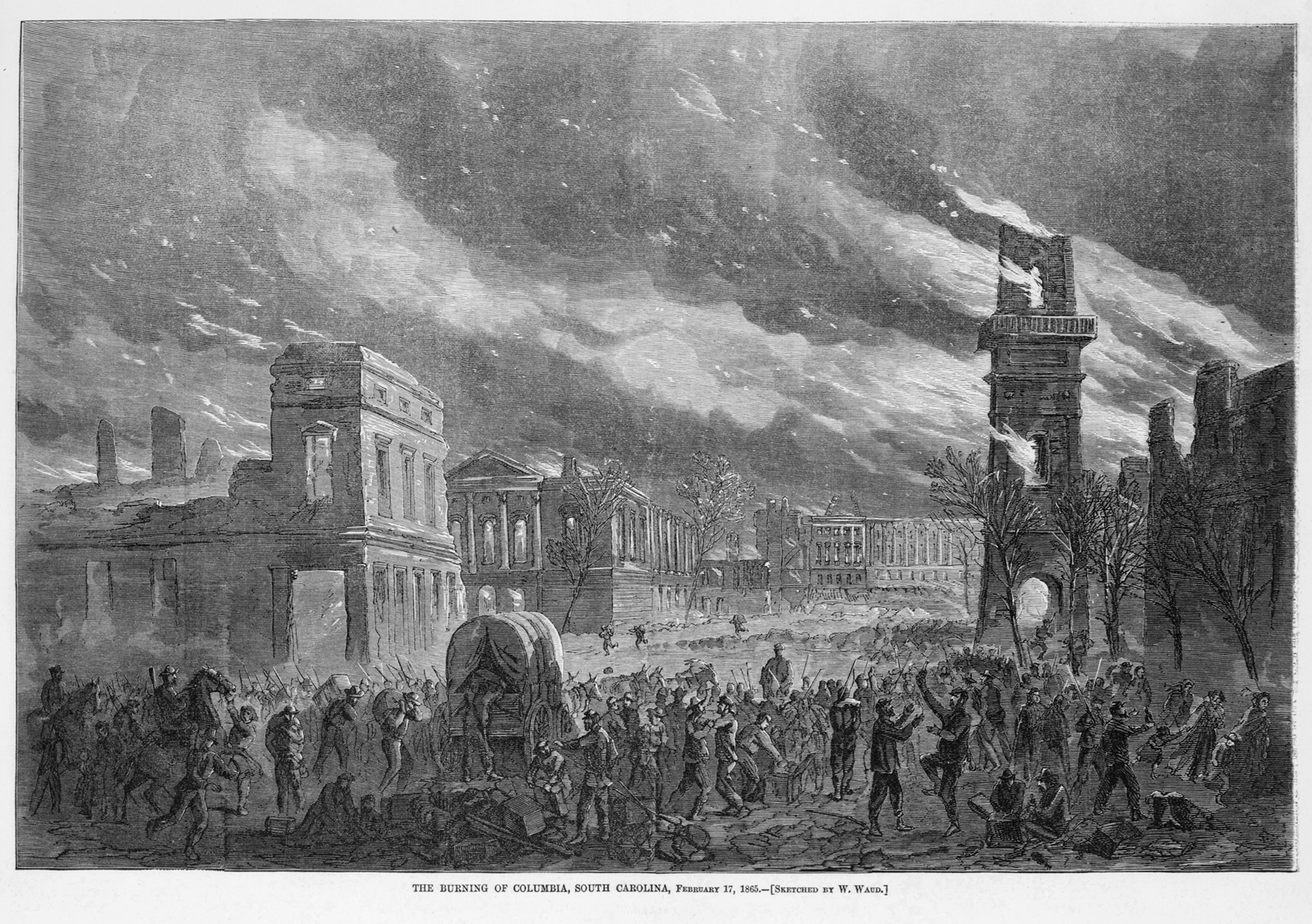
My trials, however, were not yet over. I had already suffered much in a pecuniary point of view. I had been collecting a library on Natural History during a long life. The most valuable of these books had been presented by various Societies in England, France, Germany, Russia, etc., who had honored me with membership, and they or the authors presented me with these works, which had never been for sale, and could not be purchased. My herbarium, the labor of myself and the ladies of my house for many years was also among these books. I had left them as a legacy to the library of the Newberry College and concluded to send them at once. They were detained in Columbia and there the torch was applied, and all were burned. The stealing and burning of books appear to be one of the programmes on which the army acted. I had assisted in laying the foundation and dedicating the Lutheran church at Columbia, and there, near its walls, had recently been laid the remains of one who was dearer to me than life itself. To set that brick church on fire from below was impossible. The building stood by itself, on a square but little built up. One of Sherman’s burnerss was sent up to the roof. He was seen applying the torch to the cupola. The church was burned to the ground, and the grave of my loved one desecrated. The story circulated that the citizens had set their own city on fire, is utterly untrue, and only reflects dishonor on those who vilely perpetrated it. Gen. Sherman had his army under control. The burning was by his orders, and ceased when he gave the command.
I was now doomed to experience in person the effects of avarice and barbarous cruelty. These robbers had been informed in the neighborhood that the family which I was protecting had buried $100,000 in gold and silver. They first demanded my watch, which I had effectually secured from their grasp. They then asked me where the money had been hid. I told them I knew nothing about it, and did not believe that there was a thousand dollars’ worth in all–and what there was had been carried off by the owner, Colonel Cash. All this was literally true. They then concluded to try an experiment on me which had proved so successful in hundreds of other instances. Coolly and deliberately they prepared to inflict torture on a defenceless, gray-headed old man.
They carried me behind a stable, and once again demanded where the money was buried, ot “I should be sent to hell in five minutes.” They cocked their pistols and held them to my head. I told them to fire away. One of them, a square-built, broad-faced, large-mouthed clumsy Lieutenant, who had the face of a demon, and who did not utter five words without an awful blasphemy, now kicked me in the stomach, until I fell breathless and prostrate. As soon as I was able, I rose again. He once more asked me where the silver was. I answered, as before, “I do not know.” With his heavy elephant foot he now kicked me on my back until I fell again. Once more I arose, and he put the same question to me. I was nearly breathless, but answered as before. Thus was I either kicked or knocked down seven or eight times. I then told him it was perfectly useless for him to continue his threats or his blows. He might shoot me if he chose. I was ready, and would not budge an inch–but requested him not to bruise and batter an unarmed, defenceless, old man.
“Now,” said he, “I will try a new plan. How would you like to have both arms cut off?” He did not wait for an answer, but, with his heavy sheathed sword, struck me on my left arm, near the shoulder. I heard it crack; it hung powerless by my side, and I supposed it was broken. He then repeated the blow on the other arm. The pain was excruciating, and it was several days before I could carve my food or take my arm out of a sling,–and it was black and blue for weeks. (I refer to Dr. Kollock, of Cheraw.) At that moment, the ladies, headed by my daughter who had only then been made aware of the brutality being practised upon me, rushed from the house, and came flying to my rescue. “You dare not murder my father,” said my child. “He has been a minister in the same church for fifty years, and God has always protected and will protect him.” “Do you believe in a God, Miss?” asked one of the brutal wretches “I don’t be- lieve in a God, a heaven, nor a hell.” “Carry me” said I, “to your General.” I did not intend to go to General Sherman, who was at Cheraw, from whom, I was informed, no redress would be obtained, but to a General in the neighborhood, said to be a religious man. Our horses and carriages had all been taken away, and I was too much bruised to be able to walk. The other young officers came crowding around me, very officiously, telling me that they would represent my case to the General, and that they would have him shot by ten o’clock the next morning. I saw the winks and glances that were interchanged between them. Every one gave a different name to the officers. The brute remained unpunished, and I saw him on the following morning, as insolent and as profane as he had been on the preceding day.
As yet no punishment had fallen on the brutal hyena, and I strove to nurse my bruised body and heal my wounds, and forget the insults and injuries of the past. A few weeks after this I was sent for to perform a parochial duty, at Mars Bluff, some twenty miles distant. Arriving at Florence, in the vicinity, I was met by a crowd of young men connected with the militia. They were excited to the highest pitch of rage, and thirsted for revenge. They believed that among the prisoners that had just arrived on the railroad car on their way to Sumter, were the very men who had committed such horrible outrages in the neighborhood. Many of their houses had been laid in ashes. They had been robbed of every means of support. Their horses had been seized; their cattle and hogs bayoneted; their mothers and sisters had been insulted, and robbed of their watches, ear and wedding rings. Some of their parents had been murdered in cold blood. The aged pastor, to whose voice they had so often listened, had been kicked and knocked down by repeated blows, and his hoary head had been dragged about in the sand.
They entreated me examine the prisoners and see whether I could identify the men that had inflicted such barbarities on me. I told them I would do so, provided they would remain where they were and not follow me. The prisoners saw me at a distance–held down their guilty heads, and trembled like aspen leaves. All cruel men are cowards. One of my arms was still in a sling. With the other I raised some of their hats. They all begged for mercy. I said to them, “The other day you were tigers–you are sheep now.” But a hideous object soon arrested my attention. There sat my brutal enemy–the vulgar, swaggering Lieutenant, who had rode up the steps of the house, insulted the ladies, and beaten me most unmercifully.
I approached him slowly, and, in a whisper, asked him, “Do you know me, sir–the old man whose pockets you first searched, to see whether he might not have a penknife to defend himself, and then kicked and knocked him down with your fist and heavy scabbard?” He presented the picture of an arrant coward, and, in a trembling voice, implored me to have mercy:–Don’t let me be shot; have pity! Old man, beg for me! I won’t do it again! For God’s sake, save me! Oh, God, help me!” “Did you not tell my daughter there was no God? Why cry to him now?” “Oh, I have changed my mind; I believe in a God now.” I turned and saw the impatient, flushed and indignant crowd approaching. “What are they going to do with me?” said he. “Do you hear that sound, click, click?” “Yes,” said he, “they are cocking their pistols.” “True,” said I; “and if I raise a finger, you will have a dozen bullets through your brain.” “Then I will go to hell; don’t let them kill me. Oh, Lord, have mercy!” “Speak low,” said I, “and don’t open your lips.” The men advanced. Already one had pulled me by the coat “Show us the men.” I gave no clew by which the guilty could be identified. I walked slowly through the car, sprang into the waiting carriage and drove off.
Rev. E. W. Hutter, this is the way in which I have “gloated over the barbarities inflicted on the prisoners.” This is the man whom you have wantonly and cruelly traduced. I defy you or any one else to produce a single instance to the contrary in my whole conduct, from the beginning to the close of the war.
I claim, as an act of justice, that you send me the name of your author, whom you call one of the most eminent citizens in Charleston–a native and life-long resident of that city, whom you have given us as authority for the slanders which you have perpetrated against me. I defy you to produce the name of a single “eminent citizen” who will dare, in the face of this community, to make the assertion which you have in such a cowardly and unchristian manner published to the world. When that name shall be ferreted out, I will venture to predict that this “eminent citizen of Charleston–a native and life-long resident,” will be proved to be an unprincipled, time-serving demagogue–a spy, a political turncoat, a defamer of the reputation of others, to obtain notoriety, power and money–not many degrees removed from a drunkard–a man without credit or character, and who never had either.
It is scarcely necessary to add, that I have not sought this controversy, and only defend myself when grossly and unprovokedly traduced. It should be remembered that we are here writing under surveillance, and are at the tender mercies of a Provost Marshal. The time may come when men can speak freely. Under present circumstances, it is but a contemptible, cowardly act to drag men into a discussion where the freedom of the pen is restricted to one party, and given with unbridled license to another.
Yours, &c.,
John Bachman.
Charleston, September 14th, 1865.
For further reading on the Union Army’s treatment of civilians during the war, I recommend War Crimes Against Southern Civilians by Walter Brian Cisco.