In making a previous post I realized that some of the surrounding articles might be of varying interest also, and since I couldn’t decide which to leave out, I decided to post a couple of pages worth of Der Lutheraner so that those who don’t read German well enough to do so can get an idea of what it’s like to peruse a portion of that publication.
The following is a continuous sequential selection from pages 37-39 of Der Lutheraner vol 28 (1871) No. 5 (December 1).
The Times of the Church
The obligation to adhere to the confessions, which is required of every Lutheran preacher upon assuming office, has often been loudly decried by local sects as a form of confessional and conscience coercion, yet these sects do the same. Indeed, in the “Christian Messenger” of November 15, we read that the “Evangelical Association” (the so-called Albrechtsleute) requires every teacher in their theological institutions to sign a declaration, not only upon taking office but also annually thereafter in the presence of the board of trustees: “I hereby solemnly promise to uphold and maintain the constitution of the Biblical Institute” (as they call their preachers’ seminary) “as a school of biblical theology in accordance with the doctrines and church order of the Evangelical Association, and I will teach nothing that is incompatible with or could undermine these doctrines and church order, as long as I am employed as a teacher at the Institute.” The trustees must also sign the first part of this. We do not criticize this, but we declare that it is inconsistent and unjust for the sects to complain about the fact that in the Lutheran Church, too, every teacher is strictly bound to its doctrinal confession. W[alther].
The General Council, at its last meeting on November 2 and the following days, did not make a definitive statement regarding the “four points,” despite the request of the Michigan Synod, but referred the matter to the district synods. The Iowa Synod, however, has not abandoned its “waiting stance” toward the Council; rather, it has declared that, despite remaining outside the door of the distinguished assembly (seemingly influenced by the unfortunate oversight of the Missouri Synod), it is “determined to stand by the Council through thick and thin,” as reported by the “Lutheran” on November 16. This may seem puzzling to some, but not to us; this behavior is, in fact, quintessentially Iowan. W[alther].
Canada. From the “Lutheran People’s Paper”, published by pastors of our synod in Canada, we learn that the local Missouri Special Conference has resolved to propose a three-day free conference in Berlin (Canada) to discuss doctrinal differences with the pastors of the Canada Synod. Pastor A. Ernst in Elmira announces this on behalf of the Special Conference, suggesting that the free conference take place on January 16, 1872, and the following days. May God grant grace and success to our dear brothers in the neighboring country for their godly endeavor, in the name of Christ! W[alther].
Insurance Companies. The “Joyful Messenger” of November 7 expresses the following view on insurance companies: “In our day, it has become fashionable to place much trust in people and to rely on flesh as one’s strength, thereby turning the heart away from the Lord. This category includes the various insurance companies, both fire and life insurance. When one faces distress or trouble, insurance companies are supposed to help; if a house burns down or someone dies, fire and life insurance step in. In itself, there may be nothing wrong with this, and it may often help people in times of need, but it frequently becomes a snare, leading to a sense of security and distrust in God. The great fire in Chicago has once again proven that all such institutions are unreliable. The vast majority of fire insurance companies have gone bankrupt, and the insured receive nothing or very little. The same applies to life insurance companies as a whole. It may be that they help some in times of need, but, for example, if a plague or other contagious disease sweeps away thousands upon thousands, how will they survive? They must fail just as surely as the fire insurance companies. We believe that a Christian should place his entire trust in God, do his duty, and trust in God’s rule, as the ancients did before modern insurance companies became God’s representatives on earth. For someone without faith in God, it may be fitting to rely on human inventions and speculations. For our part, however, we trust that our God will continue to provide for us and our descendants as He has done thus far.”
The Old New York Synod, which still bears the misleading title “New York Ministerium,” as if only pastors are represented in it and laypeople are excluded, passed a highly dangerous resolution during its last session. Since several congregations have separated from this body in recent years for the sake of the confession, a law was enacted to prevent such occurrences in the future, stating that no congregation may amend its constitution without the approval of the synod’s president. Now the synod may decide whatever it wants; it may fall into false doctrine as it pleases, yet no congregation, even if it must reject the synod’s teachings, is allowed to separate from it. How does this align with God’s Word, such as Titus 3:10? The New York Synod must at least admit that it is capable of falling into error. The notions of synodical fellowship in the New York Synod must indeed be peculiar. Unity in faith and the resulting conduct does not seem to be required, only the adoption of the same constitution and church governance. “Just like us,” the great unionist Hoffmann in Berlin would say. Thank God that in America, such attempts to bind congregations have little chance of actual enforcement! For if a congregation wishes to separate for the sake of conscience, no person, and least of all such a paragraph, can force it to remain in its previous affiliation. This is what happens when people prioritize not the truth and unity in it, but rather amassing the largest possible group. If a congregation leaves the General Synod and joins the Council, it is welcomed with joy. But if another wishes to leave the Council and join, say, the Missouri Synod, efforts are made to hold it back against its will. Why? Well, “that’s an entirely different matter.” (Wisconsin Congregation Paper.)
The Roman Idol. On September 16, at the opening of the Westphalian Synod, Royal Commissioner General Superintendent Dr. Wiesmann reported that the following was recently said verbatim from a Catholic pulpit: “Our songs rejoice in him, millions of Christians call out to him with a thousand voices” (why not a million voices?) “Honor and praise to the Holy Father, eternal glory and splendor to the one who sits on the throne of God; Hosanna!” A church weekly paper, “La Semaine religieuse de Tournai” in Belgium, condemns the indecision of the Catholic ministry and fabricates the following sentence: “The living Christ is the one to whom it was said: I am with you always; whoever hears you hears me, whoever rejects you rejects me—the one in whose infallible mouth the incarnation of the Word continues on earth, the holy old man [der heilige Greis] whose throne has been transformed into a Golgotha.” This was calmly accepted in Belgium without any objection. For the infallibility of a human necessarily presupposes the attribution of divine qualities. (Münkel’s New Times.)
A Form of Usury is, as is well known, often practiced by those who rent out houses. The “Pilgrim” recounts the following incident about a Berlin usurer of this kind: “A few days ago, a well-to-do citizen and homeowner celebrated his birthday in a grand manner; various gifts arrived, including a small, well-sealed, and locked box delivered by the postman. The recipient opened it with joy, but who can describe his shock when he pulled out a rope with a note attached bearing the less-than-flattering inscription: ‘Take this rope, you old miser, as a reminder of the fate awaiting you, for you shall one day be hanged as punishment for the endless rent increases with which you have plagued your tenants.’”
A Testimony to the Corruption currently prevailing in our land was recently given by the Episcopal preacher Dr. Morgan Dix in Trinity Church, New York. According to the “American Messenger”, he spoke on Galatians 5:24, “Those who belong to Christ have crucified the flesh with its passions and desires,” saying: “Who belongs to Christ? Those who have crucified their flesh with its passions and desires. Where are they to be found? I pose this question with a secret anxiety, for I ask it today, in this land and in this time, where people’s first and last thought seems to be to have what they desire, to do what they desire, to read what they desire, to go where they desire, to believe what they desire, to speak what they desire. In this fateful age, where vice flaunts itself in scarlet robes on every corner; where the drunkard staggers, the subject of light jest for neighbors; where the harlot presses herself upon us at our own doorstep; where money is squandered like water on the most useless luxuries; where the moral sense of the people sinks like the mercury in a barometer before a storm; where base souls and inferior minds hold the most influential offices; where the voice of the common, ignorant, and vicious mob elects our rulers; where religion is driven out of schools, and the youth grow up in habits of lawlessness and in a spirit of rebellion against parental authority; where the lives of those who profess Christ are indistinguishable from the confession of the children of this world; where no one hesitates to read the blasphemies of unbelievers and the ravings of freethinkers; where people choose their church as they would a club or a society, and hire a preacher as one would hire a servant; where no one seems to feel they are under a law and have a Lord who can destroy body and soul for eternity; where the only inclination of the time is self-will, the only passion is pleasure, and the great goal is money! In this age, I ask: Where are those who belong to Christ? Where are the crucified? Where are the crosses? Where are the humble who tremble at His word? Where are the simple who renounce their own wisdom and righteousness? Where are the meek whose walk is in heaven?” Excellent! W[alther].
A Screw Loose in the Odd Fellows Order. The Columbus “Lutheran Church Newspaper” of November 15 writes as follows: In the November issue of “The Odd Fellow”, we find an interesting article titled “The Puritans in Our Midst.” This article bitterly complains that in some lodges of the order, there are rather ugly machinations by the “temperance advocates,” particularly directed against the freer views and lifestyles of the German brothers. The injustice of this conduct by the Puritan brothers toward the other, more open-minded Odd Fellows is sharply criticized in the article, so sharply that the writer, in his zeal, forgets the usual caution of the brotherhood to cover up its flaws and bluntly spills the beans. We quote the conclusion of the article here: “I am well aware that I have used language here that is anything but refined and unbecoming of a good Odd Fellow. But I ask: Who can remain indifferent when he sees that religious tendencies hostile to our noble principles are forcing their way into the heart of our beloved order, threatening to deal it a deathblow sooner or later? (The above sentence structure is obviously faulty, but we copy it as we found it.) Truly! One could exclaim with Orsina in Lessing’s “Emilia Galotti”: ‘Good Odoardo, he who does not lose his reason over certain things has none to lose.’ Therefore, I would advise those Puritans, if the pillars of the Odd Fellowship are at all sacred to them, to abandon their nonsensical behavior before it is too late. For already, some are beginning to feel no longer proud of an order that harbors such sectional elements; soon, however, they will start to be ashamed of it if these machinations spread further.” Well—this is not bad at all, that the Odd Fellows (or “the foolish blokes,” as the Prussian Minister von Eulenburg calls them in his response to a lodge in Berlin requesting permission to establish itself) are beginning to feel ashamed of their order. It has long deserved this. “E.S.”
Shortage of Preachers. Loud complaints about a shortage of preachers are currently being heard in both Germany and America. The “Lutheran Visitor” from Columbia, South Carolina, dated November 10, also laments this greatly. After reporting how urgently but vainly English-Lutheran preachers are needed in Kansas, Louisiana, Florida, Arkansas, etc., it continues: “Can our readers, young and old, receive these sad facts, which accuse us as Evangelical Lutherans, without being moved? God plants the Lutheran seed throughout the land, but the church neglects it, and so it dies out. We are invited to go out and take possession of the land, but we hesitate, delay, and some outright refuse to go. Recently, a preacher said to us: ‘I want a position.’ — ‘Will you go to Florida?’ — ‘No!’ was the reply. Another said to us: ‘I am in distress, and you are the cause.’ — In utmost dismay, since we never trouble anyone, we said: ‘How so?’ — ‘You said my calling was not to split rails but to preach Christ.’ — ‘Well, was I not right?’ — ‘Tell me where I should preach.’ — ‘You are the man for Mississippi.’ — ‘I can’t go there.’ — And as with the old, so with the young. We should have a hundred young men of various educations for the holy office, and we don’t have twenty in the entire General Synod (of the South). We are therefore inclined to ordain any pious man with a good English education, well-grounded in the truth of Christ as understood by the Evangelical Lutheran Church, for any field where he has a call. We must have more preachers.” Such complaints are indeed serious accusations against the English-Lutheran church community here and a pressing call for the German-Lutheran church to take up this field, neglected due to laziness, greed, and a hireling spirit. W[alther].
Miscellaneous.
We have just come across a remarkable example of how books for public schools are being “improved” here. In the 1857 edition of Noah Webster’s “Elementary Spelling-Book”, it says on page 82: “Christ is the mediator between an offended God and offending man.” This sentence has been omitted in the new 1866 edition, apparently for the sake of the Jews. In the first edition, on page 101, it still says: “God will condemn the wicked and cast them into outer darkness.” This sentence, too, has been omitted in the new edition! Likely for the sake of the Universalists, who, as is well known, deny the condemnation of the godless. On the same page, however, the pagan sentence has been retained in the new edition: “God will forgive those who repent of their sins, and live a holy life.” — Is this not a sad kind of progress? W[alther].
From New York, the “American Messenger” reports: The excise tax on alcoholic beverages consumed in this city amounts to $2,300,000. This sum is, of course, far below what the production of these beverages cost and what those who consumed them spent on them. One consequence of this excessive consumption of spirits is that last year, the police had to arrest 75,692 people who were drunkenly and noisily roaming the streets.
Infanticide. The “Christian Messenger” of September 20 also speaks out about this terrible American sin. It writes: “It is utterly shocking how widespread infanticide is practiced in this country. Most of these female criminals want to appear so ‘respectable’ that they declare it a breach of ‘good manners’ when attention is drawn to these matters. Many of Jesus’ teachings they no longer wish to hear from the pulpit for this reason. Naturally, this is sheer hypocrisy. There is much talk in American circles about women’s rights; they would do better to study what women’s duties are. The horrific curse under which the American Republic suffers is not the ‘disenfranchisement’ of women by men, but their dehumanization by themselves. We know of a whole number who have fallen victim to their murderous trade. There are also certain women who pose as doctors, travel the country, and give lectures on matters intended only for women’s ears, in which they teach how to engage in refined debauchery within and outside of marriage without (as these shameful women say) falling into ‘misfortune.’ We know of cases where English churches were made available to them for this purpose. In this way, thousands of hearts are poisoned, and many families are made unhappy. The damnation of these child-murderers must be terrible.” We must add: Is it any wonder that such more-than-pagan atrocities flood the land in America when children are sent to schools where it is forbidden to teach them God’s holy Ten Commandments? If, instead of these godless schools, there were just as many and just as well-attended Christian congregational schools, America would surely not be so “given over” to a “perverse mind, to do what is not right” (Romans 1:26–28). As long as the church in America clings to the system of godless state schools, there is no hope for improvement, no help. These schools are the root of the tree of our corruption; the axe must be laid to them, or all other measures are in vain. W[alther].
Church News.
On the 21st Sunday after Trinity, October 29 of this year, Pastor J.J. Kern, who, with the permission of his congregation in El Paso, Woodford Co., Ill., had accepted a call to the newly formed three congregations of the Evangelical Lutheran Church in and near Chatsworth, Livingston Co., Ill., was installed in his new office by the undersigned on behalf of the honorable President Bünger.
So that the dear readers of “The Lutheran” may become better acquainted with this new field of work and also find reason to praise God for the aforementioned installation of a worker in this field, I will add the following: It was last spring, before the synod meeting, when I first visited this new field of work at the call of a faithful Lutheran living not far from Chatsworth. I found fifty Lutheran families living on the north side of Chatsworth, some of whom had already been partially or fully led astray by the Methodist Albrechtsleute and Mennonites. They might all have been completely swallowed up by these sects, not only those in the countryside but also the 25–30 Lutheran families in the town itself, particularly by the Albrechtsleute, had not God’s gracious and merciful help come to them through the establishment of the holy preaching office. — Many faithful souls, especially among the East Frisians, had for years used their small Lutheran catechism, Luther’s and Heinrich Müller’s postils, and Stark’s prayer book, besides the Bible, for their and their children’s daily and especially Sunday edification; for this had been urgently recommended by their dear pastors when they left the old fatherland, that they should rather edify themselves with pure books if they came to a place in America where their church could not be found, than join the sects. — God bless all faithful servants of Christ in the old fatherland who, through such faithful advice, preserve their dear sheep so that even in this new world, amidst the turmoil of sects, they do not fall away from the church of the pure Word and confession! — This precious advice proved to be a splendid means of salvation for them, as they never allowed themselves to be drawn to the Methodist assemblies’ strange penitential bench; but sadly, their children grow up without thorough knowledge and instruction in the pure doctrine of our Lutheran Church, and thus they more easily succumb to the attacks of the sects. —
These dear people were overjoyed—and who could blame them?—when a few years ago, men went around with a pledge list collecting for an Evangelical Lutheran parsonage in Chatsworth. Many gave 10 to 15 dollars, as it was said that an Evangelical Lutheran pastor would be called as soon as the parsonage was built. When the parsonage in Chatsworth, largely built by the Lutherans, was completed, another pledge list soon followed for the annual salary of a Lutheran pastor. Every Lutheran subscribed according to their means, some 15, others 20 dollars; but when the new pastor arrived, it was a Methodist Albrechtsleute brother. With such deceitful tactics, our brothers in faith in and around Chatsworth have been ensnared for years. It is no wonder that some have fallen away from the faith of their fathers; but it is a wonder that God has nonetheless kept most of them steadfast in the pure Lutheran confession. —
From this, dear reader, you can get a small sense of the joy of these people, which not only shone on their faces but also poured out in tears of gratitude to God, when the installation sermon resounded last Sunday, first in the morning in the countryside and then in the afternoon in the town, before a large crowd of listeners. For now, their own shepherd stood in their midst; no longer would they be visited only monthly with the preaching of the Gospel, as before, but continually, every Sunday, fed with the pure Word of Life from the mouth of their own shepherd. What great fortune for them! But, dear reader, be also moved by this to pray to the Lord of the harvest that He may send more faithful workers into His harvest; for this new field, where we have placed this servant of Christ, is so vast that he cannot manage it alone. Not only on the north side of Chatsworth, where two rural congregations have been formed, do Lutherans live, but on the south side, there are also more than 50 Lutheran families, most of whom have not yet been led astray by sects, and they too plead for the preaching of the Gospel. Furthermore, the newly installed pastor has already visited Gilman, at the junction of the Toledo, Peoria & Western R.R. and the Chicago Branch of the Illinois Central, and announced services; he has also found 40 Lutheran families at Danford’s Station, on the Chicago Branch of the Illinois Central, and has already preached to them; and finally, in Dr. Wilson’s Settlement, Ford County, Ill., many Lutherans live who have already established two preaching stations among themselves and earnestly beg the newly called pastor to serve them with the preaching of the Gospel as well. In short, his field of work spans three counties: Livingston, Ford, and Iroquois. Therefore, not only has the newly called pastor requested, but many of his dear congregation members have also urgently asked me to convey their heartfelt thanks to the synod on their behalf for sending a servant of Christ; but I would also like to present their request that the synod continue to ensure that their newly called pastor is soon provided with an assistant, as it would otherwise be impossible for him to serve and visit all these preaching stations.
May God, the Father of our Lord Jesus Christ, strengthen this newly called servant of Christ through His Holy Spirit, so that his sowing, planting, and watering in this field may be richly accompanied and blessed with His prosperity, that much fruit may also grow here for eternal life! Amen.
The following quotation appears in the literary section of Concordia Publishing House’s American Calendar for German Lutherans, 1920, pp. 35-36, edited by Pastor H. Weseloh.
Today’s Women’s Work and the Future of Humanity.
Speaking on this topic Mrs. Martin told the National League of Women: “The future shall lie in the womb of women. As long as women are in business, in the factory, and at the voting booth, the womb is empty and the future is in danger. Women’s suffrage is only an appendage to women’s commercial activity and means the downfall of the race. Because it is precisely the strongest and most powerful women who go out to earn money instead of having and bringing up children, future generations decline. Every independent woman who accepts a high salary as a substitute for a passel of children is a murderess of posterity. The strong, physically and mentally healthy children that could be born are sacrificed for Parisian clothes and automobiles. The cradle is emptied to fill expensive restaurants, the home abandoned so that girls’ rooms are overcrowded with lavish furnishings. A high salary for men means early marriage. High wages for women means postponed marriage, feminist politics, empty homes and race suicide.”–God keep us Christians, old and young, open-eyed to these serious truths that are bright as the sun’s light! The world that loves darkness cannot be helped; it does not even respect the natural order of creation on which everything rests.
Now that “the process” to remove false teaching (which is being exported around the globe and used as required reading in our seminaries), or at least have a chance to make the case for same, was followed to its ultimate end…
Now that “the process” was shut down from the podium because it might trigger certain unnamed snowflakes (LCACA authors? Editors? Foreword writers?)…
Now that the conventional delegates (with over 100 abstaining/glitching) have declined to take up the matter and thus allow for debate…
Now that the collected works of false teachers, race agitators, Marxists, and women are established beyond the ability of “the process” to question as one of the greatest treasures ever produced by American Lutheranism (with the only qualification, not included in the volume, that some things might have been worded better/more clearly)…
I anticipate a waxing comprehension by faithful pastors that dissent from Synod will come at great cost. Many will go underground and feign assent, while privately catechising their flocks against the Synod they claim fellowship within. Many will for the first time apprehend the validity, nay, necessity of pseudonymity when the times call for it.
What none but the most extreme cases of cognitive dissonance can any longer countenance is the idea that the Synod is walking in anything like unity. The divide is not now, as in past times, over the Nature of God qua God. All sides confess the Triune God and the Deity of Christ. Rather, the present struggle is over the Nature of Man (which includes the Nature of Nations) and the Nature of the Law.
For contending with Synod and within Synod over these two matters, men have been doxxed, brought before tribunals with secret proceedings, removed from elected positions, table barred, excommunicated against clearly written bylaws, and handed over to Antifa and secular authorities for torment.
Many objectors to Synod’s new doctrines rest comfortably, content that life-altering actions have only been taken against “the fringe.” They fail to understand that, with the removal of the old fringe, they are now the new fringe. A resurrected Walther himself would be required to update his views on anthropology and the Law, or be denied a call by those who sit in his seat in Missouri.
This is a moment to be shaken awake. To put aside comforting notions of “Aww shucks, it’s just St. Louis being St. Louis.” Despite the cries of “peace, peace” from convention this past week, battle is upon us. Not the Battle for the Bible this time, but the battle for the Nature of Man and the Law. These are very much matters of confession, as you will see if you compare the language of “the Image of God” in the resolutions on race with the same phrase in the Lutheran Confessions — they are at odds (see Ap II.19, 20ff; FC SD I.11ff).
Though it is worse for women to preach than seek public office, vote, or compete with men for public work, it is also true that any preacher who condemns the former but is silent on the latter, should be stripped of his office.
The following selections from Der Lutheraner are taken from the 50th and 51st volumes of that publication which appeared in 1894 and 1895. CFW Walther was the editor of der Lutheraner until his death in 1887 after which each issue has the following on its title page:
“Published by the German Evangelical Lutheran Synod of Missouri, Ohio, and other states. Edited by the Faculty of the Theological Seminary in St. Louis.”
The source is indicated at the top of each selection.
Der Lutheraner, 50th Volume, April 24, 1894. Issue. 9. p. 71 (title page article)
Women’s Rights.
What someone is authorized to do, or a service he can require others to perform, is his right, just as that which he is commanded and ought to perform is his duty.
A right of the woman istherefore something she is authorized to do. Now these authorizations are different according to the various fields of law or legal relationships. In her relationship to God, in the area of religion, the woman, if she is a child of God, has the powers that God has granted to all his children on earth, the right to pray, to use the means of grace, to rejoice in God, her Savior, to take comfort in his grace and protection, as such rights were exercised by the Canaanite woman in the Gospel. In the area of family life, a woman has the right in her relationship with her spouse to have love, fidelity, protection, and provision from him; as a mother, she has the right to command her children, as God has granted her such authority in the fourth and sixth commandments, and civil law also guarantees her these and other rights in this area.
But woman is also a member of human and civil society, and the rights she has or should have in this area are what people usually think of when they talk about women’s rights in our time, and which we will briefly discuss in this paper.
Human society is the community of men for mutual service, and in so far as this community is regulated by laws, it is called civil society or the state. But the powers granted or guaranteed to a member of such a society by the existing orders or laws are his rights in this sphere. Now, human and civil society does not exist by chance. When God created the first humans, he said: “Be fruitful and multiply and fill the earth and subdue it.” Gen. 1:28. And also after the Fall and when the waters of the flood had receded, God blessed Noah and his sons, saying, “Be fruitful and multiply and replenish the earth . . . Every living thing that stirreth and liveth shall be your meat: as the green herb have I given you all things. . . . Whoso sheddeth man’s blood, his blood also shall be shed by man. . . . Be fruitful and multiply, and be active on the earth, that you may be multiplied.” Gen. 9:1-7. And also in the New Testament, the purpose of the civil order and its God-protected preservation is stated, “that we may lead a quiet and tranquil life in all godliness and honorableness.” 1 Tim. 2:2. That men may dwell with one another and increase in number and enjoy the goods of the earth, protected in body, goods and honor, enjoying temporal well-being, should be the proximate purpose of all human orders; this purpose should be served by every member of human and civil society for his part, and to this purpose should also be directed the duties and rights of the individual members of society to mutual service. The existing orders and laws, by which the rights of the individual are determined, will therefore correspond most to the purpose of the community if they open up and assign to each member of it the sphere of activity which most corresponds to his capacity for service.
If we now ask where the sphere of activity will lie in which the woman can prove herself primarily as a useful member of society, the answer will have to be: in the home, in the family, with the children, where the man is to cultivate rest and gather strength for the work which is appropriate to his physical and mental constitution. This is already indicated by the body of the woman, which is smaller, more delicate, weaker than that of the man, and thus more suited to the domestic work in the family kitchen, in the nursery, just as in particular the share in the fulfillment of the word: “Be fruitful and multiply,” which is assigned to her alone for all time by God already at creation, makes the protection of domestic seclusion a necessity for her and is incompatible with the exercise of most male occupations. But also the dispositions of mind and spirit, which are predominantly peculiar to the female sex, that woman is gentler, milder, more considerate, more compassionate, more sensitive, more fearful than man, make her more skillful for activity in the domestic circle and less suitable for activity in the harsher environment of commercial life with its many struggles and duties, which call for strength and determination and strong courage and a firm demeanor, in short, a masculine nature. And if we now consider how important for the well-being of the individual, the family, the whole nation is the work that takes place in the domestic sphere, in the education of the children, their physical and spiritual care in healthy and sick days, how great is the influence exerted on the husband by the decent, careful, sympathetic housewife when she remains and works in her feminine vocation, we must admire and praise the wisdom and goodness of God, who in creation has given man such a helper, who is so well equipped in body and spirit for this important activity, without which no nation can flourish, the activity of the woman in the quiet domesticity of the family circle. Thus, the distribution of rights and duties in human society will be the wisest, most wholesome, and also most in accordance with God’s intention, according to which woman is and remains assigned the activity of wife, mother, educator and caretaker of the children, and of the helper loved, nourished, protected, and honored by the man. Such an order of things is then also at the same time the one in which the woman herself is in the best position, enjoys the richest, noblest happiness that this earthly life can offer her.
It is therefore an ominous sign of the times when, in our day, precisely in the world of women, there is a noticeable exodus from the sphere of activity of women which God has assigned to them and which has been granted to them by a sensible order of social life. This happens when women crowd into the hustle and bustle of public life, into the courtrooms and department stores, onto the oratory stages and the battlefields of political parties, or into various workshops of male craftsmanship; when the girls, instead of helping housewives as servants in the kitchen or as parlormaids and nannies, and at the same time undergoing a good school of training and experience for their own later vocation as housewives, go in droves to work in factories and commercial businesses, where they often perish in body and soul; when women take up the practice of legal advocacy or go about the country making speeches for political or social agitation. One example may illustrate the extent of this trend. The report of the Labor Commissioner in the State of Michigan of 1892, a volume of 472 pages, contains 189 pages of statistics on women wage earners in that state and lists 137 branches of labor and 378 types of employment in which women and girls work. This does not include teachers, writers, book agents, and many others who work on their own account. It is also noted that employers are looking to hire more and more women workers, as they find advantage in the average weekly wage of $4.81 they pay them. Thus, women are competing with men in industrial life, while they are more and more removed and alienated from their female sphere of activity. With the growing number of women in business, they come to feel of their own accord that they are an element in industrial life that must be concerned about its rights. They say, for example, “Equal work, equal pay!” And since industrial life is interwoven with political life in many ways, especially in this country, the next step is to claim political rights for women, political voting rights, the right to hold political office, and thus to join the ranks of men in political life. This is quite consistent with the fact that quite a few of the spokeswomen of this movement for the assertion of so-called women’s rights are already seriously advocating the introduction of a women’s costume that comes closer to men’s clothing. Everything is designed to turn woman, as holy scripture (Col. 3:18; Eph. 5:22, 33; 1 Tim. 2:9-15; 5:10, 14; Tit. 2:4-5; 1 Pet. 3:1-6; Prov. 31:10-31) so sweetly describes her, into a repulsive distortion, a woman without femininity, a creature that does not want to be what she should be, and cannot be what she wants to be, that has thrown away her crown to reach for another one, but instead she receives a fool’s cap and does not even notice it.
But how should we Christians behave in these times? Answer: we should be the salt of the earth and seek the best of the city, (Matth. 5:13. Jer. 29:7). But when the Savior continues Matth. 5: “But if the salt becomes dull, wherewith shall one salt?” he shows us to consider that we should first of all guard ourselves against the perversities of the world, which we should then counteract in the world. Our Christian women and girls should first of all recognize their own vocation and let it be dear and valuable to them and be content and faithful in it as in the circle in which they can primarily serve their neighbor and thus be pleasing to God and valuable to people. And Christian fathers and mothers should encourage and educate their daughters to this end, and not send them with preference to factories or department stores instead of letting them serve with domestic work at home or as servants in respectable, if possible Christian families and learn and and become fond of housework. This does not mean that a Christian girl may not temporarily pursue an occupation in which, for example, she learns to sew efficiently or to deal with the sick, or that there may not be circumstances in a family that make it necessary or desirable for the daughters to seek other than domestic work. In such cases, it will be necessary to choose primarily those occupations with which women and girls can best serve other women and girls, and of which it is therefore desirable that they remain in women’s hands, the businesses of dressmakers and other seamstresses, cleaners, saleswomen in stores where women are the main customers, and the like. In general, however, the rule should be kept that our growing daughters should not be removed in the long term from domestic work, if we want to set a good example for our part and especially educate our daughters to become women who are willing, skilled, and capable of domestic work and who would know to treasure the rights of the housewife as the highest, noblest earthly rights of women, instead of looking down on them with contempt, as is unfortunately the way of so many American women thinking that they strive higher when they seek other kinds of occupation. It would certainly be good if, especially in larger cities, suitable individuals took it upon themselves to help such girls who would like to work as domestic servants find suitable positions; and in cities where we have several congregations, an intelligence agency led by a Christian widow, for example, where employers and job seekers, including girls from neighboring rural areas seeking employment in the city, could turn to, would be of great benefit in this regard.
Then, however, in the event of a referendum on the admission of women to the political vote, as has occurred in Kansas this year, we Christian citizens will seek the best interests of the city and the state by casting our votes unanimously against such pernicious mischief, and thus do what we can on our part to put a dam against the unfounded so-called women’s rights movement, which is being carried on by fanatical women and politicians speculating on women’s votes. A[ugust].G[raebner].[1]
Der Lutheraner, 50th Volume, April 24, 1894. Issue. 9. p. 76
Women’s emancipation. Judge Weand stated in the case of Miss. Richardson in Montgomery County, Pa. that the superior court in Philadelphia had ruled that women could practice as attorneys in Pennsylvania, and then went on to say, “We would be compelled by propriety and courtesy to neighboring courts, as well as to the superior court, to allow such woman attorneys to practice their profession here as have been admitted there. By so doing, we would grant to the women of other counties rights which we deny to the female inhabitants of our county. If, on the other hand, we refused to admit women from other counties, other courts might turn the tables and exclude our lawyers from their courts. Women are now preaching God’s word, leading teaching institutes, practicing medicine, serving as school directors, public notaries, justices of the peace, and serving in many other capacities from which they were excluded only a few years ago. Twelve women have been admitted to practice law in the Supreme Federal Court and have also been recognized by the Superior Court of this state, as well as by some county courts. Besides, women have been admitted to the bar as advocates in Maine, Massachusetts, Ohio, Connecticut, Illinois, Indiana, Michigan, Missouri, Iowa, Wisconsin, California, Texas, Oregon, the District of Columbia, Wyoming, Washington, Utah, and probably other states, and Montgomery County cannot be left behind in a movement which will open to women a new and honorable field for the acquisition of their livelihood.” This perversion of the divine and natural order of things, where men become women and women become men, and misjudge and despise their wonderful vocation in the family, will avenge itself in dreadful ways, and, if the same becomes more and more widespread, must finally bring about the spiritual and physical ruin of the people in its wake. F(riedrich). B(ente).[2]
Der Lutheraner, 50th Volume, June 5, 1894. Issue. 12. p. 99
Women in the preaching ministry. A news article reports: “A female Baptist preacher, Mrs. Munns in Dawson, Kentucky, was recently licensed to perform weddings. She is thus the only woman in that state who is authorized to officiate at a marriage in the official capacity of a minister.”–When women become doctors, lawyers, and politicians, common sense tells everyone in general that it is not appropriate for the female sex. But if women push themselves into the office of public ministry, they have God’s express word against them, for St. Paul says in 1 Cor. 14:34, 35: “Let your wives keep silence among the congregation; for they shall not be permitted to speak, but to be subject, as also the law saith. But if they wish to learn anything, let them ask their husbands at home. It is evil for women to speak among the congregation.” And again 1 Tim. 2:12: “But I do not suffer a woman to teach, neither will I suffer her to be the master over man, but to be quiet.”-The sects do not care for these clear words, as for so many others, because they do not suit their purposes. But whoever wants to accept from holy scripture only what suits him and fits him, basically accepts nothing at all from God’s word, because he accepts even what he accepts, not because God says it, but because it suitshim. F(riedrich).B(ente).[2]
Der Lutheraner, 51st Volume, February 26, 1895. Issue. 5. p. 40
Should women be ordained? Under this heading, the “Christliche Botschafter [Christian Ambassador]”, the organ of the “Evangelische Gemeinschaft [Evangelical Association]”,[3] discusses the recent negotiations of the General Conference of the Free Methodists on this point. After long and heated debate, the motion to ordain women was defeated. The “Ambassador” hopes that this question will not come before the General Conference of its association and that it will “remain so for a while,” “as it is God’s order according to the view of our church”; that the women would like to be “so absorbed in their own, God-ordained profession”, “that they would not feel like competing with the man even in the pulpit.” He recalls the words that the German Emperor recently spoke publicly: “I could wish nothing better for the men of my nation than that women follow the example of their Empress, and devote themselves, as she does, to the three great Cs: the church, children, and cooking.” L[udwig].F[ürbringer].[4]
Der Lutheraner, 50th Volume, May 22, 1894. Issue. 11. p. 91
The Women’s Rights Movement has again occupied many tongues and pens in recent times. In English pulpits it has been preached for and against, in ecclesiastical and secular journals it has been written for and against, in meetings it has been spoken and voted for and against, with petitions and signatures it has been agitated for and against. In an English newspaper we read: “Women’s suffrage has never been so popular in any time or country as it is today in the United States. The slow growth of the movement has been replaced by powerful pressure; frequent victories are being reported, and to all appearances the power of women will soon become an important factor in the settlement of all contentious social and political questions. Catholics and Protestants are equally infavor of it, and in the ruling circles of society advocacy of the movement will be the rule, not the exception as heretofore. The adoption of women’s suffrage meets with little opposition, since the same apparently bears the stamp of a desirable blessins.” From these and similar statements it is sufficiently clear how necessary and timely it is for us Lutherans to make known our position on this contemporary disease and to counter the assertion that “Catholics and Protestants are equally infavor of it” with the declaration that we are decidedly against the establishment of a social order which would be a disorder, would have its source in a disregard for the divinely intended world order, and would bear its fruit in many a mischief and disruption of domestic and civil life. A[ugust].G[raebner].[1]
page 14 Women emancipation
Der Lutheraner, 50th Volume, January 16, 1894. Issue. 2. p. 14 (title page article)
Women’s emancipation is also making good progress in Germany, as it is in this country. A German magazine entitled “Frauenwohl [Women’s Welfare]” recently declared itself against the church’s marriage rite, stating: “The church, the ruler of our conscience, which likes to call itself mother, has done everything to alienate a large part of its noblest, best and thinking children. We women would have an endless number of things to complain about. The word: ‘Let the woman keep silence in the congregation’ has almost become a curse. We will be silent no longer. Paul’s saying was authoritative for that time, not for us anymore. We claim the right to withdraw from a compulsion that wants to restrict our conscience, all the more so since, to all appearances, the oldest form of association, marriage, seems to be approaching a change. But the church does quite wrong in sanctioning a completely unequal distribution of duties for both parties in the wedding; for while the man is to accept the wife ‘out of God’s hand,’ the woman is admonished to be ‘subject to the man in the Lord.’ What a sad regression to the false humility of woman, to servitude, to presumption on the part of the church, which wants to put a stop to the free movement and development within womankind!”
The following appears in Concordia Publishing House’s Magazin für ev.-luth. Homiletik und Pastoraltheologie [Magazine for Evangelical Lutheran Homiletics and Pastoral Theology], Volume 43 (1919) pages 91-96.
Mission Lectures.
Preliminary Remark. This year the “Magazine” will bring a series of mission lectures. These lectures will deal with missions in general and especially with the missions of our Synod. We expect the participation of one member from each of the mission authorities concerned. These lectures are intended not only for mission festivals, but also for a monthly or bimonthly mission service, which has been successfully introduced in some places, as well as for association meetings, where a lecture can be read. May these lectures serve to increase the missionary spirit in our congregations!
1.
Mission lecture on Africa.
Ethiopia [Mohrenland][1] shall soon stretch out her hands unto God. Ps. 68:31.
Moorland is the land where the Moors live. By the Moors we mean the black inhabitants of Africa, the Negroes. They will stretch out their hands to God, says David Ps. 68:31, that is, they will call upon the true God. This occurs through mission work. For “How then shall they call on him in whom they have not believed? and how shall they believe in him of whom they have not heard? And how shall they hear without a preacher? And how shall they preach, except they be sent?” Rom. 10:14-15. Now we shall hear a lecture about the mission work in Africa.
Africa is the second largest continent. It has an area of nearly 12 million square miles. Its greatest width is about 4500 miles and its greatest length is about 5000 miles. The black population is estimated at 140 million. This numerous people is divided into three large groups: the Negroes proper (Negritians[2]), the Bantu Negroes[3], who are considered to be mongrels of Negritians and other peoples, and the Hamites. These three great groups divide again into peoples and tribes, which are almost innumerable, and have just such differences as the various peoples of the Caucasian race. They have different political, social, and commercial institutions. The languages are also different. In the whole of Africa more than 800 different languages and dialects are spoken. But despite the many differences, fundamental similarities are found. For example, among all the Negro peoples of Africa, polygamy, slavery, sorcery, and the evils associated with them are found.
Africa is usually called the dark continent. This continent was practically unknown to the Europeans. Only the northeastern part and the thin strips along the coasts were known to them. It was only in the last century that Livingstone, Stanley and other bold travelers explored the interior of the dark continent.
Africa is also dark with regards to the culture of its dark inhabitants. The blacks are culture-poor savages who live in small huts, roam almost naked over the lonely steppe or through the dense jungle and can neither read nor write.
Africa is also dark with regard to the morals of its black inhabitants. There are people who chatter about the paradisaical innocence and childlike bliss in which such uncultured, missionless peoples supposedly live. Such chatterers should simply travel to the savages in Africa and live among them for a while. There a gruesome nightmare would reveal itself to their eyes. Everywhere they would see, for example, cruelty. The Negroes are cruel by nature. Human sacrifice, murder of twins with their mother, and other inhuman abominations flourish among them. Twins and children afflicted with abnormalities are regarded as omens of misfortune. Among these are reckoned, for example, also the poor creatures in whom instead of the lower incisors the upper incisors appear first. Out of superstitious fear, these children are either killed immediately after birth, or they are abandoned in the bush and eaten there by hyenas or other animals. The Negro child never experiences motherly love as we know it. Missionary G. A. Schmidt, who works among the Negroes in the Black Belt of Alabama, recently wrote that the parents of our school children at Rosebud, Ala. were invited to visit the school on a certain day, and there, among other things, he said in his speech that the children should show their parents with words and deeds that they love and value them. On his way out of the school he heard one of the negro mothers say, “Dat chile better not come messin’ ‘round me!” That is, her child should not kiss and caress her. That is the Negro way. A Frenchman in Africa writes: “We lived among them for several years and never saw a mother embrace her child.”
The Negro is by nature careless, sluggish, and lazy. And here, too, the saying applies, “Idleness is the beginning of all vice.” Fornication, thievery, lying are thus the chief vices of the black. His passions are strong and he lacks self-control. He is a descendant of Ham. Polygamy is the rule. It is well known that the Negroes in our country are extremely thieving and lying. This is an evil inheritance from African paganism. Paganism makes people thieves and liars. Again and again one hears the complaint of the missionaries about the unspeakable dishonesty of the Africans. They do not consider lying as something dishonorable, but treasure it as a skill. The consequence of this is mutual distrust of all towards each other.
Africa is also dark with regard to the religion of the natives. Here the word of the prophet is quite true: “Behold, the darkness shall cover the earth, and gross darkness the people!” [Isaiah 60:2] The Negro is undeniably strongly disposed toward religion; but his religion is blind, crass, dark paganism. It is true that he still has an inkling and conception of a supreme being; but this is indefinite. He has no fear, love or trust in the supreme being. Instead of worship [Gottesdienst], the Africans serve spirits [Geisterdienst]. Animism is their religion. Animism means belief in spirits, worship of spirits. The Negroes believe in the survival of the soul after death. In their opinion, the spirits of the deceased are powerful, greedy, harsh and tyrannical. They demand homage and care from the living and take revenge for any neglect by bringing misfortune, illness and death. Therefore, one seeks to make them favorable through praise, invocation, and especially sacrifice. Thus, the belief in ghosts brings about fear and anxiety. The superstitious black also seeks, outside of sacrifices, other means of protection against the wrath of the spirits. He acquires these means from a shaman or witch doctor.
Besides the ideas about the soul after death, their ideas about life forces play an important role. In the opinion of the Negro, life forces reside in the blood, but also in other parts of the body, in the hair, the nails, and the saliva of people. The heathen is now anxious not only to preserve his life forces for himself, but also to increase them by stealing them from others. This is actually the basis of cannibalism, the man-eating, which is still not extinct. Especially in earlier times, one would drink the blood of slain enemies and ate their flesh. This is not done for the sake of enjoyment, but it is a matter of the life forces of the slain, which one wants to appropriate; for he who eats another’s flesh makes his life forces his own. Also with the saliva, the cut hair and nails life forces go out of the body. Therefore, the black man is extremely careful with these things–he hides the cut nails and hairs, because if someone else were to find them and appropriate them, he would take from his life forces and gain control over him.
This animism is the mother of fetishism. The word fetish comes from the Portuguese language and signifies a magical object. The fetish is used in approximately the following manner: The Negro looks for a means of defense against the misfortune which the bad ghosts or also bad people–witch masters–always want to do to him. Such means of protection are provided by the fetish priest, who is paid handsomely for it. The Negro believes that the magic doctor can banish spirits into any object–tree, stone, bone, feathers, rags–and that such magic objects or fetishes serve to make the buyer or owner invulnerable, to protect him from illness or to cure him of it. He puts his trust in these fetishes; from them he expects protection, help, and assistance against the evil spirits and evil people; they are his gods. What sinister superstition! What poor, blind heathens! They are in fear all their lives. They sink into the grave without ever having a ray of true joy and Christian hope illuminate their dark lives. Must you not sing and say:
The poor heathen have my sympathy; How deep their woe and sin! O God, behold their misery! Their soul is dead within.
They worship idols deaf and blind, They bow to wood and stone, Not knowing in their darkened mind That Thou art God alone.
Nor do they know the Lamb that bore Our burden lest we die; Their heart is wretched to the core, Beneath a curse they lie.[4]
The plight of the poor African pagans touched the hearts of Christians in Europe and America, and they sent missionaries to them. The first messengers of the Gospel arrived in 1736, but they were few in number. Around the year 1875 the real missionary period for the dark continent first began. Today, about 118 different missionary associations and church communities are carrying out the work of salvation among the blacks. Our dear synod, however, is not represented among them.
Despite the mentioned number of missionary associations and church communities with missions in Africa, the number of workers is still much, much too small. In the Belgian Congo, there are 60 zones of 10,000 square miles each without a Christian missionary. In Sudan, there are 200 zones of 10,000 square miles each that do not yet have a missionary station. In all of Africa, there are 500 zones of 10,000 square miles that are still waiting for the messengers of the gospel of Christ. One can travel 300, 500, even 1000 miles in places without meeting a Christian missionary.
The Lord has blessed and continues to bless the holy saving work of the mission in Africa. At present there are about 1,750,000 Negro Christians in Africa who have been brought to Christ their Savior by Protestant missionaries; of this number about 155,000 are Lutheran Negro Christians.
Admittedly, the life of the Negro Christians in general still leaves much to be desired. It must be remembered that their people have been imprisoned by the powers of darkness for thousands of years. And yet, even here the gospel of Christ shows its sanctifying power. Here is an example. At a mission station in Namaland[5], the Holy Communion was to be celebrated. All those who wanted to participate had to register personally with the missionary. On the day of registration, a Nama youth entered the study room and declared that he would like to come to the table of the Lord, but that he did not have the right peace of mind. Asked to explain himself, he said: “A few weeks ago, my father refused me shooting supplies while he gave them to my brother; I did not quarrel with my father, but I angrily left him. Now I would gladly go to Holy Communion, but since my father lives fourteen hours from here, I cannot ask his forgiveness beforehand.” The father was still a pagan; for this very reason the missionary decided that the youth should not go now [to communion], but only the next time, after he had been completely reconciled with his father. Without a word to the contrary, the youth left the mission house. Not twice twenty-four hours had passed–the missionary was just about to ring the bell for the beginning of the Holy Communion–when the youth, still quite out of breath, came before him with his sister and reported, “I have been to see my father, have reconciled with him, and bring with me as a witness my sister, who also wants to partake of Holy Communion.” From Friday to Sunday, the Nama youth had made a way of twice fourteen hours in the desolate country–is not this obedience to Jesus’ word and desire for His table?
And now an example that shows how Negro Christians patiently suffer and die blessedly. Martha Gotywa was the daughter of the pious helper Jakob Gotywa from Wartburg Station in Kaffir Land[6]. As she grew up, she developed with a chest ailment. She was to be confirmed. She had just attended confirmation classes for a few months when she lay down on the sick bed. Her sickbed lasted for twelve months, during which time she learned patience and faith in the midst of much pain. At first it was very difficult for her to penetrate to a joyful faith. She often told the visiting missionary Hoppe that she loved the Savior, but she was uncertain where her soul would go, whether to heaven or hell. Finally, on the morning of the day of her death, she asked along with the request to visit her to tell her pastor that the Lord had given her light. The missionary ordered his servant to bring him his horse; since the horse could not be found, he set out on foot. He found the sick woman still conscious. But she felt that her end was approaching, and after the conversation she asked the missionary to give her Holy Communion. Hoppe hurried home again to fetch the sacred implements. In the meantime the horse had been found, so that Hoppe could now quickly get back to the sick woman. In the meantime, many Christians had gathered for the holy celebration. Martha was now confirmed and received Holy Communion. The celebration had just ended, the missionary had taken leave of Martha and mounted the horse, when the little girl passed away with the words: “It is finished!” What a blessed death!
Dear friends of the mission! Let us pray diligently to the Lord of the harvest to send more messengers of peace to the dark heathen land of Africa, so that more and more poor blacks may come to know our God and Savior, stretch out their hands to him in life and in death, and be blessed here temporally and there eternally. For whoever calls on the name of the Lord will be blessed.
C. F. Drewes.
[1] The German word Mohr ‘Moor’ was used more generally in German to refer to all Africans or Negroes, unlike in English where the term refers more specifically to the Mohammedan Africans of the Mediterranean region.
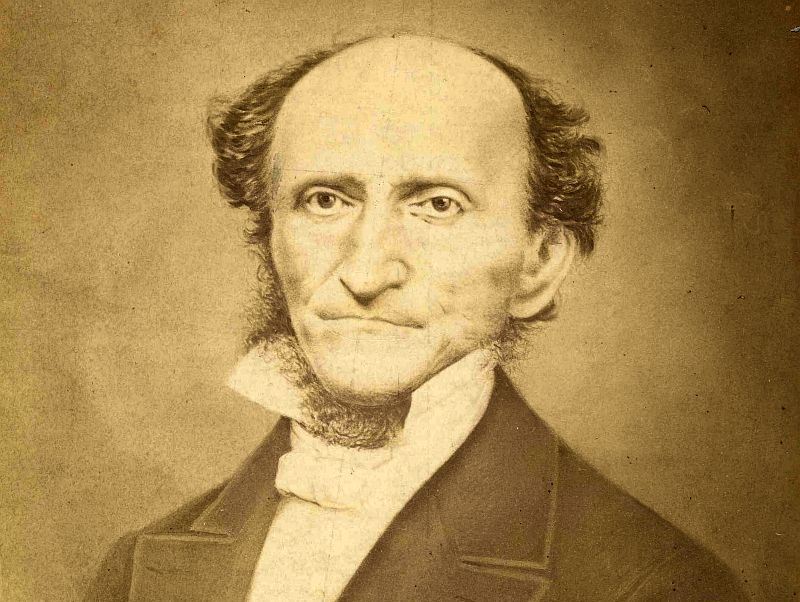
Rev. Dr. Wilhelm Sihler, (1801-1885). Third Pastor of St. Paul’s Lutheran, Fort Wayne, Founder of the Fort Wayne Seminary, Founding Vice-President of the Missouri Synod, and President of the Ohio and Indiana District.
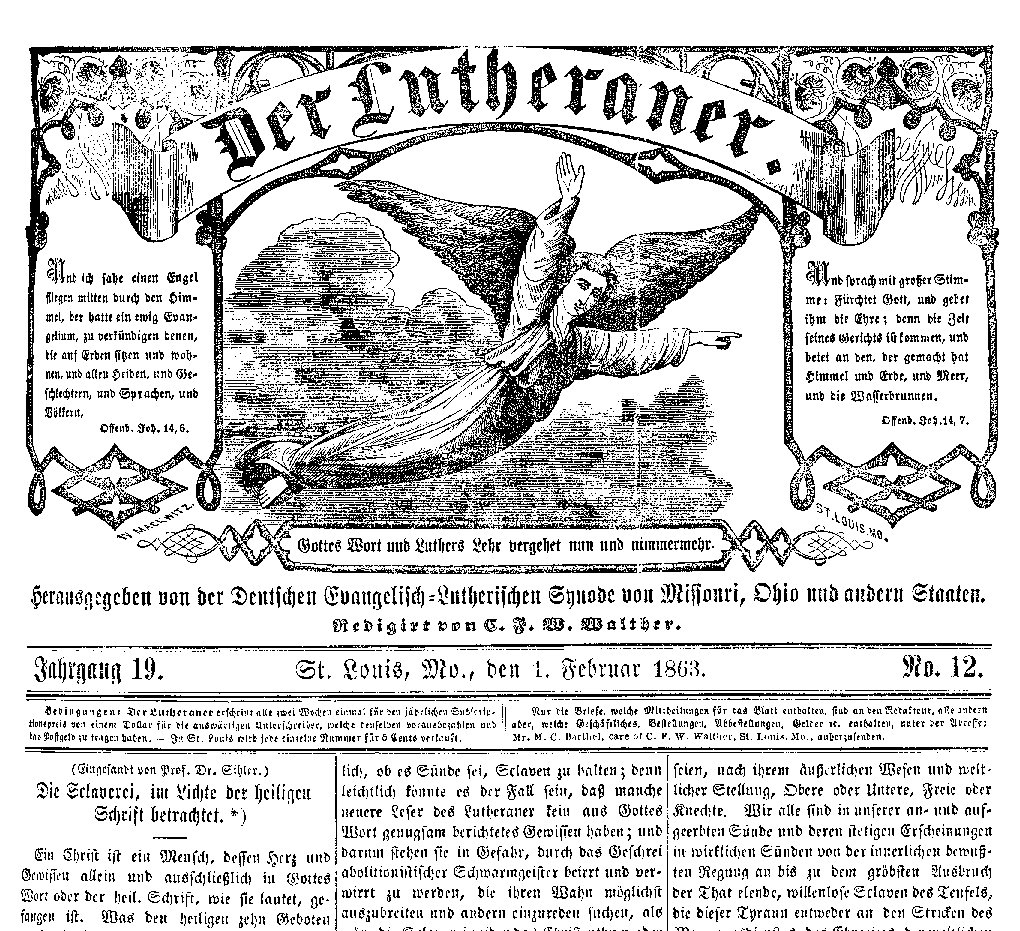
This article was published by C. F. W. Walther in Der Lutheraner Volume 19.
Slavery Considered in the Light of Holy Scripture.[1][2]
(Submitted by Prof. Dr. Sihler.)
[Volume 19, St. Louis, Mon. February 1, 1863, No. 12.]
A Christian is a person whose heart and conscience are bound solely and exclusively by what God’s Word, or Holy Scripture, says. Whatever is contrary to the holy ten commandments, with which the natural or moral law written by God in the heart of all people also agrees, that is sinful, criminal and condemnable to him. And it is all the same to him, how the mass of the unbelievers regards it and perhaps lifts up to heaven what he, according to God’s word, must reject and cast down to hell.
Again, what God does not forbid in his law, but puts into the use of his Christian freedom, that is no sin to him, even if a large number of selfish, unbelieving idolaters of the human spirit, even under the pretense of love, reject and repudiate it with hatred and disgust. We now want to apply this principle, which is an undeniably correct principle for all those who want to be Christians, to slavery, and investigate from God’s Word how it applies and especially whether it is a sin to keep slaves; for it could easily be the case that some newer readers of this publication do not have a conscience sufficiently informed by God’s word; and therefore they are in danger of being misled and confused by the clamor of abolitionist fanatics, who try to spread their delusion as far as possible and to persuade others as if slavery were against Christianity or even contrary to a sound legal state of the civil community. If only this were abolished and, where possible, all slaves were immediately set free — thus they proceed in their ravings — then it could not fail that the citizens of the United States would be blissful people as heroes of humanity and benefactors of mankind, and would bring back the golden age and restore the lost paradise.
From which spirit such delusion originates, we will see later, after we have recognized the truth from God’s word. It is obvious from Holy Scripture that through the deception and seduction of the devil our first parents in paradise and all of us in them have fallen from faith and obedience to God into unbelief and disobedience to God and thus have become servants and slaves of the devil. That is why Christ calls him the strong and armed one,[3] even the prince of this world[4], i.e. of the children of unbelief; and this is the real actual bondage and slavery in which all men as sinners from their mother’s womb (Ps. 51[5]) are imprisoned, be they, according to their outward nature and worldly position, superiors or inferiors, free or slaves. We are all, in our inherited sin and its constant manifestations in real sins, from the inward conscious impulse to the grossest outbreak in deed, miserable, will-less slaves of the devil, whom this tyrant leads captive either by the bonds of mammon-service, ambition, worldly lusts, or by the subtle sins of conceitedness, self-righteousness, and sanctimoniousness; and according to his will, are on the broad path that leads to damnation.
And if the strongest had not overcome the strong, if the seed of the woman had not crushed the serpent’s head, if the Son of God had not destroyed the works of the devil by paying our debt on the cursed wood of the cross as the Son of God and Mary and suffering our punishment of death, and by virtue of his resurrection had set free the children of death and freed the slaves of the devil: we, the children of Adam, would all have remained in this miserable and terrible captivity and bondage, and would have nothing to await after temporal death, the wages of sin, but the eternal fire prepared for the devil and his angels.
It is therefore without any contradiction that we all, according to God’s Word, in Adam, as children of wrath by nature, are all also slaves of the devil, but in Christ we are all saved from the wrath of God and redeemed from the terrible spiritual bondage under the tyranny of the devil.
But if both are equally true according to the nature of sin and grace, it is a small thing that God, within this standing contrast, according to his holy punitive justice, has also from time immemorial, just as He has imposed poverty, famine, sword, and pestilence, also imposed temporal bondage and slavery on certain people, although the particular sins that caused God to impose this special punishment are not known to us everywhere. Indeed, according to God’s wonderful ways with mankind, He often lets those bear the consequences of sin whose personal sin is not punished by it. (Joh. 9:1-3[6]) For even the hardest servitude, in which a person is subjected with his body to the will of the master who owns him as property, cannot be compared to the fact that he has stolen himself from his rightful owner, God, and sold himself to sin and the devil, Rom. 7:14[7]; but then God, by virtue of the redemption in Christ, has no other purpose in these temporal punishments than to lead the bonded prisoner to repentance and to reveal to him his dear Son as his Savior, so that he may be redeemed from the power of sin and the devil through the true faith of the Gospel and become truly free and a dear child of God, even if he also has to remain in the state of servanthood, since he is not allowed to dispose of his person according to his will, and is even a saleable commodity. Again, what special advantage have the freemen, if they conduct their rule over their servants and slaves whether in a more patriarchal[8] or in a more despotic way, if they remain unbelievers and after this short temporal rule the saying of the Lord of all lords resounds against them: “Bind their hands and feet and throw them out into the outer darkness, there shall be weeping and gnashing of teeth”? [Matthew 22:13[9]]
After these introductory and fundamental truths, we will now proceed to the matter itself, and first deal with the cause of bodily slavery, which alone is sin. First of all we find the important passage Gen. 9:25-27[10], in which the holy patriarch Noah, after he had found out about his mockery by his son Ham, pronounced, by the stimulus of God, the following curse against Ham’s son Canaan (who had undoubtedly participated in the gross sin of his father against Noah) and his descendants: “Cursed be Canaan and a servant of all servants among his brothers. And said further, Blessed be the Lord God of Shem, and let Canaan be his servant. God spread out Japheth, and let him dwell in the tents of Shem; and let Canaan be his servant.”
From the first verse of this passage and from the concluding words of the two following verses, it now becomes irrefutably clear that God, after His righteous judgment through Noah’s mouth, visited the sin of Ham and Canaan on their Descendants by continuous, servile bondage or slavery under the descendants of Shem and Japheth. But that this curse did not break out of a carnal anger of Noah and did not fade away without a trace in the air, is clear from the history of the later time. For those Canaanites, who (contrary to God’s commandment, Deut. 20:17[11]) were not exterminated by Israel (Shem’s descendants) with the edge of the sword, but were spared out of selfishness, and were consigned by the victors and conquerors of the land, as we see from Jos. 16:10 and 17:13[12], to perpetual serfdom and servitude. But the Canaanites, who lived in Gibeon and were known to have deceived Israel through a fraudulent covenant, received the following harsh sentence from Joshua’s mouth, Jos. 9:23: “Therefore you shall be cursed, so that there shall not cease from among you servants who cut wood and carry water to the house of my God.”[13]
But as God remembers mercy in the midst of wrath, these Gibeonites who had been made slaves and those other Cananites had access to his word opened to them through their dwelling among Israel, so that after they had repentantly recognized their sins in the Law of Moses, they could become righteous before God through the gospel and through faith in the promised seed of Abraham, our Lord Christ, and thus truly free from the dominion of sin.
Another passage, which also proves that within the general, spiritual slavery of all natural men under the dominion of sin and the devil, bodily slavery is a temporal judgment of God against sin, similar to famine, sword, and pestilence and other plagues, is Deut. 28:68[14], which reads thus: “And the LORD shall bring you again into Egypt with ships full, by the way of which I said, thou shalt see it no more (cf. 17:16[15]). And there ye shall be sold unto your enemies for bondmen and bondmaids, and there shall be no buyer.”
This threatening word of the Lord by Moses’ mouth is one of many others, which he directs in this chapter (verses 15-69[16]) against his own covenant people, if they would not obey his voice and would not keep his commandments and laws. And also this threat of God has been fulfilled in later times; because in the ships of the Sydonians and Tyrians after the destruction of Jerusalem Jewish slaves bought by the Babylonians were brought to Egypt for sale.
A third passage of a similar nature is found in the prophet Jeremiah, 5:19 and 17:4[17], where it reads: “As you have forsaken me and served foreign gods in your own land, so you shall serve strangers in a land that is not yours; and you (Israel) shall be cast out of your inheritance which I have given you, and will make you servants of your enemies in a land which you do not know; for you have kindled a fire of my wrath which will burn forever.”
From this it is obvious that especially because of the apostasy and idolatry, which naturally resulted in a multitude of gross transgressions of the second table, the children of Israel in the kingdom of Judah were led into captivity and slavery in Babylon before and after the destruction of Jerusalem. But since among these there were also those who sat by the waters of Babylon and wept when they remembered Zion (Ps. 137:1[18]), the gracious and merciful God comforted these shattered hearts and terrified consciences through the prophet Ezekiel with the promise of the Messiah; and as from God’s own mouth, the prophet was to say to them (33:11[19]): “As surely as I live, saith the Lord GOD, I have no pleasure in the death of the wicked, but that the wicked turn from his ways and live.”
But it was quite different and much worse for the people of Israel about 600 years later, after they had not only crucified the Lord of glory and killed the Prince of life, but also for the most part rejected the gracious gospel for about 40 years in malicious unbelief. For after the second destruction of Jerusalem in 70 A.D., many thousands of Jews, prisoners of war, were sold into slavery at a ridiculous price and scattered among all nations without prophets, without consolation, and under the judgment of blindness and hardening,[20] as it still stands today; for only a few individuals, “the elect of grace,” have been saved through the centuries by the gospel in the Christian church.
Thus we should have seen from God’s word that slavery, i.e. the state in which a man is another’s according to body and possessions, and thus is deprived of his personal freedom with regard to the disposal of his person and the choice of his employment, is indeed a consequence of sin and a peculiar manifestation of God’s punitive justice. But there is no essential difference between it and other punishments of God, as, for example, deformity, poverty, famine, and other plagues; yes, compared, for example, with epidemics, wars, volcanic eruptions, strong earthquakes, where many people are often dragged into eternal damnation by a quick evil death, slavery appears as a milder punishment of God. And this is especially the case where the slaves are within the Christian church and under the sound of the gospel, and truly even the Negro slaves brought here are much better off than if they had fallen at home in the bloody feuds of their tribes or had been sacrificed as prisoners of war to the gods of the victors or had become more and more spiritually rotten in their own idolatry as slaves of the devil.
We now proceed to prove from God’s Word, namely the Holy Scriptures, that nowhere, neither in the Old nor in the New Testament, does it forbid or even disapprove slavery or, more precisely, the owning and keeping of slaves or bonded servants.
Thus we read that the Lord God speaks to the children of Israel through Moses (Lev. 25:44-46[21]): “If you want to have bonded servants and maids, then you shall buy them from the heathen who are around you, from the sojourners who are strangers among you and from their descendants whom they beget in your land; these you shall have for your own and you shall possess them, and your children after you for property for ever, they shall be your bonded servants.” Over these the masters were also granted a stricter regiment than over impoverished tribesmen and fellow believers who had sold themselves as servants to their debtors.
For when God says in regard to these, “But over your brethren the children of Israel none shall rule with severity,” it is evident from this that this was permitted to the lords over their bond servants to a greater extent, whether they had come into their power by purchase or captivity in war, or had been born in their houses. For most of them, namely those of Canaan’s lineage, who remained later among Israel, as e.g. the Gebeonites, were actually to be “banished,” that is, cursed with eradication and completely exterminated, as wicked idolaters and perpetrators of shameful immoral abominations (Lev. 18[22]) according to God’s strict judgment during the conquering of the land of the Lord. If, however, some of them remained among Israel, because Israel was too negligent and not zealous enough to execute God’s judgments on them, it was only in accordance with God’s justice that their lot as slaves was harsher than that of the Israelite servants; for these [latter], whom the debtor was not allowed to treat as serfs, nor to sell, were to rejoin their family and their fathers’ possessions in the seventh year, Lev. 25:39-43[23]; Ex. 21:2[24].
Furthermore, when the Lord forbids, Exodus 20:17[25], “Do not lust after your neighbor’s manservant or maidservant,” He confirms the rightful ownership of them. But God could not possibly have done this if the possession of sold, bonded servants and maids were sinful in itself. Likewise, Holy Scripture describes the ownership of servants and maids, that is, of slaves in bondage, as a blessing from the Lord. For thus Eliezer, the suitor for Isaac, speaks to Rebekah’s parents and her brother Laban, Genesis 24:35[26]: “And the Lord hath blessed my lord abundantly, and waxed great, and hath given him sheep, and oxen, and silver, and gold, and menservants, and maidservants, and camels, and asses.” And the same is reported of Jacob, (Gen. 30:43[27]) and of Job (1:3[28]).
Among other earthly goods, the godly patriarchs also possessed servants and maids as a blessing from the Lord and as part of their earthly blessings. But none of them is said to have had a bad conscience about the legitimacy of this possession and property and to have freed his servants and maids. Rather, we learn that these faithful fathers, who certainly had the Holy Spirit in them, also considered the children of these servants and maids as their rightful property; for it is expressly reported about Abraham in Genesis 14:14[29] that he had 318 servants who were born in his house. And these he armed, when he pursued with this small group in bold courage of faith Kedor Laomor, the king of Elam, and his three allied kings from the Orient, in order to rescue Lot and his children from him, which he also succeeded in doing.
But someone might raise the objection: in the household governance of the old covenant, legal discipline prevailed, and there, however, the fathers, as later their descendants, the people of Israel, found slavery as an existing thing and used it without hesitation. Also, in antiquity, as an existing institution, there had been no free day laborers and hirelings, who, after free self-determination and disposal of their person, served sometimes this, sometimes that master according to the pleasure of their will. But in the household of the new covenant, in the Christian church, things are different; there the gospel and Christian love rule; and it is strictly contrary to this that one man is the slave, the saleable bondservant of another, and that the latter has the power and strength to use the bodily strength of his slave for his own advantage for any unsinful service he desires. God is said to have created all men; before Him all are equal, also Christ redeemed all men and acquired the same freedom for all.
We intend also to answer especially this objection later. For now it suffices to prove that in the New Testament itself, Christians are by no means forbidden to keep slaves and to make use of this institution and civil order handed down from paganism and Judaism, according to Christian freedom; For since it is not sinful in and of itself and is not contrary to God’s commandment, neither Christ’s nor his apostles’ mouths censure or disapprove of it, however, the Lord punishes usury and overcharging as sins against love, which not a few abolitionist Sabbatarians practice with the greatest zeal; These holy people even help to equip and dispatch slave ships in order to smuggle slaves from the African coast to America, against the civil law of their own country, while at the same time they agitate for the quickest possible release of the existing slaves. No! Not slavery as a human institution, but only the sinful abuse, which is attached to it in many ways and of course always in conflict with love, receives due censure, especially in the New Testament.
The following are the testimonies in which the Holy Spirit not only does not disapprove of the existence of slavery (let alone urges its immediate abolition), but recognizes and accepts the slave’s calling to service as unsinful: in 1 Tim. 6:1[30], St. Paul writes to Timothy: “The servants who are under the yoke should hold their masters in high esteem, so that the name of God and the doctrine be not blasphemed.”
If slavery were against the gospel and bodily bondage against the spiritual freedom of a Christian, the apostle could not have written these words. Rather, he would have had to make it a matter of conscience for the converted slaves to break the yoke, even by violent self-help and rebellion, if secret escape were impossible. Therefore, in 1525, the Anabaptist rebel, Thomas Münzer, acted thus who incited the Thuringian serf-peasants to revolt against their bodily masters, having previously confused their minds with false unevangelical teaching. For he taught them to despise spiritual freedom, whereby Christ had freed them from the yoke of the law in order to become righteous before God by His works, as well as from all human statutes and commandments, and exchange this for bodily freedom; and so it happened that, against love, they gave place to the flesh, revolted against their bodily masters, burned their castles, plundered their possessions, and murdered the defenseless; And by this they proved that they were indeed servants of corruption and slaves of the devil, but not such people who, through true faith in Christ, were truly freed from that yoke and from the dominion of sin and the devil, and enjoyed freedom of the children of God in the midst of the servitude of the saints. Luther also writes about this in his “Refutation of the 12th Articles of the Peasants,” regarding the 3rd Article:
“There is to be no serf because Christ has redeemed us all? What is this? This would be to make Christian liberty into liberty of the flesh. Did not Abraham and other patriarchs and prophets own serfs? Read what St. Paul has to say about servants, who at that time were all in bondage. Therefore this article is directly opposed to the Gospel and it is rapacious, for everyone who is a bondman to remove himself from his master. A bondman can very well be a Christian and have Christian freedom, just as a prisoner or sick person can be a Christian, but yet is not free. This article proposes to make all men equal, and turn the spiritual kingdom of Christ into a worldly one, which is impossible. For a worldly kingdom cannot exist where there is no class distinction, where some are free, some are prisoners, some are masters, and some are vassals, etc.” (Luther’s Works by Walch, Vol. 16, pp. 85 ff.) Thus St. Paul and Thomas Münzer, together with his kindred abolitionist spirits of more recent times, of English and German tongue, have nothing to do with each other. These speak out of the enthusiastic spirit, in which the murderer and liar has played his part from the beginning, even if he disguises himself here as an angel of light. St. Paul, however, speaks from the Holy Spirit, which, as we know, is the spirit of true Christian love, peace, and wholesome order. Out of this Spirit, in 1 Tim. 6:1 he admonishes the believing slaves that they should “hold worthy of all esteem” even their unbelieving and heathen masters — for only in the following verse does he speak of their behavior toward their believing masters — and indeed for the sake of the fourth commandment and godly order, according to which it pleases the Lord to make them slaves and to make those unbelievers their bodily masters; For it was precisely in such a relationship of service that they had the best opportunity to exercise faith through love and, through their willing and joyful obedience, meekness, humility and patience, to let the glory of the gospel of Christ, which so miraculously transforms and renews the heart and will through faith, shine powerfully, as it were, as a silent sermon and a speaking testimony to their unbelieving masters. And there is no doubt that many of these masters, when they saw the godly conduct of their slaves after their conversion, while they had been lazy, thieving, unfaithful, etc. before, were won to the gospel.
Similarly, St. Peter writes about believing wives who had unbelieving husbands that they should be subject to them, so that those who did not believe in the word would be won over by the wives’ conduct without the word, when they saw their chaste conduct in fear. 1 Peter 3:1-2[31].
So St. Paul admonishes the believing slaves therefore also to hold their unbelieving masters in honor, “lest the name of God and the doctrine be blasphemed.” This would undeniably have been done by the pagan masters if their Christian slaves had acted against them according to the flesh, had demanded their bodily freedom from them and, in case of refusal, had run away or, under the pretense of Christian freedom, had withdrawn from them the obedience owed or had even revolted against them with an armed hand and open violence in order to gain their bodily freedom. Of course, the pagan masters, who were uninformed about the nature of the Gospel, would have blamed the Christian doctrine for such an impudent undertaking and sacrilegious start of their slaves, and would have blasphemed it as a source of all disorder and disobedience, even of rebellion and outrage, and would have profaned the name of Christ as the head of the rebels; for before their slaves had heard this new doctrine, their malice would never have broken out so defiantly as to demand their liberty as a right now due to them.
In a similar way — for it is the same Holy Spirit who speaks through all the apostles — St. Peter also writes, 1 Peter 2:18-21[32]: “Servants, be subject to your masters with all fear; not only to the good and gentle, but also to the froward. For this is thankworthy, if a man for conscience toward God endure grief, suffering wrongfully. For what glory is it, if, when ye be buffeted for your faults, ye shall take it patiently? but if, when ye do well, and suffer for it, ye take it patiently, this is acceptable with God. For even hereunto were ye called.”
This exhortation also contains the exact opposite of what the old Anabaptists incited the serf-peasants to do and what the newer abolitionists incite the slaves to do. Yes St. Peter intensifies the already stated admonition of his fellow apostle; for he admonishes the believing slaves that they should be submissive and obedient to their heathen masters not only out of grateful love for their goodness and leniency, but that they should show the same submissiveness “with all fear” and reverence also to the “strange,” that is, the bad and perverse masters, for whom they could do nothing right and who ruled over them with severity; For this is grace and pleasing to God, and also entails the reward of grace, if they, in order not to sin through impatience and disobedience against God and against the conscience enlightened and sharpened by the gospel and faith, bear the evil, that is harsh words and blows, and suffer the injustice; for to suffer for iniquity, as rightly befalls the disobedient and insubordinate slaves, is a punishment justly inflicted and truly no glory.
If, however, they endured all sorts of things from their “strange” masters while being faithful to their service, this is grace from God, for this is what they were called to do; and Peter goes on to paint their Lord and Savior before the faithful slaves as a model of sanctification, that they not only confess him with their mouths, but also follow him in deeds and suffering. Furthermore every Christian, and therefore also every believing slave, is called not only to do good, but also to suffer evil from the one who benefits from his good deeds, namely his physical master.
Similarly, St. Paul (Titus 2:9-10[33]) admonishes the believing slaves “to be submissive to their own masters, to please them will in all things, not answering again; not to purloin, but to show all good fidelity;” and as above he had admonished them (in 1 Timothy 6:1) against dishonorable behavior toward their heathen masters, “that the name of God and his doctrine be not blasphemed,” likewise here he exhorts them to the same Christian virtues, “that they may adorn the doctrine of God our Savior in all things.” But in Col. 3:22-24[34] his words to the believing slaves read thus: “Servants, obey in all things your masters according to the flesh (be they heathens or Christians); not with eyeservice, as menpleasers; but in singleness of heart, fearing God. And whatsoever ye do, do it heartily, as to the Lord, and not unto men; knowing that of the Lord ye shall receive the reward of the inheritance: for ye serve the Lord Christ. But he that doeth wrong shall receive for the wrong which he had done: and there is no respect of persons.”
Precisely these two last verses are very important in this admonition of the Apostle. For, after they had been redeemed from the slavery of sin and the devil through faith in Jesus Christ and had attained to the blessed freedom of the children of God, he is far from declaring their continuing slavery to heathen masters as something shameful and unworthy of their present spiritual nobility. Rather, he calls their present slave service, which is sanctified by faith in Jesus Christ and performed in Christian love for their masters, even if they are pagans, a service to God [Gottesdienst]. Likewise, it does not occur to St. Paul to hold out to or place in view of the believing slaves the prospect of the quickest possible liberation from bodily bondage as a necessary or urgently desirable good for those who have become spiritually free. Rather, he opens the prospect of heaven for them and testifies, as from the mouth of the Lord, that after their faithful service on earth they would receive a glorious reward and recompense in heaven, and even inherit the Kingdom of Glory. On the other hand, he also threatens them with the judgment of God if they do “wrong” against faith and conscience, including trying to attain their bodily freedom by sinful means.
In all these passages, interpreted according to the word, there is not even the slightest hint that even the slavery of Christians under pagan masters is something contrary to the gospel and spiritual freedom. Rather, St. Paul writes, 1 Cor. 7:22[35]: “He that is called in the Lord, being a servant, is the Lord’s freeman.” But the apostle is just as far from making it a matter of conscience for Christian slaves to remain in the state of slavery. Indeed, he says in vv. 20-21 in general: “Let every man abide in the same calling wherein he was called. Art thou called being a servant? care not for it,” that is, do not be troubled with thoughts as if you could not be a righteous Christian, serve God, and please the Lord even as a slave. But then he adds: “But if you can become free (that is, by honest and sincere means, that someone buys you out or that your master releases you out of favor), then much rather do that,” do not let the permitted opportunity pass by unused.
But now, another point is to be considered according to God’s word, namely, what the relationship of converted slaves to their believing masters was to be and whether they could claim their bodily release from them as an act of their brotherly love. There is no trace of this in the New Testament either. Rather, St. Paul writes about the behavior of believing slaves towards their Christian masters, (1 Tim. 6:2[36]) thus: “And they that have believing masters, should not despise them with the pretense that they, [namely the servants] are the [spiritual] brothers of their masters,” so that through the same faith in Christ and the same sonship of God they are equal to them before God; “but rather do them service, (that is, perform their service all the more faithfully and willingly), because they (the servants) are faithful and beloved (by God, and by their physical Christian masters) and are partakers of the benefit (of salvation and spiritual deliverance from the dominion of sin through the gospel).”
Therefore in all these admonitions, especially those of the apostle Paul, about how the believing slaves should behave towards their pagan or Christian masters, there is not the slightest hint that their spiritual redemption by Christ from the slavery of sin and the devil brings immediate physical liberation with it. Rather, St. Paul always keeps bodily and spiritual freedom sharply apart as two completely different areas, while the enthusiasts of older and newer times confuse the two. According to his view, that is, according to the truth of God, the matter always stands thus: “He that is called in the Lord, being a servant, is the Lord’s freeman: likewise also he that is called, being free, is Christ’s servant.” 1 Cor. 7:22[37].
The apostle Paul confirms his teaching and admonition by his own actions. There was an unbelieving slave named Onesimus who had come to Rome after he had escaped from a believing slave owner named Philemon in Colossae, who had been converted by Paul earlier. There he was converted to faith in the Lord Christ through the preaching of St. Paul, “[who] dwelt two whole years in his own hired house, and received all that came in unto him” (Acts 28:30[38]) to hear the word of God, and thus became spiritually free. What does the apostle do? If he had been a righteous Anabaptist or abolitionist preacher, he would have declared Onesimus bodily free right away, or made it a matter of conscience for Philemon to leave Onesimus bodily free; then he would have considered it contrary to the gospel, shameful and unworthy for one believer to be the slave of another; after all, they had both put on Christ and were both God’s children; and there would be “neither bond nor free.” (Gal. 3:25[39]) St. Paul did not do so, but even though the converted Onesimus, did and could do all kinds of services of love for him, and even though his master, Philemon, was freed by the apostle from the slavery of sin and the devil, and was bound to grateful love in return, he still sent Onesimus back to his master with a letter imbued with the sweetness of the evangelical spirit and Christian love. And also in this his own handwritten letter, in which he commends this “my son Onesimus, whom I have begotten in my bonds, my own heart,” to Philemon’s heart for loving acceptance and forgiveness for his escape — also in this letter there is not contained the slightest hint to set this slave free bodily, who was indeed now at the same time “above a servant, a beloved brother” (namely his, Philemon’s). And surely Onesimus, as a Christian, as one anointed by the Holy Spirit and enlightened by God’s Word, would have known how to use his physical freedom for the glory of God and the benefit of mankind; and it would have been much different than if now, for example, a southern planter, seduced by abolitionist heresy in pamphlets and sentimental novels, had set free unconverted slaves, who until then could only be kept in outward obedience by coercion and fear of punishment. And is it not so that the runaway slaves to Canada, who unfortunately, contrary to the law, have been encouraged in all sorts of ways in the northern states, are by their laziness and immorality a great plague to that country?
On the other hand, in his letter Paul only expresses his joy that Onesimus (which means “useful”) now lives up to his name, because he “was useless to you (Philemon), but now he is indeed useful to you and to me.” (v. 11[40]).
[Volume 19, St. Louis, Monday, February 15, 1863, No. 13.]
The summary result of all these quotations from Holy Scripture, interpreted and applied according to the text and the faith, is therefore this: First: The gospel and the faith in Christ that it brings about, through which man, and thus also the physical slave, is made a partaker of spiritual deliverance from the slavery of sin and the devil in the forgiveness of sin and the reception of the Holy Spirit, has in and of itself nothing to do with the state of his physical slavery; for the gospel has to do only with the soul of the bodily slave, and primarily in its relationship to God, in order to redeem it from his wrath and severe judgment and to transform it into the blessed freedom of the children of God. On the other hand, it has nothing to do with the external nature and the bodily servitude of the slave to his master, in so far as it would give the slave a means of raising and asserting a legal claim to his bodily release from slavery against his master. And just as little does the gospel make it a matter of faith and love for the believing slave owner, that is, a matter of conscience, to set his slaves free in the flesh, even if they are his brothers in Christ.
Secondly: Just as it is the nature and character of the gospel through faith in Christ to sanctify, permeate, and spiritually enliven all other worldly orders and civil institutions, social relationships, customs, habits, and rights (provided they are not in themselves contrary to the commandments of God, and therefore sinful), so also is this done with slavery. And even if, due to human sin, all kinds of evil and pernicious abuse had been attached to this and that inherently unsinful institution and state or condition, such as the merchant profession (cf. Sir. 26:29, 27:1-2)[41], or unlimited monarchy (cf. 1 Sam. 8:9-17)[42], or to a particularly high degree to slavery, it is nevertheless contrary to the nature of the gospel and to the love of Christ, which is gradually improving from within, to insist in a stormy and violent manner even on the elimination of the abuses that cling to it, let alone to immediately remove the thing itself, to which the trouble adheres. For such unevangelical behavior is only the activity of arrogant legislators and workers, who everywhere in their revolutionary method of healing tend to throw out the baby with the bathwater, as the old and new abolitionists also do.
The gospel, however, by entering into the institution of slavery, which it found everywhere historically, works the following salutary fruit through faith in Christ and the change of mind of the slaves and slaveholders brought about by it, while leaving it in existence for the time being.
First of all, through faith, the heart, mind, spirit and will of the converted slaves are salutarily transformed respecting their physical masters. Before their conversion and spiritual deliverance from the slavery of sin and the devil, they were — by virtue of unbelief — lazy, stubborn, thieving, unfaithful, unwilling, spiteful, wrathful, groveling, false, whoring, lying, and eye-pleasing people, and where they obeyed outwardly, it was only out of fear of punishment or out of a desire for reward and praise; but inwardly there was no willing obedience and outwardly no service of true love; out of compulsion and with unwillingness they did the work commanded them and avoided the grosser outbreaks of evil. Hence Scripture so often speaks of servile fear, servile spirit and obedience in a derogatory way. And even where patriarchal house governance existed, where they had kind and gentle masters and received just treatment, they still remained, according to heart, mind, and will, unchanged and unregenerated in their inherited unbelief and disobedience, blindness and malice, aversion and spitefulness; for even the law of the holy ten commandments in correct spiritual interpretation is not able, in spite of all attached enticements and promises, as well as threats and curses, to substantially transform the heart and the will of the natural man, if he is a slave or not bodily free, and to place him in right obedience to God and man. Rather, the law, without the accompaniment of the gospel, works the exact opposite of what it demands, out of the guilt of the corrupted nature and in order to bring its extreme wickedness and corruption to light. For the more sharply the law presses upon man and demands perfect holiness of his nature and perfect obedience and love toward God in all his doings, the more vehemently it arouses man’s anger, hatred and aversion towards God and His holy will expressed in the law; and the more vehemently the desire to transgress flares up and the greater the mass of sins of commission and omission becomes. But since the law at the same time continues to pronounce the wrath of God against the children of unbelief, without giving man the desire and power to keep it, it proves itself in every man, as he is by nature (so also in every unconverted slave) to be the letter that kills, the office that preaches damnation.
But when the law thus testifies to the conscience of these bonded servants, they certainly recognize from it their sinful misery and ruin, shame and remorse, fear and terror before God’s wrath and judgment. And at the same time they realize that they have a much stricter spiritual master in the law than their physical master can ever be, for in the worst case he can punish them severely in body or have them killed. The law, however, to which their conscience assents, keeps them locked up in soul and body as evil and bankrupt debtors under its compulsion and curse, as in an unbreakable debtor’s tower and iron net, threatens them incessantly with the eternal torment and agony of hell, and lets them feel and experience the foretaste of it abundantly in the gnawing and biting of the evil conscience.
But also to them, as to all poor sinners, the law, according to God’s good gracious will, should become a disciplinarian for Christ. As soon as the gospel comes to them by some means and they do not resist the Holy Spirit, thereby kindling faith in Christ in their hearts, they receive forgiveness of sins and the Holy Spirit, are spiritually reborn and seated in the heavenly places in Christ.[43] Then they are also redeemed from the slavery of sin and the devil and made truly free through the Son, so that they are no longer slaves to sin, but live for Him who died for them and rose again. As Christ gave himself to them with his nature and work, so now, as far as the new man lives in them, they give themselves to their neighbor in love with their nature and work. Then their heart’s attitude towards their physical masters becomes essentially different from what it was before. Then their most noble thoughts and aspirations are not to become physically free as soon as possible; they close their ears to abolitionist sneaks and corner preachers and consider it theft to steal away from their master by secretly escaping.
On the contrary, they now begin to truly serve him in the fear and love of God. For by the power of faith in Christ and by the impulse of the Holy Spirit who dwells in them and enlightens and governs them through God’s Word, they apply all honest diligence and zeal to be faithful in the fulfillment of the duties of their calling and to comply with those exhortations of the apostles. Instead of the evil qualities, the habitual sins and vices with which they were afflicted before their conversion, they are now seen to have good works and virtues, wrought and sanctified by faith in Christ. As children of God, as saints and beloved, as a voluntary people in the love of Christ, they are now, predominantly, obedient, diligent, faithful, sober, chaste, disciplined, humble, meek, patient, true, sincere, and adorn the doctrine of God their Savior throughout by godly conduct and walk worthy of the Gospel.
If they have faithful, kind, and gentle masters, they recognize this as an undeserved benefit of God and make all the more effort to prove their grateful love for them through faithful service, but they are far from putting themselves on an equal footing with them in a carnal way or even claiming their bodily release as a right to which they are entitled. If, on the other hand, they have unconverted, strict, and whimsical masters, they regard this as a salvific cross, have heartfelt mercy on their devil-mastered lords and never tire of following their Lord Christ in action and suffering, taking up their cross and also showing such masters all willing obedience and good faith, bearing unjust and tyrannical treatment with patience and gentleness and praying diligently for their masters that God will grant them grace to repent.
Thus we have now demonstrated what a salutary transformation the gospel, by kindling faith in Christ in the hearts of the slaves, also brings about in their behavior toward their physical masters. But before we give the proof for how the same gospel and the same faith also bring about a salutary change in the hearts of slaveholders in their behavior toward their slaves, let us first make a helpful and appropriate observation.
We have learned above that slavery is a punishment of sin from God, although not so terrible as the evil and quick death of the guilty criminal. Nevertheless, we find already in the Old Testament, how God shows his mercy against the slaves by special decrees, and resists the mercilessness of the slave owners. Thus, God decreed (Gen. 17:12[44]) that Abraham should circumcise not only the slaves born to him at home, but also the slaves bought from all sorts of strangers.
Thereby they also entered into the covenant of grace that God established with Abraham and his seed; and although, according to their bodily descent, they were guests and strangers, they were admitted through this sacrament into the spiritual citizenship of Israel. And through this they also took part in the adoption and the glory, in the covenant and the law, in the [temple] service[45] and the promise — for this practice was to be kept among Abraham’s descendants from then on. (Rom. 9:4[46]) Likewise, God commanded Moses (Ex. 12:43-44[47]) that no stranger should eat of the Passover lamb, but whoever was a purchased servant should be circumcised first and then eat of it. Also, according to the third commandment, the slaves were to have rest from their work on the Sabbath day (Ex 20:10[48]), could participate in the services, hear the word of God, and were also to be brought to the sacrificial meals and feasts. (Deut. 12:12, 18; 16:11[49]) Furthermore, the Lord Himself protects the bonded servants bought from the Gentiles or who came under the power of Israelite masters through captivity against the tyrannical treatment of their masters. For “if a man smite his servant, or his maid, with a rod, and he die under his hand; he shall be surely punished.” (Ex. 21:20[50]) Furthermore, if the masters knocked out the teeth of their servants or maidservants or spoil an eye by striking them with their fists, they should be released on account of this. (Ex 21:26-27[51]) But the most precious thing was that the slaves also should be made partakers of the New Testament promises of grace. For thus says the Lord through the prophet Joel (2:29[52]): “And also upon the servants and upon the handmaids in those days will I pour out my spirit.”
Thus, in view of these bodily and especially spiritual benefits, the slaves of the Jews were much better off than if they, among the heathens of their kindred race, had perhaps been given bodily freedom, but nevertheless, as being outside the realm of the divine word, without God and without hope in this world, remained spiritually dead in transgressions and sins and were not freed from the spiritual slavery of sin and the devil. And similarly, as already mentioned, the Negroes brought over from Africa are much better off by coming into the realm of the gospel, even though so many sins against the fear of God and the love of one’s neighbor are connected with their coming over. God provided even more kindly and lovingly for the Israelite slaves, when free Hebrews (Neh. 5:5[53]) were sold by the court to a lord because of damages they could not compensate (Ex. 22:3[54]), or by debtors they could not repay (2 Kings 4:1[55], Is. 50:1[56]), or sold themselves because of impoverishment (Lev. 25:39[57]). They were not to serve as serfs [Leibeigene], nor were they to be sold like them and treated with the same severity. (vv. 40-42[58]) Rather, according to the law, they received their freedom in the Sabbath or Jubilee year after six years of service (Ex. 21:2[59], Deut. 15:12[60], Lev. 25:40[61]), and had to be provided with sheep, grain, oil, and wine by their former masters. (Deut. 15:13[62])
How little God was against the lifelong bondage of one Israelite to another, however, is clear from Ex 21:6[63] and Deut 15:17[64]. For if the servant, after his six years of service, did not want to make use of the legal freedom, but out of love for his master (also for his wife and his children, who might have been given to him by the master, and who otherwise both remained with the master upon his release (Ex. 21:4-5[65]), preferred to remain with his master as a servant for life, then this could happen; only his ear was to be pierced with an awl before the elders — a sign of servitude that was also in use among other peoples of antiquity.
If we now turn to the New Testament, we also find the appropriate evangelical admonitions for the believing masters with regard to their behavior toward their slaves. Thus we read (Col. 4:1[66]), “Masters, give unto your servants what is right and equal,” that is, fair, do not put them to excessive work, give them the necessary rest and refreshment, and provide for them according to need, as also belonging to your “household”, (1 Tim. 5:8[67]), “knowing that ye also have a Master in heaven” that is, do not forget that one day you will have to give an account to the Lord of all lords of how you have behaved toward your slaves. St. Paul admonishes the masters in a similar way, Eph. 6:9[68]: “And ye masters, do the same (what is right and just in the fear of God) unto them, forbearing threatening: knowing that your Master also is in heaven (and over you as his slaves); neither is there respect of persons with him.” (he rewards and punishes with righteous judgment according to his word, whether someone is master or slave).
Now as many of the physical masters who received forgiveness of sins and the Holy Spirit through faith in Christ by means of the voice of the gospel, and took these admonitions of St. Paul to heart; their hearts, minds, and wills were also salutarily transformed toward their physical slaves. If the latter were also converted to Christ out of heathendom, they recognized them as their dear brothers in Christ and did not consider themselves higher than them before the Lord (Gal. 3:28[69]). They also let Christ’s kindness and benevolence shine out in all their dealings with them, regarded them as their housemates and members of their family, cared for their needs in a fatherly way, did not impose undue work on them, granted them the necessary rest and refreshment, and took due care that they remained in the teaching and discipline of the divine word. Nevertheless, they did not cease to regard themselves as their masters, according to the salutary order of God in this world, clothed with the majesty of the Father’s name and the fourth commandment, to maintain punctual obedience and, where necessary, by the discipline of the law, to sharply punish the flesh of their Christian slaves, although in fatherly love. Nor were they bound, as God’s Word did not make them conscience-stricken, to give their slaves bodily freedom on account of being their brothers in Christ, although circumstances did arise from time to time that this happened. If their slaves were still heathen, they could of course not recognize them before God as their brothers in Christ, but they took all the more care that they, as those who had also been freed, by God’s grace and through Christian teaching, came to repentance towards God and faith in the Lord Christ, and thus were saved from the dominion of darkness and brought to the blessed freedom of the children of God.
Moreover, their behavior towards these pagan slaves was not essentially different from their behavior towards Christian slaves. Also towards them, under the governance of Christian fatherly love, the seriousness of the law and the gentleness of the gospel were wholesomely connected with each other in their discipline and regiment. And where, at the present time, there are any Christian-minded slave owners, the same thing happens essentially towards their Christian and heathen slaves; for the gospel and the faith in Christ kindled by it have everywhere in slaves and masters the same salutary effects as just described.
If, on the other hand, we consider the conduct and procedure of the older and newer abolitionists towards slaveholders and slaves, we find that it is utterly contrary to the gospel and faith in Christ and stems from a completely different spirit from the Holy Spirit and love of Christ. For it is the spirit of unbelief and enmity against Christ, the spirit of disobedience against God’s command and the spirit of insurrection and rebellion against his wholesome discipline and punishment against the children of Adam, sinners; It is the spirit of carnal reason emancipating itself from obedience to God’s word, in short, the spirit of man opposing God in arrogant self-idolatry by deception of the devil, which, where possible, overthrew the Triune God from His throne in order to sit on it and rule the world.
From this God-denying, antichristian and scripture-denying spirit have flowed for about 100 years the shameful and harmful writings of the English, French, and German deists, naturalists, rationalists, communists, and Friends of Light, in which the triune God of the Bible is dismissed as contrary to reason and instead the bastard (produced by the liar from the very beginning and the carnal reason of the apostate man) who is called “god, virtue and immortality,” is raised to the throne of the divine majesty. From this spirit came the children of the devil (the murderer from the beginning) the bloodthirsty regicides and blood-spilling monsters of the French Revolution. There, as is well known, our Lord God was deposed by popular decree on the impetus of the same, and in his place, a prostitute was worshiped as the goddess of reason by the educated madmen and uneducated rabble.[70] And what wonder if then, under the deceptive pretense of brotherhood, freedom, and equality, one party overthrew the other and delivered thousands to the guillotine and flooded France with blood. And while the guillotine continuously threw so many children of unbelief into hell every day and gave the devil a true feast, nothing but mutual suspicion, distrust, partisan hatred, rancor, malice, boasting, vengefulness, and the like prevailed between the still-living, free, and equal brothers who had been redeemed from the yoke of the allegedly unbearable royal power, so that under this regiment of freedom, brotherhood, and equality hell on earth was already to be found.[71]
The abolitionist fanatics and vocal leaders of our day and in this land come from the same spirit, who, deceived by the devil, and as deceivers of the ignorant and uncertain[72] are a devouring cancer and a malignant worm in the marrow of the people. It is true that they also adorn themselves with beautiful-sounding names, just as the devil does not like to be black, but white, even an angel of light. It is humanity and philanthropy (friendliness and love of man) that they carry before them as a figurehead. Behind it, however, they are the men of overthrow and destruction, who care little that the Constitution and the Union would perish if they could only carry through their insane enthusiasm, their singular goal; for that is their purpose, wherever possible, to emancipate all Negro slaves with one blow and to bless their own or foreign countries with these poor people, who are almost entirely uneducated for Christian, civil, and moral use of physical freedom.
In this regard, they have for years been pushing and dragging the slavery issue around in the Congress in a most excited manner, even without any motive, and have no hesitation in stirring up and embittering their Southern brethren. For this purpose they also give their speeches outside of congress in all kinds of larger and smaller gatherings, as heroes of freedom and happiness of mankind, with more or less luck and skill, in order to increase their following; and even preachers of the gospel are not ashamed, as abolitionist speechmakers, to fanaticize one part of their audience for themselves under a deceptive appeal of God’s word and against the simple understanding of Scripture and Christian doctrine, and to instill disgust and repugnance in the other, but to deceive both of them regarding the right foundation and edification in and on God’s word. To the same end, preachers and non-preachers let their pernicious foolishness go out through the press in all kinds of pamphlets, in order to spread it even further, even under Christian pretenses; and in them they have no hesitation in presenting unverified facts about the treatment of Negro slaves in the South as true and certain, and in immediately drawing conclusions about all slaveholders from individual cases of tyrannical treatment. Over this they pour the broth of their sentimental effusions of the heart in order to move other softly constituted souls to a holy indignation, if not to a crusade for the liberation of the Negroes, at least in feelings and thoughts. Indeed, their holy zeal for the emancipation of the Negro slaves goes so far that they not only, as already mentioned above, help runaway slaves across the border to Canada, with plans and action in violation of the Fugitive Slave Law, but they also dispatch spies to the South, disguised for example as peddlers, in order to, where possible, stir up trouble here and there among the blacks, to encourage them to run away, and to bring them into a hostile position against their masters by instilling their poison abolitionist potion. In summary, even if the reasons for the civil war which has now broken out and is continuing, and the manifold miseries of the country which flow from it, lie deeper, it cannot be denied that the enthusiast madness of abolitionism is one of the nearest and foremost causes of this ruin. This rage for emancipation, however, is again partly the natural consequence of the self-emancipation of arrogant carnal reason from obedience to the divine word and from true faith in Christ, and partly an inner judgment of God, who is wont to punish sin by sin.
But the outbreak of party fury into civil war and its horrors is then the external judgment of God for the same apostasy and contempt of the divine word.
It is not our intention to go into this in more detail this time. Only this much is certain, that the present abolitionism, far from helping the slaves in a salutary way, works just the opposite. In part, it drives individual slaveholders, who are more despotic than patriarchal-minded, to harsher measures, and perhaps even entire slave states to harsher laws against their slaves, and furthermore, it hinders the power of the Gospel, which, though slow and gradual, is all the more thoroughly and lastingly transforming from within.
The history of our German people, for example, shows this healing power. During the many and often very bloody wars of the individual tribes [Stämme] against each other, the victors also made their prisoners of war into slaves; and their lot was in part much harder than that of the Negroes here in the southern slave states. Then it happened by God’s gracious guidance that through the fervent zeal for love of those godly monks in English and Irish monasteries, Columbanus, Gall, Kilian, Willibrord and especially Boniface and his companions,[73] the preaching of the Gospel penetrated to our fathers in the 7th and 8th century and the Christian church also began to draw from among them.
Wherever, here and there through God’s word, individual slave masters and bonded servants became true believers in Christ and were converted, their mutual behavior naturally became different and better than before, as already explained above; the old things passed away, and through the rejuvenating and renewing power of the gospel and through faith in Christ everything became new in this respect as well. The same outward physical relationship of masters and slaves to each other, in which previously only compulsion and fear, mutual hatred and distrust prevailed, now became for both a training school of love, humility, gentleness, patience, and mutual trust in the prevailing attitude of the believing Christian-minded heart.
In the course of the centuries, however, it happened that the Christian church, even among our ancestors, grew from a mustard seed into a mighty tree, under whose branches the birds of the heavens dwelt; it happened at the same time that the Christian doctrine, the sweet and gracious gospel, proved to be a spiritual leaven; the longer that hearts were won for the faith in Christ and penetrated with it, the more there were. Slowly but surely the customs became milder and conformed to a Christian mind; even in the laws of the various countries, Christian doctrine and the educational power of the church exerted a wholesome influence, so that love and justice came more and more into their own.
This influence then also extended to slavery. Gradually, the harshest form of slavery ceased to exist, in which the slaves, who until then had been a commodity for sale, were absolutely at the mercy of the will (even the whims) of their owners, who could even impose the death penalty on them without further accountability and responsibility.
With the emergence and spread of the feudal order, since many formerly free and small landowners came under the protection of the great and powerful and entered into a certain dependent relationship with them — then in connection with that, this harsh form of serfdom ceased. The serfs now became glebae adscripti, that is, such people who, with their children and descendants, were attached to a certain property belonging to their lords. As little as they were entitled to free self-determination and disposal over their person and the choice of their work; just as little did their lords have unlimited power over them; and depending on the extent of their maintenance by their lords, the circle of their servitude and their work was also circumscribed, according to custom and law, and their persons enjoyed the legal protection of the laws against any encroachments of tyrannical lords. In this relationship, they were usually given time and opportunity to acquire property.[74]
From this transitional form and intermediate stage between complete serfdom and complete freedom, from this state of “bondage,” an even greater degree of freedom developed as “the bonded” grew in intellect, education, and civic morality. They were released from their bondage to the soil; and although they were not yet free and independent landowners on a larger scale, they became tenants of a larger landlord whom they could choose at will, and to whom, depending on the contract and agreement, as is now the case, for example, with the peasants in the Russian Baltic provinces, they must annually render a certain amount of manual labor or wages, or both, for the use of their leased land.
This wholesome educating power of the Gospel in the transformation of slavery, which works gradually, quietly, and wisely from within and yet so powerfully and lastingly, has unfortunately been most violently interrupted here in this country by the urging and raging of the fanatical abolitionists; and the most distressing and regrettable thing about this interruption is especially the fact that it has been caused to a great, if not to the greatest part, by those who, according to their actual profession, should especially be fighting it, namely by the preachers, especially those of the Methodists; for it is said that almost all of them do more harm than professional political abolitionist partisans, both in their speeches on their religious stages, where they feed their poor people with poisonous abolitionist weeds instead of God’s Word, and in their journals and pamphlets. And also by this they prove anew that they are no sons of the gospel, no true confessors of Christ and no righteous followers of the Apostles in doctrine and conduct, but legalist, hypocritical busybodies and erroneous and flattering enthusiast spirits, who, in a disgraceful and harmful way, incurably mix up spiritual and bodily freedom.
Instead of acting verbally and in writing as Christian preachers in an evangelical way against the evils and abuses of slavery, it is precisely these unfortunate and blinded people who are always urging the rapid abolition of slavery in a stormy and violent way: and it is precisely they who really have helped to bring this pernicious civil war, which they love to call a “holy” one, upon the country and to make the rupture between the North and the South, where possible, incurable. Now it could still be possible that, in spite of the raving and shouting of these senseless people, that the shouting, pleading and sighing of the true believers and children of God would obtain from their heavenly Father to heal the existing rupture once more, to give the whole people a grace period for repentance and to turn the fury of His wrath away from them, so that the quarreling factions would not yet wear each other down to complete exhaustion and crumbling. But it could also be that if the greater arrogance and reliance on flesh were with the North, the South would be able to assert its political independence and also gain external recognition. In both cases, the question would arise: What does the gospel, or more precisely, what should truly evangelical-minded people do in the first place, be they preachers or statesmen or landowners, etc., inside and outside the slave states in order to have a salutary effect on the here and there corrupted condition of slavery?
[Volume 19, St. Louis, Monday, March 1, 1863, No. 14.]
To the question that was raised in closing: What does the gospel, or more precisely, what should truly evangelical-minded people do in the first place, be they preachers or statesmen or landowners, etc., inside and outside the slave states in order to have a salutary effect on the occasionally corrupt condition of slavery? we answer as follows:
First of all, this would be the most important thing, to bring the pure Christian — that is, Lutheran — doctrine orally and in writing, which they would be able to do, more and more into the slave states and to bring slaveholders as well as slaves as far as possible into their sphere. It is true that there are Lutheran congregations in the southern states, but they are usually only called that, and are not; for they nearly all belong to the so-called Lutheran General Synod, which fundamentally denies the ninth and tenth articles of the Augsburg Confession, is reformed in its doctrine, Methodist in its practice, and unionist in its attitude.
How unclear and confused, how enthusiastic and partisan this synod is in itself, however, is irrefutably proven by the recent political discord in the country and the civil war that has broken out; for it too, like almost all other churches and their synods, is now divided, according to its political partisanship, into two hostile camps, a northern and a southern one.
How should such an impotent synod, in these stormy times, which is not held together by the unity and power of the church confession, on the basis of the divine word, which does not know how to separate and distinguish between law and gospel, or bodily and spiritual freedom — how should such a synod, as an ecclesiastical body, be in a position to have a salutary effect on the formation of healthy evangelical knowledge and attitudes, especially on the slaveholders of the South?
On the other hand, it would be highly necessary to bring the slave owners in the southern states — for in the border states, as is well known, the slaves are treated mildly on average — on the basis of evangelical knowledge and by way of inner conviction, to first abolish the grosser evils and abuses, even corruptions in the slavery system.
These include, for example, the separation of spouses or of parents and younger children by the sale of one or the other, which is said to occur from time to time in the most southern[75] states; furthermore, the perhaps excessive burden of work and the arbitrariness and harshness of the slave overseers in the infliction of corporal punishment; and therefore, the fundamental keeping down of the slaves in a state of crudeness and ignorance, in that they are regarded and treated only as living machines of service and like working domestic animals, and even the more capable are deprived of the means of attaining a certain level of knowledge and morality, which was possible even among the slaves of the pagan Romans. And, furthermore, the fact that in some states the learning of reading by slaves is forbidden by law, may also be to a large extent the fault of the revolutionary fliers and pamphlets of the abolitionists, as the dizzying and delirious spirit of these heroes of freedom and human happiness could only have had a corrupting effect on the poor slaves.
Thirdly, it would be urgently desirable that those evangelically minded men, gifted with love and wisdom, would gain a salutary influence on the legislation in individual slave states by oral and written means, insofar as these sanction those and other grosser evils by existing laws and encourage the personal harshness and severity of individual slaveholders, or at least do not oppose them.
If these truly philanthropic efforts of Christian love and wisdom were gradually heard and received in the slave states, the way would be paved at the same time to train the slaves inwardly, where possible, to the right use of bodily freedom, primarily through the teaching and discipline of the divine word and human means of education.
It would then also become clear through experience whether the children of Ham, considered as slaves, have the ability to attain civic independence and self-government as bodily freemen, or whether political dependence and servitude under the children of Japheth would be their permanent fate.
For the abortive experiments with Haiti, where the freed Negroes are revealed as lazy, ragged, loitering sluggards, do not yet furnish convincing proof of the innate incapacity of the Negro race for civic moral self-reliance and self-government.
Just as little, however, do the freed individual Negroes scattered here and there in the northern states, who present themselves as Christian-minded, intelligent, industrious people, prove the opposite. On average, the freed Negroes also seem to have a certain aversion to work in cultivating the land, since the poorer ones almost never hire themselves out as farmhands, but prefer to become barbers, cooks, and servants in inns; the well-off, however, very seldom buy land to work it themselves, but prefer to invest their money in such a way that they make as much money as possible with as little work as possible, following the example of the free white Americans.
This aversion to work in contrast to the industrious cultivation of the land, following the example of our industrious German countrymen, is, however, a bad omen and speaks more against than in favor of their future total physical emancipation; for it is difficult to deduce what the mass of the later freedmen, who, for example, would find sufficient room for profitable work as tenants in the South, should do other than cultivate land. Otherwise, they would be best used here, in my humble opinion, partly for their own advancement, partly for the support of the large plantation owners there; for experience shows that white workers are on average not able to perform the same work in the hotter regions as the muscular Negroes originating from the tropical zone, who feel all the better physically the more the burning sun drives the oily sweat on their skin. Thus they are less susceptible to climatic diseases than the whites. But to transfer them all to Liberia, or to this or that of the Central American Free States, if these would allow it, would be, especially at the present time, neither for themselves, nor for the regions and their inhabitants, to which they were sent, in any way salutary and profitable, since they are not at all trained and educated for the productive use of their physical freedom. Everything depends on whether and how such education and training is put into practice. If, to this end, where possible, the pure and truthful teaching of the divine word and suitable human means of education worked together in harmony during their present state of slavery, it would become increasingly clear during the course of this labor of love whether and to what extent the Negro race was capable of and suitable for the use of bodily freedom which would be beneficial to them and to others.
On the one hand, of course, it cannot be denied, and history has confirmed it many times, that through the gradual evangelization and Christianization of whole tribes and peoples, many gifts and powers that had hitherto been suppressed or had degenerated into sinful abuse and destructive selfishness were freed and at the same time brought into the service of love and moral, lawful order for wholesome use and common benefit. For example, this has happened in recent times in some island groups of the fifth continent, on the Sandwich, Friendship, and Society Islands, and is still happening on other islands of the South Seas, especially on New Zealand.
On the other hand, it is always questionable whether individual tribes, even though Christianity has found its way into them, are capable of the wholesome use of full bodily freedom, of civic and moral independence, and of the establishment and maintenance of a political community, especially a republican one. There are, after all, enough people in the Christian states — indeed, the greatest number of them — who, irrespective of their Christian and moral worth, in their state of dependence, even of servitude, yet for lack of higher intellectual talent, would never be able to build up a civic community on their own and to maintain it in a prosperous course, for they lack the managing ability; they are indeed the supporting feet, the running legs, the working hands of a body politic, but they need the eye that guides them, the mouth that speaks for them.
It is perhaps similar with whole tribes [Stämmen] and ethnicities [Völkerschaften] who, in spite of their conversion to Christianity, would hardly be able to escape the state of childhood and immaturity and work their way up to civil and moral independence and self-government without mixing with more talented tribes [Stämmen].
[Volume 19, St. Louis, Mon. March 15, 1863, No. 15.]
As far as the already Christianized Negroes are concerned, I have the report of a German naval officer who visited the Negro Republic of Liberia on the west coast of Africa in 1854 in a squadron. Its territory covers 450 German square miles and was then populated by 215,000 inhabitants. Of these, 200,000 are uncivilized natives who have recognized and submitted to the rule of the Republic, and 15,000 are Christian and civilized colored immigrants from the states of the Union here. As is known, the first colony of the present Republic of Liberia was founded on the coast of Upper Guinea by the North American Colonization Society in 1823. This company set itself the task of buying the freedom of as many blacks as possible and establishing an asylum for them in their homeland. Through purchases from neighboring Negro lords, it later expanded to the size indicated above, and in a period of 23 years the society sent 10,000 colored people there.
With regard to the above-mentioned reporter, it must be noted from the outset, in accordance with the truth, that he possesses a healthy, sober view and a fine power of observation and comprehension directed to the actual conditions, which does not appear to be influenced and clouded by a passionate partisan interest, either for or against slavery, to the detriment of the truth.
This eyewitness reports with regard to agriculture, to which the Republic is primarily directed, that it is practiced very casually by the free Negroes, although the excellently lush and fertile soil is unparalleled in the world and rewards even the slightest effort and work many times over, “The free colonist who emerges from the Negro race” — so it says — “only brings himself to cultivate just as much land as bare self-preservation requires. In the vicinity of Monrovia — that is the name of the capital and seat of the government in honor of the former President Monroe — one sees several thousand fields with coffee and sugar plantations, which are flourishing splendidly. However, these belong to only 5 to 6 more intelligent industrious mixlings [Mischlinge]. Further inland, one finds no trace of such plantations, although their rich yield is obvious. The ordinary black does not have the drive to do more than to gain a carefree livelihood, which comes to him with little effort in a country so favored by nature. The sluggishness which is inseparable from the character of the Negro, will therefore be the downfall of Liberia’s future.[76] The Negro wants only sufficient food and necessary clothing for himself and his family, and works merely to avoid the greatest material hardship. Farming is too arduous for him; he does not even raise cattle. Even most of the meat consumed in Liberia is imported from abroad. Only small-scale trade is still a business for him. As a craftsman, he produces such rough work that only he is satisfied by it. Any industrial object in the cities (of which there are 4) that has any claim to value comes from outside. The republic has existed with its present borders for almost 30 years, yet possesses only one road, 4 (German?) miles long, on which a wagon can travel. This road was built under the presidency of the American agent and with American money; it leads from Monrovia toward the interior. Since Liberia has become self-governing, nothing else has been done to facilitate communication.
The nearby virgin forests are the abode of countless ravenous animals that incessantly harass the colonists; these forests are also the source of the deadly miasmas (noxious vapors)[77] that kill almost half of the immigrants. It is in the interest of the state as well as of the individual to cut down the forests and to use the valuable timber as an article of commerce or even just to burn them. One would at least improve the climate, and at the same time gain millions of acres of the most beautiful virgin soil. But one is content with extracting from the forest only what is most necessary, the wood for building a house, the spot for the production of a small field, and still allows oneself to be attacked by wild animals, still breathes in death and infirmity with the poisonous vapors.”
From this description of how the freed or ransomed Negroes behave toward the cultivation of the land, it seems clear that they are just as reluctant and disgruntled by nature as they were in their former state of slavery. Just as here they are moved to work only by iron necessity and the fear of punishment, so in Liberia it is by fear of hunger and starvation, since there they have no master to provide for the satisfaction of their bodily needs. And it is difficult to foresee how they, without mixing with the white race, which, however, is utterly unthinkable, could escape from their natural life, cease to be slaves of their immediate natural needs, how they could become diligent and knowledgeable cultivators of larger stretches of land and become masters of the soil, and how they could rise in this way to a higher level of education and civilization.
How the above-mentioned intermixture has a lifting effect on the individual in the Negro race is also evident from the above description; for from it we have seen right at the beginning how the mulattoes [Mulatten], these mixlings [Mischlinge] of whites [Weißen] and Negresses [Negerinnen], possess a higher degree of understanding and prosperity. However, according to the testimony of the same reporter, the evil has been revealed in Liberia that it is these very mulattoes who form a kind of aristocratic caste and “would have long since seized all power if they were not still supervised and kept in check by the colonization society. As soon as this restraint ceases, rule must fall to them, because property and intelligence will always dominate poverty and stupidity. The Republic hereby comes to an end, while the mixlings make themselves masters of the land and turn into despots and slave owners. Actually, this is already the case, and it is the gentle, industrious Kroomen (an oppressed native Negro tribe), who look upon themselves as born beasts of burden, who willingly submit to the yoke of slavery. On the aforementioned sugar and coffee plantations, in the houses of the wealthy mixlings and Christian Negroes, the whip is already swung just as mercilessly over the Kroomen, who are used as servants, as it was formerly swung in America and the West Indies over the naked backs of their present masters. There are no worse masters than mixlings. Although born of the blood of the white and black races, they hate both irreconcilably, and they make them suffer for this hatred where they can. Moreover, the mixlings are possessed of an indomitable greed for money, and their flabby morals allow them to find every means of acquisition justified. Now they seek wealth in the cultivation of their plantations; but they will certainly prefer to engage in the more profitable slave trade as soon as the opportunity presents itself.—This cannot be said of the Christian Negroes, but they would do nothing to prevent it. The mass of Negro Christians are far too indolent and indifferent; and as long as they suffer no material hardship, it would be irrelevant to them whether Liberia were a republic, a monarchy, or a slave state, if only they themselves need not work.”
However, the Christian preachers there of all sorts and colors do not seem to contend unanimously and vigorously with the word of God and especially with the gospel against these moral corruptions that contradict the word of God. They — most of them are Methodists and Baptists — are content, after their own fashion, to give the blacks the stamp of their puritanical legal formal righteousness; for neither there nor here do they consistently recognize, by virtue of their heresies, the true nature and way of the gospel unmixed with the law and its works, which, after and with the operation of the law, as the revealer of sin and taskmaster of Christ, righteously converts, regenerates and renews the repentant sinner alone through true faith in Christ, and works the love of God and neighbor in him, and in this way also helps him to a truly moral and living activity in his civil community. In contrast, the gospel spares everything that is not intrinsically sinful but natural, as, for example, temperament, manners, habits, customs, and so on. In the manner of Christ’s love, it enters into all these natural things in order to heal them where they are diseased and where they exist among the people in a healthy way, to sanctify them and to gradually transform them into a nobler form more in keeping with the Christian sense and spirit. On the other hand, it avoids and flees coercion, the false displays of virtue, and the excessive heat of the law, which does not produce vigorous and healthy fruit, nor plants that the heavenly Father has planted and watered through the gospel.
Our author now also provides a full report of this legalist compulsion and work of the preachers there. He writes: “The blacks on the streets walk silently and with deliberate steps, the aristocrats with high white neckbands, like Puritan preachers, the lowly, though not so evenly, yet with the same solemnly composed faces. They greet each other in a formal, measured manner. If a few passers-by happen to speak together, they do so in unctuous speech and in a low voice, as if they were in a church and feared to disturb the devotion.
Whoever knows the indestructible cheerfulness of the blacks, which needs only the slightest impulse to gush forth in the most unrestrained manner, their delight in chatting and their great joy in singing — qualities which even the harshest treatment cannot suppress — must be astonished at the enormous contrast which in this respect manifests itself among the inhabitants of Monrovia.
This is the result of religious coercion exercised by the missionaries upon the inhabitants; in misconstrued zeal they have so forcibly and unnaturally changed the harmless character of the people. The clergy, both those sent by the American Missionary Societies and the native ones, exercise a great dominion over the minds of the blacks. But it seems that it is not based on love, but on fear.
If the founders of the Free State, who consisted strictly of churchmen, wanted Liberia to be regarded as a bulwark of Christianity and, to this end, sought to spread and strengthen their own principles with the help of the missionaries, there is certainly no objection to this. The small number of crimes that are punished in Liberia also proves that it has indeed succeeded in eradicating the evil passions in the minds of the blacks.” (The author means, of course, to repressing of the grosser outbreaks of the same through fear of punishment).
“But this was only done violently at the expense of the character of the Negroes, in that their childlike nature was likewise suppressed and deprived of all vigor or led to hypocrisy by means of the punishment of even the most innocent pleasures. For example, young girls are strictly forbidden to dance; only church songs are permitted. Any cheerful get-together is thus inhibited and actual sociability is lacking. In addition, friendly interaction is also disturbed by sectarianism, which is just as prevalent here as in the United States. The intolerance of the clergy has led to a situation in which the individual confessions and sects face each other harshly and in isolation, and everyone shuns contact with those who believe or think differently. That this also hinders the flourishing of the political community is obvious.”
From this description of the law-mongering and works-focused preachers there, it is clear enough that they, directly against the essence and working of the gospel, begin the process in reverse, as it were. That which is a voluntary fruit of the gospel, they try to force out by the law. Not dancing and not singing frivolous, worldly songs, for example, certainly does not make one a Christian; but he who is a believing Christian has nothing to do with dancing and such singing, because he knows and enjoys a better pleasure and a nobler joy, against which all the lusts and pleasures of this world seem to him to be gussied up corpses and apples of Sodom. In this area, too, dealing with the law can for the most part produce nothing but proud, self-righteous, works-righteous Pharisees who think they will find their righteousness before God in such outward doings, but not in Christ through faith. Another part, however, consists of secret Epicureans, who avoid what is forbidden only out of compulsion and fear of punishment, while the desire and lust for it inwardly burns all the more fiercely and occasionally gives vent to itself all the more unrestrainedly and satisfies itself all the more intemperately, the tighter and tighter the straitjacket is that is put on them.
How little hope the author has for the prosperous future of this Negro republic, in view of the ecclesiastical, political and social conditions of Liberia, is evident from his concluding words, which read thus:
“The colony, founded and cultivated under great expectations of civilization, is heading in the exact opposite direction, even if it will not arrive at this state of things for another half century. The blame for this lies in the nature of things; for the Negroes are and remain incapable of developing a civilized community of their own accord, whatever name it may have. They can be made to imitate and become accustomed to the outside world through compulsion, but as soon as this coercion disappears, they fall back into their natural barbarism without pause. The dark skin prepares the way for the whites; it will leave the stage after its work is done. As the Indians have disappeared from America, so the Negro will disappear from Africa with the incursion of the civilized peoples, even if thousands of years must pass.”
One cannot deny, of course, that this judgment of the author (who got to know the Negroes in Brazil, the East Indies and Africa) about their ability for civic-moral independence, for self-directed engagement with and independent influence on other peoples and states, i.e. for world-historical significance, has a lot going for it.
I, on the other hand, although I am more inclined to his view than not, given the way in which the Negroes have been converted to Christianity up to now, ultimately refrain from passing an unconditional judgment on the absolute inability of the Negro race to become a cultured people and to form independent states, but rather commend to God, the almighty, wise and benevolent builder and governor of all peoples, this matter as well. In my entire treatment, it has only been in my heart to prove the following points:
First, that according to God’s word, slavery is a consequence and punishment of sin, but not sinful in itself, that is, contrary to God’s commandments, even though at the same time much evil, even corruption, clings to it. Therefore, it cannot be a sin as such for any man to keep slaves.
Secondly, that everything depends on slave owners and slaves believing in Christ through the gospel and being converted to God, and thus both being freed from the slavery of sin and the devil.
Thirdly, that thereby their mutual behavior be wholesomely transformed and placed in the service of Christian love, without thereby making a bodily release of the slaves immediately necessary.
Fourth, that nevertheless, according to the evidence of history, the gospel, in the course of time, tended to alleviate and gradually abolish slavery in its harsh forms.
Fifth, that the older and newer abolitionism, as stemming from a completely different spirit, is utterly contrary to this salutary influence of the gospel and, even if it is dressed up with the figurehead of Christianity, is aggressively opposed to it and only worsens the lot of the slaves.
Sixthly, that here in this country, after the raging and storming of the emancipation mania has been eliminated and overcome (if God gives grace to that end), the gospel and the true faith in Christ thereby wrought must take up and continue its labor of love again, in order first to free unconverted slaveholders and slaves from the slavery of sin and the devil, and gradually to educate and train the latter to the Christian and moral use of bodily freedom.
Seventh, that the present method of conversion, which is customary in the country, and the associated ransom or release of the Negro slaves, will hardly enable them, by their own efforts and without mixing with the white race, to work their way out of a condition dominated only by the satisfaction of natural needs — and up into a higher condition, in which the moral and civil law, and the cultivation of natural materials and forces ordered by both, hold sway.
In conclusion, it should be expressly noted that this entire treatment, as proceeding from the word of God and supervised and guided by the same, has nothing to do with the question of slavery from the political point of view. Nor is it at all in the intention of this essay to become involved in any way in such steps and measures, which this or that slave state would like to do or take in recent times by legal means, to abolish slavery as quickly as possible in their respective areas. Whatever is wise or unwise, salutary or harmful in this procedure may be discussed and negotiated in more detail in political journals.
[1] This article was published in 1863 in four installments in Der Lutheraner, the Missouri Synod’s then flagship periodical. The source issue of each section is indicated at its head. Wilhelm Löhe also published the concluding summary statements from this essay in July 1863 in his periodical Kirchliche Mittheilungen aus und über Nord-Amerika. Another printing appeared in Baltimore in April 1863 by A. Schlitt, who appended the essay with the following remarks: Upon careful perusal of the above treatise, I found particular comfort in the soundness of the biblical proofs and other propositions cited therein; for which reason I desired to be allowed to reproduce the same by further printing. I therefore turned to the author, who also graciously granted me this wish.
[2] [Original footnote] It is therefore self-evident that the following treatment has nothing to do with the question of slavery from the political point of view, and thus does not interfere with the question of what measures a slave state might take in this present political crisis with regard to the present or later abolition of slavery from the point of view of its particular budget.
—The Author.
[3]Luke 11:21 When a strong man armed keepeth his palace, his goods are in peace:
[5]Ps 51:5 Behold, I was shapen in iniquity; and in sin did my mother conceive me.
[6]Joh. 9:1-3 And as Jesus passed by, he saw a man which was blind from his birth. And his disciples asked him, saying, Master, who did sin, this man, or his parents, that he was born blind? Jesus answered, Neither hath this man sinned, nor his parents: but that the works of God should be made manifest in him.
[7]Rom. 7:14 For we know that the law is spiritual: but I am carnal, sold under sin.
[8] Throughout, Sihler contrasts patriarchal (i.e. fatherly and caring, yet firm) masters with despotic or brutal ones.
[11]Deut. 20:17 but thou shalt utterly destroy them; namely, the Hittites, and the Amorites, the Canaanites, and the Perizzites, the Hivites, and the Jebusites; as the Lord thy God hath commanded thee:
[12]Jos. 16:10 and 17:13 And they drave not out the Canaanites that dwelt in Gezer: but the Canaanites dwell among the Ephraimites unto this day, and serve under tribute.
Yet it came to pass, when the children of Israel were waxen strong, that they put the Canaanites to tribute; but did not utterly drive them out.
[20] [Original footnote] It is also part of this that the Lord has sold them under the great god Mammon and the spirit of the swindler, because they did not want to recognize Christ, the treasure of all treasures. And it is also part of God’s judgment on the apostate Christians of the present time that the pseudo-intellectual Jews belong to their choir leaders, as well as that the rich Jews are the financiers and creditors of the Christian princes.
[21]Lev. 25:44-46 Both thy bondmen, and thy bondmaids, which thou shalt have, shall be of the heathen that are round about you; of them shall ye buy bondmen and bondmaids. Moreover of the children of the strangers that do sojourn among you, of them shall ye buy, and of their families that are with you, which they begat in your land: and they shall be your possession. And ye shall take them as an inheritance for your children after you, to inherit them for a possession; they shall be your bondmen for ever: but over your brethren the children of Israel, ye shall not rule one over another with rigour.
[23]Lev. 25:39-43 And if thy brother that dwelleth by thee be waxen poor, and be sold unto thee; thou shalt not compel him to serve as a bondservant: but as an hired servant, and as a sojourner, he shall be with thee, and shall serve thee unto the year of jubile: and then shall he depart from thee, both he and his children with him, and shall return unto his own family, and unto the possession of his fathers shall he return. For they are my servants, which I brought forth out of the land of Egypt: they shall not be sold as bondmen. Thou shalt not rule over him with rigour; but shalt fear thy God.
[24]Ex. 21:2 If thou buy an Hebrew servant, six years he shall serve: and in the seventh he shall go out free for nothing.
[27]Gen. 30:43 And the man increased exceedingly, and had much cattle, and maidservants, and menservants, and camels, and asses.
[28]Job 1:3 His substance also was seven thousand sheep, and three thousand camels, and five hundred yoke of oxen, and five hundred she asses, and a very great household; so that this man was the greatest of all the men of the east.
[29]Genesis 14:14 And when Abram heard that his brother was taken captive, he armed his trained servants, born in his own house, three hundred and eighteen, and pursued them unto Dan.
[41]Ecclesiasticus (Sirach) 26:29; 27:1-2 A merchant shall hardly keep himself from doing wrong; and an huckster shall not be freed from sin. Many have sinned for a small matter; and he that seeketh for abundance will turn his eyes away. As a nail sticketh fast between the joinings of the stones; so doth sin stick close between buying and selling.
[42]1 Sam. 8:9-17 Now therefore hearken unto their voice: howbeit yet protest solemnly unto them, and shew them the manner of the king that shall reign over them. And Samuel told all the words of the Lord unto the people that asked of him a king. And he said, This will be the manner of the king that shall reign over you: He will take your sons, and appoint them for himself, for his chariots, and to be his horsemen; and some shall run before his chariots. And he will appoint him captains over thousands, and captains over fifties; and will set them to ear his ground, and to reap his harvest, and to make his instruments of war, and instruments of his chariots. And he will take your daughters to be confectionaries, and to be cooks, and to be bakers. And he will take your fields, and your vineyards, and your oliveyards, even the best of them, and give them to his servants. And he will take the tenth of your seed, and of your vineyards, and give to his officers, and to his servants. And he will take your menservants, and your maidservants, and your goodliest young men, and your asses, and put them to his work. He will take the tenth of your sheep: and ye shall be his servants.
[44]Gen. 17:12 And he that is eight days old shall be circumcised among you, every man child in your generations, he that is born in the house, or bought with money of any stranger, which is not of thy seed.
[46]Rom. 9:4 who are Israelites; to whom pertaineth the adoption, and the glory, and the covenants, and the giving of the law, and the service of God, and the promises;
[47]Ex. 12:43-44 And the Lord said unto Moses and Aaron, This is the ordinance of the passover: There shall no stranger eat thereof: but every man’s servant that is bought for money, when thou hast circumcised him, then shall he eat thereof.
[48]Ex. 20:10 but the seventh day is the sabbath of the Lord thy God: in it thou shalt not do any work, thou, nor thy son, nor thy daughter, thy manservant, nor thy maidservant, nor thy cattle, nor thy stranger that is within thy gates:
[50]Ex 21:20 And if a man smite his servant, or his maid, with a rod, and he die under his hand; he shall be surely punished.
[51]Ex 21:26-27 And if a man smite the eye of his servant, or the eye of his maid, that it perish; he shall let him go free for his eye’s sake. 27 And if he smite out his manservant’s tooth, or his maidservant’s tooth; he shall let him go free for his tooth’s sake.
[52]Joel 2:29 and also upon the servants and upon the handmaids in those days will I pour out my spirit.
[53]Neh. 5:5 Yet now our flesh is as the flesh of our brethren, our children as their children: and, lo, we bring into bondage our sons and our daughters to be servants, and some of our daughters are brought unto bondage already: neither is it in our power to redeem them; for other men have our lands and vineyards.
[54]Ex. 22:3 If the sun be risen upon him, there shall be blood shed for him; for he should make full restitution; if he have nothing, then he shall be sold for his theft.
[55]2 Kings 4:1 Now there cried a certain woman of the wives of the sons of the prophets unto Elisha, saying, Thy servant my husband is dead; and thou knowest that thy servant did fear the Lord: and the creditor is come to take unto him my two sons to be bondmen.
[56]Is. 50:1 Thus saith the Lord, Where is the bill of your mother’s divorcement, whom I have put away? or which of my creditors is it to whom I have sold you? Behold, for your iniquities have ye sold yourselves, and for your transgressions is your mother put away.
[57]Lev. 25:39 And if thy brother that dwelleth by thee be waxen poor, and be sold unto thee; thou shalt not compel him to serve as a bondservant:
[59]Ex. 21:2 If thou buy an Hebrew servant, six years he shall serve: and in the seventh he shall go out free for nothing.
[60]Deut. 15:12And if thy brother, an Hebrew man, or an Hebrew woman, be sold unto thee, and serve thee six years; then in the seventh year thou shalt let him go free from thee.
[61]Lev. 25:40but as an hired servant, and as a sojourner, he shall be with thee, and shall serve thee unto the year of jubile:
[62]Deut. 15:13 And when thou sendest him out free from thee, thou shalt not let him go away empty:
[63]Ex 21:6 then his master shall bring him unto the judges; he shall also bring him to the door, or unto the door post; and his master shall bore his ear through with an aul; and he shall serve him for ever.
[64]Deut 15:17 then thou shalt take an aul, and thrust it through his ear unto the door, and he shall be thy servant for ever. And also unto thy maidservant thou shalt do likewise.
[65]Ex. 21:4-5 If his master have given him a wife, and she have born him sons or daughters; the wife and her children shall be her master’s, and he shall go out by himself. And if the servant shall plainly say, I love my master, my wife, and my children; I will not go out free:
[66]Col. 4:1 Masters, give unto your servants that which is just and equal; knowing that ye also have a Master in heaven.
[67]1 Tim. 5:8 But if any provide not for his own, and specially for those of his own house, he hath denied the faith, and is worse than an infidel.
[68]Eph. 6:9 And, ye masters, do the same things unto them, forbearing threatening: knowing that your Master also is in heaven; neither is there respect of persons with him.
[69]Gal. 3:28 There is neither Jew nor Greek, there is neither bond nor free, there is neither male nor female: for ye are all one in Christ Jesus.
[71] [This note does not appear in the original publication in Der Lutheraner, but does appear in the edition published by A. Schlitt in Baltimore with the designation “Anm. des Verfassers” (Note of the author.)] Nevertheless, it should not be denied that under Louis XIV and XV the most shameful profligacy of the court, the unjust one-sided tax burden on the citizens and peasants, the cruelty of criminal justice and the arbitrariness of the police had increased in a terrible way and the despotism of the royal power was quite as complete as in any Asiatic world empire of the pagan past. This long and hard pressure inevitably resulted in a powerful counter-pressure, a strong reaction. But the fact that this reaction took the horrible form of unlawful and violent self-help and, according to the just judgment of God, turned into the many-headed tyranny of the partisan rage of arrogant and domineering demagogues, made the French Revolution, even according to the judgment of pagan morality, let alone before the judgment seat of the divine word, one of the most criminal and damnable deeds in world history. —The author’s note.
[72] [Original footnote] It self-evident that they are far different from their seducers. For lack of sharpness of mind and judgment, and stupefied and confused by the clamor and fallacies of their seducers, they are unable to distinguish clearly and sharply the abuses and depraved conditions of slavery from the slavery itself, but confuse the two. D. E.
[74] [Original footnote] In a similar way, for example, some serfs of the large Russian landowners are allowed to trade in the country with the permission of their lords in exchange for an annual fee, the obrok, and there are very rich merchants among them. However, legally they and their children remain attached to the landed property of their lords, whose wealth is estimated according to the number of “souls” belonging to their estates.
[75]südlichsten ‘most southern’ in original; südlichen ‘southern’ in Schlitt edition.
[76] “The cliff upon which something fails” is a German idiom. Friedrich Hölderlin writes, “Ich glaube, daß die Ungeduld, mit der man seinem Ziele zueilt, die Klippe ist, an der gerade oft die besten Menschen scheitern.” I believe that the impatience with which one rushes toward one’s goal is the cliff that often causes the best people to fail.
The following appeared in Lehre und Wehre V. 9 (1863) pp. 26-27
The Jews and Freemasons.
Dr. Münkel reports the following about the influence that the Jews and Freemasons have finally gained on all public affairs in Europe in his Neues Zeitblatt of Oct. 3. of last year.
“A Berlin Freemason has issued a cry of distress, to which the elections of April and May of this year for the Prussian Chamber of Deputies have urged him. He reports that in Berlin 217 Jews were elected as electors, and in two districts only Jews were elected. This is an alarming event, since every Jew is a born progressive or a democrat who necessarily works toward the overthrow of princely power because it stands in the way of the Jews’ penetration of the highest offices of state. The Jews would not have achieved such successes if they had not been used and pushed forward by the rapidly growing Progressive Party in order to shake the religious and political foundations of the state.
The threads of the connection between Jews and progressives are joined in the Masonic lodges. For in these lodges, progress reigns in a frightening manner, as the Berlin elections once again prove. The nine Progressives who were elected as deputies with the help of the Jewish electors are all Freemasons, and from the 23 Berlin lodges at least three quarters of the Freemasons voted for them. ‘Practically the same ratio is in Breslau, Magdeburg, Stettin and all cities where lodges and Freemasons are widely distributed, wherefore they wrote in their secret writing: Wherever our union flourishes, it has become a power against which no one is able to do anything, which will triumph over everything and everyone.’ This means that the Federation will eventually give birth to the Free State without the Church.
The Jews are welcome collaborators in this association. Even if they were temporarily excluded from some lodges, they are now generally accepted in all lodges of the world. Only in Berlin, for the sake of the King, no Jews are accepted, but they are accepted through a back door, by admitting them as brothers as soon as they have been accepted elsewhere. The Jew, however, knows how to help himself even better, he profits from a certain peculiar feature of Freemasonry. Three masons are allowed to make someone a mason, and in doing so they have the right to communicate the masonic secrets outside the lodges without the usual ceremonies. The Jews use this to draw their co-religionists into the secrets of the Order and to establish an Order next to the Order, in which bribery and speculative arts do their work. ‘While no Christian lodge is any longer inaccessible to the Jews, there exist Jewish lodges where admission is absolutely denied to any non-Jew. In London, where, as is well known, the real hearth of the revolution is under the Grand Master Palmerston, there are two Jewish lodges where no Christian ever finds admission, or is even allowed over the threshold. The threads of all revolutionary elements that are in Christian lodges lead into these lodges. Such a Jewish lodge is now the highest revolutionary tribunal in Rome. In Leipzig, at mass time, there is always a secret Jewish lodge which, strangely enough, never opens itself to a Christian mason.’ If the lodges work for general progress, then of course the Jewish lodges work for Jewish progress; the one uses the other, and the cleverest robs the other blind. But, crucify, crucify! resounds from both regarding the church.
The Berlin Freemason concludes: ‘O would that the All-Gracious would mitigate for the nobles and princes the severe trials now befalling them as a result of their indulgence and guilelessness towards the actual “hypocrites” and let them come to a clear understanding of the aspirations of the revolutionary “works” hidden in the Masonic League.’ Yes, if only! Even Von Bennigsen, as Grand Master of the German Eclectic Masonic League and President of the National Association, delivered a good piece of work, of which the procedure of catechesis is the crown. The King of Prussia’s eyes are said to have opened somewhat at this writing, and he is said to have found the ‘hypocrites’ where he did not look for them at the beginning of his reign. Hopefully he has not found them too late!
The Order of Masons is, by the way, a mere vessel which the tendencies of the age make use of in their own way, as well as of the Jews. Accordingly, it is sometimes more, sometimes less dangerous. But the secrecy of an inaccessible covenant must always cause concern, because it can serve as a hiding place as well as a vehicle for dangerous machinations. Bishop Ketteler of Mainz is therefore right to demand that the federation be made public at a time when publicity is the law everywhere in all proceedings. But this would be the end of the Masonic Order, and not the end of secret orders. For if a certain party wants to rule the world and have everything controlled by its strings, it must demand that everything in state and church be drawn into the light of publicity, in order to be able to treat it with the arrows of suspicion or the protection of vociferous praise, while the party itself does undisturbed mole work in the dark. The Berlin Freemason should not complain if his brethren take his whole hand after he has offered them his finger.”
John Henry Hopkins, First Bishop of the Episcopal Diocese of Vermont
This book review appears in Lehre und Wehre Volume 11 (1865), Number 4 (April), pages 102-113.
“A Scriptural, Ecclesiastical, and Historical View of Slavery,
From the days of the Patriarch Abraham, to the nineteenth century. Addressed to the Right Rev. Alonzo Potter, D. D., Bishop of the Prot. Episcopal Church, in the Diocese of Pennsylvania. By John Henry Hopkins, D. D., LL. D., Bishop of the Diocese of Vermont. New York: W. J. Pooley &. Co, Harpers Building, Franklin Square, pp. VII, & 376 8vo.”[1], [2]
That the devil has succeeded splendidly in driving Christianity out of a large part of the present generation by making humanists out of Christians,—that also the present so-called Christian theology itself is infected, poisoned and corrupted by humanism, no sober Christian will or can deny. At every turn he is haunted by the ill-fated cry: “Liberty and equality!”—On every line of the prevailing daily literature someone is trying to prove to him that our treasure and salvation is not above, where Christ is, but that the truly reasonable, educated, and noble man must find his salvation in himself, and that therefore his endeavors for himself and others are only to be directed to breaking down all so-called restricting barriers, in order to procure for himself free access to all earthly treasures and free space for a full enjoyment of them. And only then, but also certainly then, will there be heaven on earth!
Even if upon a mere reasonable examination of these and similar manifestations of the “human spirit that has come to the right self-awareness,” nonsense and endless confusion of all concepts and conditions arise as a pitiable result; nevertheless even “theologians” of earlier and more recent times, but especially of the most recent time, have allowed themselves to be blinded by the devil to such an extent that they have paid homage to humanism—if initially only to this or that part of its aspirations—as being in harmony with divine revelation, and have become humanists. Even if they are not clearly aware of the spirit that drives them, if they only want to be righteous servants of Christ (which regarding some of them certainly cannot be denied), their speeches and writings prove, nevertheless, that, in certain matters at least, they mix Christ’s kingdom and the world’s kingdom together and portray all kinds of worldly, civil orders, which the gospel allows to remain, not only as hindering barriers, but even as sinful conditions that are to be abolished. This has happened especially with regard to slavery. Theologians of all stripes have declared that slavery, especially the relationship of the master to his slaves, is in itself, that is, in its essence, sin. One, in order to cut off from the outset all objections to such an assertion contrary to Scripture, pointed to Golgotha and asked: “Did not Christ by his death and shedding of blood make all men free?” Isn’t that appalling? Is that not enthusiast madness? Is the spirit that drives one to such assertions and proofs any better than that which fills the manifest children of unbelief? Does that spirit really become a righteous one by taking God’s word in its mouth? Isn’t the devil most dangerous when he uses God’s word?
It is truly refreshing in this time of progress (called “progress” because everything is to be turned upside down) to be able to read through a work like the “View of Slavery” which lies before us. This book combats with all seriousness, with worthy weapons, and with the most brilliant success the manifestations of humanism in the slavery question. And if here the honored reader of “Lehre und Wehre” is shown a selection of this work, it is mainly done in order to draw attention to its precious content and to encourage him to purchase it.
The author, Dr. J. H. Hopkins, is a bishop of the Episcopal Church in the Diocese of Vermont. He is, as he expressly remarks (pp. 51, 52), “no lover of slavery, and no advocate for its perpetuity any longer than circumstances may seem to require.” He says: “All my habits, sympathies, and associations are opposed to slavery and in favor of abolition.” “I am, and always shall be, in favor of a gradual, just, and kindly abolition of slavery, whenever it may please Divine Providence to incline the minds of Southern statesmen to adopt it.” Therefore, in 1857, the author published a work, “The American Citizen,”[3] in which he presented, among other things, a plan for a “gradual and thorough” abolition of slavery, a plan which said essentially the same thing as that presented by the President of the United States in his address to Congress in 1862[4]. But the “ultra-abolitionism” (as the author calls it), which teaches that it is sinful to hold a man as a slave under any circumstances, and teaches that the relation of masters and slaves makes a mockery of the principles of Christianity; that the Constitution of the United States, because it protects the rights of the slaveholder, is “a covenant with death, and an agreement with hell,” and that slavery is the root of all evil and slaveholding among Christians is such a crime for which even hell has no sufficient punishment,—the author combats this ultra-abolitionism, whose teachings he condemns. His whole book is the testimony of a “man in Christ” against this hypocritical abolitionism, which is really nothing but a child of unbelief and one of the many arms of humanism, whereby it draws its “millions” into its happy community, with the result, of course, of choking the inner life.
The history of the present work (which should always be kept in mind for a better understanding of it) is briefly as follows: The author was asked in 1860 from New York “to state in writing [his] opinion of the Biblical argument on the subject of negro slavery in the Southern States.”[5] This he did in a pamphlet entitled: “Bible View of Slavery,” (pp. 5-41. of the present book). Against this appeared a “Protest” from the Bishop and clergy of the Diocese of Pennsylvania, signed by Alonzo Potter, Bishop, and a multitude of Episcopal preachers in Pennsylvania. To this our author replied (pp. 44-50), promising an accurate exposition “of the truth in wherein [he] stand[s],” joined with the testimony of ecclesiastical authorities and history from the apostles’ time to the present day. We find this exposition in our book in pages 51-376.
Let us now turn our attention to the actual content of the present work. In his “Bible View of Slavery” the author defines slavery as servitude for life, passing also to the descendants. And “this kind of bondage appears to have existed as an established institution in all the ages of our world, by the universal evidence of history, whether sacred or profane.”[6] Now he does not want to deny that slavery may be an evil; but then it is only a physical, not a moral one, and therefore no sin, because sin is transgression of the law. If it is now asked: What does the Bible say about slavery?—One must not answer according to one’s own ideas, desires, habits, and personal relationships. For a Christian can only be sure of his judgment if it agrees with God’s Word. Convinced by the word for a long time, the author also only lets the word give answer to the above question. The curse of Noah over Canaan, Abraham’s household, the (9th and) 10th commandment, as well as other regulations and ordinances of the Mosaic law concerning slavery, are first brought forward as proof that the relationship of the master to his slaves was by no means regarded as a sinful one by God, but rather regulated and confirmed by him. The fact that the Lord Christ does not utter a word against slavery, although in his time it was widespread throughout Judea, and the Roman Empire counted sixty million slaves, as well as the well-known sayings of the apostles concerning “servants and masters,” he cites as evidence for the legality of slavery from the New Testament.
The author then proceeds to the refutation of various objections against slavery, on which occasion the well-known propositions from the Declaration of Independence: that all men are born equal, etc., are thoroughly and all-round illuminated and dispatched. One will not read this section without rich profit, even if one could not agree with the author’s reasoning everywhere. Throughout this section also, we see a man who is not dominated by the spirit of the times, who does not sacrifice the Word of God to his favorite opinions, but who lets the Word be his lamp and a light unto his path. What he says against the objections regarding: “Barbaric treatment of slaves;” “Immorality as a necessary consequence of the possession of slaves;” “Ownership of men;” “Would you like to be a slave?” “Separation of spouses, or of parents from children;” “polygamy and slavery were permitted in the Old Testament;”—is as true as it is thorough. He also knows very well how little these principles of his appeal to the taste of his fellow citizens and neighbors. But he does not want to suppress the truth out of cowardice in order to make himself agreeable. “It can not be long” (he says), “before I shall stand at the tribunal of that Almighty and unerring Judge, who has given us the inspired Scriptures to be our supreme directory in every moral and religious duty. My gray hairs admonish me that I may soon be called to give an account of my stewardship. And I have no fear of the sentence which He will pronounce upon an honest though humble effort to sustain the authority of His Word, in just alliance with the Constitution, the peace, and the public welfare of my country.”[7] —So far “The Bible View.”
In the following chapters of the present work, written as a defense, substantiation, and closer analysis of the “Bible View”, the author shows a thorough knowledge as well as a skillful treatment of the accumulated material. In a mass of excerpts from the writings of older and newer philosophers, jurists and theologians, from the resolutions of councils, etc., we do not have chaos in our book, but we find everything well ordered and appropriately strung together, so that one may follow the author at every turn not only without fatigue, but with ever curious interest. We find a “cloud of witnesses,” who all, although coming from the most different times, countries, and relations, directly or indirectly represent the author’s object. To the Justinian institutions we are first referred, and afterwards led to the “fathers, councils, historians, lawyers, divines and commentators.”[8] They all proved “that Christianity never undertook to abolish slavery, even when it extended over all races and all varieties of men—that religion operated to ameliorate, but not to do it away—that its extinction in Europe was not the result of any direct assault, but a gradual dying out through the changes of society—that the first positive attack upon it was not from the Church, nor from Christians, but from the Atheists of the French Revolution; and that it was never supposed to be a sin to hold a slave, where the laws of the country authorized it, until our own age assumed the novel work of ultra-abolitionism.”[9]
It would perhaps not be without interest for the reader to have some of the otherwise probably less known excerpts shared here. From the institutions of Justinian it is shown that the laws of the Roman Empire recognized and regulated slavery during the reign of the Christian Emperor Justinian; that slavery existed according to the law of nations, that its origin was attributed to war (for those captured in battle were subject to death, from which slavery saved them, and therefore the Romans called them servi, “saved ones”). It is further shown that the slavery of those times was by no means limited to Ham’s descendants, but included all nations with which the Romans had ever waged war; and although therefore many slaves were equal to their masters in descent, knowledge, skill, and mental energy, yet power over the life and death of their slaves was conferred upon the masters, and even the church in the fourth century could not emancipate a slave, even if he had been ordained a bishop, without the knowledge and consent of his master.
After our author, as it were in passing, enlists Aristotle and Philo of Alexandria as witnesses for himself, the writings of the “Fathers” are presented. There we first hear Tertullian regarding the attempt to draw away a slave from the service of his master. “What can be more unjust, what more iniquitous, what more shameful than an attempt to benefit the slave in such a way that he shall be snatched from his master, that he shall be delivered to another, that he shall be suborned against the life of his master, while he is yet in his house, living on his granary and trembling under his correction? Such a rescuer would be condemned in the world no less than a man-stealer.”[10] Then we hear Jerome on 1 Tim. 6:1, 1 Cor. 7:21. and Eph. 6:5-9.
From Augustine the following passage, among others, is shared: “The first and daily power of man over man, is that of the master over the slave. Almost every house has this sort of power. There are masters, there are also slaves—those names are different, but men and men are equal names. And what saith the Apostle, teaching slaves to be subject to their masters? ‘Ye bondservants, be obedient to your masters according to the flesh, because there is a Master according to the Spirit.’ He is the true Master and Eternal, but these are temporal, according to the time. While thou art walking in the way, while thou art living in this world, Christ is not willing to make thee proud. This happens to thee that thou mayest be made a Christian, and having a man for thy master, thou art not made a Christian that thou shouldst disdain to serve. Yet since thou servest man, by the order of Christ, thou dost not serve the man, but Him who has so ordered thee. And therefore he (the Apostle) saith: ‘Obey your masters according to the flesh, with fear and trembling, in simplicity of heart, not as eye-servants, or as men pleasers, but as the servants of Christ, doing the will of God from the mind, with good will’[11] Behold, therefore, he does not make free men of servants, but he makes good servants of bad servants. How much do the wealthy owe to Christ, who thus regulates their home.”[12]
St. Basil the Great, in his rules for the monastic orders, says: “Moreover, let slaves detained under the yoke, if they fly to the convent of the brethren, be first admonished and made better, and then be returned to their masters; in which the blessed Paul is to be imitated, who, when he had brought forth Onesimus, through the Gospel, sent him back to Philemon.”[13] Space does not allow to share testimonies also from Chrysostom, Prosper, and Gregory the Great. Also out of quite a number of conciliar decisions only one shall be shared here. At the Council of Gangra A. D. 341 it was decided: “If anyone, under pretext of religion, shall teach a slave to despise his own master, that he should depart from his service and no longer submit to him with benevolence and honor, let him be accursed.”[14]
After some excerpts from Fleury’s Church History and from Bingham’s “Antiquities of the Christian Church,” we find Melanchthon and Calvin (Luther is missing, which is very regrettable!) presented as witnesses from the Reformation era, and then comes a long series of exegetes from the Presbyterians, Baptists, Methodists, Congregationalists, and Episcopalians. It will be to the author’s credit that he always lets these witnesses speak to us to such an extent that we can form our own judgment about their actual views on the question at hand. That there are also such statements which are contrary to the biblical doctrine of slavery, will surprise no one, if one considers that many of the witnesses are people who are not always ready to give up cherished views to the service of truth in matters “where reason fights against faith.” But those very anti-biblical statements about slavery are only occasional,—and even if a testimony cannot serve to make the waverers firm and certain because of such internal contradictions, it is always the case with our compiler, that even these witnesses do not declare slavery to be sin per se, so far as and as long as they interpret a relevant passage of Scripture,—and that is sufficient for his purpose. On the whole, many of the cited testimonies give the impression that their writers, initially subdued by the power of the word, simply let themselves be guided by the word, until suddenly the abolitionist spirit gains the upper hand, and then not only the spirit [of the word] but also common sense seems to have departed from the writers. Hereafter follow some passages from the commentaries of more recent times; the above will be confirmed by them.
The Rev. Thomas Scott, whose Commentary, republished in Philadelphia in 1862 from the London edition of 1822, writes under the unmistakable influence of his time, soon after the great movement for the abolition of slavery under Wilberforce, in his notes on Exodus 21: “Slavery was almost universal in the world, and though, like war, it always proceeded of evil, and was generally evil in itself, yet the wisdom of God deemed it better to regulate, than to prohibit it. We should not, however, judge of the practice itself by these judicial regulations, but by the law of love. Slavery, like war, may in some cases in the present state of things be lawful; for the crime which forfeits life no doubt forfeits liberty; and it is not inconsistent even with the moral law for a criminal to be sold and treated as a slave, during a term of time proportioned to his offense. In most other cases, if not in all, it must be inconsistent with the law of love.”[15][16] Concerning Eph. 6:5: “Servants, be obedient to your masters,” etc., Scott says: “The Apostle next exhorts servants who had embraced Christianity to be obedient to their masters, according to the flesh, that is, to whom they were subjected in temporal matters. In general, the servants at that time were slaves, the property of their masters, and were often treated with great severity, though seldom with that systematic cruelty which commonly attends slavery in these days.”[17] (“Where,” asks our author, “did Dr. Scott find his authority for this statement? The testimony of history is altogether against him.”) “But the apostles were ministers of religion,” continues Dr. Scott, “not politicians; they had not that influence among rulers and legislators which would have been necessary for the abolition of slavery. Indeed, in that state of society as to other things, this [Lehre und Wehre interjects: “the influence on the legislators for the abolition of slavery”] would not have been expedient: God did not please miraculously to interpose in the case, and they were not required to exasperate their persecutors by expressly contending against the lawfulness of slavery. Yet both the law of love and the Gospel of grace tend to its abolition as far as they are known and regarded; and the universal prevalence of Christianity must annihilate slavery, with many other evils, which, in the present state of things, can not wholly be avoided. In the wisdom of God the apostles were left to take such matters as they found them, and to teach servants and masters their respective duties, in the performance of which the evil would be mitigated, till in due time it should be extirpated by Christian legislators.”[18]
But even more clearly than Dr. Scott in the shared excerpts, Dr. Adam Clarke, a Methodist, shows us the conflict between the spirit of God and the spirit of abolitionism. For instance: “1 Tim. 6:1: Let as many servants as are under the yoke, etc. “The word δουλος here,” saith Dr. Clarke, “means slaves converted to the Christian faith, and the ζυγον or yoke, is the state of slavery. Even these, in such circumstances, and under such domination, are commanded to treat their masters with all honor and respect, that the name of God, by which they were called, and the doctrine of God, Christianity, which they had professed, might not be blasphemed, might not be evil spoken of, in consequence of their improper conduct. Civil rights are never abolished by any communications from God’s Spirit. The civil state in which man was before his conversion is not altered by that conversion, nor does the grace of God absolve him from any claims which either the state or his neighbor may have upon him. All these outward things continue unaltered.”[19] This is, of course, quite healthy fare that Dr. Clarke is presenting to his readers here. The same Dr. Clarke, however, who lets the Holy Spirit speak to his readers from 1 Tim. 6:1, allows another spirit to speak concerning Eph. 6:5, and says: “Although in heathen countries slavery was in some sort excusable, yet among Christians it is an enormity and a crime, for which perdition has scarcely an adequate state of punishment.”[20] Thus he (or the spirit of ultra-abolitionism) speaks of Eph. 6:5. But the words “with good will” in the 7th verse of the same chapter he explains, “Do not take up your service as a cross, or bear it as a burden, but take it as coming in the order of God’s Providence, and a thing that is pleasing to him!”[21]
From a commentary which has found the widest circulation among the “Orthodox Congregationalists,” a note by Dr. Jenks, on 1 Cor. 7:21, “Art thou called being a servant, etc.,” is transcribed, which thus reads: “The sense is not clear. Chrysostom and all the old commentators understand, ‘You need care so little, that even if you can gain your freedom, prefer your servitude as a greater trial of Christian patience!’ (So a religion of despotism counsels, contrary to the precept, ‘Do not evil that good may come,’ and to the prayer, ‘Lead us not into temptation.’ By what right can any man imbrute God’s image, which Christ atoned for, to a mindless, will-less, soulless, rightless chattel! Yet) so Camer, Schmidt, Sparck, Estius, De Dieu, and the Syr. And this sense, they think, is confirmed by the following consolatory words, ‘For he,’ etc. It is also ably defended by De Dieu and Wolf. But there is a certain harshness about it to which necessity alone would reconcile me. What is detrimental to human happiness can not be promotive of virtue. The true intent seems that of Beza, Grot., Ham., and most recent commentators. ‘Do not feel a too great trouble on that account, as if it could materially affect your acceptance with God, and as if that were a condition unworthy of a Christian.’ ‘Grace knows no distinctions of freedom or servitude, therefore bear it patiently.’ Grotius adds: ‘And above all, let it not drive you to seek your freedom by unjustifiable means.’ And he remarks that a misunderstanding of the nature of Christian liberty had made many Christian slaves not only murmur at their situation, but seek to throw off all bondage. O just yet merciful God! enlighten the slave and his master in these United States, at once and always to do Thy will!”[22]
Our author calls the excerpt just given a “fair specimen of the rhetoric that has been so common, of late years, on the subject of slavery,” and he continues, “taking it for granted that the slave must be made a brute, without mind, soul, will or right, a mere chattel; although these gentlemen must know that among the ancients the slaves were often highly educated to be instructors of youth, that Esop was a slave, and Terence was a slave, and Epictetus was a slave, while amongst the slave population of the South, enough of their negroes have been taught and emancipated to plant the new State of Liberia, and of those who still remain with their masters, nearly five hundred thousand are reported as members of Christian societies, in good standing. These facts being perfectly notorious, one can hardly read such a display of our commentator’s anti-slavery prejudice without desiring that he might study the Ninth [Eighth] Commandment, ‘Thou shalt not bear false witness against thy neighbor,’ with a wholesome regard to personal application.”[23]
The reader should not tire if a few more excerpts are given from two chapters of our book. Headings of the further chapters are: Man-Stealing; The Golden Rule; Personal Fitness; St. Domingo; Wilberforce; Results of Emancipation; Gradual Cessation of Slavery; Gibbon; Robertson; Motley; Margrave; Public Opinion; The English Poor; Treatment of Slaves; Mrs. Kemble; Theodore Parker; Emerson. Let us take the chapter on “Man-Stealing” first. On this topic a pamphlet directed against the author says: “In the year 1562, Sir John Hawkins set fire to a city in Africa and carried off two hundred and fifty slaves. And the king of Dahomey captured, quite lately, a town in which he slew one third of the population and took the remainder into captivity.”[24] To which our author replies:[25], [26] “This is assumed to be the mode in which all the slaves at the South were originally reduced to bondage; and as their masters can have no better title than those who sold them, therefore they are all involved in the sin of man-stealing!” “Now, really, this sort of absurdity strikes me as a most extraordinary example of sophistical perverseness. If these facts were brought forward against the slave-trade, they might be deemed appropriate.” [….] “But what has that to do with their domestic slavery? Have they attacked the African towns, and slaughtered the inhabitants, and taken away the captives?” In former times, Old England and New England carried on the trade, but the southerners brought the Africans into their possession through proper purchase. Now, of course, ‘the receiver is as bad as the thief,’ but only if the receiver knows that the property is stolen. Now, with respect to the original stock of Africans, from which the southern Negroes have descended, can it be proved 1. that they were stolen, and 2. that the buyers knew about this crime? Not at all. “We are told, by Malte Brun, that in Africa two thirds of the population are slaves, which, as the whole is estimated at ninety millions, would give sixty millions for the present number of the native slaves.” Now, “No one can be farther than I from justifying the barbarity of the African slave-trade.” But if the slave traders received their sad cargo of human beings from the King of Dahomey out of the number of Negroes who were already slaves, can they therefore be called man-stealers? The Negroes were sold at certain prices, and if the slave traders had inquired into the origin of their sad cargo of human beings, the barbarian despot would simply have replied: That’s none of your business! So even the traders themselves cannot be convicted that they have stolen the slaves. Now, how could the southern planters have known that the slaves were stolen in the time when the slave trade was still permitted? And if they did not know, since they could not have known, how could they be accused of participating in man-stealing? But even if those planters had learned that the first slaves were really stolen, it would be neither right nor reasonable to call their heirs and descendants, who came into the possession of the slaves in a right and legal way, accomplices of men-stealers. For consider by what right you or anyone here is in possession of land and house! The land belonged to the Indians; England based its legal claim to it on the discovery of it. But can the discovery of the property of another make it my property? But according to the old European maxim, ‘All land inhabited by savage, heathen tribes belongs to us,’ this land was taken, just as the natives were taken and made slaves of them. Thus: “the ultra-abolitionist holds his property by the same title precisely, that the Southern planter claims in his slaves.” By force or fraud the land has been taken away from the real owners, the Indians. “When our ultra-abolitionist talks of the negro, he tells us that all men are brothers, and is pathetically eloquent upon the Christian rule of doing to others as we would that they should unto us. But when his subject is the Indian, he has no idea that the rule is applicable.”[27]
The author then makes a comparison between the Indians of today and the slaves of the South, which is entirely to the advantage of the latter, and says in conclusion: “Can a Christian believer in the providence of God fail to see that a blessing to the African has followed in the train of Southern slavery, while a blight has rested on the system adopted for the Indian? Is it possible to doubt that if the Indians could have been successfully subjected to the white man, it would have been infinitely better for them at the present day?”[28]
The author introduces the 42nd chapter, “The English Poor,” by speaking of the treatment of the slaves, and making a comparison between the evils which the slaves have to endure at the hands of their masters, and those to which the laboring free classes are subjected. He already remarked that he is truly hostile to all cruel treatment and oppression of the Negroes, and that he rejects it everywhere; but this kind of treatment is so little the general one in the South that in the majority of cases there is evidence of such a pleasant relationship as can only exist between slaves and masters. If, on the other hand, one looks at the misery in which, for example, a large part of the poor in England find themselves, then it can be rightly asserted that the slaves are generally much better off than those unfortunates. For proof of this he quotes a recent work by Joseph Kay, Esq. on the social condition of the people of England.[29] There we read, among other things: “In the civilized world there are few sadder spectacles than the present contrast in Great Britain of unbounded wealth and luxury, with the starvation of thousands and tens of thousands, crowded into cellars and dens, without ventilation or light, compared with which the wigwam of the Indian is a palace. Misery, famine, brutal degradation, in the neighborhood of stately mansions which ring with gayety and dazzle with pomp and unbounded profusion, shock us as no other wretchedness does.”[30]—Thus is the situation in England.
The misery of thousands of children in London and other cities of England is truly terrible. They grow up in the greatest filth of body and soul without instruction, discipline and care. “It has been calculated that there are at the present day in England and Wales nearly eight millions of persons who can not read and write…. Of all the children in England and Wales, between the ages of five and fourteen, more than the half are not attending any school.”[31] Thousands upon thousands of vagrants of both sexes, who roam the highways and byways by day, congregate by night in the most miserable dens, called “vagrant lodging houses”; men old and young, women old and young, and children of all ages pass the nights there in ghastly confusion. “The scenes which take place are horrible.” Abominations of all kinds take place.[32]
Among the poor of England, the use they make of ‘burial clubs’ is also terrible. In order to get the money for the burial of their children (a sum that of course exceeds the real costs), they not infrequently cause the death of their children by starvation, other bad treatment, or poison.[33] Sins against the 6th commandment are the norm among these poor in the most horrible way, and that in the rural districts not less than in the big cities. In certain districts it is reported not only that the women are not ashamed of fornication, but also that this sin garners no attention among the other inhabitants.[34] Even incest is no longer rare.[35] The pen refuses to copy verbatim even the mildest reports about this vice. Read this chapter in the book itself, and compare the conditions described therein with the worst that has been said of slave life, and you will be able to call it a good life compared to the misery among the poor of England, which mocks all description.
At the end of our book we find a serious and dignified admonition to the bishop Potter mentioned at the beginning. In an appendix we also have the Latin text of many of the excerpts given. The whole work is, as said, worthy of the most detailed study; one will have rich profit from it. And even if it is very regrettable that the Venerable Bishop Hopkins (now the oldest bishop of the Episcopal Church in the United States) does not stand in the one true position from which one may argue with earnestness and strength against chiliasm, which is merely “ultra-abolitionism” in the spiritual sphere, as he has against the abolitionism of the humanists, we do not want to let ourselves be hindered by this from heartily thanking him for the mass of good and instructive things presented in his book, and urgently recommending the work to all readers. W. St.
[1] Even now, when the end of slavery in our new fatherland is obviously approaching, we gladly accept the present submission, not, of course, for the purpose of stopping that end, for we, as native Germans, have never been able to acquire a taste for this peculiarly republican institution of the “glorious Union” and are therefore far from weeping a tear for this dying institution. The reason for our joy is much rather this, that thereby a testimony is given that, even if everything else becomes prey to transitoriness, nevertheless the truth concerning it remains unchanged, namely in our case, the doctrine of the Scriptures on slavery, whether the thing itself continues to exist or perishes. In the same way, the doctrine of the obedience of subjects remains true for absolute monarchies also, even if all kingdoms should one day become free republics. In addition to this, every doctrine of Scripture is of the highest importance not only with regard to its primary subject, but also in a thousand other respects, and spreads the clearest light over other areas as well. We are also happy about it, when again and again that glittering spirit of fraud, which wants to make the world happy, is opposed, which wants to put the humanistic lie in place of the biblical truth by temperance agitations, by women’s emancipation agitations, by slavery agitations, and by who knows what other agitations. Also, it will certainly please the readers of “Lehre und Wehre” to see that there are still some among the American theologians who have the courage not to give Christianity away to the fashionable American sentimentality which passes for religion. B. [Original footnote]
In Lehre und Wehre V. 8 pp. 105-110 (April 1862) a short article appeared by Craemer entitled “Dr. Hengstenberg über die Sclavenfrage.” This reproduced what Dr. Ernst Wilhelm Hengstenberg had written earlier in the Evangelische Kirchenzeitung [Evangelical Church Paper], the conservative German church paper.
In the foreword to this year’s volume of the Evangelische Kirchenzeitung, Dr. Hengstenberg also discusses our sad situation here and thus, naturally, also the slavery issue that is causing it. We are pleased to see from this that this theologian, who, although in the midst of the union church, possesses in many respects more light and a more correct judgment than hundreds of so-called Lutheran theologians, and also agrees with our highly enlightened, sober, pious fathers in the matter of slavery, and has the courage to express his conviction freely and unambiguously, in spite of all the scornful looks of the spirit of the age. He also sees where this agitation actually leads, and to which anti-Christian current of the time it belongs, which unfortunately so many here, even those who bear the Lutheran name, do not recognize. For their shame and instruction, but for the sake of the truth, we cannot do otherwise here than to allow Hengstenberg’s sound pronunciation to be produced verbatim, as it is found in the third number of the Evangelische Kirchenzeitung:
In the United States of America, the division between the slave-holding South and the slave-free North has progressed to formal and bitter civil war. Christian conviction has often taken it for granted that it must necessarily take sides with the North. At the Geneva meeting of the Evangelical Alliance, Dr. Kerr from America said that among the people of the great West the conviction had spread that it was a religious duty to take part in the present war, and expressed the hope that God would not permit the perpetuation of slavery. His view of the situation was adopted by a resolution of the assembly. The well-known American theologian Beecher, the brother of the woman who authored Uncle Tom’s Cabin, declared the present war to be a crusade, a holy war, that the trumpet of war should not rest until the last slave had been freed, that it was sad to shed brotherly blood, but that the continuance of slavery was even more atrocious. We cannot agree with this view of the situation, but are rather convinced that in the slavery question, no less than in Romans 13, a significant and alarming alteration of Christian views has taken place among Christians of English-speaking tongue, a transposition of these views with principles that sprang from a completely different soil, and that the American War is a sad consequence of this transposition and a judgment on the same.
Restless agitation against slavery, incitement of the slaves to disobedience, promotion of their escape, violent measures for their liberation, blowing the trumpet of a holy war to bring it about, a war in which a Methodist preacher has gained the fame of being able to cut off heads with one blow better than all the others, all this has Holy Scripture and also history, the practice of the entire older Christian church, against it. It has its ultimate purpose in a view that has sprung from completely un-Christian circles, which dreams of a common human dignity, because it ignores the Fall and the ghastly devastation caused by it in its manifold gradations down to animal dullness and stupidity; which ignores the mysterious counsel of God after on the Fall, whereby, as Agobard says, “He exalts some by all kinds of distinctions, and subjects others to the yoke of slavery;” which, in the psychological superficiality peculiar to the natural man, lumps all men together and fails to recognize that the relationship of rulers and servants has its basis in the peculiarities of peoples; which overestimates the importance of external freedom, because it has not itself become partaker of the great good of internal freedom and does not know how to appreciate it, and falls under the judgment of the apostle: “they promise them liberty, while they themselves are servants of destruction;” which, finally, does not know the eternal possessions and the existence hereafter, and therefore attaches an excessive importance to the goods of this world, and has lost all sense of the understanding of the apostle’s word: “Art thou called being a servant? care not for it.” [1 Cor. 7:21]
Already by an event in the earliest days, Gen. 9:25-27, we are instructed to raise our eyes above human arbitrariness and injustice in the matter of slavery and to direct them to divine fate, to God’s well-deserved judgments, which, if one does not violently evade them, but humbly submits to them and uses them for the purpose for which they are sent, are always at the same time means of salvation. We must enter the kingdom of God through many tribulations. Slavery, too, is a gateway to the same, and all that matters is to open this gateway, and grace will break out from behind the judgment.
In the New Testament, slavery is placed under the fourth commandment, no less than the relationship of wives to husbands and children to parents, Eph. 5, 21-23, 6, 1-4, 5 ff. Col. 3. The relationship can therefore not be an immoral one in itself, as is now preached. Otherwise Holy Scripture would not have recognized it as a divine order. Slaves are instructed to see behind the earthly lords another Lord who has imposed such a status on them and to serve this Lord willingly and joyfully in the earthly lords, however much the earthly lords may make it difficult for them to see in their rule a manifestation of His. As Paul says in Col. 3:22-25, “Servants, obey in all things your masters according to the flesh; not with eyeservice, as menpleasers; but in singleness of heart, fearing God: and whatsoever ye do, do it heartily, as to the Lord, and not unto men; knowing that of the Lord ye shall receive the reward of the inheritance: for ye serve the Lord Christ.” And as proof that even within the church the relationship of master and slave is not a purely inadmissible one, the same apostle says in 1 Tim. 6:2: “And they that have believing masters, let them not despise them, because they are brethren; but rather do them service, because they are faithful and beloved, partakers of the benefit. These things teach and exhort.” Peter exhorts: “Servants, be subject to your masters with all fear; not only to the good and gentle, but also to the froward. For this is thankworthy, if a man for conscience toward God endure grief, suffering wrongfully.” (1 Peter 2:18-19)
How far one has departed from the foundation of the Holy Scriptures in America is particularly clear if one compares the practice common there with the procedure of the apostle Paul in this question. The slave Onesimus ran away from his master and found the gospel as a freedman. Paul, who brought it to him, does not leave him in the state of freedom in which he found him, which he could have taken for granted, but sends him back to his master Philemon, inwardly reborn, and only asks that he lovingly accept him again and treat him as a brother in Christ. If Philemon wants to do more than the apostle says, then he should follow the course of his heart, but the general Christian duty is only what the apostle expressly demands of him.
Holy Scripture knows no other way to remove the ungodly nature of slavery than the inward one, that of teaching the masters that they have a Lord in heaven and filling their hearts with humility and love. And this way has proved more effective than any other. “In the Christian Church,” says Chrysostom, “there is no slavery in the old sense of the word; it is only in name among the Lord’s disciples; the thing has ceased.” Where this path does not lead to the goal, Scripture leaves the relationship in place, because any forcible change in it can only make matters worse.
“Before the slaves were on a higher level of moral education,” says Möhler,1 “any external liberation could only have a corrupting effect, and certainly if Christianity had preached the liberation of the slaves as such, and had succeeded in enforcing it without first loosening the inner bonds, it would have brought about a desolation similar to that which would have resulted if hell itself had sent forth all its inhabitants at once and given them a free hand on earth; in the general destruction caused by Christianity it would itself have found its downfall.” Whoever wants to see vividly what will become of the hastily emancipated slaves, especially the lowest of all, the Negro slaves, who can hardly be compared with the slaves of the old world, should read the descriptions which Count Goertz has sketched in his fascinating and instructive Journey Around the World2 on the basis of his own observations in Haiti.
If we turn from Holy Scripture to history, we will also find there a striking contrast to the restless activity of the abolitionists in North America, which has finally made the saying true: whoever strikes the nose hard, forces blood out. The Council of Gangra pronounces a ban on anyone who, under religious pretext, teaches slaves to despise their masters, to leave their service, and not to serve with benevolence and all reverence. The Council of Chalcedon forbids the monasteries to accept slaves who have not received permission from their masters, and threatens them with excommunication, lest the name of God be dishonored, i.e., lest Christianity be accused of causing disobedience. With reference to the Middle Ages, Möhler says: “The Christian spirit created for itself the form that corresponded to it, and threw off the foreign one without revolution, indeed without any external and compelling law; for such a law was only applied here and there against the last remnants of slavery.”
Shall the great work, which was begun in the Christian Church in spirit and carried on for many centuries, be completed in the flesh? Do we want to ignore the word: the weapons of our warfare are not carnal, but mighty through God to the pulling down of strong holds? (2 Cor. 10:4) We do not fail to recognize that in the southern slave states there is damage which must deeply grieve the heart of the Christian philanthropist. But one should not have been driven by such distress to ranting and raving, which can only bring about greater evils, but to redoubled zeal in the preaching of the Gospel in general, and especially of the truths which it preaches in view of slavery, that all men, masters and slaves, have one Lord, Creator and Redeemer, with whom no respect of person is valid, who does not know the rich more than the lowly, because they are all the work of his hands, who is a judge of all harshness and injustice of the rulers against the servants, who loves all with equal love, before whom there is no slave and no free, Gal. 3, 28. Philm. 16, who has wrapped the holy bond of love around all. The preaching of the gospel is the only means by which the serious wounds of these conditions can be healed. Where this remedy does not work, one must, even if with a bleeding heart, leave the matter to God for the time being and wait until His hour comes, and in the meantime work all the more earnestly for the removal of the intolerable conditions in one’s own heart, one’s own home and one’s immediate surroundings, which, of course, is more difficult than to get worked up over the removal of slavery in the Southern States and to agitate for it in the Northern States.
As Dr. von Harleß aptly says, “The gospel does not abrogate the outward consequences and punishments for sin, so that it only then looks to see whether anything good can still be made out of the now unfettered perverse heart; yes, even to the Christian who is a slave it does not say: break your chains, but it breaks the chains by taking away the hardness of the masters in the fear of a higher Lord, by erasing the reluctance of the servant in the willing obedience to Him who is Master of masters and of slaves.”3 We have good reason to wait and hope that the gospel will accomplish its work, albeit slowly, if only it is preached faithfully and diligently and not–to the gravest accountability before God for the agitators–made ineffective for the poor slaves and for their masters by a false admixture, a bad leaven of ranting and raving. It has worked wonders in this very area and has shown itself to be a force from on high. Wherever Christianity has penetrated, slavery has not been able to assert itself; it has been abolished in substance and gradually also in form, to the same extent that the slaves have proved themselves capable and worthy of freedom.
As we read in a report on the Geneva meeting of the Evangelical Confederation; The brethren from North America were deeply bowed by the grave misfortune affecting their fatherland, and more deeply still by the vivid and undoubted consciousness that this misfortune was only too much their own fault and nothing other than a judgment of God upon their people’s arrogance, greed for gold, and materialism. Such an approach, which led to the observation of a Day of Repentance and Prayer in North America on September 26th of last year, is certainly a very heartening one, an encouragement for us to the same humility. We should be mindful of the earnest word in Luke 13, 3. But besides the more distant causes, we should not have forgotten the proximate ones. It seems, however, that the “earnest insistence on the release of the Negroes in the slave states” was only counted as a merit and that there was no realization that there could be fault here as well.
The following appeared in Lehre und Wehre V. 20 (1874) p. 150.
The “Declaration of Independence”. Just now we have read the following judgment about the same, that is to say, about the expressed introductory principles therein, in a local political newspaper, proficiently edited by an unbeliever in his own way: “The statement of the Declaration of Independence, according to which ‘all men are created free and equal’ (as indeed the entire theory of the American Declaration of Independence), stems out of Rousseau’s so-called social contract theory, or actually out of the natural-right doctrine of the old Roman lawyers, and, in the vein of his usual outlook, is mindless nonsense. Men are not born in the state of freedom, but in that of greatest helplessness and dependency; and from the beginning of their lives—whether we consider the individual or the race—we do not find equality, but inequality.” So writes Judge Stallo in Cincinnati. We see from this, even the light of bare reason leads to this knowledge, when one simply follows it, which unfortunately the idolaters of reason usually do least of all.
Lehre und Wehre, Vol. 12, October 1866, pp. 297-308
(Note: This position was presented at a preacher conference held in Chester, Illinois. The following article is the substance of this presentation.)
The history of entire peoples, as well as of individual people, teaches that a man who does not find his highest good in God seeks it in himself and in the visible world, and that whoever does not recognize heaven as his true homeland makes this pitiful earth his homeland. “Away with the afterlife, if only we have a happy life here!”— that is the watchword of unbelief, which has reached its apex in materialism. While the man who is sunken in coarse sensuality lives by the popular saying: “Let us eat and drink, for tomorrow we die,” likewise the cultivated and imaginative man endowed with higher intellectual gifts makes himself an ideal of earthly bliss, whether he stops at bare ideas or attempts to bring these ideas into actual life. Whoever does not know the true freedom won by Christ regards political and civil freedom as the highest goal of human endeavors and happiness. Thus unbelief in its various forms has become the fruitful ground out of which the strangest theories of human freedom, human equality, human happiness, and inalienable human rights have come forth.
According to some strange dreams of the heathen philosopher Plato of an ideal state life, and according to some sporadic doctrines and efforts partly of individual persons and partly of individual sects in the early Christian centuries, it was especially reserved for the eighteenth century to systematically develop the ideas of inherent freedom and equality of men and of inalienable human rights, and not only that, but also to bring them practically into political and social life. It was the Englishmen Thomas Hobbes and John Locke with some like-minded men who propagated and sought to establish the theory of an inherent freedom and equality, and the Frenchman Jean-Jacques Rousseau transplanted them to the European continent. This doctrine of Rousseau spread itself across the entire civilized world with unbelievable speed; no wonder, because it found the minds there well prepared for it; even men like Kaiser Joseph II set themselves at this man’s feet. One fruit of this doctrine was the French Revolution, after it already had had its forerunner a few decades before in the American Revolution. That the American Revolution is a child of this doctrine, is proven by the Declaration of Independence of 1776, at the beginning of which the following sentences stand:
We hold these truths to be self-evident, that all men are created equal, that they are endowed by their Creator with certain unalienable Rights, that among these are Life, Liberty and the pursuit of Happiness.—That to secure these rights, Governments are instituted among Men, deriving their just powers from the consent of the governed,—That whenever any Form of Government becomes destructive of these ends, it is the Right of the People to alter or to abolish it, and to institute new Government, laying its foundation on such principles and organizing its powers in such a form, as to them shall seem most likely to effect their Safety and Happiness.
In France by the proposal of Lafayette who had returned from America and had been an enthusiast for the Revolution that was just completed there, the famous Declaration of the Rights of Man and of the Citizen[1] was raised up as a decree and incorporated into the Constitution of 1791. These ideas, after they had made way for the political revolutions of the old and new world, also finally began as an unavoidable consequence to exert their influence on social life in the socialism and communism of recent times. We confine ourselves here to the political sphere and will attempt to show how the theory of the inherent inalienable human rights contradicts the word of God and is damned by the same.
We are not afraid to receive the objection that we, as theologians are involving ourselves in political matters. Were that which we are here dealing with only a political question, then we wouldn’t say a word about it. But it is not precisely that. These days politics is all too often misused in order to spread manifestly irreligious, immoral, and above all revolutionary ideas. Then because some take up these ideas in politics, the theologians are compelled to step up against this politics. Or may we be silent when one brings manifest errors among the people in the name of politics? It is our holy duty to bear earnest witness against it so that the ignorant may be instructed and the wavering made firm. Where sin is found, the office of the theologian is also found; where sin stops, there this office also stops. When sin impudently raises its head in the realm of politics, it is the duty of the theologian to stand against it. Of course we cannot put an end to the seed of corruption, but the greater the danger becomes, all the more earnestly must we testify against it, and not just we theologians, but all Christians in general. Christians should be a light of the world because they testify to the truth; but if the Christians cease to testify to the truth against error, how can the world be enlightened? If this witness ceases, then the world can no longer remain preserved against this rot and decay. Without this witness a people will come to ruin. It depends on the right conduct of the theologians whether the blessing of God prevails in a land. If they are silent, then the weeds will gain so much ground in the field of the church that it will not be that the ideas of unbelief are swallowed up by those of Christianity, but those of Christianity by unbelief.
If we stick with our adopted fatherland, then we cannot deny that the ideas of inalienable human rights, of the inherent equality and freedom of all men have deeply permeated the spirit of the American people and bear their wicked fruits in a characteristic arrogance, in an overweening self-opinion, and a tendency to disobedience and license not merely in the adults, but also already in the youth. They also threaten the Lutheran Christians who have made this country their homeland with peculiar temptations, because the political newspapers— with hardly any exception— are the heralds of these ideas and carry them into their homes and hearts. Preachers of the gospel must not only be armed against this for themselves, so that they are not carried away by this Zeitgeist, but they also have the necessity to instruct those entrusted to them about it.
Now before we come to the matter itself we want to give notice that when we, according to the word of God, deny man these inherent inalienable human rights, we do not mean the rights of the soul and of the conscience, the right to do right, to avoid sin, and to serve God; these are undeniably given by God to man as a rational creature intended for eternal life; man can neither surrender nor allow these to be taken from himself. We also do not mean the rights which a man acquires as soon as he enters into an ordered organic political relationship, but we speak only of political and civil rights which we maintain are neither inherent nor inalienable. As Lutheran Christians, our concern may be less about investigating how those ideas comport with sound reason, and much more about becoming acutely aware of how they militate against the divine word.
1. The first reason why the doctrine of inalienable human rights of inherent equality and freedom of all men must be rejected is that it contradicts the teaching of Holy Scripture about the Fall and original sin and denies it, as if there were no difference between man before and after the Fall or as if there were no Fall. Such inequality as now exists among men, would, however, not have existed before the Fall. Other than the distinction between man and wife, parents and children, such equality would have prevailed that knew no rich and poor, no lords and servants. Love, that diamond in the crown of the image of God, which man originally bore on his head, would not have allowed that others be set back and to exalt itself over them. None had desired more for himself than he needed, and no one would have begrudged him this. There was the most perfect commonwealth, because the most perfect love animated man. It would have occurred to no one to gather riches, everyone would have had enough.
But after the fall it is different. The image of God consisting in holiness and righteousness is not only entirely lost, but also the natural, spiritual and physical powers of man are weakened, corrupted, and brought into disorder, but in different levels and degrees all the way down to bodily deformity and idiocy. Indeed the fall has made all men alike in sin and death, but it is also the reason for which the devil has attained power over men, to harm him under God’s permission in the greatest variety of ways and in the most diverse degrees in soul and body, whereby fallen men naturally became highly different among themselves in strength, health, property and honor. As sin begins with birth, likewise this inequality also begins already at birth, and even if all men were equal at their entrance into the world, inequality would still become more and more apparent in the course of a man’s development. Suppose two persons of different bodily and intellectual abilities possessed each the same sum of money, the more capable would soon gain more with this sum than the less capable, one would become richer, the other poorer.
What a truly ridiculous undertaking is that of today’s humanitarians! If they wanted to establish even some level of equality among men, then they would need to be without sin and have body and soul, life and death, health and sickness, fortune and misfortune in their hands— they would have to be God himself. Who does not see what insanity this idea of equality is? Yea, one could hardly believe that there would be men who presume to propose and realize these ideas if God’s word did not tell us that God punishes those who transgress his commands with a confused heart. The Fall has ultimately brought about such a state among men that resembles a war of all against all. The consequence of the Fall is selfishness, out of which arises ambition, wrath, hatred, envy, lies, deception, greed, theft, robbery, murder, and the subjugation of the weak by the strong. For the correction of this evil, God instituted the government. This is so obvious that even the deist Hobbes could not deny it and from this realization deduced the necessity of the state, which he, of course, only based on a social contract, while Holy Scripture calls it an ordinance of God. Therefore Luther says: politia est necessarium remedium corruptae naturae, “government is a necessary remedy of corrupt nature.” But where there is government, there must also be a reduction of individual freedom and a diversity of status. Where is the inherent freedom and equality of all men here? It was lost through the fall. To insist on it anyway is to deny the Fall and original sin. All humanitarians do this at least indirectly, and when Christians let themselves be fooled into agreeing with them, they are obviously pulling a foreign yoke with the unbelievers.
2. The theory of human rights also militates against the teaching of Holy Scripture concerning the providence of God. On the basis of the fall, Holy Scripture teaches that God appoints different stations to people in social life according to his unsearchable wisdom, justice, and free power partly passively, partly actively, through bodily birth, through different distribution of intellectual gifts and bodily goods, through the linking of countless external circumstances, and although the wickedness of other men is often the proximate cause for one being poor the other rich, one despised the other in high honor, God nevertheless avails himself of the very same as his instruments to carry about the counsel of His providence. If God let his strict justice alone reign, we would of course be equally naked, equally miserable, equally poor, the sentence of death would already be executed for us all in the womb— yea, the entire world, which was originally created for the service of man, would be destroyed and turned into nothing; but according to his mercy and patience and in view of the reconciliation of the world through Christ, God upholds and preserves this world with its population, until the last man who will be saved is born, and he distributes his gifts variously, in order to make known that he is the Lord who owes no one anything— yea, this various distribution of his goods he uses partly as a means through goodness and earnestness to provoke fallen men to repentance and partly as a means of instruction whereby he is wont to exercise his chosen children in faith and in love; for if all had the same fullness of heart, how could faith in God’s fatherly care, how could patience, how could love, which applies itself to the need of the neighbor as its own, be exercised?
An image of the inequality of men is found in the entire visible nature of things, which would lose all charm and beauty if it were nothing but a vast plain without mountain or valley. And to show that this view is no mere human thought, we will point to the following places in Holy Scripture: “For out of prison he cometh to reign; whereas also he that is born in his kingdom becometh poor,” writes Solomon in Ecclesiastes 4:14; in which he describes the wonderful governance of God. “The rich and poor meet together: the Lord is the maker of them all” (Proverbs 22:2). “He hath shewed strength with his arm; he hath scattered the proud in the imagination of their hearts. He hath put down the mighty from their seats, and exalted them of low degree” (Luke 1:51, 52). “He hath determined the times before appointed, and the bounds of their habitation” (Acts 17:26).
What do the enlightened humanitarians do with their theory of equality? They dare to meddle in God’s governance and to censure him for making everything unequal. They level the world to an inhospitable wasteland. They are far too blind to see God’s counsels in the fates of men. They want to cast God from his throne and set themselves in his place.
3. Further it militates against the fourth, sixth, and seventh commandments, which have established diversity of rank and distinction of property. If the Ten Commandments are nothing other than a summary of the law that was originally written on man’s heart, then it follows that according to the fourth and sixth commandments, even in the state of innocence, despite general equality, a distinction between parents and children, man and wife, would have existed even if we admit that this distinction has received a peculiar character through the Fall. Seemingly bodily life is vindicated as an inalienable right to man by the fifth commandment, but even if it is also true that with the fifth commandment God has protected life from harm by other men as well as from suicide, it is still not to be considered an inalienable possession since through the command of love, which is derived from the fifth commandment, man is obligated to offer up his life in service to his neighbor or his government, or insofar as God has given the punishment of death to evildoers. The execution of a murderer would be a murder and unlawful if a man had an inalienable right to life.
With regards to the seventh commandment, God has expressly sanctioned the right to property and with it the inequality of property. Johannes Brenz writes in his catechism:
This commandment: thou shalt not steal, shows us clearly that a difference in possessions and property rights among men is a Godly ordinance. For there would hardly be room for theft if, by God’s ordinance, everything were possessed in common.
The humanitarians by contrast declare all distinction of pof property to be theft, as they cannot do otherwise, driven by their terrible logic. The most extreme practical consequence comes to light in communism, and if this theory has usually confined itself to the political sphere, as in the origins of the United States, then it has only been a felicitous inconsistency.
4. It further strives against the teaching of Holy Scripture concerning the divine ordering of government. Without going deeper into the derivation of government from the fourth commandment, in which it of course has its root and foundation, it will suffice to recall the passage in Romans 13 in which the government is expressly called an ordinance of God. The apostle Peter appears to contradict this when he calls government an ordinance of man in 1 Peter 2:13; but far from conceding to the humanitarians and declaring government to be a pure human invention or a social contract, he merely wishes to say four things thereby:
that men are commonly the tools whereby governments are set in order,
that it is men who rule in the governmental office,
that governments are set in order for the benefit of men and
that they are occupied with purely human things which serve the preservation of the earthly life of men, and not with spiritual things concerning the kingdom of God.
Reason left to itself can and must of course come to the conclusion that governmental order is necessary among men; but when it bases the government solely on a social contract and not on a divine foundation, we should not be surprised that it speaks in the manner and extent to which it understands. Luther speaks very pertinently about this in the following way:
This passage, therefore, solves the problem that engaged the attention of Plato and all the sages. They come to the conclusion that it is impossible to carry on government without injustice. Their reason for this is that among themselves human beings are of the same rank and station. Why does the emperor rule in the world? Why do others obey him, when he is a human being just like the others, no better, no braver, and no more permanent? He is subject to all human circumstances, just as others are. Hence it seems to be despotism when he usurps the rule over men, even though he is like other men. For if he is like other men, it is the height of wrong and injustice for him not to want to be like others but to place himself at the head of others through despotism. This is how reason argues. It is incapable of coming up with a counterargument. But we who have the word are aware that the counterargument must be the command of God, who regulates and establishes affairs in this manner. Hence it is our duty to obey the divine regulation and to submit to it. Otherwise, in addition to the rest of our sins, we shall become guilty of disobeying God’s will, [which is, as we can see so beneficial to this life of ours]. (Commentary to Genesis 9[:6] [AE vol. 2 p. 142])
From this, the question is easily answered, what is to be thought of the now so highly exalted sovereignty of the people. Even if it is rational, it is not biblical. If it is the case, as we have shown in the above, that there is nothing to the inherent freedom and equality, then there is also nothing to the inherent sovereignty of the people, according to which all power [Gewalt] is supposed to lie in the hands of the people. Holy Scripture knows nothing of this. It declares no existing form of government to be the exclusively right and godly one; on the contrary, it requires the submission of a Christian to any existing form of government. It is a recognized axiom: the gospel does not abolish governments, but affirms them. There can only be talk of a sovereignty of the people, where either there is as yet no government at all or where it is sanctioned by a special state law as in pure republican states. But where there is a non-republican constitution of state, there the people have either never had sovereignty or have entirely or partially lost it, and cannot seize it again without militating against God’s ordinance. To rebel against existing governments, to do away with them and make new ones under the pretext of the sovereignty of the people, is nothing other than a revolt condemned by the word of God.
5. The theory of inalienable human rights further strives against the teaching of Holy Scripture concerning bondservanthood [Leibeigenschaft]. Even if the entire present cultured world should shudder and tremble with utmost horror at the name of bondservanthood, or slavery as it is called here, the fundamental law stands nevertheless firm for Christians: what Holy Scripture does not call a sin, that must not be called a sin by them, even if the entire world called it so. The Apostles who were inspired by the Holy Ghost never made it a sin for Christians to possess servants or slaves, although they admonish them to treat them in a Christian manner, and furthermore, they never permit the servants or slaves to emancipate themselves by their own power, but admonish them, if they are Christians, to remain in their unfree condition, to show obedience and patience, and thereby to adorn the gospel.
If there were really inalienable human rights, and if political and civil freedom were among them, then it would be robbery to possess slaves, and every slave would have the right and the duty to assert his rights and to emancipate himself. But where is there anything of the sort in Holy Scripture? Abolitionism, the child of that doctrine of the rights of man, must of necessity strike out at the face of Holy Scripture, as it does in its fanatical representatives and dares to throw away Holy Scripture merely on the basis that it does not stand on its side, or it seizes upon hypocritical ways to twist the places in scripture that deal with slavery and declares that when scripture teaches differently than it imagines, it is permitted to ignore it. Proof enough what spirit’s child abolitionism is.
6. It is the aping and disfiguring of the evangelical teaching of freedom and equality in Christ. Whence the manifest unbelievers, deists, and materialists may have borrowed their ideas of freedom and equality, whether from biblical reminiscences or from Plato, or from their own mind, we are little interested to discover; but it is a fact that many who confess the Christian name have taken up these ideas for themselves, in the delusion of finding harmony between them and the teaching of the gospel regarding freedom and equality in Christ. It is known that in the year 1525 the peasants in Thuringia demanded freedom from serfdom [Leibeigenschaft], supposedly because they had been made free through Christ, and the puritanical zealots [Schwärmer] in the Old and New World repeat this abolitionist reference to Christian freedom to the point of disgust; even Germany’s well-known Lutheran theologians know of no more striking reason to oppose American slavery than Christian freedom. Such an uncouth mistaking of Christian and civil freedom would be inexplicable if we did not know that the natural man does not accept what is of the spirit of God. Just as the Jews made the kingdom of their messiah into a worldly kingdom from which they expected nothing other than bodily relief from the yoke of the Romans, these enthusiasts [Schwärmer] likewise drag the evangelical freedom and equality in Christ down into earthly political things and show that they have no idea of the spirituality and splendor of the kingdom of Christ.
It is a precious, comforting truth that whomsoever the son makes free, is free indeed [John 8:36] and that in Christ there is neither Jew nor Greek, there is neither bond nor free, there is neither male nor female [Gal. 3:28]; but this freedom and equality in Christ in no way implies an equally free position in civil and political life, just as the poverty of the latter in no way removes or diminishes the former. The freest man in the world, if he is no Christian, is the most miserable slave to himself and to sin, to say nothing of the devil, and the least free slave, if he believes in Christ, is a freedman of the Lord and possesses a freedom which infinitely outshines all civil freedom and bondage. Luther expresses this very beautifully:
Christians are all alike in Christ. Before the world inequality must remain, that the father is more than the son, the lord more than the servant, that the king and prince are more than their subjects. God will have it so, who has prescribed and ordered the estates in this way. Whosoever would make equality here, that the servant should be worth as much as his master, he will set up a very praiseworthy rule, as was seen under the riotous peasants. Even if things in the world were as unequal as they possibly could be, we should nevertheless take comfort that, however high or low our estate is, that we all together have one Christ, one baptism, one gospel, one Spirit, that nobody has a better gospel, a better baptism, another Christ, than the lowest servant and the lowest maid. (Hauspostil for the Sunday of Septuagesima)
And to the rebellious peasants claiming Christian freedom, he replies:
There should be no serfs [Leibeignen] because Christ has made all free? What is this? That would be to make Christian freedom entirely carnal. Did not Abraham and other Patriarchs and Prophets also have bondservants [Leibeignen]? Read St. Paul, what he teaches about the servants [Knechten], who were all bondservants [Leibeigne] at that time. Therefore this article is directly against the Gospel and it is robbery, that everyone takes away his body, which has become property, away from his master. A bondman can very well be a Christian and have Christian freedom, just as a prisoner or sick person is a Christian, and yet is not free. This article would make all men free, and make a worldly external kingdom out of the spiritual kingdom of Christ, which is impossible. For a worldly kingdom cannot exist unless there is inequality in persons, that some are free, some imprisoned, some are masters, and some are subjects. (Refutation of the 12 Articles of the Peasantry)
From this last piece it is as clear as daylight how unjust and absurd is the accusation by the Romanists and by some Romanizing Protestants, which even Leo in his textbook of universal history gives, that the development of revolutionary civil rights theories has been the entirely necessary and inevitable consequence of the Reformation. Nobody has taught to respect the estate of government higher than Luther himself. The cause of revolutionary theories and movements is to be sought not in the Reformation, but in the apostasy from it.
7. It is the offspring of unbelief and of human reason tearing itself away from God’s word. It will suffice to point to the biographies of those who invented, developed, defended, and disseminated this theory. To say nothing of the worldly-wise philosopher Plato, who is to be regarded as the forefather of this theory, although he wanted rather to give a fantasy painting of the state rather than an seriously intended doctrine of state, but just with this he proved how far human reason left to itself can go; but it was especially the deists, atheists, and materialists of the last three centuries, who have hatched this basilisk egg and raised the spawn to maturity. The English deist Thomas Hobbes, who died in 1679, who declared the gospel of Christ to be an oriental fantasy and a mere tool of politics was the one who, in his famous Leviathan, laid down the statement out of which he deduced the origin of the state: Nature gave everything to everyone. From this principle— already in itself false— he reasoned further: there are two undeniable postulates of human nature, one is natural greed according to which everyone seeks to make his own that which is for all in common, the other is natural reason, according to which everyone seeks to avoid a violent death as the greatest evil of nature. Thus the original state of men is a war of all against all. In order to end this war, the head of the state exists, whose will must be held to be the will of the men themselves on account of the contract of several men so that the powers and abilities of individuals may be used for peace and common defense. It is remarkable that Hobbes was a defender of absolute monarchy and also wanted to have the church subject to the will of the head of state.
John Locke, who died in 1704, the author of the piece: The Reasonableness of Christianity, with which he paved the way for deism, was the one who, in his Two Treatises on Government which appeared in 1690, laid down the statement: all power has its source in the people; but by the people he understood the individuals in their atomistic state as a numerical mass. It has been said, not without reason, that the Koran has not spread greater misfortune over the earth than this work of Locke’s. Anthony Collins, who died in 1729, the English Freethinker, who was occupied with refuting the proof of the truth of the Christian religion from the prophecies, was Locke’s friend and successor in his theory of the state.
Jean Jacques Rousseau, who died in 1778, the nature-idolizing hater of all positive religion, who praised himself happily at his end, that he was aware of no sin, was the one who in his writing: The Social Contract, which first appeared in 1772, further developed Locke’s lie, and became the father of modern humanitarianism and thus giving life to a host of theories of human dignity, human rights, human freedom, human equality, human brotherhood, and human happiness.
We could enumerate a long list of such men; but it suffices to say that the very fact that it has become the creed and watchword of all contemporary unbelievers of all shades and gradations, from rationalists down to materialists and atheists, must arouse the most serious prejudice against this doctrine of human rights. So closely are unbelief and this doctrine connected with each other. Proof enough of what esteem it deserves. Given a bad tree, the fruit will also be bad, says the Lord (Matt. 12:23).
8. Finally, this theory, when put into practice, is the fruitful mother of uprisings and revolutions, as is taught by the history of the English Revolution in the seventeenth century, of the American and French Revolutions of the eighteenth century and the German Revolution of 1848; for, that these upheavals were not mere outbreaks of the wrath of the people against an unbearable tyranny on the part of the aristocracy, but primarily fruits of the seed of revolutionary humanitarian ideas of revolution sown among the people, is easy to prove from the history of those times. In direct contradiction to its own promises of happiness, it destroys precisely the happiness of humanity. If the happiness and life of only one person or one family would suffer as a result of revolution, then the harm caused would already be disproportionately greater than the supposed advantage that it would bring, which is really just an empty fantasy; how much more so, when thousands and millions lose their property, happiness, and lives by it?
That great advantages for the land and especially for the later generations have grown up out of the American Revolution, cannot in itself justify the Revolution. God has not sanctioned the revolution thereby, but has only proven that according to his wonderful goodness and wisdom he can create something good out of something evil. And what bitter fruits the ever-growing unchristian ideas which lie at the root of the American Revolution are yet to bring forth according to God’s righteous judgment, perhaps only the future will teach.
“Slavery, Humanism, and the Bible”: Selections from Lehre und Wehre
By C. F. W. Walther, 1863 Translated by Erika Bullmann Flores, 2000 Revised by Old Lutherans, 2023
The following selections were from several issues of Lehre und Wehre (Doctrine and Defense), published in St. Louis in 1863; all of the articles translated in this paper are from Volume (Jahrgang) 9. They have been pieced together for ease of reading. The first two articles were published in several issues of Lehre und Wehre and are joined together here for clarity. Where the articles spanned issues is indicated by a horizontal line. Bible quotations are from The New English Bible, Oxford University Press, 1971.
It is an irrefutable fact that humanism has not only supplanted Christianity among a large part of the current population, it has also infected Christian theology in its very inner core, has poisoned and weakened it. We define humanism as the belief in a human ideal, the belief that man within himself has the ability to develop into a state of completeness and achieve happiness. Therefore, in order to reach this ideal state nothing else is needed than to grant each person as much room as possible to develop freely and without restraint. Freedom and equality, equal rights, equal possessions, equal enjoyment and pleasure, are thus the goal of man’s striving, the attainment of which will eradicate poverty and suffering from this earth. Happiness will have found its domicile on earth; there will be heaven on earth.
This humanism is as old as the fallen world itself. As soon as man had fallen away from God, he became aware of the bitter consequences of his sin, of the curse under which God had placed this earth because of him. Despite all that still had remained for man, he felt dissatisfied, unhappy, and wretched. However, instead of recognizing his sin as the cause of his wretchedness, seeking to return to God and His help, he saw the consequences themselves as the cause, and deemed that he could achieve happiness by gaining what this world has to offer.
Therefore, the church’s antithesis of this humanism in the world of unbelievers is as old as the church itself. Already during the first world Cain’s unbelieving race sought their salvation in exploitation of the earth (Gen. 4:16-22), while the believing race of Seth (though already diminishing in numbers) renounced worldly happiness and possessions. They sought their salvation in the proclamation of the name of the Lord, that is, the promise of the one who would smash the head of the serpent and all evil, in the promise of the coming redemption from sin, death and hell, upon which they based their hope for eternal life, happiness and salvation (Gen. 4:25-26). We find the same conflict in the race after the flood. Paganism evolved which made creatures and things of this world the object of its utmost desire, to the point where it elevated creation, i.e. the creature, itself as its god and its final refuge. Meanwhile, the church— through Abraham— considered itself to be an earthly pilgrim, was waiting for a city whose builder was God and continued to seek its promised heavenly home. When finally the one whom all the prophets referred to as “the comforter of all heathens” appeared, the Jews, lost in their earthly anticipations, expected to hear from the mouth of the promised one nothing other than the pronouncement of the start of a complete, happy age. When he, the hope of all people, opened his mouth, they heard: “Blessed are the poor in spirit, for theirs is the kingdom of heaven.” They had expected to hear: “Blessed are you, for now you shall become rich.” Instead they heard the opposite: blessed are they, regardless of their worldly riches, whose spirit and heart is poor, those who are rich as if they were not, and those who are poor consider themselves rich (Matt. 5:3, cf. Luke 6:20, I Cor. 7:29, II Cor. 6:10).
Though Christianity is directly opposed to humanism, we find this concept accepted and practiced by name-only-Christians throughout the centuries. In the history of our Christian church we are confronted with numerous pages where the most consequent humanism is theoretically presented as the only right belief and openly and freely confessed. The grossest depiction of it appears during the 14th century among certain groups of The Brothers and Sisters of Free Spirit, especially the Turlupines, the Adamites and the Luciferians, who express their common theory thus:
Everything which is done in love is pure, because the spirit which is God dwelling in us cannot sin; neither can worldly desire damage the spirit. On the contrary, it redeems by disintegrating marriage and property and the feeling of uncleanliness resulting from unnatural fissure.[2]
It was this spirit which was apparent during the time of the reformation among the farmers of Swabia and Thuringia— under the leadership of Thomas Münzer; among the Anabaptists under Jan von Leide, and the Libertines of Switzerland. It was no other spirit but the spirit of humanism which promised Adam heaven on earth, promised to relieve him from his earthly burdens, thereby making all men into abolitionists and communists, with equal rights and possessions, making all superiority in these things a punishable transgression. Though the first two of these groups base their humanism on doctrine and promises of Christian revelation, and the latter on a pantheistic system, the underlying spirit is the same. For instance, the farmers stated in their “Twelve Articles”:
3) It has been the custom that we were considered property, which is abominable, in view of the fact that Christ has redeemed and saved us with his precious blood, the lowly shepherd as well as the highest placed, none excluded. Therefore Scripture tells us that we are to be free. 4) It has been the custom that no poor man has the right to game, birds, or fish in the water, which seems to us to be entirely unseemly and unbrotherly, selfish and not at all in accord with the word of God… When God, the Lord, created man He gave him dominion over all creatures, over the birds in the air and fish in the waters, Gen. 1:28, 30. God the Lord created animals for man’s free use. (Luther’s Works, Walch, XVI, 26, 27)
Münzer expressed what these articles demanded with the words “Omnia simul communia” which means all things should be communal and distributed according to need and ability. It is understood, of course, that with this new “order” there was no mention of rulers and lords. Ranke explained:
The concept was that since all are the children of one God, and all have been redeemed by the blood of Christ, it followed that there should be no more inequality in possessions or rank. Münzer preached everywhere about the liberation of Israel and the establishment of a heavenly kingdom on earth.[3]
At that time, what was the position of the church? It certainly did recognize the misuse of power by the privileged classes which had driven the oppressed into desperation and delusion. The church declared the farmer’s rebellion to be a well-deserved, divine punishment, and demanded that oppression of the poor and the tyranny against subordinates cease. It called for improvement of the shamefully flagrant, social and civil conditions of the underclass. However, the church did not succumb to the temptation to perceive the distinction between master and servant, sovereign and vassal, rich and poor, as incompatible with the Gospel. The church, together with its attempt to change these conditions, denounced with a loud voice the wrongful application and explanation of the Gospel of Christ and His Kingdom.
Pertaining to the first point, Luther wrote in his Ermahnung zum Frieden auf die zwölf Artikel der Bauernschaft in Schwaben, (Admonishment to Peace on the Twelve Articles of the Swabian Farmers), written in 1525:
First, we can’t blame anyone here on earth for this rebellion other than you lords and sovereigns, especially you blind bishops, mad monks and clergymen. To this day you are determined and do not cease your efforts against the Holy Gospel, even though you know that it is the truth and you cannot contradict it. In addition, in your worldly administrations you do no more than abuse and lay on taxes so as to increase your own glory and arrogance, until the common man can no longer endure. Know this, dear lords, God is making it so that your fury cannot nor will it be tolerated any longer. You must change your ways and accept God’s word. If you don’t do this willingly, others will do it for you in a destructive manner. If the farmers don’t do it, someone else will. Even though you may slay them all, they are undefeated, God will call forth others. For he wants to slay you and He will slay you. It is not the farmers, dear lords, who are opposing you, it is God Himself who seeks to destroy you and your madness.
However, after Luther spoke in this and similar manner to the lords and preached to them the Word of God, he turned to the subordinates, the farmers, and chastised their rebellion. Among other things he said:
What, there is to be no serf because Christ has redeemed us all? What is this? This means that Christian liberty is turned into liberty of the flesh. Did not Abraham and other patriarchs and prophets own serfs? Read what St. Paul has to say about servants, who at that time were all in bondage. Therefore this article is directly opposed to the Gospel and it is rapacious, for everyone who is a bondman to remove himself from his master. A bondman can very well be a Christian and have Christian freedom, just as a prisoner or sick person can be a Christian, but yet is not free. This article proposes to make all men equal (This is literally what Luther says in the original—“alle Menschen gleich machen.” I wonder why the American edition would alter the sense.) , and turn the spiritual kingdom of Christ into a worldly one, which is impossible. For a worldly kingdom cannot exist where there is no class distinction, where some are free, some are prisoners, some are masters, and some are vassals, etc. As St. Paul says in Gal. 3:28, that in Christ both master and vassal are one. (See also XVI, 60, 61, 85, 86.)
Luther’s coworkers were in agreement with him. Amongst other things, Melanchthon writes in his Schrift wider die Artikel der Bauernschaft (“Statement Against the Farmers’ Articles”):
It is wanton and violent that they do not want to be bondmen. They are citing Scripture, that Christ has freed them. This pertains to spiritual freedom: that we are assured that through Him our sins have been forgiven without our own doing, and that henceforth we may look to God’s blessings, that we may beseech Him and be hopeful; that Christ poured out the Holy Spirit on those who believe in Him so that they may oppose Satan and not fall under his power like the godless whose hearts he has in his power. He forces them to commit murder, adultery, etc. Therefore, Christian freedom is of the heart, it cannot be seen with the eye. Outwardly a Christian submits joyfully and patiently to all worldly and social order and makes personal use of it. He can be a bondman or a subject, he can avail himself of the Saxon or Roman law regarding the division of goods. These things do not, however, influence the faith, indeed, the Gospel demands that such worldly order be maintained for the sake of peace. Paulus writes in his letter to the Ephesians 6:5-7: “You slaves, obey your masters with fear and trembling, with a willing heart, as serving Christ, not merely with outward show of service to curry favor with men, but as slaves of Christ, do wholeheartedly the will of God.” And in Colossians 3:22, he writes: “Slaves, give entire obedience to your earthly masters… Whoever does wrong, will receive what he has done wrong.” Joseph too was a slave in Egypt for a long time, as well as many other saints. Therefore, the farmer’s demands have no basis, indeed, it seems necessary that these wild, insolent people as the Germans are, should have less freedom than they have now. (See also 48, 49)
So writes Melanchthon, the one so finely educated by humaniora, the humanist in the best meaning of the word. He was at the same time, however, an obedient and humble Christian, and a theologian who saw through the false wisdom of the blind world which concerns itself only with matters of the flesh.
This battle by the Church was not in vain. The terrible flames which would consume the entire social and governmental order of Germany, threatening to leave behind nothing but the terror of destruction, soon died down and after some time extinguished completely. However, humanism, which wants to be independent of God and men, wants man to renounce the happiness and life to come as something which is dubious. It wants man to find within himself such happiness as will surely change the earth into heaven and promise equal happiness to all. This humanism is the chiliasm of the secular world; it is its religion. It always appears with force wherever Christianity waivers. When at the end of the 17th century and the beginning of the 18th century Deism raised its head in England, moved on to France and finally was exported to Germany, there were many heralds of humanism. Rousseau stands out as a proponent of humanism. It was he who first expressed the idea that man by nature is pure and good, and that in order to achieve happiness, he needs to leave all that is unnatural and return to nature, to himself, to become human again. He spoke in a truly magical manner which, like a sweet poison, saturated the hearts of millions.[4] This idea developed into the evermore common theories of undeniable, inherent human rights, of inherent freedom and equality, that only the democratic-republican constitution as well as the socialist and communist theories of the “new times” were acceptable. These theories came to fruition in the world-shaking catastrophe of the first French revolution whose well-known slogan was “freedom, equality, and brotherhood.” They incorporated these tenets in their constitution of 1791 as the basis for their model state, and proclaimed that “human rights” was the most important principle of all state laws. It is known what pinnacle of human and national happiness this grand humanistic experiment did achieve. It was a happiness in which all of hell’s murderous spirits triumphed over the world with their demonic laughter against humanity itself, which caused terror even among humanists abroad.
Nevertheless, these first seeds of humanistic theories germinated, grew and were nourished, first through the German rationalismus vulgaris and then the German pantheistic and materialistic, philosophical systems. Communism or some other form of ochlocratic state, abrogation of all monarchies and the church, extermination of all nobility and proclaimers of Christianity and all religions (whom they refer to as Paffen[5]), that is what these public speakers of the race are presenting as the ultimate national happiness. They refer to it as the beginning of the golden age, as predicted down through the centuries by all prophets of the human spirit. The masses who have fallen away from God and who are renouncing their hope for eternal life, the masses who have been charmed and deluded, upon them they are trying to inflict brutality and bestiality as humanity.
In this respect, how is our America doing? The founding of our union occurs exactly at the time when humanism was in its youth and had the attraction of something new. In addition, it seemed to furnish the only basis for a new republican state, which obviously could not become a reality without absolute freedom of religion. Thus humanists like Thomas Jefferson, Benjamin Franklin, Thomas Paine, and others gained immense influence, not only in the formulation of our government, but also in the ideas, concepts, and views of the people. These elements of destruction and dissolution were greatly strengthened during the last decades by whole hordes of men with revolutionary tendencies. None of them acknowledge God and eternal life, for them earthly life is the only goal of human existence. They see the beginning of common human happiness in the realization of their tenets of common freedom and equality.
Especially during recent years, Christian communities have had to face trial by fire. But, to put it bluntly, they have not passed this trial. Not that the American theology— if we want to mention it— has only just now succumbed! It has been quite obvious for some time, that in addition to the various sects with their false teachings, many humanistic ideas and efforts of the modern world have found their way into Christianity. Wherever in the old world there was a revolutionary movement against a monarchy, the religious press here has announced their support of the rebels. Wherever atheistic journalists and their correspondents reported wrong-doing by a European sovereign, they have busily claimed that this was further evidence that only under a republican constitution the masses could achieve happiness; that the model republic for the entire world was the American one, and that the world was yet to enjoy freedom and happiness under such an ideal constitution. Participation in temperance agitations has almost become a test of godliness among the believers. Reverends of all so-called denominations are members of all lodges. They not only assert their freemasonic, deistic philanthropism in the hidey-holes of their meetings, but also from their pulpits, their publications and their administrations. Not one important discovery or invention is made which is not shown by the local theologians as new proof of the grandeur, the fruitfulness, the creative and all-overcoming power of the human intellect, and as actual evidence that finally the age of progress and enlightenment has come. Earlier centuries are denounced, with great pride and self-complacency, as times of darkness, superstition, barbarism, and subordination. The local theology is carried along by this stream of fashionable, current opinions. They do not even shy away from serving movements who are obviously nothing other than affirmation of the spirit of these days; movements which are quite easily such that one can perceive them as the beginning of the world’s terrible, final drama of the battle of the anti-Christian powers against the estates of state, church, and home.
The question about slavery has been foremost in the hearts and minds of many. In following issues, we intend to deal with this question. Of course, not as it relates to political issues, for we have nothing to do with that, but as it relates to Christian-religious morals.
Before we discuss the agitating question of slavery, we wish to reiterate that we are not concerned with emancipation, which for political reasons is being considered by the government, for this is not a theological issue. For us Christians here too the word of God applies: “Be subject to those who are in authority over you.” What we are dealing with here is the question whether slavery itself, that is, the relationship between slave and master, is a sin; or does sin adhere to this relationship merely in concreto, as all relationships between sinful men, for instance between poor and rich, seller and buyer. Is therefore slavery a sin which must be unconditionally opposed, or should Christians concentrate on doing away with the connected sinfulness, so that the relationship between slave and master is according to God’s will and order, according to the laws of justice, fairness, and love.[6] We therefore hold that abolitionism, which deems slavery a sin and therefore considers every slave holder a criminal and strives for its eradication, is the result of unbelief in its development of rationalism, deistic philanthropy, pantheism, materialism, and atheism. It is a brother of modern socialism, Jacobinism and communism. Together with the emancipation of women it is the rehabilitation of the flesh. As proof of this blood-relationship it suffices to point not only to its history, but also to the close union between abolition-minded representatives of Christianity and the abolitionist tendencies of anti-Christians and radical revolutionaries in church, state, and home. The more their non-religiosity increases and reaches the pinnacles of theoretical atheism and indifferentism, the more fanatically they fight for the principle of slave emancipation. Often they have no economic interests and even oppose those who do. Therefore, a Christian abolitionist, who finds himself in the company of such as these, should become aware of the wrong path he has chosen. How could it be possible that these enemies of Christianity and religion per se, all those who are intent on doing away with the existing religious, political, and economical order of things to realize their humanistic utopia, that especially they would be so enthusiastic for something good and holy, for “the final reason of Christianity” and so greatly exert themselves? Can a Christian accept that now, in the 19th century, Christ’s word has come to naught through progress, enlightenment, and civilization? “Can grapes be harvested from thorns, or figs from the thistle tree? A rotten tree does not bear fruit.” We can only pity those Christians who have forgotten all this and with best intentions, in the desire to work for a Christian-humane purpose, have allied themselves with the enemies of Christendom, and have come under the banner of anti-Christian humanism and philanthropy, thus having lent themselves as mediums of the spirit of the age.
However, we do not demand that these our erring fellow-Christians be satisfied with these á priori reasons. Regarding questions of morals or religion, Christians do not acquiesce until they have the answer to the question: “What is written?” They are ever mindful of the words of the prophet: “Yes, according to the law and witness. If they do not say this, they will not see the sun rise” (Is. 8:20). The Christian’s thoughts are as Solomon’s: “A man may think that he is always right, but the Lord fixes a standard for the heart” (Prov. 21:2). Therefore, he “gladly compels every human thought to surrender in obedience to Christ” (2 Cor. 10:6). When man has found the clear witness of Scripture, even though it may go totally against the grain of his own intellect, heart, and his entire view of the world, he will say together with Christ: “Scripture cannot be set aside” (John 10:36). For such Christians then, who are Christians according to John 14:23, 8:31, 32, 47, we will consult Scripture which alone is “the true fount of Israel,” which alone is the true guide upon which all doctrine and teachers are to be fixed and judged.[7]
In order not to commit any blunders, it is necessary that we agree with our opponents on the definition “slavery.” However, we do not know a better definition than the one rendered by the magister Germaniae, Melanchthon. It is found in the appendix to his examination of those who are to be publicly ordained and given the office of the ministry (1556). There he says:
Civil slavery, which is approved by God (as Joseph and Onesimus were slaves), is the lawful removal of the ability of ownership, the freedom to chose one’s vocation or employment, and to move from one place to another. (Corpus reformatorum, Vol. XXI, p. 1096)[8]
There is no doubt that Holy Scripture, Old and New Testament, deal with slavery in this sense. Though the word “slave” is not contained in our German Bible, the words “man-servant” (Hebrew Aebed, Greek Doulos) and “maid-servant” (Hebrew Amah or Schiphchah, Greek Doule) have the same basic meaning.[9] They are often used in reference to those without civil freedom, or to vassals, those whom we now refer to as “slaves.” That is why Melanchthon, in a citation from the New Testament quoted in the previous issue, translates the word Douloi with Leibeigene[10] and Luther himself often translated the Hebrew words Aebed and Amah with “man or maid-servant owned by another,” i.e. a slave (Gen. 47:19, 15; Lev. 25:39, 42, 44), and the Hebrew word Schiphchah with “maid-servant owned by another.” It is clear that this translation is correct, that the meaning of the words Aebed, Amah, Schiphchah, Doulos, and Doule mean nothing other than maid- or man-servants owned by another person, as is apparent by usage and context. Thus the servants of Abraham “men born in his household and those purchased from foreigners” (Gen. 14:14, 17:12) and the maid and man-servants are juxtapositioned with the “free” (Eph. 6:8; Gal. 4:30-31; 3:28; 1 Cor. 7:22). It is deceptive when the laity are told that whenever Scripture (especially the New Testament) speaks of maid- or man-servants it speaks of hired workers, which these days are called “maid or man servants.” The Hebrew and Greek languages have specific words for these, in Hebrew Sachir (from the root word Sachar = to hire out for wages). Compare Job 7:2; Lev. 19:13 (“a laborer”), Ex. 12:45 (“a hireling”), and the Greek Ergates in Matt. 10:10; 20:1 (“a worker”), or Misthotes in John 10:12 (“a hireling”).
What then do we read in Holy Scripture about slavery? Certainly it is not our intent to deal completely with every mention of slavery in Scripture. One can find relative instructions in every good, complete biblical archeology. It should suffice to highlight that which expresses God’s view of the morality and immorality of these political and economical issues.
The first mention of slavery we read in Scripture is the prophetic oath Noah utters over his godless son Ham, when he tells him that as a godly punishment his descendants shall be the slaves of slaves to his brothers (Gen. 9:20-27).
In the following we learn that almost all wealthy saints of the old covenant owned such slaves. According to Gen. 12:16, Abraham, the father of all believers, already acquired such servants in Egypt, and later we learn that he had 318 of these, able to bear arms, who were born in his house (Gen. 14:14). In the report about the institution of circumcision (Gen 17:12) slaves are mentioned which “were purchased from foreigners, not of your own seed.” Following that we read that Isaac (Gen. 26:12-14), Jacob (Gen. 32:6), Job (Job 1:3, 31:53), Solomon (Eccl. 2:7), and others, all had slaves, some of them in great number.
Further we read in the Holy Ten Commandments that slaves are to be considered as family members, whom the master bids obey just as he bids his children obey. The third commandment: “You shall do no work, neither your son, your daughter, your maid- or man-servant…,” and in the tenth commandment God Himself solemnly declares again blessing for all who will keep this commandment, and a curse for those who will not: “Thou shalt not covet thy neighbor’s wife, nor his man-servant, nor his maid-servant, nor his cattle, nor anything that is thy neighbor’s.” In the words of Ex. 20:17: “Do not lust after your neighbor’s wife, his man-servant, his maid-servant, nor his oxen, his ass, or anything which is your neighbor’s.”[11]
We also read that Moses, as commanded by God, established the law that convicted thieves, who were unable to make restitution for the goods they had stolen, could be sold into slavery (Ex. 22:3). In addition, the Israelites were allowed to purchase slaves, but with one condition: an Israelite sold into slavery to another Israelite for non-payment of debt had to be freed in the seventh year of his slavery. The Jewish people were to demonstrate also with their civil laws that they were free people of God, and because of the promised Messiah they were to retain their division into tribes until the coming of the Promised One. Thus the “slave” was to return to his father’s house, unless he chose not to be freed, in which case he had to remain as a slave “forever.” In regard to Hebrew slaves, it was also the law that if the freed slave had come into bondage without wife and children, he was discharged without wife and children. In these cases, they remained the property of the master (Ex. 21:1-6; Lev. 25:39-43).
For slaves purchased from heathens there were different rules. “Should you desire to own slaves, you shall purchase them from the nations round about you, from your guests and the foreigners among you, and from their descendants which they sired in your land. Those you may have to own, and your children after you, as your property for ever and ever, and shall have them as your slaves” (Lev. 25:44-46).
In this manner God defines the relationship between master and slave as a civil, physical, and temporal order. He reiterates this order by defining all manner of duties of the master to the slave, and the slave to the master. The master is to consider his slaves as family members and is therefore responsible for their spirituality (Gen. 17:12; 18:19; Ex. 20:10; Deut. 5:14; Ex. 12:44), not regarding them as free persons, but as slaves (Prov. 29:21), treating them with justice, fairness, and love (Job 31:13). Exodus 21:26-27 decreed that if a slave was brutally treated, where his master struck him and the slave lost an eye, the master was bound to set the slave free as a recompense for the lost eye. Servants and slaves were so tightly bound to the family that for instance, if the family was that of a priest, the servants enjoyed priestly privileges, even though a married daughter was no longer entitled to these privileges. We read in Lev. 22:10-12: “No one shall eat of the holy gift, nor may a stranger lodging with him nor his hired man. A slave bought by the priest with his own money may do so, and slaves born in his horse may eat of it. When a priest’s daughter marries an unqualified person, she shall not eat of the holy gift.”
The slaves themselves are under the obligation of honor, which includes love, loyalty and obedience towards their master. So says the Lord in Malachi 1:6: “A son shall honor his father, and a slave his master.” When the Egyptian slave girl Hagar ran away from her mistress after she had been chastised, the angel of the Lord, that is the Lord Himself, appeared to her and asked her: “Hagar, slave of Sarai, where have you come from and where are you going?” She answered: “I am running away from Sarai, my mistress.” And the angel of the Lord said to her: “Go back to your mistress, and submit to her ill treatment.” In this manner God Himself decided when a slave girl tried to emancipate herself.
From all this we can conclude that according to Holy Scripture (here the Old Testament) God did not initially institute slavery or servitude as he did the state of matrimony or civil authority. Neither did He institute absolute monarchy, the class of the poor or any other social burden in life. Rather He deemed them punishment for sin itself and considered them as a “duty-relationship” based on the fourth commandment. Furthermore, he declared slaves to be the indisputable property of their master in the tenth commandment, in societies where such a relationship is lawful, just as He confirmed all other worldly and civil freedoms, burdens, rights, duties, ownership, etc.
We willingly agree, however, that if the Old Testament alone spoke of such slavery, there would still be room for the idea that the morality of such a relationship has not been proven beyond all doubts. The people of Israel received from God, through Moses, their civil laws. These civil laws, though, could not punish all that which is punished by “moral law,” the law of the eternal will of God Himself. Therefore, because of the wickedness of man a lot could not be held to be moral, but things were allowed which were directly in opposition to the “moral law” in order to maintain civil peace, based on the old axiom: aliud jus poli, aliud jus soli, “a different law for heaven, a different law for the earth.” One might think that this relationship between master and slave could fall into this latter category.
For instance, divorce was allowed, according to Deut. 24:1, with a letter of divorce “if the wife does not win her husband’s favor.” And yet, when the Pharisees referred to this passage, our Lord directed them to God’s institution of matrimony as the eternal valid order and added: “Moses allowed you to divorce your wives because of the hardness of your hearts. It was not like this in the beginning. I say to you: If a man divorces his wife for any cause other than unchastity, and he marries another, he commits adultery. And whoever marries the divorced woman, is also committing adultery” (Matt. 19:3-9).
Does the question of master-slave therefore also belong to the category which during Old Testament times were permitted, according to worldly law, but according to moral law and conscience were sinful and therefore punishable by God? Does it belong to those liberties which were only granted on behalf of the stiffnecked people but was not used by those who wanted not only to keep worldly law but also wanted to remain faultless in the face of God? Does this belong to the New Testament where only moral law is valid, and Old Testament dispensations have been canceled? The manner in which not only Moses, but other prophets of the Old Testament deal with this issue makes it quite clear that it does not belong into the latter category, but concurs with moral law. In order to achieve certainty, let us therefore search the New Testament.
Even though during the times of the apostles, under the Roman Empire, slavery was closely tied to the injustice of raiding by the envious and everlasting thirst for conquest of the Romans (often with the worst types of tyranny, where the masters had the right over life or death of the slaves, a right which was not withdrawn until Antonin), we never read that the apostles themselves denounced slavery as a sin against the law of “love thy neighbor.” Neither did they denounce the authority of Nero, despite this monster’s horrible abuse of his power. They do, however, emphasize the masters’ responsibilities. Thus writes the holy apostle Paul in his letter to the Christians in Ephesians: “You masters also must do the same by them (the slaves), give up the use of threats, remember you have the same master in heaven, and He has no favorites.” In a similar manner he writes to the Christians in Colossae: “Master, be just and fair to your slaves, knowing that you too have a master in heaven” (Col. 4:1). At the time, however, the same apostle admonishes the slaves to obey their masters. In his letter to the Ephesians, after having addressed children and parents regarding their duties to one another: “Slaves, obey your masters with fear and trembling, single mindedly as serving Christ. Do not offer merely the outward show of service, to curry favor with men, but, as slaves of Christ, do wholeheartedly the will of God. Give the cheerful service of those who serve the Lord, not men. For you know that whatever good each man may do, slave or free, will be repaid him by the Lord” (Eph. 6:5-8).
He uses almost the same words as he counsels the slaves in his letter to the Colossians in Col. 3:22-25. Paul also asks the bishop of Titus in Crete to remind the slaves: “Tell the slaves to respect their masters’ authority in everything, and to comply with their demands without answering back; not to pilfer, but to show themselves strictly honest and trustworthy; for in all such ways they will add luster to the doctrine of God our Savior” (Titus 2:9-10). He gives the same pastoral advice to Timothy when he writes to him: “All who wear the yoke of slavery must count their own masters worthy of all respect, so that the name of God and the Christian teaching are not brought into disrepute” (1 Tim. 6:1). Unanimous with Paul, because he is inspired and driven by the same Spirit, Peter writes, after having explained his basic principle: “Servants, accept the authority of your masters with all due submission, not only when they are kind and considerate, but even when they are perverse. For it is a fine thing if a man endure the pain of undeserved suffering because God is in his thought” (1 Peter 2:18-19). Thus Peter equals obedience and disobedience of a slave to his master to obedience and disobedience to authority per se, and declares the disobedient slave and the one who has incited him to be a rebel.
Who then can read all of this, in his heart accepting Holy Scripture as the word of God, and still consider the relationship of master and slave to be a sinful one, offensive to God’s will and order and to the spirit of the Gospel which therefore must be abolished? Is every slave owner a thief, a robber, and a denier of the truth and therefore guilty; and if he wants to be just before the eyes of God must he release his slaves? How could than the apostle give instructions to the masters, as he does, and how could the apostle demand from the slaves that they obey their masters “as Christ” and to “give them all honor,” even those masters who mistreat them, to submit to them for “the sake of their conscience”? Can one give rules and instructions to a thief and robber to treat that which he has stolen in a decent and righteous manner? Does one consider a thief and robber who has unlawfully set himself over us “with all honors” and submit even to those who mistreat us “for the sake of conscience”? Or does one want to believe that the holy apostles thought up such teachings only for political reasons, and for political reasons explained the duties of master and slave, based on the fourth commandment; that the Gospel actually condemns slavery and demands emancipation? Did they avoid this issue because they feared the power and rage of those in authority and did not want general unrest and change?
What Christian could speak in such a blasphemous manner of God’s chosen saints and His word? No, those who say of themselves: “We cannot agree with falsehood, neither do we pervert God’s word, rather we confess the truth and stand fast before God against the conscience of others” (2 Cor. 4:2); they cannot turn light into dark and evil into good for political reasons or fear of their fellow man. Had the Holy Spirit enlightened them that slavery is an immoral practice which is irreconcilable with the spirit of the Gospel, they would have boldly spoken out against it. They would have demanded its abolishment from all those wanting to be saved, without compromise, just as they have fought any other ungodly ways of the pagan and Jewish world. They would have demanded that they desist, or else lose salvation. They were under the command: “What I say to you in the dark, you must repeat in broad daylight; what you hear whispered, you must shout from the housetops” (Matt. 10:27). They had the promise: “However, when He comes who is the spirit of truth, He will guide you into all truth…” (John 16:13). And they knew that Christ “had not come to bring peace to the earth, but a sword” (Matt. 10:34), and to “light a fire on earth” (Luke 12:49) which would burn them too. And note, not fearing this sword and fire, they fearlessly “disclosed to them the whole purpose of God” (Acts 20:27). Therefore, far be it from every true Christian to suspect that these “chosen instruments” (Acts 9:15) who did not shrink from the fight with the whole word, namely the rich, would have agreed with the worldly view concerning slavery.
Had the apostles only admonished the slaves and bade them to be obedient and loyal to their masters, one might think that slavery was a cross to be borne patiently. To be a slave owner, however, would be incompatible with Christianity, such as a Christian is required to patiently endure the tyranny of a despot, but may himself not be a tyrant. However, as we have already learned, the apostles of the Lord did not only admonish the slaves, they also admonished their masters and instructed the latter not how to set their slaves free, but how to treat them properly. Even escaped slaves whom they converted, were sent back to their masters from whom nothing else was demanded but to accept them as their spiritual brothers (Philem. 10-19). It is quite clear that the apostles did not only address pagans and Jews, but Christians as well, as can be ascertained from a letter Paul wrote to Timothy, in which there is explicit mention of “believing” slave owners. It states: “If the masters are believers, the slaves must not respect them any less for being their Christian brothers. Quite contrary, they must be all the better servants because those who receive the benefit of their service are one with them in faith and love” (1 Tim. 6:2). It is not the intention of the Holy Spirit that the slaves of believers should get the idea: “My master is my brother in Christ, therefore I am his equal. Consequently he should free me, and I need no longer serve him.” To the contrary, they should think: “My master is my brother in Christ, before God I am his equal, he has no greater father in heaven, no greater savior nor spirit, no better mercy and justice, no greater hope, than I. So I will not concern myself with the physical inequality in which I find myself here on earth, but I will serve him all the better as a dear brother in faith.” In another letter the apostle writes: “For the man who as a slave received the call to be a Christian is the Lord’s freedman, and equally, the free man who received the call is a slave in the service of Christ” (1 Cor. 7:22).
It is noteworthy at 1 Tim. 6:1-2 that the apostle, after first having defined the duties of slaves—both those belonging to believers and non-believers—addresses Timothy himself with these words: “This is what you are to teach and preach. If anyone is teaching otherwise, and will not give his mind to wholesome precepts—I mean those of our Lord Jesus Christ—and to good religious teaching, I call him a pompous ignoramus. He is morbidly keen on mere verbal questions and quibbles, which give rise to jealousy, quarreling slander, base suspicions, and endless wrangles: all typical of men who have let their reasoning powers become atrophied and have lost grip of the truth. They think religion should yield dividends” (1 Tim. 6:2-5).
Truly, we cannot understand how a believing Christian can read this and still agree with the humanists of our times that slavery and serfdom are unjust. We assert that anyone who still has regard for God’s Word will be pierced by these words into his very heart. Anyone dreaming this modern world’s dream of abolition should perceive these words as God’s slaps, waking him from his dream. For here the apostle, in the Holy Spirit, explains in plain words that all he had said before, concerning the slave’s conduct towards his master, should be taught by every preacher of the Gospel; and that he who teaches otherwise is in the dark and knows nothing, no matter how brilliant he considers himself. Such a man, therefore, is to be avoided by the believing Christian! This must, therefore, be a matter of consequence and great importance, on which hinges God’s honor and man’s salvation. And so it is! For the Christian this is not merely a neutral, political issue. The question is not: Is it advantageous for a state, a country, a people, to lawfully abolish slavery? The question is: Does the law of love and justice demand that all people enjoy equal civil liberties and rights; is it right or wrong to use the existing civil law which enables one to exercise rights over another person; is it right or wrong to acknowledge and accept such a law? The question is whether the old canon—Evangelium non abolet politias—the Gospel does not remove political law—is a lie, and whether the Gospel demands civil equality. The question is whether Christian freedom, that is the freedom we received from Christ, is a physical, civil one; whether Christ was the kind of Messiah expected by the Jews, who would free his people from earthly oppression; whether the Gospel contains elements of rebellion which seek to do away with worldly law. The issue is whether the apostle’s words are the truth applied to all conditions: “Where there is authority, it is ordained by God.” According to the old logical principle Non variant speciem plusve minusve suam, (“more or less does not change the essence of a thing”), every other involuntary relationship of subservience especially in a monarchy where voters do not elect their leaders, would also be against the law of human rights. Furthermore, it is a question whether it is a sin to be rich while the neighbor is poor, and whether love and “inherent equal human rights” demands that the rich use his possessions to prevent the poor from falling into slavery and thus effect emancipation via sharing of goods.[12] It is a question whether he is a thief, who, though he lawfully acquired his possessions, cannot prove whether those from whom he acquired them legitimately owned them; whether all owners, based on the origin of their property, are thieves and should be treated as such. And finally it is a question whether the large number of saints mentioned in Holy Scripture in the Old Testament who owned slaves, were in reality tyrannical thieves of men, and whether Holy Scripture is the holy, eternal, unchanging word of God, or man’s composition to effect a quasi-godly approval of oppression and a product of papal lies and deceit (as claimed by atheists).
“What then,” comes the cry, “does the Gospel not demand compassion for the often terrible conditions of slavery? Does the Gospel demand that one remain unsympathetic to the tears and sighs forced from these slaves by inhumane masters? Does the Gospel not demand that at least one works on removing these horrible atrocities so often connected with slavery? Or does the Gospel cover all these obscenities, this total spiritual neglect, injustice, destruction of marriages, cruelty, etc., with a halo?” We answer: “Far from it!” We have already pointed to Gen. 18:19, 17:12; Exod. 20:10; Deut. 5:14; Ex. 12:44, 21:26-27; Job 31:13; Eph. 6:8-9; Col. 4:1, where it is shown how slaves are to be treated by their masters. We also remind of scripture which deals with abduction or selling of men into slavery and the punishment thereof (1 Tim. 1:10; Ex. 21:16; Deut. 24:7). To see to it that these godly rules are observed, especially by authority, this we consider to be the true task of each Christian who lives in a land where slavery is lawful. Such efforts, where slavery itself remains (in principle: Abusus non tollit usum, sed confirmat substantiam, “misuse does not abolish proper use but rather confirms the essence of a thing”), which would result in a Christian, just, loving, formulation of this political and economical condition which would honor God and serve man. Such efforts are worthy of the diligent efforts of the true Christian.
May this suffice as proof that slavery is not against Christian morals. In the following issues we intend to let our true theologians of old speak to this matter. Their comments will make clear that we have no hidden agenda underlying our protest against acceptance of the humanistic, revolutionary leaven into our Lutheran theology. We are merely concerned with the preservation of purity of our Lutheran, biblical theology. We have long since given witness privately, and in publications, of our opposition to the current political confusion and the dangerous abolitionist movements which are anti-Gospel and anti-Christ.
We come to the close of this year’s foreword by declaring our serious fight against the spread of humanism, which has already infiltrated our church with its deistic and atheistic concepts of philanthropy, as the most important issue for this year.
True to our promise, we are now citing some of our old scholars on the question of slavery. Quite properly, we start with Luther. He mentions slavery often, especially in his exegetical writings. In his explanation of Chapter 7 of 1 Corinthians, Paul’s words give him the necessary impetus. We quote:
1 Cor. 7:20-21: “Everyone should remain in the condition in which he was called. Were you a slave when you were called? Do not let that trouble you, but if a chance for liberty should come, take it.”
At another time Paul reiterates this counsel. At that time there were still many who were slaves, as still are to this day. Just as a spouse is to relate to the other spouse, which is also a form of slavery, so shall a slave relate to his master, if his master owns him. That is, his slavery is no hindrance to his Christian belief. Therefore, he should not run away from his master, but remain with him, whether his master is a believer or not, whether he is good or evil; except in cases where the master keeps or forces the slave from his belief, then it is time to escape and run. However, as mentioned above concerning a Christian spouse, that applies also to a Christian slave of a non-Christian master. “…But if a chance for liberty should come, take it.” Not that you rob your master of yourself, and run away without his will and knowledge. This does not mean that you should remain in bondage though you want to be free and your master is willing to set you free. Paul merely wants to inform your conscience so that you know how both these states are free in the sight of God— whether you are a slave or not. He does not want to deny you the right to become free, with your master’s agreement, rather to assure your conscience that you are equal in the sight of God, free to honor God. For Christian doctrine does not teach to steal another’s property, but rather to honor all commitments one has towards another.
Verse 22: “For the man who as a slave received the call to be a Christian is the Lord’s freedman, and, equally, the free man who received the call is a slave in the service of Christ.”
This means: It is all the same to God whether you are free or a slave; just as circumcision does not matter: none of these are a hindrance to faith and salvation. In this respect I might say: in matters of faith it is of no consequence whether you are rich or poor, young or old, handsome or unattractive, educated or uneducated, a lay-person or a cleric. Whosoever was poor when called into the faith is rich in the sight of God. Whosoever was rich when called into the faith is poor in the sight of God; whoever was young when called is old in the sight of God; whoever was unattractive when called is handsome in the sight of God. And vice-versa: The uneducated one is educated before God; the layperson is a cleric before God. All this is to show that our faith makes us equal in the sight of God, and that before God there is no difference between persons or class. Therefore here too: Whoever was a slave when called to faith is a freedman of God, that is, God values him the same as if he were free. And again: Whoever was a freedman when called to faith is a slave of Christ, that is, he is no better than the slave. It is as Paul said in Gal. 3:28: “There is no such thing as Jew and Greek, slave and freedman, male and female; for you are all one person in Christ Jesus.” For there is equal faith, equal property, equal inheritance and all is equal. So you might also say: “If a male has been called, he is female before God, and where a female has been called, she is male.” Therefore, the words “slave of Christ” do not refer to the service for Christ, but mean that he is a slave among men on earth, because he belongs to Christ and is subject to Him. Thus, he is equal to the freedman, and the freedman is equal to the slave, and yet he belongs to Christ because he is His slave.
Verse 23: “You were bought at a price, do not become slaves of men.”
What has been said here? Just now he taught that to remain a slave for slavery is no hindrance to the faith, and then he admonishes not to become a slave? Without doubt this is a statement against men’s teaching, which wants to negate such freedom and equality in faith and burden the conscience. It becomes clear that this is what he means when he says: “You have been bought at a price…” He is referring to Christ here, who has redeemed us from all our sins and laws with his own blood (Gal. 5:1) This redemption does not occur in a worldly manner, and it disregards all relationships men have with one another, such as between slave and master, husband and wife. These relationships all come to naught, for here something spiritual is happening, in the knowledge that before God we are no longer bound by the law, but we are all free of it. Before we were prisoners of sin, but now we are without sin. Whatever worldly obligations or freedom remain, however, are neither sin nor virtue, they are merely external comfort or discomfort, sorrow or joy, just as other worldly possessions or unpleasantries. With either of them we can live freely and without sin.
Verse 24: “Thus each one, my brothers, is to remain before God in the condition in which he received his call.”
Here he reiterates for the third time the concept of Christian freedom, that all external things are free before God. A Christian may therefore use them as he likes; he may take advantage of them or leave them. Then he adds: “before God,” which means it is between you and God. For you are not performing a service to God when you marry or remain unmarried, are a slave or free, or become this and that, eat certain things only. Neither are you offending God if you do the one or the other. Finally, all you owe God is to believe and confess. Concerning all other matters He gives you the freedom to do as you want, without risk to your conscience. Neither does He care whether you release a woman, run away from your master or keep a promise. What does He care if you do these things or omit them? But since you are obligated to your neighbor by becoming his slave, God does not want to deprive anyone of his property by demanding freedom for another. He wants you to honor your commitment to your neighbor. For even though God does not care for His own sake, He does care for your neighbor’s sake. This is what He means when He says: “Among men or your neighbor I will not free you, for I do not want to take what is his, until he himself sets you free. But for me you are free and cannot come to ruin, whether you hold on to or let go of things external.” Therefore, note and understand this freedom properly, that the relationship between you and God is not like the one between you and your neighbor; in the former there is freedom, in the latter there is not. The reason for this is that God gives you this freedom only in what is yours, not what is your neighbor’s. Differentiate, therefore, between what is yours and what is your neighbor’s. For this reason a man cannot leave his wife, his body is not his, it belongs to his wife. And again. The physical body of the slave is not his own, but it belongs to the master. Before God it is nothing whether a man leaves his wife; for the physical body is nothing to God but has been freely given by God for external use. Only the inner faith belongs to God, but men must honor their commitment to each other. Sum total therefore: We owe no one anything except to love them and serve our neighbor with our love. Where there is love there is no danger of conscience or sin before God with eating, drinking, clothing, living this way or that— where it is not offensive to one’s neighbor. We cannot sin against God in this manner, only against our neighbor.
Now it must be noted that the word “call” here does not refer to position (status) into which one is called, as one says: matrimony is a position, the priesthood is a position, and so on, each has such a call from God. St. Paul is not referring to such a “call” here, rather he is speaking about the evangelical call which means: Remain in the call to which you have been called, that is, as the Gospel calls and finds you, there remain. If you are married when receiving the call, remain in that position; if it calls you while in slavery, remain in slavery into which you have been called. What then? If it is calling me while in a sinful position, must I remain therein? Answer: If you are in the faith and love, that is, you have received the Gospel’s call, do whatever you will, go on sinning; but how can you sin if you have faith and love, since by faith things are done for God and by love for your neighbor. Therefore it is impossible that you would be called while in a sinful position, remaining in it. However, if you so remain, you either have not been called or you have not perceived the call. For this call causes you to change from the sinful position to the devout one so that you cannot sin as long as you remain within the call. You are free before God by faith; but for man you are everyone’s servant through love. From this you can determine that monasticism and spirit-mongering are wrong for our times, for they join forces before God with external things, though God readily releases them they strive against faith’s freedom and God’s order. Again, they ought to be committed to man in that they lovingly serve everyone, yet they obtain their freedom and are of no use or service to anyone but themselves, striving against love. Thus it is a foolish people, reversing all of God’s rights, wanting to be free though they are committed, and committed where they are free, and yet aiming to obtain higher seats in heaven than the ordinary Christian. Indeed, they will be seated in the abyss of hell, they who perverted heavenly freedom into hellish constraints and made loving servitude into hostile freedom. (Walch Tom., IIXX, 1123-1130)
Melanchthon writes further:
Aristotle rightfully denounces those who, based on their unlawful and excessive desire for freedom, indict the type of slavery accepted by international law. However, we would be greatly more justified to indict the Schwärmerei of our times, who under the guise of the Gospel are calling people to freedom, insisting that slavery is against the Gospel. Since we have already discussed this matter quite often, let it suffice for now to remind the reader that just as the Gospel does not negate the command: “Honor your father and mother,” neither does it disapprove of masters or slavery, but rather confirms them by its witness and teaches that for the taming of the godless, human masters and slaves are necessary. And these things are being made use of by the saints, as well as other good creatures of God… The concept that according to natural law all is common is being explained in that it applies to man’s nature as it was before the occurrence of original sin. Speaking of the current condition, after the fall, we rightfully ascertain that the apportionment of things is a matter of natural law. And I do not agree with the assertion of the old lawyers that based on natural law all is common; for they are speaking of the current natural condition which indicates that apportionment of things is necessary. Thus they say: “According to natural reasoning that which previously belonged to no one will be apportioned to the one who takes possession.” This assertion teaches that based on natural reasoning one gains a thing by simply taking possession. Natural reasoning here means natural law. I am saying this in order to warn the reader not to be fooled by those declarations which praise those platonic communes which because of their newness tempt the uninitiated, giving opportunity for vast, destructive, errors. No other virtue adorns Christian cognizance more fully than when one conscientiously honors the state’s laws and its heads. Therefore statements which speak against public peace must be far removed from the Gospel. If someone says that community of goods is a godly law, let your reply be: “Thou shalt not steal.” For that command demands that everyone keeps that which is his. If someone insists that community of property is an evangelical prerogative, answer with St. Paul’s statement which refers to lawful orders of government as God’s order, Rom. 13:1. If someone argues that community of property is based on natural law, reply with the judgment of reason, proving that based on the sinful nature of man it is impossible to have property in common. For the slothful would want to be sustained by the labor of others, against natural law, which is validated by the words of Gen. 3:19: “You shall gain your bread by the sweat of your brow…” (Corpus Reformator, XVI, 426, 427, 432, 433)[14]
Luther writes about Johannes Brenz, whom he respected highly:
Among the Israelites, there were two systems of slavery. One concerned Israelites who were sold to other Israelites or to foreigners living among them. About these the law says: “When your brother is reduced to poverty and sells himself to you, you shall not use him to work for you as a slave. His status shall be that of a hired man or a stranger lodging with you; he shall work for you until the year of jubilee. He shall then leave your service…” (Lev. 25:39-41). Concerning those who sell themselves to foreigners, it says: “One of his brothers shall redeem him…” (v. 49). Shortly thereafter it says: “…you shall not let him be driven with ruthless severity by his owner. If the man is not redeemed in the intervening years, he and his children shall be released in the year of jubilee…” (v. 53-54). The other dealt with conditions for slaves which the Israelites purchased from foreigners or had taken as prisoners of war. There conditions were much more severe. Here the law says that “These may become your property and you may leave them to your sons after you; you may use them as slaves permanently” (v. 46). These never gained freedom, not even during the year of jubilee, except when their master released them or they were redeemed with money, or in cases of disability (see Ex. 31). One can thus see that the conditions for slaves were sometimes severe, sometimes more easily bearable. Though the experts of the law contend that slavery is against natural law, for according to natural law all men are at first born free. However, because of sin, slavery is one of the bonds with which those who are mentally weak are held to their duties; and those who are reckless and irresponsible are controlled.
Therefore, God does not condemn civil law where slavery is legal, as long as it is bearable and not in conflict with Love with which we are to treat our neighbors; where the master does not have the right to mistreat or kill the slave according to his own desires, treating them like beasts of burden, but must provide sustenance and discipline for the slave, as discussed by Syrach. The Holy Spirit Himself expressed that God does not abhor slavery among men, and that the wicked and wild must be held in check and punished with the yoke of slavery when He cursed Canaan: “Cursed be Canaan, slave of slaves shall he be to his brothers” (Ex. 9:25), and to Esau He said: “…the older shall be servant to the younger” (Gen. 25:23). And St. Paul says: “Every man should remain in the condition in which he was called for the man who as a slave received the call to be a Christian…” (1 Cor. 7:20-21). Elsewhere he admonishes the masters, not that they should set their slaves free if they want to be Christians— though this is allowed and would be a great mercy— but that they demonstrate justice to their slaves and to remember that they too have a master who is in heaven. (About Leviticus, Chap. I, p. 902, 903)
Brenz, the old, enlightened theologian, is very certain that the duty of the slave against his master is part of the fourth commandment. Instead of proving this, he uses it as proof. About Gen. 16:9 he writes:
Let us analyze what the angel is saying to Hagar, the slave woman. First he orders her to return home and obey her mistress according to the law. We can see from this that we are dealing with a good angel, for Satan’s angel does not teach lawful obedience, but unlawful rebellion and riots. (ibid)
Luther says about Caspar Cruciger, his co-worker on Bible translation: “His books are ample proof of the spirit in which he teaches and advances God’s word.”[15] Cruciger writes the following, among others, about 1 Tim. 6:
To instruct people of various social positions, St. Paul also instructs the slaves of their duties. Here we have to accept that the Gospel does not abolish civil slavery or the difference between freedmen and slaves. Indeed, as the Gospel confirms other political issues, so it also confirms freedom, dominion and slavery. Other testimony by St. Paul regarding masters and slaves must be viewed in the same manner, in opposition to that of the Schwärmgeister (those filled with the spirit of religious visions)[16] who strive to abolish dominion, property rights, slavery, and similar political orders. Without doubt, at the time of our church’s beginning there were some, wrongly informed, who had similar views, as if man ought not be burdened with slavery. These views caused dissension among the slaves. For these reasons St. Paul often repeats the relevant commandment, adding that they should not desecrate the Gospel. For men, upon hearing that the Gospel negates political relationships, become fearful of the Gospel and insult it. Even believers must diligently beware of such vexations. (In epist. Pauli ad Tim. Argentor, 1540, pp. 257-258.)
Martin Chemnitz, the well-known, incomparable, “Second Martin” (“Alter Martinus”) of our church, citing Scripture in his Loci dealing with the slave owner’s duties, continues:
However, the slaves’ duties are more carefully defined because their conditions are harsh, and seem unworthy of the Christian confession, in that those who have been freed with the blood of Christ should be under men’s yoke of slavery. St. Paul describes the obedience of slaves by first explaining that they are not in slavery as the result of chance or human oppression, but that God Himself has established these differences of occupation. Therefore they are to be obedient to their masters for thus they are doing God’s will, for God has in this manner given their (the slaves’) labors to their masters. Consequently they need not doubt that God regards these labors as if having been done for Him. (Loc. Th. II, 64.)
Friedrich Balduin, professor in Wittenberg (d. 1627), writes concerning 1 Tim. 6:1-2:
The apostle begins with the slaves, as his letters often do, especially those letters to Asian congregations, such as the Ephesians, the Colossians, and Timothy. He was compelled by five reasons.
There were many slaves in Asia who were well reputed, as Agesilaus, king of the Lacedaemonians, used to say that the freedman among the residents of Asia were wicked while the slaves were good. If these slaves were to be converted to Christianity, they needed to be instructed that though their worldly position was disdainful, it was nevertheless pleasing to God as long as they would diligently perform their duties according to their positions.
Hebrew slaves obtained their freedom after six years (Ex. 21:2). To prevent Christian slaves from demanding the same of their masters, they are commanded by St. Paul’s apostolic authority to be subject to their masters, as explained by Augustinus in his 77th question about Exodus.
Already at that time there were people who misunderstood the apostolic doctrine of Christian freedom, which frees from sin, death, hell, and other spiritual enemies. These people understood this to mean political freedom as if Christians are not subject to authority and sovereignty. This instruction was therefore necessary because the Gospel does not negate political law. This issue is treated by Chrysostomus in his 16th Homily, a commentary on this text.
Disgust expressed by the heathen had to be dealt with lest they become more repulsed by the Christian religion when they observed immorality even among the slaves. For the heathen did not base their judgment on words, but on works and conduct, says Chrysostomus in his fourth homily on the letter to Titus.
The lifestyles of the slaves themselves demanded repeated instruction of this kind, Chrysostomus continues. It was accepted as fact among all peoples that slaves were usually impudent, intolerant, spiteful, sly, and scarcely able to accept the doctrine of virtue; not because of their very nature, but because of their consociates and negligent lifestyle. Concerning morality they seem to have been totally neglected by their masters. For these reasons then the apostle often reminds the slaves of their duties.
In our text he gives them two rules: One pertains to those slaves whose masters are unbelievers; the other to those whose masters are believers. The first one: “Slaves are to honor their masters, so as not to revile the name of God and His doctrine.” Slaves are different from laborers, though. Laborers serve many. They are also called banausi and also thetes. The Athenisians called them thessae because they were low-class women serving for hire. Among these same Athenisians the “thetic” class was the fourth after the census which included tradesmen and day laborers which were excluded from holding public office and were exempt from tax.
Slaves, however, are those whose service has become the property of another. Of these it is said that they have either been born into this class or have been made slaves. Born into it because they were born by women slaves; made into slaves by political power, e.g., by being a prisoner of war or, as a freedman over twenty years old, who sold himself into slavery. The apostle is not talking about hired laborers here, because they are not owned by any one master, and are under the rule of 1 Thess. 4:6. “No man must do his brother wrong in this matter or invade his rights…” He is speaking of slaves, of whom he says are “under the yoke,” for they are not their own masters but tied to a master.
Slavery is indeed a yoke under which one suffers. It is a lowly and terrible state, for nothing is lower and more terrible than to be given to another as his own, and if one obtains something, it is obtained for the other. “Yoke” (zygos or zygon) is a pair of oxen, tied together. As a metaphor it relates to slavery. Plato speaks of the yoke of slavery, describing the hardship and misery of slavery. Those who are under the yoke of slavery are called by the apostle to “honor their masters.” He defines as “their masters” those who have authority over them, regardless of their social position or their religion, as long as they are masters of slaves. He wants these not only to be honored— something which is often against the slave’s will— he also wants them deemed to be worthy of honor, because God Himself has found them worthy of this honor, He defined the difference between slave and master. This is made clear in the fourth commandment which says to honor father and mother, names which also apply to our masters and all those who have been set over us. He refers to “all honor” which slaves owe their masters, for there is also an honor which is due only to God and which we exclude here, of course. This honor to which masters are entitled, is not only reverence, but all acts of kindness[17], and everything else which is not against God. The basis for this rule is: “So as not to revile the name of God,” namely among the heathens. For, as we said above, the heathens do not judge our belief by words, but by the actions and lives of men.
Homer writes about slaves in his Odyssey that they have lost half of all virtues, that slaves usually are evil and sly and are perceived as such. For these reasons, terrible punishments were devised by governments in order to curb this evil and increasing audacity. Therefore, says Chrysostomus in his fourth homily on the Epistle to Titus, once the heathens notice that such an impudent, insolent type of people are influenced by our religion and become controllable, honorable and humble, their masters will respect the tenets of our religion, though they (the heathens) may be ignorant and unreasonable. Obedient slaves can be of great service to our church. As Chrysostomus himself adds, the more wicked they once were, the more the power of the Gospel becomes apparent through them once they have become believers.
This is the other rule for slaves: “Those whose masters are believers ought not despise them because they are brothers, but rather be all the more of service to them because they are one with them in faith and love.” Converted slaves could have objected that all Christians are united by Christ, and therefore it is iniquitous that one assume authority over the other, or that one should become subservient to another. The apostle answers that Christians should not scorn their masters. The relation through Christ refers to the soul, the faith, word and sacrament, and salvation itself, where there is no difference between slave and freedman (Gal.3:28). However, concerning their vocation and social position, they are different. Therefore, they ought to be even more willing to serve those masters whom they know to be believers. These faithful he calls “brothers” of the church.
It must be noted here what Hieronymus said to contradict Helvidius towards the end. Holy Scripture uses the term “brothers” with four different meanings: based on nature, based on race, based on kinship, and based on affection. Based on nature, brothers are those with the same parents like Esau and Jacob; based on race such as all Jews (Deut. 15:12); based on kinship as Lot is referred to as Abraham’s brother. Brothers based on affection are divided into two categories— spiritual and general. In the spiritual sense all Christians are brothers, according to Psalm 133:1 “How good it is and how pleasant for brothers to live together.” In this sense then slaves become the brothers of their masters who are believers, because all people are of one father and therefore in brotherhood with one another. 1 Cor. 5:11 states: “I now write that you must have nothing to do with any so-called Christian who leads a loose life…” However, the apostle adds three reasons why slaves should obey their masters who are believers.
“Because they are believers.” Common faith works toward greater love, and the apostle advises elsewhere to do good works but first of all to those who are fellow believers (Gal. 6:10).
Because they are “loved.” The Greek word agapetos usually means a loved one or one who already is being loved by another. Hieronymus comments on the epistle to Philemon that it means the same as being worthy of love, because the run-away slave Onesimus is referred to as a beloved (agapetos) brother (v. 16), which means that he is worthy of love. Christian masters are loved by God, therefore worthy of the love of men. Others use the words “gentle, kind, not testy but affable.” All this is the result of the Christian religion, for the sake of which slaves are to honor these masters even more.
Because “they are the recipients of good deeds.” Chrysostomus relates these words to the slaves as if they receive more good from their masters than the masters receive from the slaves. However, because this is the same for slaves of believers and non-believers, this explanation does not fit. We tend to agree instead with Ambrosius who speaks of “God’s good deeds,” which is otherwise referred to as God’s mercy which He grants, through Jesus, to the slaves as well as to their believing masters. That is why some have added the word “God”: “They are recipients of God’s good deeds,” which is not found in the Greek text. Because all believers receive God’s mercy in Christ, no one is to scorn the other, nor should the believing slave deny his service to his master.
These are the rules for slaves. According to the apostle’s admonishment they should not only be taught, but also be impressed upon the slaves. It is in their nature to defy those masters whom they know to be their equal concerning spiritual blessings, against whom they easily rebel unless they are regularly reminded of their duties. He goes on to discuss false teachers, who either scorn certain doctrines concerning domestic life and therefore claim to possess superior wisdom and concoct new, but useless ideas, or are otherwise not sound in their faith. (Commentar. in Epp. Pauli Francof, 1664, pp. 1367-1369)
Michael Reichard, during a Latin disputation held in 1617 in Wittenberg, answered the question “Does slavery disagree with Christian freedom?” thus:
Erasmus of Rotterdam writes about Eph. 6:5: “Among the Christians the words master and slave seem to be scorned; for as baptism makes us all brothers, how then is it fitting for a brother to call the other ‘slave’”? However, it is quite wrong to mistake Christian freedom for civil freedom. We need to realize that man must be regarded in two vocations and social positions. First as a Christian and in fellowship with God, all of which relates to spiritual matters. Here of course is the highest measure of equality between masters and slaves, for in Christ we are neither man nor woman, neither slave nor freedman (Gal. 5:13); in love we serve one another. Such services were probably performed by men while in the state of innocence; as it is fitting that the younger obey the older and the inexperienced obey the experienced. Secondly, man is also viewed as a citizen, which pertains to matters of physical and external nature. Here there is a difference between freedmen and slaves, but neither does being a master increase Christian freedom nor does slavery decrease it. Christian freedom is not of external relations, nor is it part of civil law; but it belongs to Christ’s kingdom which is spiritual. Therefore, slavery can coexist with Christianity and Christian freedom as well as submission of children to their parents.
Politicians and theologians view the origin of slavery differently. The former are of the opinion (according to Plinius in the Seventh Book of Natural History, ch. 56) that the Lacedaemonians were the first Greek people (among which slavery was unknown for a long time, according to Herodotus’s witness in the Seventh Book) to espouse the concept of slavery; as it spread, the victor would not slay those whom he had actually captured (manu cepissent), keep them for himself (servarent) whereby they became servants (servi) and were consequently called slaves (mancipia). Horace refers to this in his Epistles, Book 1, Ep. 16 when he says: “If you can sell the prisoner, do not slay him” (“vendere cum possis captivum, occidere noli”).
The apostle Peter writes in 2 Peter 2:19 “…for a man is the slave of whatever has mastered him.” However, the origin of slavery accepted by theologians is much older. They refer to slavery as a consequence of sin, and rightly so. Man was made in the image of God, but it is God’s nature to rule, not to obey. Therefore it follows that it is not in man’s nature to be a slave. For this reason then, while in the state of innocence, men were not masters over men, for they willingly did everything in order to do the will of the Creator. However, after the fall all this changed, and soon dominion of men over men and the difference between master and slave developed as punishment for sin on both parties. For the master is subject to much toil and endless dangers. The slave must submit to another’s will, and neither of them lives his life without severe hardships. They are both suffering the just punishment from a just God. That is why Scripture mentions the first slave after the flood, Gen. 9:25 where Noah says: “Cursed be Canaan, slave of slaves shall he be to his brothers.” Ambrosius refers to this section of scripture in his Book of Elisha and Fasting, Chapter 5: “If there had been no dipsomania, there would be no slavery today.” That is why God Himself later on gave the law, defining the duties of slaves in the Hebrew republic (Ex. 21ff.). Based on these, the condition of our slaves is much more bearable.
All of this leads us to believe that slavery is a God-pleasing condition, ordered by Him; a condition under which everyone can live as best as possible and do God-pleasing works, even though there are enough tribulations. Some of these are because by nature we are not suitable for slavery, some of them are because we were born to pride and arrogance. It is much easier, though, to serve than to rule, especially if one deals with wicked, stupid, people. For these reasons we repeatedly read apostolic admonishments concerning slavery, such as Eph. 6:5; Co. 3:22; 1 Tim. 6:6; 1 Peter 2:18, and so on. (Quaestiones Illustres Ex Epp. Ad. Phil. et Col. Erutae Aut, F. Balduino, Disp. 8, Mich. Reichard. pp. 5-7)
III. A Later Lutheran Theologian About Slavery.[18]
We could refer to many more testimonials by old Lutheran teachers. The above, however, suffice to show to what conclusions they have come, concerning Christian doctrine and slavery. After having cited a number of these testimonials, we now turn to a newer theologian.
Dr. G. C. A. von Harless writes in his Ethics:
It is the relationship of Christian brotherhood under whose guise the slaves attempted to change the God-ordered difference between master and slave into a false equality; or, in the name of Christian freedom tried to replace Christian obedience with disobedience and rebellion. (Compare admonishments to the slaves by St. Paul and Peter: “If the masters are believers, the slaves must not respect them any less for being their Christian brothers. Quite the contrary, they must be all the better servants because those who receive the benefit of their service are one with them in faith and love” (1 Tim.6:2). “Servants, accept the authority of your masters with all due submission, not only when they are kind and considerate, but even when they are perverse. For it is a fine thing if a man endure the pain of undeserved suffering because God is in his thoughts” (1 Peter 2:18, ff.). The perverse attitude of the slaves is often met with the equally perverse attitude of the masters. They either think that they must yield their right over the slaves in order to demonstrate to them the concept of Christian brotherhood, or, under the pretense of their Christian rights, they harbor selfish and cruel harshness.
The spirit of Christ reacts against this self-delusion or deceit of all sorts. By His power we transfer to relationships within the family those principles with which we are already familiar, we realize that within the family too there is godly order and structure. These are not to be torn down but to be fulfilled, filled with the power of the spirit of Christ, which is a spirit of righteousness as well as of self-denying, merciful love. According to the apostle, in this manner then the slaves obey their masters “as serving Christ” (Eph. 6:5), and the masters forget the state of slavery in their treatment of slaves “as their brothers.” (See also Philem. 15)
Therefore, the form is not changed (1 Cor. 7:21), but everything is new through the spirit of Christ’s freedom, which gives the proper content to all earthly form, excluding all selfish misuse which is perversion of earthly form. (See also 1 Cor.7:22). (Christian Ethics, 5 ed., Stuttgart 1853, pp. 287, 288.)
Concerning Eph. 6:1 and following, he writes:
The apostle discusses the issue of slaves also in Col. 3:22ff; compare Tit. 2:9ff.; 1 Tim. 6:1 ff.; 1 Cor. 7:21 (where I accept the explanation of the Greek elders “if you can obtain freedom remain a slave,” as the right one, based on language and content), also on 1 Pet.2:18. The apostle shows that even under these conditions the power of the Gospel can be manifest in the individual, not by repulsion of slavery, but in that the curse of slavery turns into a blessing through ready obedience.
The Gospel does not abrogate external consequences and punishment for sin. First it waits to see if the contrite, unfettered heart can be turned around. Neither does it say to the Christian slave: “break your fetters.” It breaks the fetters for him in that it removes the master’s cruelty in his fear of a higher master. The repulsion of the slave turns into willing obedience towards him who is the lord of both slave and master. External slavery is neither a product nor a hindrance of the power of the Gospel’s truth. Once the truth takes over, whatever external issue does not agree with it will disappear on its own. It penetrates the roots of the dead tree and with renewed life-power it casts off the dead leaves. Human wisdom cleans the hard trunk of the dead leaves, making it more visible in its ugliness.
I cannot understand, however, how one can consider the concept “general(?) human dignity and human rights”[19] as the doctrine by which the Gospel abolishes slavery— defining it as a doctrine based on Gospel. Heathen antiquity already had this realization. “They are slaves? No, human beings. They are slaves? No, companions. They are slaves? No, fellow servants (conservi)” said Seneca. Antiquity does not lack good principles, suggestions for proper authority and proper service (“serve freely and you will not be a slave,” says Menander).
However, none of these realizations led to abolishment of slavery. Heathendom was not able to get beyond the following: “Every freedman is under a law, but the slave is under two, the law and his master.” That which caused slavery to remain slavery was done away with by Christianity, in that it gave one redeemer to both master and slave, where there is only brotherly love, no slave and no freedman (Gal. 3:28; Philem. 16), but all are one in Christ.
Faced with such a freedom, could the apostle advise to remain in earthly slavery? Or should he at least advise it (1 Cor.7:21) where the concept of Christian freedom was in danger of being misused for the flesh? It is evident that the ancient church did not use this section as perverted ascetics (compare Ignatius im Briefe an Polykarp, chapter 4), as also taught by Thedoret’s comments to 1 Cor. 7:21: “He did not mean this hyperbole to be a generalization, but saw its use in preventing escape from slavery under the guise of religion.” And the master remained master, and the slave remained slave, even though they had become brothers in Christ.
Notes:
Forward. “Vorwort,” No. 1, January 1863, pp. 1-8 and No. 2, February 1863, pp. 33-46. ↑
It seems that these brothers and sisters of the free spirit, with their ways of the flesh, free love, and communism, have already robbed our “young Germany” of the glory to have introduced something new, and impress on our era the stamp of emancipation. ↑
Cf. Ranke’s Deutsche Geschichte im Zeitalter der Reformation, 3rd. Ed., Ch. II, pp. 144-183 (German History During the Reformation). ↑
It is the same Rousseau who turned over his five illegitimate children to an orphanage, and on his deathbed declared that he was returning his soul to nature in as pure a condition as he had received it. ↑
Paffe = a cleric, referred to in a contemptuous sense. ↑
We are quite aware of what kind of antagonism we are inviting in that we are discussing the issue based on God’s word. We are quite aware of what terrible weapon against us we are placing into the hands of those who oppose slavery. However, the word and honor of God is higher than all else. What God has made known to us in His word, we will confess, for as long as God allows us to live, no matter how the world and its charmers rage against us or laugh at us. We are not conformists, rather we stand on God’s word. We know that ultimately God’s word and the truth will be victorious, and all who have fought against this word will see that they have fought against God himself, in vain. We see quite well that the wild waters of the new spirit will not be dammed. Unobstructed they flow their way, washing away all that now exists. We, however, do not want to throw ourselves into this stream and perish in it. We will raise our voices, though weak, and give witness against it, hoping for the day when it will be apparent that “God’s foolishness is wiser than man’s wisdom.” That day will grant, without doubt, that for which Christendom has prayed for nearly two thousand years. Amen! ↑
We are therefore inconsiderate of those who have themselves confessed that they will no longer accept the Bible as the word of God if it justifies slavery, but rather condemn it as a work of tyranny. It is clear that these have never truly regarded Holy Scripture as God’s word. Should this article prompt rebuttals, we will only deal with those who seriously consider our biblical explanations. Others, merely expressions of power under the influence of Zeitgeist, empty humanistic declamations or even malicious insinuations with political motives, will be disregarded, no matter how long or seemingly thorough they might be. According to Hamann “those with the emptiest heads have the loosest tongues and most prolific pens” (See Hamann’s Schriften III, 10). ↑
Immediately before that, Melanchthon defines civil liberty thus: “It is the physical ability, as decreed by law, to move one’s body in an honorable manner, from locality to locality, to freely elect an honorable vocation, to own property and to dispose of it at will, as well as enjoying lawful protection of person and property; while Joseph could not move his person from locality to locality neither could he take it away from his master. However, the emphasis is on ‘as decreed by law’ because freedom is not uncontrolled licentiousness. . .” (see also p. 1095). ↑
It is a given that these words also have other, related meanings, just like other words; and it is not important here. ↑
Translator’s note: Leibeigene means literally the proprietary right over the person of another, i.e. a vassal, bondman, or slave. ↑
Therefore Luther says about the ninth and tenth commandments in his Large Catechism, as can be found in our Book of Concord: “God has added these two, that it should be considered a sin; he forbade that one covet his neighbor’s wife or property, especially because under Jewish rule servants were not free to serve for hire, as they do now, but rather they were owned by their masters together with all they might have.” ↑
These latter consequences are readily understood by our radical men of rebellion. The same spirit which in Europe declared the rank of princes to be an outrage in this century, who strove to depose them and replace them with democracy as the only rightful order; this same spirit compels them here to denounce slavery as a degradation of free-born man. It drives them to communism, demanding women’s emancipation (though they quite clearly agree that the female, according to God’s order, is in a certain kind of slavery). Every Christian who aids these agitators concerning slavery, is in the service of this radical-revolutionary spirit. Horrified, they will find out that these contemporary revolutionaries will not be satisfied, that after having achieved once, they will determinedly go on. By then regret over the coalition with these men of radical advancement will be too late. ↑
“The Old Lutheran Scholars About Slavery.” “Die alten lutherischen Lehrer über Sclaverei,” No. 3, March 1863, pp. 79-84, No. 4, April 1863, pp. 118-120, and No. 5, May 1863, pp. 142-147. ↑
Even Calvin could not avoid recognizing that this teaching about servanthood was Biblical. He writes about Ephesians 6:5-9: “The apostle is not speaking about servants who are working for a salary, as is the case today, but about that of those whose servanthood was permanent, unless they were set free out of the goodness of their masters. Their masters had bought them with money for the purpose of misusing them for the dirtiest of services, and by law they had the power of life and death over them. To those servants, he commanded that they should obey their masters, so that they should not dream, but that they might obtain a freedom of the flesh through the gospel…He testifies, however, that they are obedient to God when they serve their earthly masters faithfully; as if he wished to say: do not be sorrowful that you have been brought into servanthood through human arbitrariness. It is God who has placed this burden upon you, who has lent your services to your masters. So the one who does the duties which he owes his earthly master with a clear conscience, not only fulfills his obligations to a person, but to God.” (John Calvin in N.T. Commentary. Ed. A. Tholuck. II, 68.) About Philemon, said Calvin in his commentary about the epistle to the same: “Philemon was not one of the common people, but a coworker with Paul in Christ’s vineyard, and yet his lordship over his servant, which was his through the law, was not taken from him, but he was only instructed to grant forgiveness to the same, and to reinstate him, yes, Paul pleaded on his behalf, that he should receive his former position.” (U. a. D. G. 371.) ↑
See Luther’s introduction to his explanation of Genesis. ↑
Translator’s note: There is no satisfactory one-word translation of the German word Schwärmer; he is a person whose views are not based on fact, but rather on his own visions and imaging. The word Schwärmer can be used with negative as well as positive connotations. ↑
Translator’s note: The German word used is Liebesdienste, i.e. services as an expression of love. ↑
“A Later Lutheran Theologian About Slavery.” “Ein neuerer lutherischer Theolog über Sclaverei”, No. 6, June 1863, pp. 186-187. ↑