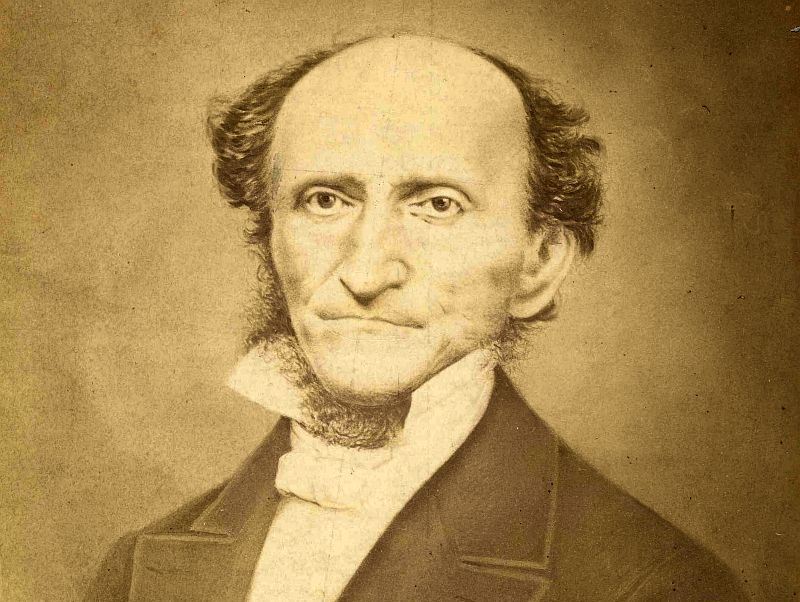
As it has been amply documented by fr.s Osmanthus (read Parts 1, 2, 3 & 4) and Francis Greenwood (read On Sodomites Axioi Thanatou), Issues Etc. host Todd Wilken and guest Mike Middendorf are sorely mistaken in their reading of Romans 1:18-32 as being relevant to and regarding all sinners,-Christians included!- both in terms of bare surface logic (as Osmanthus has demonstrated) and in terms of the underlying Greek text of the Scriptures (see Francis Greenwood’s accessible exegesis of the text). But if these modern refutations were perhaps not enough to secure one’s conscience on the matter, we here at Old Lutherans are happy to produce selections from the sainted Georg Stöckhardt’s Commentary on Romans affirming all the same.
The below excerpts are formatted with the exact verse in reference at the header, with the verses themselves underlined as original. Editorial emphasis is added with bolded letters. A short concluding comment follows.
I.18
From the revelation of the righteousness of God the apostle turns to the revelation of God’s wrath. For the wrath of God is revealed from heaven against all ungodliness and unrighteousness of men. He who is righteous through faith will receive life and salvation. In contrast, he who is ungodly and unrighteous will incur God’s wrath. This wrath of God is the inner reaction of divine holiness against sin. When revealed, it appears as punishment, judgment and damnation for all ungodliness and unrighteousness of men. Ungodliness is personal misconduct against God. Unrighteousness is the denial and violation of divine law, the norm for man’s conduct.
I.19
Because that which may be known of God is manifest in them for God hath shewed it unto them. That which is known of God is known to all men, also to natural man. God Himself, as far as men are able to know Him, that is the truth which they have suppressed. This knowledge of God is in them, in their hearts. God Himself revealed it unto them. He wrote in their hearts this knowledge of Himself.
I.24
Having characterized the godlessness of men, the apostle presents their unrighteousness. Wherefore God also gave them up to uncleanness. Therefore, because of their godlessness and idolatry God surrendered them to uncleanness. Uncleanness is here the punishment of Godlessness and divine affliction. God punishes sin with sin. This the world experiences. The curse of the evil deed is that it must produce evil.
I.28
The apostle introduces a new guilt of men, which also appears as a punishment inflicted upon them by God. And even as they did not like to retain God in their knowledge. God had made Himself known to them. Men knew God, but they lacked inner conviction of this knowledge. They did not have this knowledge subjectively. They did not make use of it, not thinking it worth the trouble. And the punishment suited the transgression: God gave them over to a reprobate mind, to do those things which are not convenient. Just as they did not deem it worthy to have God in their knowledge, just as they rejected God and the knowledge of God, so in like manner God gave them over to a vile mind, so that they freely and unhindered adapted themselves to their perverse disposition, so that they did what, according to their own judgement, was not proper. Along with knowledge of God there is also implanted in man’s heart knowledge of good and evil. However, even this moral knowledge men denied by their disposition and deeds.
The apostle has special kinds of evils in mind. The common thing in the transgressions listed is that the neighbor is harmed and love to him violated. Four series of transgressions are distinguished. Men are full of deceit, and not merely guilty of isolated errors and vices. From head to foot there is nothing sound in them.
I.31
The fourth series describes the evil disposition and immoral deeds of men negatively. They are disobedient to parents. Without understanding, permit no one to tell them anything. Covenant-breakers. Without natural affection, loveless, destroying all natural affects of love. Implacable. Unmerciful, hardhearted to the need of their fellow men. In short, they deny all piety, all human feeling and compassion. They have become true monsters. Why? Simply because they did not let God be their God. Only where God is known, feared and loved is true humanitarianism found.
I.32
Men have robbed God of His honor and have given it to the creature; they serve unrighteousness and uncleanness; they deny their fellow men all justice and love. Thus has the apostle described the world which he had before his eyes, the cultured Graeco-Roman world. The high degree of culture, which the world had achieved at his time, included a very deep moral decay. To all outward appearances everything was inwardly rotten and decayed.
Since Paul speaks of natural man estranged from God, this description of morals also fits the generation of our day. One cannot better characterize the religious and moral condition of our civilized world than with these words of the apostle.
It is a God-forgetting, idolatrous generations which lives upon earth. Who yet thanks God for His goodness, to which men owe their life and all blessings? The religion, the pseudo-religion, of the world is the deification of the creature. The world deifies her great man, her heroes, deifies herself, her own power, wisdom, excellence and achievements. The philosophical contemplation and adoration of God are nothing else than changing God into an image of weak, mortal man. Man views God and divine things according to human standards.
The generation of this age is an adulterous one. The world feasts her eyes upon and delights in the lusts of the flesh, shame and filthiness. Man’s carnal desires are no longer satisfied by common adultery but long for the unusual, refined enjoyment. Unnaturalness and unchastity of the apostle’s time have today only assumed another form and appearance.
It is a murderous generation in which we live. Avarice, insatiable envy, is the mainspring of commercial life. Man has no consideration for his neighbor. Every one strives to rise in the world and thus ruins and tramples upon others. It is idle scorn and mockery when the world writes humanitarianism or universal love upon her standard.
And this stream of destruction rushes onward incessantly. One can no longer check and restrain this disgraceful state of things. In vain are all attempts at reform. Men are, as it were, chained to unrighteousness by iron fetters. And why? A destiny rules over the activities of the children of men. God has given them up to their corrupt ways. Knowledge of God and morality has not altogether ceased. Man still hears proclaimed what is right before God and men. But whatever exists of truth serves only to call forth opposition, to goad men on to do the opposite of what is right. Therefore, men have no excuse. The world is continually driving herself forward to the abyss, to the Day of Wrath and the righteous judgement of God.
As Stoeckhardt demonstrates, Romans 1 addresses natural man, estranged from God; doubtless still a condition all the more prevalent today with our culture’s exceeding vileness in unnaturalness and unchastity. Yet the point stands, by no means should we conflate the condemnation of natural, unsaved man as outlined in Romans 1:18-32 with the daily contrition and repentance of justified, Christian sinners. To do so is a great danger to souls, whom hearing such from pastors could then reasonably disregard any further pursuit of sanctification in their Christian lives, because hey!- my sodomite neighbor’s buggery is just a speck in his eye, I’ve got to get working on the heterosexual log in mine. As stated above, see the thorough refutations of this antinomian heresy and its insidious logic.
A final comment may be necessary. Stoeckhardt nowhere pulls punches. He nowhere throws up his hands – however daintily – and says, we’ve had such success with the Gospel, why try Law now? No, our sainted teacher of Old Missouri blessed George is unremitting in his sober-eyed, clear judgement of the world and its children; rather, God’s judgement in particular. Stoeckhardt never mistakes the joy of the Lord with the excusal of sinners in conflating all sins as equal, nor conversely is Christ’s wrath misdirected to all sinners to the harm of those Christians covered in His blood. The world is continually driving herself forward to the abyss, to the Day of Wrath and the righteous judgement of God.
And if any man shall take away from the words of the book of this prophecy, God shall take away his part out of the book of life, and out of the holy city, and from the things which are written in this book.
-Revelation 22:19



Leave a Reply