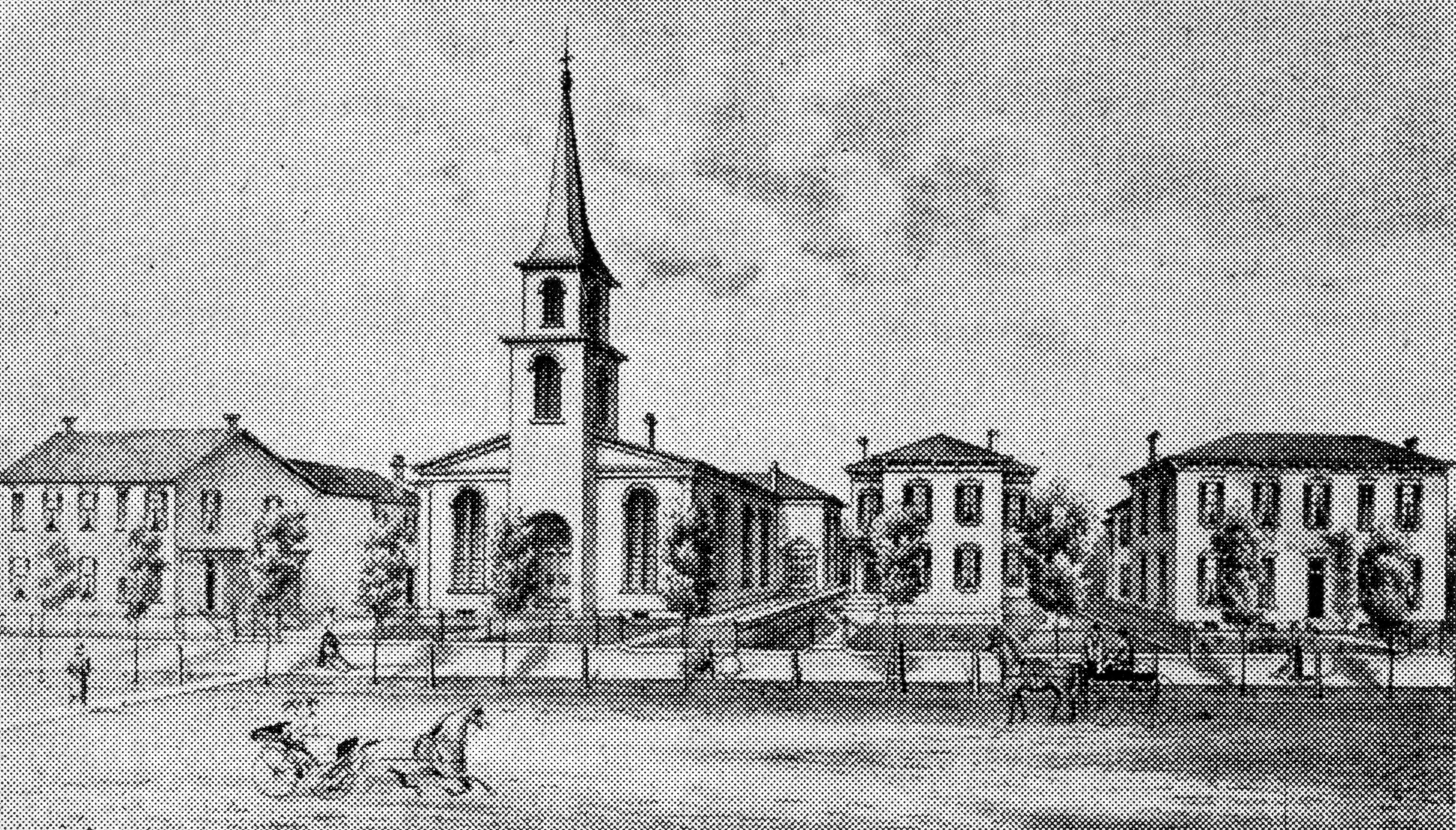
St. Paul’s Lutheran Church, Ft. Wayne Ind. (where the 1864 convention was held)
6th Session:
This session was opened Saturday, November 3, at half past 8 in the morning as usual with a service in which hymn 159 was sung and Ps. 68 was read. The minutes from the 4th session were read aloud and accepted with a few necessary improvements. In connection with an expression contained in yesterday’s minutes—that someone who had not actually lost true faith is not really under the ban, even if every Lutheran preacher in the entire world had excommunicated him—it was asked how the matter would stand if someone did not wish to submit himself to a good, wholesome ordinance [Ordnung] in the church and, yet, could not be accused of apostasy, whether he could be placed under the ban on account of his obstinance and stubbornness.
It was answered that such an excommunication would not be a valid excommunication. Only public, gross sins incur excommunication. Violations of human ordinances are only sins when thereby love is damaged; but wherever love is not harmed by the transgression of human ordinances, no excommunication may be pronounced. In fact, if someone were to hold to a purely human ordinance as if it were a divine ordinance, then such an ordinance would have to be broken for the preservation of Christian freedom. So, for example, the celebration [of the Divine Service] on Sundays is only a churchly ordinance. Here the sin consists in despising God’s word and not making use of it. But if there were no Divine Service on this day, I could work on Sunday, and no one would have the right to give me a bad conscience for doing so. No congregation should exclude a member for the sake of transgressing a human ordinance, unless love were clearly harmed thereby.
The following example was brought up: a congregation sends a delegate to a convention and resolves that each member should contribute something to his travel expenses; however, there is one member who does not want to contribute; this is conceded to him as long as he leaves the matter in peace and does not agitate the other members. But instead of leaving the matter alone, he incites a rebellion. If a congregation then excluded the person for this reason after admonishing him to no avail, would it be in the right to do so? Certainly, since love had suffered harm and sedition had been incited.
Disagreement arose in respect to a passage in yesterday’s minutes which indicated that that person who left the Lutheran church due to an erring conscience had not necessarily lost the Lutheran faith thereby—which passage had been altered to make it clearer: “such a person has not necessarily thereby fallen from faith in Christ.” It was asserted that one would have to say that those persons who had fallen away from our church and had gone over to a heterodox fellowship had fallen away from the Lutheran faith. This was admitted in as much as the Lutheran faith was understood as the developed dogmatic understanding. This assertion, too, was regarded as dangerous, since many would then fall away from the Lutheran church.
The objection was raised whether someone who had erred out of weakness could be excommunicated. When this question could not be answered in the affirmative, the distinction was referenced which had already been made yesterday between someone who errs due to inhibition or unclarity and one who willfully hardens himself against the truth. If someone is to be excommunicated, then that person himself must be able to be convinced that his sin is damning, so that if he were open and not obdurate, he himself would have to say: “Yes, I ought to be excluded, but nevertheless I do not want to repent and will not follow your admonitions.”
In order to shed some light on what cases are included in this, reference was made to the vast difference between those who are clearly established in true doctrine and the thousands of believing immigrants who are only barely familiar with and hardly established in the Lutheran doctrine and have let themselves be seduced by the sects here in America. One could certainly not say about these that they had lost faith in Christ. It would be different if, for example, someone had stepped away from our Lutheran congregations after hearing the true doctrine year after year; in this case it may well be that as a rule this falling away from the visible, orthodox Church is connected with a true apostasy from faith in Christ. Lastly, the distinction made yesterday was repeatedly referenced, namely that it all depends on whether someone falls away in ignorance and out of weakness or from despising the divine, maliciously and willingly. In every individual circumstance, however many may be thought up, it always depends upon this.
Since when discussing this matter a brother expressed himself to the effect that God may judge this way or that concerning the brother who has fallen away, but the congregation and the preacher would need to know how they are to regard and treat this person, we were made aware of how terrible it would be if we wished to judge and treat a person in such a case differently than God would. No, in excommunication it is decisive that the pastor and congregation must be entirely certain from God’s Word that this person has been excluded by God and so we also must exclude him. If there is no certainty, then one must leave it be and not excommunicate someone.
Here it was also remarked that many preachers and congregations only go according to their so-called moral conviction and the impressions that the behavior of one person makes upon another’s feelings and disposition. But this moral conviction may never serve as our measure. Rather, we must deal according to the clear, certain Word of God alone. If you want to act in a case of excommunication according to human discretion and feeling, then you are a dreadful tyrant. In a case of excommunication, you must know from God’s clear word what God would think about such a person.
St. Paul’s Lutheran Church, Ft. Wayne Ind. (where the 1864 convention was held)
Synod in Convention, 1864
Session 5:
Friday afternoon, Nov. 2, the session was opened as usual and, after handling formal business, it was resolved to deal with Rector Schick’s submission: “On the ban and the Synod’s participation therein.” At the end, this submission was first read aloud and then it was decided to use the sequence of reasons put forth in the document as the basis for discussion. The following remarks were made:
Christians are not held responsible for the false exercise of the ban wherever it is done without their cooperation, nor do they partake in the sins of another. To be sure, the good works of Christians are shared, including therefore the correct use of excommunication, but a false excommunication cannot be carried out by the Church as such. But it is another question, whether it would be wise given our circumstances, if individual congregations gave the Synod [Synodalgemeinde] the authority, to advise it in cases of church discipline. To be sure, this authority can be denied the Synod, but it is another question whether that should happen. If the only correct way were that each congregation had to seek the Synod’s counsel in matters of church discipline, then we would not have acted according to God’s Word up to now.
The ban publicly excludes from the local congregation as well as the kingdom of God by pronouncing the public and unrepentant sinner to be like a heathen and a tax collector in the name of the Triune God. Accordingly, congregations which persist in a brotherly relationship with one another will carefully and conscientiously guard against accepting someone as a member who has been excommunicated by a congregation before having been completely convinced as a matter of conscience and according to God’s Word that that person has been unjustly excommunicated. However, every conscientious congregation would have to do precisely this if, after the congregation had given the Synod such a supervisory right, the Synod had rendered an advisory opinion in such a case. For even an entire Synod can err; God’s Word alone can and must decide.
The first reason why it would be desirable for the Synod to be given such a supervisory right over excommunication cannot be the one provided by the submitter, but must be Christian love. For how could we practice love among one another more than by offering our experience to one another in order to avoid where possible the terrible sin of excommunicating even a single person unjustly.
God possesses the highest right of the keys; the Church has a delegated right and confers this right upon her stewards. Now, if a congregation is a member of the Church, then it excludes in the name of the Church, therefore also in the name of the Triune God, if it does so justly; for doing something in the name of God means to do something upon His command and with his full power. Therefore, if a congregation rightly excludes someone in the name of God, it does so in the name of the Church, that is with the Church’s command and full authority, in which alone the Church can act. For a congregation can do nothing right apart from the name of God.
Therefore, love should drive us to strive, as much as we can, so that none of our congregations become schismatic by unjustly excommunicating someone. Conversely, if the entire Synod pronounced the ban, it would avail nor more, because the Synod had done it, that if it had been done by a single congregation.
The question also arises whether the Synod has the duty of love to help and advise the congregations in this sense so that no false excommunication is pronounced. In itself, excommunication is nothing other than a display of the congregation’s love toward a poor sinner by not leaving untried the last means given to her by God for rescuing the soul of the poor man. It would, therefore, require 1) love toward the congregation which has pronounced the excommunication and 2) love toward the person who is regarded as excluded. It would, therefore, be delightful if we let such love have free course among us so that we joyfully entitled one another to the right to practice this duty of love among one another, so that those who intend to excommunicate are kept from sin and those who are to be excommunicated are kept from great tribulation. Indeed, the exercise of such a duty of love should be received by every congregation with heartfelt thanks. For since any number of things can occur in such cases of excommunication on both sides whereby both parties are aggravated and become ill disposed and finally the excommunication can be pronounced by the congregation in undue haste whereupon the excommunicated can complain of partisanship, premature judgment, and the like, it would be a great help if we established a certain order in this respect, not one encumbered with a law, but only an ordered practice of love.
To be sure, faith is a lord over all things, but love is the servant of every man. To be sure, every single congregation, even the smallest, originally independent, has the same authority as the largest, indeed, as the entire Church, within her limits. But does not love command us not to seek after right and might but after that which benefits?
For the Synod it would only be a burden laid upon her to serve the congregation in this respect. For the congregation, on the other hand, it would be a work of love shown to her. Only a preacher wise in his own eyes would regard it as a limit upon his freedom that he should and must seek the advice from the Synod in such matters. Preachers in particular have to contend with the demon of arrogance and thus it is precisely they who most need to be advised and assisted by other brothers in such cases. For how easily can it happen that a preacher who has been treated indecently, aggravated, and after forming an opinion and admonishing, is made even more ill-disposed by the offending party—how easily can it happen that he then presses out of personal considerations that that person be placed under church discipline! While the first sin was perhaps only a sin of haste, this sin is later increased with new sins through a false treatment, which would then, as a consequence, make excommunication necessary. Haven’t many dragged even those sins, about which Dr. Luther says that they belong in the Lord’s Prayer, into the light after they have been chastised at the first and second level, and brought the sinner, aggravated thereby to desperate refusal until he was finally gotten rid of through excommunication?
We should daily grow in knowledge, and in this matter too we are still greatly lacking. The fear of God, conscientiousness, love, and humility should move such a preacher so that he does not wish to stand only on his own two feet or rely upon his own cleverness alone, but rather he should gladly place himself at the feet of those more experienced and seek their instruction, since God gives grace to the humble but opposes the proud. Just how necessary this admonition is has been established by the facts in as much as the honorable District President explained that he had been called upon for counsel in two cases of excommunication. In both of these cases the congregations as well as the preachers were firmly convinced that excommunication could rightly be pronounced and had to be, and in both cases he succeeded in showing the affected parties from Gods word that they would have exercised a false excommunication if it had gone that far. Therefore, we should make a great help for ourselves and make use of the gifts and goods that God has given us for the common benefit. The reason that this has not happened sooner comes from the fact that originally our congregations were very reticent to accept any synodical fellowship because they feared the loss of their freedom as well as sacerdotal tyranny, and secondly because we had so little experience since we are all Germans who prefer to leave everything the way it had been.
How suitable, how in keeping with Christian conscientiousness, how supportive of unity would it be if, in a case of excommunication that is called into question, not only the congregation, which can easily be regarded as a party to the matter, gave an account, but also others, who would have to be regarded as entirely unpartisan, judged the matter according to God’s Word! Finally, hereupon it was recognized as the conviction of the Synod by means of a vote that it would be beneficial to and supportive of the edification of the Church for the Synod to participate in matters of excommunication with the local congregation.
It was, however, found to be excessively difficult to decide upon the manner in which such cooperation ought to occur. Therefore, the wish was expressed that a document be composed by competent men from writings already extant, especially from the writing of older teachers of the Church on the correct use of excommunication. The opinion was quite generally expressed that the congregations should, on the advice given, agree not to enforce excommunication without previously obtaining counsel. It is advisable to establish such an order not only for the unexperienced, frivolous, and unsound preachers, but also for the sake of inexperienced, frivolous, and unsound congregations. Yet, it would first be necessary to convince every congregation of the benefit of such an order before one could seek to move them to adopt such an order. Of course, it is precisely the most conscientious pastors and congregations which would do what such an order would prescribe without its introduction, but common orders are necessary precisely for the sake of those who do not have order.
A written opinion, it was thought, would hardly suffice. For someone who is participant in the excommunication, either actively or passively, should not always be regarded as an unpartisan reporter. The responder, on the other hand, can only judge according to what has been placed before him.
Further discussion on the manner of this order was delayed until the next session. Adjourned with the Lord’s Prayer.
A new and genuinely novel interpretation of the fourteenth article of the Augsburg Confession began to circulate in the Lutheran internet this week, at least in the corners of it that we frequent.
Before we get into the new interpretation, the text in question, by way of reminder:
Of Ecclesiastical Order they teach that no one should publicly teach in the Church or administer the Sacraments unless he be regularly called.
— Article XIV, “Of Ecclesiastical Order”
It may not be consciously espoused by anyone—then again, it may be—but the new interpretation, which seems to have been adduced from an ad hoc polemical position against “alt-right” Lutherans, is this:
Only ordained men may publicly opine about or make theological assertions in public.
Now, that only men, and not women, should be opining publicly about anything, really, is indisputable. As a rule, women should not be speaking publicly. If they are, it’s because something in the society in question is very wrong; examples in Scripture, such as Deborah, are not normative (cf. Isaiah 3:12ff).
However, that only ordained men should be speaking, asserting, and arguing about theology in public is a preposterous notion—ludicrous, really, especially coming from Lutherans. So, too, the idea that an ordained man may only be admonished, corrected, rebuked, etc., by another ordained man. This is sacerdotalism, pure and simple.
AC XIV is about who may teach in the church. It is not only about the divine service (see this fine translation of Stoeckhardt on the topic), but neither is it about every forum in society. If it were, it would follow that only pastors may speak publicly about anything, since literally all topics are ultimately theological.
Not so fast! St. Paul says to St. Timothy, “Rebuke not an elder, but intreat him as a father.” ‘Elder’ means ‘presbyter.’ QED TKO, layman!
Well, you can think that. That’s a plausible reading. But even if it were the only allowable one (it’s not), it would not follow that only ordained men may publicly opine about or make theological assertions in public.
If and when pastors err in their theology, and do so persistently—especially if they do so as a group—they can and must be corrected. Yes, even by laymen, if necessary, as the citation from the Formula of Concord featured above attests. To be frank, this is about the most Lutheran contention imaginable.
We’ll go further. If and when pastors act shamefully in public and attempt to use their status as pastors to shield themselves from rebuke and criticism, they should be rebuked by other Christian men, firmly and decisively, in order that they may be brought to repentance. They should be, as they say, taken down a couple notches. After all, we are all called to repentance daily, are we not? “The blood of Jesus his Son cleanses us from all sin” (1 John 1:7). Where that call to repentance is not heeded by erring pastors, there must be defrocking.
This is borne out in the writings of the Blessed Doctor, Martin Luther. The citations which follow are from his Church Postil. God grant that the pious reader would read, mark, learn, and inwardly digest them, for his own edification and that of the Evangelical-Lutheran Church, the true Visible Church on earth.
Dr. Luther on the Duty of Christians to Judge Doctrine
27. Now the Church is not wood and stone, but the company of believing people; one must hold to them, and see how they believe, live and teach; they surely have Christ in their midst. For outside of the Christian Church there is no truth, no Christ, no salvation.
28. From this it follows that it is unsafe and false that the pope or a bishop wishes to have himself alone believed, and that he poses as a master; for they all err and are inclined to err. But their teaching should be subject to the congregation of believers. The congregation should decide and judge what they teach; their judgment should stand, in order that Mary may be found before Joseph, the church be preferred to the preachers. For it was not Joseph but Mary who retains the words in her heart, ponders them, gathers them together and compares them. The apostle also taught this in 1 Corinthians 14:29-30 when he says: “And let not the prophets speak by two or three, and let the others discern. But if a revelation be made to another sitting by, let the first keep silence.”
14. Now Paul begins to mention the nature of love, enabling us to perceive where real love and faith are to be found. A haughty teacher does not possess the virtues the apostle enumerates. Lacking these, however many gifts the haughty have received through the Gospel, they are devoid of love. First, love “suffereth long.” That is, it is patient; not sudden and swift to anger, not hasty to exercise revenge, impatience or blind rage. Rather it bears in patience with the wicked and the infirm until they yield. Haughty teachers can only judge, condemn and despise others, while justifying and exalting themselves.
10. But what does the resurrection advantage us? It has already brought us this gain: our hearts are enlightened and filled with joy, and we have passed from the darkness of sin, error and fear into the clear light; the Christian is able to judge all sects, all doctrines of devils, that may arise on earth. Is it not a thing of unspeakable value, a precious gift, to be enlightened and taught of God to the extent of being able to judge correctly every doctrine and every kind of conduct exhibited in this world, and to show all men how to live—what to do and what to avoid? Well may we boast, then, of having here on earth also a Father—“the Father of lights”—from whom we receive blessings of such magnitude that man should willingly yield body and life for their attainment. What would I in my darkness not have given to be liberated from the very dread which prompted the celebration of masses and other abominations, yes, from the torture and anguish of conscience which left me no rest? Or to have instruction enabling me rightly to interpret a single psalm? I would, for such enlightenment, readily have crawled on the ground to the ends of the earth. Thank God, we now have the blessed treasure abundantly, the great and precious light, the gracious Word. What is the sum of all suffering and misfortune compared to this light?
51. In the first place, therefore, it is necessary that both preachers and hearers take heed to doctrine and have clear, unmistakable evidence that what they embrace is really the true Word of God revealed from heaven; the doctrine given to the holy and primitive fathers, prophets and apostles; the doctrine Christ himself confirmed and commanded to be taught. We are not permitted to employ the teaching dictated by any man’s pleasure or fancy. We may not adapt the Word to mere human knowledge and reason. We are not to trifle with the Scriptures, to juggle with the Word of God, as if it would admit of being explained to suit the people; of being twisted, distended and patched to effect peace and agreement among men. Otherwise, there would be no sure, permanent foundation whereon the conscience might rely.
52. Nor is it any more admissible for one who chances to have an office of greater influence than others, who is peculiarly holy, or who is of exalted spirit and intellect—even though he were an apostle—to presume upon his gifts and the office and take authority to teach according to his own inclinations, requiring his hearers to accept unquestioningly his word and rely upon it because what he teaches must be right. But thus the Pope in time past persuaded the world that because he occupied the seat of the apostles, the highest office, and assembled the councils, the latter could not err, and that therefore all men are obliged to believe and obey what they resolve and confirm.
33. The second truth is that all Christians have the power and right to pass judgment upon any doctrine, and to turn from false preachers and bishops, refusing obedience to them. For you hear in this Gospel that Christ says of his sheep: “My sheep hear my voice, and a stranger they will not follow, but will flee from him, for they know not the voice of the stranger.” The reason Christians can rightly judge is because they apply the standard—as I mentioned—from this Word of Christ, that all who fail to teach Christ are thieves and murderers. These words have already passed the judgment and further knowledge than that of Christ is unnecessary. Christians, then, are in duty bound to follow this judgment, fleeing and avoiding all it contains, it matters not who, how wise or how many they are.
2. We must boldly consider the two kinds of doctrine, the true and good, and the false and erroneous, and that they will always accompany each other, for thus it has been from the beginning, and thus it will continue to the end of the world. Hence it will not do for us to creep along in silence, and resort to a safe and secure manner of life. The evil teachings of men and the doctrines of devils, and all our enemies oppose us without ceasing, and hence we dare not think that the issue is settled. We are not yet across the river. Therefore the Lord diligently warns us and says: “Beware of false prophets, which come to you in sheep’s clothing, but inwardly they are ravening wolves.”
3. We should well consider this passage, for Christ our Lord here commands and gives all Christians the power to be judges of all doctrine, and he gives them power to judge what is right and what is not right. It is now well on a thousand years that this passage has been perverted by false Christians, so that we have had no power to judge, but had to accept what the Pope and the councils determined, without any judgment of our own.
4. Now this Gospel here overthrows the very foundation of popery and of all councils, for we are not bound to keep what the Pope commands and men decree. Therefore I say again, firmly grasp what this Gospel teaches, for the authority has never been given either to the Pope or councils, or anyone else, to sit and determine what is faith. For Christ says: “Beware of false prophets.” Either the Gospel lies, or the Pope and the councils do. Christ says we have the right to judge all doctrines, and whatever is proposed for us to keep or to reject. Here the Lord does not speak to the Pope, but to all Christians. And as the doctrine is proclaimed to all: “Whatsoever ye would that men should do to you, do even so to them;” so likewise the words exclude no one: “Beware of false prophets.” From which it clearly follows that I may indeed judge of the doctrine.
8. These words are blows and thrusts for the false apostles and preachers. Paul is mortal enemy to the blockheads who make great boast, pretending to what they do not possess and to what they cannot do; who boast of having the Spirit in great measure; who are ready to counsel and aid the whole world; who pride themselves on the ability to invent something new. It is to be a surpassingly precious and heavenly thing they are to spin out of their heads, as the dreams of pope and monks have been in time past. “We do not so,” says Paul. “We rely not upon ourselves or our wisdom and ability. We preach not what we have ourselves invented. But this is our boast and trust in Christ before God, that we have made of you a divine epistle; have written upon your hearts, not our thoughts, but the Word of God. We are not, however, glorifying our own power, but the works and the power of him who has called and equipped us for such an office; from whom proceeds all you have heard and believed.
9. It is a glory which every preacher may claim, to be able to say with full confidence of heart: “This trust have I toward God in Christ, that what I teach and preach is truly the Word of God.” Likewise, when he performs other official duties in the Church—baptizes a child, absolves and comforts a sinner—it must be done in the same firm conviction that such is the command of Christ.
10. He who would teach and exercise authority in the Church without this glory, “it is profitable for him,” as Christ says (Matthew 18:6), “that a great millstone should be hanged about his neck, and that he should be sunk in the depths of the sea.” For the devil’s lies he preaches, and death is what he effects. Our Papists, in time past, after much and long-continued teaching, after many inventions and works whereby they hoped to be saved, nevertheless always doubted in heart and mind whether or no they had pleased God. The teaching and works of all heretics and seditious spirits certainly do not bespeak for them trust in Christ; their own glory is the object of their teaching, and the homage and praise of the people is the goal of their desire. “Not that we are sufficient of ourselves, to account anything as from ourselves.”
11. As said before, this is spoken in denunciation of the false spirits who believe that by reason of eminent equipment of special creation and election, they are called to come to the rescue of the people, expecting wonders from whatever they say and do.
4. Therefore, not without reason does Paul warn Christians to be always wise and circumspect— to keep the Word of God before them. Upon so doing depends their wisdom and understanding. Let each one make it a matter of personal concern, and especially should it be the general interest of the congregation. Where care is not observed to retain the Word in the Church, but there are admitted to the pulpit brawlers who set forth their own fraudulent doctrines, the Church is injured; the congregation will soon be as the preacher. Again, if the individual fails to regulate his daily life—the affairs of his calling—by the Word of God; if he forgets the Word and absorbs himself in accumulating wealth; if he is tangled with secular interests, he soon becomes a cold and indolent Christian, then an erring soul, and finally utterly disregards God’s will and his Word. It is for these reasons God so frequently commands us in the Scriptures continually to explain and apply his Word, to hear it willingly and practice it faithfully, and to meditate upon it day and night. He would have our lives emanate from the Word in honor to God and gratitude to him— from the Word wherein we daily look as in a mirror. But care and diligence are necessary to bring it to pass, and we should faithfully assist each other by instruction, advice, and in other ways.
39. [The foregoing] is a brief statement as to the first estate or government, both in its higher and its lower functions, to show how far we. are away from our true position and how full the world is everywhere of thievery. But these matters are worst of all, if one is to expound this passage (Render to God what is God’s) and speak of the God-thieves in the spiritual government of Christendom, in which I and the likes of me are. For as high as heaven is above the earth so dangerous and difficult is this office in comparison with secular or imperial positions which, indeed, are also dangerous where their occupants do not call upon God for help to discharge their duties properly and without injury to their subjects. But if unfaithful ministers or preachers get into their office they will be, not thieves of bread, meat or clothing, wherewith the body is nourished and with which jurists busy themselves, who teach nothing further than what ministers to the belly and try to check that class of stealing; but those who occupy the office that is to give the bread of eternal life to souls and, instead, cause them everlasting thirst, hunger and nakedness, taking away the word by which man is nourished from death to life, such are not simply belly-thieves, but thieves of God and of the heavenly kingdom.
By all means. For not only did priests in the Old Testament have their lawful wives, but Paul also writes, in the New Testament, that such a bishop and elder is to be chosen as is both of blameless life and the husband of one wife (l Ti 3:2; Tts 1:5-6).
But some say: Paul is to be understood allegorically, namely that a bishop is to be appointed over only one church, or that he indeed can be chosen bishop who formerly was the husband of one wife, but not he who still is, or he who still has his own wife.
Paul himself is his own clear interpreter, namely that by husband of one wife he means him who has children, and not only of the church, but also of a family, that is, he rules well a wife, children, and servants (1 Ti 3:4; Tts 1:16). So also some of the apostles had their own wives, not only before they became apostles, but they also lived in marriage with them at the very time when they were apostles (1 Co 9:5). So also Ignatius and Clemens explain that passage of Paul. Moreover, Paul does not say, He who was the husband of one wife, but: He who is. And if these words were to be wrested to the past tense, it would necessarily also follow therefrom that a bishop is to be chosen who was at one time sober and able to teach, but is no longer so.
Martin Chemnitz, Ministry, Word, and Sacraments: An Enchiridion (1593, 1603), ed., trans. Luther Poellot; St. Louis: Concordia Publishing House, 1981; 148-149