Are you an Old Lutheran?
Do you have something to say?
Send it: oldluth at protonmail dot com
Submitted by anon
Dear brother,
You asked, “Why isn’t the Eucharist observed as a full meal?” As I said the other night, it’s a good question. I hope I can do it justice with my answer.
No particular short-form article comes to mind, but, as I wrote in my text to you, a few books do. I began rereading some relevant sections the other night before bed, some of which I will reproduce and comment on here. First, though, I’ll give you a thesis of a sort:
The Church has always recognized the Eucharist (variously known as the Holy Communion, the Lord’s Supper, the Sacrament of the Altar, the Blessed Sacrament, or simply the Sacrament) to be the observance (=celebration[1]) not of the Last Supper in toto, but specifically of those words and actions of Christ which He Himself identified as constituting “the New Testament.” From St. Matthew, Ch. 28:
And as they were eating, Jesus took bread, and blessed it, and brake it, and gave it to the disciples, and said, “Take, eat; this is my body.” And he took the cup, and gave thanks, and gave it to them, saying, “Drink ye all of it; For this is my blood of the new testament, which is shed for many for the remission of sins.” (vv. 26-28)
As you may know, the term “Eucharist” (εὐχαριστία) specifically refers to the giving of thanks (cf. above: “and gave thanks”) which has from ancient times been a part of the celebration of the Sacrament and has come to be a sort of synecdoche or shorthand for the Sacrament itself. The liturgical form of this thanksgiving is known as the “eucharistic prayer,” and in those rites where it is retained it precedes the Words of Institution[2] in the Liturgy of the Sacrament, which is, roughly speaking, the second half of the Mass. So even the term “Eucharist” alludes to the fact that what is being celebrated or observed is the New Testament that Christ institutes at the end of the Passover meal.
That’s probably the simplest and most perfunctory scriptural explanation as to why the Eucharist is not observed as a full meal; however, a consideration of the purpose of the Eucharist helps to illuminate the subject a bit more.
The purpose of the Eucharist is not that of ordinary food — that is to say, its purpose is not the sustenance of the human body as a mere biological hypostasis whose end is death, but the sustenance of both body and soul unto life everlasting, i.e., “the resurrection of the body and the life of the world to come” (Nicene Creed, XI-XII). Put another way, the purpose of the Sacrament is to nourish the life of faith which has been begun in the regenerating waters of Holy Baptism. Yet sin hinders this life of faith, separating us from the One who is life, who says of Himself, “I am…the life” (St. John 14:6). Thus Our Lord, when He institutes the Blessed Sacrament, says that it is “for the forgiveness of sins” (St. Matthew 26:28), and connects it with the atonement He is about to make with the offering of His body and blood on the altar of the cross, that we might be saved from death, hell, and the power of Satan, be reconciled to the Father, and participate in the life of God.[3], [4]
It is certainly no accident that Christ institutes the Sacrament within the context of the Jewish Passover: the deliverance of the ancient people (the Israelites) from bondage in Egypt foreshadows the deliverance of mankind from bondage to sin, death, and Satan; the sacrifice of the Passover lamb, the partaking of its flesh, and the marking of the Israelites’ homes with its blood (so to protect them from the Angel of Death) — these vividly foreshadow the Person and Work of Christ as the promised Seed of the Woman (Genesis 3:15) and the Lamb of God (St. John 1:29), specifically His passion and sacrificial death.[5] So, too, the Israelites’ deliverance from Pharaoh’s pursuing host through the Red Sea has from ancient times been understood as a type or prefigurement of Baptism, as was also the deliverance of Noah and his family from the Flood by the ark — this is specifically attested by St. Peter in his first epistle as a type of Baptism.
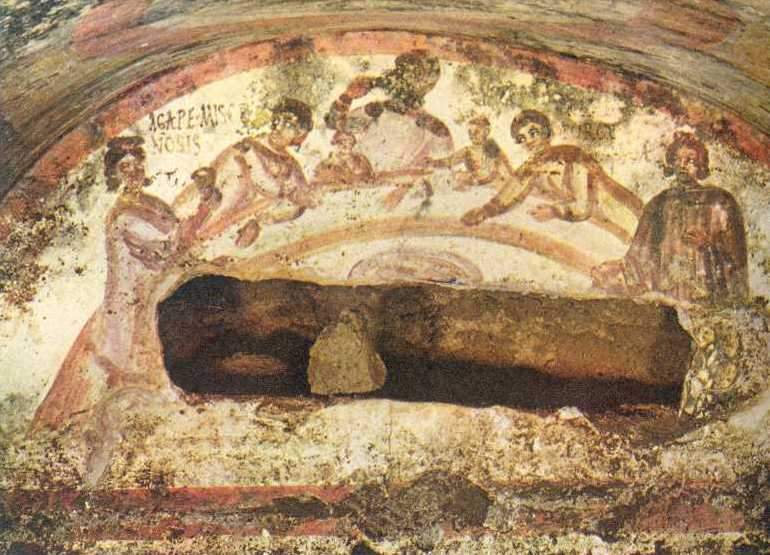
In fine, and to put it perhaps a bit too plainly, the Eucharist is food for our hungry souls, not our hungry bodies. Still, you may be wondering: if Christ’s institution of the Sacrament did take place within the context of the Passover meal, why isn’t that meal retained as part of its celebration in the Church today? As a matter of fact, some early Christian liturgies did include a communal meal known as the “Agape” (Ἀγάπαις). Here is some helpful history from Dr. Luther D. Reed’s magisterial work The Lutheran Liturgy, Ch. 1, “Earliest Christian Worship”:
The Agape, an ordinary meal of semireligious character, preceded the Eucharist. This fellowship meal was a continuation in Christian circles of the custom of Jewish fellowships which regularly partook of a meal of social and religious character in connection with their assemblies. As Christian thinking gradually grasped the sacrificial significance of our Lord’s death and its redemptive purpose, emphasis shifted from recollections of the Last Supper to observance of the Lord’s Supper as an institution of formal and ceremonial character and universal import. In the early decades, however, men and women brought their own provisions and ate them in company with their fellow believers. The wealthy brought much and presumably ate much; the poor brought little and were satisfied with that. Paul in his first letter to the Corinthians (Chaps. 11-14), seeks to correct abuses which had arisen in connection with the Agape and the more or less spontaneous devotional exercises which followed the Eucharist. (Reed, 26)
As Reed alludes above, already during St. Paul’s ministry divisions had arisen in association with the Agape — the Greek word is σχίσματα, that is, “schisms.” The specific portion of St. Paul’s First Epistle to the Corinthians is Ch. 11, v. 17ff:
Now in giving these instructions I do not praise you, since you come together not for the better but for the worse. For first of all, when you come together as a church, I hear that there are divisions among you, and in part I believe it. For there must also be factions among you, that those who are approved may be recognized among you. Therefore when you come together in one place, it is not to eat the Lord’s Supper. For in eating, each one takes his own supper ahead of others; and one is hungry and another is drunk. What! Do you not have houses to eat and drink in? Or do you despise the church of God and shame those who have nothing? What shall I say to you? Shall I praise you in this? I do not praise you. (vv. 17-22)[6]
The Apostle’s words here are anything but commendatory vis-a-vis the Corinthian practice of the Agape, as it had come to obscure the celebration of the Eucharist itself, which, unlike the Agape, had the command and institution of the Lord. The Agape’s lack of dominical[7] institution does not mean that it was an intrinsically wrong or sinful practice, only that it was potentially disruptive of the proper end or goal of the eucharistic liturgy, i.e., the participation in and reception of the Sacrament for the forgiveness of sins, life, and salvation. In the case of the Corinthian church, there was nothing potential about the disruption: the Agape had indeed become an occasion for selfishness and ostentation, as though it were a mere social event — and a rather stratified one, at that. St. Paul goes on:
For I received from the Lord that which I also delivered to you: that the Lord Jesus on the same night in which He was betrayed took bread; and when He had given thanks, He broke it and said, “Take, eat; this is My body which is broken for you; do this in remembrance of Me.” In the same manner He also took the cup after supper, saying, “This cup is the new covenant in My blood. This do, as often as you drink it, in remembrance of Me.” For as often as you eat this bread and drink this cup, you proclaim the Lord’s death till He comes. (vv. 23-26)
If I might paraphrase: “Remember, this is what you are gathered to do; this is of first importance; this concerns your eternal salvation. Follow the command and institution of Christ, don’t just imitate what has been described. This — the Eucharist, the Lord’s Supper — is what I received from the Lord.”
St. Paul’s goal is not to preserve the Agape, but to preserve the Sacrament. To be more sympathetic, however, the ostensible purpose of the Agape was honorable and truly Christian: as its name suggests, it was to be an expression of unconditional love and sharing in common. St. Paul does not denigrate such things — on the contrary: love is the necessary fruit of faith, its sine qua non, and all throughout his epistles St. Paul exhorts the brethren unto works of charity for the building up of the body of Christ. His question, “Do you not have houses to eat and drink in?” really implies that the kind of divisive cliquishness which was taking over the Corinthian church’s Agape was abortive of its own ostensible purpose: “If you’re not going to share in common, then go ahead and wall yourselves off in your houses, do your own thing, and ignore the needs of others — but such behavior has no place in the church.” There’s some definite irony in his words here.
With all of that said, the Agape did not so much die out; rather, it was gradually transferred from the context of the Church’s corporate worship, i.e., the liturgy, to the broader context of the Christians’ common life together.[8]
Yes, but why? There are two main reasons, I would say. The first was alluded to by Reed above: “As Christian thinking gradually grasped the sacrificial significance of our Lord’s death and its redemptive purpose, emphasis shifted from recollections of the Last Supper to observance of the Lord’s Supper as an institution of formal and ceremonial character and universal import.” Adornment can either accentuate or obscure the virtues of the thing which is adorned. With that said, the Agape was like a celebratory adornment to the liturgy of the Sacrament — fine so far as it went (sometimes), but as the Christians grew in knowledge, as the splendor of Christ Himself in the Sacrament dawned more fully in their minds, they began to tailor such adornment. Undoubtedly, as the years wore on and persecution began to increase, and increase in brutality, the early Christians became more solemnly aware of the full significance of the Sacrament as “the medicine of immortality.” “I have no taste for the food that perishes nor for the pleasures of this life,” wrote St. Ignatius of Antioch in 110 AD, on his way to be fed to the lions. “I want the Bread of God which is the Flesh of Christ, who was the seed of David; and for drink I desire His Blood which is love incorruptible.”[9] No earthly meal, no memorable instance of altruism, no man’s friendship, no woman’s love, no assured knowledge of your own authenticity will do in the last extremity. When you are about to die, you want the mercy of God.
The second reason relates to the first, howbeit somewhat tangentially. The “Agape” was also known as a “love-feast.” If that strikes us as a bit orgiastic-sounding, that’s not just our modernism — that’s how it sounded to the Romans, too, and not for no reason: various Gnostic sects did in fact hold orgies as part of their secret rites, as did the followers of the cult of Mithras, which had a fashionable following among the socialites of the Hellenized Roman empire, especially in places like Asia Minor.[10] The Romans were not overly studious in distinguishing between the Christians and other troublesome religious minorities, and regarded all of them alike as immoral and lascivious atheists. By the end of the first century rumors had begun to circulate alleging that Christian worship consisted of an orgy followed by a “Thyestean Feast,” i.e., a cannibalistic banquet.[11] In a letter to the emperor Trajan, Pliny the Younger (governor of Bithynia from 111-113 AD) expressed genuine surprise at the fact that no such salacious details were forthcoming from the Christians he captured and tortured:
They asserted, however, that the sum and substance of their fault or error had been that they were accustomed to meet on a fixed day before dawn and sing responsively a hymn to Christ as to a god, and to bind themselves by oath, not to some crime, but not to commit fraud, theft, or adultery, not falsify their trust, nor to refuse to return a trust when called upon to do so. When this was over, it was their custom to depart and to assemble again to partake of food — but ordinary and innocent food… I judged it all the more necessary to find out what the truth was by torturing two female slaves who were called deaconesses. But I discovered nothing else but depraved, excessive superstition.
Sadly, not all such rumors were unfounded. The Gnostic leaven had come in on a wafting, zeitgeisty breeze and begun to fester in some Christian congregations even as early as the first century AD, as attested by the Epistle of St. Jude, the only explicit biblical reference to the Agape (although no one disputes that St. Paul is writing about the Agape in 1 Corinthians 11). St. Jude writes:
Beloved, while I was very diligent to write to you concerning our common salvation, I found it necessary to write to you exhorting you to contend earnestly for the faith which was once for all delivered to the saints. For certain men have crept in unnoticed, who long ago were marked out for this condemnation, ungodly men, who turn the grace of our God into lewdness and deny the only Lord God and our Lord Jesus Christ… [T]hese dreamers defile the flesh, reject authority, and speak evil of dignitaries. Yet Michael the archangel, in contending with the devil, when he disputed about the body of Moses, dared not bring against him a reviling accusation, but said, “The Lord rebuke you!” But these speak evil of whatever they do not know; and whatever they know naturally, like brute beasts, in these things they corrupt themselves. Woe to them!… These are spots in your love feasts, while they feast with you without fear, serving only themselves. They are clouds without water, carried about by the winds; late autumn trees without fruit, twice dead, pulled up by the roots; raging waves of the sea, foaming up their own shame; wandering stars for whom is reserved the blackness of darkness forever. (vv. 3-4, 8-11a, 12-13)
Practitioners of some species of the Gnostic heresy, having no qualms about syncretism, would prey upon the naïve charity of the Christians, infiltrating their congregations and seeking to subtly pervert the worship of Christ, denying that He was the incarnate Logos, God-in-the-flesh. Why this denial, specifically? The Gnostics believed that the world of matter and corporeal existence was a vile prison to be escaped and transcended, utterly incapable of being mingled with divinity or sanctified by God. To say that the Incarnation was an affront to their sensibilities would be to understate the matter quite a bit.[12] In order to express their disdain for the flesh, some Gnostics engaged in every form of sexual deviancy you can imagine; others took the opposite tack and shunned even the most benign pleasures. Needless to say, it was the practitioners of the first variety that were infiltrating the Agape and causing the problems described by St. Jude (I would also venture to guess that those sects in the first category had more adherents — Chesterton’s “Song of the Strange Ascetic” comes to mind). I guess after a few bowls of unmixed wine, the line between a potluck and an orgy gets blurry, especially if you’re part of a sect for whom crossing that line has the character of a solemn religious duty.
By the middle of the third century, the Agape had more or less disappeared from those liturgies which once featured it; however it did persist for a time in some places as an extra-liturgical event (i.e., outside the context of the worship service proper). Even so, communal eating, sharing in common, and bearing each other’s burdens continued to characterize the common life of ancient Christians on the whole, yet in contexts which preserved the sanctity of the Eucharist as “holy things for the holy ones.”[13]
So there’s an answer, or something like it. I was going to editorialize a bit at this point, but this letter is already long enough, and I’m sure that you think I’m autistic now. Whatever the case may be, please don’t hesitate to follow up with more questions, if any more are forthcoming. I’d be glad to continue this conversation, so long as it’s helpful to you.
Oh, and I hope that the footnoting is not a distraction. The footnotes contain material that I thought was relevant but which seemed to derail the letter a bit. Just call me Anon Foster Wallace or David Foster Anon or whatever.
Love, your brother,
anon
Oculi Sunday/St. Joseph’s Day
March 19, 2017 A+D
Do you enjoy this site? Help us cover our hosting costs and fund Old Lutheran Book Concern. Thank you!
Footnotes:
Although the term “celebration” may sound trite, its liturgical denotation is anything but, and it is the more venerable term for the sacramental action. For me, references to the “observance” of the Sacrament are ineluctably associated with the dour Calvinists, who are wont to speak of all of the sacraments as “ordinances,” and whose joyless celebrations of the Eucharist resemble nothing so much as “memorials for an absent friend” (to quote Pastor Louis). The word “ordinance,” at least for me, conjures up images not of heaven and the marriage feast of the Lamb, but of parking tickets, traffic court, and shrewish county clerks. ↑
The Verba Christi, “words of Christ”; often simply called the Verba. ↑
The Gospel according to St. John, though it alone contains no account of the Last Supper, is unique among the four gospels in its record of the “Bread of Life” discourse, which, when read in light of Christ’s words at the Last Supper, is unavoidably sacramental. ↑
Sectarians like our dear cousin Hannah hear a statement such as “the Eucharist gives and seals the forgiveness of sins” or “Baptism now saves you” (1 Peter 3:21) and immediately retort: “No! We’re saved by Jesus dying on the cross!” They do not understand that the sacraments are the means by which the saving work of Jesus Christ is applied to us, instituted by Christ Himself. To put it even more scripturally, the sacraments are the means by which we are united to Christ’s death and resurrection (Baptism: Romans 6:3ff) and strengthened in that sin-absolving and life-giving union (Eucharist: St. John 6:14ff, 1 Corinthians 11:23ff; Absolution: St. John 20:21ff). Relatedly, they also do not believe that the bread and wine in the Sacrament are the Body and Blood of Christ, as Christ Himself says and as the Church has confessed for over 2000 years; rather, all Protestants except Lutherans and (some) Anglicans believe that the Bread and the Wine are mere symbols of Christ’s Body and Blood. For some (i.e., the Reformed) the symbolism is more complex and entails what they call the “spiritual presence of Christ,” but it is symbolism all the same. The point is that any teaching that the elements in the Eucharist are anything less than the life-giving Body and Blood of the deathless Son of God was regarded as heretical in the early Church — and also in the medieval Church (see: . Such doctrines were unable to flourish without censure until the sixteenth century, at which time they began to be promulgated by heterodox theologians like Ulrich Zwingli, Jean Calvin, and others. You didn’t ask about this, so I won’t go into it at length, but I would be remiss not to at least make mention of it. ↑
Indeed, for God, to whom all time is eternally present, these events are nothing if not the radiant effulgence of the Person and Work of Christ “reaching back,” as it were, and permeating the Old Covenant, thus showing it to be “old” only in a human sense. ↑
I checked my analysis against that of the redoubtable R. C. H. Lenski, a late nineteenth-century German-American Lutheran émigré theologian whose twelve-volume New Testament commentary has been released to the public domain by the ELCA, a “church” which isn’t really interested in the Bible and thus has no reason to gate-keep this resource. Anyway, Lenski backs me up. ↑
Dominical, i.e., “of or coming from the Lord”; cf. Latin: Dominus. ↑
For this reason I jokingly say that I credit St. Paul with indirectly instituting Sunday Brunch. To be honest, though, there’s a grain of truth to that. Moreover, time was when it was rather unimaginable for there to be no potluck luncheon in a church’s social hall after the service; now a common meal is the exception rather than the rule. Instead you’re expected to sit through a (quite often) boring Bible class with a dinky styrofoam plate of spam and crackers. I’m not going to say at this point, “No wonder people don’t go to church!” as if it were that simple. It’s not that simple, and if one were simply going to church for a “sociological group-hug” (as an English prof at Middlebury once put it), that’d be equally problematic — in fact, that’d be worse. But there’s no need to play both sides against the middle: orthodoxy and beautiful liturgy can and ought to be followed by relaxed and amicable socializing and sharing of food, either at church, or at members’ homes, or at a restaurant. Our family is very good at this; I miss being able to have Sunday brunch at Mom and Dad’s house. Mary and I try to imitate their hospitality in our home, especially on Sundays. ↑
The Seven Letters of Martyrdom of St. Ignatius of Antioch; Letter to the Romans, Ch. VII, iii; ca. 80-110 AD. ↑
An apt modern analogy would be to Madonna’s dabbling in Kabbalah, other Hollywood types taking up Scientology, etc.— bored rich hedonists, basically. ↑
Cf. Myth of Thyestes. ↑
The history of Gnosticism, as well as the fathers’ writings against it, is extremely interesting and extremely important. However, when one ventures beyond the few New Testament references to its early antecedents, it is also so compendious and dense a topic as to positively defy summary. If you’ve ever wondered about Marty’s kid’s name, he’s named after St. Irenaeus of Lyons, best known for his monumental work Adversus Haereses, the longer title of which, translated from the Greek, is On the Detection and Overthrow of the So-Called Gnosis. While I have read some of St. Irenaeus’s works, I have barely scratched the surface of Adversus Haereses. In any event, if you are interested, I could point you to a couple worthwhile volumes of Church history which take on the Herculean task of summarizing Gnosticism and the late-antique Hellenic philosophical milieu in which it arose. Here, regardless of whether you’re interested: Early Christian Doctrines by J. N. D. Kelly and The Early Church by Henry Chadwick. ↑
In this ancient Greek liturgical phrase, “holy” is not employed as a personal attribute that anyone may boast of, but it refers to the fact that the saints have been made holy by Baptism, the Gospel, the Eucharist, etc. It is a derived holiness only: the saints are clothed in white robes not their own, which have been washed in the blood of the Lamb (cf. Revelation 7:14). ↑