Are you an Old Lutheran? Do you have something to say? Send it: oldluth at protonmail dot com
Submitted by Sean Russell
A recent discussion online with a Baptist gentleman reminded me of two pivotal moments—both related to the sacraments—which finally tipped me over the edge to the point where I officially thought of myself as being more Lutheran than Reformed Baptist. The relevant part of the online discussion was this:
Baptist: Not true at all. Salvation (however you want to describe it) is brought by the baptism with/by the Spirit – same as circumcision made without hands. Water baptism comes after, as a testimony of that salvation.
Me: Well this is how the Apostle Peter explains it. Which Apostle explains it the way you say? “Then Peter said to them, ‘Repent, and let every one of you be baptized in the name of Jesus Christ for the remission of sins; and you shall receive the gift of the Holy Spirit.’” (Acts 2:38 NKJV )
Baptist: Review that with other Scripture that describes how a man is saved and make sure you don’t put stock in that one passage, which may not say what you think it does.
Me: I’ll wait.
Unfortunately, I’m still waiting at the time of this writing, and I’m confident that I’ll be waiting for eternity. The truth is that nowhere in the Bible is baptism explained the way this gentleman explains it.
This point of contention—how the sacraments are to be spoken of—is the foundation of the two tipping points I alluded to earlier. Here are those stories:
Baptism for the remission of sins?
It was Easter Sunday at the Reformed Baptist Church. A handful of new members were being received into the fold through baptism, and everyone was excited. Our worship leader—a great man of God who I still love—was giving a speech in between songs. (I hate worship leader speeches, but that is a topic for another day.) During the speech, he said excitedly, “These people are about to be baptized for the remission of sins!”
After the song, he came back to the microphone to give another speech, but this time more somber. He said, “I have to apologize. I said something before the song that wasn’t exactly right. These people are not being baptized for the remission of sins.”
I was floored by this apology, but I took it as a simple worship leader mistake. Why would he apologize for directly quoting a phrase used multiple times in Scripture—a phrase so important to the early church that they enshrined its verbage into the Nicene Creed? He knew his Bible so well that in the heat of an impromptu speech, he quoted straight from it. Why did that scare him?
I spoke with him after the service, as I always did. I joked that he didn’t have to apologize for quoting the Apostle Peter in Acts 2. He laughed and said, “I know, but people take that so far out of context.”
I did not debate the point, since I was new to the study of Lutheranism and still considered myself a Reformed Baptist at the time. I did not know exactly where I stood, and yet I still knew that I had to be comfortable explaining baptism the way the Bible does.
This is my Body?
The second of the two pivotal moments happened during an evening service. It was the one time a month that the church gave the Lord’s Supper. I was excited because it was the first time in a year I had been able to get to the evening service, let alone a communion service.
As the pastor broke the bread, he said, “This represents my body.”
I was appalled. These were not the Words of Institution. What was stopping him from saying the correct words? I had one idea why. This time I did not follow up and address the situation, but I was now two sacraments deep into Lutheranism, because the alternative could not so much as stomach the direct words of Scripture.
Why Change the Verbiage?
Many jokes have been cracked at the expense of Lutherans for saying that is means is. It’s been said that “is means is” is a silly argument. But consider this: If “is” does not really mean “is” when it’s spoken by Jesus during the words of institution, why are some afraid of having the actual words of Christ in their mouth?
I contend that people who do not feel comfortable quoting Christ directly do so because they know what “this is my body” actually means, and there is no way to twist it while saying it verbatim. They know what they are communicating when they say the word “is.” They know that their congregants know enough of the English language to understand the definition of “is.”
This is the same with baptism. We know what “baptism for the remission of sins” means. We know what “wash away your sins” means. (Acts 22:16) We know what we are communicating when we cite this either in the Nicene Creed or directly quoting Scripture. So why be scared and apologetic about directly quoting the Scriptures? The reason is because some do not truly believe it, even when they accidentally quote it from memory.
Ok, so is means is. That’s one verse.
When Paul says that we are communing with the body and blood of Christ when we eat the bread and drink the wine, (1 Cor. 10:16) does that mean we actually partake of the body and blood of Christ? Are you comfortable saying that you eat His flesh and drink His blood? (John 6)
When Peter says baptism now saves you, (1 Peter 3:21) does that mean baptism is actually the means by which God saves us? Are you comfortable saying baptism saves? Are you comfortable saying that baptism is the appeal to God for a clean conscience, as in a conscience which has had its sins washed away?
When Peter says that you will receive the Holy Spirit when you are baptized, (Acts 2:38) do you believe it, or do you teach to the contrary? (See further: Acts 19:1-7) Can you tell someone to be baptized for the remission of sins, and they will receive the Holy Spirit?
The Verbiage Matters
My point is that as a Lutheran, I can use the exact verbiage of Scripture with plain definitions and without changing a word or qualifying a statement, to describe what I believe about the sacraments. Test yourself to make sure you are comfortable doing the same thing.
These words passed down through Scripture are the Christian’s heritage. These words have power. Words are how God created the world. Jesus calls Himself the Word. The word applied to the elements are what gives the sacraments their power. Words are not meaningless, and if we cannot use the exact words Christ and the Apostles handed down to us in order to speak about the work of the church, then we are not holding to right doctrine.
So are the bread and wine the body and blood of Christ? I guess that depends on what the definition of “is” is.
Do you enjoy this site? Help us cover our hosting costs and fund Old Lutheran Book Concern. Thank you!
The German Lutherans in America once had a powerfully true confession that would have prevented so many subsequent problems not only in the church but perhaps the nation. At some point their descendants grew shy about sharing that confession in English, but we’re here to share what should have been transferred to English-speaking Christendom.
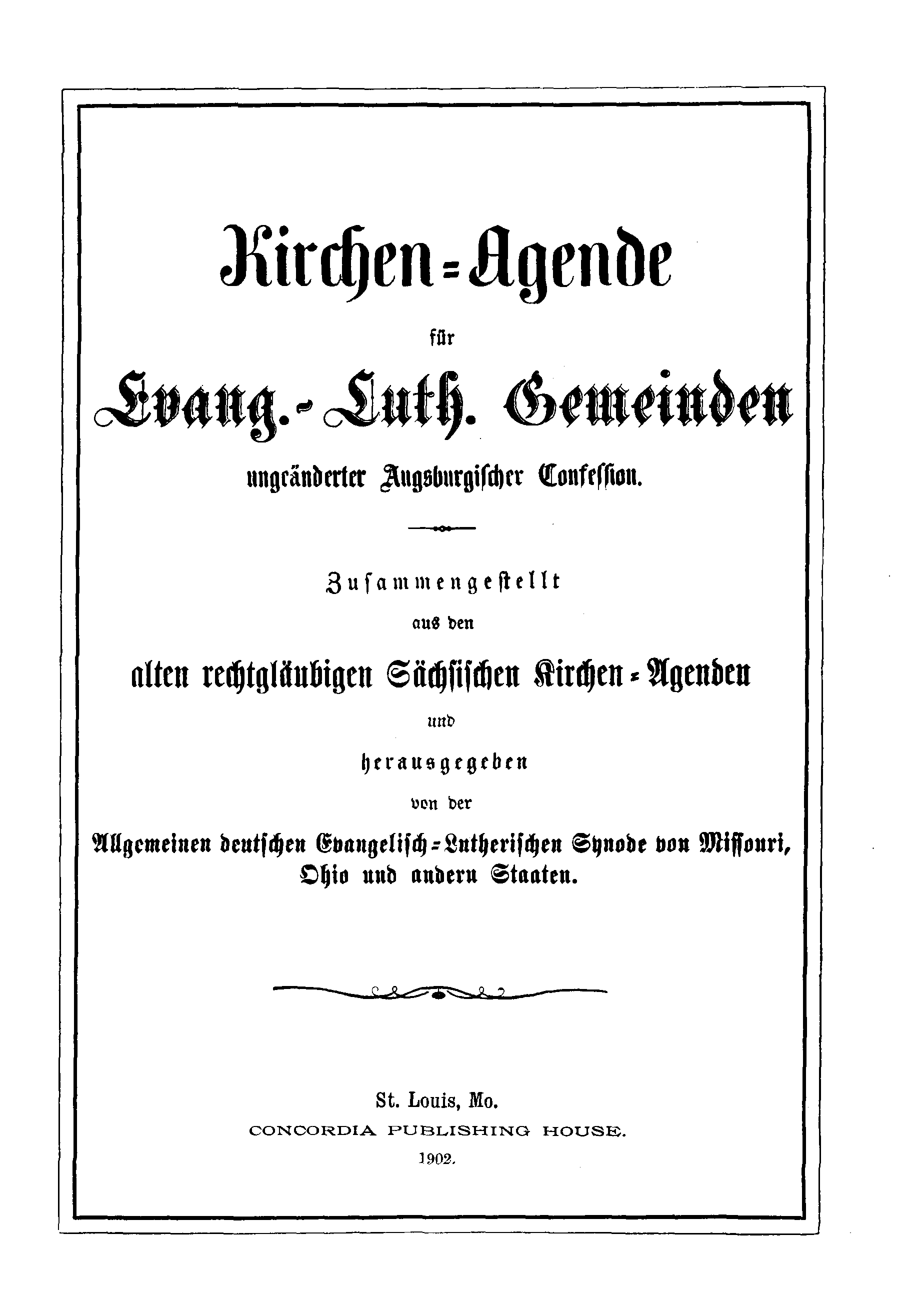
Following three pages of prayers, the first questions in the rite for adult baptism in the 1902 Church Agenda translate as follows:
Here the following questions are asked of the one to be baptized: Do you renounce the Devil? Answer: Yes! And all his works? Answer: Yes! And all his ways, especially the Jewish (heathen, Unitarian, separatist) unbelief and blasphemy? (the gross and dangerous Anabaptist errors and enthusiasm?) Answer: Yes!
Kirchen-Agende für Evang.-Luth. Gemeinden, Concordia Publishing House, St. Louis, 1902, pp.13-14
We see the same text still included in the 1922 edition with the addition of brackets before insonderheit ‘especially’:
Kirchen-Agende für Evang.-Luth. Gemeinden, Concordia Publishing House, St. Louis, 1922, pp.144-145
Why were the brackets added? Was this part of the question considered less important by then? We find the answer in another change that was made in the second paragraph of the prayer at the beginning of this rite, which reads:
“And also thy present servant (maid), born of Jewish (heathen etc.) parents, has to thank this thy undeserved grace and unfathomable mercy alone that his soul has been freed from damnation. Before now, he was without Christ, foreign and outside of the spiritual kingdom of Israel, and therefore on account of his sins, he was in an entirely unholy state. Now, however, after he has been converted by thy wonderful goodness and united through the faith with Christ, he has drawn close.” (1902 Agenda p. 11)
The 1922 Agenda is missing the phrase italicized above.
1902 Agenda p. 111922 Agenda p. 143
Here we see why these particular ways of the Devil are listed: Any adult convert has been under the power of the Devil and therefore deceived by heretical beliefs up until the time of his conversion. This baptismal rite lists the most common forms of unbelief and blasphemy that ensnare people before their conversion and expects that they condemn their former unbelief and blasphemy publicly before their baptism.
This list of potential converts to Christianity (Jews, heathen, Unitarians, separatists, Anabaptists) were the most common types of non-Christians in America at that time who would have needed a baptism before joining a Lutheran church. Converts to the Lutheran church from other Christian churches with valid Trinitarian baptisms would not have to be baptized before joining.
Now that the context for this passage is clear, we would like to make a few points regarding the inclusion of “Jewish Unbelief and blasphemy” in this rite.
First: The beliefs and practices of Jews are contrary to the true faith in Christ, they are blasphemous, and these beliefs and practices are the work of the Devil.
Second: Jews are cut off from the true Israel unless they repent of their unbelief and turn to Christ their Savior. They are not part of Israel on account of their ancestry or by means of their blasphemous teachings and practices.
Third: Anyone who renounces the Devil, all his works, and all his ways renounces all the false beliefs and practices listed in this rite: Jewish, heathen, Unitarian, and separatist unbelief and blasphemy, the gross and dangerous Anabaptist errors and enthusiasm (and many others including Mormonism and Mohammedanism). If it was ever appropriate for any convert to renounce these things explicitly then all Christians renounce them implicitly.
Fourth: It would be wise to bring these specific condemnations of the Devil’s snares back to our baptism rite for adults. For the sake of the souls who join our churches we should not be shy in making sure that all our members have the strength to admit their former errors and renounce them publicly.
Fifth: Although it is doubtful that new Christians were given the option to renounce this whole list of heresies publicly, that would have been beneficial, and it would also be beneficial to begin that practice not only in baptismal rites but also in the confirmation of new members etc. Since we live in a time and place where so many religions of the Devil are tolerated and promoted, we shouldn’t hesitate to renounce the prominent ones by name. Should we be in fellowship with men who are hesitant to renounce Mormonism or Buddhism as the work of the Devil? If not, then we also shouldn’t be in fellowship with men who hesitate to renounce Judaism as the same.
Antinomianism is poison to the soul. It turns the truth of God, the precious Holy Gospel, into a lie and leads inexorably to the death of faith and the loss of salvation.
We offer to you, dear reader, a javelin in the fight against this monstrous error. The following sermon of the sainted doctor Paul Edward Kretzmann for Rogate Sunday, was published in his 1956 collection of Lenten and Post-Easter sermons, Jesus Only. (View available copies on Bookfinder here.) Read, mark, learn and inwardly digest it, and ask yourself whether it accords with the Word of God.
I thirsted for such teaching when I was a young man. Thanks be to God, I eventually learned that men like Kretzmann were the true torchbearers of Lutheran doctrine, and that the horrendous caricatures of the Gospel in the name of Lutheranism—yes, in the name of “Confessional Lutheranism”—that I had previously encountered were not, in fact, true Christianity.
God’s people—especially His young people—are destroyed for lack of such knowledge. Pray for reformation and revival. If the lamp-stand of a major American Lutheran synod is removed, that does not spell the end of Lutheranism in our land; no, it means that the faithful men and congregations which remain must hold their candles higher aloft that they might the more easily find one another and rejoice in the godly concord that the Holy Spirit has given.
n.b. — Dr. Kretzmann quotes several wonderful hymns. We have included in-line citations to where they may be found in TLH as well as links to MIDI/MP3 melodies (hosted on the site of Ascension Lutheran Church (CLC), Tacoma, WA) for those who might wish to learn them.
Dr. Paul Edward Kretzmann (1883-1965)
(Introit, Is. 48:20b)
Rom. 6:3-9: “Know ye not, that so many of us as were baptized into Jesus Christ were baptized into his death? Therefore we are buried with him by baptism into death: that like as Christ was raised up from the dead by the glory of the Father, even so we also should walk in newness of life. For if we have been planted together in the likeness of his death, we shall be also in the likeness of his resurrection: knowing this, that our old man is crucified with him, that the body of sin might be destroyed, that henceforth we should not serve sin. For he that is dead is freed from sin. Now if we be dead with Christ, we believe that we shall also live with him: knowing that Christ being raised from the dead dieth no more; death hath no more dominion over him.”
Those who watch the liturgical side of the Sunday service carefully, may have some reason to ask questions regarding the name and the lessons of this Sunday. In the first place, the common name for this Sunday, namely Rogate, is not taken from the Psalter or from one of the Prophets, but from the ancient Gospel lesson of the day, as we find it in John 16:23-30. On the strength of the admonition there presented by the Savior: “Ask, and ye shall receive,” the Sunday also bears the name Prayer Sunday, and the emphasis on prayer was ever an important feature of the day.
But this fifth Sunday after Easter bears also another name, one taken from the Introit of the day, found in Is. 48:20b, where we read: “With a voice of singing declare ye, tell this, utter it even to the end of the earth” In the Latin language, as formerly used in the services of the Church, we have the words Vocem jucunditatis, and therefore these words are the second name for the present Sunday.
And surely, this Introit has special significance and value in connection with the time of the church year and with the general theme of the series of meditations which have engaged our attention. In view of the coming third great festival of the Church, Pentecost, it is necessary for us to cultivate prayer and to be engaged in prayer without ceasing, for, as Jesus assures us, the heavenly Father will give the Holy Ghost to them that ask Him. — And if we turn to the Introit as now contained in our hymnal, we remember all the miracles of God as performed for our salvation, and we look back once more to the miracle of the resurrection of our blessed Savior. With a heart full of unspeakable joy every Christian will give heed to the call: “With a voice of singing declare ye, tell this.” It was ever thus in the Church, in both the Old and the New Testament, that it was the message of salvation, not only in the spoken language of men, but also in the voice of singing which made known to others what great things God has done in preparing redemption for all mankind. That is why the Prophet admonishes us to utter the good news even to the end of the earth. Even in the Old Testament the message of redemption was not confined to the believers of Jewish descent, for we have evidence that the story of the one true God was known in many parts of the ancient civilized world, even before the great Dispersion of the Jews as the result of the exile. And if we turn to the New Testament, we have that overpowering text of the Great Commission, in which our Lord bids us: “Go ye therefore, and teach all nations, baptizing them in the name of the Father, and of the Son, and of the Holy Ghost: teaching them to observe all things whatsoever I have commanded you.” Or, as the Evangelist Mark reports, Jesus told His disciples: “Go ye into all the world, and preach the gospel to every creature.”
And what is the content of that Gospel which we are to proclaim? It is well summarized in one line: “The Lord hath redeemed his servant Jacob,” the name here representing all those who are the spiritual children of the patriarch, as he waited for the salvation of the Lord. And so we gladly receive the Lord’s exhortation: “Make a joyful noise unto God, all ye lands: sing forth the honor of his name: make his praise glorious.”
We ask: How could we employ our time to better advantage than in learning more about the great Shepherd of our souls, our Savior Jesus Christ, and in telling others about Him? For this is surely the motto of our lives, that we see no man but Jesus only. And another phase of this motto is brought out in the text which we have before us, since it suggests the wonderful topic to us:
JOINED WITH CHRIST IN THE LIKENESS OF HIS DEATH AND HIS RESURRECTION.
Let us, with the gracious assistance of the Holy Spirit, learn what the inspired Apostle presents to us under this heading. The chief thoughts of our text may well be presented in three statements:
Our baptism in its relation to the death of Christ:
Our baptism in its relation to the resurrection of Christ;
Our baptism and our life in Christ.
1.
Our text presents a thought which is probably foreign to our daily thinking. How many of us have this day given thought to the Sacrament of Holy Baptism and its significance in our lives? How many of us make it a practice daily to renew the baptismal vow? How many of us connect the baptismal blessings with our conduct throughout the day?
And yet, by our Baptism we are joined with Christ. The Apostle asks a very searching question: “Know ye not, that so many of us were baptized into Jesus Christ were baptized into his death?” The tone of the question implies: You should know this fact; you should keep it in mind always, since it is so fundamental in our spiritual life. We are bound to note at once that the Apostle in this instance does not say, “baptized in the name of Jesus,” but “baptized into Jesus Christ.” The expression, as used by the Greeks, indicated that a person, by some ceremony — in this case, by the Sacrament of Holy Baptism — became the property of the one in whose name he was baptized, that is, he dedicated himself to the service of Jesus. The Apostle, at the same time, says that being baptized into Jesus means being baptized into His death, That means: In Holy Baptism we become partakers of all that He gained for us by His death, when He died on the cross as the Substitute for men.
This thought is further developed by the Apostle, when he writes: “We are buried with him by baptism into death.” He uses almost the same words in Col. 2:12: “Buried with him in baptism.” We know that, after Christ had died on the cross, He received an honorable burial at the hands of two disciples who had, till then, remained in the background. But the burial of the Savior had a figurative, spiritual significance, since He thereby buried our sins, with all their dire consequences. And to this we must add the statement of the Apostle: “We have been planted together in the likeness of his death.” Note that he uses the verb “planted,” not merely, placed into the grave. For he pictures the entire process like that involved in the sowing of seed or planting a small flower: he looks forward, even here, to a new life springing up out of death.
This thought is presented by the Apostle in still another picture when he writes: “Knowing this, that our old man is crucified with him, that the body of sin might be destroyed, that henceforth we should not serve sin.” To understand this we must remember that the purpose of crucifixion was to destroy life, to cause life to be replaced by death. This was true even in the case of the Savior, when He laid down His life. In applying this picture to us the Apostle states that our old man, our natural sinful self, is crucified with Christ, nailed to the cross in order to effect its death. In this way the body of sin, that is, sin as it lives, as it is active in us, should be destroyed, made ineffective, removed entirely. As a result of this removal we should henceforth not serve sin, not be subject to it. In other words, the Apostle declares that we should and can overcome sin.
Just how much headway have we respect? How is our struggle against sin The Apostle John goes so far as to state: “Whosoever is born of God doth not commit sin; for his seed remaineth in him; and he cannot sin, because he is born of God” (1 John 3:9). Is this expecting too much of the Christian? Is the Apostle presenting an impossibility? Not if we keep the proper balance in our thinking and follow what the Apostle Paul describes in Romans 7, where he closes his argument with the words: “So then with the mind I myself serve the law of God; but with the flesh the law of sin.” The Lord rightly expects us to fight every inclination to sin, so that, according to the new man, we serve only that which is good. Surely no Christian will knowingly, willingly, commit sin. And if he out of ignorance or weakness does stumble and fall, he immediately turns to the Lord in true repentance, for he cannot have his relationship with his Savior severed.
2.
This entire series of arguments is now further strengthened by the Apostle’s reference to our Baptism in its relation to the resurrection of Jesus Christ,
We here remind ourselves once more that the fact of our being baptized into Christ has made us, in a most unique way, the spiritual property of the Savior, that we have thereby been dedicated to His service. The words found in the explanation of the Second Article may well be applied here:
“That I may be His own, and live under Him in His kingdom, and serve Him in everlasting righteousness, innocence, and blessedness.”
It is this point which the Apostle brings out so beautifully in our text: “Like as Christ was raised up from the dead by the glory of the Father, even so we also should walk in newness of life.” We have here a number of important points for our faith and life. When Scripture wants to emphasize the divine nature of the Redeemer in connection with the Easter miracle we usually find the expression “Christ rose from the dead.” If, on the other hand, Holy Writ wants to point to the human nature of Christ in connection with His resurrection from the dead, it usually speaks of His being raised from the dead. We are at once reminded of passages like these: “Who (that is, Christ) was delivered for our offences, and was raised again for our justification” (Rom. 4:25). And Peter, in his great Pentecost sermon, tells the assembled multitude: “This Jesus hath God raised up, whereof we all are witnesses” (Acts 2:32). Truly, Christ was raised up from the dead by the glory of the Father. God’s almighty majesty was displayed in the Easter miracle, because God wanted to testify before the whole world that He had accepted the sacrifice of His Son and was now fully reconciled to the world. It is now true, eternally true, as our text says, in verse 9, that death hath no more dominion over Christ. Death, to which He had surrendered Himself of His own free will, could not hold Him who had declared: “I have power to lay it (my life) down, and I have power to take it again” (John 10:18).
And now we have an amazing fact before us, namely this: that we are not dealing with a mere historical account, but with a fact which has the most definite relationship to our Baptism, since it means being united with Him, It is a fact that we, all believers, share with Christ in His resurrection and its glorious fruits and consequences. Our text says: “If we have been planted together in the likeness of his death, we shall be also in the likeness of his resurrection.” As we were, in a spiritual sense, but nevertheless in a very real manner, buried with Christ, we placed our old sinful flesh in the grave with Him. And as Jesus arose from the grave as the Victor over death and the grave, so we should share in this victory. We have left our sinful flesh in the grave, and therefore it can no longer rule over us. The beautiful Easter hymn by Paul Gerhardt brings out this truth in a most impressive manner.
Now hell, its prince, the devil, Of all their pow’r are shorn; Now I am safe from evil, And sin I laugh to scorn. Grim death with all his might Cannot my soul affright; He is a pow’rless form, Howe’er he rave and storm.
And a hymn by Gellert offers some of the same thoughts:
Jesus lives! I know full well Naught from me His love shall sever; Life nor death nor powers of hell Part me now from Christ forever: God will be a sure Defense; This shall be my confidence.
And all this glorious assurance is ours because we were baptized into His resurrection, because He, by faith, has made us partakers of all the blessings which were assured to the world on Easter morning. The cheering word of the angel comes to us whenever we think of our Baptism in connection with Christ’s resurrection: “Fear not ye: for I know that ye seek Jesus, which was crucified. He is not here: for he is risen” (Matt. 28:5-6). We also should cast aside all fear, as we sing with the great hymn-writer of the 17th century:
Jesus Christ, my sure Defense And my Savior, ever liveth; Knowing this, my confidence Rests upon the hope it giveth Though the night of death be fraught Still with many an anxious thought.
But there is still another thought that is connected with the fact of our being joined with Christ by virtue of our Baptism. It is a very practical thought, for it is connected with our every-day life. The Apostle has already taught us that we are partakers of all the blessings which He earned by His death and resurrection. These truths, however, are not to be mere head-knowledge; they are, rather, to become part and parcel of our daily life.
We are no longer in bondage to sin, since we are joined with Christ in His glorious victory. We should, and we can, overcome all deliberate sinning; we should, and we can, withstand the attempts of Satan to lead us astray. In fact, the only sins which may be found in a Christian are sins of weakness and of ignorance, of which we daily repent, as did the Apostle Paul. The argument of our text runs along these lines: “Now if we be dead with Christ,” in His death, and its results, “we believe that we shall also live with him;” and “he that is dead is freed from sin.” Sharing in the death of Christ and its marvelous consequences, we not only rest our trust in the forgiveness of our sins, which is a glorious truth in itself, but we also share in His gracious power to overcome sin. “Christ, being raised from death dieth no more: death hath no more dominion over him.” Now here is the comforting argument and thought. We share in the fruit of Christ’s death. But the sting of death is sin, and Christ has taken sin with its curse upon Himself, and likewise Christ, by His death, has overcome death and brought life and immortality to light. Death and sin have no more dominion over Him, and death and sin should have no dominion over us, who share in the fruits of His redemption. Every Christian, in repeating his baptismal vow every morning, should tell himself: With the help of my risen Savior I can and I will make progress in sanctification today, just as the Apostle states: “Likewise reckon ye ye also yourselves to be dead indeed unto sin, but alive unto God through Jesus Christ our Lord. Let not sin therefore reign in your mortal body!” A very fine stanza for the opening of the day is that by Albert:
Let the night of my transgression With night’s darkness pass away: Jesus, into Thy possession I resign myself today; In Thy wounds I find relief From all sorrow, sin, and grief.
I am joined with Christ, my Savior, By the bonds of faith and love And His mercy daily draws me To the throne of grace above; He with me His mercy shares And I cast on Him my cares.
I was buried with my Savior By Baptism into death When He, on the cross suspended, Gave for me His final breath: Then my sins were laid away In the Savior’s tomb to stay.
As my Savior was delivered From the power of the grave, As His resurrection witnessed: He has grace and might to save; I may in this glory share Since His robe of love I wear.
By the death of Christ, my Savior, I am freed from death and sin; Sin no longer has dominion Nor can rule my soul within: In my heart my Savior lives And to me His strength He gives.